
Category: History
The Battle of Grunwald: The Last and Largest Medieval Battle
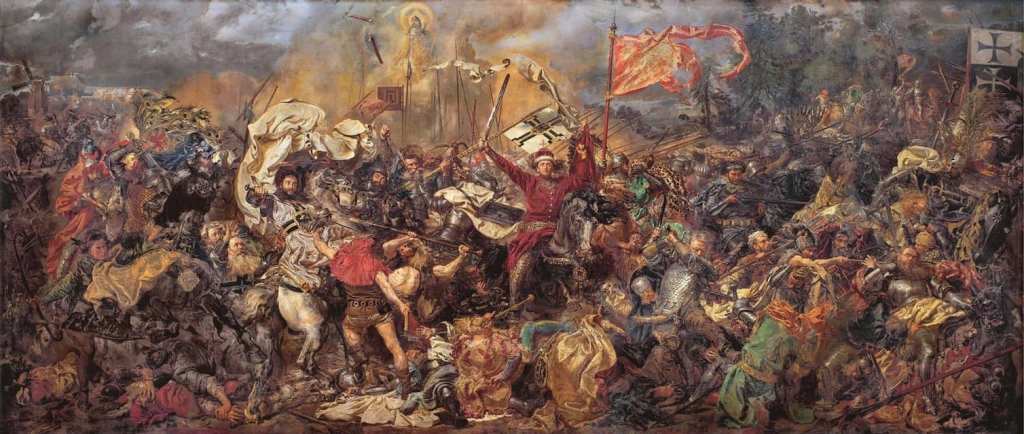
In early 15th century Eastern Europe, the Order of Brothers of the German House of Saint Mary in Jerusalem, better known as the Teutonic Knights, relentlessly expanded under the guise of “crusade” along the Baltic coast into the Christian Kingdom of Poland and the Grand Duchy of Lithuania. The effort reached a high water mark on the field between the towns of Grunwald and Tannenburg on 15 July 1410. 39,000 Poles, Lithuanians, Czechs, Russians, Ruthenians, Bohemians, Tatars, and Wallachians faced 27,000 Teutonic Knights, their retainers, mercenaries, and crusading knights from across Europe, including England, France, and the German and Italian states. Although the Polish-Lithuanian troops were more numerous, only the knights of Poland and a few other small contingents were of the same standard of discipline, training, and armor as the Teutonic Knights.
The Knights formed for battle in the morning, but were forced to stand in the hot sun all day because King Wladyslaw Jagiello, the commander of the Allied army, had his men wait in the trees as he heard three masses in spiritual preparation for the battle. The battle finally began in the afternoon when both sides were on the field. The weary and parched Teutonic Knights under Grand Commissar Kuno Von Lichtenstein, on the Knights’ left, charged the fresh Lithuanian and Tatar light cavalry under Lithuanian Grand Duke Witold on the Polish right… and promptly routed them. The Knights assumed they won the battle and began pursuit. The heavy warhorses of the Knights, however, couldn’t catch the lighter but faster horses. Most of the pursuing knights never returned and thus missed the real fighting. They couldn’t help defeat the much more heavily armed Poles. Despite the collapse of the Polish and Lithuanian right, no breakthrough was had: three companies from Smolensk fought to the death and heroically prevented the remaining Knights from getting behind the Polish lines.
The main battle was between the Teutonic right under Grand Master Ulrich Von Junginenen (pictured above in Jan Matejko’s painting, in the large white cape) and the Polish left wing under King Wladyslaw Jagiello (in the painting, the king is in the silver armor on the hill on the right) and his tactical commander Zyndram of Maszkowice (the bearded knight next to Ulrich in the picture).
Unlike the Grand Master and Zyndram, who charged with their knights in the Western tradition, the King directed the battle from a hilltop in the Eastern tradition. After the initial thundering clash in which both sides crashed into each other at full speed, the battle stalemated into a churning meat grinding mass, a situation that favored the more heavily armored and trained Teutonic Knights. The melee included one of the most famous knights of the age: Jan Zizka, a Czech mercenary who would become famous as a battle lord during the Hussite rebellion of 1414 (in the scale armor above the Royal Banner about to kill a German knight).
The Battle of Grunwald was not only one of the largest of the Middle Ages, it was also the last of the true knightly battles. It was the last battle where might made right. Strength of arm, whether wielding sword, axe, spear, hammer, or mailed fist, won the day — Not technology, but intestinal fortitude. Archers? Mere splotches on the ground where they were trampled underfoot. Cannon? Noisemakers abandoned after the merest hint of a mounted warrior. Amazingly brilliant tactics? Defeat is more crushing if you look your foe in the eye and rip out his soul. For hours, the battle was a swirling melee. As the shadows became long in the early evening, the Teutonic Knights managed to bring down the Royal Banner of Poland by knocking over Marcin of Wrocimowice (holding the banner in the picture above) which was the traditional medieval sign of victory. But for the Allies, this was a fight for national survival, and chivalric ritual would not interfere with military efficacy, so they fought on.
Sensing the Knights were finally committed, King Wladyslaw launched his coup de d’eclat: a three pronged attack that decided the battle. First, he sent most of personal bodyguard charging into the mass to fix the Knights. This charge was made by the crème of Polish knighthood, fresh and eager for battle after watching their comrades fight for hours. This august host included the greatest knight of the early 15th century – the folk hero Zawisza Czarny — Zawisza the Black Zawisza was a knight so renowned for his honor, loyalty, and reliability, 600 years later the Polish Boy Scouts’ motto is still “Rely on him as on Zawisza”. (He is pictured just above Jan Zizka with black hair and black armor couching a lance).
Once the Knights were fixed by the new attack, the King unleashed a hammer blow into the flank of the Teutonic host: 3000 unarmored Polish peasants armed with scythes, axes, and clubs, whom hid in the woods for most of the battle. They were fiercely anti-German and had suffered the worst under the decades of Teutonic raids and “conversion”. The peasants gave no quarter, and although a single knight could fight off six or seven peasants, they couldn’t do the same for ten or twelve.
As devastating as the charges by Wladyslaw’s personal guard and the mass of furious peasants were, the real killing blow came most decisively from Duke Witold who returned to the battle in spectacular fashion after rallying most of the Lithuanians from the routed right wing (Witold is featured prominently above clad in red holding the sword aloft).
The painting “The Battle of Grunwald” by Jan Matejko depicts the moment of the three charges that broke the Teutonic Knights. It more specifically depicts the death of Grand Master Ulrich to a Polish peasant’s spear (pictured next to Ulrich). According to legend, Ulrich’s last words were, “Damn these flies!” The 10,000 manacles the Teutonic Knights brought to use on the Allies that night were used on themselves instead. The Teutonic Knights never recovered from the defeat and the Union of Poland and Lithuania became the super power of Eastern Europe for the next 300 years.
The Siege of the International Legations
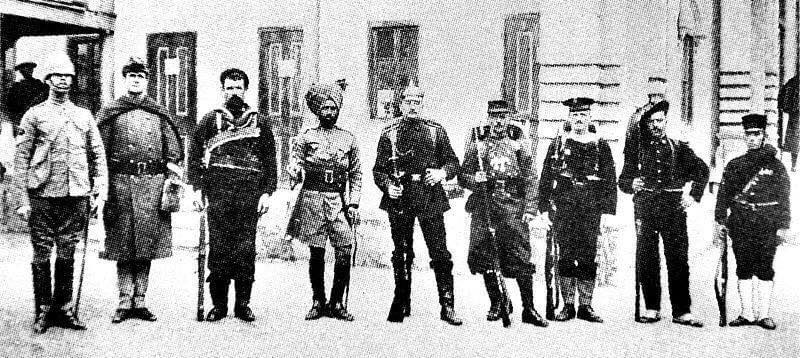
In early 1900, the Chinese Boxer Movement, an indigenous, anti-Christian, anti-foreign, semi-mystical peasant crusade, erupted into open “rebellion” against Christians and missionaries, and the Victorian era Great Powers that were slowly carving up China. 3500 Chinese Christians and foreigners sought refuge in the International Legations (embassy) Quarter outside the Chinese Imperial City in Peking (Beijing).
In late May 1900, 450 soldiers, sailors, and marines of eight countries: the US, Great Britain (Including Indians), Germany, France, Austria, Russia, Italy, and Japan disembarked from the ships off the coast of Tiensten and secured the Legation Quarter. They arrived just before 40,000 Boxers including Imperial Chinese troops after the Qing Empress gave her blessing. Most of the foreign civilians took refuge in the British Legation because it was the most defensible and British Minister Claude MacDonald took charge of the defense of the entire Quarter. 150 civilians volunteered to fight. The Austrians and Italians abandoned their exposed embassies, and withdrew inside, the Austrians with the French and Italians to the Japanese embassy. The small force, with considerable Help from the Chinese Christians, constructed barricades and had protection on two sides by the large walls of the Imperial city. However, they were low on ammunition. Only the contingent of US Marines was sufficiently equipped. Furthermore, they had only three machine guns and two small artillery pieces, one of which, “Betsy”, the Americans constructed from various Chinese pieces they found and patched together.
On 20 June, 1900, the Boxers attacked, mostly armed with spears, swords and the belief that they couldn’t be harmed by bullets. The international defenders continually fought them off, but after ten days of constant hand to hand combat, casualties became a serious issue. On 3 July, the Boxers pushed the Germans off the Tartar Wall, and American Marines fell back with them to organize a counter attack. Pvt Dan Daly volunteered to hold a critical chokepoint at the top of the stairs on the wall to buy time. He fought all night as Minister MacDonald and Marine Captain John Twiggs Meyers organized a counterattack. The next morning they found Pvt Daly calmly smoking a cigarette at his post — his machine gun and rifle out of ammunition, and 200 dead Chinese to his front, including 18 by bayonet. For remaining at his post, Pvt Dan Daly was awarded the first of his two Medals of Honor.
The siege came to a crescendo on 13 July 1900, when the Boxers exploded a mine underneath the French Legation and promptly over ran it. They were only stopped from breaking inside the defense by furious counterattacks by the remaining French and Austrian soldiers, and civilian volunteers. Simultaneously, the Boxers broke through the Fu, held by the Japanese led by the indomitable LtCol Goro Shiba, and only determined counterattacks by the Japanese and British soldiers and civilians (including a group known as “The Fighting Parsons”) prevented the massacre of the Chinese Christians there. Nonetheless, they lost their positions and still had to fall back. Minister MacDonald wrote that 13 July was, “a most harassing day…”
The 13 July attacks were the last chance for the Empress and the Boxers to overrun to Legations Quarter. Though the defenders didn’t know it, a 20,000 strong relief force had landed at Tientsin, and captured the city that day. The full might of the Imperial army and the Boxers were forced to move against the relief column for the rest of the siege. The attacks on the legations slowed considerably as the Boxers concentrated on destroying the relief force. The Boxers were defeated at the Battle of Peking on 20 August and the 55 day siege ended the next day.
The Battle of Fornovo
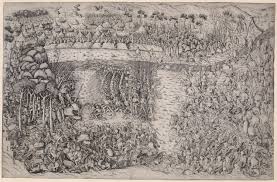
In the late 15th century, French monarch Charles VIII standardized and increased the mobility of his siege cannon and ushered in a true revolution in military affairs. No medieval castle could withstand his guns. He seized castles “in the time it took to seize a villa.” In 1494, at the behest of Milan and Venice, Charles blitzed down the Italian peninsula to press his claim to the Kingdom of Naples, which he successfully took in February 1495. The Middle Ages came to a close.
Charles VIII’s 1494 campaign horrified the Italians. No one had traversed the length of the Italian peninsula as quickly since Hannibal crossed the Alps. During the Renaissance, the Italian boot consisted of dozens of super rich merchant republics, prosperous petty kingdoms, independent city-states, Papal States, and ultra-wealthy families, who vied with each other for political power. If an outside force intervened, such as Spain, the Holy Roman Empire, or France, the invader was usually fixed at fortress cities in northern Italy. While they sat outside the walls of Milan, Florence, or Mantua, the Italian petty rulers had time to buy them off, hire mercenaries known as condottieri (literally: “contractors”) to discourage any advance, or work political angles to turn back the invaders. Or they could just wait for the cold, muddy, and miserable Italian winters to break the will of even the most resilient invader. Charles VIII changed all that, and the Italians concluded they had to defeat him, lest he conquer them all with his cannon.
Charles’ erstwhile allies were the first to recognize the danger. The Sforza’s of Milan saw no reason for Charles not to seize their city on his way back to France. The Merchants of Venice knew they were next if Milan fell to the French. Pope Alexander VI, born Rodrigo de Borja, had already been defeated by Charles and forced to flee Rome. He put his considerable diplomatic and political skills to work. Not that much incentive was needed, everyone saw what Charles’ troops, particularly his Swiss mercenaries, were capable of. Any town that offered resistance was massacred, looted, and put to the torch. In March 1495, Alexander VI formed the Holy League with Venice, Milan, Ferdinand of Aragon and Sicily, most of the northern Italian city-states, and Emperor Maximillian I of the Holy Roman Empire to oppose the French.
Naples wasn’t worth being trapped there, so Charles gathered his army and immediately departed for France. His army was wracked with syphilis (brought back by Neapolitan sailors of Columbus’ expedition to the New World and subsequently passed onto the city’s prostitutes, and then to the French), heavily laden with booty, and although his cannon were effective against walls, they were not as effective in a field battle. Furthermore the longer Charles delayed, the stronger the Italian army grew. And, even worse, it looked as if the Italians meant to fight.
The Holy League chose famed condottiero Francesco II Gonzaga, the Marquis of Mantua, then in Venetian employ, to lead the League’s army against Charles, at least in theory. In reality, the League’s army was actually controlled by Francesco’s uncle Rodolpho, the commander of the army’s reserve, and led by committee, with the Venetian Senate the most influential.
The squabbling among the League’s members continued until Charles’ army reached Florence, and even then Francesco wouldn’t move until he had nearly a 3 to 1 superiority over the French. Charles had no idea how large the League’s army was or even where it was: his spies were forced into hiding, and his efforts at reconnaissance thwarted by the League’s stradioti, fearsome light cavalry recruited from the Balkans. When Parma threatened to side with the approaching Charles, the League’s army finally advanced. Just south of Parma, the League’s army encamped around the village of Fornovo on the right bank of the Taro River to wait for Charles.
As Charles approached Parma from the south on the road paralleling the right bank of the Taro River, he stopped as soon as he came into contact with the League’s army. He waited for a few days for news of a French army in the vicinity of Milan, and Francesco obliged him. On 5 July, 1495, Charles learned no reinforcements were coming, and decided to bypass his adversaries.
On the morning of 6 July 1495, Charles nonchalantly continued negotiations with the condottieri heavy Italian army, while his own crossed over the shallow Taro River to the left bank and proceeded north. The maneuver took the Italians by surprise, as normally no further movement was permitted until pre-battle negotiations were concluded. By the time the Italians reacted, they were forced to attack across the river to reach the French. The river was swollen, and the fords limited which effectively neutralized the League’s greater numbers. Charles didn’t want to fight a battle in any case: he planned for his vanguard to fix the Italians in their camp, while the rest continued to Parma following the left bank north.
Charles’ vanguard consisted of the best troops in the army: his cannon, Swiss halberdiers, and the Gendarme, the heavily armed and armored noble French knights. His cannon shrugged off the obsolete Italian cannons’ volleys from across the river and pummeled the League’s camp. The Italians hastily form battlelines at the river’s edge, and searched for fords. Unfortunately for the French, the stradioti and other Italian light cavalry raced upstream, and more importantly, downstream to cross were the French crossed that morning. They fell upon the heavily laden but lightly guarded baggage train, ponderously attempting to keep up with the fighting troops. The League’s light cavalry slaughtered the guards and spent the day looting, taking them out of the battle.
Charles could not react because the Italian right wing found a ford and attacked the vanguard, while he watched the League’s massive center battle attempt to find a suitable place to cross. The League’s right wing however could only cross piecemeal, and they were defeated in detail: the Italian knights were torn apart by Swiss halberds, and then the Italian infantry was run down by the Gendarme.
The center force, which was supposed to attack simultaneously with the north, finally crossed, and the battle engaged in earnest. However, they took too long to find a ford, and the French were prepared for them. Though the fighting was fierce, the issue wasn’t really in doubt: the superior cohesion of the French units overcame the disorganized Italians, many of whom deserted to go loot the French baggage train. The League’s only real chance at victory was when Charles was briefly vulnerable and exposed on the battlefield. However, the opportunity was missed by Francesco and passed quickly. His failure to capture the enemy commander was just another example of Francesco acting less the army commander and more of a unit commander. Despite the losses in the north, center, and baggage train, he still had numerical superiority, but he didn’t know it since he was so consumed with the fighting. A strong reserve, nearly half of the army, was still on the right bank uncommitted. Francesco was only entrusted with half the army; the other half belonged to Rodolpho, the commander of the “reserve”.
Disaster struck when Rodolpho was killed. As commander of the reserve, no one else had authority to order the reserve into battle, even Francesco. Thus nearly half of Francesco’s army never saw fighting that day.
The French pushed the Italians back to the river and gave no quarter. With no support from the reserve, a river behind them, and certain death in a losing battle, the Italian condottieri called it a day. They withdrew to the fords, then across the river and back to camp.
The French recovered what was left of the baggage train and continued on their trek, leaving the Holy League in possession of the field.
Despite the French successes, Francesco declared the Battle of Fornovo a great victory for the Holy League, and initially there was much jubilation in Venice and Rome. Not only had the French “fled” the field, but 300,000 ducats worth of booty was looted from Charles’ baggage train. After a few days though, Francesco Gonzaga’s condottieri competition began evaluating the battle with professional, calculating, and sober eyes.
The Holy League outnumbered the French nearly three to one, but took nearly three times the casualties as the French. The loot was good, but the purpose of the army was to prevent Charles from escaping to France, where he can raise an even bigger army to return. Gonzaga utterly failed in that objective. Moreover, his personal battle command was found wanting since he acted as a field officer instead of the commander of a great army. He was blamed for the looting of the baggage train which siphoned much needed troops away from the battle. He was blamed for the death of his uncle, and not committing the reserve. In the eyes of his peers, Francesco Gonzaga’s personal conduct had allowed the French to defeat the Holy League and escape.
Charles VIII of France did not return with a larger army, French debts prevented him from rebuilding the army he almost lost. Spain retook Naples shortly thereafter. He wouldn’t get another chance to return to Italy, Charles VIII died 2 ½ years after his retreat. He accidentally knocked his head on a door frame, fell into a coma, and never woke up.
Charles’ death was not the end of the troubles for the Italians. In fact, they had just started. Thousands of French, Swiss, and German soldiers and mercenaries returned home with stories of a weak, prosperous, and divided Italy, ripe for plunder and conquest. The myth of the fighting ability of the Italian condottieri died on the banks of the Taro. It seemed as if the condottieri would rather negotiate than fight, retreat at the first sign of difficulty, withdraw at the slightest disadvantage, and would not attack unless they had overwhelming odds. The command of any condottieri army would always be fragmented. The condottieri’s northern adversaries no longer respected them. Their Roman legacy was lost and the condottieri’s professional reputation was forever tarnished.
After the Battle of Fornovo, France, Spain, the Holy Roman Empire, even the Ottoman Empire salivated over potential Italian conquests and loot. They ended the Italian Renaissance and ravaged the Italian boot for the next 75 years, a time known collectively as the Italian Wars
The Battle of Kłuszyn

The late 16th and early 17th centuries were the Golden Age of the Polish-Lithuanian Commonwealth. During this time, the Commonwealth was a “republic of nobles” with the gentry, known as the “Szlachta”, able to vote for their king. The nobility and gentry of the Commonwealth differed from many other nations in Europe with the Szlachta making up about 10% of the population, the upper and most of the middle classes, compared to 2%, or just the upper classes, across the rest of Europe. In the first decade of the seventeenth century, the elected king of the Commonwealth was Sigismund III Waza, from the Swedish royal house of Vasa. The Commonwealth throne was just a step to attaining his true objective, regaining the Swedish throne. In 1605, Sigismund III saw his chance to increase the Commonwealth’s power at the expense of his troubled neighbor, Muscovy. Sigismund planned to incorporate it into the Commonwealth with Poland and Lithuania, or at least place his son on Muscovy’s throne. The might of the three most powerful nations in Eastern Europe would be enough to seize the Swedish crown, turning the Baltic into a Commonwealth lake under Wasa rule.
With the death of Ivan the Terrible in 1589, Muscovy entered the Time of Troubles, specifically the “Dmitriad” or the time of the three false Dimitris who vied against Boris Godunov and Vasili IV Shuysky for the title of Tsar of all Russians. The Time of Troubles greatly weakened Muscovy. In 1609, Sigismund just finished putting down a nobles’ rebellion, and with his power consolidated, he made no attempt to hide his next target – Moscow. Sigismund III invaded Muscovy after the weakened Vasili IV made an alliance with Sweden to oppose the inevitable Commonwealth invasion.
In September, 1609, Sigismund III invested the Muscovite fortress at Smolensk with the help of Russian boyars supporting Dmitry II. But Smolensk, the gateway to Moscow, was well defended, well-armed, and well supplied. The siege continued all winter. In the spring of 1610, Vasili IV dispatched an army under his younger brother Dmitry Shuysky and Swedish general Jacob De la Gardie.
Shuysky commanded about 48,000 Russian troops and 11 cannon, supported by De la Gardie’s 5,000 Flemish, French, German, Spanish, Scottish, and Swedish mercenaries. Sigismund sent 12,000 Commonwealth troops, including 5500 of the famed Polish winged Husaria, under Hetman (warlord) Stanisław Żółkiewski to intercept them. Żółkiewski’s scouts found Shuysky’s 8,000 strong advanced guard at the villages of Tsaryovo and Zaymishche. The Muscovites fortified the town to secure their lines of communication against raids by the Commonwealth’s cavalry heavy army. Żółkiewski attacked and trapped the Muscovites in the fort. Żółkiewski left 6,000 men, which included most of his infantry and some cavalry, to isolate the Muscovites. On the evening of 2 July under the cover of a heavy rain, Żółkiewski slipped away with the bulk of his cavalry, his cannon, and some supporting infantry. Confident in the power of the Husaria, he silently galloped off to strike the overwhelming numbers of the Muscovite main body while they were strung out on the march.
The next night, Polish scouts spotted their adversaries in two fortified camps about five miles from the town of Kłuszyn, one for Shuysky’s Russian troops and a separate for De la Gardie’s mercenaries. Żółkiewski sent a spy with a letter to the mercenary camp offering them better pay to switch sides. Taking advantage of the bad weather, Żółkiewski attempted to sneak his army around the Russian camp to strike at them the next morning from behind when they resumed the march.
De la Gardie got wind of the letter and ended any conspiracy to switch sides en masse, but the letter’s damage was already done. The mercenaries’ military efficacy was greatly diminished by the prospect of greater pay in the service of what was thought to be a superior Commonwealth force. They fragmented on national lines: some switched sides, some refused to fight, some fought half heartedly, while others honored their contracts fully.
Żółkiewski’s hussars were spotted strung out on a narrow and muddy trail attempting to infiltrate behind the Russian camps. With his movement uncovered and unable to immediately attack, Żółkiewski consolidated his army opposite Shuysky’s camps. He rested his men who had been on the march for almost 48 hours straight, and cleared some obstacles from the future battlefield.
Formed in the dark, both armies faced each other as the sun rose on 4 July 1610. 30,000 of Shuysky’s Russians occupied their center and left, with De la Gardi’s foreign mercenaries on the right. They frantically reinforced fence lines and dug redoubts as Żółkiewski’s 5,500 Husaria supported by 1000 Cossacks on their left cantered forward. The masses of Russians in the redoubts and behind the fence lines were enough to prevent an outright charge by the Husaria, who resorted to the caracole tactic to break the lines, albeit one specifically suited to the Husaria.
In a traditional caracole, the dense mass of riders moved forward slowly. At pistol range the front rank discharged their firearms, and then made way for the next rank to do the same while they went to the rear and reloaded. Thus the cavalry formation either moved forward or backwards slowly by rank while maintaining continuous fire. A Husaria caracole differed and was more akin to the ancient Cantabrian Circle. The Husaria would leave their lances behind and charge forward. At pistol range they’d quickly turn and fire their brace, and then continue to move out of the way. They moved to the rear as the next unit followed up. The movement never stopped and the circle flowed seamlessly. Once at the back end of the circle, they’d pull their carbines and repeat the process. Once the carbine circle was completed, the Husaria charged with their lances, with the hope that the firearms broke up the dense formations, leaving them vulnerable to their terrible charge. As their lances shattered on the Russians, if no break out immediately occurred they’d then turn, and pull their sabers. The momentum of the charge carried them back out of the enemy formation. The Husaria would then retire to reload their pistols and carbines, and begin the maneuver again. The Husaria caracole required immense discipline and exquisite horsemanship just to maintain the timing. At any given moment there were at least four groups of Husaria in the caracole: one moving forward, one charging, firing, or fighting, one retiring, and one reloading. Some Husaria completed this maneuver 8-10 times over the course of the day.
The reinforced hedges and fence lines blunted the worst of the Husaria charges, but the continuous Polish caracoles gave the impression that the Commonwealth’s numbers were much greater than they were. For next five hours, the Husaria caracoles smashed against the Russian defenses of the center and left, while the Cossacks fixed the reluctant mercenaries on Shuysky’s right. The Husaria’s discipline, armor, and firepower were offset by the greater Russian numbers.
The turning point of the battle was a counterattack by Russian reiters (Muscovite boyars equipped as German or Swedish riders) in the center. Sensing the Husaria’s charges diminishing, Shuysky ordered his still fresh reiters forward against the exhausted Poles. The reiters began their own traditional caracole with their pistols, in front of the beleaguered, but still solid, Russian defensive lines. The Poles rushed at the chance to fight the Russian riders. The Husaria abandoned their caracole and charged the exposed Russian reiters with their lances and sabers. The Russians quickly broke in the melee. The routing Muscovite reiters did what the Husaria could not, break the Russian lines. As the defeated reiters pushed their way back through the Russian defenses, the Husaria victoriously followed, and Shuysky’s center collapsed.
Seeing the Russian center break, De la Gardi withdrew back to his fortified camp with men guarding his flank in the woods at the edge of the battlefield. Shuysky and his shattered center withdrew to the Russian camp, while the left held strong. However the timely arrival of the Commonwealth cannon and infantry, which had marched all night after being left behind by the cavalry, were deployed against the remaining Russian lines. (In the haste to form the battle lines in the predawn darkness, Shuysky left his 11 cannon in his camp.) The Commonwealth infantry and cannon broke the Russian left, and the Husaria followed them back to the Russian camp. The Russians routed through the camp and prevented Shuysky from rallying his troops. They abandoned their fortified camp. The exhausted Cossacks and Husaria could not pursue far though, and many looted Shuysky’s extravagant camp and its wagon loads of valuables.
Żółkiewski’s army could not take the remaining mercenary camp with force. De la Gardi’s mercenaries had a much higher ratio of harquebusiers and much better training than the Stuysky’s Russians. Żółkiewski’s men were exhausted and disorganized. So under a flag of truce, he offered the mercenaries the same deal as before, and many switched sides. The remainder were given free passage out of the country on their word never to take up arms against the Commonwealth again.
Żółkiewski took the captured banners and prisoners back to the fort at Tsaryovo and Zaymishche which prompted its defenders to surrender. The Commonwealth victory at Kłuszyn did not however convince Smolensk to surrender. While Sigismund III maintained the siege at Smolensk, his son Wladyslaw IV Wasa advanced on Moscow with the Żółkiewski’s reinforced army. On 3 August they arrived at the gates of Moscow to find that the Russian boyars overthrew Tsar Vasili IV Shuysky. For the next three weeks, the boyars negotiated with Prince Wladyslaw IV and Hetman Żółkiewski.
In return for electing Wladyslaw the new Tsar, the boyars demanded that Muscovite territory remain intact and the Commonwealth would respect Russian social and political institutions, e.g. the rights of the boyars and the Orthodox faith. And finally, as Tsar of “The Third Rome”, Wladyslaw would have to accept the Orthodox faith.
Wladyslaw IV agreed. On 27 August 1610, he was elected Tsar of all Russians. On 3 September, Tsar and Grand Prince Vladislav Zigimontovych of all Russia triumphantly entered Moscow at the head of Hetman Stanislaw Żółkiewski’s Husaria and occupied the Kremlin.
Unfortunately, the Wasa dynasty in Muscovy was short lived. Wladyslaw sent his father the agreement, and Sigismund rejected it outright, despite it securing Muscovy’s support for the Commonwealth. Sigismund wanted to Catholicize Muscovy, which the Russian boyars would never agree to. Furthermore, he refused to abandon the siege of Smolensk. Smolensk had been part of the Grand Duchy of Lithuania, which had only been lost to Muscovy in the last century. It was the key to any advance on Moscow. With Smolensk in Commonwealth hands under Lithuanian control, the heartland of Muscovy would be open to invasion at any time, and Muscovite politics easy to influence. Moscow would be at the Poles’ and Lithuanians’ mercy. The permanent loss of Smolensk would keep the notoriously finicky Russians in line, and secure Muscovy for the upcoming campaign for the Swedish throne. However, Sigismund didn’t understand that the boyars understood this also. They would never stop fighting while Smolensk was in foreign hands.
Sigismund’s rejection of Wladyslaw’s agreement infuriated the Russian boyars, and turned them against the Commonwealth. Smolensk fell in 1611, but the boyars refused to sign a peace treaty. Tsar Wladyslaw IV and his army were unwelcome foreigners whose control extended little beyond Moscow and the Kremlin. In late 1611 Tsar Wladyslaw departed Moscow never to return, and the Commonwealth troops were trapped in the Kremlin. After a brutal siege in which there were reports of cannibalism among the Commonwealth’s troops, the Russians retook the Kremlin in November of 1612. In 1613, the boyars chose Shuysky’s 16 year old cousin, Mikhail Romanov, as the new Tsar. Tsar Mikhail Romanov ended the Time of Troubles and the Romanov Dynasty ruled Imperial Russia for the next 300 years, until the Bolshevik revolution of 1917.
Wladyslaw IV would eventually be elected, as had his father, king of the Polish-Lithuanian Commonwealth. He would reign for the next 38 years through what remained of the Commonwealth’s Golden Age, until The Deluge began in 1648. He was one of Europe’s most beloved and successful rulers, though as King of Poland and Grand Duke of Lithuania, and not as Tsar of all Russians.
The Battle of Osan: Task Force Smith
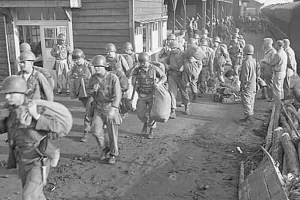
At 0700, on 5 July 1950, TF Smith, the farthest forward US unit on the Korean peninsula, engaged attacking elements of the Communist (North) Korean People’s Army in an attempt to delay their advance so General McArthur’s United Nations Command could establish a perimeter around the critical Korean port city of Pusan.
TF Smith was a 540 man battalion sized task force led by Lieutenant Colonel Brad Smith, the commander of 1st Battalion, 21st Infantry, of the 24th Infantry Division. TF Smith was the first American unit to engage communist North Korean troops, who had invaded South Korea two weeks before on 25 June. TF Smith consisted of just two rifle companies and one artillery battery of six guns. Although World War Two ended less than five years before, only 1/6th of the unit had combat experience. Though they were highly trained, TF Smith was organized and equipped as a constabulary for the occupation of Japan. They were still equipped with the obsolete (even by WW2 standards) bazooka, and had no anti-tank guns or tanks. The hard lessons of combined arms warfare learned through the bloody crucible of the Second World War were lost or disregarded by petty bureaucrats who looked to make the peacetime army more efficient and cost effective. Consequently, TF Smith had no engineer or air support, and they lacked land mines, barbed wire, and had almost no time to dig in before they were attacked by a force that just days prior couldn’t be stopped by four entire South Korean divisions.
Despite given a mission that a fully equipped 3000 man regimental combat team would be hard pressed to execute, TF Smith held the line at Osan for three hours against two North Korean divisions, one infantry and one armored. By 1000, on 5 July 1950, they were out of ammunition and began an orderly withdrawal. However, in the process TF Smith was assaulted in the flank by about 40 communist tanks. LTC Smith’s men simply had no capability remaining (if it had any to begin with) to stop the Soviet produced T-34/85 tanks, the best Soviet tank of Second World War. TF Smith’s withdrawal immediately turned into a rout and only about half of TF Smith made it back to the Pusan perimeter.
TF Smith has since become a metaphor for ill preparedness though this was no fault of LTC Brad Smith or his men.
La Noche Triste

In early 1520, Spanish conquistador Hernan Cortez’ conquest of the Aztec Empire fared poorly. The Aztecs no longer thought he was a god and lost their fear of the Spanish guns, steel, and horses. Increasing Spanish demands of gold, food, and women grated on the Aztecs. Especially chafing was the ban on human sacrifice, which was central to Aztec religion and society. Just prior to initial Spanish contact, the Aztecs held a ceremony during which 80,000 captive men, women, and children had their hearts torn out and eaten. These ceremonies were held regularly, though those so large were reserved for special occasions. To the Aztecs, all of the ills that had befallen their empire and people since European contact were due to the Spanish prohibition on human sacrifice. The Aztecs felt the gods were punishing them since they couldn’t be appeased with human blood.
Exacerbating the volatile situation with the Aztecs was Cotrez’ problems with the Spanish governor of Cuba. Their relationship had deteriorated to the point where the governor sent an expedition to arrest Cortez. Cortez was forced to leave the Aztec capital, Tenochtitlan, to confront the interlopers.
Tenochtitlan was one of the largest cities in the world with a population of over a million. Tenochtitlan by all accounts was absolutely massive, easily larger than the largest European cities at the time, London and Constantinople, both of which topped out at 200,000. Tenochtitlan was even larger before the mumps epidemic (which one of Cortez’ men brought in 1519) that killed about 100,000. Cortez’ kept a tenuous hold on the city with just a few thousand conquistadors and non-Aztec Indian allies.
Cortez left a subordinate to maintain the delicate relations with the Aztecs, while he left the city to deal with the governor’s expedition. Cortez managed to coopt his would-be captors, but he lost Tenochtitlan while he was away. In his absence, the lieutenant whom he left in the capital had arbitrarily slaughtered some Aztec nobles. Their deaths were the final humiliations. The entire city rose against the Spanish. The Aztecs swarmed the conquistadors, despite their technological advantage. The Spanish had harquebuses, crossbows, pikes, halberds, steel breastplates, small cannon, dogs of war, and armored knights on horseback – the very best of early 16th century military technology to fight the Stone Age equipped Aztecs. Dismissing the odds, the 1000 conquistadors in Tenochtitlan killed 30 for every loss. Nonetheless, the Aztecs still came on. The remaining 200 conquistadors were besieged in the emperor’s palace with the Aztec emperor, Montezuma, held captive.
Cortez heard of the news as he returned to Tenochtitlan. He had 1200 conquistadors and 3000 Tlaxalan allies recruited from one of the many Aztec enemies in the region. Cortez felt it was enough to chastise the Aztecs. He entered the city and the Aztecs allowed him to make it to the palace. They then closed the causeways behind him. Montezuma attempted to parley with the besiegers but the Aztecs had had enough. The Aztecs disavowed their emperor, denounced him a traitor, and killed him.
The next day Cortez sent 400 conquistadors to break out. Although the Aztecs took 20,000 casualties, all 400 Spaniards were killed or captured. Cortez was trapped.
On the night of 30 June/1 July 1520, the Spaniards attempted to sneak out, but they were spotted by an old woman fetching water. Soon the city descended upon the expedition and a running battle was fought through the streets. The Aztecs destroyed the causeways to trap the conquistadors but the Spanish filled the gaps with dead Aztecs and crossed over the bodies. The Aztecs disregarded the losses and continued to attack, especially targeting the stragglers. Cortez gave permission for each man to take as much gold as he could carry and the greedy ones were the first to die when they couldn’t keep up. The more gold the individual conquistadors took, the less likely they were to loie to spend it.
Cortez’ entire expedition would have been wiped out but the Aztec way of war centered on capturing not killing. They kept trying to take the Spaniards captive in order to sacrifice and eat them later, particularly Cortez. The Aztecs knew that without his leadership the expedition would have certainly broke up. But each time he was swarmed and hauled off, his men charged and rescued him. Despite grievous losses, the Spanish reached the mainland where the conquistadors could finally unleash the full power of their armored knights. The final charge by the last 20 knights routed the blocking Aztec force of 40,000. The thundering horsemen cut down every warrior with many colorful plumes, a symbol of Aztec status, eventually killing their commander. Only about 250 conquistadors and 1000 Tlaxalans managed to escape what the Spanish would call “La Noche Triste” or “The Sad Night”.
The next morning, the Aztecs resumed their practice of human sacrifice, and many a Spanish and Tlaxalan heart was consumed by the jubilant Aztecs.
The Aztecs would not enjoy their victory for long though. One of the conquistadors who arrived to arrest Cortez eventually joined with him. This particular conquistador was killed on a causeway during La Noche Triste. He fell behind, not because he carried too much gold, but because he was sick and weakened. He had smallpox.
The resulting smallpox epidemic caused by this initial vector killed 250,000 Aztecs in the coming months. When Cortez returned, he found the Aztecs of Tenochtitlan much easier to reconquer.
The Fall of Fort St. Elmo
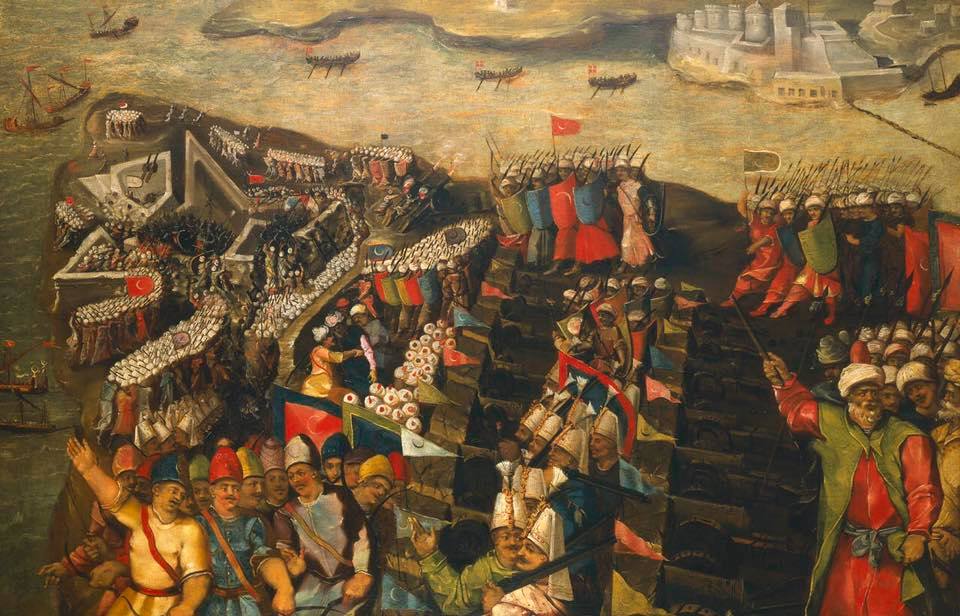
For more than a month, the 1500 Knights of St John, Spanish and Italian knights, and Maltese militia held the exposed Fort St. Elmo across the harbor from the Maltese Knights’ main defenses at Fort St. Michael, Fort St Angelo, and the towns of Birgu and Senglea. Ft St Elmo was an anchor point for the great chain that blocked the harbor’s entrance and the Turks had to take it.
Forty great siege guns pounded the fort but the Knights were able to repair and reinforce St Elmo by boat at night from across the harbor. On 3 June 1565, Dragut Reis, the greatest of the Turkish commanders, managed to get trenches and guns to cover the water approach. Furthermore, he lashed galleys together and built a platform on the great chain over which he could pass small galliots packed with archers. This completely cut off the fort and made any resupply a major operation using resources the Knights could no longer afford. On 9 June, its commander said it would fall within days and asked that the position be evacuated. Jean Parisot La Vallette, the indomitable commander of the Order, knew that every day Fort St Elmo held was another day closer to the Spanish relief, wrote back, “If you cannot find it in yourself to die for Jesus Christ and St John, then I will send men who will.” The Fort of St. Elmo held strong for another two weeks.
The constant bombardment reduced Fort St Elmo to rubble, and repeated Turkish assaults captured its entirety except for buildings of the inner courtyard and church. On 23 June 1565, Pasha Mustapha, who replaced Dragut Reis when he was mortally wounded by a cannonball, ordered the final assault. The Janissaries assembled within yards of the Knights, just out of pike range, because the Knights had long been out of powder for their harquebuses. The Knights sold themselves dearly as La Vallette watched from St Angelo. The last thing La Vallette saw through his telescope, was the Italian knight Francesco Lanfreducci laying about with a massive two handed sword underneath the banner of St. John. Lanfreducci managed to light the fire signaling the imminent fall of the fort before being swarmed by Turks, and the banner was quickly replaced by the Ottoman standard.
That night, the Turks mutilated and killed any survivors, less several knights for interrogation, and only a few Maltese militiamen escaped by swimming across the harbor. Mustapha ordered 1000 bodies nailed to makeshift crosses in a grim parody of the Crucifixion, and floated them across the harbor to demoralize the remaining defenders. On the morning of 24 June, the feast day of the Order’s patron, St John the Baptist, the bodies came ashore near St Angelo. But it did not have the promised effect. The infuriated La Vallette ordered all Turkish prisoners marched to the walls and beheaded in full view of the Turkish siege lines. And then their heads were fired out of cannons into the Turkish trenches.
The Great Siege of Malta would not be a repeat of the relatively chivalrous and “civilized” Siege of Rhodes. Both sides knew the stakes involved and there would be no quarter.
The Battles of Connecticut Farms and Springfield

Washington described his time at the Continental Army’s encampment at Morristown, New Jersey from 1779 to 1780, as “The Hard Winter”. American logistics had broken down, so the Continental Congress abdicated their responsibility and told the states to supply their own troops. Many troops went weeks without seeing meat or bread, sometimes days without seeing anything at all. Washington resorted to foraging the countryside to prevent his army from starving to death. The weather was colder than the winter at Valley Forge, with 23 major snow storms, including one that dumped four feet of snow on the encampment. Of the 12,000 Continental soldiers that entered winter quarters at Morristown in December 1779, 4000 had deserted by June, and of the remainder, 1/3 were unfit for duty.
British General Henry Clinton, whose troops were snug in New York City for the harsh winter, sought to take advantage of the Continental Army’s weakness. With the focus of the war moving elsewhere, the Southern colonies and the Caribbean for instance, Clinton surmised that he had one last shot at Washington, before other theaters made demands on his resources in New York. Washington, however, did not choose Morristown for its amenities, but for its tactically and operationally favorable position.
The encampment at Morristown was close enough to bottle up the British in New York but far enough away to permit Washington some reaction time when Clinton sortied. Furthermore, the only approach was via Newark Bay, and Morristown was screened from any landing there by the Great Swamp and Watchung Mountains. Any British landing force would have to make an amphibious landing in marshland, then a long approach march through hostile New Jersey countryside only to force one of the passes through the mountains just to fight a battle on the other side in constricted terrain against a dug in enemy under proven leadership. Clinton sent the Hessians.
In early June, 1780, Hessian General Baron Wilhelm von Knyphausen took the cream of Clinton’s army and crossed from Staten Island to bring Washington to battle. Knyphausen’s army consisted of the best of the Prussian regiments, the British Guards regiments, the Highlanders, the Royal Artillery, dragoons, the Queen’s Rangers, and two regiments of New Jersey Loyalists. Knyphausen’s 6000 men were thought to be more than enough to defeat Washington’s famished and mutiny wracked army.
On 7 June 1780, Knyphausen’s army landed at Elizabethtown Point in New Jersey. He planned on making the 11 mile march to Hobart Pass and be through the mountains before Washington could react. It was not to be. Knyphausen was spotted and the cry went up throughout New Jersey, not unlike Lexington and Concord five years before. A brigade of New Jersey militia formed at Springfield on the near side of Hobart Pass. Knyphausen met them at the small hamlet of Connecticut Farms just outside Springfield.
Stiffened by the presence of Washington and his personal guard, the militiamen made the British and Hessians pay for every foot they moved forward. They turned every house into a fortress, and every tree into a firing position. Nonetheless, Knyphausen took the village, but could see even more Americans forming in the pass. Disorganized, and bit surprised at the strength of the resistance thus far, Knyphausen impotently burned Connecticut Farms to the ground, and withdrew back to Elizabethport.
Two weeks later, Knyphausen tried again, however he knew he’d never be able to force the pass. Washington would know within minutes of his assembling to march. Clinton devised a trap. This attempt was a feint to draw Washington into a battle to the west of the mountains. Knyphausen would again march on the Hobart Pass, this time with a diminished force, and engage the militia around Springfield. He’d be the bait. Washington had spent the entire war trying to bring the British to decisive battle on his terms, and Clinton planned to give him one. As the battle against Knyphausen was fought at Springfield, Clinton expected Washington to march around the British flank and cross the mountains west of Newark. Clinton would then destroy him with a strong reserve as Knyphausen quickly disengaged from Springfield and turned on Washington. On 23 June 1780, Knyphausen marched on Hobart Pass. But this time, he met not only a horde of New Jersey militia, but also Continentals under Nathaniel Greene.
Greene had John Stark’s composite New England Brigade, “Light Horse” Harry Lee’s Legion, and William Maxwell’s New Jersey Brigade. Greene met Knyphausen at Elizebethtown, far forward of where the Hessian expected. Knyphausen attacked and Greene deftly withdrew fighting a running battle all the way back to Springfield. With Washington nowhere on the battlefield, Clinton and Knyphausen assumed their plan was working.
Washington knew of Clinton’s reserve, and had no intention of falling for the trap. The Continental Army was in no condition to attack in any case. The times were desperate, but not as desperate as they were when he pulled off the miracle at Trenton. The British were going to have to come to him. If Knyphausen wanted to make a fight of Springfield and Hobart Pass, Washington had Greene oblige.
Knyphausen fought up the Galloping Hill road toward Springfield, with Green fighting him every step of the way. The ruins of Connecticut Farms was an apt reminder to the New Jersey militia of what waited for their homes if the British won. At the bridge across the Rahway River, the Americans made a stand, and an artillery duel developed. When the Americans began to run out paper wadding, the Continental Army’s head chaplain, Reverend James Caldwell, who lost his wife in the Battle for Connecticut Farms, ran into Springfield and came back with box of hymnals. The hymnals were published by English clergyman Issac Watts. Caldwell and the gunners tore them up, and stuffed them in barrels with the cannon balls. The chaplain exclaimed, “Give’ em Watts, boys!”
The spirited defense of the Galloping Hills Bridge forced Knyphausen to send a column on the Vauxhall road to outflank the Americans. As the column got further away, it was threatened with being isolated and destroyed. The column eventually reconsolidated back on Galloping Hill road after its commander became concerned with the number of militia organizing on Newark Mountain and in the Short Hills, out in the open but just out of range. Fortunately for Knyphausen, the Queen’s Rangers found a ford and the British and Hessians crossed. Greene withdrew back into Springfield where again the Americans made the British, Hessians, and Loyalists fight for every building and street.
When Knyphausen was sufficiently bloodied, Greene pulled everyone back into the Hobart Pass, taunting his opponent to follow. But by late afternoon, it was obvious Clinton’s plan had failed and Washington wasn’t coming. Knyphausen called off the attack and declined to pursue. Clinton’s reserve was too far away to be of any use forcing the pass even if he wanted to, and there seemed to be thousands of additional American militia converging on the battlefield from all over northern New Jersey. Dead mercenaries can’t spend their pay.
In a last act of defiance, Knyphausen fired Springfield as he withdrew. He left only four buildings standing, because he was informed they belonged to Loyalists. All he did was signal to the Americans who the Loyalists were, so they just tore them down for building materials, completing the destruction of Springfield. Clinton withdrew his army back to Staten Island the next day.
The Battle of Springfield provided a significant boost to the flagging American morale after the disastrous winter. The destruction of Connecticut Farms and Springfield solidified American resolve against the British and proved an effective recruiting tool, not to mention increased the American population’s generosity towards supplying the Continental Army. The Battle of Springfield was the last major battle in the northern theater of the American Revolution. Greene’s experience in New Jersey — fighting, withdrawing, and fighting again, would come in useful when he was assigned to take command of the Southern Department later in the summer.
The Battle of Waterloo: The Final Assault by the Imperial Guard
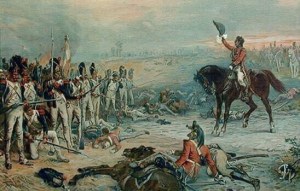
Napoleon’s Imperial Guard was comprised of three groups and at the time of Waterloo, nearly 22,000 strong counting the Guard Cavalry (with Ney) and Guard Artillery (in the Grand Battery). They were the Young Guard, the Middle (Aged) Guard and the Old Guard. (The Old Guard are who most people are familiar with). The Young Guard were the pick of the litter of the 1810-1815 campaigns and draft classes, and those not good enough for the Middle Guard. The Middle Guard were the best veterans from Napoleon’s 1805 to 1809 campaigns. The Old Guard consisted of the best soldiers in Europe, and were veterans of most of Napoleon’s campaigns, from as far back as the Italian campaign in 1790s. The Imperial Guard, particularly the Old Guard, had better pay, better rations, and the most senior were permitted to fight in their dress uniforms (back when awards actually meant something). They never retreated and they never surrendered. Napoleon knew each guardsman by name. They were the only soldiers outside of the Marshals permitted to disagree with or even complain in front of Napoleon, thus earning them the nickname “Les Grognards”, “The Grumblers.”
Thirty minutes after Ney’s request for the Guard, and a personal inspection by Napoleon himself, the remainder of the Imperial Guard, the last uncommitted French troops, stepped off into the attack at 1930. But that thirty minutes proved fatal. In that time, Wellington was able to reorganize his lines and bring over troops from the now inconsequential fight at Hougamont, or units pinched out of the fight by the Prussian advance near Pappelote. Nonetheless, the Old Guard had never been committed unless victory was assured. When the other French troops saw them in the attack, a great hurrah echoed across the battlefield, and any troops not engaged at Hougamont or Plancenoit, surged forward. Stragglers, wounded, staff, the lost, and the remnants of shattered formations joined in the attack. Everyone wanted to be a part of the last glorious charge of the battle; the Old Guard was in the van.
The final assault by the Imperial Guard was not enough. The Guard were too few, and the reorganized Allied firepower and numbers too great. One Middle Guard battalion took 20% casualties from a single volley from a British line that popped up 25 feet in front of them. The second volley caused even more damage. The same resulted wherever the Guard met the line, but still they came on or engaged in furious point blank musketry exchanges.
In a curious historical irony, it wasn’t the renowned disciplined firepower of the British that first broke the Guard, but a Dutch brigade led by Gen David Henrik Chasse. Chasse had fought against Wellington at Talavera in 1809 as a subordinate of D’Erlon. Chasse’s troops did not exchange fire with the Guard like the British but crashed into them with their bayonets, and overwhelmed the Imperial Guard with superior numbers. Chasse’s target was the unit whom a French soldier said of, “La garde recule ! Sauve qui peut!” or “The Guard retreats, save yourself!” Within minutes the rest of the Middle Guard broke. Other French units watched in horror as the unthinkable happened: the Guard fell back. With the Guard and consequently the French morale broken, individual British, Belgian, Dutch and German units advanced, just as the Prussians emerged from Planceoit. Wellington, sensing the battle won and ever the politician, raised his hat and signaled the general attack, lest Blucher get the credit for the victory.
By 2050, the only French units not destroyed or in full rout were the two of the four most senior Old Guard regiments, the 1st and 2nd Chasseurs. They escorted Napoleon from the field and when he was safely on a carriage to Paris, they turned and fought. First in a line, and when they were out-flanked, a square. When casualties were so high they couldn’t maintain a square, they formed a triangle. Finally the Allies brought up cannon and threatened to finish them with a bayonet charge. Before they fired, a young German Osnabrucker, Sgt Conrad Fuerhing, asked their commander, Gen Pierre Cambronne, if he wanted to surrender. Victor Hugo wrote that he replied, “La Garde meurt, elle ne se rend pas!” or “The Guard dies, it does not surrender!” But what the hard drinking, hard fighting, tough as nails, soldiers’ general actually said was,
“Merde.”
In literal English, “s**t”. In the figurative,
“F**k off.”
The reply was an apt end to the Napoleonic Era.
The Battle of Waterloo: The Prussian Attack and the Fall of La Haye Sainte

Wellington got his wish, though while he was stuck in a square fending off Ney’s cavalry, he didn’t know it. Blucher kept his promise from the night before. Von Bulow’s IV Corps slammed into Lobau’s understrength corps at Plancenoit and D’Erlon was forced to commit much needed units to keep Zeiten’s I Corps from rolling up his flank. Furthermore, Napoleon had to commit part of his reserve just to stabilize the situation, the least senior battalions of his Imperial Guard, the Young Guard.
The Young Guard was part of Napoleon’s personal command, the Imperial Guard, and could only be committed by his own words. Despite their lack of seniority, the Young Guard were some of the best troops in Europe and temporarily checked the Prussians, but the fighting in Plancenoit was fierce. It was the reverse of Hougamont and La Haye Sainte with the French barricaded in the buildings and courtyards and is considered by most historians as the worst urban fighting of the Napoleonic Era. Just after 1800, Blucher paused his attack and began to reorganize for a final push.
At 1830, Maj Baring could no longer defend La Haye Sainte: his troops were out of ammunition. They had fired everything they brought, everything they were given, and everything they could scrounge. D’Erlon finally threw them out. At 1850, the nimble horse artillery batteries began to pound Wellington’s vulnerable squares from near point blank range and soon they were joined by the big guns from the Grand Battery. It was at this point the mounted Earl of Uxbridge approached the Duke of Wellington and just that moment a cannon ball took his leg. Completely unperturbed, he said,
“By God, Sir, I’ve lost my leg.”
The Duke coolly replied, “By God, sir, so you have.”
Despite the pounding the Allies were receiving, the Prussian attack, Baring’s defense, and six hours of near constant fighting severely depleted D’Erlon’s Corps. Moreover, a reformed Dutch brigade attempted to retake La Haye Sainte. Even worse Wellington reformed most of his men back into lines. D’Erlon would need more men to even attempt to break through. And he needed them ricky tick: the Prussians renewed their attack on Plancenoit at 1900 with the near assurance of quick victory, and the French artillery was almost out of ammunition.
After a personal inspection by Napoleon himself, the remainder of the Imperial Guard, the last uncommitted French troops, stepped off into the attack at 1930, 18 June, 1815.
 Buk's Historical Ad Hockery
You must be logged in to post a comment.