
Tagged: WWII
The Normandie Fire and Operation Underworld
On 9 February 1942, the interned French ocean liner SS Normandie caught fire and capsized off of Pier 88 in Manhattan. The Normandie, recently rechristened the USS Lafayette, was in the process of being converted into a troop ship that could carry an entire infantry division’s worth of men (15,514 in 1942). The fire was almost certainly an accident, even though mob boss Albert Anastasia claimed credit (to enhance his reputation and send a message to the govt not to interfere with the waterfront rackets. He regretted it later.). Despite, or maybe in light of Anastasia’s claim, the Office of Naval Intelligence (ONI) suspected Nazi sympathizers, maybe even Nazi saboteurs.
In early 1942 New York, this was not an unreasonable assumption. Just after Pearl Harbor, the FBI had broken up the Duquesne Spy Ring and arrested 33 German spies in New York after two years of investigations. That there were some that escaped capture was considered a given. Furthermore, America’s largest immigrant community in 1942 were German Americans; New York City was a stronghold of the influential German American Bund, essentially the American branch of Hitler’s National Socialists. Also, U boats were literally torpedoing merchant ships within sight of the Statue of Liberty. It was suspected that they were receiving information from the dockworkers (true, until the Duquesne Spy Ring was broken up) and that the U boats were receiving fuel and supplies from fishing boats (Not true, the Americans were just unaware of the Type IX U-boats true range) On top of all that, New York’s docks, shipping, and fishing industries were controlled by the Teamster, Longshoreman, and Seafood Worker’s Unions. All of whom were dominated by the Jewish, Italian, Sicilian, and Irish Mafias. None of these were seen as particularly friendly to America’s wartime interests, and would greatly profit from chaos on the waterfront.
The Mafia’s control of these critical wartime requirements greatly concerned Naval Intelligence. Black marketeering and corruption were on the rise, if only because of the increased amount of wartime goods and supplies moving through New York. Also, union strikes in New York reached an all-time high in early 1941 (while the Soviet Union was a defacto German ally) and was still a serious problem. Anastasia’s claim of credit was seen as further proof that the immigrant communities would at best encourage the sabotage, and at worst actively participate. Although Ireland was technically neutral in the Second World War, their hatred of Great Britain was legendary, and tacit Irish support for German operations in the Atlantic was not unheard of. Most disconcertingly, Mussolini’s Italy was Hitler’s closest ally. There were twenty years of ties between the Italian Mafia in Italy, the northern branches of which Mussolini used to gain power, and the Italian mobs in New York. The Sicilian and Southern Italian Mafia were a different story, but who the hell in the US Navy knew the differences between the Italian and Sicilian mobs? The various mafia organizations needed to be brought on America’s Team, or eliminated by those that were. But where to start? When Naval Intelligence approached the longshoremen about the Normandie fire, no one would say a word, and they were quietly “escorted” from the Manhattan docks.
After speaking with New York district attorneys, the question wasn’t “where”, but “with whom”. They recommended the Jewish Mob, who had ties to all the others through their lock on the gambling racket. More importantly, they had a fierce reputation of street fighting with the German American Bund and regularly broke up Bund marches, rallies, and meetings. Of all the Mafioso in New York, they had the least ties to Italy or love of Germany. So Naval Intelligence contacted Meyer Lansky.
Lansky was a Jewish immigrant from Eastern Europe, and he came to America in 1911 after the Russian pogroms. He was a slight, well dressed, bookish man who could pass for an accountant in any New York City firm. He was also a ruthless killer, and The Bund Nemesis. He was the undisputed boss of Jewish organized crime, and the most feared enforcer of the “Syndicate”. The Syndicate was the unofficial organization that kept the Italian “Five Families”, and the various other ethnic mafias working in their own areas and own specialties, and generally not killing each other. Violence was bad for business. Lansky was the perfect man to contact.
Lansky assured the ONI that although the immigrant communities were from countries generally hostile to the US, they embraced their new homeland for the most part, and disdained Nazi Germany and Fascist Italy. They would refrain from active sabotage. However issues arose when ONI asked for the mafia members to report unusual activity, stop strikes, limit black marketeering, and even accept federal agents into the unions to keep an eye on things. Lansky was skeptical: mafia members, of any ethnicity, were anti authoritarians in the best of times, and would need some incentives for that level of support, and compensation for the consummate loss of profit.
The ONI made them an offer they couldn’t refuse: Cooperate or Washington will declare them a national security threat. Once that happened the FBI and an infantry division will descend upon New York and “kill them all”. (The Big Red One was passing through NYC at the time… Anyway, legend has it the threat came from FDR himself, whcih is not much of a stretch. Remember FDR was also the guy that had no problems rounding up every Japanese American in the country and putting them in concentr… err… “internment” camps.)
Lansky naturally agreed, “out of patriotism”, of course. Anyway, he had no problems with working against the Germans, if only for their treatment of Europe’s Jewish population. Also, once he explained the terms of the “agreement” to his fellow childhood friends, “Bugsy” Siegal and “Socks” Lansa, the ONI would eventually have no problems with the Italian and Sicilian controlled teamsters, longshoremen, or fishermen (with whom the ONI wanted to place agents to spot U boats). Lansky recruited Irish enforcer John “Cockeye” Dunn and his thugs to roam the waterfront. In Lansky’s words, “I gave Cockeye the orders. Go down to the piers and find out who is loyal and who is not loyal. You have to see that there are no strikes and that the job is done quickly when military stuff is loaded. And we have to make sure everybody keeps his mouth shut about troop movements. That means going into bars to make sure the crews and longshoremen don’t start sounding off when they get drunk”.
However, Lansky had no influence over the Irish mob on the West (Hudson) docks and rail yards, the surrounding Hells’ Kitchen slums, nor the Brooklyn Docks. They were run by Albert Anastasia, the same guy who “torched the Normandie”. The Irish had the biggest problem with authority. The “’G-Men’ really would need an infantry division”, and turn lower New York into a battleground, before the Irish submitted to federal authority. There was only one man who could convince Anastasia to cooperate: the Emperor of Vice in New York – “Lucky” Luciano.
Lucky Luciano owned the New York underworld, even from the maximum security prison at Dannemora, where he was serving a fifty year sentence. Luciano got the Irish on board under three conditions: His cooperation be kept secret, as he was an Italian citizen and if he was deported, Mussolini would have him killed. His sentence is commuted. And finally that he is moved to a nicer prison. The Navy agreed and Luciano was transported to the minimum security prison at Great Meadows. (He was eventually freed in 1946 and deported to Italy after being incarcerated for just 9 ½ years.)
Once the Navy had Luciano’s blessing, the Mafia were their enforcers. “There was peace on the waterfront. It was kept with rough methods. But that’s what the Navy asked us to do and that’s what the Navy got.”
Operation Underworld ran for the rest of the war, and was kept secret until 1977.
The Marshall and Gilbert Raids: America Strikes Back
With the battleships at the bottom of Pearl Harbor, the US Navy’s aircraft carriers in the Pacific were America’s only force capable of offensive operations in early 1942. The carrier admirals wanted to be unleashed, if only to restore the Navy’s honor.
The new commander in the Pacific, Adm Chester Nimitz, knew something needed to be done but the four carriers were the only defense against a Japanese invasion of Hawaii. However by constraining them to Hawaiian waters they were also a target. On 11 Jan the Saratoga was torpedoed by a Japanese submarine, and only the heroic efforts of her crew kept her afloat. She would spend the next two months in dry dock in Washington, and out of the war: “a 25% reduction of America’s offensive combat power.” At the ardent behest of Halsey, Nimitz had made the decision, and the Saratoga sealed it: the carriers needed to attack something, anything. The air bases at the far eastern end of the Japanese Central Pacific perimeter offered an opportune target.
Under cover of escorting a convoy carrying a marine brigade to Samoa, Halsey and the Enterprise met Rear Adam Fletcher and the Yorktown, then in transit from the Atlantic. On 21 January, the two carriers and escorts sped off into the night to strike isolated Japanese air and sea bases in the Marshall and Gilbert islands, despite the threat from Japanese land based planes. It was a plan that, “was ‘daring’ if it worked, but ‘foolhardy’ if it didn’t.”
America’s first offensive of the Second World War started poorly and to much frustration for Halsey. Even before the Enterprise arrived off of Samoa, the limitations, and most importantly, the self-imposed constraints of peacetime training were glaringly obvious. Peacetime procedures were simply inadequate for wartime operations, even without enemy contact. Fatal accidents, friendly fire episodes, security breaches, flight delays, navigation errors, and logistics difficulties of all types were commonplace. According to Halsey, the US Navy “needed more of everything: more training, more gunnery practice, more anti-aircraft guns of every caliber, more ammunition, more torpedoes, more radios, more radar, more intelligence, more reconnaissance, more planes, more supplies, and more spare parts”. Refueling at sea was particularly cumbersome, and Halsey commented that “it took longer to get into action today than it did in 1812”.
On 31 January, Nimitz received confirmation from his code breakers that the Japanese carriers were in the Dutch East Indies, and gave Halsey and Fletcher the go ahead to extend their initial timelines and expand their targets. They were to “press home their attacks and work over the Japs”. On the night of 31 Jan/1 Feb, the American carriers parked themselves between the two largest Japanese air bases in the Central Pacific.
Around 5 am the two carriers launched their bombers, Halsey and the Enterprise’s against the Japanese bases in the Marshalls, and Fletcher and the Yorktown’s against the Gilberts. They were unescorted because there were not enough fighters to protect the fleet and escort the bombers at the same time.
Fortunately, the surprise was complete. It was a reverse Pearl Harbor, albeit on a much smaller scale. The dive and torpedo bombers neutralized both main air and sea bases, severely damaged several cruisers, and sank a plethora of merchant ships. The ineffectual previous generation Japanese Claude and Nate fighters were swept from the sky by the few American fighters that got into battle, while the carrier’s escorts made high speed runs to fire at targets from off shore.
For seven hours, the American crews listened to the radio transmissions and pilot chatter of the bombing raids with the undisguised glee of football fans listening to their team winning the big game. About noon, some of the pilots and senior officers began to wonder if they were pushing their luck. They were within easy reach of at least nine Japanese air bases (and maybe more) in various states of destruction, and surely every Japanese submarine in a thousand miles was heading for them.
At one pm, the ops officer from the squadron “Bombing Six” came back from his third run that morning and confronted Halsey, “Admiral, don’t you think it’s time we got the hell out of here?” He replied, “I’ve been thinking the same thing myself”.
The carriers recovered their aircraft and forty five minutes later were heading back to Pearl.
The strikes on the Marshall and Gilbert Islands shocked the Japanese. The events since 7 December were a nearly unbroken string of victories; this was the first time the US Navy fought back effectively. Moreover, just two months into the war, the flawed premises of the General Staff’s perimeter defense strategy were exposed. The physical damage was temporary and repaired quickly, but only because there were no follow up landings. The far flung bases were not mutually supporting and the Japanese did not have enough carriers to cover the entire perimeter. Yamamoto quipped that, “We will have to dictate peace terms from inside the White House”.
But first things first: he needed to destroy those carriers, even at the expense of ongoing operations. The experience they gained on the raids was invaluable and they were now even more dangerous. Yamamoto needed a suitable target to lure them out and destroy them. That target was Hawaii, more specifically the last stepping stone before the invasion of Hawaii:
Midway Island.
The Politics of Defeat
America’s entry into the war had so far, by late January 1942, produced little more concrete assistance to the British than they had provided before Pearl Harbor. In fact, they were complicating matters with their failure to take the U-boat threat seriously off the American East Coast, and the tonnage sunk was rising dramatically. Despite the creation of ABDA Command, American assistance was sparse in the Western Pacific. The Philippines were doomed, and America’s Asiatic Fleet was inexperienced, untrained, undisciplined, and also didn’t take the threats seriously. Their sole contribution should have been an unparalleled victory when four American destroyers surprised a Japanese convoy off of Balikapan in the Dutch East Indies a few days before, but they only sank or damaged four of the 18 un-escorted transports. All of their torpedoes failed to explode, and their gunnery was poor even by American standards. American submarines and B-17 bombers were in theatre, but their support requirements far exceeded their value. The submarines were not doing damage consummate with their numbers, and the B-17s couldn’t actually prove they hit anything, either by damage assessments, photo reconnaissance, or by Japanese intercepts. But the blame for the state of the war couldn’t be put on the Americans. The Russians were facing the bulk of the Wehrmacht, and what adversaries faced the British were victorious much more often than not.
It was these defeats, and their political fallout, that occupied Churchill in the last half of January.
Operation Crusader failed to secure Western Cyrenaica, so Malta was vulnerable indeed, but unless the Germans and Italians invaded the situation was politically manageable. Additionally, Bismarck’s sister ship Tirpitz was spotted recently in Norway. After the loss of Repulse and Prince of Wales to the Japanese, the loss of the Queen Elizabeth and Valiant to Italian frogmen, and the loss of the carrier Ark Royal to U boats, all in December, the Royal Navy simply did not have the capital ships necessary to deal with another breakout. Commando raids were planned to neutralize the Tirpitz. However, Churchill couldn’t say anything about them, and his Labour party opponents were beginning to grumble that he was again losing the Battle of the Atlantic.
In the Pacific, the Dutch lost Borneo and the Australians were thrown off of the Bismarck Archipelago. The Aussies were beginning to panic, and again threatened to pull all of their troops back to Australia to defend against a Japanese invasion. The British and Commonwealth troops were being run out Burma. Even Kuala Lumpur fell to the Japanese recently, proving that speed doesn’t equate agility as the outnumbered trail bound Japanese consistently out maneuvered the road bound British and Commonwealth forces in Malaya. But Churchill was assured that they would retreat to the island fortress of Singapore which could withstand any Japanese assault. Domestically, all of these were manageable unless Malta or Singapore fell. If one of those disasters occurred, his government would face a no confidence vote in Parliament – one which he would not win.
For months, the Imperial General Staff assured Churchill that Singapore was ready for any attack, whether by land or sea. The reality was much different. Singapore was a naval base with no navy. And it was a poor naval base at that. It had suffered from interwar defense cuts worse than most, and was last in priority for all classes of supply. Its harbor defenses were pointed to sea, and not landward towards Malaya, just one short mile to the north across the Johore Strait. Its water reserves were located on the north coast. The civilian population had not evacuated, and until recently had not even accepted there was anything to worry about. Singapore’s many beautiful and wide beaches were undefended. The RAF on the island nearly ceased to exist and there was no Royal Navy of any great capacity left in the East, and therefore no possible repeat of Dunkirk. Morale was non existent, and most units felt that the Japanese were invincible jungle fighters. It didn’t help that the commander, Lieut Gen Arthur Percival ordered the port facilities manually destroyed over the last few weeks, confirming in many eyes their fears that all was lost. The only reliable units were those that were still arriving, and only continued to do so because Churchill was convinced the island was impregnable.
On 19 January 1942, the Imperial General Staff briefed Churchill on Field Marshal Wavell, the ABDACOM commander’s assessment of the situation. Wavell pulled no punches, and flat out stated he expected Singapore to fall within the month.
Churchill was furious.
He flew into a booze filled rage unlike any that had been seen before. He demanded that the entire city be defended to the death, and that “commanders and staffs should perish at their posts.” He tore into the Imperial Staff all day. But in the end, he knew he was responsible.
On 27 January, 1942, Churchill assembled the Parliament and his ministers for a frank three day long debate and assessment on his conduct of the war. Nothing was held back, except ULTRA intelligence. The discussions during those days were arguably the most polite, open, honest, and vicious parliamentary proceedings in history. At the end of the day on 29 January, Churchill gave an impassioned speech which ended,
“Although I feel the broadening swell of victory and liberation bearing us and all the tortured peoples onwards safely to the final goal, I must confess to feeling the weight of the war upon me even more than in the tremendous summer days of 1940. There are so many fronts which are open, so many vulnerable points to defend, so many inevitable misfortunes, so many shrill voices raised to take advantage, now that we can breathe more freely, of all the turns and twists of war. Therefore, I feel entitled to come to the House of Commons, whose servant I am, and ask them not to press me to act against my conscience and better judgment and make scapegoats in order to improve my own position, not to press me to do the things which may be clamoured for at the moment but which will not help in our war effort, but, on the contrary, to give me their encouragement and to give me their aid. I have never ventured to predict the future. I stand by my original programme, blood, toil, tears and sweat, which is all I have ever offered, to which I added, five months later, “many shortcomings, mistakes and disappointments.” But it is because I see the light gleaming behind the clouds and broadening on our path, that I make so bold now as to demand a declaration of confidence of the House of Commons as an additional weapon in the armoury of the united nations.”
The Motion of Confidence passed 464-1.
On 31 January, the last Commonwealth troops crossed onto Singapore, and blew the causeway behind them. The Japanese arrived several hours later.
The Battle of Bataan: The Stand
MacArthur’s order to fall back to the Bataan Peninsula concentrated the American and Filipino forces and provided them with good defensive lines but it also cut them off from the supply depots scattered about Luzon. (MacArthur initially wanted to fight aggressively so the depots were placed closer to potential Japanese landing zones). LieutGen Homma, the Japanese commander, felt that with the Allies on the run and no US Navy to rescue them, they would be an easy target. If they weren’t then he could just besiege them and starve them into surrender. So he released his best men to accelerate the timetable for the real prize in the South Pacific: Java and the Dutch East Indies. His remaining 60,000 men were facing 80,000 Americans and Filipinos, but were much better supplied and had complete control of the air. But in Malaya, Homma’s peer and rival, Lieut Gen Yamashita, was making steady progress against the British and Commonwealth troops, and he only had less than half what the British had. If Homma didn’t continue to attack, he would be disgraced.
Homma’s men and tanks threw themselves at the first defensive line stretching Abucay in the East to Mauban in the West. The Allies put up tough resistance but with little capacity for reconnaissance operations, and an impassable mountain prohibiting mutual support between the defending corps, the well fed and well supplied Japanese used solid infiltration tactics to establish local superiority at the points of attack. What little counterattack capability the Allies had, including the last horse mounted cavalry charge in American history by F troop 26th Cavalry Regt (Philippine Scouts) led by 1LT Edwin Ramsey couldn’t stop the Japanese. MacArthur abandoned the Abucay-Mauban Line on 22 January 1941.
Under pressure from the Japanese the exhausted and hungry Allies were slow to abandon the line lest the withdrawal became a rout. Homma decided to speed things up, and ordered all of his units to attack. Many Japanese units bypassed the retreating Allies, and drove deeply down the peninsula, some infiltrating well passed the next defensive position, the Orion-Bagac Line. Bypassing the units was a mistake. Recognizing the danger, an adhoc force of American and Filipino troops plugged the gap on 23 January and held the vital Trail 2 open as the galvanized remainder of Allies trudged into the much more easily defended Orion-Bagac Line.
The Orion-Bagac Line was much shorter, and very quickly the infiltrating Japanese found themselves isolated and cut off. As the main Japanese force launched banzai charge after banzai charge against the Allies in order to break through to these “pockets”, the Filipinos took to them with a vengeance, systematically eliminating each one over the next two weeks. Homma attempted and end run with amphibious landings on the southern end of the peninsula but these too were quickly contained. They were initially supposed to trap the retreating Allies, then they were to relieve the pockets, but instead they became pockets themselves, just on the “points” of land jutting into the sea.
The Americans and Filipinos on Bataan at the Battle of Trail Two, The Stand at the Orion-Bagac Line, the Battle of the Pockets, and the Battle of the Points caused Homma enormous casualties. So many so that the Japanese could not continue the offensive. On 13 February 1941, the disgraced Homma ceased operations, dug in, and to his eternal shame, requested reinforcements.
The Japanese took extensive casualties (and would lose one of their best generals), but to the Allies, this small consolation prize couldn’t change the horribly obvious truth that the Americans and Filipinos on Bataan were still doomed.
The Battle of Rabaul: Nos Morituri Te Salutamus
On 22 January 1942, the Japanese 8th Area Army invaded the Australian New Guinea Mandate, which consisted of eastern half of Papua New Guinea, the Bismarck Archipelago, and the Solomon Islands. Their immediate objective was the capture of Rabaul, on the northeast tip of New Britain in the Bismarck Archipelago. Rabaul offered a deep water port and secured the southern flank of the main Japanese naval base in the South Pacific, Truk, in the Caroline Islands. On the twenty second, the Japanese 55th Division landed on the island of New Ireland. The next day they assaulted New Britain to capture the port and airfield. They were garrisoned by the 2bn/ 22nd Infantry, an Australian unit recruited almost exclusively from members of the Salvation Army, a battalion of the New Guinea Volunteer Rifles, and a squadron of training aircraft, some light bombers and seaplanes from the Royal Australian Air Force.
For three weeks, the massive waves of Japanese carrier fighters and bombers from Pearl Harbor veterans, Akagi and Kaga, struck Rabaul and the airfield, and swept the skies clear of RAAF resistance. On 23 January as the Japanese were landing, the last Hudson bomber took off for Australia stuffed with wounded. The last obsolete lightly armed trainer had already taken off to attack the invasion force. Before he climbed into his cockpit, the pilot sent a message off to the RAAF HQ: “Nos Morituri Te Salutamus”, the ancient Roman gladiatorial motto, “We who are about to die, salute you.” It was a giant FU for the real and imagined lack of support from the newly formed ABDA Command.
The Australians met the Japanese on the beaches but were thinly spread way, and though they inflicted heavy casualties on the Japanese, were quickly overwhelmed. About 2/3rds of the defenders escaped into the interior of the island from which they conducted guerrilla attacks for many weeks. But long term guerrilla operations were not planned for and no weapons, ammunition, and most importantly medical supplies were stockpiled. The Australians simply died out, or surrendered and were worked to death.
Rabaul became the main Japanese Army and air base for the SouthWest Pacific. The recapture or isolation of Rabaul became the main Allied operational objective in the South Pacific for the next two years. It was from Rabaul that the Japanese conducted the Solomon Islands campaign (started w/ Guadalcanal) and the longest continuous land campaign of the war against the Americans and Aussies: the now mostly forgotten fighting for the island of New Guinea. They were the last obstacles before the Japanese could invade Australia. The brutal fighting for New Guinea and the Solomon Islands continued for the remainder of the war. Amidst their mountainous jungles, these campaigns consumed Allied divisions at a frightening pace and never received the recognition (or supplies) that Nimitz’ Central Pacific and MacArthur’s Philippine’s campaigns received.
Rabaul was never retaken by the Allies during the war.
Operation Drumbeat
On 18 December 1941, Adm Karl Doenitz dispatched five of his long range Type IX U-Boats from Lorient, France on Operation Paukenschlag or Operation Drumbeat. British Intelligence picked up on the departure and warned the Canadians and Americans that they were most likely heading to the Western Atlantic. They indeed were: each U-boat was stuffed with to capacity with food, fuel and torpedoes for an extended patrol off the US coast. Each had tour guides of the coasts of their respective patrol zones, many of which included harbor maps, and in many cases, military installations.
President Roosevelt established the Pan American Security Zone after Germany declared war on 11 December, and the Eastern Sea Frontier included the Atlantic coast. But the unfortunate rear admiral who pulled that duty had only seven coast guard cutters, four yachts, and a smattering of civilian sailing ships. In any case it didn’t matter: cargos ships traveled with their running lights on, there was no blackout along the coast, and no convoy system between American ports was adopted for months.
The first ship sunk off the American coast was on 14 January when U-123 put a torpedo into the Norwegian tanker Norness, within sight of Long Island. (There were 13 American destroyers sitting idle in New York harbor.) Those five Uboats would submerge during the day, and attack on the surface at night against targets brightly silhouetted by the coastal lights, many with civilians watching along the coast. The Germans sank 160,000 tons of shipping in two weeks, more than the last six months combined.
U boat crews called the next six months, “Die Glueckliche Zeit” or “The Happy Time”.
The End of 1941
Late December 1941 was a time of unexpected changes in the Second World War. War Plan Orange, the interwar campaign plan for the Pacific was permanently discarded on the 31st – its centerpiece, the battleship squadrons, were all sunk or severely damaged. The old guard of battleship admirals in the Navy Department were thrown into chaos, but the carrier admirals led by Nimitz and Halsey were already planning to strike back at Japanese possessions in the central Pacific with their surviving ships.
However, the state of American land forces in combat was deceptive. Wake Island had fallen after an epic 13 day defense, and other American possessions in the Pacific such as Samoa, Johnston, Howland, Baker and Midway Islands, and even Hawaii and the American West Coast thought they were next. In the Philippines, MacArthur pulled most of his Far East Command back to the strong defensive lines on the Bataan peninsula, while other American and Filipino units spread throughout the archipelago were holding their own against the Japanese. But without relief from Hawaii, their fate was sealed. The Japanese knew this, and accelerated their timetables to seize the true prizes of the South Pacific: the oil fields, tin mines, and rubber plantations of Borneo and Dutch East Indies.
At the hastily planned Arcadia Conference in Washington, British and Americans created the much needed ABDA Command (American, British, Dutch, and Australian) to coordinate the fight against the Japanese. Unfortunately, the forces at its disposal were meager. In any case, larger problems loomed: The inexperienced Americans struggled against a very prepared British delegation in hammering out a common strategy for war. The British (and FDR) wanted to focus on the fight against Germany, while Adm King and Gen Marshall wanted to focus on the Japanese and avenge Pearl Harbor.
With the destruction of the Royal Air Force on the ground in Malaya, the Japanese acquired a near mythical perceived ability to appear anywhere. The air attacks and sea borne landings down the Malaya peninsula perfectly complimented the light Japanese infantry’s ability to out flank the road bound British and Commonwealth defenders through the jungle. Churchill still believed in the “fortress” of Singapore, but it was a hollow shell due to interwar spending cuts. Moreover, its defenses briefed well by staff officers in London, but were totally inadequate for coming Japanese onslaught. Entire Commonwealth brigades, desperately needed in Burma for the defense of India, would continue to arrive in Singapore: a naval base with no navy after the sinking of the Prince of Wales and Repulse.
The Royal Navy’s fortunes were the gloomiest yet in the war. The U boats heading to the American east coast were a looming train wreck and the British could do nothing but watch, and continue to pester the obstinate Americans. In the Mediterranean, Italian frogmen sank or damaged four capital ships in Alexandria harbor in late December, and almost single handedly returned naval parity. This was confirmed when in an attempt to sink a convoy of desperately needed tanks for Rommel, Force J and K from Malta were devastated at the First “Battle” of Sirte. The opposing sides barely saw each other, but British ships wandered into an Italian minefield near Tripoli, which sunk or severely damaged six ships. It would have been a great Italian victory had they too not wandered into the same minefields. In any case, Rommel’s tanks got through.
In defiance of Hitler’s No Retreat order, Rommel fell back all the way to his supply dumps and fuel farms at El Alghelia, where he had started the spring before. But the pursuing British were strung out. Although Operation Crusader was everything Auchlinek wanted, they were now 180 miles from their own depots. Rommel just received a new shipment of tanks, which he recently used to maul the pursuing British armor. He now had the initiative and planned to use it to reestablish a line before Hitler noticed and took action on his violation.
Hitler had already fired his top commanders, and had taken direct control of operations in the East. His no retreat order saved precious equipment from being abandoned, but only the professionalism and desperation of the Wehrmacht prevented a disaster in front of Moscow. Germany would pay for Hitler’s decision for years to come. Nonetheless, the Soviets were attacking everywhere, but the Germans were containing the hastily trained and poorly led troops, if barely. Although the Germans didn’t conquer the Soviet Union in 1941, they were confident they would in 1942. Everywhere the Axis reigned supreme.
On the 26th Winston Churchill addressed the US Congress. He felt that with America in the war, it was now winnable, but it would take 18 long months for the tide to change. Congress was not prepared when Churchill told them that “many disappointments and unpleasant surprises await us” in the New Year.
The End of an Era
Britain was the most affected by the Washington Naval Treaty of 1922, which prevented a post war arms race by limiting capital ship construction, and placed a 10 year moratorium on new capital ships. It eased the effects of the bad post war economy, but the British shipbuilding industry atrophied, and the specialized knowledge required of the big ships disappeared. When the Treaty limits were completely dropped in 1936 in the face of German and Japanese aggression, a shipbuilding boom happened, but unlike their adversaries whose capital ship industries started from scratch, the British just recycled and updated Great War designs (They won, why change?).
With the Battleship Admirals still in control of the Royal Navy, the battleship was seen as the means by which deterrence was measured. But the Admiralty had a huge problem: the shipbuilding industry couldn’t produce the required numbers of battleships vis a vis their potential adversaries (much less the much more important carriers, cruisers, and especially destroyers, frigates, and corvettes). And they were all lower quality. After the 1940 and early 41 battles with the German capital ships, the Admiralty couldn’t rely on parity, they needed superiority, at least 4 to 1 against Bismarck’s sister ship, the Tirpitz. The latest British design, the King George V, was simply no match for the Bismarck (The Prince of Wales, a KGV design, had to run away from the Bismarck after the Hood blew up, and the KGV herself couldn’t sink the Bismarck even though the Germans couldn’t maneuver and could only sail ten knots.) And to make matters worse, the Italian designs were far superior, so battleships needed to stay in the Med in case the Italians decided to sortie (the Italian problem was leadership, not design). Britain didn’t have enough ships for its current commitments let alone enough ships for her other global commitments, especially after the losses suffered over two years of war.
When Japan occupied Indochina in the summer of 1941, the Admiralty planners’ worst nightmare came true: a likely maritime war with three major naval powers in three distinct areas: Germany in the Atlantic, Italy in the Med, and Japan in the Far East. Up until then the Far East question was an academic exercise, but now it needed an answer. The old French, now Japanese anchorage at Cam Ranh Bay was only a short three day sail from Britain’s main, if neglected, naval base in the East, Singapore.
But Singapore had no fleet, and this was not lost on Australia, New Zealand, Burma, East Africa, South Africa, and India, all of whom were particularly vulnerable to Japanese aggression. The combined Commonwealth navies barely amounted to a few cruisers and destroyers, but tens of thousands of Commonwealth troops were fighting the Germans and Italians vast distances away from home. They expected a British fleet to come to their defense, but the British simply didn’t have one to send.
In late November, after Australia and New Zealand threatened to pull their troops out of North Africa for home defense, Churchill ordered the two largest and most modern warships in the Royal Navy to Singapore: the battleship HMS Prince of Wales, and battlecruiser HMS Repulse, with four destroyers, as a deterrent (it didn’t matter, the Japanese were already committed to the attacks on Malaya and Pearl Harbor, but the Kiwis and Aussies felt better.) They were expected to pose a threat similar to the Tirpitz and Bismarck and tie up Japanese assets. But the Japanese were keen observers of the last two years, and saw little threat from the two British ships, given their lack of cruiser support (especially the lack of a Dido class specialized antiaircraft cruiser, all of whom were needed for the Malta convoys) and Britain’s piss poor naval–air coordination (a product of RAF Coastal Command’s red headed step child status compared to Bomber and Fighter Commands)
On 10 DEC 1941, Prince of Wales and Repulse, with supporting destroyers, moved north from Singapore to intercept Japanese landings on the east coast of Malaya. They were both sunk by Japanese torpedo bombers in less than three hours. Afterwards, the Japanese ignored the destroyers, and even signaled that they wouldn’t be molested if they stuck to picking up survivors. The Prince of Wales and Repulse were the first major warships sunk by planes on the open sea. Combined with the American disaster at Pearl Harbor two days before, it became clear airpower now defined seapower, even to the eldest and most hardheaded battleship advocate. The Age of the Battleship was over; the Age of the Aircraft Carrier had begun.


The Wild Run of Victory Begins
The Japanese struck Pearl Harbor on Sunday, 7 Dec, Hawaii time, but due to the vast distances involved and the international dateline, the strike occurred on Monday 8 Dec local time in Tokyo and across the Western and Southern Pacific Ocean. The Japanese did not actually begin their war with the Western Allies with the raid on Hawaii. It began with landings in Malaya and Thailand that occurred about 90 minutes before Fuchida dropped the first torpedo into the USS Nevada.


“Tora Tora Tora”: The Raid on Pearl Harbor
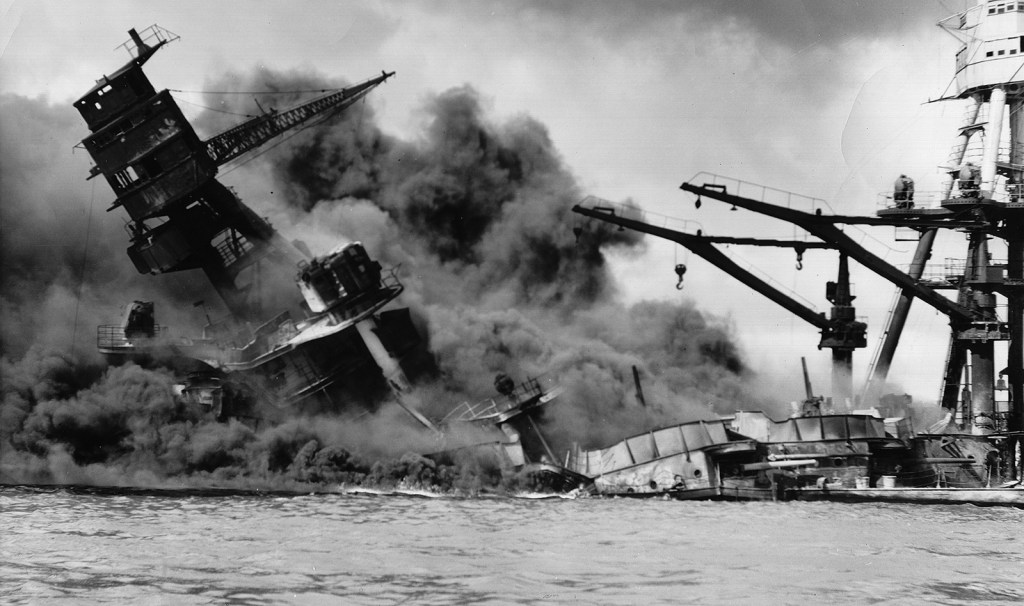
When the 183 Japanese planes of the first wave approached Pearl Harbor from the north without any resistance from the Americans, LtCmdr Mitsuo Fuchida, the commander of the Japanese air strike, signaled to Adm Nagumo the code words “Tora Tora Tora” (tiger, tiger, tiger) which indicated the attack began with complete surprise. Five minutes later, Cmdr Logan Ramsey, Ops officer of Patrol Wing Two, attempted to get the tail number of a plane he thought was flying recklessly. But he recognized the red “meatball” on the plane’s wing and immediately sent out the radio message in plain English, “Air Raid Pearl Harbor. This is no drill.”
Fuchida had six objectives for the first wave. The first five were Pearl Harbor’s air defenses: Wheeler and Hickham Army Airfields, Ford Island and Kaneohe Naval Air Stations, and Ewa Marine Air Station. Most of the planes on these airfields were destroyed before they could get off the ground. And many even before the ammunition could be distributed to the anti-aircraft defenses, which despite repeated war warnings was still locked up in distant armories. Nevertheless, in the chaos, men fought back, including mechanics on Wheeler who threw wrenches at the low flying Japanese. Or more effectively, Chief Petty Officer John Finn, who pulled a .50 Caliber machine gun from a damaged PBY and fought through 21 separate wounds to earn the first Congressional Medal of Honor of the Second World War. Or an unknown marine at Ewa who stood in the middle of the runway firing his pistol at the low strafing planes. The official Japanese records of the attack refer to him at “The Bravest American”. The Japanese pilots specifically targeted him, like jousting knights, but as far they knew the young marine survived the attack. A large portion of the Japanese casualties at Pearl Harbor came by way of that most mocked and denigrated Army and Marine rank, the second lieutenant; eight of whom courageously took off into the teeth of the Japanese onslaught in far inferior planes to take them on at 20-1 odds.
While the Japanese bombed and strafed the airfields, Fuchida personally supervised his pilots at his sixth and primary objective – Battleship Row. There the eight battleships of the US Battleship Divisions 1, 2 and 4 sat. The surprise attack caught the ship’s crews preparing for the day. On the USS Nevada, the band played for morning colors just as the Japanese attacked. They finished despite being strafed because, “It was inconceivable to break formation during the Star Spangled Banner.” Specially designed low draft Japanese torpedoes struck the Nevada moments later, along with her sisters the USS Arizona, California, West Virginia, and Oklahoma. The torpedoes sank the West Virginia and capsized the Oklahoma. In spite of the surprise, the sailors were a bit more prepared to fight than their land based brethren as they had their ammunition on board. During Sunday morning mass on the cruiser USS New Orleans, the chaplain Lt.jg. Howell Forgy blessed his gunners, and told them to “Praise the Lord and pass the ammunition.” On the West Virginia, Messmate Third Class Doris Miller manned a .50 Cal in the conning tower, a weapon he was unfamiliar with, until his ammunition ran out. Miller would receive a Navy Cross for carrying many of his wounded comrades to safety before the West Virginia sank.
After the torpedo bombers, Japanese dive bombers dropped specially converted 16in armor piercing battleship shells on the giant American targets. They would damage every battleship on the Row, but one hit in particular caused nearly half of the American casualties that day. Like her sisters, the Arizona was a battleship developed for the last war. Her armored citadel, the area that protects the vital areas of the ship, could withstand a hit from largest shell of that time, 14”. One of the dive bombers managed to place its converted 16in shell right above the forward magazine, where it penetrated. Seven seconds later a catastrophic explosion destroyed the ship, killing 1100 sailors instantly.
The entire island seemed to be on fire. In 90 minutes, four battleships and three other ships were sunk, four more battleships, and nine others damaged, 300 aircraft destroyed, and 3700 soldiers, sailors, marines, and civilians were killed or wounded by two waves of Japanese carrier based aircraft. It was still less than what was expected. On the outset, Fuchida gave a flare signal for an hastily planned conventional attack, one configured for an expected American defensive preparedness, instead of the planned signal for the attack in case surprise was complete, which it was as signified by the famous “Tora, Tora, Tora” broadcast. Fuchida’s signal prompted the torpedo bombers to wait a few critical minutes before attacking Battleship Row while the dive and level bombers plastered the airfields. Those few minutes were key: they allowed the crews to secure battle stations and close water tight doors. The torpedo bombers as a result took more casualties and their hits less devastating than they could have been. Consequently, Fuchida wanted a third attack: to destroy the fuel farms, dockyards, and repair facilities, and probably also to correct the sub par, though still devastating, results. But he was overruled by Adm Nagumo: most of the Japanese losses occurred during the second wave, and the American carriers were not in port and therefore an unknown threat. Also, the fuel situation would be critical if the Kido Butai lingered which it would have to do all day if a third strike was launched. By noon, all aircraft were recovered, and the Japanese were racing home.
Nagumo would regret his decision for the rest of the war.
 Buk's Historical Ad Hockery
You must be logged in to post a comment.