
Tagged: WWII
The Yorktown Dies Hard
The American aircraft carrier USS Yorktown was no stranger to pain and suffering. She had been officially “sunk” by the Japanese three times in the last month – once with the “Lady Lex” in the Coral Sea, but against all expectations, she managed to limp back to Pearl for repairs. And twice more the day before after the Japanese got over their initial surprise at her appearance north of Midway. Admiral Yamaguchi and the planes from the Hiryu were sure they “sunk” her in their first counterattack after the devastating American attack that sank the Akagi, Kaga, and Soryu. However the repair crews did such a good job that when the Japanese returned, they mistook her for the Enterprise and “sunk” her again. Each time her repair crews and damage control parties brought her back from the brink of death to fight another day. And they were determined to do so again.
The damage from the last attack was so extensive that Captain Elliot Buckmaster even ordered an “Abandon Ship”. But when she stubbornly refused to sink, he and his crew re-boarded the ship to continue repairs. A tug, the USS Vireo, was summoned from Pearl Harbor. A destroyer, the USS Hammann, pulled alongside to pump out water and provide electricity to the Yorktown’s repair crews during the long tow back to port. The crew worked all night and into the afternoon of 6 June.
However, at 3:30 pm, the Japanese submarine I-168 fired four torpedoes which sank the Hammann and damaged the Yorktown: this time fatally. Still, she remained afloat for another 15 hours, but with a terrible list to port. At 7:01 am, 7 June 1942, the list became too great and she rolled over. A submarine finally did what the full weight of the Japanese surface fleet and naval air arm couldn’t do: sink the Yorktown.
The Bedford Boys
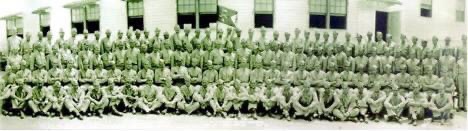 President Roosevelt federalized the National Guard in early 1941, and in Virginia and Maryland that meant that the men of the 29th Infantry Division “The Blues and Grays” reported to their armories. All across Virginia, guardsmen mobilized and formed the historic 116th Infantry Regiment, the “Stonewallers”, so named because they traced their unit lineage to the 2nd Virginia Regiment. The 2nd Virginia was the senior regiment in Stonewall Jackson’s Confederate Brigade and was present during the brigade’s famous stand during the 1st Battle of Manassas. Company A, of the 1st Battalion, 116th Infantry Regiment was formed from citizens in the sleepy little town of Bedford, Virginia, population of about 3000.
Over the next three years, the 125 men of Company A trained together in Maryland, crossed the Atlantic on the Queen Mary in 1942, and then trained in Scotland. In early 1944, they moved to the south coast of England, and trained some more, this time on amphibious operations and assaulting fortified positions in preparation for Operation Overlord. Due to normal transitions in any normal military unit, there were only 34 original members of the company that marched out of Bedford three years prior. The rest were replacements, though all of the officers and senior NCOs were still Bedford natives.
In the upcoming invasion of France, Company A was assigned Dog Green beach, the 116th’s western most section of Omaha Beach with objective of securing Exit D1: the Vierville draw. On 3 June, CPT Taylor Fellers and 1SG John Wilkes loaded their men onto the British troopship SS Empire Javelin. For the next two days, the seasick Stonewallers steamed in circles in the naval assembly area known as “Piccadilly Circus” waiting on The Word from Gen Eisenhower. On the night of June 5th, they got it, and the Empire Javelin headed south.
In the early morning hours of 6 June, 1944, the 116th loaded into their Higgins boats and began the approach to the beach. It was chaos. Higgins boats were everywhere and navigational errors were rampant. It was never completely sorted out, but at least they were headed toward Normandy.
Unfortunately for CPT Fellers, the Bedford Boys, and the rest of A Company, they were the only formation headed to the correct beach. The rest of the 116th was too far to the east. Two boats full of Rangers tagged along but the engineers that were supposed to land ahead of them and clear obstacles were nowhere to be seen. Looking out over the gunwale, CPT Fellers was horrified to see that there was nothing to his left. The only target for every German gun within 3/4 of a mile was A Company.
200 yards out the British coxswains couldn’t get any closer, one yelled “Up and at ‘em, boys!” and dropped the ramp. Within seconds a mortar exploded inside of a nearby boat and killed everyone. At least three German strongpoints, six MG 42 machine guns and hundreds of Mauser rifles zeroed in on the rest of A Company. Within ten minutes, 90 members of the company were casualties, including all of the officers and most of the NCOs. Only four soldiers would make it to the shingle, which was still two hundred yards from the bluffs that the Germans occupied. Most of the remaining soldiers survived by hiding in the surf and staying underwater while breathing through their nose, their nostrils being the only exposed part of their bodies. The Germans would eventually run out of targets and shoot the wounded to make sure they were dead. Those that the Germans didn’t kill were drowned as the tide came in. 19 of the 34 Bedford Boys were killed in the first minutes of the battle, including CPT Fellers and 1SG Wilkes, and the rest wounded to some degree. Three more would die later in the day.
The first death notifications came to Bedford Virginia about a week later. There were nine on the first day, and the rest were spread out over the next week. They came as Western Union telegrams and were delivered by cab drivers. The small town was devastated. There wasn’t a single person in the town who did not personally know someone killed between 0630 and 0640 on 6 June, 1944.
To honor the sacrifice the town made on that day, the National D-Day Memorial was established in Bedford on 6 June 2001.
The Battle of Midway
On 3 June 1942, Japanese planes from the light carrier Ryugo strafed and bombed Dutch Harbor on the island of Unalaska in the Aleutian Islands. The Japanese hoped to lure the American carriers into the open with the attack on American soil. As the American carriers respond to the attack on Alaska, they were to be destroyed by the four carriers of Admiral Nagumo’s Kido Butai which was fast approaching the island of Midway.
However the Americans were already there and waiting. On 2 June 1942, Admiral Fletcher’s Task Force 17 rendezvoused with Admiral Spruance’s TF 16 at “Point Luck” 325 miles north east of Midway. The next day, 3 June 1942, aircraft from Midway Island spotted the Japanese invasion fleet and the three American carriers, the USS Hornet, the USS Enterprise, and the USS Yorktown, began steaming west to engage the Japanese.
In the early morning hours of 4 June 1942, Admiral Chuichi Nagumo, the Victor of Pearl Harbor, assumed that the greatest threat to his aircraft carriers, the Kaga, Akagi, Hiryu and Soryu, were the land based bombers on Midway Island. He had no idea that three American carriers were lurking nearby.
Nagumo’s first strike on Midway Island did extensive damage to the airfield but a second strike was needed. While he was arming for a second land attack, one of his reconnaissance planes radioed that they had spotted an American carrier. With the first strike’s planes returning and low on fuel, he sent his second strike back below decks to rearm for a naval attack while he recovered the first strike. Unknown to him, an American attack was on its way.
Due to confusion on the American carriers, navigation errors in the search, and haste to launch the attack, the Americans were not synchronized. The coordination between Admiral Fletcher’s aircraft from the Yorktown, and Admiral Spruance’s aircraft from the Enterprise and Hornet was poor at best. Moreover, the attacks were supposed to be integrated: with torpedo bombers, dive bombers, and escorting fighters all arriving over the target simultaneously. This would have dispersed defending Japanese fighters and anti-aircraft fire, but some squadrons couldn’t find their compatriots, some squadrons didn’t wait around, and some waited in the wrong spot. To make matters worse, Nagumo’s carriers made a slight course correction, and many planes flew to the wrong spot only to find empty ocean. The Battle of Midway looked to be a repeat of the Battle of the Coral Sea.
Fortunately, individual squadrons found the Japanese on their own. The first were the torpedo bombers of LtCdr “Lem” Massey’s Torpedo Squadron Three (VT-3), followed shortly by LtCdr John Waldron’s Torpedo Squadron Eight (VT-8). As the Japanese planes were being recovered, the American torpedo bombers attacked and the defending Japanese Zeros made short work of the low and slow flying TBD Devastators. The six fighters of LtCdr Jim Thach’s Fighter Squadron Three couldn’t adequately protect their vulnerable wards and the TBs suffered almost 100% casualties. Of the twenty seven torpedo bombers that attacked, only two from Waldron’s squadron returned, and only one man from VT-8 survived: wounded and floating in the ocean was a young ensign, George Gay. As the historian Samuel Elliot Morrison pointed out, “For about 100 seconds, the Japanese thought they had won the Battle of Midway, and the war.”
They could not have been more wrong.
Two squadrons of Dauntless dive bombers approached almost simultaneously. The first, Max Leslie’s Bombing Three (VB-3) was the last squadron to take off from the aircraft carriers, and was actually the only squadron to have an accurate idea of where the Japanese were. The second squadron, Bombing Six (VB-6) was escorted by LtCdr Wade McCluskey’s Fighting Six (VF-6). Initially, they couldn’t find the Japanese ships. But, McClusky, low on fuel, decided not turn back even though he knew most of his planes would have to ditch in the ocean. His persistence paid off when he spotted a lone Japanese destroyer sailing at flank speed. He decided to follow it, and it led his planes directly to Nagumo. Adm Nimitz would credit McClusky’s decision, that of a relatively junior field grade officer, as one of the most important of the war; “It decided the fate of carrier task force and our forces at Midway…”
The suicidal torpedo runs by VT’s 3 and 8 were not in vain. They forced the defending Japanese Zeroes near sea level to chase the slow TBs and left the sky above the Japanese carriers free of air protection. The American dive bombers took advantage of the clear approaches to their targets.
In four minutes, from 10:22 to 10:26 am on 4 June 1942, VB-6 from the USS Enterprise screamed out of the sun and scored direct hits on the Kaga and Akagi, while VB-3 from the USS Yorktown pounded the Soryu. The Japanese carriers had decks packed with bomb and fuel laden planes, and the American dive bombers turned them into exploding infernos. Only the Hiryu escaped complete and catastrophic destruction.
The Hiryu responded and launched two counterattacks which severely damaged the Yorktown later that morning. That afternoon, planes from the Enterprise, including ten originally from the Yorktown, so damaged the Hiryu that she had to be scuttled. Admiral Tamon Yamaguchi, probably the best Japanese carrier admiral of the war, chose to go down with the ship in shame.
Without air cover, Admiral Yamamoto turned his battleships and the invasion fleet around. By the evening of 4 June 1942, the Japanese lost four carriers, all of their aircraft, most of their experienced pilots, and incalculable crew and staff experience in carrier operations. They would never recover from the loss. The dreaded Kido Butai, the most powerful and feared fleet in history, was no more. The massacre of the torpedo bombers during the Battle of Midway was the Japanese high water mark. There were still three long years left in the Pacific fight but initiative was now with the Americans and would stay that way for the rest of the war.
Operation Anthropoid: The Assassination of Reinhard Heydrich
Reinhard Heydrich was one of Hitler’s favored young Nazi leaders. In 1942 at the age of 38 he was a picture perfect National Socialist: tall, blond, courageous, arrogant, intelligent, and utterly ruthless. In his youth, he was an uncompromising street thug, and quickly rose through the Nazi ranks. He betrayed the SA during the “Night of the Long Knives” in 1934 when he saw that Himmler and the SS were Hitler’s personal favorites. He personally sent thousands of Jews to concentration camps four years later during Kristallnacht, or “The Night of the Broken Glass”. He masterminded the fake border attack that gave Germany the pretext to invade Poland in 1939 when he was head of the combined SD (Nazi Party Intelligence), Gestapo, and Criminal Police. In 1940, he ordered the SS and occupying troops to collect Jews and other “undesirables” into ghettos in the newly occupied territories to make their eventual extermination easier. Soon after, he formed the first Einsatzgruppen to follow behind the the German invasion of the Soviet Union and massacre “Enemies of the Reich”. He chaired the infamous Wannsee Conference where the logistical and practical details of the Final Solution were worked out in cold detail. In late 1941, Heydrich was made the military governor of Bohemia and Moravia (roughly the modern Czech Republic). Heydrich ensured the brutal and iron grip of National Socialism was absolute.
Details of Heydrich’s inhuman rule made it to London, and the Czech government-in-exile decided to act. They approved Operation Anthropoid, the mission to assassinate Heydrich. In cooperation with Britain’s Special Operation Executive (SOE), the forerunner of MI6 and the organization responsible for wartime espionage and sabotage on the Continent, six Czech agents were parachuted into the Bohemia from an RAF bomber. Over several months, they slowly made their way into Prague. Once there, they were surprised to find that Heydrich’s control of the city was so complete, that he arrogantly rode in the back of an open topped black Mercedes marked by several small Nazi flags from his opulent home to work every morning along the same route.
On the morning of 27 May, 1942, two of the agents ambushed Heydrich at a sharp turn which forced his driver to slow down. One of the agent’s weapons malfunctioned, and a shootout on the street ensued. Heydrich was eventually fatally wounded by a grenade thrown by the other agent. He was rushed to the hospital but would die several days later.
Even before his death, the reprisals began. 21,000 police and soldiers descended upon Prague to search for the agents. A cordon was laid around the city permitting no one to leave. In the next few days, 3000 were arrested and 1357 were summarily executed. 637 more would die under Gestapo interrogation in the coming weeks. When Heydrich died on 2 June, Hitler personally ordered the extermination of an entire Czech village in response. SD agents and German soldiers surrounded the nearby town of Lidice, shot all 172 men and boys over 10, and sent the women and children to Ravensbruck concentration camp. Lidice was then razed to the ground.
Despite the reprisals, it took the Germans three weeks to find the actual killers. They were hiding in the basement of the Church of Saints Cyril and Methodius in the city. On 18 June, the SS surrounded the church and attempted to storm it. But the six agents fought for over two hours before they ran out of ammunition. In the exchange, the SS took almost forty casualties. When the SS finally overran the crypt, they found nothing but corpses: the Czech agents used the last remaining bullets to kill themselves rather than be captured.
A Uniquely American Miracle: the USS Yorktown
On 27 May 1942, the battered USS Yorktown limped into Pearl Harbor from the Coral Sea, and Admiral Frank Fletcher did quite the same from the harbor into his boss’s office, the Commander in Chief Pacific Fleet, Admiral Nimitz. Fletcher wanted to ask Nimitz for permission to continue on to the West Coast for much needed repairs.
The Yorktown suffered tremendous damage at the Battle of the Coral Sea. From the executive summary of report sent to Nimitz the day before, “A 551-pound armor-piercing bomb had plunged through the flight deck 15 feet inboard of her island and penetrated fifty feet into the ship before exploding above the forward engine room. Six compartments were destroyed, as were the lighting systems on three decks and across 24 frames. The gears controlling the No. 2 elevator were damaged. She had lost her radar and refrigeration system. Near misses by eight bombs had opened seams in her hull from frames 100 to 130 and ruptured the fuel-oil compartments…”
Fletcher told Nimitz that with the San Diego facilities the Yorktown could be operational in a month but would need three months to do the job right. Admiral Nimitz looked him in the eye and said,
“Frank, you have three days.”
Admiral Spruance, “Bull” Halsey’s replacement (Halsey was in the hospital with a bad skin rash), was due to leave for Midway in two days with the carriers USS Hornet and USS Enterprise to intercept the Japanese. If Fletcher left any later than two days after that, he would miss the upcoming battle.
Nimitz himself was one of the first to wade into the dry dock to inspect the damage, and he personally waived hundreds of safety regulations preventing the timely, albeit slightly more dangerous, repairs. In order to accommodate the massive power needs of the repair parties to work around the clock, the mayor of Honolulu diverted power to Pearl Harbor causing rolling blackouts across the city. Less than a dozen people within a hundred miles of Pearl Harbor knew of the Japanese plan to attack Midway, but Fletcher’s call for help in immediately repairing the Yorktown could only mean one thing: the Japanese were close. In countless feats of ingenuity, initiative, professionalism, competence, and old fashioned hard work, the workmen and maintenance personnel of the island of Oahu surged on the USS Yorktown. Navy, Army, Marine, and civilian mechanics, engineers, electricians, yard workers, pipefitters, welders, sailors, maintenance techs, cabin boys, and deck swabbers from all walks of life worked day and night to get the Yorktown prepared for the coming battle.
72 hours after Nimitz’ challenge, Admiral Fletcher and the Yorktown steamed out of Pearl Harbor to join the Hornet and Enterprise north of Midway Island with a full complement of fighters, dive bombers, and torpedo planes. The people of Oahu came together at a moment’s notice for the Yorktown, not in survival and recovery as they had after Pearl Harbor, but with the can-do attitude that only comes when you’re finally given a chance to strike back. They did three months’ work in as many days.
With the addition of the Yorktown and a report that two Japanese fleet carriers were spotted in Japanese home waters (the Shokaku and Zuiakaku), America now had three carriers to the Japanese four instead of the two to six they were expecting to fight the battle with less than a week before. Furthermore, because the American carriers were larger, they had near parity in planes. The Americans had a fighting chance in what Admiral Nimitz knew, one way or another, would be the most decisive naval battle in American history: The upcoming Battle of Midway.
The Battle of Bir Hacheim
On 26 May 1942 German Field Marshall Erwin Rommel launched his offensive in Libya with the intention of capturing the Allied port of Tobruk and pushing on to Egypt. This would keep the British at bay so the Italian Army and Navy and German Paratroops could capture Malta in Operation Herkules, which was in the final stages of preparation. The PanzerArmee Afrika feinted along the coast road, and sent the Afrika Korps with most of the German and Italian panzer and armored divisions around the south of the British Gazala line.
The Allies fortified the Gazala Line after stopping Rommel’s Riposte in response to their over-extension during Operation Crusader the winter before. After months of digging in and preparing to renew the offensive, the British, Commonwealth, and other Allied troops defended brigade sized defensive boxes or sand forts reinforced by mines and barbed wire along the forward edge of the battlefield. These boxes ran from the coast road along the Mediterranean south into the desert with the areas in between patrolled by the garrisons. The box furthest south was held by the Free French at the oasis near Bir Hacheim.
Up to this point in the war the Free French were still tainted by the surrender of France two years before and the Vichy French collaboration with the Germans. The determined Vichy defense of Syria and Lebanon the previous summer especially stung. Additionally there were few purely ethnic French formations in the Free French units (most surrendered in 1940) and the majority were French colonial troops or Foreign Legionnaires, considered unreliable or freebooters by the other Allies. The Battle of Bir Hacheim would change all that.
The Free French consisted of two battalions of Legionnaires, a colonial battalion from Central Africa, one battalion from Indochina and the French Pacific possessions, and a motley crew of Arabs, Bedouins, and French sailors and marines. The Free French box at Bir Hachiem suffered the brunt of Rommel’s attack. The fort of Bir Hacheim was the only position preventing Rommel from flanking the entire British line. Rommel expected the fort to fall in one day, but General Marie-Pierre Koenig’s Free French brigade at Bir Hacheim disillusioned him of that notion. The British just north fell back, and Rommel ended up sending the bulk of his five best and most powerful German and Italian Divisions at the French. The German attacks repeatedly bogged down in the face of tenacious French resistance and options for maneuver were limited by what Rommel came to call the “mine marsh” of Bir Hacheim. For sixteen days, Koenig’s Frenchmen held off the best Rommel could throw at them and gave the British to the north the needed time to prevent themselves from being encircled and counterattack.
Only overwhelming firepower from German Stuka dive bombers and a lack of ammunition forced the evacuation of the fort on 10 June. During the escape, the only female French Foreign Legionnaire in history, the Englishwoman Susan Travers, was awarded France’s Croix de Guerre and the Legion’s highest honor, the Legion d’Honneur. She reconnoitered a gap in the Axis encirclement which allowed more than 2/3rds of the French strength, including equipment, to escape back to Allied lines to fight another day.
The Battle of Bir Hacheim lessened the stigma of the French defeat in 1940, delegitimized the Vichy French regime, and proved that Free France was a real partner in the Allied fight against the Germans.
Operation MI
On 24 May 1942, Admiral Isokuru Yamamato was a troubled but confident man. He and his staff had just finished up his final wargame for Operation MI, the invasion of the Aleutians and Midway Island. It was a resounding success… but only because his chief of staff declared the results of two Japanese carriers sunk as unrealistic. That was half of his current force of four carriers. He was troubled not because of the result of the game but because he only had four carriers: the Kido Butai should have six. Unfortunately, the Zuiakaku and Shokaku inexplicably returned to Japan after the Battle of the Coral Sea instead of returning to his main base at Truk, the Japanese version of Pearl Harbor in the Central Pacific where they could make repairs and cross level planes. And they could not be called back without delaying the operation. He had lost 1/3 of his main strength before the battle even began.
Yamamoto still had many advantages. His aircrews had infinitely more experience than the green American airmen. Also, even without his two wayward carriers, he still outnumbered the Americans 2 to 1 in that all-important class of ship. But most importantly, he believed he would have the element of surprise in the coming battle. Yamamoto was sure the Americans would react to an invasion of Alaska and he would ambush them at Midway as they did so. Four carriers should be more than enough. On the morning of 25 May, 1942, the various Japanese task forces would begin leaving their home ports for the intricate and complicated Operation MI.
Up to that time, Admiral Yamamoto’s Japanese Combined Imperial Fleet of four fleet carriers, seven battleships, and 174 other ships was the largest and most powerful naval force ever assembled for a single purpose in human history. The vast majority of it was headed directly for the Hawaiian Islands, specifically the tiny island of Midway.
WAACs
On 15 May, 1942, the Women’s Army Auxiliary Corps was created in the United States Army. Initially the WAAC was open to just 10,000 women to serve in jobs to free up men for combat duty. Eventually over 150,000 women would serves as “WAACs” or “WACs” for Women’s Army Corps as it was known in 1943. They were the first women to serve in jobs other than nursing in the US Army. The program was so successful it eventually spread to the other services: the Navy WAVES (Women Accepted for Volunteer Emergency Service), the Coast Guard SPARS (Semper Paratus, Always Ready), the Air Corps civil WASPS (Women’s Air Service Pilots) and the Marine Women’s Reserve. Gen MacArthur called the WACs “my best soldiers”, adding that they worked harder, complained less, and were better disciplined than the men.
Objective A-F
In spring of 1942, US cryptanalysts had great success reading the Japanese naval code but so far in the war, the results have been mixed at best. Still, the cryptanalysts continued to decode Japanese radio transmissions and they knew the next Japanese target was “OBJ A-F”. With only two remaining American aircraft carriers operational, the USS Enterprise and the USS Saratoga (the USS Yorktown was still limping back from the debacle in the Coral Sea) Admiral Nimitz had to know where OBJ A-F was so he could ambush the six fleet carriers he expected to participate in the next Japanese operation. The list of possible targets included another raid on Ceylon (Sri Lanka), American Samoa, Hawaii, the Aleutian Islands, and several others.
Cmdr Joseph Rochefort, the senior intelligence officer of the Pacific fleet, thought it might be Midway Island and used a radio deception to confirm. He sent a cable to the garrison to tell them to send a radio transmission in the clear stating that their freshwater distillation system was broken and they needed freshwater as soon as possible. The confused radioman at Midway, who walked past the fully functioning system all the time, initially questioned the order but sent the message anyway. On 15 May 1942, Cmdr Rochefort’s cryptanalysts decoded a Japanese message saying that OBJ A-F requests freshwater. Nimitz immediately began preparing his ambush of the Japanese carriers as they approached Objective A-F, Midway Island.
Operation Ironclad: the Invasion of Madagascar
After the fall of France in June of 1940, France’s overseas colonies declared for either De Gaulle’s Free French or Germany’s puppet Vichy Regime. The large island of Madagascar off the East African coast declared for the Vichy.
The island sat astride the Mozambique Channel, through which vital shipping transited that the Allied forces in India, Egypt, and the Western Desert depended upon. Though the Vichy were technically German allies, the French on Madagascar left the British and American convoys that passed by alone. However, British codebreakers discovered that the Japanese were in negotiations with the French to use one of the many ports in Madagascar as a secret submarine base, if not seizing one outright. The largest of which was the port of Diego Suarez on the very northern tip of the island. After the Japanese raids into the Indian Ocean in April 1942, the possibility of Japanese submarines severing the Eighth Army’s lifeline through the Mozambique Channel was too likely to ignore.
Just seven weeks after its first proposal, a joint Combined Operations’ Commonwealth/British task force arrived off of Diego Suarez. Such importance was given to the operation, codenamed Ironclad, that the invasion force consisted of ships and troops urgently needed in the Mediterranean, Western Desert, or Burma. The large force sailed from Britain in late March and assembled along the way in Sierra Leone and South Africa. It consisted of the old battleship Ramilles, the carriers Indomitable and Illustrious, an almost excessive assortment of support ships, and carried three British infantry brigades and the No 5 Commando to take on the 8000 odd Vichy French defenders, mostly Senegalese and Malagasy tirailleurs.
Utilizing copious amounts of South African photo reconnaissance, the landing craft expertly navigated the coral reefs and disgorged their troops on shore about ten miles from the port in the early hours of 5 May 1942. The landings were generally unopposed, but just inland the brigades ran into tenacious and well planned French resistance which lasted all day and into the next. Despite advantages in almost every category, including airpower, the British advance was stopped cold by the French and the tirailleurs. The deadlock was only broken when the old destroyer HMS Anthony pulled alongside the Ramillies and embarked its compliment of fifty Royal Marines who until then were destined to listen to the fighting on shore in between watches on the big ship. That evening, the Anthony sailed around to the east end of the island and approached Diego Suarez from behind, past French defenses completely surprised by the audacious maneuver. Despite heavy incoming fire, the destroyer pulled up to the quay with guns blazing and the fifty Royal Marines swarmed ashore. They rushed into the port and created a “disturbance in the town out of all proportion to their numbers”. They stormed the French commandant’s house and headquarters, the naval barracks, and rounded up and captured every Frenchman they could find. When news of the naval commandant and garrison commander’s surrender reached the front lines and fighting some miles away to the west, the French resistance crumbled. However, their surrender only affected the fixed French fortifications around the port, and the French governor maintained control of most of the tirailleurs. They withdrew into the interior of the large island where they would continue resistance for another six months. The governor only surrendered after receiving news of the Vichy French capitulation in North Africa after the Operation Torch landings in November.
Operation Ironclad was the first successful large scale Allied amphibious invasion of the Second World War. After the disaster of the invasion of Norway in 1940, the Allies came a long way in amphibious operational competency, mainly through the tactics, techniques, procedures, and specialized craft and equipment employed and improved upon by Lord Mountbatten’s Combined Operations and commandos. The lessons learned during the planning, preparation, and execution of Ironclad paved the way for larger and more successful (and not so successful) operations in 1942, such as the Raid on Dieppe, the Watchtower landings on Guadalcanal, and the Torch landings in North Africa.
 Buk's Historical Ad Hockery
You must be logged in to post a comment.