
Tagged: WWII
The Fourth Battle of Monte Cassino: Unexpected Breakthroughs
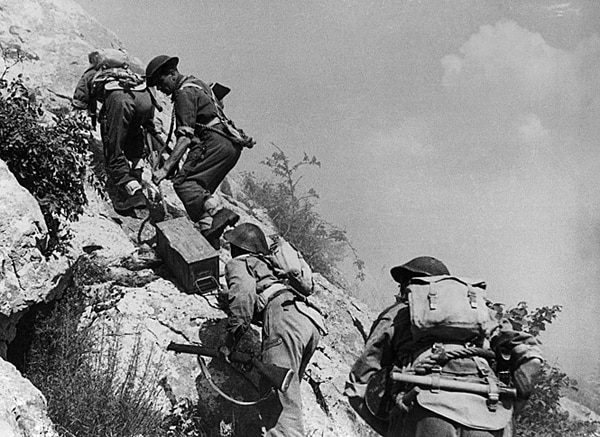
The Germans were caught completely by surprise with Operation Diadem. They believed the Allies were going to make an amphibious landing north of Rome, and they positioned their reserves accordingly. Subsequently, many key commanders and staff officers from units on the Gustav Line were in Rome on pass. Both Gens. Vietengoff and Senger, the repective German army and corps commanders at Cassino, were receiving medals from Hitler when the battle started. In fact, all of the German preparations on the Italian peninsula were in accordance with Allied intentions, as per their deception plan, Operation Nonton. Even worse, German planners made a critical assumption that turned out to be grossly naive: that if the Allies attacked the Gustav Line, they would only attack at Monte Cassino. Much to their later consternation, the Germans reinforced the area around the Monastety at the expense of the rest of the front.
That one bad assumption played right into the strengths of the various national armies. Along the coast, American tenacity and firepower, in the form of massed artillery, close air support, and naval gunfire, steadily reduced the strongpoints blocking their way. In the Auruncii Mountains, mountain expertise and espirit de corps allowed the Frenchmen, in particular the Goumiers, to negotiate terrain that no German ever considered passable. Entire platoons of Goumiers free climbed cliffs, draws, and stream banks, and they did it with 25kg packs. German positions were consistently outflanked and French troops seemed materialize out of the ground.
Along the Rapido River, the British penchant for preparation and organization to be “just so” was exactly what was needed for that most demanding and exacting of offensive operations: contested river crossings. By the night of 13 May, the 8th Indian Division had a solid bridgehead across the Rapido at San Angelo, in almost the exact same spot where the Texans of the US 36th Division were massacred four months before. That night they would pass a Canadian armored brigade over the river. It would soon push into the Liri Valley: treading where no Ally had treaded before.
Along Snakeshead Ridge, the Poles took horrendous casualties attacking the prepared and reinforced Fallschirmjaeger positions. They recklessly threw themselves into “the amphitheater” formed by the imposing heights that formed its rim: Point 593, Albaneta Farm and the Monastery. Despite neither cover nor concealment, they made great gains, on both slopes of Monstery Hill. They captured Cassino town and almost reached the Liri Valley north of the Abbey. The 3rd Carpathian Division even captured Pt 593, several times. However, most Polish maneuver battalions were at 50% strength by the end of the second day of fighting. Pt 593 needed to be consolidated to prevent its recapture, but unfortunately, the Green Devils immediately recognized the nature and importance of the Poles’ main objective and continued to feed its defense. A desperate final counterattack on the night of 13 May of just 14 remaining able bodied troops, led by the remaining instructors from the German parachute school, regained the crucial objective from its final seven Polish defenders.
The battle was coming down to whose mules could feed the battalions in the assault zones the fastest. The critical logistics calculus was changed not by the Poles, but by the British advance. Their bridgehead across the Rapido and into the Liri Valley allowed artillery to fire onto the hitherto protected German assembly areas and “forming up points” on the reverse slopes of the Albaneta Massif and Monte Calvario. For the first time in the battle, the Germans on Monte Cassino were receiving fire from directions and in areas they had not previously experienced. The limited German reserves were thrown at the Canadians and Indians pushing up the Liri Valley to fix their fires and protect their concentrations.
But the Germans also knew they would not hold Point 593 for long if the Poles held the gains they made. The Polish assault battalions were within meters of cutting off the star fort. They were temporarily spent and their gains exposed, but the Polish sense of duty and resilience would see them through. They burrowed into the shattered terrain and four months of dead bodies and awaited their mules and comrades. Gen Anders himself went to his support units for volunteers. Thousands put down their wrenches, typewriters, and ladles, picked up their rifles, and headed up the mountain. Even Private First Class Wotjek, the ursine ammo handler of 22 Artillery Company and II Polish Corps’ mascot, followed his comrades up the hill after they volunteered to fight as infantry. One way or another, the next attack would be the last.
The Fourth Battle of Monte Cassino: Operation Diadem
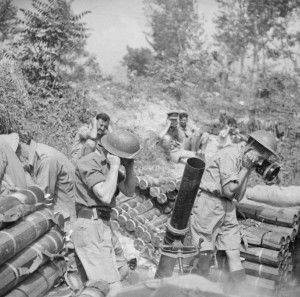
At 2230 on 11 May 1944, 1667 artillery pieces opened fire on German positions along a 20 mile front stretching from the Tyrrhenian Sea to the Abbey at Monte Cassino. The Germans were shocked and did not suspect an Allied attack, much less the largest offensive by the Western Allies so far in the Second World War. Thirty miles to the north, the Brits, Canadians, and Americans of the US 5th Army began near suicidal fixing attacks to tie down German troops at the Anzio/Nettuno beachhead. More night attacks all along the Gustav line followed immediately behind the two hour artillery barrage. The National Guardsmen of the US II Corps attacked across the open fields of the Tyrrhenian coastal plain. The British XIII Corps began a series on contested river crossings over the Rapido and its tributaries. In the Aurunnci Mountains, Moroccan goumiers and Tunisian tirailleurs pushed up narrow passes, or used grappling hooks, ladders, and free climbed their way up and forward into the German defenses.
All of these attacks were expected to fail.
But even in failure, they would accomplish their mission in drawing German reinforcements away from the decisive operation: the Polish II Corps’ assault into the minefields, barbed wire and devastated terrain of Monastery Hill, Cassino town and, most importantly, over Snakeshead Ridge at Monte Calvario, better known to Allied planners as Point 593.
The Fourth Battle of Monte Cassino: The French Reenter the Line
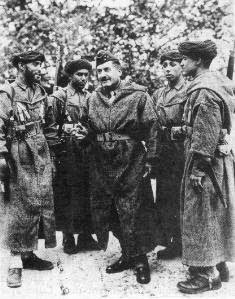
During the First Battle of Monte Cassino in January, the French Expeditionary Corps (FEC) was undoubtedly the most successful unit in that battle, despite advancing over the worst terrain. The Corps’ commander, Gen Alphonso “No Mules, No Maneuver” Juin, felt betrayed by Gen Mark Clark for his refusal to reinforce the French during the battle. Juin felt that one more regiment, even an American one, would have allowed him to break through to the Liri Valley behind Monte Cassino and avoid the last three months of bloodshed.
To add insult to injury, in April, 1944, the FEC was pulled out of the area that they had fought so hard to capture in January. Juin was outraged: the blood of France was on the slopes of Monte Belvedere and the Colle Abate. The FEC was sent to the near impassable Aurunci Mountains on the southern wall of the Liri valley. Juin suspected (accurately, but only partially) that his soldiers were being sent into the Aurunci mountains because they could do less damage to Italian civilians there. His colonial troops, in particular the Goumiers from Morrocco, saw the infidel Italian civilians and their property as spoils of war, and their French officers either could not control them or encouraged the depredations. There were hundreds of reports of Italian women being raped, and anything valuable or useful stolen. The Allied Italian government routinely complained that his soldiers were driving the Italians back to the Germans. Although the French had ravaged the Italian peninsula for centuries, Juin knew modern warfare necessitated the humane treatment of civilians. He sent a strongly worded letter to his division commanders to control their men, summarily executing them if need be.
To Juin, those issues were deplorable and regrettable because they stained the image of France. However, he also thought that he had more important matters to worry about. He was told (also accurately) that the defenses in the Aurunci Mountains could only be breached by his soldiers, easily the best mountain fighters in the Allied army. But even with his troops, the Aurunci Mountains were a formidable obstacle. There were only two small mountain paths suitable for mule trains and none for vehicles. Those two trails could barely support one regiment in the attack and there was nearly two thirds of a German division defending the area. But he had been hoarding his mules, supplies, and equipment, and his troops had been in no significant offensive action against the Germans in months. With proper planning, complete surprise, colonial toughness, and French élan, he would succeed where the British and Americans expected failure. On 6 May 1944, the last units of the French Expeditionary Corps entered the line just south of the Liri Valley.
Impassable or not, Juin was determined to break through the Aurrucci Mountains: the honor of France demanded it.
Leonard Dawe, MI5, and the Daily Telegraph Crossword Puzzles
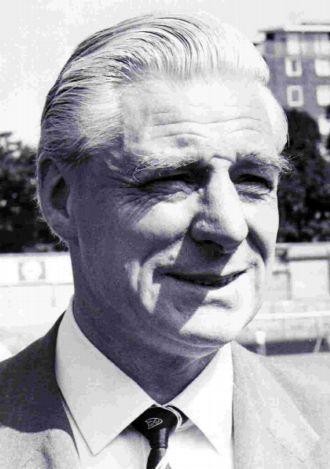
In the 2 May 1944 morning edition of London’s Daily Telegraph, the British Secret Service, MI5, saw “Utah” in the answers for the daily crossword puzzle. This was only days after the disaster at Slapton Sands, and troops killed there were slated for “Utah”, the secret code name for their landing zone on the Cotentin Peninsula in Normandy. In April, other secret landing zone code names, “sword”, “gold”, and “juno” (the British and Canadian beaches), had also appeared in Daily Telegraph crossword puzzles, but they were common puzzle words and deemed coincidences. But the word “utah”, coming so close after the Slapton Sands incident, surely could not be a coincidence. MI5 immediately placed Leonard Dawe, the paper’s crossword puzzle creator under surveillance. Dawe was headmaster at a prestigious English public (read: private) school. He did the puzzles for the paper on the side as an intellectual exercise for himself and his students, and then gave the puzzles to the Telegraph. MI5 considered bringing him in but decided to wait.
During the war, MI5 had an extraordinary amount of success in finding, capturing, and turning German agents in Great Britain. Virtually all the information the Abwehr, the German intelligence agency, was receiving from the British Isles was planted by MI5. They planned to continue this with Dawe.
But for the next month, they could find nothing sinister about Dawe. This was despite more secret code words appearing in the puzzles: On 22 May, “omaha” appeared, the beach on which the US 1st and 29th Infantry Divisions were supposed to land. On 27 May, “overlord” appeared, the code name for the invasion of France. On 30 May, it was “mulberry “, the code name for the artificial harbors that were developed in great secrecy to supply the Allied armies over the beaches. And on 1 June, 15 down “god of the sea (7)” was “neptune”, the naval operations in support of Overlord. In spite of constant surveillance, MI5 had no idea how Dawe was receiving his information. With the invasion scheduled for 5 June, a mere four days away, they decided to dispense with the subtleties.
MI5 arrested Dawe, and ransacked his home and office. They found nothing incriminating. Needing evidence, they then forcefully interrogated him, and still the headmaster kept professing his innocence. MI5 still didn’t believe him but he refused to change his story. As a precaution, MI5 kept him in isolation until well after the invasion began even with the school wondering where he went.
Eventually Dawe was deemed innocent and released, and only years later, were the reasons discovered for the coincidences. In creating the crossword puzzles, Dawe only came up with half of each puzzle. He asked his students to come up with words to fit the rest. Once he had the words complete, he would then write the clues and submit it to the paper. The code words were appearing because the children frequently interacted with the soldiers and listened in on their conversations while they were on leave in London. Although the specific location and timings of the landings were not common knowledge among the soldiers and sailors, the code names themselves were. The students heard the soldiers talk about “Sword”, “Gold”, or “Omaha”, and if they fit, incorporated those fascinating words into Dawe’s puzzles.
Exercise Tiger
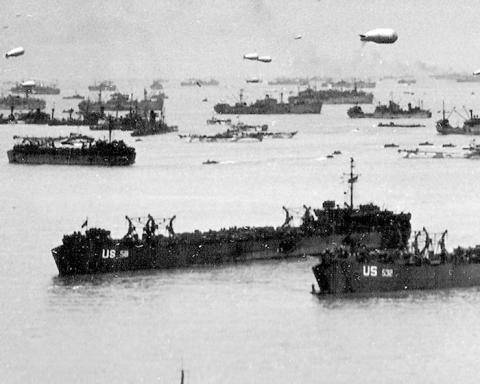
By late April 1944, over one million men and women from 14 Allied countries were massed on the southern coast of Great Britain in preparation for Operation Overlord, the Invasion of France. Shipping requirements reigned supreme on Allied staffs and was by far the most important constraint to Allied operations. In May, the Allied General Staffs had to face the fact there simply wasn’t enough to go around and hard choices had to be made. Operation Neptune, the actual invasion of Normandy, was postponed to June. Operation Dragoon, the invasion of Southern France was postponed to August. All reinforcement to the Anzio lodgment in Italy was cancelled. And finally, all further landings in the Mediterranean were postponed indefinitely. This situation was primarily due to the shortages in two critical ship types: the small wooden LCVP, Landing Craft Vehicle Personnel aka “Higgins Boat”, and the large 4000 ton LST, or Landing Ship Tank, which could carry 300 troops and 30 vehicles. The LST had a draft shallow enough to disgorge its charges directly onto the beach. The LST was so important to Allied operations that an officer in Eisenhower’s headquarters was dedicated to knowing the status and location of every LST on the planet.
On 27 April 1944, the Allies were finishing up Exercise Tiger off the south coast of Great Britain. The previous morning, the sea sick soldiers of the 1st Engineer Brigade landed on the beaches of Slapton Sands, England which was painstakingly made to look like Utah beach, their invasion beach in France. It was a disaster. The British cruiser assigned to simulate the pre invasion bombardment actually caused real friendly fire casualties. And the chaos on and just off the beach needed no simulation, it was real also. That evening, the weary engineers loaded back up to do it again. The slow convoy took a long circuitous route to accurately simulate the travel time across the Channel to Normandy.
In Lyme Bay in the early morning hours of 28 April 1944, the convoy of 8 LSTs, escorted by a single small Royal Navy corvette, began its final approach to the beach. They never made it there. Nine German E-Boats, slightly larger versions of the famous American PT Boat, snuck out of their harbor at Cherbourg in Normandy to raid Allied ships in the Channel. They avoided Royal Navy and RAF patrols and minefields, and under cover of darkness, attacked the convoy. The E-Boats sank two LSTs and damaged two others before getting away unharmed. Over a thousand American soldiers and sailors died or were missing. Ten of the missing had clearances high enough that they knew the details of Operation Neptune, and Overlord was almost cancelled until their bodies were recovered and identified.
Unfortunately, the great loss of life was the least of the Allies’ problems. Adm Ramsay, who was only promoted to Eisenhower’s Chief of Naval Forces the day before, now only had the exact, and minimum, number of LSTs needed for the Normandy Landings. The loss of one more to any cause: enemy action, maintenance, accidents, whatever for any reason, would require Operation Neptune, and thereby Operation Overlord, to be delayed until July.
The Fourth Battle of Monte Cassino. The Poles Enter the Line

On the night of 21 April 1944, a thin Maj Gen Wladyslaw Anders stood next to Kiwi Lieut Gen Freyburg and watched in silence as the first units of his Polish II Corps secretly replaced the shattered New Zealand Corps in the vicinity of Monte Cassino. Anders’ smallish frame and unpretentious demeanor was exasperated by Freyburg’s larger-than-life presence, but Anders was by far the more experienced. A veteran of the First World War, the Russo-Polish War of 1920, a brigade commander in the old Polish Army, Anders was one of the few men on the planet who had walked out on the Soviet’s infamous Lubyanka Prison alive. Now he was the commander of 100,000 exiled Polish soldiers. For last three years, he and his men and women had prepared for this moment, for the road back to Poland went through the Germans at Monte Cassino.
Poland was secretly partitioned by the Germans and their Soviet socialist brothers as part of their de facto alliance in August of 1939 and dual invasion of Poland in September of 1939. Invaded from all sides, the Polish army collapsed after fighting for only 37 days. Having already experienced German and Russian occupation in the First World War, millions of Poles fled the country. Some went north through Scandinavia and eventually to Britain. Some went south to the Balkans. And some went east, only to be captured and interned by the Soviets. Of those hundreds of thousands of Polish refugees in Soviet Russia, 20,000 teachers, officers, politicians and intelligentsia were separated out by the NKVD, the forerunner of the KGB, and murdered. The rest were condemned to prison or labor camps in Siberia by the Soviets… at least until they became useful again for something other than slave labor.
The German’s sudden and inevitable betrayal of Soviet Russia in June of 1941 proved to be the imprisoned Poles saving grace. Stalin, in desperate need of soldiers to fight the Germans, offered to raise a Polish Army from those refugees as long as Britain equipped them. Churchill agreed. Col. Wladyslaw Anders, one of the highest ranking Polish officers still alive, was chosen to lead the new Polish Army. Training camps were set up in Turkmenistan and Uzbekistan.
Hundreds of thousands of Poles volunteered rather than be worked to death. They departed their labor camps in Siberia over the winter of 1941/42 and made the long trek to the training camps. Tens of thousands starved or froze to death enroute. Nevertheless, Anders collected 50,000 soldiers and 100,000 family members in his camps around Tashkent. In the spring of 1942, Stalin recognized the cognitive dissonance of supporting a Polish army from refugees he created, and wished the problem to go away, so he stopped rations to “Anders’ Army”.
Anders knew they could no longer stay in the Soviet Union. In a modern day Anabasis, Anders led his army into the desert, marched 3,500 miles out of the Soviet Union and through British held Persia to Palestine. There he joined other free Poles: the 3rd Carpathian Division, comprised of Poles who fled south to the Balkans after the invasion, and the forgotten defenders of Tobruk— the Free Polish Brigade who fought with the British in North Africa. With these units he formed the II Polish Corps in early 1943, and after the invasion of Italy by the Allies, was assigned to the British Eighth Army along the Adriatic coast. In March, 1944, Anders was told that if the Kiwis failed at Monte Cassino, the Poles would finally get their chance to fight the Germans.
One factor would color all of Anders’ decisions in the coming battle at Monte Cassino, which would be the largest the Western Allies fought against the Germans to this point of the war. It was that he had a national army but no national state. More practically, he didn’t have a country from which to receive replacements. Unlike other national armies who were under the command of the British or Americans; such as New Zealand, Australia, Canada, South Africa, France and the Netherlands; Poland had no state support structure or colonies from which to receive resources. His army, for the most part, was Poland. Furthermore, there were no more replacements for his army from Poles outside Poland: the Poles in Britain formed the I Polish Corps and they were preparing for their part in the upcoming invasion of France. Stalin killed any Pole left in the Soviet Union. Those who emigrated abroad, to their everlasting credit, enlisted in the armies of their adopted homeland, whether it be America, Canada or Australia. There were Poles forced into conscription by the Wehrmacht, but they were few and likely to be killed before they made it to him. The only way back was forward. Killing Germans was good, but the men needed to fight the Soviets were in Poland, and the Germans at Monte Cassino stood in Anders’ way.
The Siege of Kohima
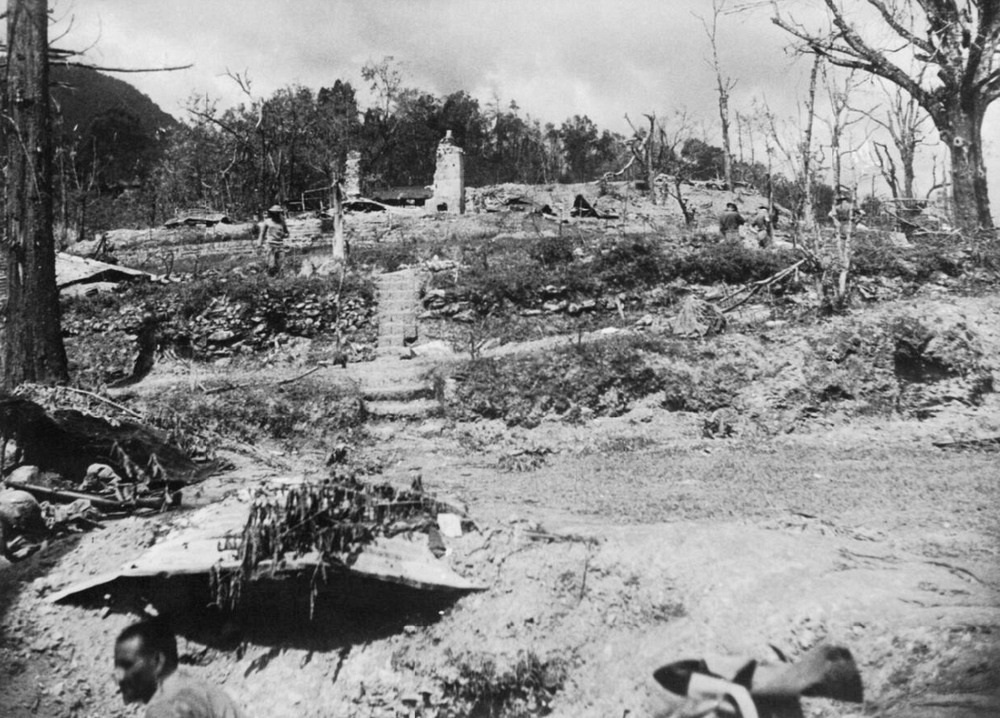
In late March 1944, the Japanese launched the invasion of India from Burma. British Gen William Slim, the 14th Army commander, was poised to invade Burma but wished to kill as many Japanese as possible prior to it. The invasion of India was the perfect opportunity and Slim planned to concentrate his troops on the Imphal plain to do so. Unfortunately, the Japanese were more numerous than he thought, many of his troops were still too far from the battle, and “most distressingly”, the Japanese moved faster than Slim expected.
While Slim was sorting out the battle on the Imphal plain, Japanese Maj Gen Kotaku Sato’s 31st Division made a lightning fast forced march thru the jungle toward Kohima, the halfway point on the crucial Dimapur to Imphal supply route. (Dimapur was Slim’s railhead and main logistics area). Slim’s box tactics allowed his soldiers to be cut off temporarily, but the loss of Kohima would prevent all ground supply from reaching Imphal and there wasn’t enough air transport in Southeast Asia and India to supply his four divisions. The 31st Division’s advance was rapid, but they were opposed by a single battalion from the Assam Regiment and some Assam policemen over the last 60 miles. They heroically delayed Sato for four critical days before the Japanese could reach Kohima.
Those four days allowed Col. Hugh Richards to organize an ad hoc defense of Kohima centered on the ridge east of the road. Thousands of noncombatants were evacuated and any soldiers who knew how to handle a rifle were organized into units and dug in. Richards had only the 2500 soldiers, including 450 men of the 4th Bn of the Queen’s Own Royal West Kents, part of a heaven sent Rajput machine gun Bn, 400 men of the Shere Regt of the Royal Nepalese Army, the remains of the Assam Bn (when they arrived from delaying the Japanese) and 500 convalescents and transients from the hospital and way station in Kohima, to fight the 13,500 approaching Japanese. On 3 April 1944, the Japanese surrounded the town. The Battle for Kohima began the next day.
For the next 13 days, the besieged Allies faced suicidal but effective human wave assaults, and brutal hand to hand combat all along Kohima Ridge. Rajput machine guns and British artillery melted down because of their rapid and continuous fire in the 120 degree heat. The battle eventually focused on the Allies’ critical vulnerability: water. By 16 April, the Allies were down to one pint of water per man per day. Eventually, the thirsty remnants of Richard’s defenders were forced back into a 500m by 500m box on Garrison Hill which contained a small spring outside of the old district commissioner’s house. The only thing separating the spring from the Japanese was the commissioner’s garden and tennis court. On the night of 16/17 AprIl, the Japanese, who had suffered 8000 casualties by this point, tried one last banzai charge across the tennis court to capture the spring. The “Battle of the Tennis Court” raged all night, but by dawn it was obvious the Japanese would not succeed.
On the 19th, the Indian 161st Brigade of the British 2nd Division, attacking from Dimapur, broke through to Garrison Hill. The next day, the Japanese dug in and prepared for the inevitable Allied counterattack.
The Fourth Battle of Monte Cassino. The Poles Discover the Key to Cassino, Point 593

The British and Americans knew the destruction of the Abbey at Monte Cassino in February changed the calculus of the battle, though they did not realize its extent. The key to the Liri Valley and Route 6 to Rome was the town of Cassino; the key to Cassino was Castle Hill, the key to Castle Hill was Hangman’s Hill; and the key to Hangman’s Hill was the Abbey itself. Since the clumsy and brutish destruction of the Abbey allowed the Germans to fortify it, the Brits and Americans assumed that it needed to be the focus of the battle. But as the Germans suspected, and the Italians knew, that this was not the case: the key to the Abbey was actually Point 593, which was a small hillock just to the northwest on Snakeshead Ridge.
In the previous three battles, a supporting attack was always launched against Pt 593, but only to prevent enfilading fire on the main attack or tie down counterattack forces, not to capture it. When the Polish II Corps received the mission to take the Abbey, the corps’s staff naturally started its mission analysis. During their initial intelligence preparation of the battlefield, a young analyst did his research on the area and noticed the ruins of a small 17th century Papal star fort on Pt 593. But why was that star fort in such an inaccessible location? Digging into the history of the area for the answer, he found that the star fort (and presumably the earlier medieval keep ruins beneath it) provided a last desperate refuge for the monks during Italy’s turbulent past. Control of the star fort by the monks ensured that if it wasn’t also captured, the Abbey was untenable. The analyst studied the terrain further and found that the Allies could reverse engineer the battle: If Pt 593 fell, the Abbey would fall; if the Abbey fell, Hangman’s Hill would fall; if Hangman’s Hill fell, Castle Hill would fall; if the Castle fell, Cassino would fall. And if Cassino fell, the Road to Rome through the Liri Valley was open.
So think of the Abbey as a typical suburban American house. The star fort on Point 593 was (and still is) a sort of combination storage shed and fortified zombie apocalypse safehouse in the back corner of the monastery backyard. Also, it butt’s up against the back fence (Snakeshead ridge), so unless you climb over the back fence, you can’t approach the shed (Pt 593) except through the house (the Abbey).
In that context, think of the Liri Valley as the street the house is on. Throughout the Monastery’s 1500 year history, any army wishing to drive down the street, i.e. exit or enter the Liri Valley to capture Naples or Rome, had to secure the Monstaery because it dominated traffic on the street. To do this some secured Papal approval because the Monastery was property of the Papal States, governed directly by the Roman Catholic Church. But most chose to capture the Abbey.
These historic encounters usually followed a similar pattern. The attackers would initially try storming the hill, and inevitably fail. There would then be a siege. Shortly thereafter, the attackers would get restless because they were wasting time and resources on the Monastery that would be required for use on Rome or Naples. So they would get impatient and launch multiple costly assaults, which would wear down the monks and their defenders. When capture was imminent, the monks would then retire to the small fortress on Pt 593 and the attackers would flood victoriously into the Monastery. That was, until they got into the backyard and were stopped cold by the defenders on Pt 593. The star fort on Pt 593 made the northwest corner of the abbey untenable and the space between the monastery and the fort a killing ground, i.e. the backyard in our house simile.
Now here’s the true genius of Pt 593: Occupying it could only tangentially affected the Liri Valley. Attackers that captured the monastery but not Pt. 593 could enter and exit the Liri Valley at will, even with the monks still occupying the back corner of the backyard. However, it was to the backyard of the Monastery what the Monastery was to the Liri Valley: As the Monastery made passage in the Valley difficult, Pt 593 made the northwest portion of the Monastery grounds untenable. So naturally, the attackers looked at Pt 593, then looked at the valley, then looked back at Pt 593 and said, “Screw this, I’m not attacking that, I’m done with this place. We need to move onto Rome (or Naples).” And the invaders would invariably move on to Rome or Naples, and leave a token force to keep the monks isolated in the star fort. This was the signal for the monks to make the attackers lives miserable until they either left, or were weakened sufficiently that the monks could burst forth from Pt 593 and slaughter them. In either case, the monks would then reclaim the Abbey, clean up the debris, restock the library, and resume the Rule of St Benedict, at least until someone else wanted to enter or exit the Liri Valley without the Pope’s permission.
In the mid twentieth century, this all changed. Modern engineering, improved and efficient aerial and ground logistics, proper reconnaissance and modern firepower lessened the formidability of the terrain. Snakehead Ridge was still impassable to vehicles and even to mules in some places, but the French in January proved that that was no barrier to a successful assault, if you had prepared properly, conducted a sufficient recce, surprised your enemy, had a touch of élan, and most importantly, threw a ton of soldiers at it.
To deceive the Germans, the Polish II Corps planned to execute the same plan as the Indians and Kiwis before them. But since they had a larger force along the same frontage, they would weigh the attack on Pt 593 from over Snakeshead Ridge, thereby breaking the historic cycle, by taking Pt 593 before the Abbey. As the monks knew, this would make the backyard and NW side of the Abbey untenable, but this time not for the attackers, but for the defenders, the Germans.
The young Polish analyst presented his findings, and the Corps operations officer issued initial reconnaissance guidance to confirm it. Unfortunately, the Poles were not yet in the line at Cassino and moreover, Operation Nunton forbade any patrolling to minimize the risk of capture. But MajGen Wladyslaw Anders, the Polish II Corps’ Commander, was so intrigued with the information that on 5 April 1944, he personally undertook a dangerous low level aerial reconnaissance of the area. Though he was nearly killed for his efforts, he confirmed the analyst’s assessment and issued his commander’s planning guidance accordingly. Disconcertingly, he found that the Germans turned the area around the ruins of the star fort in a hellish maze of mines, wire, interlocking fields of fire, and preregistered artillery. On the other hand, he also saw it was possible, if improbable, to capture Pt 593 from the north and northeast, but only if the attack was properly planned and coordinated. Unlike the Americans, the British, the Indians, and the Kiwis; the Poles’ main objective during the Battle for Monte Cassino would be Point 593, not the Monastery itself.
The Fourth Battle of Monte Cassino: Operations Nunton and Diadem
Gen Harold Alexander, the Allied commander-in-chief in the Mediterranean, was exasperated with Gen Mark Clark’s unimaginative and uncoordinated attacks on Monte Cassino, and his failure to capture it despite three attempts and the priority of support in the theatre. Moreover, the landing at Anzio was at a stalemate. It was obvious that the forces at Anzio were not going to come to the rescue of those at Monte Cassino, but those at Monte Cassino needed to break through to come to the aid of those at Anzio. Finally and most importantly, Alexander knew that he would only have one more “go” at Monte Cassino before the priority of men and material went to Operation Overlord, the upcoming invasion of France in May. The fourth battle for Monte Cassino had to succeed or any chance of capturing Rome before autumn, or even winter, would be nonexistent and Germany would be able to shift troops from Italy to resist the invasion of France.
Alexander’s staff produced Operation Diadem, a massive coordinated attack involving all Allied troops in Italy. To gain the necessary mass and concentration, Alexander stopped all operations along the Adriatic coast, and to Clark’s relief, had the British Eighth Army take over the area around Monte Cassino. Alexander then shifted the American 5th Army south west and told Clark to focus on Anzio. The 5th Army units still in the south would nominally be Clark’s but would actually support the Eighth Army whose boundary was extended to the Liri Valley.
Alexander, ever a fan of Lord Horatio Nelson, took to heart Nelson’s quip prior to the Battle of Trafalgar, “Only numbers can annihilate”. He had to do just that in order to prevent the Germans from falling back to the next mountain defensive line and repeating the bloodbath of the last four months. Alexander planned to use entire Allied corps to seize areas that were division objectives in Clark’s operations. The US Second Corps would attack up the Tyrrhenian coast road. French Gen Alphonso Juin’s French Expeditionary Corps would attack over the impassable Aurunnci Mountains that formed the southern shoulder of the Liri Valley. While the British XIII Corps would attack over the northern shoulder. The Canadian I Corps would be in reserve to exploit the breach, and it fell to the 75,000 men and women of the Polish II Corps to seize the Monastery.
An ambitious plan of this size and scope took a month to prepare and required the movement of hundreds of thousands of troops, all of which had to be in secret. On 2 April, 1944, the Allies launched Operation Nunton to deceive the Germans as to the Allies’ preparations over the next five weeks for Diadem. Nunton consisted of thousands of fake radio messages, and dummy vehicle parks and supply depots around Naples in order to convince the Germans that the Allies were planning another amphibious invasion north of Rome. Additionally, Nunton encouraged the Germans to believe that the units to their front were not being reinforced or replaced.
Operation Nunton was wildly successful. The Germans didn’t suspect another assault to open the Liri Valley and had no idea the Allied troops to their front had shifted and were reinforced. For example, Juin’s, 50,000 strong French Expeditionary Corps with their diverse colonial troops and distinctive uniforms had to move from vic Monte Cairo to below the Liri Valley, a distance of 15 miles, and the Germans never suspected a thing. Alexander tripled the number of soldiers in the attack zones for Operation Diadem, set to launch concurrently with Operation Overlord in May.
The Third Battle of Monte Cassino
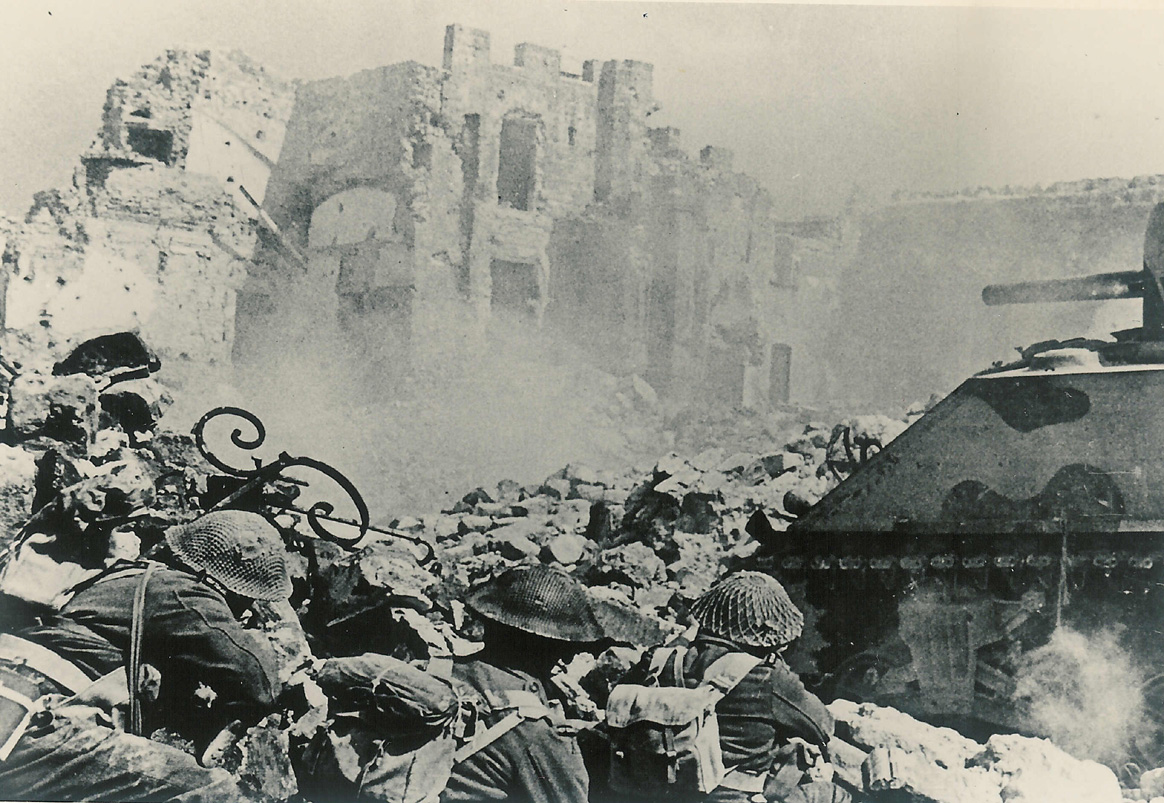
After the destruction and fortification of the Abbey, the uncoordinated attacks by the 4th Indian Division failed to dislodge the Germans on the Cassino front in mid February. For the next month, cold and rainy weather prohibited any further Allied attempt.
On 15 March 1944, the skies cleared briefly and for three hours, thousands of Allied bombers and artillery pieces turned the area around Monte Cassino into a roiling mass of smoke, dust, fire and debris. The Allies thought that surely no one could have survived. But if there was one lesson the Allies would refuse to learn during the Second World War it was that no matter how devastating and intense the bombardment, there was always some stubborn fool who refused to die, and emerged from the rubble to defend with a vengeance against dumbfounded attackers. As it was at Tarawa, so it would be at Monte Cassino.
Unlike the Second Battle, the Fifth Air Force properly coordinated with Gen Freyburg’s New Zealand Corps. As soon as the bombing ended, Freyburg’s troops hurled themselves toward the monastery and against the dazed German paratroops, with some success. They were assisted by tanks that arrived over a road laboriously cut over the mountain. The Indians captured Castle Hill. The Gurkhas secured Hangman’s Hill (named for the broken cable car cable that hung from a pole on the hill which made it look like a gibbet). The Kiwis captured most of Cassino town, although the center was still in German hands including the railway station, which dominated the entrance to the Liri Valley.
The air bombing however, destroyed any roads and trails and made resupply and further armor support difficult. Furthermore, fire from the abbey and incessant German counterattacks prevented any further gains. The Allied attacks ground to a halt, they were within 250m of the monastery.
After the initial two days, the Third Battle of Monte Cassino could be likened to two punch drunk fighters wearily flailing away at each other. Unfortunately, the Germans landed the last punch before the bell rang. Heavy rains on 23 March convinced both exhausted sides to stop fighting. But the writing was on the wall: the Green Devils of the German 1st Fallschirmjaeger (Parachute) Division were now horribly under strength and there was very little prospect of replacement or relief.
 Buk's Historical Ad Hockery
You must be logged in to post a comment.