
Tagged: WWII
The Systematic Bombing of Japan
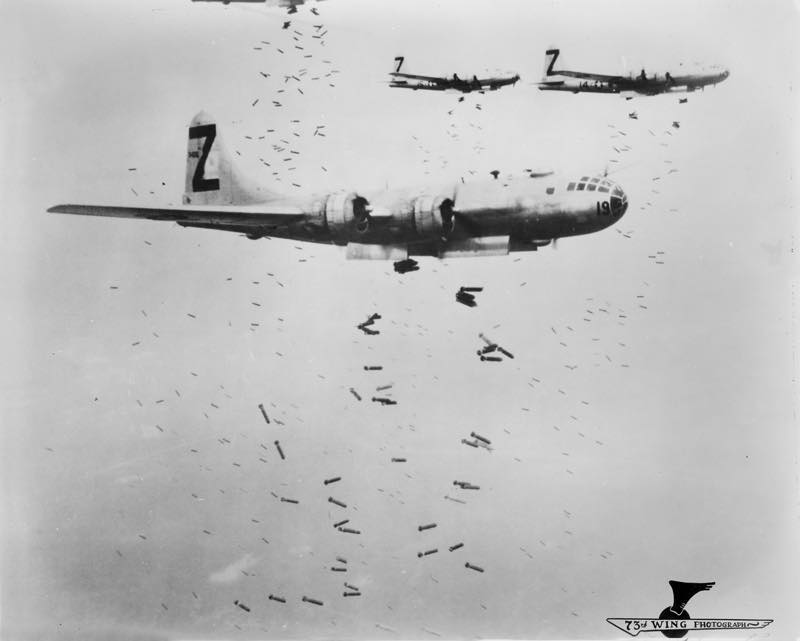
The first American B-29 bomber raids against Japanese industry began soon after Saipan was captured. They were tentative at first, about one a month and used different mixes of ordnance. By mid January, XX Air Force planners, led by a young “iron major” Major Robert McNamara (JFK and LBJ’s future Secretary of Defense), devised a campaign for the most effective way to destroy Japanese morale and the war making capability of the home islands in preparation for an invasion of Japan in late summer.
McNamara was instrumental in establishing an entire school for the study of statistics at Harvard from which up and coming young Army Air Corps planners graduated. McNamara’s reliance of statistics permeated every part of the plan in preparation for the invasion. The timing, targets, routes, formations, ordnance etc. were mathematically planned down to the last detail for an effective and efficient “reduction of Japan”. Major General Curtis LeMay, the XX Air Force commander, briefed the plan to his superiors and famously summed it up, “If you kill enough of them, they will stop fighting.”
It was brutally effective. The plan’s focus on incendiaries devastated Japan’s primarily wooden cities. The morale of the Japanese population was crushed but only because there was little response from the now defunct Japanese air force, and the shock at the scale of the raids. For years the Japanese ministry of propaganda had fooled the Japanese people into thinking they were winning the war. But no amount of official lying could cover up the loss of Saipan, a Japanese home territory, and the B29s that appeared in the skies with increasing frequency.
On 27 January 1945, 68 B29s bombed Tokyo and reduced 15% of it to ash and rubble with the loss of only six planes, despite the lack of escorting fighters. McNamara’s plan was deemed successful and implemented in full. Every city in Japan, no matter the size, was targeted. A new raid launched every seven days until the end of the war. 500,000 Japanese civilians would die in the campaign and over five million displaced into the countryside.
Operations North Wind and Dentist: the Other Bulge
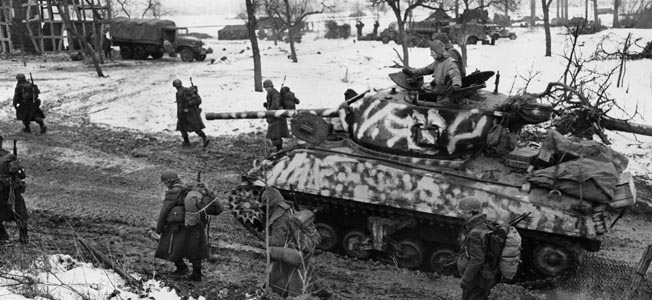
Patton’s counterattack towards Bastogne was not only predicted by Hitler’s Ardennes planners, it was relied upon. As Patton’s 3rd Army attacked north, his lines would have to be taken over by Lieutenant General Patch’s 7th Army to the south. The 7th Army was already overextended from the Saar Valley down to the “Colmar Pocket” along the Swiss border. This presented an opportunity for the Germans to break through the thinly held lines and force Eisenhower to choose between the encirclement and destruction of the 7th Army, or the German recapture the Franco-Teutonic city of Strasbourg (it changed hands between France and Germany a few dozen times over the last 1500 years. Both countries considered it national territory).
Eisenhower could be counted on to choose to maintain the continuity of the front and withdraw from Strasbourg. This would be a national disaster for France (they couldn’t give up the city again to the Germans) and would almost assuredly force De Gaulle to withdraw France from the Allied Coalition. In any case, it would open up Patton to attack and destruction from behind. Operations North Wind and Dentist nearly succeeded on all accounts.
On 1 January 1945, the Germans launched Operation North Wind to destroy the 7th Army and seize Strasbourg. And on 15 January they launched Operation Dentist to assault into the 3rd Army’s rear area and defeat what they thought was the Allies’ most dangerous general – Patton. As expected, Eisenhower ordered a withdrawal of all troops from Strasbourg to shorten the lines, and the French ignored him and planned on fighting alone for the city. De Gaulle even threatened to stop Allied supplies from arriving in French ports and from traveling along French roads and railways. He also secretly began organizing the French resistance to “fight the new invaders”, the Americans and British. Fortunately hard fighting by the vastly outnumbered US VI Corps, which defended against attacks on three sides, held long enough for reinforcements to arrive from the Ardennes.
The VI Corps’ unexpected stand precluded the Allied abandonment of Strasbourg and allowed Eisenhower to avert France’s withdrawal from the Allied nations. (Eisenhower would say in his memoirs that De Gaulle was his biggest challenge of the war.) By 25 January both offensives were defeated. Strasbourg, Patton, and the coalition of Western Allies were saved. In hindsight it seems a foregone conclusion, but early January 1945 was one of Eisenhower’s most stressful times of the war.
The Liberation of Auschwitz
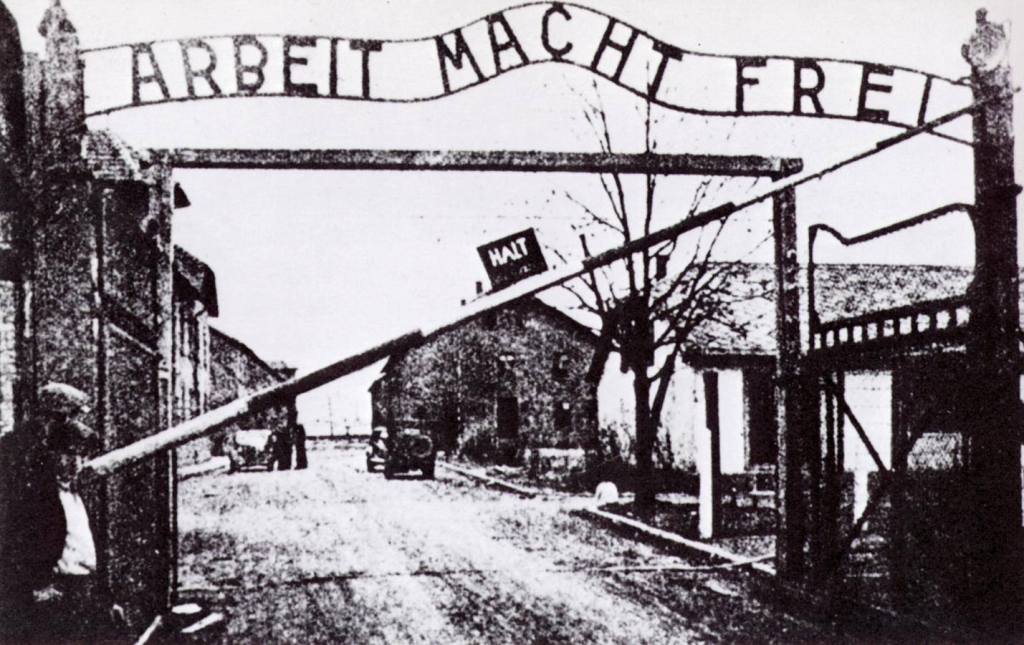
On 27 January 1945, the Soviet forces in the Vistula-Oder offensive liberated the Nazi camps in the vicinity of the towns of Auschwitz and Birkenau in German province of Silesia (Occupied Polish province of Upper Silesia). The “Auschwitz Death Camp” was originally a concentration camp for Polish political prisoners in 1940, but by 1945 it had grown into a series of 48 extermination, concentration, and labor camps around the towns of Auschwitz, Birkenau and Monowitz.
Unlike pure extermination camps like Sobibor, Treblinka, and Belsec, Auschwitz-Birkenau was hybrid camp system of three main camps and their satellite camps. KL Auschwitz I was the original concentration camp and railway terminal, with the infamous “Arbeit Macht Frei” gate (“Work makes you free”). Built in the spring of 1940, the first Polish prisoners arrived shortly thereafter. The first gassing and mass cremation took place in August 1941, when 300 Russian prisoners of war were used to test the effects of Zyklon-B. The first mass arrival of Jewish prisoners occured in February 1942, shortly after the Wannsee Conference in January. The Wannsee Conference was a meeting of high level Nazi officials to work out the logistical details needed to eradicate European Jews, with a planning factor of 10,000,000.
Auschwitz II Birkenau was a purpose built death complex, opened in late 1941, whose slave labor inmates worked the gas chambers and crematorium ovens. Most prisoners never made it to the main camp and went directly gas chambers after their baggage, clothes, and even hair were collected. 900,000 people were murdered at Auschwitz II Birkenau.
KL Auschwitz III at Monowitz was a slave labor camp complex for IG Farben that produced synthetic rubber for the German war effort. Many German corporations threw in their lot with the National Socialists, whom offered free land, labor, and tax credits in the conquered territories for ideologically pure companies. Each SS guard was paid for each inmate that worked a shift under their watch. 23,000 workers were executed, worked to death, or died of disease or malnutrition at KL Auschwitz III. This number doesn’t include the monthly 1/5 worker turnover of those sent to Auschwitz II Birkenau to be killed to make space for healthier workers.
1.1 million people, from all over Europe, were systematically worked to death, or looted, murdered and cremated in the camps. This also includes those that died during the routine sadistic torture, and/or the gruesome medical experiments on human subjects, few of whom survived. 90% of the victims were Jewish but they also included ethnic Poles, Roma, homosexuals, Polish and Russian soldiers, and German political opponents of National Socialism.
The camps of Auschwitz-Birkenau were murder on an industrial scale.
When the Soviets launched the Vistula-Oder Offensive in early January, 1945, the German administration of the camps attempted to hide the evidence of their crimes: They destroyed the gas chambers and crematoriums. They burned down the warehouses of stolen looted goods that had been an integral part of the German economy for the previous five years. They burned the meticulous camp records. They murdered as many inmates as they could, stopping only when they couldn’t dispose of the bodies. The remaining inmates were marched west to rail heads where they were sent to camps further inside Germany. Those that fell out were shot and left behind. Tens of thousands died on these death marches in the frigid January temperatures. However, the scale of their crimes against humanity couldn’t be covered up.
On morning of 27 January 1945, scouts from the 322nd and 100th Rifle Divisions of the 1st Ukrainian Front found first a sub camp of KL Auschwitz III, and then the main camps of Auschwitz II Birkenau and KL Auschwitz I later in the morning and afternoon, respectively.
The Russian troops found only 7000 scattered survivors; most were too sick to move or had hid during the prisoner round ups prior to the death marches.
Auschwitz-Birkenau camps weren’t the first extermination camps discovered by the Soviets, but they were the first to expose the scale of National Socialist crimes against humanity. The first extermination camp “liberated” from the Germans was Majdanek in July, 1944. The Majdanek Death Camp was overrun during Operation Bagration before it could be dismantled. Ironically, or maybe not so, the Soviets kept Majdanek open for Polish, Ukrainian, and Belorussian partisans allied with Western powers and supporters of the Polish Government in exile in London. At the very moment the Russians were realizing the scale of the German camps around Auschwitz, they were processing tens of thousands of political prisoners in former German camps for transport to the gulags in Siberia. However, several KL Auschwitz III camps were used for workers to dismantle the IG Farben factories for transport east. And several other camps were eventually used to hold Polish political prisoners by the NKVD and its proxies once Silesia was fully occupied by the Soviets. The Soviet vow of “Never Again” clearly didn’t apply to themselves.
The conversion of Auschwitz-Birkenau into a Soviet reeducation camp initially wasn’t attempted due to the scale of the Nazi slaughter and its later documentation. Russian soldiers found 350,000 men’s suits, 860,000 women’s garments, and seven tons of human hair estimated to be from 150,000 people. Entire buildings were full of human feces, to the point where it was caked and solidified on the walls and ceilings. Soviet doctors and the Polish Red Cross managed to save 4500 of the 7000, though some were still in the camps months later because they were too weak to move. Soviet authorities estimated 4,000,000 people were killed at the Auschwitz-Birkenau camps, and the Soviets maintained this number until 1989. The inflated number actually assisted the German cover up, as Western observers dismissed the number as propaganda, and by extension the camps themselves. The discovery of Auschwitz-Birkenau was only taken seriously by Western journalists and authorities after similar camps were liberated by the Allies in April.
In 2005, 27 January became known as the International Holocaust Remembrance Day to commemorate the six million Jews and 11 million others murdered by Nationals Socialists during the Second World War, 1.1 million of whom were killed in the camps at Auschwitz-Birkenau.
Stalin Delays… Again
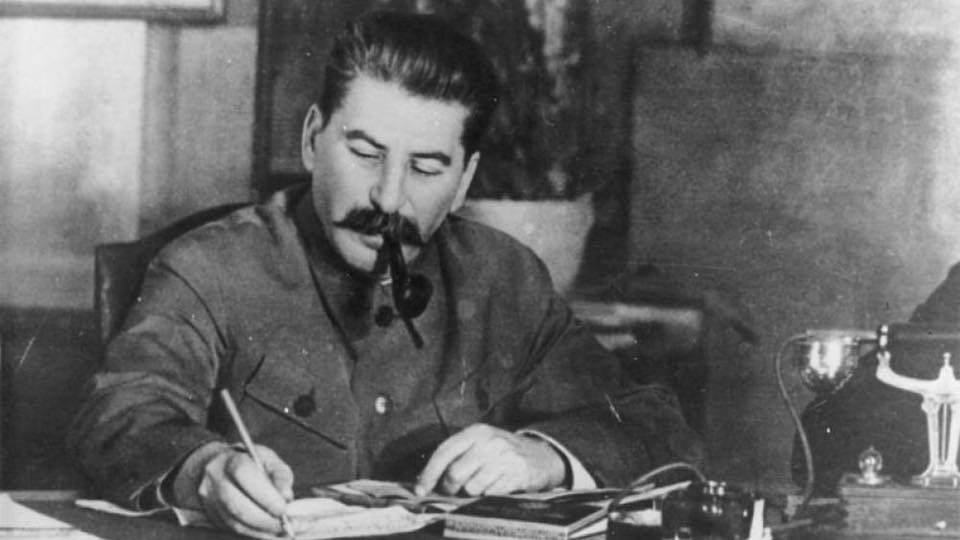
In the late autumn and early winter of 1944, Hitler risked everything on one last throw of the dice: the Ardennes offensive. With it he hoped to force the Western Allies out of the war so he could concentrate on the war weary Soviet Union. He was a paranoid and delusional tyrant living in a tactical and operational Never-Never Land but his strategic acumen was still sharp, far sharper than most future historians gave him credit for.
All of the nations in the conflict were reaching the bottom of their respective manpower pools. America was critically short of infantry and increasingly bringing women and African American troops closer to the front lines to make up the difference as male Caucasian and Latino troops in the rear echelons were dragooned into combat jobs. Great Britain was reduced to combining understrength formations wholesale to keep up the pretense of units at full strength. Germany and Russia had long emptied out their prisons and hospitals for replacements, and were fielding ad hoc units of underage teenagers and old men. Hitler thought Germany’s ideological fervor could overcome these shortcomings and that it was possible to come to an accommodation with Soviet Russia if a separate peace could be made with Britain and America. The bulk of his western front forces could then be moved to face the Russians and it would also grant him time for his “wonder weapons” to come on-line. This was the overall objective of his great gamble in the Ardennes.
And Stalin privately agreed.
Despite Stalin’s rhetoric, the Soviet Union reached most of its wartime goals by December 1944 and more importantly, was at its human limit. The Soviet Union had lost 22 million dead in 3 ½ years of fighting – fifty times the wartime deaths suffered by America with only 30% greater population. And they had not reached the fighting in Germany proper yet, where the Wehrmacht was sure to zealously defend, especially as stories got out of Communist troops raping their way across former Axis territories. Furthermore, Stalin knew the Soviet Union was already in an excellent position for the inevitable post war conflict with his current capitalist Allies. The Soviet Union had (or would soon have) complete control of its traditional western buffer states: Ukraine, Poland, Hungary, Romania, and Finland. The Red Army specifically stopped short of capturing Warsaw to allow the Wehrmacht the time to crush the pro Polish Govt in Exile (In London) Home Army in the midst of the Warsaw Uprising. Furthermore, the Soviet Union would have access to warm water ports on the Mediterranean through Tito’s communist partisans whom controlled Yugoslavia and Albania. Finally, National Socialism and Soviet Communism were natural ideological allies, if intense and bitter rivals as only sibling twins could be. A post war National Socialist rump state in Germany and Austria would provide additional depth and a further ideological buffer against its capitalist adversaries, America and Britain, and its allies in France and Italy.
In late 1944, Stalin saw no reason to invade Germany from the east if the Western Allies did not do so from the west. It would be a waste of resources that were needed after the war. Russian troops had stopped in Poland in late August and for the last several months were consolidating their gains in the buffer states. On 20 December 1944, German intelligence analysts were surprised when the long awaited Soviet winter offensive did not begin.
Stalin personally delayed it. He was waiting to see if the Hitler’s Ardennes Offensive did indeed force the Allies to the negotiating table, however slim that possibility might be. Stalin did authorize offensives to clear the remaining Germans along the Baltic coast and the Balkans, but the main Russian armies of the Belorussian and Ukrainian Fronts were held back, awaiting news from the West.
On New Year’s Day 1945, the Luftwaffe launched a massive raid with every plane it had left against the Western Allies tactical air forces, and the initial reports indicated the British and American fighters and fighter bombers were wiped out. So on 2 January, Stalin delayed the offensive again. (The massive dawn raid, “Operation Baseplate”, did destroy 500 allied planes on the ground and shut down 12 airfields for a week. The airfields’ anti aircraft crews were sent to the front as infantry replacements, and combat air patrols over the fields were minimal if the existed at all. In any case, the Luftwaffe was annihilated in the process). Only in the second week of 1945, when it was obvious that Hitler had failed in the Ardennes, did Stalin unleash his armies. On 12 January, Marshals Zhukov and Konev were given authorization to launch the war winning Vistula/Oder Offensive that would carry the Russians to the gates of Berlin in April.
The Battle for St. Vith
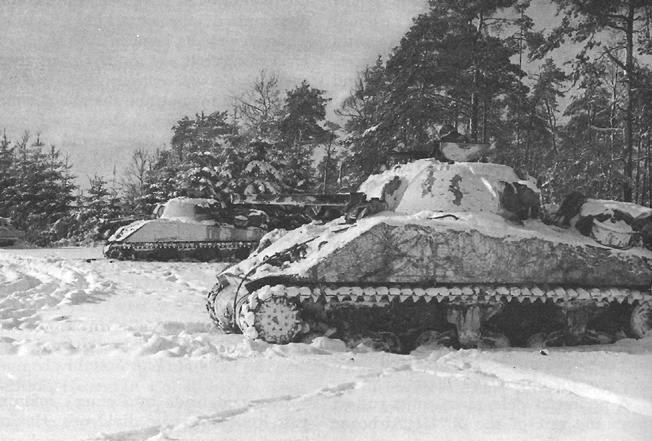
On Saturday 16 December 1944, the Germans Ardennes offensive broke through the Losheim Gap and encircled two regiments of the 106th Infantry Division, soon to be the second largest surrender of American soldiers after the fall of Bataan two and a half years before. The German’s next target was the critical Belgian crossroads town of St Vith.
In the restricted terrain of the Ardennes Forest, the Battle of the Bulge was a fight for roads and crossroads. Unlike the French in 1940, Eisenhower quickly recognized this and ordered his reserves to two critical road junctions: the towns of Bastogne and St Vith.
The common historical narrative is that Eisenhower’s only reserves were the much ballyhooed Airborne divisions – the 82nd and 101st. This is not entirely accurate, he also had Bradley’s reserves which were sitting idle because of the confusion in Bradley’s 12th Army Group headquarters. Bradley was having difficulty getting back to his headquarters from Versaille due to German commandos dressed in US Army uniforms causing confusion and doubt on the roads (At one checkpoint, he was asked the name of Betty Grable’s current husband to prove he wasn’t German). Without Bradley, the 12 Army Group headquarter’s operations essentially ground to halt trying to figure out what was going on. Eisenhower took control and ordered Bradley’s reserves forward while his own reserves, the “airborne” divisions, were still trying to find trucks. He could do so because the Automotive Revolution had happened 40 years before and Bradley’s reserves were armored divisions.
The Infantry’s motto is “Follow Me!”, and whenever they get into trouble that phrase is usually followed by “Where are the tanks?” This could not have more true at the Battle of the Bulge, despite what the Airborne Mafia parrots daily. Troy Middleton’s infantry, who bore the brunt of the German’s Ardennes Offensive for the last 48 hours, were not going to be able to hold much longer without Bradley’s three armored divisions. The Tenth Armored Division moved to Bastogne where its Combat Command B provided the 101st the much needed firepower to prevent the lightly armed paratroopers from being rolled over by the German panzers like pierogi dough in my grandma’s kitchen. And the 7th Armored Division moved to St Vith where in true cavalry fashion they arrived just in the nick of time on the evening of 17 December 1944 to prevent its capture.
St. Vith was the junction of all of the roads between the Ambleve and Our Rivers, and no movement north or northwest out of the Ardennes was possible without taking the town. St Vith was a Day Two objective for the 9 ½ divisions of Erich Von Manteuffel’s 5th Panzer Army.
The commander of Combat Command B of the 7th, Brigadier General Bruce C Clarke, arrived in town just as German reconnaissance units appeared on the hills just east of St Vith, the 106th Infantry Division’s headquarters. The commander of the 106th Infantry Division, broken by the entrapment and imminent destruction of two entire regiments of his division, turned the battle over to Clarke. With his tanks strung out in columns behind the town, Clarke immediately unsnarled the traffic jams and formed his men into a horseshoe shaped defense around the town and deftly incorporated retreating elements into the defense. The first of which was the 424th Regimental Combat Team, what remained of the 106th Infantry Division, and CCB of the 9th Armored Division, the only reason the 424th still existed. From the south, the 112th RCT was detached from the 28th Inf Division after its other two regiments withdrew east and south toward Bastogne and deeper into Luxembourg. The importance of St Vith was not lost on Eisenhower and he sent Clarke his reserve engineer battalion to further bolster its defenses.
BG Clarke, the 7th Armored Division’s CCB commander, took command of all of the combat units in St Vith: CCB and CCA of the 7th, the 424th, the 112th, the remains of the 14th Cavalry Group, Eisenhower’s engineers, and CCB of the 9th Armored Division, whose commander, also a BG, came to an understanding with Clarke. Eisenhower later called Clarke’s defense of St. Vith the “turning point of the battle”.
(The 7th’s actual division commander, Major General Robert Hasbrouck, spent the battle unscrewing the mayhem behind St Vith and fed Clarke units as they became available. Though lost to history now, Hasbrouck’s contribution in getting tanks and halftracks full of heavy infantry to Clarke was one of the only reasons Clarke held. Hasbrouck could have sped to St Vith to take over Clarke’s division sized command and left the odious and inglorious task of traffic cop to a less experienced subordinate, but instead stayed exactly where he was needed: generating combat power. Hasbrouck prevented Manteuffel from smashing Clarke and seizing the town in those critical early days of the battle.)
Clarke’s eclectic command held St Vith against overwhelming German force on 18, 19, and 20 December 1944. Their stand severely disrupted the German timetable and caused snarling traffic jams in the German rear areas. (These traffic jams were so bad even Field Marshal Model himself couldn’t untangle them.) Although St Vith was threatened with encirclement because of German penetrations to its north and south, the 7th didn’t retreat until they were struck by an SS battalion of brand new German “King Tiger” super heavy tanks. This heavy battalion had wandered lost through the Ardennes looking for roads and bridges that could support its tanks great weight. For five days, it simultaneously assaulted any American units it encountered and “cleared” any German traffic jams in its way, both with equal fervor. Inevitably, the roads drew them to St Vith where they finally found a proper target to crush (and could do it before all of the King Tigers broke down).
On 21 Dec, the 506th SS Heavy Panzer Battalion struck and systematically destroyed the 7th’s much lighter Sherman tanks, whom could not penetrate the King Tiger’s armor anywhere at any nearly any range beyond muzzle blast. The other German units rallied to the King Tigers. Soon the town became a liability and Clarke was threatened with encirclement. In the late afternoon Clarke said, “This ground isn’t worth an acre a nickel to me”, and ordered the defenders of St Vith to fall back to the northwest to where the 82nd Airborne had established a defensive line. It took three days for the 82nd to round up enough trucks and get to the front, and though ordered to St. Vith by Eisenhower, never actually made it there. So when the Airborne Mafia tries to tell you that the 82nd was critical to the defense of St. Vith, as their 101st brothers were to Bastogne, you tell that lyin’ Bragg Bastard that there wasn’t a single paratrooper at St Vith, and its defense was primarily due to the efforts BG Bruce C Clarke and the mighty 7th Armored Division, “The Lucky Seventh”.
St Vith was an unimaginably important Day Two objective for the Germans. Along with the defense of Elsenborne Ridge by the 9th Armored, 2nd, 1st and 99th Infantry Divisions, St Vith was critical in preventing the Germans from breaking out north toward their objective, Antwerp. The Germans were pushing west when they wanted to go northwest, and though their offensive made for great drama, they were still going in the wrong direction and desperately trying to go around the American defenses now known as the “northern shoulder of the Bulge”. Because of the 7th Armored Division’s stand at St Vith, the Germans were four more days behind schedule and the 5th Panzer Army’s drive was all but stopped. Consequently, Model shifted the focus of the entire offensive further south around another vital crossroads, Bastogne.
The Battle of the Bulge
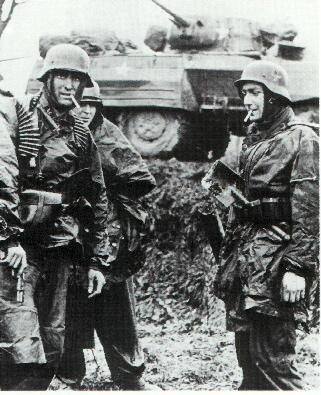
On 16 December, 1944 Hitler launched a surprise attack into the lightly defended Ardennes Forest in order to split the American and British armies, capture their main port of supply, Antwerp, and force the Western Allies to a negotiated peace. With only two minor exceptions, no one expected the Germans to attack. German Gen Walter Model’s thirty divisions in three armies, the 6th SS Panzer, 5th Panzer, and the American’s old nemesis from Normandy – the 7th, crashed into LTG Troy Middleton’s VIII Corps of four divisions from the 1st US Army: two were brand new, the 106th and 99th, and two were bloodied and mauled in the Hurtgen Forest, the 4th and 28th.
The American commanders dismissed the initial reports as spoiling attacks intended to prevent the US V Corps from seizing the Roer river dams, or Patton from seizing the Saar River industrial region (north and south of the Hitler’s offensive respectfully). So sure that the Germans were defeated, all of the important Allied commanders were disconnected from the soldiers they commanded that day: Bradley went far behind the lines to Versailles, Eisenhower attended the wedding of his driver, and British Field Marshal Montgomery golfed.
The surprise was complete. Total chaos reigned along the American lines in the Ardennes on 16 December. Model had every reason to believe his troops would be on schedule and make the Meuse River in three days, just as they had done to the French four years before in 1940 (which forced the French to surrender). But the Germans only had enough fuel and supplies for three days full assault. They had to reach the Meuse River in that time. After that, the American’s considerable flexibility, not to mention air power, would be brought to bear. The first few days were decisive.
On 16 December 1944, the 99th was penetrated, and most of its troops broke, and the 106th was crushed and bypassed. The 28th’s initial defensive positions were overrun and the 4th fell back. By all contemporary metrics the American’s were defeated.
But although the majority of the American units in the Ardennes collapsed, some did not, despite the German’s best efforts. Those platoons and squads, led by sergeants and young lieutenants and captains, that didn’t break bought the time necessary for the Allies to seal off the “Bulge” created by the German offensive. By the end of the 16th, 80,000 Allied soldiers were enroute to the battle, 250,000 more would follow over the next week. By the end of the day the Germans strict timetable was already irreparably upset, although this was unknown to the Allies at the time. By the 18th the northern and southern shoulders of the bulge were solidly in the hands of the Allies, and Model’s main effort was switched to the center of his increasingly narrow penetration.
It is said that generals and politicians win wars, but sergeants, lieutenants and captains win battles. This was no truer than in the snowy hills of the Ardennes Forest on 16 December 1944.
Germans in the Ardennes

On the northern edge of the Ardennes Forest on 13 December 1944, the 2nd Infantry Division, supported by several battalions of the 99th Division, both of the US 1st Army, attacked into the Siegfried Line hoping to break through and seize the Roer River Dams. The dams were one of the objectives the Americans failed to seize during the Hurtgen Forest offensive the previous months.
As part of a British delegation to observe the attack, Hollywood actor-turned-British Army Lieutenant Colonel David Niven (He would be the last to lose to Sean Connery for the role of James Bond a decade later) visited an old friend in the Belgian resort town of Spa on 15 December 1944. Captain Bob Lowe was a former reporter for Time, and an intelligence officer and assistant G2 in the U.S. 1st Army’s Headquarters. After the normal chit chat, Niven asked his friend what was going on in the sector, Lowe pointed east out of the window and responded,
“See that hill with the trees on top? On the other side is a forest. In that forest is the entire Sixth SS Panzer Army. Any day now they’re going to roll right through this room, cross the Meuse, turn right and seize Antwerp.”
Niven laughed and asked if he told anyone. Lowe dejectedly replied, “Everyday. The generals know better though.”
Five miles away in that same forest, SS Panzer General Sepp Dietrich was dressed as a Wehrmacht infantry colonel debriefing returning patrols incognito. Dietrich was a former butcher, close friend of Hitler, and one of the original “Beer Hall Putsch” Nazis. But he was also the exception to the rule that politically appointed generals were incompetent. He was pleased to find out the “the Amis” still considered the Ardennes a rest area, and pulled their outposts in at night to keep warm. Dietrich and his Sixth Panzer Army, Erich Von Manteuffel’s 5th Panzer Army, and Erich Brandenburger’s 7th Army would make them pay for those mistakes the next morning
The Greek Civil War and the Beginning of the Cold War

In the late summer of 1944, Hitler pulled all Wehrmacht troops out of the Balkans to help stop the Soviets and the Allies as they raced towards Germany. Hitler’s Balkan allies, Romania and Bulgaria, sought an accommodation with the Soviet Union and switch sides. In Yugoslavia, Josef Tito’s highly organized communist partisans filled the vacuum left by the retreating Germans and successfully stiff armed “liberating” Soviet troops. In Greece however, the partisans were generally divided into two camps that were hostile to each other. The first were the various factions supported by Tito’s Partisans and the Soviet Union, the National Liberation Front (EAM), and the other was composed of the various groups and reformed army units supporting the Greek Government in Exile, backed by Great Britain.
Winston Churchill foresaw the coming post war conflict with Communism and vowed Stalin would not have direct access to a port on the Mediterranean. All through 1944, the British made a point of securing German occupied islands in the Eastern Mediterranean and Aegean Seas. The stage set, Winston Churchill quietly pulled British units out of Italy and the Middle East to accompany the return of the Greek Government in Exile after the Germans departed. On 3 October, British and Greek units occupied Athens and began funneling supplies to allied militias and disarming the EAM and the Greek Communist Party.
The EAM organized a general strike and on 3 December staged a massive protest in Athens to stop the complete erosion of communist power in Greece. The protest degenerated into a riot and eventually into open street fighting by the EAM against Greek soldiers, police and militias and their British backers. On 12 December, the tough 4th Indian Division, veterans of the 2nd Battle of Monte Cassino, arrived from Italy and this turned the tide against the Communists. By late January, the EAM was defeated. In February the various parties signed a ceasefire, supported by the US, Great Britain and even the Soviet Union. Stalin knew he could then use Churchill’s intervention in Greece as a pretext to openly do in Bulgaria, Romania, Poland, and Hungary what he was already doing in secret.
The Greek Civil War began in earnest in March 1946 when the Yugoslav and Soviet backed Democratic Army of Greece (DSE) attacked Greek policemen across the country (the DSE was formed from the remnants of the EAM). Great Britain was bankrupt from six years of war and asked for the United States to take their place as the Greek government’s patron.
In 1945, President Truman recognized America’s new found leadership role in the Free World, and with Secretary of State George C Marshall developed and adopted the “Truman Doctrine”, which vowed America would stop the spread of Communism, starting with Greece.
The Winter War

In September 1939, de facto allies Soviet Russia and National Socialist Germany conquered Poland and as part of the Molotov-Ribbentrop Pact, the Soviet Union then invaded Estonia, Lithuania, Latvia, and the Bessarabian region of Romania without fear of German interference. In late November 1939, Josef Stalin, the leader of the Soviet Union, set his sights on the next target: Finland.
On 26 November, the Soviets staged a false flag incident to justify the war. Four days later, 1,000,000 Soviet troops with 3,000 tanks poured across the border against 250,000 Finns and volunteers from other Scandinavian countries.
The Finns and their allies massacred the Soviet troops.
The Red Army was a ghost of its former revolutionary self in late 1939. In 1937 and 1938, Stalin’s purges killed off 90% of the Red Army’s officer corps. Only blind, dogmatic, and politically correct loyalty to Socialism and Stalin was the criteria for being a good officer. Furthermore, Stalin and his party apparatus murdered over 30 million people in those years. In this monstrous number included most non-Russian communists, including all Finnish communists who thought they were safe in their Russian exile. When the Soviets invaded Finland, former lieutenants were leading divisions, former sergeants: brigades and former privates: battalions, and no one was familiar with the terrain because any Finnish sympathizers were in mass graves.
The Finns and their allies were initially very successful. The Soviets were limited to attacking along unpaved roads on the mostly impassable Finnish frontier where they were endlessly ambushed by bands of Finnish ski troops. Or the Soviets had to frontally assault heavily fortified defensive belts on the Mannerheim Line, named after the Finns’ extremely competent and resourceful commander in chief, Field Marshal Gustaf Mannerheim. The Soviets suffered tens of thousands of casualties for no appreciable gain.
No amount of propaganda could cover up the grievous Soviet defeats. In January of 1940, Stalin had the Soviet commander killed. The new commander, General Seymon Timoshenko was one of the tiny number of senior commanders to survive the purges. He instituted the first of the Red Army’s much needed reforms. The reforms were basic and really only solidified and concentrated on the single Soviet tactic of the day, the frontal assault, but it was enough.
In late January 1940, the Finns were running out of ammunition and the Soviets were grinding through the Mannerheim Line. The British and French began supplying ammunition and supplies to the beleaguered Finns. Also, in one of the great “what if?” questions of the century, they planned on intervening directly with an expeditionary corps in March (though it was mostly meant to secure Swedish iron ore from the Germans). But it was too late. The Soviets broke through in late February and the Finns signed a peace treaty with the Soviet Union on 12 March.
Americans in the Ardennes

On 6 December 1944, in the Ritz Hotel in Paris, Marlene Dietrich’s manager finished planning their USO troupe’s next trip to the front. The German born Hollywood starlet was one of the USO’s most active shows. She had a reputation for going as far forward as possible to visit units, even to places where it wasn’t prudent for Marlene to slip out of her tailored uniform and into her sleek black evening gown to perform her signature song “Lil Marlene”. Her USO troupe planned on visiting the American units in the quiet Ardennes Forest over the next 12 days.
There was one division the blonde bombshell would not visit in the Ardennes because it wasn’t there yet. The US 106th Infantry Division was just getting off the troopships in LeHavre harbor. The 106th was Eisenhower’s newest division both literally and figuratively: America was reaching the bottom of its manpower pool in late 1944, and the 106th was the first division formed from almost all 18 year old draftees, including a young Pvt Kurt Vonnegut who would use his experiences over the next months to write “Slaughterhouse-Five”. Whereas the average age of soldiers in other divisions was 26, it was 19 in the 106th.
The 106th was destined to replace the veteran 2nd Infantry Division on the Schnee Eifel in the Ardennes Forest, where it was said they would be able to get some experience in the quiet sector. The US 2nd Infantry Division was assigned to the Ardennes after a bloody mauling in the vicious street fighting in the German city of Aachen in September and October. After several weeks of receiving replacements, training and planning, the 2nd was destined to move to the northern shoulder of the Ardennes. From there, they would assault east into the teeth of the German Siegfried Line to hopefully capture the Roer River dams. They were just waiting on the 106th to get off the boat and take their positions.
To keep the timetable on track, the US 28th Infantry Division of Pennsylvania Army National Guardsmen extended their line to a ludicrous distance in order to allow the 2nd to make the move before the 106th could take over. Also on 6 December 1944, the US 1st Infantry Division, the “Big Red One”, arrived to the north of the 28th. Both divisions were chewed to a bloody pulp in the recent campaign around the city of Aachen. The “Red” in the Big Red One and the red keystone of the 28th’s division patch, aka “the Bloody Bucket”, took on a new meaning after the brutal fighting in the Hurtgen Forest. Both divisions were looking forward to some quiet recovery, refit and reorganization time in the Ardennes.
The Big Red One moved in to the south of another green division who, like the 106th, had only just arrived in Europe. However the US 99th “Checkerboard” Infantry Division had been there a week and had taken to digging defensive positions in order to keep warm in the snow and freezing temperatures. The 99th was assigned to protect the 2nd Division in its attack, and to do that it had a front five times the doctrinal length. On its far right the division had a single intelligence and reconnaissance platoon to tie into the battered Big Red One. The 22 men of the 394th Regt’s I&R platoon were solely responsible for six miles of the 99th’s front line.
Once the 106th arrived in a few days, LTG Troy Middleton’s VIII Corps would have four divisions on the line in the Ardennes: the 99th, the 1st, the 106th and the 28th, with the 2nd just to the north preparing to move to their assault positions. From the sleepy Belgian town of Bastogne, Middleton commanded 80,000 men spread out over 90 miles. His lines were impossibly thin but it was thought it was an acceptable risk because he was assured that the Germans would never attack into the broken terrain of the Ardennes in winter. Besides, just about every commander and intelligence officer in the European Theatre of Operations thought the war would be over by Christmas.
Unbeknownst to the Allies, Hitler had assembled in complete secrecy 300,000 men, 1600 tanks and 2500 artillery pieces opposite the VIII Corps’ lines. The Germans planned on attacking ten days later on 16 December, the same day Marlene Dietrich was scheduled to perform at the 99th’s Division Headquarters in the tiny Belgian town of Krinkelt.
 Buk's Historical Ad Hockery
You must be logged in to post a comment.