
Tagged: WWI
The Battle of St Mihiel
The Battle of Amiens: “A Black Day in the History of the German Army”
The Battle of Belleau Wood
“The deadliest weapon in the world is a Marine and his rifle.”
The Battle of Cantigny
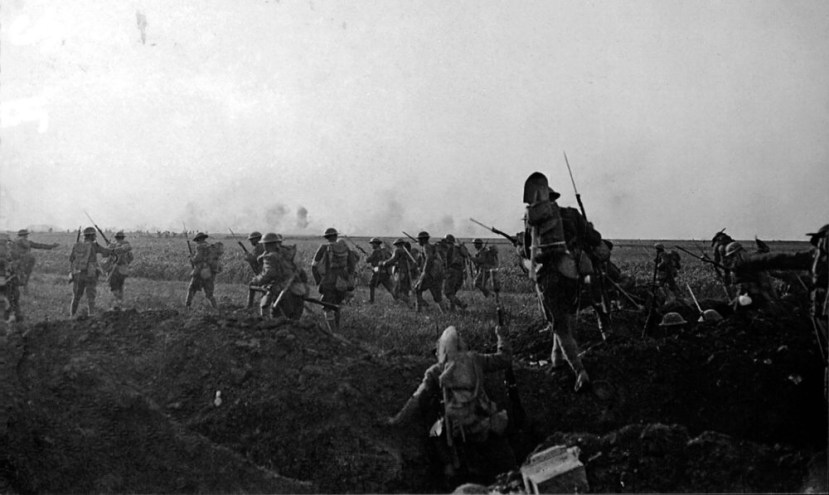 When the Germans started the Kaiserschlacht, the 1918 Spring Offensive with the troops released by victory against the Russians on the eastern front, Gen Pershing was under immense pressure by the British and French to get American troops into the trenches in number. The British wanted the Americans as replacements for Allied casualties. The Commonwealth commanders wanted smaller American formations i.e. battalions and brigades, to augment British and French divisions, just as they were doing. The French just wanted the Americans to enter the lines in any form whatsoever despite any deficiencies in training, though they supported Pershing’s views. As commander of the American Expeditionary Force, Pershing was under explicit instructions from President Wilson that Americans would fight under their own flag and in their own formations, and not as part of another national army. To this end, Pershing told the French that the Americans wouldn’t be ready to assume a portion of the front until late 1918, or more probably 1919.
In mid-April 1918, only five American divisions were trained to the point where they would be effective in the trenches, despite hundreds of thousands of Americans arriving in France each month. Under pressure from the French, Pershing relented and the American troops were placed at the seam between the British and French armies just south of Amiens and just north of Paris. Previously in the war, whenever the inexperienced American troops took over part of the line, they were specifically targeted by the Germans, with predictable results. With rare exceptions, the Germans had their way with the novice doughboys, and the British and Canadians had no respect for the soldierly prowess of American troops. According to many a British officer, American soldiers may have been good at subjugating Indian tribes, but they were a detriment to the continuity and contiguousness of the front on a modern battlefield.
The French recommended a small American counterattack to exhibit the battle prowess and state of American training. The attack would take some pressure off the British, who were suffering from the bulk of the Spring Offensive, and announce to the world that the Americans were finally capable of offensive operations. Of the five available divisions, Pershing chose his favorite, the 1st, to make the assault. The selected objective was a small German salient around the town of Cantigny, which sat on high ground that offered the Germans excellent observation of the surrounding area.
The commander of the 1st US Infantry Division, Maj Gen Robert Bullard, chose the 28th Infantry Regiment supported by two companies of the 18th, with machine guns, artillery and engineers from the division troops to conduct the attack. Lieutenant Colonel George Marshall (you might have heard of him) wrote the 34 page operations order detailing the movement, rolling barrage schedule, and the general scheme of maneuver. The Americans rehearsed the attack for three weeks prior. The Germans spotted the two American companies that arrived in the trenches a day early. They pounded them with artillery. Nevertheless, the 28th went “over the top” at dawn on 28 May 1918.
The French were wedded to a successful American assault. They didn’t want to squander the immense advantage that America gave the Allies in men and material if the British were knocked out of the war, which was the aim of the Spring Offensive, and would result in the Americans taking over their portion of the front. A successful American attack would put them in the line that much faster, and most importantly, where the French wanted. So the French supported Bullard’s assault on Cantigny with prodigious amounts of artillery and transport. With the copious amounts of French support, the 28th secured their assigned trenches and dugouts, and cleared the cellars of Cantigny of Germans. That night there was a great celebration in Pershing’s headquarters.
The German artillery wasn’t to disrupt the American attack, it was to presage Operation Blücher–Yorck, the third phase of the Kaiserschlacht. The German operation aimed straight at Paris in order to pull Allied troops away from assisting the British farther north. All along the front, French units demanded support. The French artillery and the dedicated resources to the 1st US Infantry Division disappeared on the night of 28/29 May. Overnight, Cantigny became solely an American operation.
The German counterattack started shortly thereafter, and the 28th screamed for more support. Several requests to pull back to the original 27 May start lines were sent. All were refused: American national pride and the fate of the American Expeditionary Force was on the line with this single battle. The 28th had to hold, and Pershing needed to assure that that happened with just American resources. The Americans had relied on French support since they landed in the country 11 months before. No more – the Americans were on their own.
For two days and nights the novice 1st US Infantry Division slugged it out at Cantigny with waves of German attackers. The final German assault came at dusk on 30 May. The next morning, Cantigny was still in American hands, albeit tenuously. Nonetheless, the amateur Americans proved they had what it took to fight, and prevail, on the Western Front. There would be no more talk of amalgamating the American troops into the French or British armies. They had received their baptism of fire. The 1st US Infantry Division, soon to be known as “The Big Red One” from their distinctive shoulder patch, proved they could stand their ground in the face of the best the veteran Germans could throw at them. The Americans had finally entered the First World War in earnest.
With a few limited exceptions, the Allied offensives on the Western Front were all failures. The naïve, but enthusiastic, American army inoculated with the bloody and hard won experience of the Allied failed efforts, would soon go on the offensive… and surprise the hell out of the Germans.
The Harlem Hellfighters and Black Death

In late April 1918, the German troops opposite the French in the Argonne Forest began a series of trench raids and reconnaissance patrols in preparation for the third phase of the Spring Offensive – Operation Blücher–Yorck, whose objective was Paris. The Germans were surprised to find not French troops but African American soldiers of the 369th US Infantry.
Formerly known as the 15th Regiment of the New York National Guard, the 369th was re-designated when they got to France in the First World War. The 369th was recruited primarily from Harlem, where 50,000 of New York’s 60,000 African Americans lived. When they landed in France on New Year’s Day 1918, the regiment was assigned supply, labor and support jobs because many of the American regiments from the South refused to train with them. When the Germans launched their Spring Offensive in March, the French were in need of men to fill their trenches. However, the commander of the American Expeditionary Force, General John “Black Jack” Pershing, was under orders from President Wilson that American troops were to fight together, and not used as replacements for British and French casualties. Pershing recognized that because of the discrimination, it would be difficult to assign the 369th to an American division. By assigning the 369th to the French, under the strict provision that they fight as a regiment, Pershing was assisting his distressed French allies and getting the 369th into the fight, while still adhering to the letter of Wilson’s orders, if not the spirit.
In early April 1918, the 369th was assigned to the 16th French Infantry Division. Because American equipment would be difficult to get while attached to the French army, the 369th turned in all of their American equipment, except their uniforms, and drew French equipment, including weapons. They were then assigned to partner, man for man, with a French regiment for three weeks of grueling training behind the front. In the mid-April 1918, the 369th took their place in the trenches opposite the Germans.
On the night of 15 May, a 24 man German patrol crept through No Man’s Land opposite the 369th. In a small listening post to the front of the American trenches, Pvts Henry Johnson and Needham Roberts heard the distinct clip of wire cutters. Johnson told Roberts to run back to the trenches to warn the rest. Just as he departed the first German grenades landed. Johnson was wounded by shrapnel in the hip and back, but Needham was nearly killed. Johnson threw his own grenades. Then as the Germans charged, he shot three with his French rifle, the last with the muzzle directly in the chest of the German. Johnson then noticed two Germans trying to carry off Needham. With no time to reload (the French Lebel Rifle only had a three-round magazine), Johnson pulled his US Army issue bolo knife, essentially a Filipino machete, disemboweled one German, and then sunk the heavy blade into the skull of the other. At this point the rest of the German patrol arrived, so Johnson attacked them too. His aggressiveness and ferocity came as a terrible surprise. In the ensuing melee, Johnson suffered 21 separate wounds, but drove the Germans off and saved Needham.
The German patrol stated later that they had been assaulted by “Black Death”, and the name showed up in propaganda specifically directed at Johnson. The name stuck.
The French awarded both Johnson and Needham the Croix de Guerre, the first American soldiers to receive the honor in the First World War. Over the 191 consecutive days of combat the 369th fought in, their French partner referred to the unit as the “Harlem Hellfighters”. That name stuck too.
The Harlem Hellfighters hold the honor of having served the most time in combat of any American unit in the First World War. President Obama awarded a posthumous Medal of Honor to Henry Johnson on 2 June 2015. The medal was received by the New York National Guard, since there was no next of kin.
“Don’t Tread On Me, God Damn, Let’s Go!”
Kaiserschlacht: The Spring Offensive
By 1918, the British blockade forced a near famine on the German population. Imperial Germany would be starved into submission by 1919. However, the peace treaty with the Bolsheviks at Brest-Litovsk formally took Soviet Russia out of the First World War and freed up hundreds of thousands of German troops for the Western Front. Since the early winter, American troops arrived in French ports at the rate of 200,000 a month. Erich Ludendorff, ostensibly known as the First Quartermaster-General of the Imperial German Army but in reality the brains behind the entire German war effort, devised a plan to defeat the British and French before American numbers, and industrial and agricultural capacity could be brought to bear.
Using the divisions released from the Eastern Front, Ludendorff’s offensive sought to split the British and French armies by driving for the English Channel. Once the surrounded British Army was rolled up from the south or its ports captured, the British Army would assuredly surrender, and the French would be forced to sue for peace. The “Kaiserschlacht” or “King’s (Caesar’s) Battle” would consist of three separate offensives: Operation Michael launched on the Somme to split the British and French Armies, Operation Georgette near Ypres to seize the Channel Ports, and Operation Blücher–Yorck to draw French and American reserves south.
The Spring Offensive used “Stormtrooper” tactics perfected against the Russians but on a much larger scale. Whereas previously the best and fittest German troops in a division were specially trained and formed into stormtrooper battalions to infiltrate the enemy trenches and seize strongpoints at the outset of the attack, for the Kaiserschlacht Ludendorff formed entire Stormtrooper divisions. On paper, this seemed a good idea, but actually encouraged the wasteful use of these elite troops against unimportant targets. Being specialist formations, the Stormtrooper divisions forced the basic tactical formation i.e. the lowest level where a single commander controls all of his combined arms formations and specialist attachments, back to the corps level. Since the advent of gunpowder, the basic tactical unit became increasingly smaller: In 17th and 18th century, it was the army. In the 19th, the corps system allowed Napoleon to conquer Europe. By 1918, the smallest combined arms formation was the division. In a First World War division assault zone, not every strongpoint or trenchline was a key piece of terrain, where the stormtroopers were needed. Normally, whatever positions the stormtroopers bypassed were reduced by regular line infantry. By having entire stormtrooper divisions, this forced the elite units to assault positions that could have been taken by regular units, incurring unnecessary casualties and tiring them out. The entire offensive was a gross misuse of a limited resource.
On the foggy morning of 21 March, 1918, Operation Michael unleashed Ludendorff’s Stormtroopers in the Cambrai sector after a short vicious bombardment of key terrain and strongpoints, artillery positions, and Allied command and control centers. In a single day, the Germans recaptured all of the terrain that the British had spent the last three years taking. Within two days, the British Army was in full retreat.
However, the assaults wore down the all-important stormtrooper units. Moreover, the British retreat wasn’t a rout, and the British just withdrew from tactically insignificant terrain, while reinforcing vital areas. Furthermore, Ludendorff “reinforced success”, while nominally a great idea, in the context of the Western Front in 1918, all it lead to were meandering uncoordinated forward advances along paths of least resistance. Within days, the important British defenses had to be reduced by the line divisions (who were stripped of their best men for the stormtroopers) in costly frontal assaults while the exhausted stormtrooper divisions continued the advance over ground mostly abandoned by the British. The Germans had no exploitation force and the speed of a man walking was simply not fast enough to break out before the British and French reacted, who were mostly operating on interior lines (Breakthrough Theory would come to fruition 15 years later with improvements to the tank, motorized transport, and “Blitzkrieg”). The British defended these key points for many reasons, most of which had to do with logistics. While the Germans advanced unprecedented distances which made for great headlines, their supplies couldn’t keep up. Finally, and not insignificantly, the British blockade effectively grounded the German air force for lack of fuel, giving the Allies an immense advantage in reconnaissance.
Operation Michael cost the Allies and Germans 250,000 casualties each, but could not isolate and destroy the British Army. Operation Georgette got to within 15 miles of the Channel ports, but was slowed by last stands from the Portuguese Expeditionary Force, and British, French, and Australian reinforcements that poured in later. Operation Blücher–Yorck was blunted by French and American troops, including the US 1st Division, after some initial success, but failed to draw away significant troops from the main effort, Operation Michael, to the north. In these operations the Allied and German casualties were about the same, a combined 300,000. However, the Allied casualties were replaced in a few months by American troops; the German casualties were irreplaceable, especially in the Stormtroopers divisions who took a disproportionate percentage of losses.
By the end of June, Ludendorff simply ran out of men. There were more in the East which could have been available, but they were “Germanizing” and “civilizing” the vast tracts of Poland, the Baltic States, and Belorussia seized from the Russians. There was no time to reorganize them and bring them west. In July, Ludendorff called off the offensive. The Kaiserschlacht was a body blow to the Allies, but one from which they quickly recovered. The German Army was hollowed out, and unable to conduct further large scale offensives. The conclusion of the war was just a matter of time. The end of The Great War was in sight.
The Spanish Flu
The rapid spread of disease among the cramped conditions of military cantonment areas has been a problem for armies since time immemorial. The unprecedented scale and rapidity of the US military’s expansion in the wake of the America’s entry into the First World War made it especially susceptible. The US Army and Marine Corps, to include the National Guard began the war with 218, 265 men in uniform. Just 16 months later there were more than four million. Every one required the creation of brand new facilities to house, feed and train them. The cramped and sometimes unsanitary condition were ripe for outbreaks of disease.
In 1917, several outbreaks of the flu ravaged American training camps. Not especially noteworthy at the time, on 4 March 1918, company cook Pvt. Albert Gitchell reported to sick call at Camp Funston, Kansas with the flu. But Pvt Gitchell contracted a new strain dubbed H1N1, and he was first documented case of the virus. Unlike previous flu outbreaks which were generally only fatal to young children, the previously sick or the elderly, H1N1 targeted healthy adults, and was highly contagious. More than 500 cases were reported at Camp Funston and nearby Fort Riley over the next few days
The H1N1 flu virus quickly spread across the country with the troop trains. Just a week later on 11 March, the first case was diagnosed in Queens New York, where troops prepared to depart overseas for France. From New York, it spread to all parts of the globe.
Wartime censors kept the flu outbreak out of the newspapers and off the radio in countries that were fighting. However, the morale of the civilian population was not a concern in neutral countries, such as Spain. The flu epidemic dominated the headlines of Spanish newspapers, especially after Spain’s ruler, King Alfonso XIII, contracted the sickness. With the greater press attention, the world began referring to it as the “Spanish Flu”. A second deadlier wave broke out in August of 1918.
The H1N1 “Spanish Flu” pandemic infected nearly 1/3 of the world’s population between March and November, 1918. Reported cases dropped off dramatically that winter. But in the space of just nine months, nearly 80 million people succumbed to the Spanish Flu, or about 5% of world’s population.
The Bolshevik Revolution: Red October
On 25 October 1917, (7 November according to the Gregorian calendar) radical socialists called Bolsheviks, led by Vladimir Lenin, Josef Stalin, and Leon Trotsky hijacked and precluded a wider socialist rebellion against the Russian Provisional republic led by Alexander Kerensky.
In February 1917, Tsar Nicholas II abdicated after the massive casualties sustained on the Eastern Front, mostly during the failed Brusilov Offensive in late 1916, and the resultant second and third order effects back home. A Provisional Government was formed, but to coordinate action of the middle and far left in the Provisional Government, a separate Petrograd Soviet, or worker’s council, was formed and chaired by Leon Trotsky. The Petrograd Soviet was based on other soviets that ruled locally in many parts of Russia. Petrograd, modern St. Petersburg and the capital of Russia at the time, was one of Russia’s most important cities, along with Moscow, and its soviet, and by default Trotsky, wielded outsized influence.
During the summer, the Provisional Government weathered several rebellions but in September and October 1917, Russia was wracked by massive strikes. On 23 October 1917, the Bolshevik Central Committee of the 2nd Congress of Soviets, which was meeting in Petrograd, resolved that the time was ripe for revolution, which was planned for two days later to coincide with the arrival of a flotilla of destroyers crewed by pro-Bolshevik sailors and marines.
On 25 October, Red Guards, specially formed paramilitaries consisting of armed factory workers, peasants, and deserters from the army and navy, seized strategic locations throughout the city in a near bloodless coup, as most of the Petrograd garrison joined the insurrection. That evening they seized an abandoned Winter Palace, the symbol of Russian Imperial rule. Kerensky fled earlier in the day to find military forces loyal to the Provisional Government specifically Cossack units outside the city. But since the Red Guards controlled the railroads, telegraphs, and the chokepoints around the city, Kerensky ended up borrowing a car from the American Embassy to flee. He managed to make his situation worse when some soldiers loyal to him fired on a unit that could have been persuaded to join his cause, and this act made him seem very Tsar-like in the eyes of many.
The next day, the Bolsheviks announced to the 2nd Congress of Soviets they had seized Petrograd and the Winter Palace. But instead of immediately forming a Constituent Assembly for a new constitution, the Bolsheviks announced that rule of Russia would be immediately given to the deputies of the local soviets. The Mensheviks and most of the Socialist Revolutionary Party walked out in protest, but Trotsky taunted them on the way out, “You are pitiful isolated individuals; you are bankrupts; your role is played out. Go where you belong from now on — into the dustbin of history!” But Trotsky was right, they were used, and when they were no longer needed, discarded. As many groups found out later much to their detriment (Lenin famously referred to them as “useful idiots”).
A new Constituent Assembly was elected from the Bolsheviks, the remaining Socialist Revolutionaries, and their allies, but even that was quickly disbanded when it proposed reforms that took power away from the soviets. Within a month, private property was confiscated, wages were fixed, and all forms of social hierarchy that didn’t stem from the barrel of a gun were abolished, such as military rank and noble or educational titles, the first secret police, the Cheka, were established, and the “hammer and sickle”, a proposed symbol unity between the worker and peasant, was adopted. The Bolsheviks would immediately seek terms with Imperial Germany, resulting with the Treaty of Brest-Litovsk, which ended Soviet Russia’s participation in the First World War, and began the Russian Civil War.
The Great Emu War
 Buk's Historical Ad Hockery
You must be logged in to post a comment.