
Tagged: OnThisDay
O’Hare
Executive Order 9066
From 1936 to 1941, the FBI, Office of Naval Intelligence, and US Army Military Intelligence collected information on Japanese, German, and Italian immigrant communities in the United States and compiled lists of potential “troublemakers” that would be put into concentration camps in the event of war with the Axis powers. In mid-1941, FDR ordered a comprehensive investigation of the Japanese American communities on the West Coast. The “Munson Report” released a month before Pearl Harbor, stated that though some Japanese retained loyalty to Japan and its emperor, “the Japanese (American) problem didn’t exist”, and there was a “remarkable, even extraordinary degree of loyalty among some of this generally suspect ethnic group…” FDR ignored the report.
With war tensions high and a general civilian paranoia of a potential Japanese invasion of the West Coast, FDR issued Executive Order 9066, which gave the Secretary of War the authority to “prescribe military areas . . . from which any or all persons may be excluded” and to “provide for residents of any such area who are excluded therefrom, such transportation, food, shelter, and other accommodations as may be necessary . . .”
Three weeks later Congress passed legislation which funded Executive Order 9066 after the briefest of discussions. Opposition to the obvious unconstitutionality and potential for abuse in the bill made strange bedfellows. The minority Republican leadership in Congress was muted under their pledge to FDR in December to not let domestic politics interfere with the conduct of the war, so they found their champions in the only two of FDR’s cabinet members that opposed the EO, Attorney General Francis Biddle and Interior Secretary Harold Ickes. Biddle and Ickes would eventually get Executive Order 9066, and related later EOs, to the Supreme Court and have them declared unconstitutional. But after a decade of the courts and Congress acquiescing to FDR’s expansion of executive power during the Great Depression, it would take three long years for that to happen. However, just after Pearl Harbor that didn’t matter – on 9 March 1942, FDR signed Public Law 503 into law, and the legal justification for one of the greatest tragedies in American history was established.
Surprisingly, Executive Order 9066 was not used as justification for exclusion of the largest Japanese American community in the US on one of the few pieces of American soil under actual threat of Japanese invasion: Hawaii. US Authorities there had arrested 2500 Japanese illegal aliens under FDR’s Alien Enemies Act in December. The other 100,000 Japanese Americans in Hawaii were not deemed a threat, too important to Hawaii’s economic well-being, and their internment not a military necessity citing the Munson Report, and a separate Naval Intelligence report which found “no evidence of ‘fifth column’ activity among Japanese Americans”. This was not the case for the American West Coast.
Shortly after EO 9066’s funding by Congress, Arizona and California, and Oregon and Washington were in their entirety designated as two military districts by LTG John DeWitt, the commander of the Fourth US Army and the Western Defense Command. DeWitt applied EO 9066, probably against its spirit, to the entire Japanese American community on the West Coast. DeWitt wanted to relocate anyone of Japanese American ancestry out of the two West Coast military districts. But there were 120,000 Japanese Americans in his area, so DeWitt, through the Sec of War Henry Stimson requested additional funding for quasi permanent internment camps throughout the US and a separate organization to coordinate and administer the relocations. FDR signed Executive Order 9102 on 18 March 1942, and Congress funded it. 9102 created the War Relocation Authority. Moreover, the racialists and Eugenicists in FDR’s administration reared their ugly heads and the EO was applied to anyone with 1/16th Japanese blood, or in practical terms one great-great-grandparent born in Japan. These also included Koreans and Taiwanese whose lands were Japanese colonies since the 1880s. EO 9066 could be argued as not racial in character and just an abuse of eminent domain; EO 9102, DeWitt’s proclamations, and the administration’s and army regulations pertaining to both, cannot.
In April, flyers from the Western military district headquarters began appearing in Japanese American communities advising not only Japanese resident and illegal aliens but also Japanese American citizens to prepare for relocation. Flyers also appeared in German and Italian American communities, but the racial character of DeWitt’s proclamations, and the easily identifiable stereotypical facial features of Japanese Americans meant that few Caucasians were interred, and those that were, were already identified on FDR’s lists. The director of the War Relocation Authority, Milton Eisenhower (Dwight’s younger brother), attempted to mitigate and limit the relocations through various means, including limiting them to just adult males, but was thwarted by DeWitt and administration officials.
Throughout the end of April and through the summer, more than 120,000 Japanese Americans, 2/3rds of whom were US citizens, were ordered to report to assembly areas in parks, stadiums, and even racetracks. They were permitted to bring one suitcase and the clothes on their backs. The rest of their possessions were left behind, and left at the mercy of their communities. Many families lost everything: land, pets, furniture, cars, and savings were all gone when they returned three years later. The internees were packed into buses and trains for long journeys to ten hastily and poorly constructed internment camps, two as far away as Arkansas, each surrounded by barbed wire, and armed guards.
In late April, the frustrated and defeated Eisenhower wrote, “when the war is over and we consider calmly this unprecedented migration of 120,000 people, we as Americans are going to regret the unavoidable injustices that we may have done…”
The Channel Dash
The Normandie Fire and Operation Underworld
On 9 February 1942, the interned French ocean liner SS Normandie caught fire and capsized off of Pier 88 in Manhattan. The Normandie, recently rechristened the USS Lafayette, was in the process of being converted into a troop ship that could carry an entire infantry division’s worth of men (15,514 in 1942). The fire was almost certainly an accident, even though mob boss Albert Anastasia claimed credit (to enhance his reputation and send a message to the govt not to interfere with the waterfront rackets. He regretted it later.). Despite, or maybe in light of Anastasia’s claim, the Office of Naval Intelligence (ONI) suspected Nazi sympathizers, maybe even Nazi saboteurs.
In early 1942 New York, this was not an unreasonable assumption. Just after Pearl Harbor, the FBI had broken up the Duquesne Spy Ring and arrested 33 German spies in New York after two years of investigations. That there were some that escaped capture was considered a given. Furthermore, America’s largest immigrant community in 1942 were German Americans; New York City was a stronghold of the influential German American Bund, essentially the American branch of Hitler’s National Socialists. Also, U boats were literally torpedoing merchant ships within sight of the Statue of Liberty. It was suspected that they were receiving information from the dockworkers (true, until the Duquesne Spy Ring was broken up) and that the U boats were receiving fuel and supplies from fishing boats (Not true, the Americans were just unaware of the Type IX U-boats true range) On top of all that, New York’s docks, shipping, and fishing industries were controlled by the Teamster, Longshoreman, and Seafood Worker’s Unions. All of whom were dominated by the Jewish, Italian, Sicilian, and Irish Mafias. None of these were seen as particularly friendly to America’s wartime interests, and would greatly profit from chaos on the waterfront.
The Mafia’s control of these critical wartime requirements greatly concerned Naval Intelligence. Black marketeering and corruption were on the rise, if only because of the increased amount of wartime goods and supplies moving through New York. Also, union strikes in New York reached an all-time high in early 1941 (while the Soviet Union was a defacto German ally) and was still a serious problem. Anastasia’s claim of credit was seen as further proof that the immigrant communities would at best encourage the sabotage, and at worst actively participate. Although Ireland was technically neutral in the Second World War, their hatred of Great Britain was legendary, and tacit Irish support for German operations in the Atlantic was not unheard of. Most disconcertingly, Mussolini’s Italy was Hitler’s closest ally. There were twenty years of ties between the Italian Mafia in Italy, the northern branches of which Mussolini used to gain power, and the Italian mobs in New York. The Sicilian and Southern Italian Mafia were a different story, but who the hell in the US Navy knew the differences between the Italian and Sicilian mobs? The various mafia organizations needed to be brought on America’s Team, or eliminated by those that were. But where to start? When Naval Intelligence approached the longshoremen about the Normandie fire, no one would say a word, and they were quietly “escorted” from the Manhattan docks.
After speaking with New York district attorneys, the question wasn’t “where”, but “with whom”. They recommended the Jewish Mob, who had ties to all the others through their lock on the gambling racket. More importantly, they had a fierce reputation of street fighting with the German American Bund and regularly broke up Bund marches, rallies, and meetings. Of all the Mafioso in New York, they had the least ties to Italy or love of Germany. So Naval Intelligence contacted Meyer Lansky.
Lansky was a Jewish immigrant from Eastern Europe, and he came to America in 1911 after the Russian pogroms. He was a slight, well dressed, bookish man who could pass for an accountant in any New York City firm. He was also a ruthless killer, and The Bund Nemesis. He was the undisputed boss of Jewish organized crime, and the most feared enforcer of the “Syndicate”. The Syndicate was the unofficial organization that kept the Italian “Five Families”, and the various other ethnic mafias working in their own areas and own specialties, and generally not killing each other. Violence was bad for business. Lansky was the perfect man to contact.
Lansky assured the ONI that although the immigrant communities were from countries generally hostile to the US, they embraced their new homeland for the most part, and disdained Nazi Germany and Fascist Italy. They would refrain from active sabotage. However issues arose when ONI asked for the mafia members to report unusual activity, stop strikes, limit black marketeering, and even accept federal agents into the unions to keep an eye on things. Lansky was skeptical: mafia members, of any ethnicity, were anti authoritarians in the best of times, and would need some incentives for that level of support, and compensation for the consummate loss of profit.
The ONI made them an offer they couldn’t refuse: Cooperate or Washington will declare them a national security threat. Once that happened the FBI and an infantry division will descend upon New York and “kill them all”. (The Big Red One was passing through NYC at the time… Anyway, legend has it the threat came from FDR himself, whcih is not much of a stretch. Remember FDR was also the guy that had no problems rounding up every Japanese American in the country and putting them in concentr… err… “internment” camps.)
Lansky naturally agreed, “out of patriotism”, of course. Anyway, he had no problems with working against the Germans, if only for their treatment of Europe’s Jewish population. Also, once he explained the terms of the “agreement” to his fellow childhood friends, “Bugsy” Siegal and “Socks” Lansa, the ONI would eventually have no problems with the Italian and Sicilian controlled teamsters, longshoremen, or fishermen (with whom the ONI wanted to place agents to spot U boats). Lansky recruited Irish enforcer John “Cockeye” Dunn and his thugs to roam the waterfront. In Lansky’s words, “I gave Cockeye the orders. Go down to the piers and find out who is loyal and who is not loyal. You have to see that there are no strikes and that the job is done quickly when military stuff is loaded. And we have to make sure everybody keeps his mouth shut about troop movements. That means going into bars to make sure the crews and longshoremen don’t start sounding off when they get drunk”.
However, Lansky had no influence over the Irish mob on the West (Hudson) docks and rail yards, the surrounding Hells’ Kitchen slums, nor the Brooklyn Docks. They were run by Albert Anastasia, the same guy who “torched the Normandie”. The Irish had the biggest problem with authority. The “’G-Men’ really would need an infantry division”, and turn lower New York into a battleground, before the Irish submitted to federal authority. There was only one man who could convince Anastasia to cooperate: the Emperor of Vice in New York – “Lucky” Luciano.
Lucky Luciano owned the New York underworld, even from the maximum security prison at Dannemora, where he was serving a fifty year sentence. Luciano got the Irish on board under three conditions: His cooperation be kept secret, as he was an Italian citizen and if he was deported, Mussolini would have him killed. His sentence is commuted. And finally that he is moved to a nicer prison. The Navy agreed and Luciano was transported to the minimum security prison at Great Meadows. (He was eventually freed in 1946 and deported to Italy after being incarcerated for just 9 ½ years.)
Once the Navy had Luciano’s blessing, the Mafia were their enforcers. “There was peace on the waterfront. It was kept with rough methods. But that’s what the Navy asked us to do and that’s what the Navy got.”
Operation Underworld ran for the rest of the war, and was kept secret until 1977.
The SS Housatonic and Unrestricted Submarine Warfare
Although the Royal Navy’s Grand Fleet lost more tonnage than the Imperial High Seas Fleet at the Battle of Jutland, the Germans never sortied from port again. In response, they prepared for a policy of unrestricted submarine warfare to begin on 1 February 1917. If the Royal Navy couldn’t be beaten at sea then the country would be starved into surrendering. The sinking of the ocean liner RMS Lusitania in 1915 had almost brought the United States into the war on the Allied side; unrestricted submarine warfare in 1917 surely would. If the plan worked Britain would sue for peace before the US presence could make itself felt on the Western Front.
On 3 February 1917, the first victim of the new policy was spotted. U-53 stopped and boarded the cargo ship SS Housatonic off the southwestern tip of England. The Housatonic was sailing with a hull full of wheat from Galveston to Liverpool. The polite U boat captain ordered the ship abandoned then sank her with a single torpedo. He then towed the life boats toward shore and subsequently snuck away.
The Housatonic was the first of many ships sunk under unrestricted submarine warfare. The homely old steam freighter caused an uproar in the US Congress and inside the the Wilson Administration. President Wilson had just narrowly won the recent election on a platform of non intervention in the the war in Europe, even though he privately expressed his doubts that America could stay out of the war.
Great Britain knew it too, and was just waiting for the right time to inform America of a recent intelligence development. The sinking of the SS Housatronic provided the perfect opportunity.
Paranoid
Like every other rock band during the British Invasion era, the band “Earth” started as a blues tribute garage rock band. But after being double booked with another band of the same name, Tony Iommi, Geezer Butler, and Ozzy Ozbourne decided to change their name to “Black Sabbath” after the Boris Karlov flick that was playing across the street from one of their rehearsals.
Black Sabbath released their eponymous debut album in early 1970. It was a commercial success but critics hated it. BS found their niche in the darker themes reminiscent of Karlov’s movies and “stupid melodies” that were quite different than the flower power and hippie music that dominated the charts. In the fall of 1970, Black Sabbath went back to the studio to record the songs that they didn’t get a chance to for their first album.
They had just two days to record and one to mix. At the end of the second day, their album “War Pigs” was finished. However, their producer said they needed another three minutes of music. Iommi quickly came up with a riff, Ozbourne some angsty and depressing lyrics, and Butler called it “Paranoid”, which Ozbourne replied, “What the f**k does that even mean?” “Paranoid” took 25 minutes to record from request to final cut.
With the “counter culture” mainstream, Black Sabbath didn’t want the anti Vietnam song War Pigs to headline the album lest it get lost in all of the other aforementioned flower power music on the charts. They decided to name it after the shortest song on the album and the one most likely to get radio time: the afterthought, Paranoid.
Paranoid released in Oct 1970 in the UK, but it’s the release in the US on 7 January 1971 that changed the world. Like before, critics hated it, and it received near zero radio time. But the generation of resentful kids who were just then coming of age and beginning to realize they missed the crazy days of the swinging late sixties that their big brothers and sisters experienced, absolutely loved it. Most of the combat troops left Vietnam, the draft was winding down, and the economy began to stagnate, so what did it all mean? The world of Paranoid provided a glimpse of the answer. (And it helped that the songs were simple to enough to inspire a new generation of band members to pick up instruments and emulate them.)
Most of Black Sabbath’s signature songs appeared on the album. These included Paranoid, War Pigs, and one fantastical story of a future traveller who saw the end of the world but was turned to metal by a magnetic field on his return. The Iron Man then brought about the very apocalypse he warned against when his people wouldn’t believe him.
And Heavy Metal was born. \m/
Operation Bolo
By the summer of 1966, Operation Rolling Thunder, the American air campaign against North Vietnam, was in full swing, and American bombers and fighter bombers were engaging the most sophisticated air defense network produced by the Communist Bloc. Radar controlled SA-2 and AAA guns took a heavy toll on the B-52 bomber and the F-105 fighter/bombers (the F-105 could carry more bomb tonnage than a WWII era B-17). In the fall of 1966, the US Air Force introduced new radar jamming pods that were so effective that they reduced the SAM threat to zero. But there weren’t enough of them to go around, so the pod less F-4 Phantoms of the fighter escort were kept out of SAM range to protect them.
The North Vietnamese air force pounced. Guided by ground stations, the F-4’s nemesis, the delta winged MiG-21 Fishbed, made short work of the heavily laden F-105s. They effectively “waged guerrilla war” on the American formations: “one pass and haul ass” before the F-105s could dump their bombs and engage. They always engaged within the SAM ring so no F-4s were ever around. American losses spiked, and the fighter pilots of F-4’s were catching hell for not protecting the bombers, even though they were kept out of the fight by a well-meaning risk assessment.
Enter Col Robin Olds, a natural leader and an old fashioned “fighting commander” who wasn’t afraid to fly missions with his men. He was a former P-51 pilot with a plethora of Luftwaffe kills, and he scorned his superiors and peers who just came to Vietnam to “check that career box”, and sit behind a desk in Thailand. He wasn’t going to let his charges get shot down just because someone said it wasn’t safe. His magnificent mustache would not allow it.
Around New Year’s, Col Olds and his staff planned Operation Bolo. Air Force intelligence placed about 25 of the modern MiG-21s in Vietnam (there were only 18), if he could get them up and engage them, he could change the entire air war in South East Asia. He planned for his fighters to be “Wolves in sheep’s clothing” (hence the name of the 8th Tactical Fighter Wing, the Wolfpack). He would electronically disguise his air to air armed F-4s as bomb fitted F-105s. Furthermore, they operated on known F-105 frequencies, and used bomber call signs to deceive the North Vietnamese ground controllers. (The Black Sheep squadron is WWII did the same thing in the Solomon’s in 1943.) The MiGs took the bait.
On 7 January 1967, 12 MiG-21s screamed in to engage the “bombers”, only to meet a wall of Sidewinder missiles. Seven were shot down. 1/3 of the total MiG-21 force in Vietnam was destroyed in one afternoon. Olds tried again a few days later, not expecting much. But the North Vietnamese blamed the ground controllers. Then, like all good Communists, they thought if they just did the same thing and other people tried harder it would work out. Olds’ men shot down another four. The MiG-21s wouldn’t be back in the air for another ten weeks.
The End of an Era
Britain was the most affected by the Washington Naval Treaty of 1922, which prevented a post war arms race by limiting capital ship construction, and placed a 10 year moratorium on new capital ships. It eased the effects of the bad post war economy, but the British shipbuilding industry atrophied, and the specialized knowledge required of the big ships disappeared. When the Treaty limits were completely dropped in 1936 in the face of German and Japanese aggression, a shipbuilding boom happened, but unlike their adversaries whose capital ship industries started from scratch, the British just recycled and updated Great War designs (They won, why change?).
With the Battleship Admirals still in control of the Royal Navy, the battleship was seen as the means by which deterrence was measured. But the Admiralty had a huge problem: the shipbuilding industry couldn’t produce the required numbers of battleships vis a vis their potential adversaries (much less the much more important carriers, cruisers, and especially destroyers, frigates, and corvettes). And they were all lower quality. After the 1940 and early 41 battles with the German capital ships, the Admiralty couldn’t rely on parity, they needed superiority, at least 4 to 1 against Bismarck’s sister ship, the Tirpitz. The latest British design, the King George V, was simply no match for the Bismarck (The Prince of Wales, a KGV design, had to run away from the Bismarck after the Hood blew up, and the KGV herself couldn’t sink the Bismarck even though the Germans couldn’t maneuver and could only sail ten knots.) And to make matters worse, the Italian designs were far superior, so battleships needed to stay in the Med in case the Italians decided to sortie (the Italian problem was leadership, not design). Britain didn’t have enough ships for its current commitments let alone enough ships for her other global commitments, especially after the losses suffered over two years of war.
When Japan occupied Indochina in the summer of 1941, the Admiralty planners’ worst nightmare came true: a likely maritime war with three major naval powers in three distinct areas: Germany in the Atlantic, Italy in the Med, and Japan in the Far East. Up until then the Far East question was an academic exercise, but now it needed an answer. The old French, now Japanese anchorage at Cam Ranh Bay was only a short three day sail from Britain’s main, if neglected, naval base in the East, Singapore.
But Singapore had no fleet, and this was not lost on Australia, New Zealand, Burma, East Africa, South Africa, and India, all of whom were particularly vulnerable to Japanese aggression. The combined Commonwealth navies barely amounted to a few cruisers and destroyers, but tens of thousands of Commonwealth troops were fighting the Germans and Italians vast distances away from home. They expected a British fleet to come to their defense, but the British simply didn’t have one to send.
In late November, after Australia and New Zealand threatened to pull their troops out of North Africa for home defense, Churchill ordered the two largest and most modern warships in the Royal Navy to Singapore: the battleship HMS Prince of Wales, and battlecruiser HMS Repulse, with four destroyers, as a deterrent (it didn’t matter, the Japanese were already committed to the attacks on Malaya and Pearl Harbor, but the Kiwis and Aussies felt better.) They were expected to pose a threat similar to the Tirpitz and Bismarck and tie up Japanese assets. But the Japanese were keen observers of the last two years, and saw little threat from the two British ships, given their lack of cruiser support (especially the lack of a Dido class specialized antiaircraft cruiser, all of whom were needed for the Malta convoys) and Britain’s piss poor naval–air coordination (a product of RAF Coastal Command’s red headed step child status compared to Bomber and Fighter Commands)
On 10 DEC 1941, Prince of Wales and Repulse, with supporting destroyers, moved north from Singapore to intercept Japanese landings on the east coast of Malaya. They were both sunk by Japanese torpedo bombers in less than three hours. Afterwards, the Japanese ignored the destroyers, and even signaled that they wouldn’t be molested if they stuck to picking up survivors. The Prince of Wales and Repulse were the first major warships sunk by planes on the open sea. Combined with the American disaster at Pearl Harbor two days before, it became clear airpower now defined seapower, even to the eldest and most hardheaded battleship advocate. The Age of the Battleship was over; the Age of the Aircraft Carrier had begun.


The Wild Run of Victory Begins
The Japanese struck Pearl Harbor on Sunday, 7 Dec, Hawaii time, but due to the vast distances involved and the international dateline, the strike occurred on Monday 8 Dec local time in Tokyo and across the Western and Southern Pacific Ocean. The Japanese did not actually begin their war with the Western Allies with the raid on Hawaii. It began with landings in Malaya and Thailand that occurred about 90 minutes before Fuchida dropped the first torpedo into the USS Nevada.


“Tora Tora Tora”: The Raid on Pearl Harbor
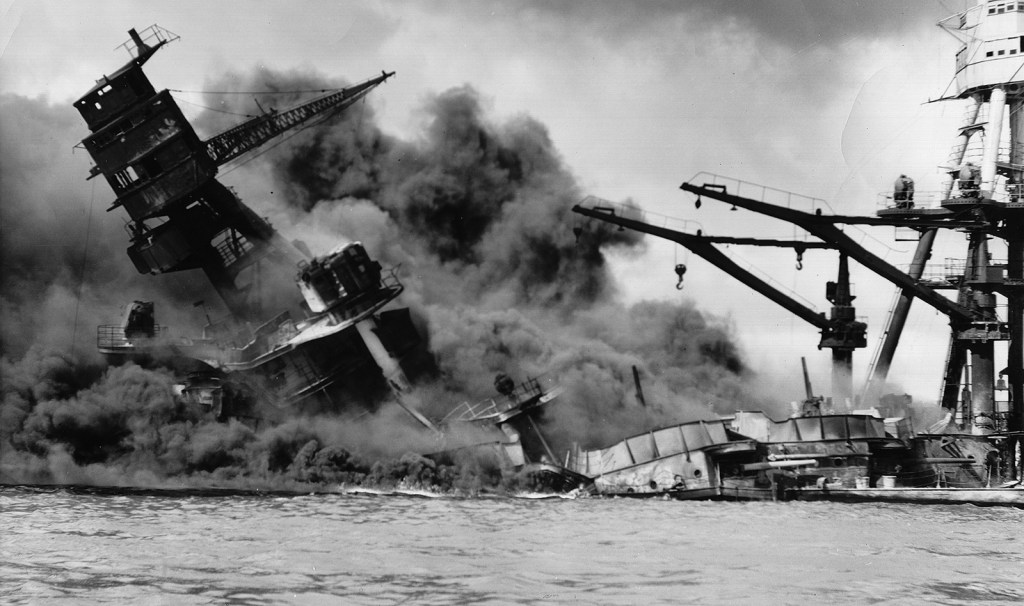
When the 183 Japanese planes of the first wave approached Pearl Harbor from the north without any resistance from the Americans, LtCmdr Mitsuo Fuchida, the commander of the Japanese air strike, signaled to Adm Nagumo the code words “Tora Tora Tora” (tiger, tiger, tiger) which indicated the attack began with complete surprise. Five minutes later, Cmdr Logan Ramsey, Ops officer of Patrol Wing Two, attempted to get the tail number of a plane he thought was flying recklessly. But he recognized the red “meatball” on the plane’s wing and immediately sent out the radio message in plain English, “Air Raid Pearl Harbor. This is no drill.”
Fuchida had six objectives for the first wave. The first five were Pearl Harbor’s air defenses: Wheeler and Hickham Army Airfields, Ford Island and Kaneohe Naval Air Stations, and Ewa Marine Air Station. Most of the planes on these airfields were destroyed before they could get off the ground. And many even before the ammunition could be distributed to the anti-aircraft defenses, which despite repeated war warnings was still locked up in distant armories. Nevertheless, in the chaos, men fought back, including mechanics on Wheeler who threw wrenches at the low flying Japanese. Or more effectively, Chief Petty Officer John Finn, who pulled a .50 Caliber machine gun from a damaged PBY and fought through 21 separate wounds to earn the first Congressional Medal of Honor of the Second World War. Or an unknown marine at Ewa who stood in the middle of the runway firing his pistol at the low strafing planes. The official Japanese records of the attack refer to him at “The Bravest American”. The Japanese pilots specifically targeted him, like jousting knights, but as far they knew the young marine survived the attack. A large portion of the Japanese casualties at Pearl Harbor came by way of that most mocked and denigrated Army and Marine rank, the second lieutenant; eight of whom courageously took off into the teeth of the Japanese onslaught in far inferior planes to take them on at 20-1 odds.
While the Japanese bombed and strafed the airfields, Fuchida personally supervised his pilots at his sixth and primary objective – Battleship Row. There the eight battleships of the US Battleship Divisions 1, 2 and 4 sat. The surprise attack caught the ship’s crews preparing for the day. On the USS Nevada, the band played for morning colors just as the Japanese attacked. They finished despite being strafed because, “It was inconceivable to break formation during the Star Spangled Banner.” Specially designed low draft Japanese torpedoes struck the Nevada moments later, along with her sisters the USS Arizona, California, West Virginia, and Oklahoma. The torpedoes sank the West Virginia and capsized the Oklahoma. In spite of the surprise, the sailors were a bit more prepared to fight than their land based brethren as they had their ammunition on board. During Sunday morning mass on the cruiser USS New Orleans, the chaplain Lt.jg. Howell Forgy blessed his gunners, and told them to “Praise the Lord and pass the ammunition.” On the West Virginia, Messmate Third Class Doris Miller manned a .50 Cal in the conning tower, a weapon he was unfamiliar with, until his ammunition ran out. Miller would receive a Navy Cross for carrying many of his wounded comrades to safety before the West Virginia sank.
After the torpedo bombers, Japanese dive bombers dropped specially converted 16in armor piercing battleship shells on the giant American targets. They would damage every battleship on the Row, but one hit in particular caused nearly half of the American casualties that day. Like her sisters, the Arizona was a battleship developed for the last war. Her armored citadel, the area that protects the vital areas of the ship, could withstand a hit from largest shell of that time, 14”. One of the dive bombers managed to place its converted 16in shell right above the forward magazine, where it penetrated. Seven seconds later a catastrophic explosion destroyed the ship, killing 1100 sailors instantly.
The entire island seemed to be on fire. In 90 minutes, four battleships and three other ships were sunk, four more battleships, and nine others damaged, 300 aircraft destroyed, and 3700 soldiers, sailors, marines, and civilians were killed or wounded by two waves of Japanese carrier based aircraft. It was still less than what was expected. On the outset, Fuchida gave a flare signal for an hastily planned conventional attack, one configured for an expected American defensive preparedness, instead of the planned signal for the attack in case surprise was complete, which it was as signified by the famous “Tora, Tora, Tora” broadcast. Fuchida’s signal prompted the torpedo bombers to wait a few critical minutes before attacking Battleship Row while the dive and level bombers plastered the airfields. Those few minutes were key: they allowed the crews to secure battle stations and close water tight doors. The torpedo bombers as a result took more casualties and their hits less devastating than they could have been. Consequently, Fuchida wanted a third attack: to destroy the fuel farms, dockyards, and repair facilities, and probably also to correct the sub par, though still devastating, results. But he was overruled by Adm Nagumo: most of the Japanese losses occurred during the second wave, and the American carriers were not in port and therefore an unknown threat. Also, the fuel situation would be critical if the Kido Butai lingered which it would have to do all day if a third strike was launched. By noon, all aircraft were recovered, and the Japanese were racing home.
Nagumo would regret his decision for the rest of the war.
 Buk's Historical Ad Hockery
You must be logged in to post a comment.