
Tagged: OnThisDay
America Enters the First World War
The transatlantic telegraph and steam powered ocean transit made the world quite a bit smaller, and brought about the first period of true globalization. For the first time the events across the globe could be read at the breakfast table by ordinary Americans in great detail and relatively soon after they happened. The Zimmerman Telegram and Unrestricted Submarine Warfare by Germany meant that actions by other nations directly affected ordinary Americans. In 1914, the majority of Americans wanted to stay neutral in the latest iteration of the four hundred years long Franco-German struggle for dominance of continental Europe. Less than three years later, the majority of Americans were for intervention.
On 2 April 1917, President Woodrow Wilson broke his campaign promise to “Keep us out of the war” and asked Congress to declare war on Imperial Germany in order to go to “war to end war” and, “The world must be safe for democracy”. On 4 April the Senate voted to declare war and at 3 am on 6 April 1917, the House of Representatives followed suit. That day, President Wilson announced that America had entered the Great War.
The United States was woefully unprepared. The US Army, to include the entire National Guard, was only 208,000 strong. They had just 10,265 men in the US Marine Corps. More Frenchmen and British had been killed (much less wounded) at Verdun and the Somme just the year before than existed in the entire US military. The American army had little experience with units over the size of a regiment since the US Civil War, fifty years before. The War Department had no experience, infrastructure, staff, or plans for the millions of Americans that would need to be drafted in order to stabilize the Western Front.
Nonetheless, the first Americans headed “Over there” in less two months.
The Spanish American War might have introduced us to the World Stage, but now we were starring on it, and would continue to so for the next century. But at the time, we didn’t even know our lines.
The Battle on the Ice
In the late 12th century, the Hanseatic League colonized the upper Baltic around Livonia (modern day Estonia and Latvia), and began converting the pagan Finnic and Ugric peoples there to Christianity. They formed the crusading order The Swordbrothers of Livonia to forcibly convert the pagans. But after a serious defeat in 1236, the Livonian Order merged with another order, the Teutonic Knights.
The Teutonic Knights, who were the most dedicated to the Baltic Crusades (or Northern Crusades, as opposed to the earlier crusades in the Middle East) were themselves defeated by the Mongols along with their uneasy Polish allies at the Battle of Liegnitz in 1241. Checked in the south by the Mongols and the already Catholic Poles, the Teutonic Knights turned north to lands adjacent to their Livonian brothers, and sought to expand their conquests at the expense of the only Russian entity that did not fall to the Mongols, the merchant republic of Novgorod.
Novgorod was not Roman Catholic, but Eastern Orthodox and a legitimate, even preferred target for the Baltic Crusades. The mid-13th Century was the high point of the schism between Orthodoxy and Catholicism; the Fourth Crusade captured Constantinople in 1204 from the Byzantines and in 1242 the city and a large portion of the Byzantine Empire was still part of a Roman Catholic state ruled by a transplanted French born nobility. A Teutonic conquest of rich Novgorod would be a serious blow to the primacy of Orthodoxy in Eastern Europe.
However, Novgorod was led by the young and energetic Prince Alexander Nevsky, who even at the age of 21, was a proven battle leader and adept politician. As the last remaining unconquered Kievan Rus holding, he knew the Teutonic Knights would take advantage of its weakness and attack the city. With the main Mongols army temporarily stymied by the vast marshlands to the east, he gathered his militia, some Mongol mercenaries who were left behind and bored, and the households of his boyars, or nobles, and attacked Livonia in the west, before they could do the same to him.
The raiding into Livonia in the cold March of 1242 brought the Teutonic Knights out of their castles before many of the “summer soldiers” (the crusaders, adventurers, and mercenaries that arrived every spring to loot and rape their away across the Baltic until it got cold.) could arrive. Nonetheless, the Teutonic Knights could muster 100 heavily armored brothers (easily the best trained and best equipped knights in Eastern Europe at the time), 800 superior German and Danish knights, and about 1800 Estonian, German, and Danish infantry.
Nevsky greatly outnumbered the Teutonic Knights but most of his army was of much lower quality. His best troops were the druzhina, the body guards and household companions of the boyars. That thousand was (very) roughly equivalent to the German and Danish knights if a bit more eclectic and not nearly as disciplined. His most numerous troops were the city militia of Novgorod and Finnic-Ugric tribesmen who knew the Teutonic Knights all too well. Though unarmored for the most part, combined they were a formidable mass at nearly 3500 men. Finally, Nevsky had 600 Mongol horse archers.
When the Teutonic Knights attempted to put an end to the embarrassing raids, Nevsky withdrew. The Teutonic Knights assumed that although Nevsky greatly outnumbered them, the poor quality of his troops wouldn’t be able to withstand a charge by the heavily armored knights. But Nevsky was just executing the time honored Russian tactic of withdrawing until turning and facing their attacker on the ground of their own choosing (See every invasion of Russia ever). On 5 April, 1242, Nevsky stopped marching and formed on the east bank of the frozen Lake Peipus.
By withdrawing to the east bank of the frozen lake, the Teutonic Knights were forced to charge across the ice to reach the Russian army. Nevsky drew up his men in three ranks with the tribesmen in front, the city militia behind, and the cavalry in the third, screened by the first two. The knights thundered across the lake and charged directly at the Russian infantry. Their target was Nevsky, as the army would disintegrate without him. However, their slipping and sliding on the ice lessened the blow significantly. The tribesmen and militia held despite horrendous casualties. In many places the ice broke under the immense weight of the charging knights. Fortunately for them Lake Peipus was shallow at the point where the battle was fought, so they didn’t drown. But many knights found it difficult to maneuver in the freezing water up to their stirrups or even knees, whether while engaging the spear and polearm wielding infantry dancing about the unbroken ice, or attempting to force their way through the unbroken ice to engage the infantry on shore. The surviving accounts of the battle describe the knights growing exhausted just from killing infantry, but they never broke. Moreover, the Knights never got close to Nevsky: he commanded from a position behind where he could effectively direct the battle in the Eastern tradition, unlike the Teutonic commander who was in the thick of the melee.
Once the Knights were committed, Nevsky then released some of his cavalry to flank the Knights to the south, while the horse archers did the same to the north. He kept the cream of the druzhina to await a suitable moment for a devastating counterattack. The Teutonic Knights saw the maneuvers, but the ice and the numerous infantry kept them from responding effectively. The horse archers in the north were particularly effective as the lighter horses were much more nimble on the ice, and the heavily laden knights could not effectively come to grips with the Mongols, who picked off the Danish knights at their leisure. The northern flank of the Teutonic line broke.
Nevsky ordered the remaining druzhina to charge into the gap. The Teutonic Knights were surrounded, and it was clear to everyone on the “field” of battle that the Knights’ cause was lost. Individually, then in groups, they began to cut their way out. The infantry routed and “countless Estonians were killed”. In their haste many perished when they traversed patches of thinner ice to avoid the pursuers and plunged into the icy water, which was much deeper the further they were away from the eastern shore.
Alexander Nevsky’s victory at the Battle on the Ice ended the Teutonic Knights’ ambitions on Russian territory. Once the Mongol threat subsided, they would eventually turn on Lithuania and Poland. Ten years after the battle, Nevsky was crowned Grand Prince of Vladimir, the supreme ruler of all Russians, and in 1547, he was canonized by the Eastern Orthodox Church. In 1938, the campaign and battle was immortalized in Sergei Eisenstein’s Soviet propaganda film, “Alexander Nevsky” which became very popular during the Second World War, even though it was taken out of circulation when Nazi Germany and Stalin’s Soviet Union were allies between August 1939 and June 1941.
The Combat of the Thirty
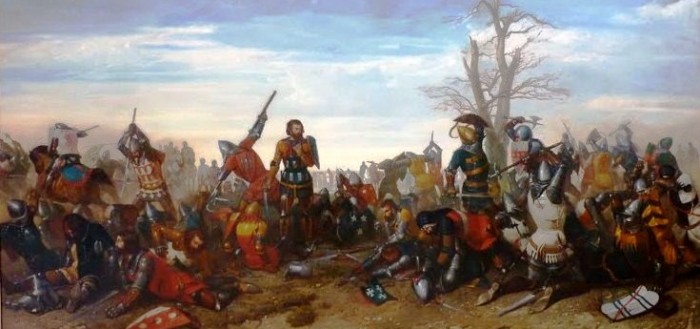
With the death John III, Duke of Brittany (in today’s northeast France), the Houses of Blois and Montford fought for control of the Duchy in the Breton War of Succession, a “subwar” of the Hundred Years War between England and France. On 26 March 1351, thirty Breton knights and squires from French aligned House of Blois, and thirty English, Breton, and German knights, with squires and men at arms from English aligned House of Montford met at the “Place of the Midway Oak”.
The field was located between the castles of Plomeril and Josselin in Brittany. The arranged chivalric melee was to end the bitter raiding that plagued the lands of both Houses. After hearing Mass together, the two groups exchanged pleasantries and small talk for several hours before lining up to fight on trodden ground. The first clash was an inconclusive brawl in which many were wounded. Both sides broke off combat to tend the injuries, mingle, and share wine with their foes.
The second melee was much bloodier than the first and the wounded included the Blois leader, Jean de Beaumenoir. When he asked for water and a stop to the combat, his second replied “Drink thy blood, Beaumanoir; thy thirst will pass”. The combatants of Blois eventually broke the Montfords after killing their leader, the Englishman Robert Bramborough, and riding down the unhorsed Germans who attempted to form a shield wall on the open ground. Seven were killed on the Montford side, three on the Blois side (including the leaders of both) and everyone else was wounded, most seriously.
Everyone captured recovered from their wounds and were released after a small ransom. House Blois would eventually control Brittany, or “Little Britain”: one of the Six Celtic Nations. Up to that point, Brittany was much more culturally aligned with their liegemen across the channel, the Cornish of the southwest Kingdom of England. However the House Blois renounced any ties to England and became part of France, where it remains today.
The Second Battle of Sirte
On 18 March 1942, Malta suffered its 1600th air attack by the Italian air force and German Luftwaffe. That is one attack every ten hours for 21 months on the tiny island 60 miles off of Sicily. Most fell on the ships and airfields around Valetta and the Grand Harbor, but no place was safe above ground and the Maltese civilians could only find refuge in the vast system of medieval catacombs cut into the rock. Since Italy entered the war in June 1940, the planes, ships, and submarines from Malta sank nearly 2/3rds of the Axis supply ships destined for Italian and eventually German operations in North Africa. But in December of 1941, winter weather on the Eastern Front precluded Luftwaffe operations there, and the planes of Luftflotte 2, commanded by Gen Albert Kesselring (we will hear his name again) were sent south to Sicily. They pounded Malta’s defenses into submission. By mid-February, Malta was no longer an offensive base. By March, all of its defending fighters were shot down, anti-aircraft ammunition was dangerously low, spare parts had to be brought in by submarine, fuel oil for the port was low, and its coastal defenses wrecked. Via Ultra, the British knew of Operation Herkules, the proposed German-Italian invasion of the island was coming soon. Malta needed help, and needed it immediately.
However, with the loss of the Cyrenaican airfields to Rommel’s riposte after Operation Crusader, every convoy required a massive undertaking by the Royal Navy’s Mediterranean Fleet. Along with protecting the freighters from the ubiquitous Axis aircraft, the convoy escorts also had to worry about the Italian Navy, which in March 1942, had a substantial qualitative and quantitative advantage over the Royal Navy, at least in regards to ships. In December, Italian frogmen infiltrated Alexandria harbor and severely damaged the only two remaining British battleships in the Eastern Mediterranean, leaving just light cruisers and destroyers to defend the convoys should the Regina Maria sortie from its port in Taranto to intercept. But there was no longer a choice.
On 20 March, 1942, convoy MW-10 (Malta West-10) consisting of just three fast freighters and a fast tanker, departed Alexandria escorted by every available ship in the British Mediterranean Fleet, whether from Malta or out of Alexandria: four light cruisers, one special anti-aircraft cruiser, twelve destroyers, and six destroyer escorts. Italian submarines spotted the departure, and a few hours later the Regina Maria departed Taranto to intercept.
The British commodore, Rear Admiral Phillip Vian was as tough as they came: it was he and his men who boarded the Altmarck in 1940, made near suicidal torpedo runs on the Bismarck, survived numerous Arctic convoys, and made the run to Malta several times in 1941. But he was no fool. The Italian sortie was his enemy’s most likely and most dangerous course of action. His numerous but lightly armed force could not win a long range gun duel with Italian heavy cruisers and battleships. He had to force the Italians to close the distance, and then flee, while still protecting the convoy from direct fire. All the Italians had to do was get between him and Malta, and then they could just conduct a gunnery exercise, only with live targets. He decided not to attack the Italian ships, but their leadership.
On the early afternoon of 22 March, the British spotted two Italian heavy cruisers in the Gulf of Sirte off of Libya. In fine Nelsonian tradition, most of the British escorts charged through the heavy Mediterranean winter swells “to engage the enemy more closely”. The convoy itself turned south with the antiaircraft cruiser and the destroyer escorts. But the Italians weren’t looking for a fight just yet. Soon they returned with the rest of their force: another cruiser, ten destroyers and the modern battleship, the Littorio.
The Littorio and the two heavy cruisers out ranged and out gunned everything Vian had by a wide margin. To compensate for this he divided his force into five divisions which in perfectly rehearsed fashion laid smoke at 45 degree angles to the Italians. This created corridors of smoke from which the British divisions could emerge, fire, and when the bracketed Italian salvos grew close, to retreat to without fear of colliding with friendly vessels. The radar-less Italians would be forced to close the distance if only to prevent the convoy from slipping past in the confusion. He could then assault the Italians with his most potent weapon: the short range torpedoes on his destroyers. If they didn’t, Vian would wait behind the smoke until nightfall, when his radar would give him a significant asymmetric advantage. The appearance of just the Littorio also simplified his plan to attack the Italian leadership. He had expected all three remaining Italian battleships (the Italian commander didn’t want to risk all of his battleships. That should tell you something right there). When there was just one, it was clear where the admiral was.
With the smoke laid, the British ships began a game of cat and mouse with the Italians, albeit with much more serious consequences. Through the high seas that soaked even observers in the range towers, the British concentrated their fire on the Littorio to the most reasonable extent possible, even though no British ship could penetrate its armor at even medium range.
By late afternoon the plan was working. The Italians kept heading west to get between the convoy and Malta, but they couldn’t spot the freighters even though they were well within range. The strong westward wind kept the vulnerable convoy screened by the smoke until nightfall, with Vian’s cruisers and destroyers darting in and out, pounding on the Littorio. Vian expected the Italian commander to go east and around the smoke screen, from where he could have run down the slower convoy. However, this would have exposed the Italians to close contact with the aggressive British, and this was a risk Italian commander was not prepared to take.
By sundown, the Italians had had enough. They had damaged three British cruisers and at least five destroyers, but they couldn’t close with and destroy the ships carrying the vital supplies for Malta. Not wanting to risk the Littorio in a night action (and Mussolini’s wrath if it was sunk), the Italian commander sailed north back to port.
It was a great victory against overwhelming odds, but with an asterisk.
Vian’s tactical success at the Second Battle of Sirte unfortunately had serious operational consequences. The Italian ships may not have been able to fire on the convoy, but the delay caused by the battle meant that they would not arrive in Malta during darkness. When the sun rose on the 23rd, they were still many miles from Valletta. The Luftwaffe pounded them that next morning. Two of the four ships in the convoy were sunk along with three destroyers. The other two freighters were sunk while they were being unloaded. 80% of their cargo was lost.
Malta was on life support.
The Canine Corps
On 13 March 1942, the US Army Quartermaster Corps established the Canine (K-9) Corps to train dogs for a variety of wartime duties. The dogs went through “basic training” for 8 weeks and then, based on performance, would be assigned a specialty: sentry, scout, messenger, or mine dog. The program was so successful that K-9 “recruiters” had sought “volunteers” to fill the burgeoning need for the dogs, and quickly separate programs were established in the Navy and Coast Guard. Originally, over thirty breeds were accepted into the K9 Corps but by 1944 only 7 were accepted: German Shepherds, Doberman Pinschers, Belgian Sheep Dogs, Siberian Huskies, Farm Collies, Eskimo dogs, and Alaskan Malamutes. The most famous WWII K9 was a sentry trained German Shepherd named Chips who was assigned to the 3rd Infantry Division. In 1943, Chips single pawedly attacked four Germans in a machine gun nest after they wounded his handler and forced them all to surrender.
The Battle of the Taukkyan Roadblock
The Seabees
Admiral Ernest King, the US Chief of Naval Operations, and indefatigable advocate of an Allied “Japan First” policy, saw that the inevitable American counterattack in the Pacific would require a US Navy capability and capacity to build multiple naval facilities on captured Japanese islands in order to prepare for further operations. In late 1941, the US Navy had no such capability. The interwar system for building facilities relied on designated naval officers who outsourced the work to civilian, native, or colonial contractors and then oversaw the project to completion. This method was used for all of America’s overseas possessions, and was fine for peacetime. But the use of civilian labor for constructing wartime infrastructure could be construed as a violation of the laws of warfare, and the civilians labeled as “unlawful combatants”. Furthermore, the use of civilian contracts was too time consuming for wartime when facilities would be required within weeks, and sometimes days and hours, of a landing on a Japanese held island. The Navy’s proposed solution, “naval construction battalions”, would need to follow close behind, if not accompany, the Marine Corps’ assault forces. In January 1942, Adm King authorized the formation of a Naval Construction Regiment of three battalions that could not only provide infrastructure support for the US Navy and Marines in remote locations, but also defend themselves if need be.
Though they could find sailors that could defend themselves, they couldn’t find many in the active duty navy, or even naval reserve, that had the necessary skillsets to provide the infrastructure support. For obvious reasons, the sailors were required to be master journeymen in over 150 different trades, such as electrician, mason, carpenter etc. There were few resident in the force, and those that were, were immediately sent to Tongatabu and Effate in the South Pacific to build critical convoy refueling stations between the United States and Australia. By February, the US Navy realized they couldn’t man the construction battalions, or “CB”s for short.
On 5 March, 1942, Rear Admiral Ben Moreell, the Chief of the Navy Bureau for Yards and Docks authorized the direct recruiting of civilians into the “SeaBees”, a term he allowed for use by the recruiters. The recruiters were unleashed on the big construction sites across the US looking for those skilled enough and between the ages of 18 and 50 (Though the recruiters didn’t look too hard at the ages: the oldest in that initial recruiting drive was 62, the average 37). By April, the need was so great that SeaBee recruits went through a short basic training of just three weeks before they were assigned to an adhoc detachment and shipped overseas.
The SeaBees would be with the Marines during the first air attack on Midway, endure the shelling of Henderson Field on Guadalcanal, and participate in every American naval campaign in the Pacific. By the end of the war, 191 US naval construction battalions were created.
Construimus, Batuimus
“We build. We fight”
The Battle of the Java Sea
On the morning of 26 February 1942, the forlorn sailors on ships of four nations, America, Britain, Australia, and the Netherlands, dejectedly listened to the words of the Adm Ernest King, the American Chief of Naval Operations, tell the world that the United States would concentrate on Germany first, then Japan. About that time, the last B-17, packed with US Army Air Corps ground crew, departed Surabaya on Java for Australia, never to return. The sailors were being sacrificed, and they knew it.
Later that morning, Adm Karel Doorman, the Dutch commander of the remaining Allied ships, received a report that the long awaited Japanese invasion fleet destined for Java had set sail from Borneo. One hundred Japanese transports were escorted by a light aircraft carrier, six heavy and five light cruisers, and over forty destroyers. Doorman had a motley crew of three British, four American, and two Dutch destroyers; one Australian light cruiser, the HMAS Perth, and two Dutch, the HMNLSs Java and DeRuyter; and two heavy cruisers, HMS Exeter (of Graf Spee and River Platte fame) and USS Houston (“FDR’s Fishing Yacht”, whose polished teak wood decks carried the Commander in Chief on many an overseas voyage).
Doorman’s task force was ragged. They had just returned from another fruitless sweep of the Java Sea, sighting only Japanese planes, and no ships. All of his ships were in various states of repair. One of the Houston’s turrets was destroyed by an air attack, which reduced the firepower of her big 8” guns by a third. The crews were exhausted, and at sea they had to man double watches in order to have any warning at all of air attack. Communications in battle were especially hard, as the majority of his force spoke English which he did not. Any orders he gave had to be translated, which took time. Moreover, he had to work with three sets of code, so most transmissions were in the clear. Furthermore, his flagship, the DeRuyter, could only communicate via radio with the Houston; its sets incompatible with the rest of the non-Dutch fleet. So in order to do a simple maneuver, Doorman gave an order, have it translated, sent to the Houston, who then transmitted it to the other ships. During battle, this was not a satisfactory state of affairs.
Doorman set sail to find the Japanese and stop the invasion of Java. All day and into the evening of 26/27 February he searched but could not locate them. Meanwhile the sailors on the heavy swells caught the occasional glimpse of Japanese reconnaissance planes through the low overcast skies in the worsening weather. That night, Doorman decided to turn back and refuel, and try again the next day.
They were only in port that morning for a few hours, before a frantic report was received which sighted the Japanese fleet only 90 miles northwest. Doorman ordered all the ships back to sea, no matter the state of refueling.
Adm Takeo Takagi was driving for them. He sent his transports to the north, on first sighting, and closed with the Allies as fast as he could. They were the last obstacle between Japan’s conquest of Java, and Japan was down to two months’ worth of oil reserves. Days mattered.
The two fleets spotted each other on the afternoon of 27 February 1942 at 30000 yards. At 28000 yards the Japanese cruisers opened fire; they missed but the rounds straddling the Allied ships astonished their crews. The Japanese were still well outside the range of even the big guns on the Exeter and Houston. Doorman closed but ordered a turn so as to not get the Allied “T” crossed, which unfortunately kept the Japanese out of range of the light cruisers quick firing 6” guns, his most numerous and dangerous weapons. Then a round penetrated the Exeter, the second cruiser in line behind Doorman, which didn’t explode but cut a steam line and blew out a boiler. Her speed was cut in half. She turned to starboard so as to not get hit by the Houston speeding at her from behind, but the Houston just slowed down and followed to maintain formation. She in turn was followed by the rest of the light cruisers and rearward destroyers, while Doorman and the forward destroyers sailed on ahead. The mistake was only corrected as the Exeter, unable to make more than 13 knots, turned about with the nearest two destroyers for escort, to head for Surabaya, but the formation was by this point broken. About this time a dud shell knocked out the Houston’s TBS radio, the ship-to-ship set that passed the communications from Doorman on the DeRuyter. For the rest of the battle, orders had to be relayed by blinker light, in high seas, from great distances, and across patches of oily smoke from fires or laid by screening destroyers. The Japanese had no such problems.
Takagi had clear communications with his ships, longer ranged guns on his cruisers, and spotting planes which greatly increased his fire control. Furthermore, his Long Lance torpedoes had twice the explosive power and twice the range of the Allied equivalents, and he had more of them. In the chaos caused by the Exeter’s damage and the breakdown of Allied command and control, the Japanese closed in for the kill.
However they only managed to sink one Dutch destroyer, the Kortenaeur, which was hit by a torpedo, “went up in a great flash of light, and a thunderclap”, then “broke in two, jack knifed, and sank” in less than fifteen seconds, and a British destroyer, the HMS Electra (the ship that rescued the only three survivors from the destruction of the HMS Hood nine months before), who went dead in the water and took her punishment for a much longer time. The chaos actually worked in the Allies’ favor. The four American destroyers of DESRON 58, out of contact with everyone but themselves, on their own initiative made a torpedo run (that didn’t hit anything), laid smoke, and then, nearly out of fuel, turned back for Surabuya. The smoke gave Doorman just enough time to turn back around and miraculously gather up the other cruisers before nightfall, but he would never again see the four American destroyers.
Later that night, Doorman attempted several times to sneak around Takagi and engage his true objective: the transports. But without air reconnaissance he would need a miracle, and Japanese night fighting superiority did not allow for Allied miracles. Japanese ships fired star shells and planes dropped flares. They routinely spotted his ships, now down to only four cruisers, after his last remaining destroyer was sunk in an unmarked Dutch minefield. Takagi closed in time and again, and each time Doorman withdrew into the darkness for another attempt to get around him. But Takagi eventually cornered the Allies, and to much better effect than the afternoon before. He sank both the Java and DeRuyter just before sunrise on the 28th. Doorman, ever the courageous and duty bound romantic, went down with his ship. His last order was for the Houston and Perth not to stop to pick up survivors, and make a run for Australia.
The Japanese through superiority in almost all areas, sunk or scattered the last remaining obstacle before their successful conclusion of the East Indies campaign. They only needed to prevent the remaining Allied ships from escaping. The Japanese were now free to go east to New Guinea and America’s possessions in the Pacific, south to Australia, or west to India and Ceylon (modern Sri Lanka)…
Or as they have so ably demonstrated over the last three months – all three directions at once.
The Battle of Los Angeles
On the night of 23 February 1942, the Japanese submarine I-17 crept along the coast of California; lookouts desperately trying to identify their captain’s very specific target – the Ellwood Oil Fields. Commander Kozo Nishino had an intensely personal reason for the target of the first Japanese attack on the Continental United States: The Americans laughed at him there.
Nishino was a naval reserve officer, and as a civilian he was an oil tanker captain. A few years before the American embargo, he sailed through the Santa Barbara strait destined to pick up a load of oil from Ellwood. On his way to the docking ceremony, he tripped and fell into a cactus, and his crew had to pull needles from his posterior. He never forgave the snickering Americans.
At 7 pm, the I-17 spotted the oil fields, and Nishino ordered his 5.5” deck to fire. On the choppy seas, the Japanese gunner was not very accurate. But each of the 21 rounds fired landed within about a hundred yards of the spot where Nishino had the cactus spines removed from his ass, so his honor was satisfied. I-17 sailed away to look for merchant ships. The bombardment did about $500 worth of damage, and slightly lowered property values.
The psychological effect was much greater. Pearl Harbor was only 80 days or so previously. The US Army had recently established black out and civil defense procedures and drills. But this was No Drill: those were real explosions, made by real Japanese shells, fired by real Japanese guns, from a real Japanese ship, by really real Japanese sailors shouting “Banzai”. After dutifully blacking out his hotel, a local innkeeper near the oil fields called the sheriff to report explosions nearby. More drmatically, the ship was spotted by a reverend in Motecito, who also called the police. From those two initial reports rumors snowballed across southern California: The Japanese were going to invade.
The next night the entire 37th Coast Artillery Brigade, responsible for Los Angeles and the surrounding area, went on alert. A total blackout was ordered and they prepared to repel the invaders. Nothing happened until 3:14 am on the morning of the 25th, when someone thought they heard something above. Search lights pierced the night sky, then someone fired. Soon, everyone began shooting. For the next hour, Angelinos and their defenders in the 37th blazed away into the darkness above. They fired 1400 large caliber anti-aircraft gun rounds, and tens of thousands of small arms ammunition, before order was restored. Seven civilians were killed: three from heart attacks caused by the stress of the situation, and four from descending rounds, because what goes up must come down.
The Japanese later denied any forces in the area besides I-17. The official US Army investigation concluded that the incident was “a case of war nerves”, and the object sighted at 3:14 in the morning was an “errant weather balloon”, which led many conspiracy theorists to believe that the object was actually a UFO.
Operation Junction City
After Operation Cedar Falls, Gen Westmoreland’s staff felt that the Central Office of South Vietnam (COSVN), the Viet Cong’s primary headquarters in the south, escaped into the Tay Ninh province along the border with Cambodia, with the VC battalions that weren’t found in the Iron Triangle. Furthermore, due to the movement to contact-esque and adhoc nature of Operation Attleboro in November, Westmoreland felt that, though the 9th VC Division and 101st NVA Regiment were mauled, their base areas in Tay Ninh weren’t completely destroyed. So he ordered the II Corps commander, LTG Seaman, to “think big”, and plan a deliberate operation to clear the Tay Ninh province, and complete the destruction of the Communist main force units. The problem was they weren’t there.
As per Giap’s orders after Operation Attleboro, the relatively unpopulated Tay Ninh, known as War Zone C to the Americans and South Vietnamese, was used strictly as a transit area for men, weapons, and supplies for guerilla operations in the much more densely populated area around Saigon, known as War Zone D. COSVN was firmly established in the Fishhook in Cambodia, where it would remain, except for a brief period in 1970, until 1975. COSVN did have the equivalent of a tactical command post in Tay Ninh, but it was just a clearing house for reports from inside South Vietnam. The VC that escaped the Cedar Fall’s cordon around the Iron Triangle, were either in the Cu Chi tunnels near Saigon, or were used to reconstitute the 9th VC Division, which was in Cambodia. The only Communist troops in Tay Ninh in mid-February 1967 was an understrength local VC battalion primarily used to watch potential landing zones. LTG Seaman’s next big search and destroy operation, Operation Junction City, named after Fort Riley’s ville, was seemingly destined to find little and destroy less.
Operation Junction City was massive: Sixteen battalions from the 1st and 25th Infantry Divisions, and the 196th Infantry Brigade, established the eastern and western cordons. In the only airborne operation of the Vietnam War, a battalion of the 173rd Airborne Brigade dropped in to form blocking positions to the north, after the brigade commander lobbied Westmoreland, himself a paratrooper, to include a combat jump in the operation. With the anvil set, the hammer would again fall to the 11th Armored Cavalry Regiment supported by a brigade from the 25th Infantry Division, both assaulting into the pocket from the south.
At dawn on 22 February 1967, B-52’s pounded suspected Communist positions inside War Zone C. They hit nothing but earth and just alerted the small COSVN TAC to escape. At 9 am, paratroopers drifted down into drop zones, and enormous armadas of helicopters and trucks delivered the anvil battalions to their positions. They trapped virtually nothing, certainly not the twelve VC and NVA main force battalions Westmoreland expected to be there.
Fortunately, Gen Nguyen Thi Thanh, the COSVN commander and Giap’s rival, wanted to engage the Americans in battle. Unlike Giap, he felt that engaging the Americans would increase the likelihood of a general uprising in South Vietnam, and increase the morale of his men. If the Americans wanted a fight, he would oblige them.
It was the VC that would save Westmoreland and Seaman from embarrassment, cover up one of the biggest intelligence failures of the war, and prevent Operation Junction City, the largest Allied operation so far, from being a complete waste of resources.
 Buk's Historical Ad Hockery
You must be logged in to post a comment.