
Tagged: NeverForget
The Sook Ching Massacre
Like all racialists, the victorious Japanese on Syonan-to (Japanese for “Light of the South”, the new name for Singapore) immediately separated their adversaries and the civilian population by the color of their skin. In a process known as “Daikensho”, “The Great Inspection”, Japanese Kempeitai (secret police) categorized each prisoner and civilian based on race, and then by how likely they would resist the Japanese occupation.
After an initial bloodletting in which all of the occupants and staff of the Alexandra Hospital were murdered, and all surrendering wounded were killed, the white civilians, and officers and soldiers of the British and Australian units were marched north. They were sent to camps in Thailand where they were to be worked to death building roads, bridges, and railroad tracks in support of the Japanese invasion of Burma, and subsequently India.
The 40,000 Indian soldiers and ex-patriates were initially treated quite differently. The Japanese sought to exploit Indian nationalism, and actively recruited Indian soldiers to fight against the British in Burma. An Indian expatriate, Mohan Singh, gave a powerful speech to the assembled mass on an independent India’s role inside the Japanese Co-Prosperity Sphere. Over 12,000 volunteered to fight for Japan under the banner of the Indian National Army. The wounded from the remainder were then killed, and the rest were sent to camps on Singapore and were worked to death improving Japanese defenses and facilities around the Southeastern Pacific.
Most of the population of Singapore was ethnic Chinese, and the Japanese were concerned about their support for Chiang Kai-shek, the Nationalist leader in China. The Kempeitai set up screening centers all across the island. At first, only members of Chinese nationalist organizations were killed. Then the killing was extended to wealthy Chinese, then businessmen and capitalists, and then teachers, priests and monks. Soon, as with any bureaucracy drunk with power and evaluated by “numbers processed”, the criteria constantly changed to include more and more “undesirables”. Civil servants, Chinese who arrived after 1937 (the beginning of the Second Sino-Japanese War, men with tattoos (thought to be Triad), men from Hainan (thought to Communist), people who possessed weapons of any kind, even “tall” men (thought to be potential leaders), and anyone deemed a threat were all killed, many in the most gruesome manners possible.
The process dehumanized the Chinese, and in the eyes of the Japanese were unworthy of dignity. They weren’t just murdered, they were used as objects to fulfill a purpose – as training aides and playthings for the Japanese occupiers. The women were forced into brothels or raped to death in the barracks. The men were used as live bayonet dummies, targets on rifle and machine gun ranges, or tortured for fun or sport at the end of a hard day’s work.
Over the next three weeks, the Daikensho would claim the lives of at least 70,000 Chinese on Singapore, with tens of thousands more unconfirmed.
The Chinese would remember The Great Inspection of Singapore as the “Sook Ching”,
“The Purge”.
“Tora Tora Tora”: The Raid on Pearl Harbor
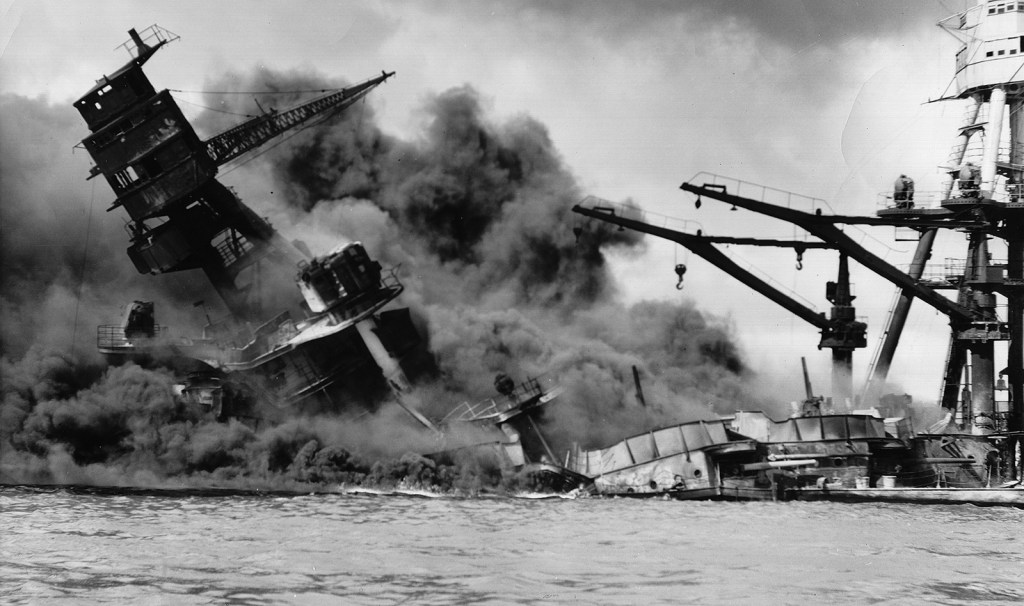
When the 183 Japanese planes of the first wave approached Pearl Harbor from the north without any resistance from the Americans, LtCmdr Mitsuo Fuchida, the commander of the Japanese air strike, signaled to Adm Nagumo the code words “Tora Tora Tora” (tiger, tiger, tiger) which indicated the attack began with complete surprise. Five minutes later, Cmdr Logan Ramsey, Ops officer of Patrol Wing Two, attempted to get the tail number of a plane he thought was flying recklessly. But he recognized the red “meatball” on the plane’s wing and immediately sent out the radio message in plain English, “Air Raid Pearl Harbor. This is no drill.”
Fuchida had six objectives for the first wave. The first five were Pearl Harbor’s air defenses: Wheeler and Hickham Army Airfields, Ford Island and Kaneohe Naval Air Stations, and Ewa Marine Air Station. Most of the planes on these airfields were destroyed before they could get off the ground. And many even before the ammunition could be distributed to the anti-aircraft defenses, which despite repeated war warnings was still locked up in distant armories. Nevertheless, in the chaos, men fought back, including mechanics on Wheeler who threw wrenches at the low flying Japanese. Or more effectively, Chief Petty Officer John Finn, who pulled a .50 Caliber machine gun from a damaged PBY and fought through 21 separate wounds to earn the first Congressional Medal of Honor of the Second World War. Or an unknown marine at Ewa who stood in the middle of the runway firing his pistol at the low strafing planes. The official Japanese records of the attack refer to him at “The Bravest American”. The Japanese pilots specifically targeted him, like jousting knights, but as far they knew the young marine survived the attack. A large portion of the Japanese casualties at Pearl Harbor came by way of that most mocked and denigrated Army and Marine rank, the second lieutenant; eight of whom courageously took off into the teeth of the Japanese onslaught in far inferior planes to take them on at 20-1 odds.
While the Japanese bombed and strafed the airfields, Fuchida personally supervised his pilots at his sixth and primary objective – Battleship Row. There the eight battleships of the US Battleship Divisions 1, 2 and 4 sat. The surprise attack caught the ship’s crews preparing for the day. On the USS Nevada, the band played for morning colors just as the Japanese attacked. They finished despite being strafed because, “It was inconceivable to break formation during the Star Spangled Banner.” Specially designed low draft Japanese torpedoes struck the Nevada moments later, along with her sisters the USS Arizona, California, West Virginia, and Oklahoma. The torpedoes sank the West Virginia and capsized the Oklahoma. In spite of the surprise, the sailors were a bit more prepared to fight than their land based brethren as they had their ammunition on board. During Sunday morning mass on the cruiser USS New Orleans, the chaplain Lt.jg. Howell Forgy blessed his gunners, and told them to “Praise the Lord and pass the ammunition.” On the West Virginia, Messmate Third Class Doris Miller manned a .50 Cal in the conning tower, a weapon he was unfamiliar with, until his ammunition ran out. Miller would receive a Navy Cross for carrying many of his wounded comrades to safety before the West Virginia sank.
After the torpedo bombers, Japanese dive bombers dropped specially converted 16in armor piercing battleship shells on the giant American targets. They would damage every battleship on the Row, but one hit in particular caused nearly half of the American casualties that day. Like her sisters, the Arizona was a battleship developed for the last war. Her armored citadel, the area that protects the vital areas of the ship, could withstand a hit from largest shell of that time, 14”. One of the dive bombers managed to place its converted 16in shell right above the forward magazine, where it penetrated. Seven seconds later a catastrophic explosion destroyed the ship, killing 1100 sailors instantly.
The entire island seemed to be on fire. In 90 minutes, four battleships and three other ships were sunk, four more battleships, and nine others damaged, 300 aircraft destroyed, and 3700 soldiers, sailors, marines, and civilians were killed or wounded by two waves of Japanese carrier based aircraft. It was still less than what was expected. On the outset, Fuchida gave a flare signal for an hastily planned conventional attack, one configured for an expected American defensive preparedness, instead of the planned signal for the attack in case surprise was complete, which it was as signified by the famous “Tora, Tora, Tora” broadcast. Fuchida’s signal prompted the torpedo bombers to wait a few critical minutes before attacking Battleship Row while the dive and level bombers plastered the airfields. Those few minutes were key: they allowed the crews to secure battle stations and close water tight doors. The torpedo bombers as a result took more casualties and their hits less devastating than they could have been. Consequently, Fuchida wanted a third attack: to destroy the fuel farms, dockyards, and repair facilities, and probably also to correct the sub par, though still devastating, results. But he was overruled by Adm Nagumo: most of the Japanese losses occurred during the second wave, and the American carriers were not in port and therefore an unknown threat. Also, the fuel situation would be critical if the Kido Butai lingered which it would have to do all day if a third strike was launched. By noon, all aircraft were recovered, and the Japanese were racing home.
Nagumo would regret his decision for the rest of the war.
 Buk's Historical Ad Hockery
You must be logged in to post a comment.