
Tagged: MiddleAges
The Raid at Targovisti and The Forest of the Impaled
In 1559, the Ottoman Sultan Mehemd II sent envoys to the Principality of Wallachia to inquire why the jizya (The Islamic tax on non-believers) had not been paid. Wallachia’s voivode, or prince, Vlad III Dracula (“Dracula” because he was the son of Vlad II Dracul) felt that his rule over Wallachia was sufficiently consolidated, and that he no longer needed the Turks. He knew war would come with the Ottoman Empire if he didn’t pay so in his customarily bloodthirsty manner, Vlad provoked one. He asked the envoys why they didn’t remove their turbans in his presence, and when they replied it was not their custom, he had his guards nail the turbans to their heads.
After ambushing and defeating the army the sultan sent for revenge, Vlad III Dracula invaded Bulgaria. He slaughtered, by his own words, over 25,000 Turks and Bulgars, “…without counting those whom we burned in [their] homes or the Turks whose heads were cut [off] by our soldiers…” In retaliation, Mehmed II sent a massive army of over 130,000 against Vlad to annex Wallachia outright.
Vlad could muster only about 30,000 men against this force, so he needed to reduce the Turkish numbers if he planned to defeat them in battle, or more likely, force them into a siege where the Turks could be weakened then annihilated. Vlad conducted a guerrilla campaign against the Turks with his cavalry, killing and capturing thousands of foragers and stragglers. He also sent diseased people into the Turkish camps in a crude form of biological warfare, and managed to infect part of the sultan’s army with the Bubonic plague and leprosy. Worse still, he conducted a scorched earth policy back across Bulgaria and into Wallachia. He killed or removed the people, poisoned the wells, salted the fields, burned the villages, rerouted rivers to make swamps, and rendered the castles indefensible, even in his own country. The Turks advanced into a wasteland. In mid-June 1462, Mehmed approached Vlad’s capital, the fortress city of Targoviste, where he knew Vlad planned to make a stand. A few days before the Turks invested the city, they paused and made camp to prepare. Vlad, who grew up among the Turks as a hostage but didn’t convert, snuck into the camp to assess his adversaries. He found them weak and disorganized.
On the night of 16-17 June 1462, Vlad III Dracula attacked the Turkish camp in daring torch lit raid for the specific purpose of assassinating the sultan. The charge of about 10,000 horsemen caused great confusion amongst the Ottomans. Vlad himself led the attack directly at the sultan’s tent. However, in the confusion of the assault, Vlad mistook the grand vizier’s opulent tent for the sultan’s. By the time he realized his mistake, the sultan’s Janissaries (elite warriors comprised of Christian boys forcibly converted to Islam then trained as soldiers) led by Vlad’s brother Radu, whom shared his time as a hostage, rallied and protected the sultan. The Wallachians withdrew back into Targoviste, unsuccessful in their mission.
It took the Ottomans several days to reorganize. Once ready, Mehmed advanced again on Targoviste intent on ending the Wallachian resistance once and for all time. He was not prepared for what he found in the fields just outside the city.
Vlad III Dracula was one of the most bloodthirsty men in history, for good reason. Even by the brutal standards of the day, Vlad set himself apart. His favorite form of torture and execution was “impalement”. During impalement, a long thick sharpened pole was inserted into the victim’s anus and the pole was then placed upright into the ground with the victim perched above. Over hours and sometimes days, the victim would slowly slide down the pole until sharpened end pierced out of the torso, or even the throat or mouth if the angle was correct. In an age of gruesome executions, impalement was probably the worst way to die.
On 23 June 1462, Mehmed approached Targoviste and found tens of thousands of his warriors and people impaled. All of the stragglers and any Turkish people Vlad captured, including prisoners from the recent raid, Vlad had impaled in front of Targoviste. An observer noted, “Twenty thousand men, women, and children had been spitted” and “There were infants too affixed to their mothers on the stakes, and birds had made their nests in their entrails…” The sultan called the grisly sight, “The Forest of the Impaled”. It had its intended effect on the Ottoman Army; Mehmed withdrew from Wallachia.
Thereafter Vlad III Dracula would be known as “Vlad Tepes” – Vlad the Impaler.
Miyamoto Musashi Defeats Sasaki Kojiro
The Battle on the Ice
In the late 12th century, the Hanseatic League colonized the upper Baltic around Livonia (modern day Estonia and Latvia), and began converting the pagan Finnic and Ugric peoples there to Christianity. They formed the crusading order The Swordbrothers of Livonia to forcibly convert the pagans. But after a serious defeat in 1236, the Livonian Order merged with another order, the Teutonic Knights.
The Teutonic Knights, who were the most dedicated to the Baltic Crusades (or Northern Crusades, as opposed to the earlier crusades in the Middle East) were themselves defeated by the Mongols along with their uneasy Polish allies at the Battle of Liegnitz in 1241. Checked in the south by the Mongols and the already Catholic Poles, the Teutonic Knights turned north to lands adjacent to their Livonian brothers, and sought to expand their conquests at the expense of the only Russian entity that did not fall to the Mongols, the merchant republic of Novgorod.
Novgorod was not Roman Catholic, but Eastern Orthodox and a legitimate, even preferred target for the Baltic Crusades. The mid-13th Century was the high point of the schism between Orthodoxy and Catholicism; the Fourth Crusade captured Constantinople in 1204 from the Byzantines and in 1242 the city and a large portion of the Byzantine Empire was still part of a Roman Catholic state ruled by a transplanted French born nobility. A Teutonic conquest of rich Novgorod would be a serious blow to the primacy of Orthodoxy in Eastern Europe.
However, Novgorod was led by the young and energetic Prince Alexander Nevsky, who even at the age of 21, was a proven battle leader and adept politician. As the last remaining unconquered Kievan Rus holding, he knew the Teutonic Knights would take advantage of its weakness and attack the city. With the main Mongols army temporarily stymied by the vast marshlands to the east, he gathered his militia, some Mongol mercenaries who were left behind and bored, and the households of his boyars, or nobles, and attacked Livonia in the west, before they could do the same to him.
The raiding into Livonia in the cold March of 1242 brought the Teutonic Knights out of their castles before many of the “summer soldiers” (the crusaders, adventurers, and mercenaries that arrived every spring to loot and rape their away across the Baltic until it got cold.) could arrive. Nonetheless, the Teutonic Knights could muster 100 heavily armored brothers (easily the best trained and best equipped knights in Eastern Europe at the time), 800 superior German and Danish knights, and about 1800 Estonian, German, and Danish infantry.
Nevsky greatly outnumbered the Teutonic Knights but most of his army was of much lower quality. His best troops were the druzhina, the body guards and household companions of the boyars. That thousand was (very) roughly equivalent to the German and Danish knights if a bit more eclectic and not nearly as disciplined. His most numerous troops were the city militia of Novgorod and Finnic-Ugric tribesmen who knew the Teutonic Knights all too well. Though unarmored for the most part, combined they were a formidable mass at nearly 3500 men. Finally, Nevsky had 600 Mongol horse archers.
When the Teutonic Knights attempted to put an end to the embarrassing raids, Nevsky withdrew. The Teutonic Knights assumed that although Nevsky greatly outnumbered them, the poor quality of his troops wouldn’t be able to withstand a charge by the heavily armored knights. But Nevsky was just executing the time honored Russian tactic of withdrawing until turning and facing their attacker on the ground of their own choosing (See every invasion of Russia ever). On 5 April, 1242, Nevsky stopped marching and formed on the east bank of the frozen Lake Peipus.
By withdrawing to the east bank of the frozen lake, the Teutonic Knights were forced to charge across the ice to reach the Russian army. Nevsky drew up his men in three ranks with the tribesmen in front, the city militia behind, and the cavalry in the third, screened by the first two. The knights thundered across the lake and charged directly at the Russian infantry. Their target was Nevsky, as the army would disintegrate without him. However, their slipping and sliding on the ice lessened the blow significantly. The tribesmen and militia held despite horrendous casualties. In many places the ice broke under the immense weight of the charging knights. Fortunately for them Lake Peipus was shallow at the point where the battle was fought, so they didn’t drown. But many knights found it difficult to maneuver in the freezing water up to their stirrups or even knees, whether while engaging the spear and polearm wielding infantry dancing about the unbroken ice, or attempting to force their way through the unbroken ice to engage the infantry on shore. The surviving accounts of the battle describe the knights growing exhausted just from killing infantry, but they never broke. Moreover, the Knights never got close to Nevsky: he commanded from a position behind where he could effectively direct the battle in the Eastern tradition, unlike the Teutonic commander who was in the thick of the melee.
Once the Knights were committed, Nevsky then released some of his cavalry to flank the Knights to the south, while the horse archers did the same to the north. He kept the cream of the druzhina to await a suitable moment for a devastating counterattack. The Teutonic Knights saw the maneuvers, but the ice and the numerous infantry kept them from responding effectively. The horse archers in the north were particularly effective as the lighter horses were much more nimble on the ice, and the heavily laden knights could not effectively come to grips with the Mongols, who picked off the Danish knights at their leisure. The northern flank of the Teutonic line broke.
Nevsky ordered the remaining druzhina to charge into the gap. The Teutonic Knights were surrounded, and it was clear to everyone on the “field” of battle that the Knights’ cause was lost. Individually, then in groups, they began to cut their way out. The infantry routed and “countless Estonians were killed”. In their haste many perished when they traversed patches of thinner ice to avoid the pursuers and plunged into the icy water, which was much deeper the further they were away from the eastern shore.
Alexander Nevsky’s victory at the Battle on the Ice ended the Teutonic Knights’ ambitions on Russian territory. Once the Mongol threat subsided, they would eventually turn on Lithuania and Poland. Ten years after the battle, Nevsky was crowned Grand Prince of Vladimir, the supreme ruler of all Russians, and in 1547, he was canonized by the Eastern Orthodox Church. In 1938, the campaign and battle was immortalized in Sergei Eisenstein’s Soviet propaganda film, “Alexander Nevsky” which became very popular during the Second World War, even though it was taken out of circulation when Nazi Germany and Stalin’s Soviet Union were allies between August 1939 and June 1941.
The Combat of the Thirty
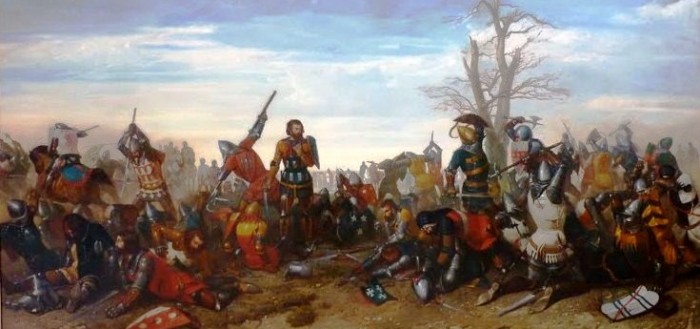
With the death John III, Duke of Brittany (in today’s northeast France), the Houses of Blois and Montford fought for control of the Duchy in the Breton War of Succession, a “subwar” of the Hundred Years War between England and France. On 26 March 1351, thirty Breton knights and squires from French aligned House of Blois, and thirty English, Breton, and German knights, with squires and men at arms from English aligned House of Montford met at the “Place of the Midway Oak”.
The field was located between the castles of Plomeril and Josselin in Brittany. The arranged chivalric melee was to end the bitter raiding that plagued the lands of both Houses. After hearing Mass together, the two groups exchanged pleasantries and small talk for several hours before lining up to fight on trodden ground. The first clash was an inconclusive brawl in which many were wounded. Both sides broke off combat to tend the injuries, mingle, and share wine with their foes.
The second melee was much bloodier than the first and the wounded included the Blois leader, Jean de Beaumenoir. When he asked for water and a stop to the combat, his second replied “Drink thy blood, Beaumanoir; thy thirst will pass”. The combatants of Blois eventually broke the Montfords after killing their leader, the Englishman Robert Bramborough, and riding down the unhorsed Germans who attempted to form a shield wall on the open ground. Seven were killed on the Montford side, three on the Blois side (including the leaders of both) and everyone else was wounded, most seriously.
Everyone captured recovered from their wounds and were released after a small ransom. House Blois would eventually control Brittany, or “Little Britain”: one of the Six Celtic Nations. Up to that point, Brittany was much more culturally aligned with their liegemen across the channel, the Cornish of the southwest Kingdom of England. However the House Blois renounced any ties to England and became part of France, where it remains today.
The Battle of Castagnaro
 Buk's Historical Ad Hockery
You must be logged in to post a comment.