The Battle of Sullivan’s Island

While the British regulars were locked up in Boston throughout late 1775 and early 1776, Americans in the remaining colonies threw out most of the British and loyalist officials. When Howe evacuated Boston, two large expeditionary forces were made available to Howe: one under Gen. John Burgoyne that went to lift the siege of Quebec, and another under Gen. Henry Clinton, which sailed south.

In June 1776, Britain’s only friendly harbor north of the Caribbean was in Nova Scotia. And another was needed to effectively subdue the colonies. With only 4000 men New York and Virginia were out of the question, so Clinton headed south to the supposedly friendlier Carolinas and Georgia.

Clinton sought to link up with Scottish loyalists from the backwoods of North Carolina. However, when he arrived off of Cape Fear, he found out that the Scots were defeated at the Battle of Moore’s Bridge two weeks before so he headed further south to Charleston, South Carolina.

In colonies that were prepared to fight against the Crown, South Carolina was close to the top of the list. Charleston was the third largest city in the colonies, the center of patriot resistance in the south, and home to most of the arms manufacturers in the Southern colonies. Thousands of Scots-Irish patriot militia poured into the city from the backwoods, and fortifications defending the city were started in late March 1776. Unfortunately, they were not completed when Adm Peter Parker’s flotilla of eight warships appeared off the coast in June with Clinton’s men. The northern entrance to Charleston Harbor was guarded by a half finished fort on Sullivan’s Island commanded by COL William Moultrie with 500 men and thirty pieces of artillery. Only two walls of the “fort” we’re started. But they were thick and consisted of palmetto log retaining walls filled in with sand, and had firing platforms for the guns.

On 28 June 1776, Clinton’s men attempted to march on the rear of the fort by fording from nearby Long Island while Parker destroyed the it with cannon fire and landed marines. But the ford was chest deep, and a small blocking force prevented Clinton from ferrying across. Nonetheless, Parker was confident he could complete the task himself.

Parker opened fire and Moultrie responded in kind. To make up for a relative lack of gunpowder, Moultrie’s gunners made every shot count, greatly damaging the fleet. Parker’s fire was continuos and heavy but the spongy palmetto logs absorbed the shot. Most accounts of the battle note the logs of the fort “quivered” when hit instead of splintering. But that didn’t help the men on the platforms whom took a terrible pounding. The high watermark of the fight came just before dusk when the flag Moultrie designed was struck down fell outside the walls. SGT William Jasper yelled “We shall not fight without our flag!” and ran through the fire to grab it. He fastened it to a cannon swab so the city could see it since the flag staff was broken. The act inspired the defenders and they increased the rate of fire, so much so that when dusk fell, Parker decided that any further bombardment would just get his barely floating ships sunk.

Unable to force the narrows, Clinton’s men reboarded. Parker returned to the bigger Long Island to join with Howe’s substantially larger invasion of New York later in July.
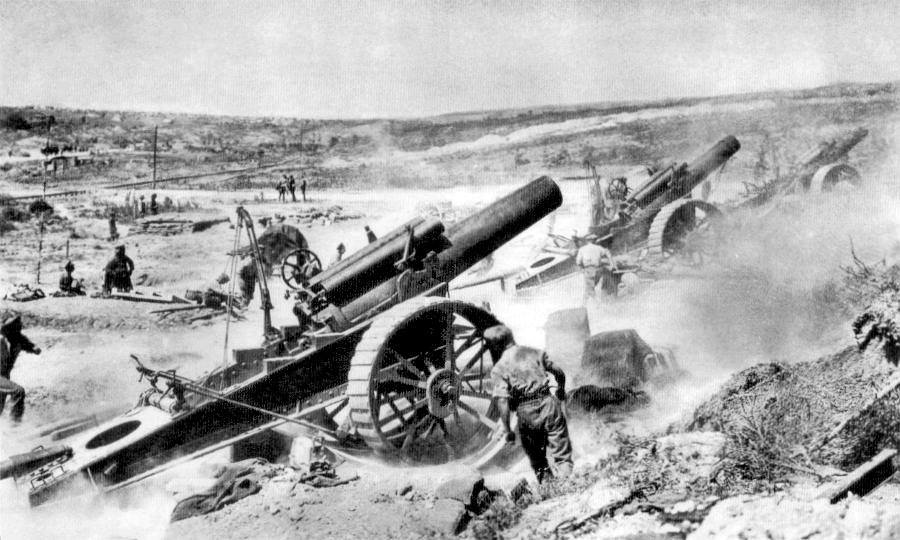
The Battle of the Somme: Artillery Preparation

On 24 June 1916, at exactly 0900, 427 British and French heavy field guns and howitzers, and 1010 pieces of field artillery opened up on at a 23 km section of the German trench lines just north of the Somme River. (That’s one gun firing for every 16 meters of trench.) They would fire ceaselessly for next week, stopping only when the gun barrels overheated. Once they cooled off, they continued firing. They were tasked to destroy the German trenches and strongpoints, and cut the wire in no man’s land.

As it began, General Sir Henry Rawlinson commented, “Nothing could exist at the conclusion of the bombardment in the area covered by it“

Operation Barbarossa: the Invasion of the Soviet Union

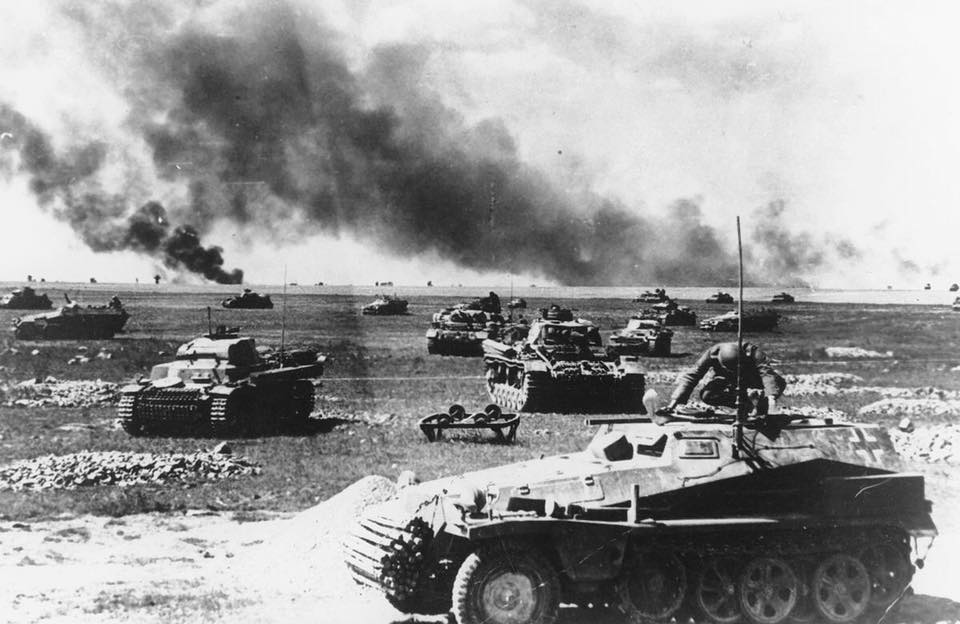
On 22 June 1941, the largest, costliest, and most bitter, brutal and destructive military campaign in recorded history began when four million mostly German troops stepped off along a thousand mile front in their long march to destroy the Red Army.

Most Red Army units were taken completely by surprise. Up until 21 June, Nazi Germany and the Communist Soviet Union were defacto allies. Furthermore, Stalin’s purges had eviscerated the Red Army, and even the limited reforms brought on by Marshal Georgy Zhukov after the near defeat in Finland the year before couldn’t change the fact that the quickest way to get shot or sent to Siberia was showing any capacity for independent thought. The new T-34 and KV-1 tanks, which were far superior to anything the Germans had, were the Soviets’ only tactical advantage, though the lack of any competent supporting leadership or logistics and communications systems rendered them mostly ineffectual.

But what the Soviets lacked tactically was more than compensated for in the long run by the Germans’ flawed strategic thinking. “Blitzkrieg” was an operational concept not a strategy, but Hitler was using it as one. Blitzkrieg finally had its bugs worked out after poor showings (in professional warfighters’ eyes at least) in Poland, France and the Low Countries, but finally came into its own in the Balkans, even if the still mostly foot bound and horse drawn Wehrmacht was not equipped to properly exploit it. In any case, Blitzkrieg was enemy focused, not terrain focused and its ultimate objective was always the destruction of the enemy army. Hitler believed that a quick campaign to destroy the Red Army would cause the “whole rotten house to crumble down”. He could not have been more wrong.

Hitler underestimated Stalin’s control of the population and willingness to sacrifice it to slow the invasion. The German General Staff estimated that the Red Army had 350 divisions. By August the German Army killed or captured more than 2 million Soviet soldiers and identified more than 600 divisions. The stunning advances and destruction of entire Soviet fronts in July and August turned into the realization in September and October that the Red Army didn’t matter. In the vast wilderness of the Russian hinterlands, only the Communist regime in Moscow mattered. But by then it was too late: the weather turned and the Eastern Front had turned into an apocalyptic battle of attrition.

Upon hearing of Barbarossa, Churchill was asked if he would support Stalin despite him standing for everything Churchill opposed. He replied, “If Hitler invaded Hell, I’d at least make a favorable reference to the Devil”.

The first phase of the Second World War was over; it’s most destructive phase had begun.

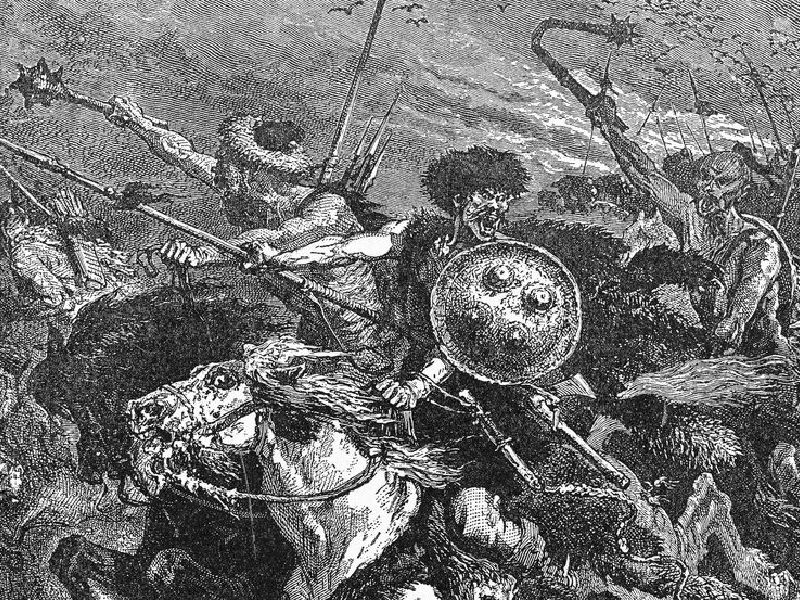
The Battle of Chalons (Catalaunian Fields)

Stymied by the Great Walls of the Qin and Tang Dynasties in the early first millennium CE, the Huns moved west. They drove entire nations before them, creating a ripple effect that exacerbated the rot inside the Roman Empire and brought about its fall. When the Huns burst into Europe 400 years later in the mid fifth century, Rome had been sacked three times in fifty years, and what remained of the Western Roman Empire was a Romano-Celtic-Germanic conglomeration at the ripples’ end in Gaul (modern France).

In 450 CE, Honoria, the sister of Roman emperor Valentinian III, was unhappy with her betrothal so she sent a message to the Huns’ leader, Attila, for assistance. Attila took the message as a marriage proposal with the Western Roman Empire as a dowry. Valentinian obviously disagreed. Atilla, known as the Scourge of God because Christians believed that he was sent to punish the corrupt Romans, invaded.

In 451, Attila and his army crossed the Rhine and sacked most of Gaul before confronting a combined Romano-Germanic army under Attila’s friend, Flavius Aetius, and the Visigothic King Theodric I, son of the infamous Alaric, who sacked Rome in 410.

The Allied army was typical of the “barbarization” of the Roman military in the final days of the Roman Empire. Ironically, so was Attila’s. Gone were the days of Roman legionary heavy infantry and Hunnic horse archers, though they existed in small numbers in both armies. Each army was mostly Germanic foederati, light spearmen and horsemen, though the Franks allied with Flavius were already known for the quality of their heavy(er) cavalry. On 20 June 451, outside of Chalons on the Catalaunia Fields, the two nearly indistinguishable armies met. In a chaotic battle in both which commanders lost control, they fought each other to a standstill. Theodric was killed, but Attila felt that no chick was worth this and retreated.

The Battle of Chalons was the last gasp of the Western Roman Empire. Attila’s campaign broke the Roman army, destroyed Gaul, shattered the Visigothic Kingdom, and neutered the Hunnic army. None recovered. Into the vacuum stepped the Slavs and various Germanic nations, especially the Franks. In gratitude for their service (and because they were going to take it anyway) Valentinian gave the semi mythical leader of the Franks, Merovech, land around the town of Aachen as his own. Within 50 years the Merovingian Franks would be the masters of west central Europe.

The Death of Mumtaz Mahal

Photograph by Kristian Bertel

In the late 15th and early 16th century, Timurid Prince Babar conquered the Indian subcontinent and established the Mughal Empire (Mughal is the Hindi word for Mongol).

In 1631, the Mughal empire was ruled by Shah Jahan I and his beautiful wife, trusted confidant, and constant companion, Empress Mumtaz Mahal. On 17 June, 1631, the empress died giving birth to their 14th child. Shah Jahan commissioned a 46 acre resting place in Agra for his beloved wife that would take 17 years to complete. The Tomb of Mahal, or Taj Mahal, is the ultimate expression of Islamic art in India.

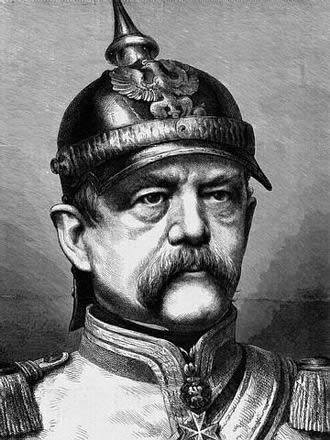
The Austro-Prussian War

Romanticism was the emotional reaction to the rationalism of the Age of Enlightenment and the first Industrial Revolution. By the end of the Romantic Era in the mid nineteenth century, there was no greater zeitgeist in Central Europe than the unification of the German people. Since the creation of the Holy Roman Empire in the Dark Ages, the German people have been ruled by dozens of small independent dukes and princes. Other nations had united and formed great empires, such as France, Great Britain, and Russia. Now it was the Germans’ turn. In 1866, it wasn’t a matter of if or when, but who would lead it: the Prussians on the North German Plain or the Austrians of the Austrian Empire.

The multiethnic Austrian Empire wasn’t a melting pot. It was more of a garden salad with each ethnicity separate from the others, but all in the same bowl covered in a bit of Habsburg dressing. In 1866, the empire was wracked and weakened by 30 years of nationalist revolutions. Prussia was almost the exact opposite. He had been at peace with only limited wars since the Age of Napoleon half a century before. Furthermore, Prussia on the vulnerable North German plain had for centuries known that the only defense it had against its enemies was the quick mobilization of his army. The technology in the mid-19th century finally allowed that mindset to become a strategic advantage.

Under the direction Field Marshal Helmuth Von Moltke (the Elder) the Prussian army developed a General Staff dedicated to the operational and logistical details necessary to fighting a modern war. This led to a mobilization plan that was regional and four times as fast as Austria. Furthermore, Prussia had extensive railways and telegraphs which allowed those mobilized troops to concentrate quicker. Finally, the Prussians were equipped with the Dreyse Needle Gun, the world’s first bolt action rifle, which was far superior to the muskets and muzzle loading rifles of the Austrian army. (For comparison, imagine if the entire Union army in the contemporary American Civil War had been equipped with Spencer repeating rifles).

Prussia’s pragmatic chancellor, Otto Von Bismarck, deftly negotiated the European isolation of Austria and then on 16 June 1866, engineered a dispute with Austria over the succession of the Duchy of Schleswig-Holstein. The resulting Austro-Prussian War of 1866 lasted just seven weeks, and only so because Austria continued well after defeat by the Prussians against Garibaldi and his crusade to unite Italy. As a result, Prussia would unite all of the North German states under its rule. It was the first step to Kaiser Wilhelm I forming the German Second Reich in 1870.

The Bayonet Trench

On 12 June 1916 during the battle of Verdun, two battalions of the French 137th Infantry were caught in exposed trenches by German artillery observers. In the subsequent bombardment the regiment broke and scattered . As the survivors reformed, no members of the 3rd Company were found.

Three years later after the war was over, French burial and UXO teams exploring the battlefield found a precise row of bayonets sticking up from the earth. Digging underneath, they found the members of the 3rd Company locked in a death pose preparing to go over the top. They were all simultaneously killed by concussion and their trench instantly filled by debris from the bombardment.

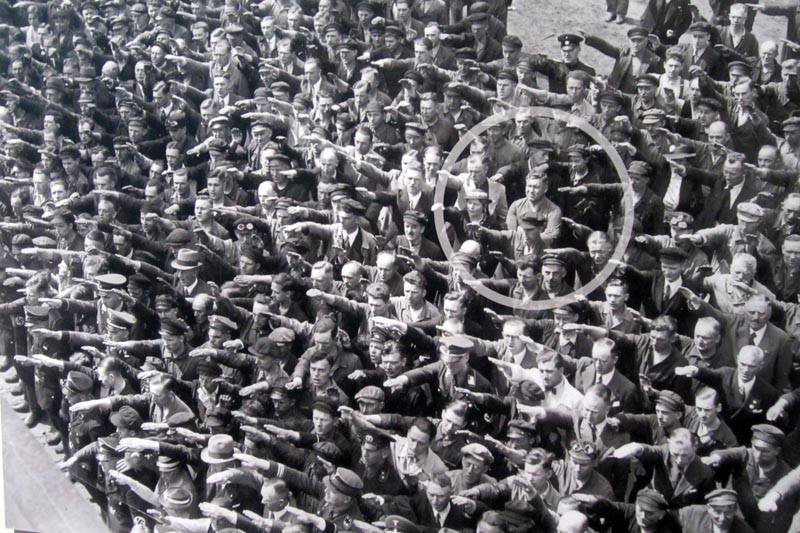
August Landmesser

Be this guy.

August Landmesser, like many Germans, joined the National Socialist German Workers’ Party because of Adolf Hitler’s promise to undo the wrongs perpetrated against the German people in the Treaty of Versailles. However, by 1936, he was concerned with the Nazis demonizing anyone who disagreed with Hitler – he was married to a Jewish girl. However, the population of the country at this point was disarmed, and criticizing the Nazis meant a one way trip to the Dachau concentration camp. Many of his friends agreed with him privately, but were cowed into blindly following Hitler.

On 13 June 1936, August Landmesser attended the launching of the new Kriegsmarine training ship, the Horst Wessel. Surprisingly, Adolf Hitler himself dedicated the ship. When Hitler stepped up to smash the champagne bottle on the bow, the crowd cheered wildly and saluted.

Landmesser couldn’t bring himself to salute a man who demonized his wife and daughter.

August Landmesser was caught in 1937 trying flee to Denmark with his family. They were imprisoned for “dishonoring their race”, and were never seen again.

The Battle of Trois-Rivieres

America’s first invasion of Canada in 1775 started off well. Colonel Benedict Arnold’s surprise attack through the Maine wilderness was a disaster, with troops having to eat their belts, but it fixed Governor Guy Carleton in Quebec, and allowed Brigadier General Richard Montgomery who moved north from Fort Ticonderoga to seize Montreal and besiege Quebec. On New Year’s Eve, a surprise assault in a blinding snowstorm was discovered by an alert sentry mere seconds before the Americans were over the wall. Montgomery was killed and the new commander Brigadier General John Thomas, with the headstrong Arnold (still an ardent patriot at this point in the war) settled in for a siege.

In May 1776, the first British and Hessian troops from Europe under General John Burgoyne arrived to put down the rebellion. With just 2000 men, Thomas couldn’t continue the siege and retreated toward Montreal. But the American governor there so alienated the population of the city that they banded together with a small outlying British garrison, and the Mississauga, Seneca, and Cayuga Indians to throw out the Americans. By this point Brigadier General John Sullivan arrived with reinforcements, saw the futility of trying to hold Montreal with a superior British approaching from Quebec, took command of everyone, and headed quickly back to Ft Ticonderoga.

They would have made it intact if they hadn’t been intentionally led astray by a Canadian guide on 8 June 1776. The treacherous canuck led the American army into a swamp while “looking” for the ford at Trois-Rivieres. By the time they extricated themselves Carleton’s vanguard caught them. In the chaos that followed, 50 Americans were killed and 230 captured. The British had ten casualties.

Sullivan still managed to save the bulk of the men, which prevented Burgoyne from invading the nascent United States in 1776, but America’s first invasion of Canada had failed.

Brusilov’s Offensive: Necessity is the Mother of Invention

In 1915 and 1916 the First World War battles along the solidified trench lines of the Eastern and Western Fronts followed a familiar pattern: the attacker would launch a massive weeks long artillery bombardment to shatter the defenses. At the appointed time, the attacking infantry officers would blow their whistles and they and their men would climb out of their trenches i.e. “go over the top”, into “no man’s land” and get mowed down by machine guns because artillery never kills everyone. But soon the weight of numbers told and the attackers broke through. However the breach was not exploited because the attacker’s reserves and logistical support couldn’t traverse the artillery shattered terrain quick enough. Even if they could, the defensive reserves were already close because the build up and long bombardment gave away the point of attack. The defenders would inevitably counterattack and retake the positions. The defeated attacking commanders would cry lack of artillery and demand more and heavier guns, and more shells. The bloody cycle would continue. Millions died.

In early May 1916, the Imperial Russian government was under intense pressure to launch a general summer offensive in order to draw the Germans away from Verdun where the Germans were erasing a 3000 man infantry regiment from the French order of battle every day. The Russians reluctantly did so but only had enough shells for an adequate pre attack bombardment for one front, and they chose General Ewart’s Western Front. The other fronts would have to make do with enough shells for just a single day’s bombardment, well below the minimum ten days thought necessary to break the standard German or Austro Hungarian triple belt defensive line.

The Southwest Front Commander, General Aleksei Brusilov, protested that the lack of shells would cause excessive casualties. He was told that was his problem and to attack anyway. Brusilov wasn’t a deep thinker but he was a practical and competent cavalrymen who cared deeply for his soldiers. He gathered his staff to figure out a way to break the opposite Austrian lines without murdering entire armies. He and his staff locked themselves in the headquarters for three days and did what Russians do best: drink vodka and figure out new, efficient, and effective ways to kill people.

They did.

After the vodka laden brainstorming and planning session with his staff, Brusilov issued new guidance to make up for the lack of artillery support for the upcoming June offensive. Normally, at least ten days’ worth of shells were needed to break a triple belt trenchline, he had but one. To make up for this weakness, he had to use what he had more efficiently, specifically his infantry. Strong points and key terrain in the Austro-Hungarian line were identified, scale models were created, and picked troops were assigned, specially equipped, trained, and rehearsed in their capture. The rest of his troops dug massive underground bunkers that could house these assault troops close to the front lines without alerting the Austro-Hungarians. They also went back to old siege techniques from 17th and 18th centuries, and dug assault and infiltration trenches into no man’s land, some of which got to within 75m of the enemy forward trenches. Brusilov also used his artillery to directly support the infantry attacks, instead of the indirect blanket support heretofore used so far in the war. He would have just a single hour’s worth of initial bombardment, and its only task was forcing the defenders into their own bunkers. The artillery would then switch to counterbattery and opportunity fire which necessitated an overhaul of the poor fires coordination between the artillery, infantry, and aviation. Finally, he brought up all of his reserves, and more importantly, delegated most of them to his army commanders since he did not see the Austro-Hungarians counterattacking in force the way the Germans would farther north. His army commanders could respond more quickly with them close at hand.

On 4 June, 1916, the entire Russian Army, from Baltic Sea in the north, to the Carpathian Mountains in the south, went over the top. Troops of Ewart’s Western Front facing the Germans were massacred. Brusilov’s Southwestern Front broke through and exploited the breach on the first day.

With no massive telltale artillery stockpiles and troop concentrations, the Austro-Hungarians were completely surprised by the attack. Brusilov’s revolutionary new tactics ensured that most forward Austro-Hungarian units were captured in their bunkers settling in in anticipation of a long bombardment. In most areas, two of the three trench lines were overrun before the defenders put up any resistance. And the third was easily punched through. Since the roads were relatively undamaged by the shelling, the nearby reserves quickly drove into the Austro-Hungarian rear areas.

In a war where offensive gains were measured in yards for the last 20 months, Brusilov’s Southwest Front drove forward fifty miles in 72 hours. Despite the seemingly narrow gains on the map, Germany’s ally crumbled.

By July, the Germans had to withdraw troops from the North and West to finally stop Brusilov’s drive from knocking the Austro-Hungarian Empire from the war. This relieved pressure on the French, but it finally ground the Russian’s wildly successful offensive to a halt. Still Brusilov was the darling of Tsar Nicholas’ II court and the Southwest Front was showered with resources. If Alexei Brusilov could do so much with just a single day’s artillery, imagine what he could do with twenty!… or so the thinking went.

Unfortunately, Brusilov didn’t learn his own lessons.

With the massive support, Brusilov reverted back to the old ways. Four months and one million casualties later, the Russian people were tired of the senseless killing. Revolution was in the air.