The Battle of Long Tan

SEATO was the South East Asian equivalent of NATO, and in 1966, several countries contributed troops to halt the Communist expansion into South Vietnam, including South Korea, Thailand, The Philippines, New Zealand, and Australia.

The 1st Australian Task Force was assigned the Phuoc Tuy province on Vietnam’s southern coast. They built a base at Nui Dat between April and June, and in July began securing the population and conducting offensive operations against the local Viet Cong.

Nui Dat was decidedly inconvenient for the Communists; it had to be destroyed. Nui Dat sat astride a major communist supply route and base area, and was dangerously close to the population centers (Something the Americans wouldn’t do for another two years). Additionally, Gen Giap, North Vietnam’s military commander, wanted to inflict a quick defeat on the Australians and force them out of the war. So he ordered the entire 275th VC Main Force Regt down from the Iron Triangle to overrun the pesky base.

The plan was the time honored tactic that worked so well against the French: lure a company (coy) off of the base into an ambush, ambush the inevitable relief column, destroy them both, and then overrun the weakened base. The first part worked perfectly.

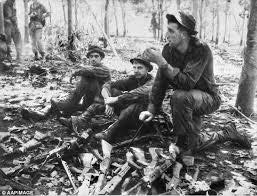
On the night of 16/17 Aug 1966, the VC bombarded the base, and B coy, 6th Bn/ 6th Royal Australian Regt gave chase. On 18 Aug, D coy took over and walked into a large ambush on the Long Tan Rubber Plantation.

However, the Australians knew exactly what they were getting into. Their signals intelligence had tracked the 275th into the sector. The odds were daunting, but the Aussies fell back on their unique talent for not giving a fuck. At Long Tan, the 108 men of D Coy 6/6 RAR, were assaulted on all sides by the entire 275 VC Main Force Regt, a local VC Bn, and a regular North Vietnamese Army Bn that Giap threw in like a cherry on top of the sundae. The attackers numbered nearly 2500 men, 20:1 odds is a sure victory in any commander’s mind.

But the Aussies dug in and were supported by copious amounts of American and New Zealand artillery which massacred the attackers. Nonetheless, quantity has a quality all its own and by the afternoon, the diggers were hard pressed and low on ammunition. Fortunately, two Royal Aus Air Force Huey’s piloted by men with Outback sized gonads, braved brutal ground fire to resupply the company just in time to defeat a full regimental assault. (For context, imagine if vegemite fueled Texans won at the Alamo.) By nightfall just as D coy was firing it’s last rounds, the expected relief column of APCs and tanks fought through their ambushes, and like the good cavalrymen they were, arrived in the nick of time. The battered D coy fell back to a landing zone with the column for the night. They had 18 killed and 28 wounded, and despite the casualties they inflicted, thought they had lost the battle.

But in a typically Australian “Fuck it” moment, the D Coy commander, Maj Harry Smith, decided to return to the plantation to recover the dead bodies of his men. To his surprise, they didn’t find live VC but dead ones: the Communists were gone. The relief column forced the Communists to withdraw just as they were about to launch their inevitably successful final assault. An NVA report later stated that the 275th was combat ineffective for months and had to be reconstituted. More importantly, the local VC Bn was destroyed and the NVA Bn had to take over the defense of the district.

Like the Battle of Tet 18 mos later, the destruction of the local VC and subsequent NVA takeover of the area made securing the population much easier. (Despite speaking the same language, the North Vietnamese were as foreign to the area as the Australians.) Unlike many American units, the Australians would have a much easier time securing their province in the ensuing years.
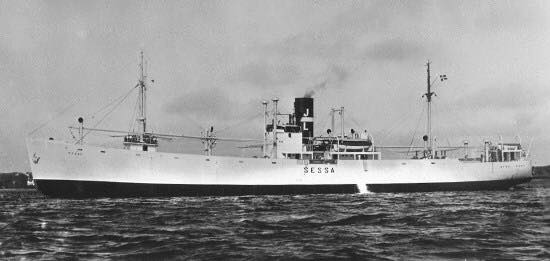
U-38 Sinks the Longtaker

After Denmark surrendered to Germany in 1940, Great Britain invaded Iceland, a Danish protectorate, to prevent its use by Germany in the Battle of the Atlantic. When The US approved the Lend-Lease Act, one of the leased bases was Iceland and the US 6th Marines garrisoned the island (which freed the British garrison to fight).


On 17 Aug 1941, the unescorted Longtaker, a Panamanian flagged steam merchant was enroute to Reykjavik to resupply the garrison with food and timber. Panama, though also technically neutral, was an American protectorate due to the Canal Exclusion Zone in all but name. The Longtaker was spotted by U-38, and sunk with torpedoes. The Longtaker sank in under a minute, and six of the 25 crewmen survived, but three more would die before they were picked up by a US destroyer 20 days later.


The Longtaker Incident was the first US ship sunk in the Atlantic, and the first of a series of encounters that directly led to FDR relaxing the US Navy’s ROE. Within a month, a state of undeclared war existed between the US Navy and the German Kriegsmarine around the world, months before Pearl Harbor.

The Fall of Trebizond and the End of Rome

In 753 BCE the semi-mythical twin brothers Romulus and Remus founded Rome on the site where they were supposedly suckled by a she-wolf as orphans. A thousand years later in the 4th century CE, the unwieldy Roman Empire was split into its eastern and western halves. The Western Roman Empire would fall to the Barbarian invasions of the next century. While the eastern half, or Byzantine Empire because it was centered on the city of Byzantium, which was renamed to Constantinople after the eastern half’s first emperor, Constantine, would last until 1204.

Orthodox Constantinople was captured by Catholic crusaders during the Fourth Crusade in 1204 due to the various political machinations of Venice, the Byzantines, and Crusaders. The Byzantine Emperor was deposed and a Latin Crusader state was established. This fractured the Byzantine Empire into a series of successor states (similar to the fall of Alexander the Great’s empire), most notably the Despotate of Epirus, and the Empires of Nicaea and Trebizond.

Immediately, all vowed to restore the Byzantine Empire and declared war on the Latin State of Constantinople. Nicaea reconquered the city in 1261 and reestablished the Byzantine Empire, but the power of the Empire was broken forever.

The New Byzantine Empire was unable to withstand the Ottoman Turks and most of the successor states were subsumed in the 14th and 15th centuries. Constantinople itself fell to Sultan Mehmed II in 1453.

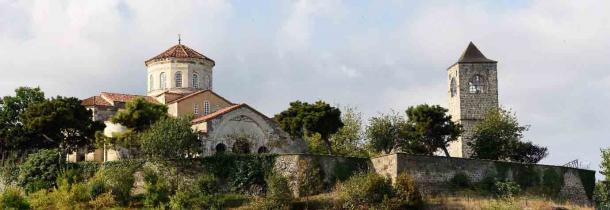
Mehmed II then turned his attention to the last remaining Byzantine successor state, the Empire of Trebizond, in the mountainous northeast of Anatolia. On 15 August, 1461, David Megas Komnenos, the last Byzantine emperor surrendered the city of Trebizond (modern Trabzon, Turkey), to the besieging Turks.

With the fall of Trebizond, 2,214 years of Roman history came to an end.

Anders’ Army

The Soviets captured or deported nearly 325,000 Soldiers and civilians after the dual German/Soviet invasion of Poland in Sep 1939 (and murdered another 100,000). But by August 1941, Stalin was desperate for soldiers to repel the German invasion of the Soviet Union. In conjunction with the nascent Polish Govt-in-exile in London, Stalin agreed to establish a “Polish Army of the East”. Stalin signed the order on 13 August 1941, and the Gen Wladyslaw Anders, a former cavalry brigade commander in 1939, was chosen for the army’s commander. The gulags and prisons across Siberia were combed for Poles still healthy enough to train and fight. By the end of 1941, Ander’s had 25,000 soldiers and 1000 officers training deep in Siberia, and were supported by about 60,000 “camp followers” (for lack of a better term).

Anders was the senior surviving Polish officer captured by the Soviets in 1939. On 14 Aug 1941, the day after the order was signed, Anders was released from the NKVD’s dreaded Lubyanka Prison, one of only a handful of human beings in history that ever walked back out of Lubyanka after being sentenced there.

Operation Dervish: the First Arctic Convoy

On 21 August 1941, Operation Dervish was launched from Hvalfjoror, Iceland, when five British and one Dutch merchantmen left the harbor to convoy to Archangelsk, Soviet Union, far above the Arctic Circle. As it was the first such convoy into unknown waters, it was heavily escorted lest a German success against the convoy be seen as the Allies balking in their commitment to help the Soviet Union who was doing the lion’s share of the fighting against Germany. Dervish was escorted by three destroyers, three minesweepers, and three anti-submarine trawlers, with a heavy cruiser and three destroyers on patrol in the Norwegian Sea to deal with German raiders if needed.

The Dervish convoy was unlike any other convoy so far in the war. The bitter cold, icebergs, and unpredictable storms made the ten day journey treacherous. Combatting ice buildup on the ships was a constant chore, and the perils of not doing so were quickly felt when on the third day, ice formed from normal sea spray grew so heavy and thick on one trawler that it nearly capsized. The entire convoy made it safely to Archangelsk on 31 August without German interference. (The Germans had no air reconnaissance in Norway at the time. That changed quickly once word got out.)

The Soviet reception (or lack thereof) at the port threatened to derail the whole operation. No stevedores were available so the sailors unloaded the ships themselves, only to face the wrath of the local Soviet bureaucracy for faults both unintentional and imagined (Such as placing the crated Hurricane fighters in the wrong warehouse). Events came to a head when sailors were arrested and beaten for not having the proper identity papers. But fortunately, a high ranking Soviet official from Moscow arrived and released the battered detainees, before there was further bloodshed.

The successful Dervish convoy proofed the Arctic route, and established common procedures for both the Allies and Soviets. Further Arctic convoys to the Soviet Union were given the “PQ” designation (the tragic PQ-17 being the most famous), and those returning QP. The Dervish ships themselves would be “QP-1”, and PQ-1 would leave Iceland later in September. 25% of all Lend Lease aid to the Soviet Union went via the Arctic convoys.

Selective Training and Service Act of 1940 Extension

At Roosevelt’s request, Congress voted on 12 August 1941, to extend the Selective Training and Service Act of 1940 beyond 12 mos. It passed by one vote.


The first draft class of October 1940 threatened to desert and spray painted “OHIO” (Over the Hill In October) across their barracks, but few did. The extension affected about 70,000 draftees by the time of Pearl Harbor. The vast majority of these men would form the NCO corps of the US Army in 1942. The US Army would most likely not have been able to conduct effective offensive operations in 1942 without the extension.

The Ottoman Fleet of Selim II

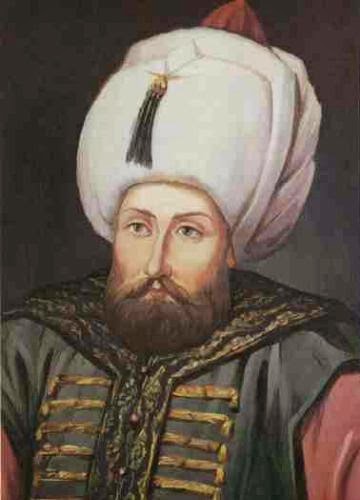
Grandmaster Jean de Valette’s and the Knights of the Order of St John’s victory at the Siege of Malta essentially put a cork in the central Mediterranean and prevented Ottoman expansion westward. The elderly Sultan Sulieman the Magnificent, convinced by the Siege that only he could lead his armies victoriously, lashed out at Protestant Hungary but died of dysentery during the campaign. In 1566, he was succeeded by his son Selim II.

Selim was not the same man as his father whom was the greatest of the Ottoman sultans. He had much more interest in leisurely pursuits such as wine and the pleasures of the flesh. After concluding peace with Hungary and a disastrous campaign against the Tsardom of Russia, Selim, aware that he was being compared to his father, decided to seize an easier target closer to home, the Venetian island of Cyprus, the source of his favorite vintage.

In response, the newly elected St Pius V, (one of the Catholicism’s greatest Popes) called for a crusade and a league of nations to oppose the Turk’s invasion of Christian Cyprus. On 7 Mar 1571, the Holy League was formed of most Catholic states on the Mediterranean (except France which habitually opposed Hapsburg Spain and Austria, despite the consequences). However, before a force could be assembled to relieve the besieged Cyprus, the Venetians defending the port of Nicosia capitulated on 1 August 1791.

With the fall of Cyprus, Selim was no longer drunk on wine but on the sweet taste of victory. He vowed to crush Venice for Islam. But first he had to blockade the merchant city and to do that he needed to control the Adriatic. On 13 August 1571, 230 galleys under his grand admiral Ali Pasha with the prized possession of the Ottoman Empire, The Banner of the Caliphs, arrived at a bustling trade port at the mouth of the Gulf of Corinth:

Lepanto

The Dead Man’s Hand

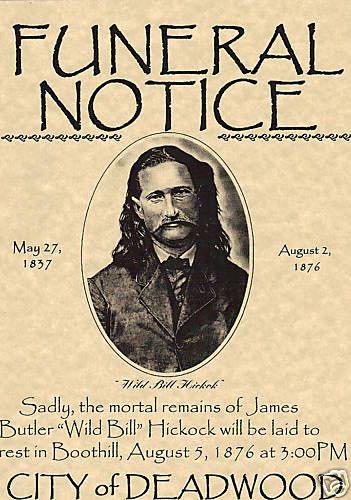
On 2 August 1876, famed Union scout, frontier lawman, sometime gunfighter, and professional gambler James Butler Haycock aka “Wild Bill” Hickok, was shot in the back during a game of five card stud in Nuttal and Mann’s Saloon in Deadwood, Dakota Territory (today’s South Dakota). He was holding two pair, black aces and eights, with an unknown, and much disputed, red fifth card. Wild Bill’s final hand is now known as The Dead Man’s Hand.

Operation Barbarossa, Fuehrer Directive 33, Supplement 1

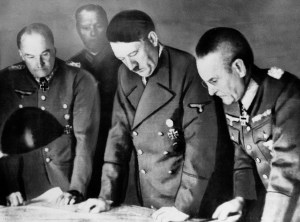
Brauchitsch, Hitler, and Halder 25 July 1941

The first five weeks of Operation Barbarossa were a smashing success. The Wehrmacht encircled and destroyed hundreds of Soviet divisions, and had taken almost a million prisoners. At the end of June, the last organized Soviet mechanized corps were destroyed at the Battle of Brody in the largest tank battle to date. The Soviet KV-1s and T-34s were a nasty surprise to panzertruppen in the outmatched PzIIIs, Pz38s, and PzIVs, but Soviet self inflicted logistics, command and control issues, the vaunted 88s flak guns, and Luftwaffe induced supply problems evened the odds. By mid-July 1941, both Army Groups North and Center were within striking distance of their final objectives, Leningrad and Moscow.

But all was not going according to plan. For every dozen divisions the Germans destroyed, Stalin put 14 ill trained, ill led divisions back into the line: just enough to slow them down. Supplies and maintenance were becoming an issue: Most German divisions were at 70% strength and the Panzer and motorized divisions at 50%. Army Group Center’s forward supply dumps were 750km from nearest railhead. Army Group South, separated from the other army groups by the Pripyat Marshes faced much more effective delaying tactics on the Ukrainian Steppe by the Soviets under Marshal Budyonny (and his Political Officer Nikita Khrushchev). Furthermore, the bypassed Fifth Army in the Pripyat Marshes threatened AG South’s flank, and many divisions were forced from the advance to contain them.

On 19 July 1941, Hitler issued Directive 33, which was a very vague order to capture Leningrad, Moscow, the industrial area around Kharkov, encircle and destroy the Soviets facing AG South, and clear the Pripyat. The German High Command, particularly General Halder the chief of the OKW, disagreed with Hitler’s focus on the Red Army in the South. It was clear even at this early stage of the campaign that unlike in France, the army was not the center of gravity. He pushed for continued attack to seize Moscow at the expense of Leningrad, the Ukraine, the much needed reorganization and refit of Army Group Center, and the destruction of the Red Army in the South. Unlike Napoleon’s invasion 130 years before, Moscow was much more important to Stalin than to Tsar Alexander. Moscow was the cultural, industrial, administrative, and communications center for the Soviet Union, the Communist Party, and Stalin’s regime. Virtually all rail traffic west of the Urals went through Moscow. On 26 July 1941, there just 19 under strength Soviet divisions between Army Group Center and Moscow. Finally, Halder knew Stalin would defend it with everything he had left, which incidentally would satisfy Hitler’s fetish for destroying the Red Army.

The ill Hitler disagreed. The Soviet armaments and tank factories were in the south and that’s where the most effective resistance by the Red Army was. They had to be crushed. Moreover, the German economy and Wehrmacht were desperate for oil, which could only be obtained in quantity from the Caucuses. On 27 July Hitler issued Supplement 1 to Directive 33, which ordered AG Center to clear the Pripyat marshes. Even worse, Supplement 1 stripped Army Group Center of its two Panzer Groups: the 3rd to the north to isolate Leningrad, and the 2nd south to seize Kharkov. Those troops would not be able to participate in the attack on Moscow until September, at which time they’d be even more in need of a respite. Moscow would have another month to prepare its defenses.

The Battle of Wisby

In the mid 14th century, the Black Death ravaged Europe and killed one third of the population. By 1353 it burned itself out but in many areas severely degraded the power of the absolute monarchs. This vacuum empowered the Hanseatic League, a commercial and defensive confederation of merchant cities that dominated trade on the Baltic Sea (“hansa” is Old German for “convoy”).

For decades, in order to maintain power in Denmark, the Danish kings mortgaged Danish land, and in 1356, King Waldemar IV reconquered and reoccupied that Danish land after being depopulated by the Black Death. On the island of Gotland, the merchants of the Free City of Wisby, a member of the Hanseatic League, mocked Waldemar for being dishonest and unable to manage his finances.

So Waldemar invaded.

In July 1361, King Waldemar landed on the west coast of the island of Gotland with 2800 Danish infantry and German mercenaries. Outside the city walls on 27 July, they were met by the 2000 Gutnish yeomen, burghers, and dismounted knights. Both sides were armed and armoured roughly the same: the knights had plates covering the vitals and joints over mail hauberks, and the yeomen and burghers had “Wisby Plate Armor”, which consisted of metal plates sewn into a leather of fabric hauberk. Both sides were armed with swords, hammers and axes with round or long shields, and an eclectic variety of polearms. Neither side had cavalry. And both sides considered bowmen a waste of precious bodies on the long shield line. As expected, there were no real tactics, and Waldemar’s greater numbers carried the day. Once the line broke, individual Gutnish bands fell in upon themselves, and were isolated and overrun. 1800 Gutnish were killed. The Battle of Wisby was the largest longbowless, pre-swiss pike, purely infantry field battle of the Middle Ages.

Despite the objections of his men, Waldemar decided not to sack the town, but extort it. He decreed that the citizens of Wisby had three days to fill three giant beer barrels with gold and silver (or booze and rattan), or he would massacre them and raze the city. The rich citizens paid Ransom of Wisby within a day, and Waldemar went home.

Waldemar won the first round against the Hanseatic League, but none of the subsequent ones, as the Battle, and more importantly the Ransom, united the loosely organized Baltic merchants against him.