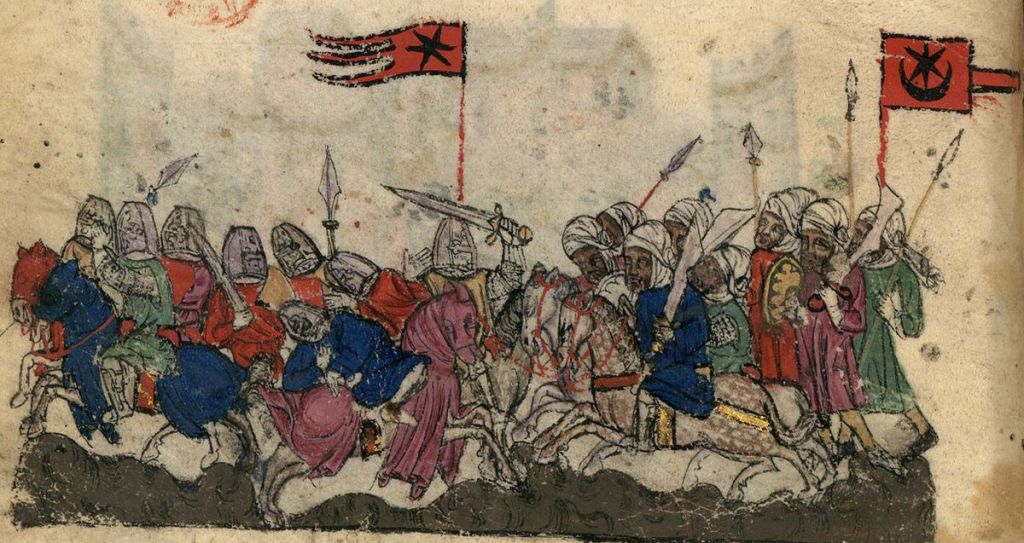
The Siege of Svigetvar

After his loss at the Siege of Malta the year before, Suleiman the Magnificent turned his attention to expansion into the Kingdom of Croatia and Hungary in 1566. As the massive Ottoman army approached, its foragers and scouts were constantly ambushed and harassed by men of Croatian Count Nikola Zrinski, whom even defeated the Turkish vanguard at the Battle of Siklos. In response, Suleiman decided to make an example of him and marched straight to Zrinski’s ancestral seat of Svigetvar.

Zrinski was a skilled tactician, and a veteran of decades of border skirmishing with the Ottomans and their subjects in the Balkan marches. However, the odds were daunting: he had just 2300 Croatian and Hungarian knights and men at arms to face Sulieman’s 150,000. Svigetvar was very defensible, with two walled sections of the town (one with a medieval castle) separated by the swampy tributaries of a river, and a final star fortress with two baileys. But at 65-1 all Zrinski could hope to do was hold out long enough for Holy Roman Emperor to come to his aid (which he wouldn’t because the Hapsburg administration and the German princes were paralyzed with fear, but Zrinski didn’t know that).

Suleiman arrived on 2 August and was easily repulsed after ordering an immediate assault. So the Ottomans settled into a siege, with their usual constant bombardments, mining and the occasional surprise assault. Zrinski didn’t even entertain the frustrated sultan’s peace envoys, despite the increasingly more lavish promises by Suleiman. By the beginning of September, the New Town fell, the Old Town and castle were burned to the ground, and all that remained was the fortress, held by Zrinski and 600 grim survivors of the previous month. But the Ottomans suffered much worse – 20,000 warriors dead. Moreover, disease caused by the marshy ground was rampant, and Suleiman himself died of dysentery on 6 September. His advisers and viziers, at great pain, kept his death a secret lest it break up the army. They ordered a last assault for the next day.

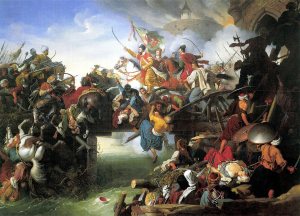
But Zrinski had other plans. His fortress walls were rubble, the buildings inside were ablaze, and he would attack. As the sun poked over the horizon, with flaming embers drifting down from above, and the drums and yelling of the Turks permeating the air, Zrinski beseeched his men to accompany him on one final charge. They followed.

The stage was set for an epic clash on the causeway. As the Turks surged across the causeway they were surprised to see the gates of the fortress open before them. The surprise turned to horror as they glanced the giant maw of a great mortar leveled at them. The monstrous belch flung nails, cooking utensils, spare daggers, and even door hinges, into the Turks. 600 immediately were slain, and thousand more wounded. More importantly, it cleared the causeway. At the van, Zrinski charged across and his men crashed into the surprised Turks in the Old Town. They cleared the plaza and took the fight into the charred narrow streets and alleyways. But numbers matter, and no 600 men in history could stand against those odds. Zrinksi and his men were overwhelmed.

But that isn’t the end of Zrinski’s tale. Thousands of victorious Turks swarmed into the fortress in bloodlust to butcher the remaining inhabitants. But before he charged, Zrinski had the extensive powder magazine lit with a slow fuse. As the Ottomans were gleefully looting the remains, a massive explosion leveled the fortress, killing thousands and wounding thousands more.

In its state, the Ottoman army could not continue on to Vienna, and it slowly drifted back to Constantinople. Cardinal Richelieu of France called Zrinksi’s defense of Svigetvar, “the battle that saved the civilization”.


Star Trek

In the early 60s, television was dominated by declining Westerns. Furthermore, the genre of Science Fiction was well past its Golden Age of Arthur C Cark, Ray Bradbury, Isaac Asimov, and the best episodes of the Twilight Zone. Enter Eugene “Rod” Roddenberry, a former B-17 pilot in the Pacific, Pan Am pilot, and LAPD beat cop. He had a vision of combining the two genres. In 1964, he pitched a treatment for a very different television show to Desliu executives (a production company formed by Desi Arnaz and Lucille Ball), and the show was eventually picked up by NBC.

Roddenberry’s “Star Trek” was set on a futuristic 23rd century spaceship, the USS Enterprise, that explored the unknown expanse of our galaxy. Unlike Buck Rogers and Flash Gordon, the star ship was a naval vessel with a lingo that seemed familiar to the World War Two generation, which was the original target and most lucrative audience at the time. The show’s liberal interventionist and character driven plots would revolve around the three main characters. This trio consisted of the Horatio Hornblower-esque captain and decision maker, and the two halves of his conscious: the coldly logical science officer and the emotionally charged medical officer. The agreement of the three was then supported by a diverse crew – the swashbuckling physicist and helmsmen (the first Asian character portrayed in a positive light), the stereotypical but willful nurse (and ship’s computer), the supremely competent, if irascible Scottish engineering officer (a hit with the generation that saved the world), and the stupid hot and always capable African-American communications officer (the first African American on prime time TV not in a menial role), among many others. (The youthful mop topped navigator, for the girls spellbound by the contemporary band The Monkees, did not join the crew until the second season.)

The first episode of Star Trek, “The Man Trap”, aired on NBC at 8:30 pm on 8 September 1966. Most critics hated it, particularly the New York Times and the Boston Globe. And it also opened to generally poor ratings among most viewers, except one key demographic: young people. They had never before watched TV in these numbers in this timeslot. Young viewers were drawn to the unheard of combination of heady science fiction, utopian respect, cultural diversity, egoless teamwork, unbridled optimism, and all wrapped up in good old fashioned American “Can Do” attitude. The show only lasted for three (glorious) seasons, mostly due to the peace movement, the Vietnam War, and the souring of American attitudes to intervening in other cultures.

However, the fans of the show wouldn’t be kept down for long. In 1972, a surprisingly successful convention for Star Trek enthusiasts was held in New York City, and the first “fandom” was born (not to mention the “con”). It was this fan base, and their renewed interest in Science Fiction, that would form the lines outside movie theaters to see the future Star Wars and Close Encounters, and lead directly to the intellectual property model of entertainment we enjoy today. These fan bases would go on to make Science Fiction, and its off shoots in comic books and fantasy, among America’s greatest cultural exports. The informal networks of the shared interests in these fandoms would not only precede social networking by 40 years, but form their models.

In many ways, Kirk, Spock, Bones, Scottie, Uhura, Chekov, and Sulu prompted America ‘to boldly go where no man has gone before”.

The League of the Three Petticoats and The Seven Years’ War

In 1754, a young Virginia militia officer, Lieutenant Colonel George Washington, renewed the centuries’ long conflict between Britain and France when he ambushed the French at Jumonville Glen in the moraine-carved, serene, and picturesque wilderness of what would become Western Pennsylvania. King George II dispatched troops to the New World, and we would know this conflict as the French and Indian War. Although the war raged in the colonies, in 1756, the conflict had yet to spread to Europe. However that year, George II felt that his ancestral home in central Germany, Hanover, was threatened by France. So he made an alliance with King in Prussia, Frederick I, to protect the small city state.

The new alliance upset the delicate balance of power in Europe at the time. Maria Theresa of Austria, a traditional enemy of France and ally of Britain was upset with George’s new alliance with her rival, Prussia. She desired the return of the rich Polish province of Silesia, which she lost the decade before, and furthermore despised Frederick whom never failed to insult her every chance he got. She made an ostensibly defensive alliance with France in May 1756.

France was also ready for war with Prussia. For twenty years the second most powerful woman in France was Madame de’ Pompadour, the 13th handmaiden to the queen. This doesn’t sound like much but she was intelligent, driven, an economic genius, ran the royal household, and was the highest authority in France on matters of taste and fashion, not to mention the king’s mistress, and the queen’s closest confidant. In the spring of 1755, Frederick insulted her through their mutual friend Voltaire, and Madame de’ Pompadour never forgave him. She was not above using her influence, and the mechanisms of the state, to avenge the insult.

That summer, a third target of Frederick insults also decided the time was ripe to avenge her honor. The wily Empress Elizabeth of Russia loathed Frederick for calling her a “superstitious and indolent voluptuary”. So she put aside Russia’s traditional hostility with France to chasten the insolent Frederick… and take advantage of Prussia’s isolation. In July, 1756, Russia joined the anti-Prussian Alliance, which throughout Europe became known as the “League of the Three Petticoats”.

Frederick, surrounded by three of the most powerful nations in Europe, decided to attack before Prussia was overwhelmed. On 29 August 1756, the Prussian army of Frederick the Great crossed into Saxony to subdue his troublesome smaller neighbor before turning on Austria.

And with it, a remote colonial dispute and the salon games of the affluent, became a world war.

Private Richard Winters

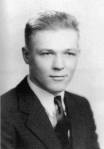
On 25 August 1941, Richard “Dick” Winters, a June graduate and Magna Cum Laude of Franklin and Marshall College, walked into a recruiting office in Lancaster, PA. With the recent passage of the Selective Service Extension, he figured it was only a matter of time before he was drafted. He’d go to Camp Croft, SC for Basic Training, and then Ft Benning, GA for Officer Candidate School. In August 1942, he volunteered for the new Parachute Infantry, and was assigned to E Company, 2nd Battalion, 506th Parachute Infantry Regiment at Camp Toccoa, GA.

You can watch the rest on Band of Brothers.

Escape From Brooklyn

In the afternoon of 28 August, 1776, after a council of war with Greene, Putnam, and Sullivan, George Washington decided that the storm could be used as a cover to gather boats and escape the trap. It took a full day and then some to gather all the small craft on the East and Hudson rivers in the middle of the nor’easter, but by the evening of the 29th, they were assembled below Brooklyn Village. Just after dusk, almost as if Baby Jesus turned off the faucet, the storm dissipated, and left the East River calm.

Two Massachusetts regiments would ferry the Continental Army to Manhattan in great secrecy. Pvt Joseph Plum Martin wrote that the men were “enjoined not to speak, or even cough”, and that “orders were passed from officer to officer, and then to the men in a whisper…” All night Washington’s soon-to-be indispensable regiments of fishermen, mostly from Marblehead, slowly rowed the stores, powder, tents, cannon, horses and men of the heretofore doomed army across the mile wide East River.

In the morning twilight of the 30th, the men left behind in camp to stoke the fires scampered down to the bank, and were surprised to find three regiments, and Washington’s headquarters, still awaiting transport. The operation would be exposed at dawn for all eyes to see, whether Manhattan loyalists, the elder Howe’s gunners, or the younger Howe’s pickets. Washington, personally supervising the embarkation, briefly entertained the idea of sending the men back to the entrenchments to make a fight of it. But just as the sun was about to peak over the horizon, another freak accident of nature, some would say a miracle, happened – a heavy fog descended on the river. It was so thick men “had to hold the shoulder of the man in front of him”. When the fog finally lifted two hours later, Lord Howe, looking through his spyglass in the New York Harbor, watched the final load cross the river, which contained Washington as he was one of the last to embark.

The Continental Army would live to fight another day.

Almost a hundred years later, German Chancellor Otto Von Bismarck would say, “There is a Providence that protects idiots, drunkards, children, and the United States of America.”

The Nor’easter

On the evening of 27 August 1776, General Sir Henry Clinton and Lord Cornwallis were furious with their commander, General Howe: Washington’s army was just waiting on destruction and instead of attacking, Howe ordered siege works constructed. He later explained to Parliament in 1779 that his men were tired after marching all day, and he wanted to avoid another Bunker Hill. Furthermore, his brother, Admiral Lord Howe could easily trap the Americans by sailing into the East River the next morning. Nevertheless, Clinton and Cornwallis felt that when total victory was within your grasp, you seize it with both hands, lest the opportunity slip away. They were right.

On the early morning of 28 August, in the exhausted and battered American camp on Brooklyn Heights, the sentries’ eyes began adjusting to the twilight and they could just make out their British and Hessian counterparts 150 meters below them. But before their besiegers’ camp could become more than thousands of tiny fireflies in the black, darkness reemerged. In less than a minute, the clear starlit sky was a mass of dark angry clouds streaked of lightning. In its horrible fury, the thunder awoke both camps, and the horizontal rain blew over tents and extinguished fires. A Nor’easter had blown down the coast.

The storm, uncommon in the summer, howled all day, and showed no signs of abating. In New York Harbor, it was all Lord Howe could do to save his ships, much less than trying to sail up the East River.

It was the second time that year that Washington was saved by a freak phenomenon of the weather. It would not be the last.

The Battle of Long Island

New York was LTG George Washington’s nightmare: the city was on the southern tip of Manhattan Island and dominated by the western tip of another island, the Brooklyn Heights on Long Island, and he had no navy. In July, Washington politely rejected Lord Howe’s offer of pardons, just after Howe’s adjutant pointed out these exact inconvenient facts. He also dismissed Nathaniel Greene’s suggestion to burn the wretched hive of loyalists to the ground and fight somewhere else. Washington understood that the Continental Army had to be seen defending all Americans, not just particular groups. Despite the difficulties, a defense of New York would at least be attempted. Washington had 22,000 men but Howe had 35,000 so he split his army: half on Manhattan, 1/10 in forts blocking the Hudson (Forts Lee and Washington. We will speak of them later), and 2/5 on Long Island.

On 21 August 1776, Washington’s spy network determined that Brooklyn would be Howe’s next target. That night Washington rushed reinforcements to Long Island, where MG Sullivan discerned that the best place to meet Howe would be the Guan Heights south of Brooklyn Village. The Guan Heights were a series of hills and passes which was thought would negate Howe’s advantage of superior numbers. But the defensive preparations were muddled. It was clear that Washington and his subordinate commanders and staffs were still having difficulty with all aspects of running the army, particularly one so large as the Continental Army in the summer of 1776. The three western passes were defended, but far to the east, the Jamaica Pass, was thought too far away for use by the British. They were wrong.

On 22 August the first British and Hessian troops landed at Gravesend Bay on Long Island. By 25 August Howe had 20,000 men on the island. On the evening of 26 August, Howe led a night march of 10,000 guided by loyalist farmers around the American defenses through the Jamaica Pass. At 0300, Cornwallis and Clinton attacked the Guan Heights to fix Washington, and at dawn Howe crashed into Sullivan’s unprotected flank and rear. The entire left of the Continental Army broke. Washington ordered a retreat for the fortifications of the Brooklyn Heights but the entire army was in chaos. That so many men would escape was solely the result of the defense and counterattacks of the 1st Maryland Line, led by MAJ Mordecai Gist, known to history as “The Maryland 400”.

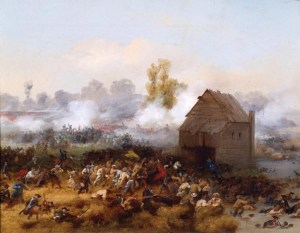
MG William Alexander Lord Stirling, in command of the Washington’s right on Battle Hill thought he was winning the day against the Hessians and Royal Marines to his front until British regulars appeared behind him. He ordered most of his troops back but stayed with Gist and the rearguard of Marylanders. The Maryland 400 had never been in a fight together before that morning and took on 2500 British and two cannon. They alternated between breaking up attacks and counterattacking with bayonets, which they did six times, twice to capture an old stone house, before being destroyed. 256 Marylanders were killed, the rest wounded and captured, including Gist and Stirling. Washington watching from a nearby hill, said of them “Good God, what brave fellows I must this day lose.” Only twelve made it back to the Brooklyn Heights.

That afternoon, Washington and his commanders scrambled to reorganize the shattered army to defend the Brooklyn Heights for Howe’s inevitable assault that evening.

But it never came. Nonetheless, as soon as the Royal Navy entered the East River the next morning, Washington would be trapped, and there was nothing he could do about it.

The Battle of Manzikert: “The Disaster”

For hundreds of years the Byzantine army held back the various waves of Muslim and Steppe invaders because of an effective and efficient defense in depth throughout the empire. The first layer was a superior intelligence system, managed from the “Office of Barbarians” that tracked the movements of tribes on the Steppes, and the activities of the sultans. It gave sufficient warning for Byzantine diplomats to bribe a rival tribe or sultan into war against the impending invader. The next layer was the buffer states, Georgia, Armenia etc which could be reinforced or let fall as needed, but gave time for the next two layers: The first was a series of well stocked, manned and provisioned border fortresses, which could hold out for years if necessary. The next and most important were the troops of the “themes” or provinces, comprised of free peasants who served in times of crisis in exchange for land. Finally, the thematic troops were backed up by the semi-autonomous regional tagmata, or professional armies. All of which if necessary could be reinforced by the Emperor’s personal guard and the nobles levy from Constantinople.

The system was amazingly flexible and effective on the defense but cumbersome on the offense. In the early 11th century, when the threat of invasion seemed remote, the emperors wanted to recover lost land, and began reorganizing it to better suit offensive operations. Unfortunately, they undermined the critical foundation, the self sufficient thematic peasants, whom made amazing soldiers, chiefly because they, being free, were well equipped, and they had skin in the game defending their own lands. However, that came at a cost because they weren’t productive if they were deployed. The emperors gradually mobilized them less and less, but took increasing portions of their goods, not to pay for more tagmata, which potentially posed a threat to their reign, but to pay for mercenaries loyal directly to emperor (and that didn’t have to return for the harvest). Finally, in their attempt to expand the empire, they directly annexed in a bloody and destructive war, Armenia – the bulwark against the east and north east. The tenacity in which the Armenians fought the steppe invaders was turned against the Byzantines, and it would result in the virtual destruction of the country and the first Armenian diaspora. More importantly, it meant no Armenian buffer.

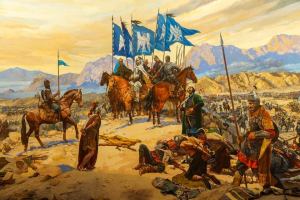
In the mid eleventh century, the Byzantines were victorious and modestly expanded the empire, but it did not mattter. In 1070, the Seljuk Turks took advantage of the Armenian situation and crashed through the weakened area, and overran the border fortresses devoid of thematic troops. The next year, Emperor Romanos himself led the army against the Seljuk Turks under Sultan Alp Arslan, and on 26 August, was decisively defeated at the Battle of Manzikert in what is now eastern Turkey. The hardcore of the Byzantine Army was destroyed, including all of the tagmata, the households of all the major nobles, and the famed Varangian Guard, the intensely loyal viking mercenaries whom died to a man defending the emperor. Emperor Romanos was captured, and within six years most of Eastern and Central Anatolia would fall.

The Battle of Manzikert would be known as “The Disaster” for the next 500 years. More immediately, 13 years later in 1094, the Byzantines, still reeling from the complete loss of the professional core of its army, would ask the Pope for help against the Turks, leading to the First Crusade.

Operation Countenance: The Invasion of Iran

The phrase, “The Great Game” usually describes the Anglo-Russian rivalry that played out across Central Asia, especially Afghanistan, in the 19th century, but has its roots in an earlier (and eventually overshadowed) rivalry between the two Great Powers in Persia, modern Iran. For hundreds of years, the Iranian people and shahs were used for both good and ill in the diplomatic, economic, and military maneuvering of the British and Russian Empires. In the late 19th century, Iran began asserting its own political independence by establishing ties to the new German Empire. In 1925, a new Shah came to power, Reza Shah Pahlavi, and began a massive modernization program funded by the nationalization of the Anglo-Iran Oil Company (Today we know them as BP), and much foreign assistance, particularly German and Italian.

Reza Shah declared neutrality at the outset of the Second World War, but both Great Britain and the Soviet Union suspected that German advisors in the economy and to the Shah had outsized influence over Iranian foreign policy. After the German Invasion of the Soviet Union in June 1941, Stalin was desperate for Lend Lease supplies and FDR was more than willing to provide them, but the convoy routes through the Arctic Circle were especially dangerous. The old Anglo-Russian trade routes through Iran, especially the railroad from the Persian Gulf to the Caspian Sea known as the “Persian Corridor”, were a perfect compliment.

By the summer of 1941, the Red Sea, Gulf of Aden, Arabian Sea, and northern Indian Ocean were no longer considered war zones, and could be freely transited by American ships. The British had just secured Ethiopia, Somaliland, and Eritrea from the Italians, cleared Iraq of Fascists, and threw out the Vichy French from Syria, which released several Indian divisions for duty elsewhere. The Soviets additionally wanted an excuse to seize Iran as the next Socialist republic, and secure the oil fields around the Caspian Sea. Britain also saw a pro German Iran as a destabilizing influence to eastern India, and neutral Turkey. When British diplomats delivered an ultimatum to the Shah on 17 August 1941 to expel all Germans from Iran, it didn’t matter what he said: Iran was going to be invaded.

On 24 August, British and Indian troops crossed into Iran from Diyala and Basra in Iraq, in a surprise attack which quickly defeated the Iranian Army that Shah Reza spent a decade and half modernizing with great difficulty. And his new roads expedited the invaders movement in the country. The next day, three Soviet armies did the same from the Transcaucasus and Turkmenistan. In just four days, Soviet and British troops met at Qazvin, just north east of Tehran, and the Shah sued for peace.

The first Americans to facilitate the Persian Corridor arrived a few days later (In 1941, British and Soviet troops were needed for fighting. By 1943, 30,000 Americans were serving in Iran maintaining the Persian Corridor). The first convoys and train loads of American supplies to the Soviet Union would commence in just a week. 30% of all Lend Lease supplies to the Soviet Union would transit through Iran.

The Battle of Yarmouk

The Byzantine Empire and the Sassanid Persian Empire had been archrivals for nearly four hundred years: ever since the Eastern Roman Empire split from the Western, and the Sassanids replaced the Parthians in the third century. In the early seventh century, the two old rivals fought a twenty year increasingly expensive and destructive war for control of the Near East and Egypt that in the end resulted in little change to the status quo, and left both empires exhausted. While both empires hammered on each other, the prophet Mohammad preached Islam in the deserts of Arabia, and just after his death, the Rashidun Caliphate was poised to expand beyond the Arabian Peninsula.

In 634, the Muslim Arabs exploded into the Levant (modern Israel, Jordan, Lebanon, and Syria), and quickly overran the Byzantine Christian lands. To the credit of both the Sassanids and the Byzantines, they recognized the threat that the Rashidun Caliphate represented. Byzantine Emperor Heraclius secured an alliance with the Persians, but the damage they did to each other was extensive and complete. Nonetheless, Heraclius concentrated his diverse armies into an overwhelming mailed fist, and in May 636 sought to crush the invading Muslims.

Khalid ibn al-Walid, the supremely competent, dedicated, and faithful Muslim battle commander, was outnumbered at least four to one, and fell back to the Yarmouk River, where if he was defeated, could easily seek refuge in the stronghold of Najd. Heraclius, whose army was wracked with logistics difficulties (the Byzantines never concentrated their armies for exactly this reason; although the bureaucracy was extensive, the effectiveness of the old Roman supply system was long gone), and bickering factions (ditto: the Slavs, Armenians, and Christian Arabs couldn’t get along), felt compelled to fight the Muslims on the ground of their choosing.

The battle began with Muslim warriors challenging various Byzantine commanders to single duels, but after losing several of his best soldiers, Heraclius attacked. For five days, the Byzantines pounded the Muslim lines, but the attacks were uncoordinated, and breakthroughs were never exploited because of the emperor’s cumbersome, complicated, and lethargic command system (one could say it was “Byzantine”… Ba Dum Tiss!). Furthermore, because of the feuding, Heraclius never committed his reserve to the fight: his cataphracts, the most powerful armored mounted force in the world, and hundreds of years ahead of the mounted knights of the West, whom sat watching the battle for most of six days. Conversely, Khalid’s mobile guard, comprised of the best warriors of Islam, consistently and routinely appeared at troubled spots on the line, stabilized it, and quickly moved off to another threatened area to repeat.

Nevertheless, Heraclius’ almost secured victory twice: On the third day, his army broke through the Muslim right which fell back to its camp. But there the defeated warriors were met by their camp followers. The enraged wives and servants used tent poles to beat the warriors back into the line. Not wishing to face the wrath of their women, the ashamed warriors counterattacked. With no follow up, the overextended Byzantines fell back. And again on the fourth day, when Byzantine horse archers (a direct result of experience fighting the Persians) dominated the Muslim Left. The fourth day of the battle would be forever remembered by Muslims as, “The Day of Lost Eyes” due to the uncanny accuracy of the Byzantines. The lack of follow through, and darkness, saved the Muslims.

On the fifth day, Heraclius, whose disorganized army by this point had thousands of casualties and low morale, asked for a truce. Khalid, sensing weakness declined. The next day, Khalid concentrated all of his cavalry in a decisive flank attack, and before his infantry broke, smashed the Byzantine Left in an unexpected charge.

Khalid ibn al-Walid’s stunning victory at the Battle of Yarmouk cemented Muslim control of the Levant for the next 450 years, and was the first Muslim conquest outside of Arabia. It would not be the last.