
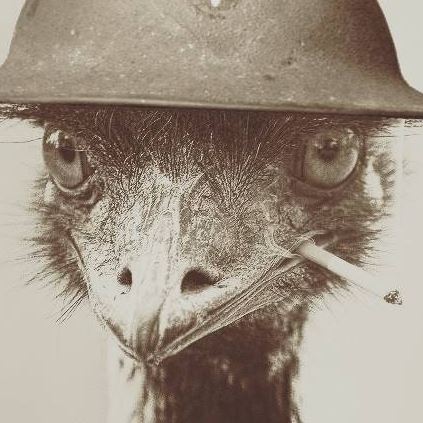
The Great Emu War


For a week, the battle between Field Marshal Erwin Rommel’s Panzer Armee Afrika and Lt Gen Bernard Montgomery’s Eighth Army raged around an obscure railroad terminal in Egypt at El Alamein. In the previous weeks, both sides dug in and laid extensive minefields all the way from the coast to the impassable Qatarra Depression in the south. So far, the Second Battle of El Alamein was a constant cut, parry, and riposte by both sides, as the Eighth Army sought weak points in the German defenses, and slowly ground down Rommel’s forces. From Enigma intercepts, Montgomery knew of Rommel’s supply difficulties; it was only a matter of time before the Axis lines broke.
On 1 November 1942, Montgomery found his weak spot just above the Miteirya and Kidney Ridges in the north of the battlefield. There, dismounted engineers (the “light feet” of Operation Lightfoot, since they wouldn’t set off the anti-tank mines if they stepped on them) had cleared several passages through the German and Italian minefields. That evening, Montgomery reshuffled his forces and formed a composite division under the redoubtable Bernard Freyberg (Crete notwithstanding, Freyberg was still the best division commander the British had) and what remained of his 2nd New Zealand Division.
Just after 0100 that night, Freyberg launched Operation Supercharge to crack the German lines and pass the 1st and 10th Armoured Divisions through so they could engage and destroy the remainder of Rommel’s ever dwindling supply of panzers. After a furious four hour bombardment, the Kiwi and British infantry forced the ridges doggedly defended by dug in Italian infantry, but expended themselves doing so. The only remaining static Axis defense was an anti-tank screen along the Rahman track. Freyberg had no infantry left to clear it, but with the breakout so close, a good old fashioned cavalry charge, Light Brigade-style, had to be tried.
The job fell to Brigadier Currie’s 9th Armoured Brigade, initially attached to Freyberg to fix Rommel’s inevitable counterattack after the infantry pierced the line. Now they were attacking directly into the teeth of German anti-tank guns. Just after dawn with the sun at their backs the British tankers rolled forward desperately trying to close the distance before the dreaded 88s shot them to pieces. But attacks that were suicide earlier in the year were merely exceptionally dangerous now. Thanks to Roosevelt’s stripping of tanks from America’s first armored division and sending them to the Middle East after the Fall of Tobruk, the thin skinned and light gunned Honeys, Cruisers, and Crusaders had been replaced by heavier and newer Churchill, Grant, and Sherman tanks, with thicker armour and longer ranged guns. For 30 intense minutes, Currie’s tanks dueled with Rommel’s guns. He didn’t break through, but there were few anti guns remaining. Rommel reinforced the line. However, only a counter attack could prevent the Eighth Army, a formation that Auchinlek and Montgomery spent months painstakingly building up, from breaking through and cutting the all-important coast road.
About an hour later, a Kiwi brigadier was wondering why the 9th Arm Brigade wasn’t supporting the defense. He found Currie dozing on a stretcher. “Sorry to wake you, John, but where are your regiments?” Currie waved to the half dozen tanks laagered around him. “Not your headquarters, your regiments?” Channeling Picket at Gettysburg, Currie groggily replied, “These are my regiments, Bill.”
Fortunately for Currie, Freyberg, and Montgomery, Rommel had little fuel and few tanks left to effect a counterattack. That afternoon, he threw the Littorio Armored Division and the 15th and 21st Panzer Divisions at the gap, where they were stopped cold by British and Kiwi anti-tank guns and artillery, supported by waves of RAF air support, who by this point in the battle had near complete control of the air. The Germans and Italians lost nearly 100 tanks in what became known as “The Hammering of the Panzers”. It was about the same number of losses as the British, but Rommel had no replacements. He had just 35 tanks remaining, little fuel, and there was a British armoured car squadron rampaging through his rear areas who had slipped through in the confusion. Rommel knew the battle was lost.
However, Rommel was determined to save as much of his command as possible. That night he radioed Hitler directly for permission to withdraw, which Hitler replied the next day that Rommel needed to stand his ground, and ended his message with, “you can show them no other road than that to victory or death.” Rommel decided to compromise, but waiting on Hitler’s reply cost him dearly. He planned on withdrawing six miles, but never had the chance. During the night Montgomery again reorganized his forces and launched three infantry brigades at what was left of Rommel’s defenses along the Rahman Track, and broke through. Only the determined and stalwart defense by several Italian units prevented the PanzerArmee’s complete destruction, as Rommel waited on Hitler’s response. The elite Folgore Parachute Division, which spent most of its existence preparing for an airborne assault on Malta, was encircled and destroyed. They literally fought until the last bullet was expended. The Afrika Korps’ longest serving Italian allies, the Ariete and Littorio Armored Divisions and the Trieste Motorized Division, were also destroyed in desperate rear guard actions to buy Rommel time for the rest to withdraw.
By the morning of the 4th, the situation was hopeless, and Rommel abandoned the line to fall back to Fuka, 50 miles west. But he couldn’t even stop there. Montgomery’s armoured divisions dogged him the entire way, and by the 11th, Rommel was thrown out of Egypt. Rommel deemed Cyrenacia untenable with what remained of his once feared PanzerArmee Afrika, and by 23 November was back at El Algheila, where he started nearly eleven months before. Despite Hitler’s order to stand and die, Rommel’s compromise to withdraw just six miles at the end of the 2nd Battle of El Alamein, turned into a retreat of over 650 miles. He would never return.
After the Second Battle of El Alamein, Churchill noted, “We can almost say that before Alamein, we never had a victory. After Alamein we never had a defeat”.
On All Hallow’s Eve, 1517, local teacher, professor of theology, and Augustinian monk, Martin Luther posted a proposal for a public debate on the door of Wittenberg castle’s church regarding the sale of indulgences by traveling Dominican friars. In 1517, indulgences were certificates guaranteed by the Pope that the bearer would not have to spend time in Purgatory for their earthly sins. Luther had drawn up a list of 95 theses which were his concerns, not specifically against indulgences themselves, but with their sale without any true contrition. He wanted to provoke debate, something he was very good at, and reform the Church, not break with it.
There is no evidence of Luther actually “nailing his theses to the door”. However, that day Luther did send copies of his 95 theses to Albrecht the archbishop of Mainz and Jerome the Bishop of Brandenburg, who forwarded them to the Pope. The bishops then let the matter drop. Stymied by his chain of command’s inaction, Luther sent his 95 theses to several friends throughout Germany. These friends promptly had many more copies made on one of the newest inventions of the Renaissance, the printing press. Luther gained a following and the Dominicans’ revenue from indulgences dropped. At the powerful Dominican order’s request, Pope Leo X issued a decree demanding the following of the Dominican practice of indulgences, which Luther and his adherents ignored. He wouldn’t give in without his debate.
Prominent German theologian John Eck took up Luther’s gauntlet. In July 1519, the two debated in Leipzig. Eck got the best of Luther, but only because Eck slandered him by pointing out that a century before, Jan Hus also thought indulgences were sacrilegious. This bit of sophistry horrified Luther, who had accepted Jan Hus and his failed Hussite rebellion in Bohemia in 1414, as the height of heresy. There were quicker ways to get burnt at the stake than by being called a “Hussite”, but not many.
Luther dug into Hus’ teachings to refute Eck. However, he found that he was actually fully in agreement with Hus, and speaking to his followers, said, “We are all Hussites without realizing it.” Luther began a proper campaign of book and pamphlet writing espousing and clarifying his thoughts on the Church, which due to the printing press, spread rapidly throughout Europe. It was at this point that Luther began calling for a break with the Church of Rome.
At several points in those formative years of the Protestant churches, Luther could have easily been declared heretical and burned at the stake. However, Luther had a powerful benefactor, the Elector Frederick of Saxony, who did not want his star orator and teacher, and Saxony’s most famous subject, harmed. When Luther was summoned to Rome to explain his views (where he would have almost certainly been killed), Frederick convinced the Holy Roman Emperor, Maximillian, to allow Luther to debate the Dominicans in Augsburg. The ailing Maximillian, who needed Frederick’s vote to get his grandson Charles elected as the next Emperor, was only too glad to accommodate Luther.
After Charles was elected Emperor, the politics of the Holy Roman Empire continued to be more important than the “Monk’s Quarrel”. Under Frederick’s protection, “Lutheranism” spread throughout Europe. In 1521, Luther was at the height of his popularity, and Charles requested that he explain himself at the Diet of Worms, fully expecting Luther to recant. But Luther did no such thing, and many of the members of the Diet called for his immediate execution. However, Charles honored his promise of Luther’s safe conduct. The Diet was called because Charles needed funds to fight the Turks, who had just recently captured Belgrade, which opened up the Hungarian Plain to Turkish raids and incursions. Frederick was by far the richest elector in the Empire, and Charles needed his support.
After securing Frederick’s support, Charles did outlaw Lutheranism, but by then it was too late. Luther translated the New Testament from Latin to German, so that “every man can be his own priest”, which broke the power of the clergy and “democratized salvation”. Due to Luther’s superior rhetorical skills, prolific book writing and pamphleteering, which was compounded by the printing press, Lutheranism could no longer be contained. It had spread throughout Germany, France, the Low Countries, and even England.
The Protestant Reformation would eventually set Europe on fire. It would take over a hundred years of bitter and bloody internecine warfare before most Catholics and Protestants realized religion wasn’t worth killing each other over.
For various reasons, there was no clear successor to the Roman Empire after the death of Emperor Constantius in 306 CE. In the following years, two clear candidates emerged: Maxentius, who held Rome and made himself emperor, and his brother in law Constantius’ son Constantine who was in Britain at the time. In 312, Constantine gathered his legions and marched to the Italian peninsula to challenge the usurper.
On the night of 27 October, Constantine said he had a vision (some accounts say his legions saw it also) of a symbol, and heard the words “Under this sign you shall conquer”. Although commonly thought to be the cross, the symbol was the early Christian Chi Rho (P with an X in the stem) made of the first two letters of the word “Christ”. That night Constantine had the symbol painted on his legion’s shields, helmets, and banners.
The next morning, Constantine’s legionnaires met Maxentius at Milivian Bridge over the River Tiber on the Via Flaminia. Constantine decisively defeated Maxentius, and killed most of his troops, including the usurper himself, as they tried to flee across the bridge or swim the river. Constantine claimed divine intervention of the Christian God as the reason for his victory.
Constantine was not a Christian himself. Like most Roman soldier-emperors he worshipped Sol Invictus and Mithras, but saw the Christian god as one of many, and for the rest of his reign he ended the persecution of Christians. Emperor Constantine I did much to promote and protect Christianity across the Empire and was baptized a Christian on his deathbed. Constantine is arguably the single most important secular reason for Christianity rising from a mostly Eastern slave, outcast, and women’s cult, to the state religion of both the Western and Eastern Roman Empires.
Ever since Rommel arrived in North Africa in Feb 1941, he used virtually the same tactic to defeat the British: He would make a wide sweeping movement with his tanks in the open desert around the flank of the British line which would inevitably obligate every British tank to counterattack in a grand charge to defeat the German maneuver. Rommel would then ambush and destroy the British force with his long range and very destructive 88mm anti aircraft guns. The only thing left was to pursue the routed and flanked British force.
In mid Sep, 1942, Rommel sought to do this again but the British 8th Army’s new commander, General Bernard Law Montgomery, had other ideas. Instead of gallantly charging into the teeth of German firepower, he let the Germans turn the flank and ambushed them behind the British lines at Alam Halfa Ridge. All of the British armour was dug into defensive positions along the ridge, effectively turning the tables on the German maneuver. The Battle of Alam Halfa was Erwin Rommel’s first serious defeat.
The Panzer Armee Afrika retreated to their former positions and awaited the expected British counter attack. But it never came. Gen Montgomery knew that in order decisively defeat Rommel he had build up an overwhelming superiority in men, weapons and equipment. An immediate counterattack would initially be successful but it would eventually run out of supplies as the British pushed Rommel back towards his own supply bases in Libya. If that happened the see saw campaign in North Africa would continue. So Montgomery used the time after Alam Halfa, when he was still close to his supply dumps in Cairo and Alexandria, to build up an overwhelming superiority in combat power while Rommel was still stuck in Egypt and a thousand miles from his supplies.
On 23 October 1942, just when Rommel was on sick leave in Germany, Montgomery’s Eighth Army launched Operation Lightfoot, named for the infantrymen and engineers who had to clear the anti tank mines but were too light to set them off when they stepped on them. Operation Lightfoot initiated the Second Battle of El Alamein and by 2 November 1942, Montgomery defeated Rommel, and the Axis forces would be in full retreat back to Libya against Hitler’s specific orders to stand and die. Unlike previous withdrawals, Rommel would never recover the lost ground.
1587 was a critical year in the Counter Reformation. Protestant Queen Elizabeth I of England was funding and supporting the Dutch revolt against the Catholic Spanish in Eighty Years War in Flanders and the Spanish Netherlands. When Elizabeth beheaded Mary Stuart in February, it deprived English Catholics of a leader to rally around, and Phillip II of Spain decided that the only way England could be brought back into the Catholic fold was to invade. Phillip authorized “the Enterprise”, the Spanish Armada, to invade England that summer. The plan was for the Armada to defeat the English at sea, then convoy the Duke of Parma’s army, then in Flanders, to seize London, with the support of England’s beleaguered Catholics. Upon the news, Elizabeth’s most devoted champion, Francis Drake, immediately put to sea, and raided the Spanish anchorage of Cadiz. He destroyed thirty Spanish ships destined for the Armada, including the Marquis of Santa Cruz’ flagship. As devastating as this was, it paled to Drake’s subsequent raids off of Portuagal’s Cape St Vincent where Drake destroyed nearly a year’s production of barrel staves, without which the Armada was delayed a year. But before these consequences were realized, the Duke of Parma masterfully seized the port of Sluys on the North Sea for an embarkation point. But Sluys was suboptimal, what would be even better was a French port on the English Channel.
France was caught in the middle of the Anglo-Spanish War and the Counter Reformation in general. France’s Catholics were fighting the Protestant Huguenots in France’s “Wars of Religion” but in reality the conflict was a complicated three sided civil war known as the “War of the Three Henrys”. The first Henry was Henry De Guise, an influential French noble and an ardent Catholic. He was France’s most vocal member of the Holy League who took his instructions more from Spain and the Pope than the French monarch. The next was the last of the House of Valois and current French King, Henry III. Henry III was Catholic, and former King of Poland-Lithuania (long story), and a French nationalist. However, he was opposed to Habsburg hegemony through Spain and the Holy Roman Empire, and secretly thought that an alliance with England was the best way to prevent this. However, as a Catholic he had to officially oppose the third Henry, Henry of Navarre, the leader of Huguenot resistance in France. Henry, the King of Navarre, was next in line for the throne, but was a Protestant. In 1587, on behalf of France’s semi-independent Protestant nobles, he fought both Henry III’s ideas of a centralized monarchy and De Guise’s militant Catholicism. On the morning of 20 October 1587, the normally very competent and professional Henry of Navarre found himself surprised by a Catholic army under one of Henry III’s dandies, Anne de Joyeuse.
But Joyeuse wasn’t any ordinary courtier of the French king. Though an amateur, Joyeuse threw himself into warfare with as much enthusiasm as he did court politics. Joyeeuse’s superior force stole a night march on Henry and cornered him at the village of Coutras. The village was in a cul de sac between two rivers and Henry planned only to stay long enough to water his horses and rest for the night. However, he misjudged how far Joyneuse’s army was away, and was surprised to hear his pickets firing on the morning of 20 October 1587. Henry’s first thought was escape as a pitched battle would risk the entirety of the Huguenot leadership. And the village was a decidedly bad place to defend. However, he could possibly get away with the leadership and the cavalry, but the bulk of the army would have to be sacrificed. All he had was his reputation as a leader of men, and if he abandoned his army, that would never survive.
Henry began organizing his men in the field outside the town when Joyeuse’s army broke through the woods into the clearing opposite him. Fortunately both sides were equally disorganized, as the night march wreaked havoc on Joyeuse’s formation. By what seemed mutual agreement, both sides spent the next two hours forming battle lines. Joyeuses’ army was larger and better equipped. She had the crème of Catholic French nobility, the Gendarme, and the best troops De Guise’s money could buy. But Henry’s men were solid professionals and veterans of a hundred skirmishes and battles.
On the left, Henry’s cannon, masked by a marsh, were in place first and savaged the Catholic formation, forcing Joyeuse into a premature attack. Though on Henry’s right the tired light cavalry fell back, any Catholic advance was stopped amidst bitter fighting in the town. On the far right, Henry’s arquebusiers held strong along a shallow ravine. But these didn’t matter, the battle was decided in the center.
A thousand Catholic armoured knights in full plate and mail began at a walk, then a trot, then about a third of the way across the field, at a charge. It was too soon. The timing of a charge is a delicate matter: too late, and the knights were not at full speed, too soon, and the formation was ragged as the lesser horses couldn’t keep up. There was no such problem among Henry’s veteran heavy cavalry. They smashed the Catholic charge with a well-timed counter charge of their own. A massacre ensued. Joyeuse surrendered and offered a hundred thousand gold pieces in ransom, but was summarily shot though the head seconds later.
In 1587, there was no love lost between Catholic and Protestant in France. The Catholic French nobility was slaughtered, and the power of De Guise was diminished. More important, there would be no French Catholic support for a Spanish invasion of England. But Henry was also a nationalist, and didn’t want to see a weak French monarchy at the mercy of powerful French dukes. The slaughter of the radical French Catholics at Coutras directly led to the rise of nationalism at the expense of religion in France during the Thirty Years War (See Cardinal Richelieu). The Battle of Coutras kept France out of the Anglo-Spanish War, and two years later Henry III was assassinated by a Dominican monk who thought Henry III was not doing enough against the Huguenots. By Salic law, Henry of Navarre was crowned King of France, the first of the Bourbon line.
In September 1942, the Rattenkrieg, or War of the Rats, in Stalingrad had reached a fever pitch. For almost a month, German General Frederich Paulus’ Sixth Army and Gen. Herman Hoth’s Fourth Panzer Army fought LtGen. Vasily Chuilov’s Soviet 62nd Army in the rubble of the industrial city of Stalingrad. Chuikov instituted a policy of “hugging the enemy” to neutralize the Germans’ superior firepower. In effect, the Germans had to fight for every street, every block, every building, every floor, and every room. Germans complained of seizing “the kitchen” only to be “stopped at the living room”. Entire companies fought pitched battles through holes in the floor or ceiling, or in the sewers beneath the city.
But the Soviets weren’t passive. They were constantly attacking the northern flank of the Paulus’ drive at Kotluban to ease pressure on the city. After Stalin’s “Not one step back” order, more than 15,000 Soviet soldiers and civilians were killed by the NKVD trying to cross the Volga to safety, but it forced the remaining civilian population to join the fight against the Germans, and stiffened the flagging resolve of Chuikov’s troops in the city. Despite horrific losses, the Soviets continued to poor troops into the city by ferrying them across the Volga, which was under constant bombardment by German artillery and the Luftwaffe.
By the second week of October, Paulus and Hoth had for the most part cleared the southern and central portions of Stalingrad, with the exception of a small beachhead in the center, and could place direct fire on the crossing sites in the north, reducing Soviet reinforcement to nighttime operations only. In the north of the city, the Soviets were anchored on three massive industrial complexes, the Red October Steel Works, the Barrikady Ordnance Factory, and the Stalingrad Tractor Factory. Until recently, the Tractor Factory continued to produce T-34 tanks whose issue were fed directly into the fight, sometimes within minutes of leaving the complex. The T-34s had no sights, so the adhoc crews, mostly civilians, had to aim down the empty barrel, then load and fire the main gun. On the 11th and 12th, the Germans ceased major assaults. It was just the calm before the storm.
At dawn, Paulus assaulted the factory complexes with 90,000 men, 300 tanks, 2000 guns, and waves of Stuka dive bombers and Heinkel level bombers, against Chuikov’s 30,000 men and 80 tanks. The German force was not so much a bludgeon as a giant scalpel carving up the city. German radio direction finders pinpointed Soviet headquarters and blasted them, and then turned to Soviet strongpoints, such as Pavlov’s house, many of which had been a thorn in the German side for over a month (Pavlov’s House held out for 58 days defended by single platoon under the command of Lt Ivan Avanaslev and Sgt Yakov Pavlov). But the initial focus on Soviet headquarters had the detrimental effect of allowing the strongholds to prepare and weather the bombardment. Most Soviet units were out of contact with their commands anyway, and the initial Germans assaults were repulsed. However, the surprised Germans regrouped and seized their initial objectives. (Never trust and artilleryman or air force officer who says, “No one can live through that.”)
The fighting dragged for two days as the panzers prowled the factory floors, assault pioneers reduced Soviet strongpoints with explosives and flamethrowers, followed by intense close combat by what remained of the infantry. The Barrikady Ordanace Factory fell on the 13th and the Red October Steel Works on the 14th. That night the entire elite 37th Guards Division died to a man in the Tractor Factory. Chuikov’s army was split in two, and his headquarters was just 800 yards from the Volga. 3500 seriously wounded men were evacuated across the Volga that night alone.
About 2200 on the 15th, Chuikov, “the Stone of Stalingrad”, requested permission to withdraw. His commissar, Nikita Khruschev, demanded he rescind the request and even had him fired later that night. Chuikov was reinstated, but having won his power struggle with Khruschev asked again. However, Khruschev again protested but contacted STAVKA directly. And this time Stalin came down hard on Chuikov’s immediate superior, Gen. Yeryomenko, to provide Stalingrad with more support (Yeryomenko was hoarding troops on the far side of the river for the planned counterattack). On the night of the 15th, the 138th Rifle Division crossed the Volga and reinforced Chuikov’s battered and broken defenses, sometimes within the sight of the river.
By the night of the 16th, the Germans were spent. It says a lot about the state of the fighting that a single understrength and poorly trained, but fresh unit, could turn the tide of a battle. However, four days of no sleep and constant fighting is about all a human being can handle. The factories of Stalingrad for the most part were taken, but Chuikov and the 62nd Army still held on to a small sliver of the city along the river.
Sharing historic adventures
Ramblings of a Druid Farmer
Conflict simulation, peacebuilding, and development
Research from the Defence Studies Department, King's College London
The historical writing of Barry C. Jacobsen
If this history blog was a military unit it would be named "Kampfgruppe Buk", "Task Force Ski", or maybe, "Bukforce".
This WordPress.com site is Pacific War era information
If this history blog was a military unit it would be named "Kampfgruppe Buk", "Task Force Ski", or maybe, "Bukforce".
History and Hardware of Warfare
If this history blog was a military unit it would be named "Kampfgruppe Buk", "Task Force Ski", or maybe, "Bukforce".
Lead With the Best Version of Yourself
If this history blog was a military unit it would be named "Kampfgruppe Buk", "Task Force Ski", or maybe, "Bukforce".
The Premier Online Military History Magazine
Of history, warfare, leadership, and alcohol
You must be logged in to post a comment.