The Liberty Ship

With the German U-boats and Japanese submarines prowling between America and any potential future battlefield, the United States needed a cheap and easily constructed cargo ship to quickly replace the inevitable losses. On 27 September 1941, the SS Patrick Henry is launched: the first of 2700 Liberty class ships constructed during WWII. These large welded cargo ships formed the backbone of the American merchant fleet. They were the prime targets for German U Boats and surface raiders and the US Merchant Marine took the highest proportion of casualties of any service during the war. By 1943, a new Liberty ship was being launched every 8 hours.

The Norman Invasion of England

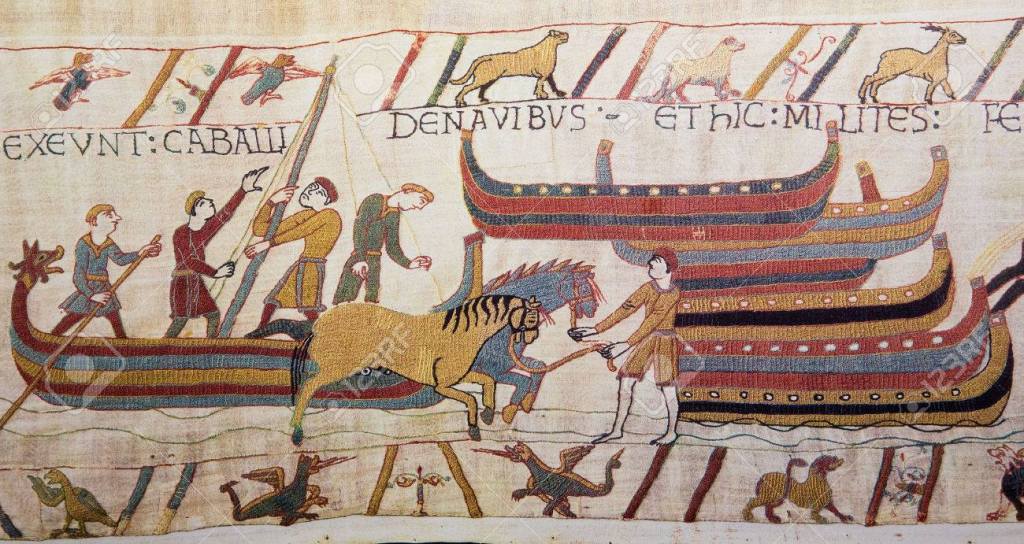
In September 1066, William the Bastard, Duke of Normandy and direct descendant of Rollo the Viking (the founder of Normandy), was waiting for an opportunity to seize the crown of England from Harold Godwinson, his cousin once removed, whom he considered a usurper and believed only had the crown because he was at Edward’s deathbed. On 22 September, William was granted his opportunity when his spies reported that Harold marched north in great haste with his army (to Stamford Bridge). William loaded his ships but there was no wind: the finicky weather of the English Channel prevented him from sailing.

On 27 September, a storm blew in but the wind was in the correct direction so William ordered his Norman-French army to sail north. The storm dispersed his ships and the Normans landed all along the southern English coast, but with Harold gone there would be time to consolidate. William landed with a large force at Pevensy in Sussex after scattering Harold’s weak navy. Then in an act that would be emulated by Hernando Cortez 450 years later, William dismantled his ships to signal to his men that there was no return to Normandy. He used the wood to build a castle near the town of Hastings.

William had to wait until the English army moved away from Sussex to land, but now that his army was on the ground, William desperately needed a battle with Harold. With only 11,000 men he could not seize London, and with no way to resupply from Normandy so late in the season (which was why he was ok with dismantling his ships) his army would eventually starve. So William decided to force Harold south before he could gather even more reinforcements from the furthest reaches of England and overwhelm him.

As the former Earl of Wessex, Sussex was part of Harold’s own personal holdings, and nearby Kent belonged to Harold’s brother Leofine. Any on goings in those lands would eventually reach Harold, and more importantly, the nobles and fighting men who left their wives and children to head north. If the news was bad, Harold would be forced to react. So William unleashed the Norman army on the English countryside.

William scourged the undefended Sussex and Kent.

The Normans and French ravaged Harold and Leofine’s lands. They foraged anything useful from the villages and farms, and then fired them. They killed any men they found, and brought the women back to be wives for the army in arranged marriages. The children became pages and servants to the nobles. William wanted the future generations to be Normanized, or “normal”. And his men went about the task with a fury worthy of the Vikings whose descendants they were.

The devastation of Sussex and Kent was so thorough that thirty years later the most common town description in the Doomsday Book (the very detailed tax record of all of England) for those areas pillaged by the Normans was simply,

“Laid to waste”.

The Battle of Stamford Bridge

Even though King Harold Godwinson and his men marched 50 miles a day for four days straight, York still surrendered to the Viking King Harald Hardrada before they could arrive. Hardrada, his army still disorganized from the Battle of Fulford, didn’t sack the city but demanded supplies and hostages lest he would burn it to the ground. The supplies and hostages were to be delivered to the bridge over the River Derwent at Stamford on 25 September 1066. That morning, Hardrada and Tostig Godwinson, Harold’s exiled brother, took about two thirds of the Viking army to the bridge to help carry the supplies and escort the hostages. Most didn’t wear armor as they weren’t expecting resistance, and well, it was hot and armor is heavy. While they waited many Vikings lounged on the river banks or sunbathed in warm September sun.

Around mid-morning the English arrived, but cresting over the small rise into the valley weren’t supplies and hostages. The glint of the sun was first seen off of thousands of spear points, then the steel caps, and finally the metal kite shields of Harold Godwinson’s huscarls and fyrdmen in battle formation. The Norse Sagas record the moment as,”Their shining arms were to the sight like glancing ice”. The surprise was complete. Tostig attempted to stall the English and negotiate with his brother, whom offered him his earldom back if Tostig switched sides. Tostig counteroffered and asked what Harold would offer Hardrada. Harold replied, “Seven feet of good English soil, as he is taller than normal men”. The Vikings on west side of the Derwent were quickly overwhelmed and crushed, and Tostig fled.

Hardrada needed more time to form a shieldwall on the eastern end of the bridge, and it was given by a single Viking berserker. This lone greataxe wielding wildman prevented Godwinson’s entire army from crossing the bridge until an enterprising young fyrdman found a boat, rowed it underneath the bridge, and stabbed the berserker in the groin through a gap in the planks.

Godwinson’s men rushed across the bridge and crashed into the half formed Viking shield wall on the other end. The Viking’s lack of armor was balanced by the English exhaustion of having marched in full kit 220 miles in the last five days, and twelve to this battlefield. Nonetheless, weight of armor and numbers told, and Tostig and Hardrada’s army were slowly wrapped and massacred. The king was killed by an arrow to the throat during a savage charge in a desperate attempt to breakout. For a brief moment near the end, the Viking’s fortunes changed when Eystein Orre, Hardrada’s son in law, led a furious assault into the flank of the English army by the fully armored Vikings just arrived to the battle from guarding the ships. But “Orre’s Storm” was too little too late, and they too were crushed.

Godwinson chased the remaining Vikings back to their ships where he accepted a truce from the survivors to never set foot on English soil again. Hardrada’s original army arrived on 336 longships, just 24 returned to Norway. The Vikings would never again raid or try to conquer England. The Viking Age was over.

The Battle of Fulford

In January of 1066, Harold Godwinson was crowned King of England after the death of Edward the Confessor. His exiled older brother Tostig Godwinson (he was such a bad ruler of Northumbria that Edward threw him out) felt that he had a better claim than Harold and began looking for allies. The King of Norway, Harold Hardrada, also had a claim, and accepted Tostig’s offer of help in overthrowing Harold Godwinson. Tostig and Hardrada, with a large Viking army, landed in Yorkshire in the north of England in early September 1066. Harold Godwinson’s spies knew they were coming, and his fully mobilized armies of his Earls Edwin of Mercia and Mocar Northumbria met them at the town of Fulford.
The first English charge almost broke the Vikings but Harold and Tostig managed to form a shield wall which held until men still disembarking from the ships could reach them. The battle then devolved into two rival shield walls attempting break each other. This lasted for several hours(!) but eventually the English sobered up and the arriving Viking numbers were still boozed up enough to continue to push. (Just about every source on fighting in a shield wall at this time mentions that one had to be drunk to get up enough courage to attack a shield wall or defend in one against a determined charge.) The English broke, and due to the swampy terrain were trapped and annihilated.
King Harold Godwinson was in the south preparing for the inevitable invasion by another claimant to the English thrown, Duke William of Normandy. When he heard that his armies in the north were destroyed, Godwinson hurried north with his household guard, the Huscarls, and every Anglo Saxon thegn enroute. Godwinson needed to protect the largest city of the north, York, and the only defensible terrain between it and Fulford was the bridge at Stamford on the River Derwent. For a week he marched night and day – he had to arrive before the Vikings reorganized.

Nathan Hale

After the defeat at the Battle of Long Island, LTG Washington was desperate for information regarding British operations against Manhattan. On 8 September 1776, CPT Nathan Hale of the 7th Connecticut Regt, a graduate of Yale and a former schoolteacher, volunteered to infiltrate Long Island and ascertain British intentions. He posed as an unemployed schoolmaster, and made his way from Connecticut, to Long Island, and eventually Manhattan, after the British landing at Kip’s Bay.

However, Hale was probably the worst possible choice for a spy: he was tall and “impossibly good looking”. He stood out in crowds. He was earnest, forthright, outspoken, and according to his friends, “incapable of duplicitous action”. Finally, he had a distinctive powder burn on his cheek from a skirmish with the British during the Siege of Boston.

On 20 Sept, Hale collected his notes and sketches of the British Army and Navy in and around New York City, and decided make his escape back to Washington on Harlem Heights. Unfortunately that night, a fire, which started at The Fighting Cocks Tavern, destroyed one third of the mostly abandoned city. The British blamed American spies (and the Americans blamed the British who used the fire as an excuse to loot the rest of the city… but let’s be honest: it was probably the Americans), and the next morning rounded up more than 200 ”suspicious men”, including Hale.

Hale was captured by none other the Major Robert Rogers of the Queen’s Rangers who was unconvinced with the school teacher story of the tall, ruggedly handsome blonde man with a nearly fresh powder burn on his cheek (even though he was actually a schoolteacher). Rogers spun a tale that he was also an American spy and had set the fires. Unfortunately the naive Hale believed him and gave himself away.

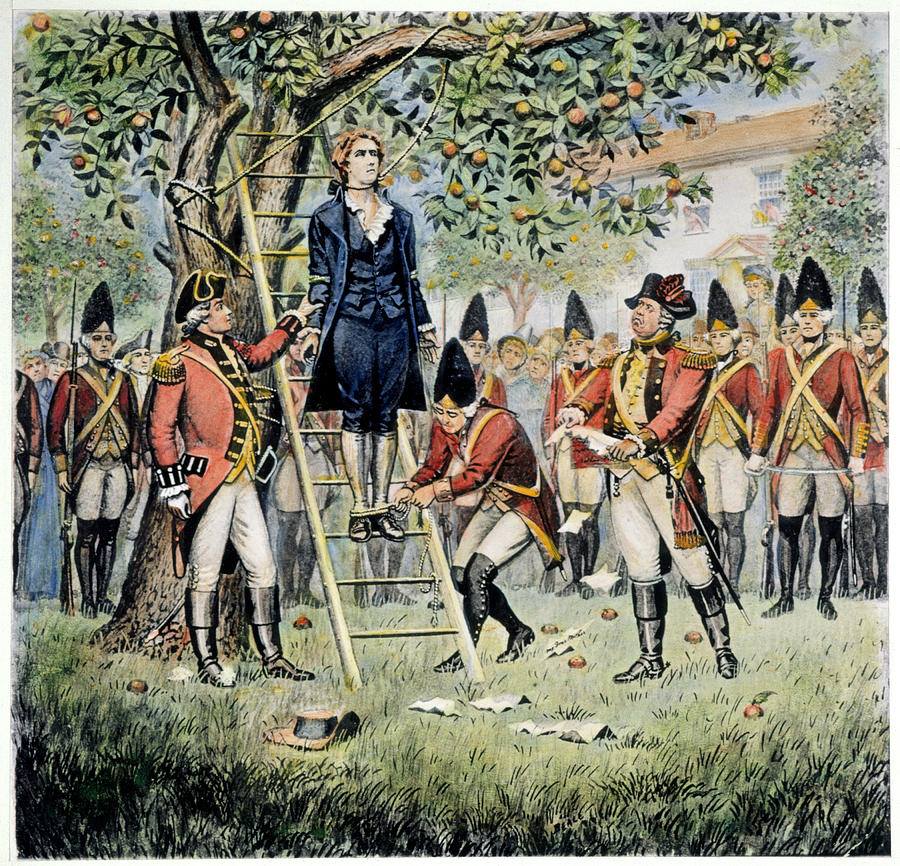
Of the 200 men rounded up as American spies, Hale was the only one who admitted he was a Patriot when he looked Gen Howe in the eye and told him so. According to the customs of war at the time, soldiers not in uniform were illegal combatants and were summarily hanged without a trial. At dawn on 22 September, 1776, CPT Nathan Hale was led to a tree outside of Dove Tavern in New York City, surrounded by only a few British officers and soldiers. But when the hangman asked the 21 year old if he had any last words, Hale, with “great composure and resolution” paraphrased a passage from a popular play at the time and said,

“I only regret that I have but one life to lose for my country.”

Frogmen

The ships of the Italian Navy might have been neutralized during the Raid on Taranto and the Battle of Cape Matapan, but the Regina Maria itself was still in the fight. The Italians were years ahead in the use of underwater demolitions to attack shipping in port. Between June 1940 and August 1941, the Italians made nine attempts on British ports in the Mediterranean, but only one was successful. It was simply an issue of stamina.

The men of the secret Decima Flottiglia MAS, the 10th Assault Vehicle Flotilla, were the best combat divers in the world, but no human being had the strength and endurance to swim several miles underwater with enough equipment and explosives to cut through any obstacles and sink a ship, and then swim out again without being seen. Their only success was through the use of speedboats to sink the HMS York in Suda Bay in May 1941, which would never work again. But by July of 1941, the Italians perfected the use of the “human torpedo”: a self-propelled and nearly silent miniature submarine that divers could attach equipment to and ride or hold on to the outside of during the approach swim to the objective.

On 20 September 1941, eight divers on three human torpedoes departed from the Italian submarine Scire docked in Cadiz, Spain to attack British ships in the port of Gibralter. They avoided the extensive minefields, cut through the torpedo netting, and attached limpet mines to three ships, two tankers and a cargo freighter, which were all subsequently sunk. The frogmen swam to Spain, rejoined the Scire, and went back to Italy to be decorated.

The frogmen of Decima Flottiglia MAS would carry out monthly (mostly successful) attacks until Italy surrendered to the Allies in 1943. The raid on Gibraltar fascinated the nascent “Observer Group” and “Navy Combat Demolition Units” that were just being formed by the US Military in 1941 to tackle the problems of amphibious assault, specifically beachhead reconnaissance and destruction of beach obstacles, and their training was altered accordingly. These groups would go on to be the Underwater Demolition Teams, and eventually the Navy SEALs we know today.

The Siege of Leningrad

On 8 September 1941, Hitler’s Army Group North reached the southern shore of Lake Ladoga outside of Leningrad, the symbolic home of the Bolshevik Revolution, and one of the Germans’ three objectives for Operation Barbarossa. It effectively cut the city of 2.5 million off from the rest of the Soviet Union. Two days later, the German High Command requested that Finnish troops seize the city through the weakly defended northern approaches. However, Finland was at best a reluctant German ally and Marshal Mannerheim, the CinC of the Finnish Army, refused stating that Finland’s war aims only allowed for the recovery of territory lost in the Winter War with the Soviet Union in 1940. It proved to the last chance that Germany had to seize the city in the war.

Operation Typhoon, the campaign to seize Moscow, was scheduled to launch in October and the tired 4th Panzer Group, which fought its way to Leningrad, was needed. The Siege would be carried out by the foot sore remainder of Army Group North which had an extremely difficult time keeping up with the Panzers. Nevertheless, the Germans thought the city would starve in a matter of weeks.

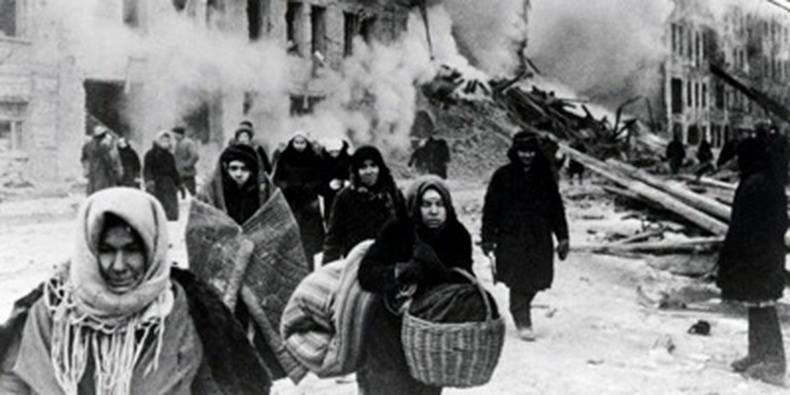
The only route into and out of the city was over Lake Ladoga, which was under constant artillery bombardment and Luftwaffe attack. The journey over the Lake, in slow boats in the summer and over the ice road known as the Road of Life in the winter, was perilous. 500,000 non-essential personnel were evacuated in the coming months but not before rats, cats, and dogs were a feast, horse a delicacy and cannibalism appeared in the less affluent neighborhoods. Only draconian measures kept the city from surrendering.

On 16 September, Marshal Zhukov was given command of the garrison and he directed the Soviet commissars that workers and soldiers would receive 500 grams of daily bread ration, officer workers and non-laborers would receive 200, and children and old people would receive none pending evacuation. Failure to comply was punishable by death. One Soviet teenager said later, “I watched my father and mother die – I knew perfectly well they were starving. But I wanted their bread more than I wanted them to stay alive. And they knew that about me too. That’s what I remember about the blockade: that feeling that you wanted your parents to die because you wanted their bread.”

On 17 Sep, the 4th Panzer Group began loading tanks on rail cars for the journey south, effectively beginning the siege.

It would last for 900 more days and claim the lives of 1.5 million.

The Battle of Harlem Heights

On 15 September 1776, General Howe landed 4000 men at Kip’s Bay in Lower Manhattan. Washington’s spies knew of the landing and he planned to meet them at the waterline, but the Americans broke at the sight of the Royal Navy, despite Washington’s exhortations to stay and fight. Private Joseph Plumb Martin said of the embarrassing episode, “The demons of fear and disorder seemed to take full possession of all and everything on that day.” Washington reorganized the Continental Army on Harlem Heights and left Lieutenant Colonel Thomas Knowlton’s Rangers to monitor and harass the British.

Knowlton’s Rangers was arguably America’s first Special Forces unit. He patterned his men on Robert Roger’s Rangers from the French and Indian War (Roberts was fighting for the British in this war.). On the morning on 16 Sep, Knowlton’s 150 men surprised the pickets of the 2nd and 3rd Battalions of the Light Infantry. Once the British were roused, Knowlton fell back, and the British pursued. The Light Infantry dragged the entire 42nd Highlander Regt, the Black Watch, with them: the uppity Americans had to be chastised. The Light Infantry liked to use fox hunting calls in their pursuits, and Washington took the sound as an insult.

The infuriated Washington organized an ambush for the cocky Brits, but a jittery young officer prematurely ordered his men to fire just as the Brits entered the kill zone. The British retreated to a field on Morningside Heights, but they were exposed and Washington decided to attack. All was going well for Washington, but a bungled flank attack (and death of Knowlton) failed to isolate them. The Brits retreated into the trees of Hollow Way, but Martin said of the withdrawal, they “were entering a thick wood, a circumstance as disagreeable to them as it was agreeable to us at that period of the war.”

At this point both Howe and Washington fed troops into the battle and they pounded each other for several hours, with the Americans having the upper hand in what was described as a “cursed thrashing” by one British officer. Nevertheless, Washington knew he was pressing his luck in the slug fest, as he was unwilling to commit more troops and risk the loss of the very defensible Harlem Heights behind him. When Howe arrived with the bulk of his 9000 man army, Washington prudently withdrew back up the hill.

The Battle of Harlem Heights, as it subsequently became known (it was named for the location of Washington’s headquarters, not the location of the actual battle), was Washington’s first battlefield victory. The Continental Army locked horns with best regiments in the British Army and gave better than they got. It proved a significant boost to the morale of the wavering Americans, which had only known defeat in New York.

The Tank

For two solid years, the trench systems of the First World War claimed the lives of millions. Russia (briefly) broke the stalemate through imaginative planning, rehearsals, and targeting, while Great Britain and France took a more technological approach. Under the auspices of the Royal Navy, “landships” were created which were heavy enough to crush the wire of no man’s land, long enough to cross trenches, impervious to shrapnel and machinegun fire, capable of traversing the tortured countryside, and with enough firepower to break the German lines. The caterpillar vehicles, code-named “tanks” (to hide their development), were tested and manufactured in the south of England in response to the butchery on the battlefields of Flanders in 1915. On the Somme in 1916, a new level of slaughter was achieved, and British leaders decided to unveil their secret weapon.

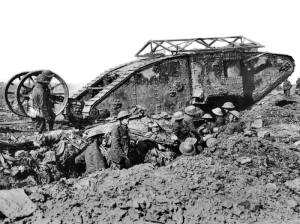
On 15 September 1916, Mark I tanks of the eager and frustrated Heavy Section advanced at a walking pace toward the Germans between the French villages of Flers and Courcelette, followed closely behind by British infantry. 19 of them would break down or become stuck before reaching their objectives. But 13 of the Iron Behemoths rumbled forward like the Juggernaut crushing all before them. German soldiers who just the day before were well entrenched and confident of victory, fled at the sight of the earth shaking, fire breathing impenetrable steel beasts. The British advanced over three kilometers in a battle whose gains for the last 76 days had been measured in yards. One French pilot observed from above, “Tank walking up High Street of Flers with British Army cheering behind”.

Regrettably, the British had no plan to exploit this breakthrough, and the Germans recovered all of the ground in subsequent counter attacks. Many derided the effort as at best a premature disclosure of an asymmetric advantage, and at worst a failure and waste of resources. It would be months before another tank saw action. Nonetheless like the bow, stirrup, gunpowder, bayonet, and the Dreadnought before it, the tank changed warfare forever.

Michelangelo’s David

In the High Renaissance, the feuding Italian city states were constantly at war with each other, when they weren’t at war with France or Spain. Perhaps the greatest rivalry of the city states was between Papal Rome under Cesare Borgia and Pope Alexander VI, and the idealistic (and relatively corruption free) Republican Florence under Piero Soderini, Niccolo Machiavelli, and the various merchant families (notably the recently deposed Medici).

For decades, the Office of Works for the Florence Cathedral wanted a series of Old Testament statues for the tops of the Duomo’s buttresses, but for various reasons little came of them. They were concerned for the hugely expensive block of magnificent Carrara marble exposed in the sacristy courtyard. At the behest of Leonardo Da Vinci, they commissioned 26 year old Michelangelo to sculpt Florentine David in direct defiance to Rome’s Goliath.

On 13 September 1501, Michelangelo began sculpting the colossal five m/17 ft David, which became one of the greatest achievements of High Renaissance art. The statue is of the young shepherd in the moments after he decided to fight the massive Philistine warrior Goliath, but before combat began. The tense, frightened, but observant David is poised but about to spring into action. The exquisitely and meticulously crafted sculpture took two years to finish.

A commission led by Da Vinci and Botticelli was so impressed with David that instead of placing it on Il Duomo, it be given a place of greater prominence. Michelangelo protested briefly because David was proportioned to be seen from below, but his concerns were dismissed. On 25 January 1504, David was unveiled at the entrance of the town hall in the Palazza Vecchio, gazing defiantly toward Rome.