The Battle of Hastings: The English Army

The razing of Harold and Leofine’s lands had the intended effect: the English army raced south from the Battle of Stamford Bridge. Harold stopped briefly in London to gather his army and collect stragglers, but every day he waited dozens of villages burned, and their inhabitants slaughtered or carried off. On 13 October 1066, Harold and his footsore and much reduced army moved south to Senlac Hill.

Harold led 15,000 at the Battle of Stamford Bridge, but for the upcoming battle he had less than seven, most of whom forced marched nearly 500 miles in the last month, and the rest were hastily armed locals because he dared not wait for other contingents of fyrdmen and huscarls from the distant parts of his realm. But Senlac Hill was a strong position, nearly impossible to flank, with a steep, but not too steep, slope to the south. It was a perfect position for Harold’s infantry based army. A huscarl shield wall at the top would be difficult to break.

In England the most common invaders were footbound i.e. the Romans, Germanics, Vikings etc and usually nearby on the relatively small island, so there was little reason to engage in the expensive horse breeding and logistics support required for the warhorses needed to carry heavily armored knights. So feudalism (such as it was) developed differently in England and this reflected in Harold’s army: the money saved on cavalry was used for the training and equipping of professional heavy infantry, huscarls, and semi-professional medium infantry, fyrdmen.

The fyrdmen were trained militia, though most likely unarmored, but disciplined and proficient in the use of round shield, long stabbing knife, and spear. They were the foundation upon which the huscarls won the battles. Harold’s huscarls were the exact sort of composite heavy infantry that Western Civilization has depended upon since the Greeks threw the Persians back into the sea at Marathon: stalwart and deadly in any defense, and unstoppable in the attack under deliberately prepared circumstances. The huscarls were trained and influenced by the best standards and practices of their day: they carried the long Norman kite shield that protected the legs and prevented the Viking penchant for thrusting under the shield wall. They wore Frankish chainmail, a Frankish steel cap with distinctive noseguard, and carried a bearded Frankish throwing axe to break up charges and formations (and you know, chop wood). From their Saxon, Angle, and Jute forefathers they had the seax, a long stabbing knife, perfect for gutting a fish… or an adversary in the press of a shield wall. Furthermore, they were trained in that one constant of warfare since the Stone Age: the venerable and versatile 7 ft spear, whether thrown, braced for a charge or a boar, or overhand in a way familiar to the Greeks and Romans in ancient past. Finally, they carried the deadly Viking great axe, for the general melee after their adversaries’ shield wall broke, or more commonly for individual combat.

These professional soldiers and militia made an imposing sight on Senlac Hill, and an even more formidable shieldwall. On 13 October 1066, they were just seven miles from the Norman army gathered around Duke William the Bastard’s wooden castle at Hastings.

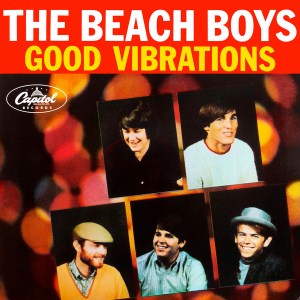
Good Vibrations

1966 was the Year of LSD in Rock and Roll. The Byrds released “8 Miles High” earlier in the year heralding the Age of Psychedelia, and John Lennon one upped them with “Tomorrow Never Knows” just after. The Beatles joined in and followed it up with their album “Revolver”. They were so whacked out Ringo doesn’t remember recording “Eleanor Rigby” (probably for the best), and they literally phoned in their parts to the animated movie Yellow Submarine (not the origin of the phrase, but probably the first actual use in filming). The Beach Boys also took up John Lennon’s psychedelic gauntlet. But the Beach Boys were far from the fresh faced bubble gum surfers they were a few years earlier and were themselves deep into drugs. Lead singer and song writer Brian Wilson, easily the heart and soul of the band, knew the end was near: like the Beatles, the individual Beach Boys rarely spent time in the studio together and relied on session musicians for recording.

Wilson knew this would be the last opportunity for the Beach Boys to release a great album, and used the drug fueled challenge to explore some musical avenues he couldn’t convince anyone to get on board with earlier. With legendary producer Phil Specter and an army of session artists, he wrote, produced, and recorded the album “Pet Sounds” over four months. The other members of the band, his two brothers, cousin and childhood friend, only came in to record their singing parts (for all their failings, the Beach Boys are unequaled vocally). From the greatest opening song on an album ever, “Wouldn’t It Be Nice” to Wilson’s first solo hit, “Caroline, No”, Pet Sounds, the first concept album, is Wilson’s magnum opus, and duly earned its rightful place as #2 on Rolling Stone’s Top 500 albums.

And this despite leaving his best song off the album.

Brian Wilson took another four months and an unheard $70,000 to perfect his greatest creation, “Good Vibes”, which he was eventually convinced to change to “Good Vibrations” late in recording. The final 3:37 minute song was edited/mixed over nine laborious days from 3 ½ hours of finished recorded music. Good Vibrations was released on 10 October 1966 and would earn the Beach Boys an instant Emmy, bring Psychedelic Rock mainstream, give the burgeoning antiwar counterculture its anthem, and launch the sub-genre of Progressive Rock. Finally, it convinced the Beatles to forego the upcoming Monterey Pop Festival and that the future of music was not in live performance but increasing complexity in the studio. They started to record Sgt Pepper’s Lonely Heart Club Band (the first pop album and #1 on Rolling Stone’s Top 500 albums) less than two weeks later.

Admit it: you’re singing “Good Goood Good, Good Vib…” right now.

The Battle of Valcour Island

While Washington was struggling around New York City, the failed invasion of Canada was coming to its inevitable conclusion: the invasion of the United States from the north. Since the American high water mark on New Year’s Eve, the death of BG Richard Montgomery on the walls of Quebec (Ontario and Quebec were one disciplined soldier’s action away from being the 14th and 15th States), the campaign in Canada went badly for the Americans. Parliament recognized how perilously close was Canada’s loss that they sent Maj Gen John Burgoyne and 10,000 British regulars and Hessian mercenaries to reinforce Gov Guy Carleton. Faced with this overwhelming response, the remnants of Montgomery’s army, led by newly promoted BG Benedict Arnold, quickly retreated back to Lake Champlain in the late winter of 1776, burning all the boas and ships on the lake, Fort St Jean and destroying anything that they couldn’t carry or the British could use to builds ships on the lake. Without ships, Burgoyne could not proceed south.

Carleton anticipated this situationand requested prefabricated ships from Europe which could be transported overland and assembled on Lake Champlain. While those ships were enroute, MG Horatio Gates and nascent shipbuilding team from the brand new US Navy built ships as quickly as possible on the southern end of the lake. But the efforts were inadequate. An outbreak of smallpox slowed work down considerably, and furthermore there were too few American shipbuilders and sailors that could be lured away from the lucrative Atlantic seaboard to the wilderness of upstate New York. With great difficulty, the Americans built 15 ships (including two galleys, and the sloop USS Enterprise). The British managed to assemble 25 ships, the two largest with more firepower than the entirety of the American fleet.

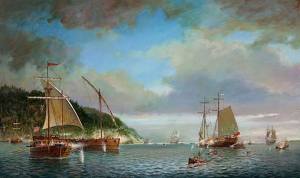
Through sheer force of personality Arnold, an experienced sea captain, took command of the fleet. (The fight for command was the first glimpse at the problems with joint operations. Arnold didn’t accept that CDRE Esek Hopkins had command over him, and Hopkin’s choice didn’t accept Gates’ authority. Arnold won because of his rapport with the men.) Accepting that he couldn’t stand the British firepower on the open lake, Arnold moved the fleet to the narrows between Valcour Island and the shore (Plattsburg NY today). The next morning 11 October 1776, Carleton’s Navy attacked Arnold. The battle was fought all day and Arnold was correct that most of the British ships couldn’t engage, but it didn’t matter. Even though only a third of Carleton’s ships could enter the narrows, the British thrashed the inexperienced Americans, despite Arnold’s flagship, the galley USS Congress, fighting three different and larger ships simultaneously. Almost one year to the day after its establishment, the US Navy lost its first real battle.

That night Arnold’s fleet stealthily escaped sure destruction the next morning, and Carleton chased him down the lake. At Crown Point, Arnold burned his fleet, burned the fort and made his way overland to Ticonderoga. With a battered fleet, no places to winter, restless Indian allies, a strongly defended Fort Ticonderoga, and the smell of snowfall in the air, Carleton withdrew north. Though Benedict Arnold and the US Navy lost the battle, they did enough damage to delay the British invasion of the Hudson Valley until the next year.

The Battle of Lepanto cont.

In the north near the island, the numbers were relatively matched, but it was the Venetians who were at a disadvantage: the smaller Turkish galleys and galliots of Mehmet Scirroco’s corsairs could traverse the shallower water closer to shore and get around the Ventian left flank. Only brilliant seamanship prevented a Turkish attack into the vulnerable galley sides. Like Chamberlain at Little Round Top, Agostino Barbarigo refused his line, and when that wasn’t enough he counterattacked with his own galley. Barbarigo was killed when he opened his visor to call out a command in the din battle, and was shot through the eye with an arrow. Only the timely arrival of Alvar de Bazan with galleys from the reserve prevented the destruction of the Christian left.

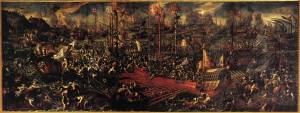
In the center, Ali Pasha on the Sultana rowed directly at Don Juan on the Real. The two ships were easily discernable to both sides. The Sultana flew the great green banner of the Caliph, inscribed Allah Akbar 28,000 times in gold, while the Real flew the great blue banner of the Crucifix presented to Don Juan by Pope Pius V. The two ships crashed into each other. Legend has it that the only woman of the battle, “Maria the Dancer” disguised in armor to accompany her Spanish lover, was the first Christian to board the Sultana. The two ships locked in a death struggle and became the focus of the battle as galleys on both sides poured troops onto them for the next three hours. Makeshift fortifications appeared on both decks as Christian knights and Turkish Janissaries charged, held, and countercharged in what was essentially a land battle, as more and more ships lashed on.

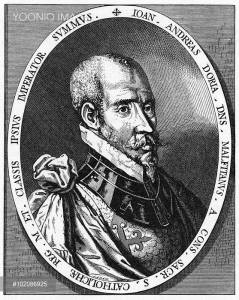
In the south and furthest away, the galleasses never got into position, leaving Uluch Ali at full strength. Furthermore, he outnumbered Andrea Doria’s squadron significantly and used the open sea to try and outflank the Christian line. This led to a series of maneuvers by Doria to the west that opened a gap between his division and the center division. Uluch Ali, seizing the moment reversed his southern and westward push to outflank Doria and charged into the gap. In it were some Venetian ships that thought Doria was retreating from battle, and were making their way to the center division, and the ships of Maltese Knights whom correctly anticipated Ali’s maneuver. All were overwhelmed and destroyed. The melee in the Center lay exposed to a flank attack.

Despite the severe disadvantages and greater losses than the Christians, the Turks were a hair’s breadth away from victory.

This however was not to be the case, as events in the north would directly affect those in the south, which allowed Don Juan’s advantages discussed previously, his weight of numbers (his rowers could fight unlike the slaves of the Turkish galleys), his firepower and better armor decide the center.

After the arrival of de Bazar to stabilize the north, the fight devolved into a melee as it did in the center. But two factors quickly decided it in the Christians’ favor. First, three separate slave revolts sent confusion into the Turkish line, which led to the second – the shore. The failed flanking maneuver by the lighter Turkish galliots and galleys along the shallows eventually caused the Turkish line to be pinned against the shore, which isn’t in itself bad. But it does confer a psychological disadvantage: there is now a way to escape the battle. Every Turk from that point on had a choice: continue fighting among chained but restless slaves and against heavily armed and armored adversaries in what was increasingly a losing battle, or swim the short distance to safety. The Turkish line collapsed.

This freed Alvar de Bazan and his Spanish reserve to sail south to engage Uluch Ali in the gap opened by Andrea Doria’s maneuvers. His 25 galleys slowed Ali long enough for Don Juan to finally overwhelm Ali Pasha, who simply ran out of men to throw onto the Sultana. Once Uluch Ali was informed that Ali Pasha’s head was seen on a pike, he disengaged and escaped. His 33 galleys were the only Turkish ships to survive the battle.

The ships could be replaced, and were, but the loss of tens of thousands of elite Janissaries, bowmen, and sailors, each of whom took years of training to reach proficiency, much less mastery, meant that never again would the Ottoman Turks seriously threaten maritime invasion in the Mediterranean.

After a 3500 year run, the Battle of Lepanto was the last major navel battle in which galleys played a significant role. The loss of the rams, the success of the galleasses, in particular the broadsides and high decks, were the future. The galleons that ruled the Atlantic were soon adapted to the Mediterranean.

The Battle of Lepanto

The roar of the cannon from the four Venetian galleasses lumbering ahead of the Christian line unleashed a storm of firepower hitherto unseen in the history of seapower. The large cannon balls smashed into the galleys destroying structure and body alike as the shot from massed harquebuses tore through the heavy robes, turbans, and leather and scale armor of the Turkish troops. With no broadside cannon, few harquebuses of their own, bows could not pierce the Christian soldiers’ armor at greater than 100 yards, and to get that close invited grape and chain shot, there was little the Ottomans could do. The galleasses’ own poor maneuverability had to be used against themselves, so the Ottomans flew past. But the damage was done: sixty Ottoman galleys and galliots were sunk even before the main battle joined, and the Turkish battleline was in disarray.

The drummers increased the beat from cruising speed, then as they approached the galleasses to battle speed, and finally as they approached the Christian line to ramming speed. The critical moment in contemporary 16th century galley warfare was reached: when to fire the bow guns, which were the most destructive weapons in a galley’s arsenal, as evidenced by the withering fire from the galleasses. There was no reloading a galley’s bow guns because the effective range was too short and closing speeds were too great. The one shot had to count. Because the guns had to be fired over the ram, if they were fired too soon, the cannonballs would sail harmlessly over the target. And because the guns couldn’t depress (or fire into the ram), if they were fired too late they would do damage to the target deck which would be terrible for the soldiers but real damage by cannon is done with splinters to the rowers which left the target unmaneuverable and at the mercy of the attacker. At ramming speed, on the rolling deck, with immobile cannon, and firing over the ram, there was but a brief moment to fire the cannon’s single shot accurately.

Don Juan was betting the Ottoman gunners were not experienced enough to do much damage with their guns, and he was right. The Turkish cannon were largely inaccurate, and the Christians easily weathered their fire. But what was more disconcerting to the Turks, the Christians did not respond in kind with their heavier and more numerous cannon.

At least not yet.

At the behest of Andrea Doria, Don Juan ordered the Christian captains to do the unthinkable: saw off the ram. For thousands of years the ram was the most potent weapon on the galley, but in the late 16th century, it was a nuisance. With the rams gone, the bow guns could be depressed and fired at the very last second before collision. The shot then hulled the targets, much worse than the ram could ever do, and showered the rowers inside with deadly splinters. The Muslim archers on the deck were forced to engage in melee, and storm the Christian galley to get off their own immobile, and most likely, sinking ship.

This initial thunderous clash played out dozens of times all along the battle line. The Turks were at a further disadvantage because of another simple innovation: boarding nets. Like the barbed wire extending at an angle atop a chain link fence, the nets prevented the Turks from easily climbing on to the enemy decks. And while they were chopping through the nets, the Turks were easy targets for the pikes and harquebuses of the Christians. Nevertheless, the Turks had the numbers to make a serious fight at Lepanto

The Gulf of Patras

As the sun rose over the Gulf of Patras off of western Greece on Sunday, 7 October 1571, the Ottoman Grand Fleet poured in from the Gulf of Corinth to the east, as the fleet of the Holy League flowed in from the northwest through the Ionian Islands. About twenty miles apart they spotted each other. The Christian knights in their bright plate and men at arms in their steel helmets and chest pieces held their swords, polearms and harquebuses aloft as the monks and priests held up their golden crucifixes to create a dazzling spectacle in the morning sun for the Ottomans. The Turks amidst their colorful banners, responded in kind by beating their massive drums, stomping on the decks, and chanting the Koran as the two enormous fleets inexorably rowed toward each other at a strength saving leisurely walking pace.

The respective commanders, Ali Pasha and Don Juan of Austria, were surprised at the fleets opposite them. Both had “good” intelligence that they greatly outnumbered their enemy. It was the reason both chose to do battle today. Don Juan had his from Christian spies and Cretan fishermen whom seemed always one step ahead of the Turkish fleet, and Ali Pasha from Kara Hodje, a former Franciscan friar whom was captured, converted and became one of the most feared, cruel, and cunning corsairs in the Mediterranean (recent converts are always the most fanatical). One month prior, the daring Hodje sailed into Messina harbor at night and personally counted each Christian galley.

But the Cretans didn’t count Hodje and his squadron while he was on his scouting missions, nor the 45 Turkish galliots, small maneuverable corsair ships about 2/3s the size of a normal galley. Don Juan only wanted to know about galley strength so the Cretans never mentioned the considerable number of smaller ships. And Kara Hodje didn’t know of the 60 Venetian galleys recently completed by the Arsenal, nor the six massive ships that dotted the Christian line, whose size and use confounded the Turkish observers.

These six enormous ships could only move under their own power with great difficulty and at the moment were being towed by other galleys ahead of the Christian line. They had great wooden superstructures at the bow and stern, and dwarfed the other galleys. As they got closer, the Turks were horrified to see they were bristling with cannon, fourteen massive cannon in the bow, four more down each side, and six in the stern. These new ships were more gun platforms than sailing vessels and could fire in all 360 degrees. Moreover, these Leviathans were too high to be boarded, except by grappling hook and climbing. The Turkish commanders decided they needed to be bypassed, their fire weathered, and they would be dealt with after the Christian line was broken.

These “galleasses” were Don Juan’s secret weapon, and they were constructed in great secrecy by Venice, whose entrepreneurial captains knew that cannon and sail, not oars and rams, were the future. They were twice as long and twice as high as a normal galley, with twenty times the firepower when, along with the many cannon, the hundreds of additional harquebusiers that packed the decks were taken into account. The galleasses were impenetrable floating fortresses, around which the immense Muslim wave must flow to reach the Christian line.

For five hours the two gargantuan fleets crawled toward each other. Never before in history had so many men and ships faced off against each in other in so small a place: 30,000 soldiers and 40,000 sailors on 208 galleys and six galleasses of the Holy League, and 32,000 warriors and 50,000 rowers on 211 galleys, and 45 galliots of the Ottoman Empire. Both commanders took to small ships to visit each contingent prior to battle, and exhort them and confirm battle plans. When Don Juan returned to his flagship, the Real, it is said that in his youthful exuberance, he danced a jig with his pet marmoset to break the tension.

Just after 10 am, the right wing of the Turkish fleet came within 400 yards of the far left Venetian galleass, and its commander gave to the order to fire.

The Battle of Lepanto had begun, and over the next six hours the fate of Italy, Rome, and Western Civilization would be decided.

Breakfast at Tiffany’s

On 5 October 1961, Breakfast at Tiffany’s was released in theaters starring Audrey Hepburn and George Peppard. The adaptation of a Truman Capote novel is about a high priced American geisha (for lack of a better term) Holly Golightly (Audrey in her iconic role), and her neighbor, a kept boy toy (a young Hannibal from the A-Team) in a pre Great Society New York that probably only ever existed in the minds of rich Manhattan socialites. Audrey’s part was originally meant for Marilyn Monroe but she refused to take a part that involved playing a prostitute. The crew and producers initially complained that Audrey was miscast, but I think we can agree she brought a depth and charm to the role that might have been shallow and stereotypical in Marilyn’s hands. Breakfast at Tiffany’s is another absolute classic and movie of its time. Henry Mancini’s score, as always, elevated everyone’s performance. (My father is a huge Henry Mancini fan). However it must be said that the movie is not without controversy. Breakfast at Tiffany’s can’t be shown today in polite society because the perpetually offended will not see it for what it is, but will use a few scenes as an excuse to signal their virtue. So if you are going to watch it, know your audience. In any case, as a classic of American cinema you absolutely should, tonight even, if only to see the movie that created the modern romantic comedy, a Hollywood icon, and dare I say an American icon.

The Fate of Famagusta

Like the island of Corfu the day before, Don Juan of Austria, the Hapsburg commander of the Holy League’s fleet, splashed ashore on the island of Cephalonia at the mouth of the Gulf of Patras to find it devastated. The Turkish fleet anchored at Lepanto barely fifty miles away scoured the nearby Greek islands for extra galley slaves, provisions, and gunpowder for the upcoming clash with the coalition fleet. He was doing the same, even though he paid his rowers, well if they were Christian, not a convict… and if they lived.

With few exceptions, Don Juan’s 208 galleys would seem familiar to the Turks across the bay, or even the Greek and Roman sailors that plied these waters in the ancient past. Naval warfare in the Mediterranean remained remarkably stagnant for two millennia: oared vessels, whether biremes, triremes, or galleys, packed with soldiers attempting to ram, board and either capture or sink the enemy ships until one side broke. But a recent phenomenon changed that equation: industry produced gunpowder and cannon.

Both the Holy League’s and the Ottoman Empire’s galleys were equipped with cannon, usually one large cannon in the bow, flanked by two or four smaller cannon all pointed forward over the massive ram. But the Ottomans had little indigenous armaments industry and relied mostly on cannon either captured or purchased from arms dealers, whereas Don Juan’s galleys had the largest cannon forged in the latest metallurgical techniques by the finest German and Italian cannonsmiths at the time, that is to say in the world at the time. His guns were heavier, larger, and more numerous. Furthermore, his ships were newer: the Ottomans had been raiding since March, and many were in dire need of repair and maintenance this late in the season. Some of the Holy League’s galleys were so new they had no ornamentation – sixty were created at the Arsenal of Venice over 90 days at the end of spring. (Conventional wisdom says Henry Ford invented the assembly line, the Venetians did the same thing 340 years earlier. To impress a Genoese delegation, the Arsenal once built a galley Ikea-style in 24 hours from the stocks of pre made parts. A record that wouldn’t be broken until America started pumping out Liberty ships every eight hours in 1942. The only difference between Ford and the Arsenal was Ford moved the cars along the line, the Arsenal moved the parts and labor along the line.) But the issue with the Venetian galleys weren’t their number but their manning. They had the largest contingent of vessels, but even with every convict, household guard, citizen volunteer, and condottieri in the city that can pull an oar or man a gun, the Venetians still lacked the weight of mass to close with and engage the packed decks of the Turkish galleys. Don Juan had to augment them with infantry, and the only excess infantry he had were Spanish.

Venice in the east and Spain in the west were natural Mediterranean rivals. Since the expedition’s onset, their contention threatened to unravel the Holy League. Don Juan understood that a coalition of this size would probably not repeat in the near future. But Spain, bankrolling the whole endeavor with gold from the New World, wanted to protect its investment, and instead of fighting for Venetian holdings in the Eastern Med, wanted to wait until the inevitable Turkish attack on Italy the next year. Prior to leaving Messina in September, Don Juan placed thousands of Spanish harquebusiers (soldiers with primitive matchlock firearms) on the Venetian ships. Conflict between the crews and soldiers was inevitable.

Off of Corfu on 4 OCT 1571, a Spanish soldier stepped on a Venetian crewman’s toe, which set off a pitched battle on deck that resulted in the Spanish capture of the galley, and subsequent storming of the ship by nearby Venetian crews. Hundreds were killed and wounded. Only the direct intervention of Sebastiano Venier, the overall Venetian commander, prevented the conflict from spreading to more ships. The charismatic, energetic, tactful, but youthful 26 year old Don Juan was barely holding the coalition together. If the Turks refused to sail out and fight he didn’t think he could convince the Spanish to force the mouth of the Gulf of Corinth to engage the Turkish fleet sheltered in their well protected anchorage.

The next day, as his men searched Cephalonia, they found a single Cretan ship whose crew brought news from Cyprus: the fortress at Famagusta had fallen, and the island surrendered to the Turks. This was disconcerting for Don Juan, not because the island fell but because the relief of Cyprus was the raison d’etre of the expedition. The Spanish would surely depart.

That night, Don Juan called a council of war on his flagship, the Real (Re-Al, Spanish for “royal”) between his various commanders where he disclosed the news. The smaller Italian states, Naples, Sicily, Tuscany, Urbino, and Savoy all recognized they were next year’s target, and wanted to continue. The Papal commander, Marc Antonio Colonna, whose boss, Pope Pius V, went through so much trouble to assemble the coalition, of course wanted to attack, as did the Knights of Malta, whom had been at the forefront of the Crusade against the Ottoman Turks for nearly 300 years. But the Spanish were not the only concern of Don Juan’s: he also feared the loss of the Venetians. He thought that without Cyprus as an objective the Venetians would cut their losses. The Ottomans were their biggest trading partner, and this war was draining their coffers. Peace, even a bad peace, would return trade.

However, the Cretans also brought more disturbing news from Famagusta – the Venetian commander Antonio Bragadin was promised safe conduct for his men and the island’s Christian population if he surrendered, but once the gates were opened, the Turks, who lost 50,000 in the siege, turned on the defenders with a vengeance. The soldiers were killed, the civilians sold into slavery, and the officers tortured to death. Bragadin himself was flayed alive, his skin stuffed with straw, and along with the heads of his lieutenants, was displayed aloft on the Turkish flagship, Sultana. Venier, and his supremely competent second Agostino Barbarigo, demanded Turkish blood. The Spanish commander, the fiery veteran admiral Alvaro de Bazan recognized it was now a matter of honor, and threw his support into an attack. Only the wily Giovanni Andrea Doria from Genoa, on secret orders from King Philip II of Spain, advised caution.

Don Juan replied, “The time for advising is over, the time for fighting has begun.”

Doria, not wanting to be labeled a coward, disregarded Phillip’s instructions and agreed to attack.

Operation Typhoon: The Battle for Moscow

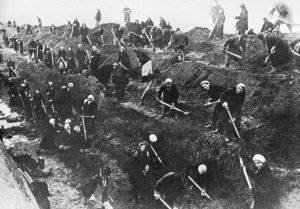
Although the first snows had fallen around Leningrad in mid-September, south west of Moscow the skies were clear and sunny. On 1 October 1941, Field Marshal Fedor Von Bock’s 750,000 men and 1000 panzers of Army Group Center finally launched Operation Typhoon to capture the cultural, industrial, administrative, and communications center for the Soviet Union, the Communist Party, and Stalin’s regime. But the month long respite given to Moscow by Hitler (German generals wanted to launch Typhoon in August at the expense of the drives on Leningrad and Stalingrad, Hitler overruled them) was used to great effect by the Soviets, though not initially.

In a week, Von Bock’s men made great gains and encircled and captured more than 500,000 Soviet soldiers. Moscow looked doomed, but on 8 October the weather abruptly changed, not to snow, but to rain. The rain turned the terrain to mud and the roads to a swampy morass, which were impassable to all but tracked vehicles. The Germans struggled through the Rasputitsa, the seasonal mud of Eastern Europe. On 13 October, they hit the well prepared defenses of the Mozhayek Line, still 100 miles from Moscow, which were built during the previous month and allowed the poorly trained, poorly led, and hastily formed Soviet divisions to halt the nearly immobilized Germans, albeit with drastic measures.

On 15 October, Stalin’s fireman, Georgy Zhukov, took control of the Moscow front after stabilizing Leningrad. He stationed thousands of NKVD troops behind the Mozhayek Line with orders to shoot deserters, and then more infamously, report their names back to Moscow so their families were shot also. The controversial order and impending German capture caused widespread rioting in Moscow, but the Germans made no headway for a month.

On 5 November, the temperature plummeted and the mud froze. Two days later the revitalized Germans broke through the Mozhayek Line, and surged 80 miles toward the Soviet capital. But by this point the cold weather was a double edged sword: the terrain was passable but the Wehrmacht was not prepared for it. Although the lack of winter uniforms made soldiers’ lives miserable beyond compare, it was the lack of winterized lubricants and antifreeze that slowed the offensive. German soldiers were required to light fires underneath their vehicles to warm up the frozen engines every morning.

On 4 December, 1941, the lead elements of Von Bock’s Army Group Center reached the western suburbs of Moscow, about 12 miles from the city center, and within sight of the spires of the Kremlin.

They would get no further.

The Massacre at Babi Yar

On 19 September 1941, the Wehrmacht’s Army Group C captured Kiev in the Ukraine. The Germans were initially welcomed as liberators (Stalin starved 7,000,000 Ukrainians to death less than ten years earlier) but the brutal treatment of civilians by the occupiers quickly turned the Ukrainians against the Germans. On 25 September, the German military governor, the rear area police commander, and the SS Obergruppen commander for Army Group C, and the Einsatzgruppen C commander decided to execute “Action T4” in Kiev.

Action T4 was originally the nickname for the National Socialist directive of forced euthanasia of handicapped and mentally ill people, but by the program’s formal cancelation in August 1941 the term Action T4 had grown to be used to justify the death of all “undesirables”, such as Jews, Poles, Gypsies, the disabled, Communist party members, capitalists, teachers, local leaders, intelligentsia, and anyone deemed a threat to National Socialist ideology. Action T4 in Kiev would be carried out by Einsatzgruppen C.

Einsatzgruppen is German for “deployment group”, a typically innocuous term that Nazi’s like to use for the various parts of the “Final Solution”. They were charged with the forced “de-politicization” of occupied territories, or more accurately the de- politicization of everyone who disagreed with National Socialism. They acted as judge, jury, and executioner, and were answerable to no one outside of the SS chain of command. The executions would occur at Babi Yar (Old Woman’s Gully) near several cemeteries inside Kiev.

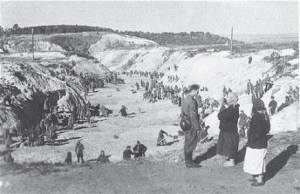
On 28 September, 1941, a trench 150 m long by 30m wide by 15m deep was dug by Soviet prisoners. Posters were placed around Kiev demanding all Jewish residents report the next day with all of their valuables, documents, and warm clothes to a street corner in Western Kiev. The next morning more than 30,000 showed up expecting to resettle.

Many arrived before dawn, hoping to get a good seat on the train. Many packed for a long journey, and one survivor noted that many women wore strings of onions about their necks. The massive group was “processed” down Melnyk Street toward Babi Yar. First they gave up their luggage, then valuables, then they progressively lost more clothes. By the time they heard the gunshots and figured out what was going on they were naked, vulnerable, and hustled between rows of German SS and Ukrainian collaborators in groups of ten to the trench. Anyone would resisted was beaten and pushed along.

At the trench, the Jews were forced to lie down in rows on top of the corpses of the previous ten, then an Einsatzgruppen officer walked by and shot each in the head. When the bodies reached near the top, they were covered over. The process lasted all day, and into the next.

33,771 Jews were murdered in the largest mass execution to date in the war in Europe. But the National Socialists were only just beginning.