The Warsaw Uprising

On the Eastern Front, Zhukov’s Operation Bagration was successful beyond his wildest ambitions. By the end of July 1944, Soviet tanks had reached the Vistula River and the eastern suburbs of Warsaw. On 1 August 1944, the Polish Underground Resistance, otherwise known as the Home Army, launched Operation Tempest to seize their capital from the Germans in order to assert their authority as the legitimate Polish government after the impending Soviet liberation. Stalin and Hitler never let that happen.

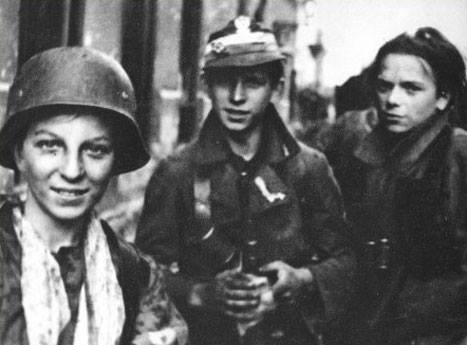
Starting on 1 August and for the next two months, 40,000 members of the Home Army fought the German 9th Army in desperate street battles in Warsaw. Despite assurances from FDR and Churchill, Stalin refused to support the uprising and ordered his troops not to cross the river. Most Soviet units could not have directly supported the Poles since they spent from the offensive, but no serious attempt to supply the Poles was even tried, despite their proximity and air superiority. The only support the Home Army received were supply drops from the RAF that landed in German hands as often as Polish. Destruction of postwar Polish leadership not under Stalin’s control was too convenient for the Soviet dictator.

Once Hitler was sure there would be no Soviet intervention, he ordered Warsaw destroyed. Heinrich Himmler, leader of the SS, declared “The city must completely disappear from the surface of the earth and serve only as a transport station for the Wehrmacht. No stone can remain standing. Every building must be razed to its foundation.” Hitler told his generals that Warsaw was to be “wiped from the face of the Earth, all the inhabitants were to be killed, there were to be no prisoners.”
In compliance, the SS sent in special extermination units with the task of murdering anyone of Polish descent: man, woman or child. They averaged about 10,000 a week. German tactics against the civilians were so brutal, 200,000 of the Warsaw’s 700,000 civilians soon stood with the Home Army to fight. Like the Jewish Warsaw Ghetto Uprising in 1943, the Germans realized that only the total obliteration of the city could root out the resistance. They began a systematic destruction of the city neighborhood by neighborhood, block by block, street by street, and house by house.

On 13 September, Stalin began a token supply effort to the uprising after several near mutinies by Polish troops in the Soviet Army, but by then the damage was done. The leadership of the Home Army was dead, and Warsaw was utterly destroyed. On 2 October 1944, the remaining Polish defenders surrendered. 15,000 of them were sent to the gas chambers in the nearby death camps, along with 60,000 civilian defenders. 200,000 Polish civilians died during the two months of brutal street fighting, and 350,000 were expelled from the city and sent to labor camps across Germany.

3½ months later, the Soviet controlled 1st Polish Army occupied the city on 17 January 1945 after the Soviet Vistula/Oder offensive. They immediately began consolidating the power of the Soviet sponsored Polish Worker’s Party: a communist organization made up of those Polish communists that survived Stalin’s purges of Poles in the Communist International in 1938 and 1939. The Soviet dominated Polish Worker’s Party ruled Poland for the next 45 years until it was defeated by Solidarity in 1989.
The Battle of Best

Operation Market Garden, the Allied airborne and ground invasion of the Netherlands in September 1944 conceived by Britain’s Gen Bernard Montgomery, didn’t need to capture just four bridges to succeed, as many of the narratives of the battle imply; the operation needed 32 bridges over 20 different rivers, canals, and streams along the 62 mile axis of advance to succeed. One such bridge was over the Wilhelmina Canal at the small town of Best outside of the Dutch city of Eindhoven. On the afternoon of 17 September, 1944, Company H, 502nd Parachute Infantry Regiment, 101st Airborne Division infiltrated the town to seize the bridge in order to allow the British armor to bypass Eindhoven on their way to Nijmegen. They didn’t know it, but they were outnumbered 6:1.

Two weeks before, Montgomery’s 1st Canadian Army seized the vital port of Antwerp and pushed the German 15th Army out of the city. A functioning port at Antwerp could alleviate the Allies massive supply problems, but the Canadians failed to also clear the Scheldt Estuary. Without the estuary cleared, Antwerp was “as useful as Timbuktu” in the words of Eisenhower’s chief of staff. Moreover, the failure to adequately clear the estuary allowed the battered German 15th Army to escape. Gen Walter Model ordered the 85,000 strong 15th Army to rest and refit just west of the Dutch town of Eindhoven.

Like Bittrich’s SS Panzer Corps at Arnhem, the German 15th Army was in a perfect position to counterattack the Allied landings and the single highway that XXX Corps was advancing northward on. The 15th Army sat astride the highway just west of the American 101st Airborne Division landings around Eindhoven.

When the planes of the airborne invasion were seen overhead on the morning of the 17 September 1944, German commanders in the 15th Army formed ad hoc “kampfgruppes” (battlegroups roughly 1000 strong) to operate against the landings. The German ability to “plug and play” units with a competent commander gave them an amazing flexibility on the battlefield. One such kampfgruppe was formed around an SS police battalion and sent to Best. As the lightly armed lone American airborne company with its attached engineers approached Best, they came under intense fire. Best became a microcosm of what happened to the British 1st Airborne at Arnhem. At Best, one platoon from Company H made it to the bridge and held the north end, while the rest of the company, and eventually the battalion was cut off nearby. That one platoon survived for two whole days before being overrun. The Germans who captured them thought an entire company had held the bridge, not just 22 men.

Over the next three days, the 15th Army counterattacked from around Best to try and cut “Hell’s Highway” at its base. Three German divisions: the 59th, 245th and 716th, and various Luftwaffe and rear area troops organized into battlegroups, including two battalions of fanatical and zealous SS policemen, launched themselves at the Americans. The fighting around the town of Best consumed the entire 502nd PIR, the 327th Glider Infantry Regiment, and the 101st’s reserve BN from the 401st Infantry; or over 2/3rds of the entire 101st Airborne Division. The battle only ended when the 101st was reinforced by a brigade of British hussars and grenadiers from XXX Corps, which crossed the canal at the rebuilt Son Bridge to the east.

That British brigade was desperately needed in the fighting around Nijmegen to the north, and the lack of an exploitation force prevented the British from immediately continuing on to Arnhem after the capture of the Nijmegen Bridge over the Waal on 20 September. And although the 15th Army did not succeed at Best, it did cut the all-important highway in two other places farther north over the next several days.

The Soviet Invasion of Poland

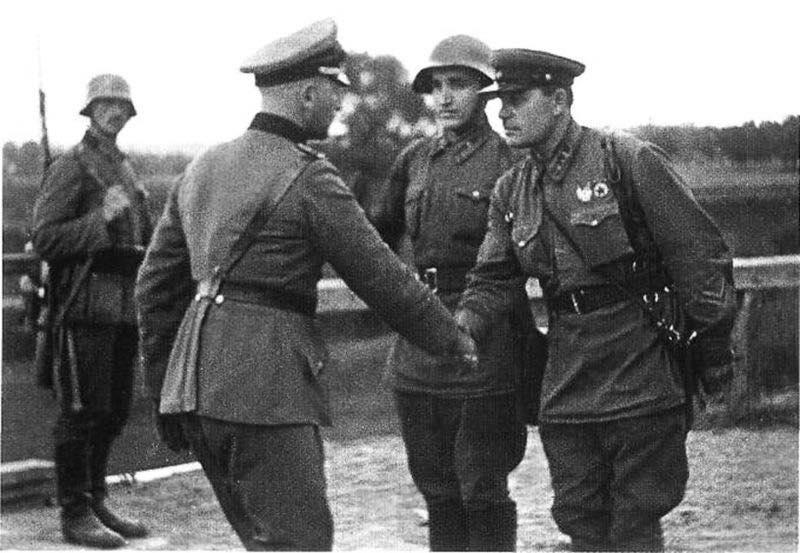
On 17 Sep 1939, Hitler’s de facto ally, the Union of Soviet Socialist Republics better known as the Soviet Union, invaded Poland from the east as the Poles were fighting the Germans coming from the west.

By 9 September 1939, Polish mobilization was complete the Poles and were holding their own along the Vistula and in the Carpathians against the German attack. They even launched a large counterattack at Bzura and repulsed the initial German attacks on Warsaw. Unfortunately on 9 Sep the German propaganda minister Josef Goebbels announced to the world that the Germans had reached Warsaw. The German people thought they had won and were jubilant. Goebbels ran with it. Poland had no way of contradicting Goebbel’s message. The British, French, and Soviets all soon believed Poland was lost. The mistaken belief absolved the Brits and French from any further assistance, and on the 11th, Stalin decided he’d better invade Poland before the Germans took it all.

On 17 September 1939, eight days after the Poles were supposedly defeated by the Germans, Soviet forces crossed the Polish frontier from the east, and made defense along the Vistula pointless. Initially Polish units on the eastern frontier thought that the Soviets were coming to Poland’s assistance, but that notion was quickly dispelled. On 25 Sep, the Polish government announced the evacuation of the country. The last Polish army unit only surrendered on 6 Oct – a month after the war had supposedly been lost.

In occupied Eastern Poland the NKVD, the forerunner of the KGB, immediately arrested and summarily executed tens of thousands of Polish army officers and NCOs, politicians, police officers, business owners, priests, school teachers, and university professors, anyone exhibiting leadership qualities. The Red Army sacked, tortured, raped, and killed its way through eastern Poland in a prelude of what would happen to Germany 5 1/2 years later. Hundreds of thousands Poles were sent to slave labor camps in Siberia. Sham elections were held by the NKVD to give an air of legitimacy to the brutal occupation. Anyone who ran against their preferred candidate was killed, and anyone who voted against them was sent to Siberia.

“The liberation of Poland (by National Socialist Germany and Communist Soviet Union) is an example of cooperation of socialist nations against Anglo-French imperialism.” – The Communist International, 7 Oct 1939

The Invasion of Angaur

On 17 September, 1944, the 3rd Amphibious Group, landed the 322nd and 321st Regimental Combat Teams of the US 81st Infantry “”Wildcat” Division on the island of Angaur to secure the phosphate plant and airfield, and prevent Japanese artillery from shelling Peleliu. By the 22nd, and after fierce fighting, the two RCTs forced the Japanese defenders into the northwest corner of the island, but then the battle began in earnest.

The northwest corner of Angaur was dominated by Romauldo Hill, but it couldn’t be approached effectively without going through the torturous terrain of a large stone quarry beneath it, dubbed by the Wildcats “The Bowl”. Furthermore, the Bowl had only one entrance, which they quickly named “The Bloody Gulch”. With the Japanese throwing shells at the Seabees constructing the airfield, all three had to be taken.

The 322nd RCT secured the Bloody Gulch after three furious and costly frontal assaults, all of which were to cover the construction of a road to bring up tanks and bulldozers. Once the entrance was secure, the battles for The Bowl and The Hill took on a different approach. The Japanese were dug in like they were on Peleliu, but the terrain meant only one RCT could fight at a time. The limited troops needed to be used differently.

The 322nd RCT decided to bury the Japanese.

Once a tunnel or bunker entrance was discovered, the Wildcats seized it. They then packed it with smoke pots and napalm from the airfield, and sealed it by bulldozer. It was then ignited and wherever the smoke and coughing Japanese appeared elsewhere on the Hill or in the Bowl, the process was repeated. After a few days, the Japanese fiercely counter attacked when they heard or felt the approach of a bulldozer. The last hole was filled a month and 1,614 casualties later, on the 23rd of October.

The 322nd had to secure Angaur by themselves was because the other RCTs were needed elsewhere. On 26 Sep, 1944, the 323rd RCT loaded up on the USS Storm King and was sent north to secure the Ulithi Atoll so MacArthur had a deep water lagoon close by for his invasion of the Philippine island of Leyte. The rest of the 321st were pulled off the line on Angaur on 23 Sep so they could be sent to help out the 1st Marine Division on Peleliu. By 27 September the 321st were in the thick of the fighting for Bloody Nose Ridge. That battle would eventually would consume all three RCTs of the 81st Wildcat Division.

The Invasion of Peleliu

Although the Japanese suffered a devastating loss at Saipan, the Imperial Japanese General Staff considered the battle lost by the Japanese Navy, not the Japanese Army: the Americans took enormous casualties taking the island. The battle validated the new Japanese island defensive tactics of dug in ambushes, interlocking fields of fire, infiltration and night counterattacks instead of defending on the beaches. The Imperial General Staff planned for the new doctrine to buy the Japanese Navy the time necessary to create the opportunity for the Khitai Kessen, or the decisive battle that would end the war. Furthermore, the war in the Pacific would become an attritional battle and the casualties sustained in taking each island could break the will of the American people.

Lt Gen Sadae Inoue, commander of the 14th Infantry Division was charged with the defense of the Palau Islands, which were tailor made for the new defensive tactics. The three islands of Peleliu, Ngesebus, and Angaur consisted of steep ridges honeycombed with caves that were perfect for this defense. His 14000 troops had four months to prepare for an American invasion. He dug his artillery in deep and his troops prepared to fight from underground for the entire battle. One of Inoue’s regimental commanders, Kunio Nakagawa, would not slavishly follow the new doctrine though. On Peleliu, the only landing areas were small and obvious and they were covered by a small outcropping on the southern coast (The Point) that enfiladed the entire beach, which could only be assaulted from inland. On Peleliu, Nakagawa planned for the Americans to fight a Tarawa style battle at the beach, followed by a Biak and Saipan style battle further inland. And the the Marines did.

On 15 September 1944, the US 1st Marine Division landed on the island of Peleliu in order to secure MacArthur’s right flank from attack as he returned to the Philippines and secure the Palau’s airfields for future use. The US Navy’s three day bombardment had little effect on Inoue’s defenses. The Marines took enormous casualties seizing the beachhead, the airfield, and finally the Point. The Japanese counterattacked with 13 Type 95 Ha Go tanks and 200 infantry supported by artillery and mortars, and nearly retook the airfield. Japanese artillery fire from Ngesebue Island and Umurbrogol Mountain, soon to be nicknamed Bloody Nose Ridge, made every square foot of Peleliu unsafe.

On 19 Sep, the Marines began their assault on Bloody Nose Ridge. The Marines quickly found that grenades and flamethrowers were no longer sufficient to root the Japanese out of their caves because they were too deep. Every cave had to be cleared and sealed, and the Japanese were ingenious in concealing entrances and firing holes. In the next six days Chesty Puller’s 1st Marine Regiment took 70% casualties. On 20 September, the 5th Marines invaded Ngesbue Island to silence the artillery there that was devastating the troops on Peleliu.

Marine regiments, and soon US Army regiments from the 81st US “Wildcats” Infantry Division were rotated through the fight for the ridge. On 23 Sep, the 7th Marines, and the III Amphibious Corps reserve, the 321st Regimental Combat Team of the US 81st Infantry Division surrounded the mountain and continued the assault. They in turn were replaced by the 5th Marines and the 323rd RCT in early October. The 81st Infantry Division took over the battle on 15 October, after the 1st Marine Division was “fought out”, until the island was declared “secure” on 27 November, two and half months after the initial landing.

The last Japanese unit on the small island didn’t surrender until April… of 1947, and the last Japanese soldier on Peleliu wouldn’t surrender until 1955.

The 1st Marine Division took 7000 casualties, and the 81st took 2500 casualties taking Peleliu. The battle for the Palau’s was the most casualties in one operation in the entire Pacific theatre up to that time. The Imperial Japanese General Staff was correct though: a great controversy immediately arose as to whether the cost to take Peleliu was worth its contribution to MacArthur’s upcoming campaign in the Philippines.

The Battle of Baltimore and “The Defense of Fort McHenry”

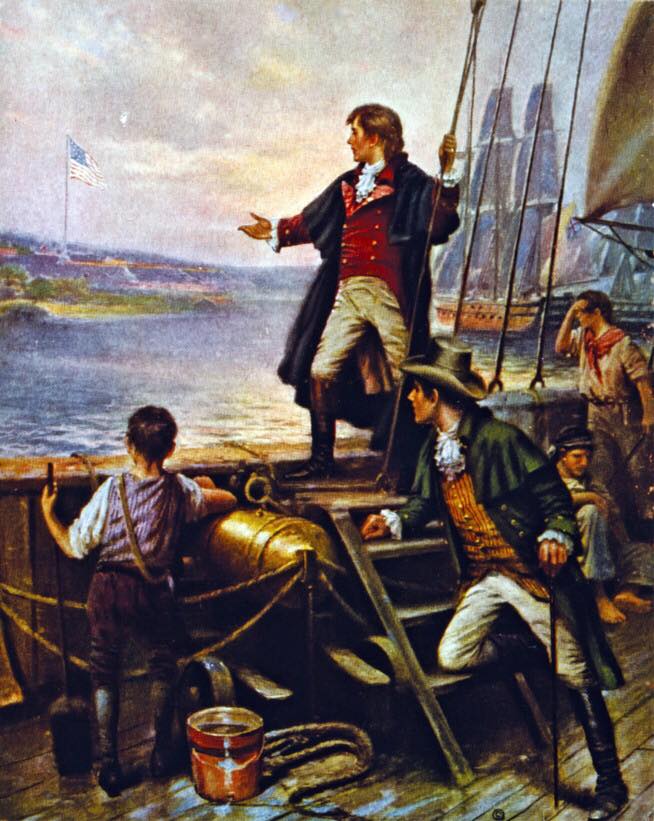
Admiral Cochrane kept his promise and bombarded Ft McHenry all night. On 13 September 1814, the last thing he saw of the fort was a giant American flag flying over it before the smoke of the cannon and the bad weather obscured it. A storm blew in that the afternoon and it rained all night. For Major Armistead, this was a gift from God. While many “bombs bursted in air” and the rockets gave off a “red glare” amidst the thunder and lightning of the gale that blew in off the Atlantic, many of Cochrane’s cannon balls did not explode because the rain extinguished the fuses and they landed harmlessly on the fort.

The bombardment was furious, but largely ineffectual. At sunset, Armistead was forced to take down the giant American “garrison” flag which he put up as a taunt to Cochrane, and replace it with a smaller “storm” flag lest the weather snap the flagpole. Armistead refused to capitulate, even after the casualties he took repelling a landing by Royal Marines under cover of the bombardment and weather. The cannons on both sides raged at each other all night.

Onboard Cochrane’s flagship, Annapolis lawyer Francis Scott Key was negotiating the release of his friend Dr. William Beane, who was to be hanged for spying. Key was successful but he was not allowed to return to shore while the bombardment continued. Like Cochrane, the last thing he saw on that evening was the giant American flag flying over Ft McHenry. To pass the long night, Key wrote poetry. He was not an especially patriotic man, he opposed the war and railed against it at every opportunity, but there was something about the tiny American garrison fighting back against the might of the largest and most powerful force on earth, the British Empire, which “stirred one’s soul”. The first verse of his poem, “The Defense of Fort McHenry”, the one that would become our national anthem, was full of doubt… and hope. He would also write third verse that night. It was full of vengeance and righteous fury against anyone that would oppose the experiment that was America.

The next morning, Armistead took down the smaller storm flag and raised the giant garrison flag just as the sun rose. The message was clear: the Americans were still in control of the fort and no naval assistance would be available for Brooke to continue his land assault of Baltimore. As the smoke cleared and night lifted, Francis Scott Key finished the second, jubilant verse when he knew Ft McHenry was still in American hands. Dawn also signaled the end of the battle for the British Navy. Adm Cochrane could not continue the bombardment because he had little powder and shot left for the fort, and what remained was soaked and needed to dry. He left the decision to continue up to Brooke, who promptly called off the attack and had his troops re-board the ships.

On his way back to Baltimore, Francis Scott Key finished the final verse, one of redemption and thanksgiving.

Admiral Cochrane and Col Brooke left for the Caribbean the next day. Failing to destroy Baltimore, Cochrane’s next target was the soft underbelly of America: the strategic port of New Orleans

“The Defense of Fort McHenry”, a poem by Francis Scott Key.

O! say can you see, by the dawn’s early light,
What so proudly we hail’d at the twilight’s last gleaming,
Whose broad stripes and bright stars through the perilous fight
O’er the ramparts we watch’d, were so gallantly streaming?
And the Rocket’s red glare, the Bombs bursting in air,
Gave proof through the night that our Flag was still there;

O! say does that star-spangled banner yet wave,
O’er the Land of the free, and the home of the brave?

On the shore dimly seen through the mists of the deep,
Where the foe’s haughty host in dread silence reposes,
What is that which the breeze, o’er the towering steep,
As it fitfully blows, half conceals, half discloses?
Now it catches the gleam of the morning’s first beam,
In full glory reflected new shines in the stream,

‘Tis the star spangled banner, – O! long may it wave
O’er the land of the free and the home of the brave.

And where is that band who so vauntingly swore
That the havoc of war and the battle’s confusion,
A home and a country, should leave us no more?
Their blood has wash’d out their foul footsteps pollution.
No refuse could save the hireling and slave,
From the terror of flight or the gloom of the grave,

And the star-spangled banner in triumph doth wave,
O’er the Land of the Free and the Home of the Brave.

O! thus be it ever when freemen shall stand,
Between their lov’d home, and the war’s desolation,
Blest with vict’ry and peace, may the Heav’n rescued land,
Praise the Power that hath made and preserv’d us a nation!
Then conquer we must, when our cause it is just,
And this be our motto – “In God is our Trust;”
And the star-spangled Banner in triumph shall wave,
O’er the Land of the Free and the Home of the Brave.

The Battle of Baltimore and the Defense of Ft McHenry

With the untimely death of Maj Gen Ross, command of the British invasion force fell to the much more cautious Col. Arthur Brooke. Brooke was surprised at the spirited defense of North Point, and his scouts told him he could expect the defense of Baltimore to be even more difficult. The Americans had large systems of redoubts and earthworks spanning the approaches to the city. And even more worrying were reports of two regiments of regulars and 4000 more militia to fill them, including the crews of the privateers.

Still, the British believed the Americans were weak and divided. They had heard reports that New England attempted to secede from the union (It tried, but failed), and the sacking of Baltimore might force the Americans to end the war. After that it would only be a matter of time before they were incorporated back into the Empire. Brooke knew he must attack, no matter the odds. But after a personal reconnaissance of the fortifications, he saw that he needed heavy siege guns to support the assault. He didn’t have any on land, but Admiral Cochrane had nineteen ships bristling with cannon that would do nicely.

Unfortunately for the British, Major George Armistead, commandant of Fort McHenry (and uncle of the future Confederate general, Lewis “Lo” Armistead of Pickett’s Charge fame), sank several merchantmen in the approaches to Baltimore harbor and this prevented Cochrane’s ships from reaching firing range of the fortifications. In order to support Brooke, Cochrane had to first reduce Ft McHenry then go around the sunken merchantmen. Armistead had only 20 cannon. Cochrane had over 200 cannon, and thousands of Congreve rockets, which although wildly inaccurate, proved to be very effective against militia.

At 6:30am, on 13 September 1814, Cochrane’s flotilla furiously opened fire on Ft McHenry. Armistead and his 1000 men and twenty cannon proved more resilient than expected. Cochrane was determined though, and said the bombardment would continue all day and night if need be. By noon, Ft McHenry was giving as good as it got and Brooke became impatient. He could see the Americans to his front improving their positions. His junior officers soon became adamant: their men had stormed the fortress at Ciudad Rodrigo and forced the breaches at Badajoz. And those assaults were against the best troops Napoleon had; the Continentals, shopkeepers, and pirates of Baltimore be damned. They convinced Brooke, and at 1 pm, he attacked.

His veterans took horrible casualties, but by 4pm his outnumbered troops miraculously held a solid foothold on Baltimore’s outer ring of fortifications. However, they would go no further. Their assault on the inner ring ran headlong into a counterattack by the veteran US 36th and 38th Infantry Regiments (Later, they formed the 4th US Infantry Regt., which today is the OPFOR at CMTC in Germany.) What can only be described as a barroom brawl with muskets and bayonets left both sides exhausted and both retreated to their respected redoubts. By evening, it seemed to Brooke that every person in Baltimore who could walk and hold a musket was opposing the British. It was all they could do to hold their gains. He needed Cochrane’s cannons to advance any further.

Admiral Cochrane continued his bombardment of Ft McHenry throughout the night.

The Battle of North Point

The British were astonished – They had looted Washington DC and burned it to the ground, and the Americans didn’t surrender! Major General Ross even supped in the White House after that coward Madison fled, and then personally put it to the torch. The shame! It was unimaginable for a European country to lose its capital and still continue the war. The capital was the center of government, the aristocracy, the bureaucracy, economics, finance, and culture. To lose Vienna, Berlin, St Petersburg, or London (!) to an invading army was unthinkable to any “civilized” country. Even Napoleon abdicated when Paris was occupied. But these Americans and their curious experiment in self-rule were strange. If they didn’t want to surrender when they were rightfully beaten then they must be taught a lesson.

In 1814, the British were finished with Napoleon in Europe and turned with a vengeance on America. They had been fighting a defensive war for the last two years, but when Napoleon surrendered that all changed. In August, Vice Admiral Sir Alexander Cochrane and Maj Gen Robert Ross, with 19 ships and 6000 elite troops, invaded Maryland and easily swept passed any resistance the Americans offered. They sacked Washington DC in late August and when President Madison didn’t accept terms, they did the same to Georgetown and Alexandria. Their next target was Baltimore, one of the largest trading ports on the Atlantic seaboard, and a haven for American privateers that raided British shipping.

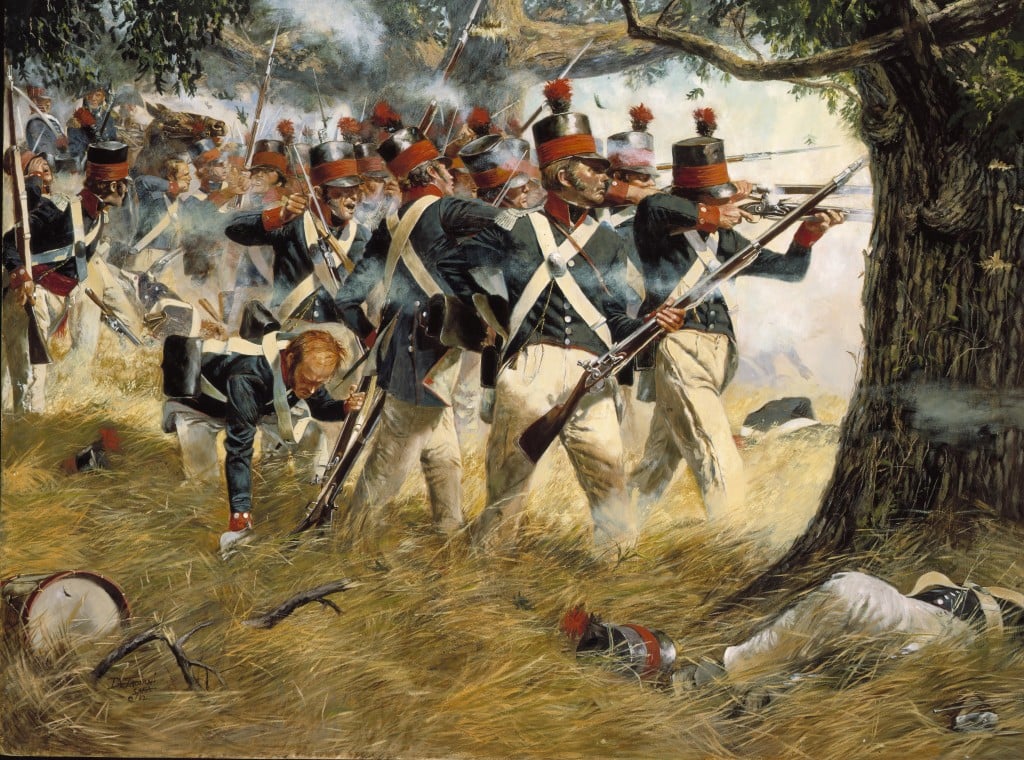
Admiral Cochrane moved his fleet up the Chesapeake Bay and landed Maj Gen Ross with a brigade of regulars and two battalions of Royal Marines with orders to seize and destroy Baltimore. Ross’s 4000 officers and soldiers were all veterans of the Duke of Wellington’s five year Peninsular Campaign against Napoleon. They were met by MG James Stricker and 3000 Maryland militia. The American militiamen fought the British veterans at North Point, Maryland in the afternoon of 12 Sep 1814. The flooding forced the British to approach Baltimore through North Point, between the Back River and Bear Creek, and funneled them into Marylander muskets. The Americans gave a much better account of themselves than they had in defending Washington DC. The battle resembled Bunker Hill more than Bladensburg, and only when their position was out flanked did the Americans fall back. And they did so in an organized and disciplined fashion, fighting the whole way.

The Battle of North Point was very costly for the British: Maj Gen Ross was shot through the head by a 14 year old Maryland sharpshooter and this left command to Col Arthur Brooke. Stricker’s stand gave MG Samuel Smith time to prepare the landward defense of Baltimore, defenses that Brooke deemed impossible to storm without support from the British Navy. And finally, the Battle of North Point gave Major George Armistead, charged with the seaward defense of Baltimore, time to gather extra powder for Fort McHenry.

The House of the Rising Sun

In early 1964, the British Invasion of the American music scene was still strictly a Beatles affair. The amazing British soul singer Dusty Springfield broke into the Billboard Top 40 in July, but didn’t reach the Top Ten. That changed in the summer of 1964, when Newcastle garage rock band The Animals, fresh off of a tour of the United Kingdom with Chuck Berry, came to America to capitalize on Beatle Mania.

The Animals, particularly lead singer Eric Burdon, played a decidedly different version of Rock and Roll than the Beatles. Their gritty take on rhythm and blues started the “Anti Beatles” movement within the British Invasion. Their first No1 hit in the UK, “Baby Let Me Take You Home” takes a very different path than the similar Beatles song “I Want to Hold Your Hand”. The Rolling Stones popularized and built a 50 year career on what The Animals started.

The Animals’ distinct take on Rock and Roll is nowhere more evident than in their signature song “The House of the Rising Sun”. It’s a bluesy soulful song about a man who lost himself in the whorehouses and dive bars of New Orleans. Eric Burdon’s deep howling voice, Alan Price’s haunting organ riffs, and Hilton Valentine’s indomitably classic and instantly recognizable Les Paul guitar riff swept America and sunk everything on the Beatles “Hard Day’s Night” album, then ruling the charts. On 6 September 1964, it hit No 1 on the US charts, the first non-Beatles British song to do so.

Taxi S’il Vous Plait! The First Battle of the Marne

Germany’s plan in the event of war with both Russia and France in the beginning of the 20th century was to defeat France with the Schlieffen Plan and then concentrate on Russia. The Schlieffen Plan was named for the former German Chief of Staff Count Alfred Schlieffen. The idea was to let the French advance in the south and then seize Paris unexpectedly from behind from along the Channel coast. First, German armies on the left in the south would fix French forces in Alsace/Lorraine and the Saar, and even allow them to advance. Using this as a hinge, the Germans on the right in the north would swing like a door through Belgium, then along the channel coast, then finally down around the concentration of French forces and seize Paris from behind. On his death bed in 1913, just before the First World War, Schlieffen’s last words were, “Keep the right wing strong!” (The attack through Belgium and along the Channel coast.)

Unfortunately for Germany, the egos of the various German commanders couldn’t accept their roles. The prestigious commands were obviously on the right (those that were to seize Paris). These went to two very competent, but not very ambitious commanders: Generals Karl Von Buelow and Alexander Von Kluck. The commander on the left wing, i.e. the one who was supposed to let the French advance so they would be encircled by the right wing, was a very ambitious and out spoken Erick Von Falkynhahn. Finally, the commander in East Prussia, the stately Paul Von Hindenburg who was pulled out of retirement for the job of facing the Russians, also had an outsized influence on the Schlieffen Plan.

When the war started, the Russians mobilized much more quickly than expected and the proud Hindenburg refused to abandon East Prussia. So he essentially bullied the Chief of Staff, Helmuth Von Moltke the Younger (the Elder was his uncle who won the Franco Prussian war in 1870) for more forces. Naturally, they needed to come from Falkynhahn for the Schlieffen Plan to work. But Von Moltke was not his uncle. At the mere suggestion of giving up troops, Von Falkynhahn threw a fit, so Von Moltke the Younger took them from Buelow on the right wing, Moreover, Von Falkynhahn couldn’t contemplate the possibility of letting the French advance into his territory: It would look like he was losing in the newspapers. So instead of defending as per the Schlieffen Plan, he attacked… and kept attacking… and kept winning… and winning some more. Von Falkynhahn insisted that Von Moltke reinforce success, not Von Buelow who couldn’t even reach the sea without over extending himself (thanks to Hindenburg). More importantly though, Falkenhahn’s success pushed the French back – towards Paris.

Despite Schlieffen’s dying words, the German right wing was so weak that in the beginning of September, 1914, instead of attacking Paris from behind (north), Von Buelow and Von Kluck could only attack it from the front (east). Von Moltke still thought this would be good enough to seize Paris, except that Falkynhahn was too successful. Von Falkynhahn had basically bulled his way through the horrible terrain of the Ardennes forest, and was now spent. The French facing him were then in a perfect position to be sent to face Von Kluck and Von Bulow, a short cab ride away.

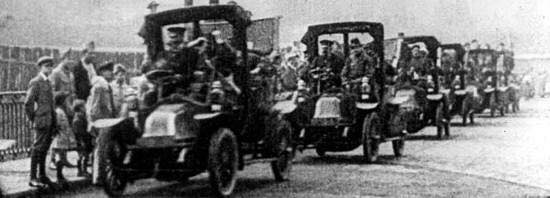
On 5 September 1914, the French commandeered 600 Parisian taxi cabs in a desperate attempt to move troops to the front along the Marne River in order to save Paris from the Germans. In actuality, only about 6000 French soldiers were ferried to the front in cabs, but afterwards hundreds of thousands would claim it. For the next week, more than one million British and French fought 1.5 million Germans to a standstill in the First Battle of the Marne. By 12 September, the German advance was stopped and Paris was saved. Over the next month, the front was solidified, and millions of soldiers dug their trenches. The war of maneuver was over , and the war of attrition began. The front line, which extended from the North Sea to Switzerland, wouldn’t change significantly for another four years.