Docturnal

Docturnal [däkˈtərnl] Adjective. 1. Unofficial, but easily understood, military phraseology which is never used in official publication, and frowned upon by pretentious doctrinaires. 2. Vain attempt to be doctrinal. 3. Military terms spoken only in the darkest doctrinal corners. 4. Terms and phrases awakened in the doctrinal twilight to rule over the deepest doctrinal night.

Examples: Adhocracy, Blowed Up, Bohica, Blue Falcon, Buttload, Crunchies, Disaster, Downtime, Epic, Eyes On, Flex, Fobbits, Fubar, F*k (a uniquely flexible term), FFG, Ginornous, Goat Rodeo, Forlorn Hope, Halfassery, Herding Cats, Hey Diddle Diddle, Intestinal Fortitude, JoeProof, Ninjas, Pipe Hitters, Pound the Sh*t Out Of, Presence Patrol, Release the Kraken, Rolled Up, Oodles, Service, Sh*tload, Slidology, Snafu, Space Cadet, Sprinkle, Strategery, Swag, Tarfulicious, Thirsty, Throwaway, Turd Burglar, Voluntold, Walkabout, Whack, Whip It Good, Wrecked, Your assembly area is so fat…

Give Men Liberty Or Give Me Death

In the late 18th century, Great Britain levied deeply unpopular taxes on its colonies in order to pay for the Seven Years War, or the French and Indian War as it was known in North America. Despite what your teachers told you, the taxes were not mainly for the defense of the thirteen North American colonies. They were also to pay for the subsidies to Prussia, who fought Austria, Russia, Saxony, and France on the continent nearly by itself. The “Golden Cavalry of Saint George”, the nickname for British gold in lieu of soldiers to its allies, was over four times what the British paid for the defense of the Thirteen Colonies. After the Seven Years War, Britain’s debt was nearly three quarters of its gross domestic product. The Thirteen Colonies weren’t the most prosperous in the British Empire (the sugar plantations of the West Indies held that honor), but they were the most resilient and could absorb and weather new taxes, if they chose to do so.

The taxes were unpopular because in the colonial charters the legislatures and governors of the Thirteen Colonies had sole authority to tax their people. If the colonial legislatures wanted to raise a tax, that was no problem, they could be replaced if it was too onerous. And they did levy taxes for defense against the French and Indians along the frontier. But there was no recourse if Parliament levied taxes directly i.e. taxation without representation. It didn’t matter if it was for defense or not. British military protection of its colonies was the price the Crown and the Parliament paid for their loyalty. That Parliament taxed them directly was considered double-dipping and a violation of their charter at best, and a violation of the unwritten social contract of empire and their basic human rights as Englishmen at worst. As the thinking went, if Parliament could disregard one of the main tenets of a colonial charter, where would their tyranny stop? Nowhere, if Ireland was any example. Ireland was a ready made case study of direct British Parliamentary rule, and American colonists had no wish to endure that.

The taxes at the end of the French and Indian War sparked widespread discontent among the colonists, and most were quickly repealed, such as the infamous Stamp Tax which placed a levy on all printed paper. The Stamp Act was especially loathed, as it was not only a tax, but it was also an indirect suppression of free speech, a human right that all Englishmen enjoyed. However their repeal did not include the tea tax because Parliament wanted to prove the point that they could tax the colonies directly at will despite their charters. Parliament figured that Englishmen loved their tea too much, and would endure the tax and subsequent higher price. Parliament would get their tax precedent and the colonists their tea. Parliament was wrong.

The Boston Tea Party in 1773 led directly to further coercive laws by Parliament to bring the “petulant” North American colonists to heel. They included the Quebec Act which extended the province of Quebec south to the Ohio River to keep the colonies from expanding west (which was ignored), and the aptly named Coercive Acts aka the “Intolerable Acts”. There were four Coercive Acts: the first closed the port of Boston to trade, the second forbade meetings and gatherings in Boston, the third forbade the detaining of British soldiers in the colonies for crimes committed, and the fourth called for the quartering of British troops in private homes.

By March 1775, the colonies seethed under these laws and rebellion was all but assured between King George III’s Great Britain and his thirteen colonies on the Atlantic coast of North America. This was particularly true in New England whose residents were all but in open war against the Crown.

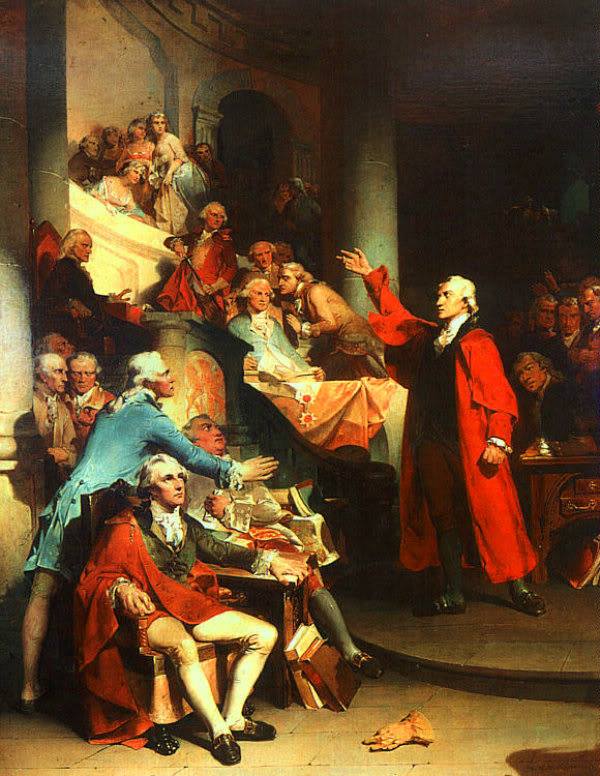
On 23 March 1775, the forcibly disbanded Virginia House of Burgesses defiantly met at St John’s Church in Richmond. During the debate on whether to raise Virginia’s militia to help the patriots in New England, a fiery 40 year old lawyer, Patrick Henry, got up to speak. Patrick Henry was a natural orator who spoke without notes or preparation. As he reached the crescendo of his eight minute discourse in favor of Virginians taking up arms against Great Britain, Patrick Henry concluded,

“It is in vain, sir, to extenuate the matter. Gentlemen may cry, “Peace! Peace!”, but there is no peace. The war is actually begun! The next gale that sweeps from the north will bring to our ears the clash of resounding arms! Our brethren are already in the field! Why stand we here idle? What is it that gentlemen wish? What would they have? Is life so dear, or peace so sweet, as to be purchased at the price of chains and slavery? Forbid it, Almighty God! I know not what course others may take; but as for me, give me liberty or give me death!”

The motion passed easily.

Ulithi Atoll: The Last Stop Before Okinawa

In September 1944, the US 81st “Wildcat” Infantry Division seized the seemingly unimportant Ulithi Atoll during the Peleiu campaign. Just six months later, the Ulithi Atoll was the largest US naval anchorage outside of the continental US, including Pearl Harbor.

The Ulithi Anchorage was built by three Seabee battalions between October, 1944 and February, 1945, with the first aircraft landing on the Ulithi ten days after the Wildcats captured it. The Seabees constructed six airstrips with full maintenance facilities, an aviation tank farm, a seaplane base, and pontoon piers, that stood up to a typhoon, for dozens of ships. Whole islands of malarial ridden swamp were paved over for the facilities. A landing craft base was constructed and eleven water purification and distillation units set up around the islands with a 5000 gallon water tower. A fleet recreation center took up a large portion of the atoll and was a major project for the Seabees. By February, Ulithi could house and entertain 8000 men and 1000 officers, boasting two bandstands, a 500 seat chapel, 1200 and 1600 seat theaters, massive beverage refrigerators, and numerous baseball diamonds and sports fields. The islands were covered with “quonset huts for storage, shops, mess halls, offices, and living quarters, and building roads, supply dumps, and necessary facilities to supply water and electricity to all parts of the island”. The Seabees completed the work in just 4 1/2 months. In February and March 1945, Ulithi was the staging base for the largest amphibious operation of the Pacific War: Operation Iceberg, the Invasion of Okinawa.

On 22 March 1945, the last of the 180,000 men of the US Tenth Army were loaded on transports. The final ships bearing the US 1st, 2nd, and 6th Marine Divisions, and US Army’s 7th, 27th, 77th, and 96th Infantry Divisions departed the atoll on the 1400 ships of the US Fifth Fleet that afternoon for the trip to Okinawa. The waters around Ulithi Atoll on 22 March 1945 was the largest concentration of fighting ships the world had ever seen — before or since.

Okinawa was the last stop before the invasion of the Japanese Home Islands. The Battle for Okinawa was the second largest naval battle of the war, second only to Battle of Leyte Gulf in October. The US Navy took more casualties in it than in any other battle of the war, including Pearl Harbor. The invasion of Okinawa was second largest amphibious operation of the war, with the Invasion of Normandy just squeaking ahead. Okinawa was the largest land battle in the Pacific and had a higher casualty rate than the largest American battle of the war, the Battle of the Bulge.

Today, both Okinawa and Ulithi are mostly forgotten.

The Hundred Days

On 26 February 1815 Napoleon escaped from his captivity on Elba and began his return to power in France. On 13 March 1815, the victors of the Napoleonic Wars: Austria, Great Britain, Prussia, Sweden, and Russia, were attending the Congress of Vienna dividing up the spoils. Upon news of Napoleon’s return, they declared him an outlaw and formed the Seventh Coalition. On 19 March, King Louis XVIII fled Paris with his court to Belgium.

On 20 March 1815, Napoleon triumphantly entered Paris at the head of an army of 90,000.

So began The Hundred Days.

From March through July 1815, the fate of Europe, and dare I say Western Civilization, hung in the balance. At the bloody end of the Age of Enlightenment, would the 19th Century belong to the Constitutional Monarchists or the Enlightened Despots? Would it belong to Britain or France? The Rule of Law or the Rule of Whim?

The world would find out 111 days later outside of a tiny Belgian town called Waterloo.

America’s First St. Patrick’s Day

In the 18th century, Ireland chaffed under Great Britain’s rule, specifically Poyning’s Law, the Declaratory Act, and the various anti-Catholic laws imposed and enforced by the state controlled Anglican Church. Poyning’s Law, passed in 1498, denied the Irish the ability to call a parliament unless it was approved by the King of England and his Privy Council. The Declaratory Act, better understood by its official name the Dependency of Ireland on Great Britain Act of 1719, declared that the British House of Lords was the final appellate court for all Irish court cases and that the British Parliament could pass legislation for the Kingdom of Ireland. Finally, through Parliament and the King, the Anglican Church enforced the Penal Laws which were a collection of restrictions and discriminatory laws, such as the Popery Act of 1698, against Roman Catholics. Since Ireland was predominately Roman Catholic, most Irishmen could not hold office, be a lawyer, own firearms or enlist, buy land, vote, intermarry with Protestants, adopt children, convert to Catholicism, buy a horse worth over 5 pounds, and Irish priests were forced to register (1698) in order to preach. Six years later in 1704, Irish priests were outlawed and bounties placed on their heads for their arrest. The register made their arrests quite convenient and lucrative for Protestant bounty hunters.

In 1778, Catholic France allied with the nascent United States of America in her fight against Great Britain. The British feared an invasion of Ireland as French support for dissident minorities on the British Isles, particularly Catholic minorities, was a time honored tradition. The British formed Irish Volunteer companies from Anglican Irishmen to fight any potential French invasion and uprising. However, as more British regiments were sent to the Caribbean and North America, the Irish Volunteers began to take Catholics upon an oath of loyalty. By 1778, the threat of French invasion was minimal, but the Irish Volunteers didn’t disband. With the emerging middle class consciousness caused by the Industrial Revolution, the Irish Volunteer companies morphed into political organizations more concerned with popular local causes, and there was no more popular local cause in Ireland than Irish Catholic emancipation. In 1778, the companies gave an Irish voice to those who advocated for the repeal of the harsh Penal Laws, deemed passé and obsolescent in the Age of Enlightenment. Later that year, the Papists Acts of 1778 mitigated much of the official discrimination against Catholics, but the backlash was severe. By late 1779, Irish Catholics were forced to defend themselves against Anglican riots and violence. The Irish Parliament, called in defiance of Britain, deliberated on how to break the British and Anglican hold on Ireland.

That same winter at Morristown, New Jersey, the Continental Army was enduring “the coldest winter in North America in 400 years”. New York Bay froze solid. General George Washington referred to the winter of 1779/80 as “the hard winter” and worse than the one at Valley Forge two years before. By March, one third of the 12,000 strong Continental Army had deserted, and one third more were not fit for duty. Furthermore, the logistics’ system of the Continental Congress had collapsed upon itself and the states were told to supply their own soldiers at Morristown. Morale was rock bottom.

Washington needed to improve morale, prevent a mutiny, give his men some respite to the ceaseless drilling and camp labor, and hopefully prevent more desertions. Irish and Scots-Irish immigrants made up a significant percentage of the Continental Army, about two fifths, with the ratio of officers being larger. Encouraged by his wife Martha who spent most of the winter with her husband, Washington planned something special for his men. On 16 March 1780, Washington a member of Philadelphia’s Friendly Sons of St. Patrick, issued a general order recognizing the Irish quest for freedom from British rule. More practically, Washington gave the Continental Army the next day off to show solidarity with the Irish fight for independence. The next day was the seventeenth of March, St Patrick’s Day.

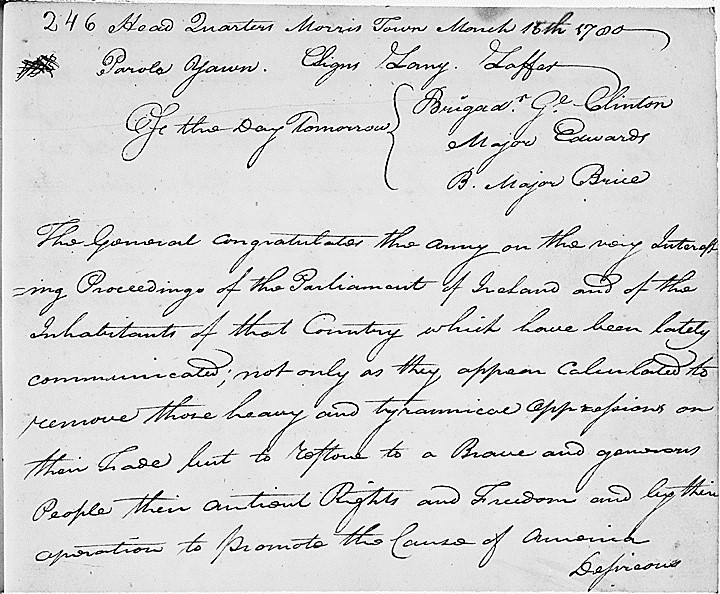
“Head Quarters Morris Town March 16th, 1780

General Order

The general congratulates the army on the very interesting proceedings of the parliament of Ireland and the inhabitants of that country which have been lately communicated; not only as they appear calculated to remove those heavy and tyrannical oppressions on their trade but to restore to a brave and generous people their ancient rights and freedom and by their operations to promote the cause of America.

Desirous of impressing upon the minds of the army, transactions so important in their nature, the general directs that all fatigue and working parties cease for tomorrow the seventeenth, a day held in particular regard by the people of the nation. At the same time that he orders this, he persuades himself that the celebration of the day will not be attended with the least rioting or disorder, the officers to be at their quarters in camp and the troops of the state line to keep within their own encampment.”

In the Pennsylvania Division, the division commander, Major General Baron Von Steuben, and his two brigade commanders, Brigadier Generals Anthony Wayne and Mordecai Gist, each bought a “hogshead” of rum (63 gallon cask) for their men to celebrate.

Happy Saint Patrick’s Day

The Ho Chi Minh Campaign: The 1975 North Vietnamese Spring Offensive

Almost ten years to the day after the first US combat troops entered South Vietnam, Communist North Vietnam launched their war winning conventional offensive against South Vietnam.

In 1964, the South Vietnamese Army was almost completely combat ineffective and had to be rebuilt. To buy the time to do so, General William Westmoreland, the commander of the US and SEATO Military Assistance Command- Vietnam (MAC-V), brought in US airpower and US combat troops. Between 1965 and 1968, Westmoreland used US and Allied troops to search for and destroy VC and NVA main force units, while relying on special forces, indigenous militias and the ARVN for counter insurgency and security. These tactics proved effective to a point, but didn’t play well on TV and certainly weren’t quantifiable, though Westmoreland tried with “body counts”. When Westmoreland was denied the authority to cut the Ho Chi Minh Trail and seize communist base camps in the Laotian panhandle and the Fishhook in Cambodia, the war was militarily unwinnable for the US and South Vietnam. North Vietnamese Minister of Defense and commander of the North Vietnamese Army, General Võ Nguyên Giáp, took advantage of this reality and advocated for a slower insurgency campaign that avoided costly big unit engagements. This approach would empower the VC, increase US casualties, embolden the US anti-war movement, and allow time for the Soviet propaganda machine to work over America.

This slower, but inevitably successful, course of action was backed by the Soviet faction inside the North Vietnamese Communist Party, led by Giap and Ho Chi Minh. In 1967, when Ho was ill and Giap at a conference in Moscow, the Chinese faction in the government and armed forces staged a soft coup. The Chinese faction, led by COSVN commander Tran Van Tra and North Vietnamese politician Le Duan, came to power and demanded big unit battle with the Americans, because that was how the French were defeated previously. Returning to Vietnam, Giap was forced to accept the new strategy.

In January 1968, the NVA and VC launched the “General Offensive/General Uprising” i.e. the Tet Offensive, which shocked the Americans and South Vietnamese. However, though the General Offensive portion of the plan was executed, the General Uprising of South Vietnamese was nonexistent. The South Vietnamese populace on the whole refused to support the communists. The NVA and VC were defeated in a few weeks, the VC decisively so. Although the communists suffered extremely heavy casualties, the Tet Offensive turned the US public opinion against the war. The scale of the offensive gave lie to the official Johnson and Westmoreland position that there was a light at the end of the tunnel. Gen Westmoreland was replaced that spring by General Creighton Abrams.

The Tet Offensive destroyed the Viet Cong as a viable military entity, and forced Giap to move NVA regular units into South Vietnam to take their place, setting the insurgency back years. This gave Abrams the opportunity to implement new tactics in Vietnam dubbed the “Inkblot Strategy”. American and ARVN troops secured the cities, town, hamlets, and then the countryside of S. Vietnam through counterinsurgency tactics the way ink blots spread on a piece of paper. Combined with targeted strikes on high value targets and partnering and training of South Vietnamese troops and irregulars, the “inkblot strategy” proved effective. Dubbed “Vietnamization” the strategy was successful, and the ARVN took over security of the country with most American combat troops out of Vietnam by 1972.

Though Abrams’ strategy was successful, the four years of lost time under Westmoreland meant that the South Vietnamese still needed American advisors, air support, supplies, and financial assistance to deal with the increasingly conventional NVA attacks. With American assistance, the ARVN held its own against the NVA coming out of Cambodia and Laos. On New Year’s Eve 1972, Giap conceded that “We have lost the war” (his words) after Operation Linebacker II and the disastrous Easter Offensive, both of which prompted the North Vietnamese to accept the Paris Peace Accords in early 1973. South Vietnam repelled North Vietnam’s 1972, 1973, and 1974 spring offensives, without American combat troops.

As usual for modern American peace deals, the United States kept its part of the bargain and its adversaries did not. In February 1975, the US public was tired of the war. The newly elected Democratic congress cut off all funding to South Vietnam, while North Vietnam was awash in funds and supplies from various Communist bloc countries. On 10 March 1975, Giap launched the spring offensive, named after the deceased former leader of North Vietnam Ho Chi Minh, with hundreds of tanks and artillery pieces. “The Ho Chi Minh Campaign” was the fourth massive conventional spring offensive in as many years against South Vietnam. Giap had reached the bottom of his manpower pool, but unfortunately South Vietnam had neither the resources nor the will to properly defend. The NVA broke through within days and Saigon fell on 30 April.

Contrary to popular historical opinion, South Vietnam did not fall to a popular insurgency, but a conventional attack that would not have been out of place in the Second World War.

130,000 South Vietnamese fled the country and 200,000 more were be murdered by the North Vietnamese over the next month. Hundreds of thousands more were forced into re-education camps. Following their victory in Vietnam, Cambodia fell to the Khmer Rouge, and Laos fell to the Pathet Lao. A further 1.6 million men, women, and children were murdered by the Communists.

The Battle of Auerstadt

During Napoleon’s invasion of Saxony and Prussia in October 1806, both the Grande Armee and the Prussian Army were moving north on opposite banks of the Saale river. On 13 October 1806, Lannes V Corps came into contact with Prussian troops at Jena. Napoleon correctly concluded that the Prussian Army under King Frederick Wilhelm III and the Duke of Brunswick was to the west of the Saale River and ordered his corps to cross the Saale. Napoleon wished to bring the Prussian Army to battle on the Landgreffenburg, the plateau west of the Jena. Most of the Grande Armee crossed the river at Jena, but two of Napoleon’s corps, Davout’s III and Bernadotte’s I Corps, were to cross downstream at Koessen. From there, they were to surprise and strike the Prussian Army from the north.

Boldy falling upon the flank of Napoleon’s adversaries in battle after a long forced march was a task in which Davout was not a stranger. He executed the exact same mission with aplomb the previous year and assured the destruction of the Austrian and Russian armies at Austerlitz. If there was anyone in the Grande Armee that Napoleon could trust with such a difficult mission, it was Davout.

Louis-Nicholas Davout was born of minor French nobility from Burgundy. Despite his noble heritage, he survived the French Revolution when most of his peers were sent to the guillotine. A trained cavalryman, he thrived in the ranks of the French Revolutionary Army through unimpeachable integrity, uncompromising discipline, unmatched military skill, and frankly just being a bit ‘arder than his contemporaries. Davout didn’t look the part: he was prematurely balding and disdained the foppery of French officers. Davout had no time for anything that didn’t directly affect military efficacy. Napoleon, like most French senior officers, despised him at first meeting, mistaking Davout’s self-confident competence for arrogance, aloofness for pride, and utilitarian uniform for shabbiness. However, Napoleon quickly recognized that Davout was not one for the salon, but for the battlefield. When the Revolutionary government forced Davout out of the army due to his noble family, Napoleon overrode them and promoted him to general of division. He arranged Davout’s marriage to his sister in law, just to get him into the family. For these acts, Napoleon gained Davout’s undying loyalty. When Napoleon became emperor in 1804, Davout was one the few generals raised to Marshal of the Empire despite being the younger (34) than his contemporaries and one of the least experienced. He was one of the few Napoleonic commanders who saw the difference between “looting” and “foraging”, punished the former with death, correctly surmising that looting just slowed the columns down. For his tough and exacting training standards, moral incorruptibility, and unrelenting discipline, Davout quickly became known as the “Iron Marshal”.

Napoleon’s confidence in Davout was not misplaced though it would be tested during the invasion of Prussia. Davout was already passed Jena and was 15 km to the north when Lannes made contact there with the Prussian Army. The Grande Armee’s turn west put Davout’s III Corps on the far right but in a position to turn the Duke of Brunswick’s flank, if possible. To do so, III Corps would have to march north to cross the Saale at Koessen then turn south and take the Prussians from the flank and rear. Davout’s men would have to march all night to complete the 50 kms route. Come dawn on 14 October 1806, II Corps was making good time on the road from Koessen toward Auerstadt and Apolda to decisively affect the Battle of Jena.
However, Davout would never make it there. He and his 27.000 strong corps were marching southwest on the same road that the 70,000 strong Prussian main army was marching on northeast towards Leipzig. In the same dense fog that affected every movement at the Battle of Jena, neither side was aware of the other, but a clash was inevitable.

At the village of Hassenhausen, Davout sent his aide-de-camp Colonel Jean-Raymond-Charles Bourke with a detachment of light cavalry to assess the road ahead. They spotted Brunswick’s advanced guard, General-Lieutenant Gerhard von Blucher’s division of cavalry with the King of Prussia Frederick Wilhelm III at its head as if he were a Roman Consul riding in a triumph. About the same time, Prussian cavalry, considered at the time the best in the world, spotted Davout’s 3rd Division, under Gen Charles Gudin advancing on Hassenhausen. Blucher convinced Brunswick that he should immediately attack. The fog would allow his cavalry squadrons to surprise the French and defeat them before they could form squares. Blucher advanced with ten squadrons and brushed aside the Gudin’s screening light cavalry
Unfortunately for the Prussians, Bourke’s reconnaissance and Gudin’s retreating cavalry gave just enough warning for the veteran French infantry to form squares. In less than a minute, Gudin’s exposed columns were a patchwork of immobile bayonet tipped squares, and a minute after that surrounded by Prussian cavalry. A horse, no matter how well trained, won’t charge a wall of bayonets. The Prussians were reduced to riding past firing their pistols or attempting to slash their way through with sabers, all the while receiving volleys from the back ranks and canister from the guns at the corners. One square was broken up by dismounted dragoons and horse artillery but most of its inhabitants managed to withdraw to another square. The sole Prussian success of the engagement was the exception that proved the rule that mounted cavalry couldn’t break an established infantry square. Every time the cavalry reformed amidst the squares, they were hammered by French volleys. Blucher’s cavalry was forced to fall back. The massive casualties among the Prussian cavalry neutralized them for the rest of the battle.

The defeat of the feared Prussian cavalry skyrocketed the morale up and down Davout columns.

Brunswick orders his infantry forward to engage the French and closed with Gudin’s men. However, Gudin was in a strong position. His men occupied Hassesnhausen and turned it into a stronghold with defensive lines to the north of the village. More Prussian troops followed behind, but since Brunswick rode up and down the Prussian line inspiring his men, their officers couldn’t find him in the confusion of the battle. So they stopped and waited for instructions as to where to place their men in the line. Brunswick was forced to place them himself while the French filled in the line as needed. Furthermore, Gudin’s men in Hassenhausen had a better line of sight over the battlefield and could observe Prussian movement. The Prussians could not do the same.

Anchored on Hassenhausen, Gudin took on all comers but, even disorganized, the Prussian numbers began to be felt. Gudin had no troops to the south of the town and the Prussians were slowly enveloping the French left. Davout’s 2nd Division, under Gen Louis Friant formed his men to the right of Gudin and caused a panic among the Prussians as Brunswick was pushing the French left. However, the sight of French troops to the north of Gudin and French cavalry even further northwest, threatened his own left flank. Brunswick sent his highly capable chief of staff, Gehard von Scharnhorst, to sort out the north while he continued to individually place regiments in the south. Though the Prussians vastly outnumbered the French, Davout’s commanders were simply quicker to get into the line. Two thirds of Davout’s corps were fighting the Prussians while barely one third of Brunswick’s army was in the fight.

At 9:30 am, disaster struck the Prussians. The Duke of Brunswick was shot in the head and taken from the battlefield. The king took personal command. There was a reason Brunswick was in tactical and operational control of the army, King Frederick Wilhelm III was not an able military mind. He knew his limits, but with Brunswick mortally wounded he felt honor bound to take command. With Scharnhorst out of contact to the north, and the Brunswick’s subordinate commanders unwilling to step up and assist the king, paralysis wracked the Prussian Army.

Brunswick’s last commands were carried out and a massive Prussian force attempted to bypass the town to the south, but it was spotted from Hassenhausen and Davout diverted troops to block it. Nonetheless, by 11 am Davout’s two divisions were hard pressed. Morand’s division was still enroute and Bernadotte’s corps was nowhere to be seen. Because of his control of the commanding views from Hassenhausen, Davout knew he was facing the Prussian main army and accurate numbers of what he faced. He sent a report to Napoleon at Jena, who curtly told the Colonel Falcon, Davout’s aide and messenger, that “Your marshal is seeing double!”

The arrival of Morand’s 1st Division to the south of Hassenhausen around noon provided much needed relief for the Gudin in the town, then fighting on three sides.. The Prussians on the right were expecting to be reinforced from the Prussian reserve, 15,000 men under Count von Kalkreuth. However, one of Friant’s brigades along with Davout’s corps cavalry turned the Prussian right and seized the town of Poppeln, far behind the Prussian lines. In an army with outstanding division commanders, Davout trained his hardest, and Friant was by far his best. The Prussian line bent dangerously backwards under Friant’s relentless assault. Kalkreuth, with two fresh divisions at Auerstadt, but without orders, recognized the danger and decided to retake Poppeln instead of reinforcing the line. With the Prussian reserves occupied elsewhere, the sight of the fresh French troops of Morand’s division broke the Prussians opposite Hassesnhausen who had been fighting for nearly four straight hours without reprieve. Like Napoleon, the Prussian king thought he faced his adversary’s main army, so he ordered a withdrawal to reorganize his own army, identify a new commander, and fight at a better location.

Davout sensed the Prussian weakness and ordered all of his units to immediately attack. What began as a small trickle of Prussian troops fleeing to the rear became a flood. Any semblance of Prussian order dissolved in the narrow streets of Auerstadt. The Prussian retreat tuned into a rout as the king’s army encountered the remains of Hohelohe’s army fleeing west and north after being defeated by Napoleon at Jena. Only French exhaustion prevented Davout’s men from pursuing the Prussians. Not that it really mattered, even Prussian formations who had no contact with the French broke and fled for their lives.
That Davout did not show up to the Battle of Jena was one of the final indicators that Napoleon was not fighting Prussia’s main army. Bernadotte made the same mistake and instead of supporting Davout, turned around and headed toward Jena, missing both battles. It was rumored that Bernadotte deliberately chose not to support Davout who was clearly Napoleon’s favorite after the Battle of Austerlitz. A defeat for Davout at Austerlitz would have brought him down a notch and not affect Napoleon at Jena since Bernadotte could block any Prussian advance south. Whatever the case, Davout won a great victory against the odds, while Bernadotte got an ass chewing that many believe began his road to betrayal.

Davout didn’t need Bernadotte, but his casualties would have been lighter had the future King of Sweden followed and supported. Davout’s III Corps endured 7500 casualties, about one quarter of his corps, but he defeated over 70,000 Prussians, almost twice what Napoleon faced at Jena. Napoleon, ever the narcissist, attempted to downplay Davout’s victory at Auerstadt in favor of his at Jena in official dispatches back to Paris. But Davout’s victory was so overwhelming and against such great odds that even Napoleon couldn’t deny it. He awarded Davout the title of “Duke of Auerstadt”. When the Grande Armee triumphantly marched into Berlin ten days later, it was Davout’s III Corps that marched in the van.

It was said later that “Napoleon won a victory that he could not lose and Davout won a victory that he could not win.” The quote overly simplified a series of complicated engagements. The Battle of Jena was far closer than it seemed with the fog limiting Napoleon’s understanding of the battle. It was Napoleon’s corps system and his subordinates’ proclivity to concentrate and march to the sound of the guns and the Prussian hesitation to do the same that won Jena. The Battle of Auerstadt was far closer than the numbers suggest. Whereas Davout and superstar subordinates efficiently and effectively got the most out their men, Prussian disorganization and paralysis negated their superior numbers.

The French pursued the surviving elements of the Prussian Army across the country, isolating them and never giving them a chance to reorganize. Hohenlohe surrendered after the Berlin fell, Ney captured Magdeburg after a short siege of its garrison reinforced with Jena/Auerstadt refugees, and Blucher was pushed out of Lubeck in a last desperate stand by the remains of the Prussian Army. The Battle of Lubeck was a taste of what the Prussian Army was capable of in competent hands.

The French victories at the battles of Jena and Auerstadt thoroughly humiliated the Prussians and laid to rest once and for all who was the true heir of Frederick the Great. The defeats shattered the idea of Prussian invincibility and directly led to a series of reforms and retirement of the elder Prussian officers. The mass exodus of Prussian officers that came of age in the mid-18th century gave way to a new generation of dynamic reformers. Led by Scharnhorst and Blucher, and consisting of great military minds such as Neidhardt von Gneisenau and Carl von Clausewitz, among many others, the reformers identified the reasons for the Prussian losses and French victories. They remade the Prussian Army into one that defeated Napoleon in the battles from 1813 to 1815. Their contributions to military theory are still felt today.

Operation Rolling Thunder and the Ground War in Vietnam

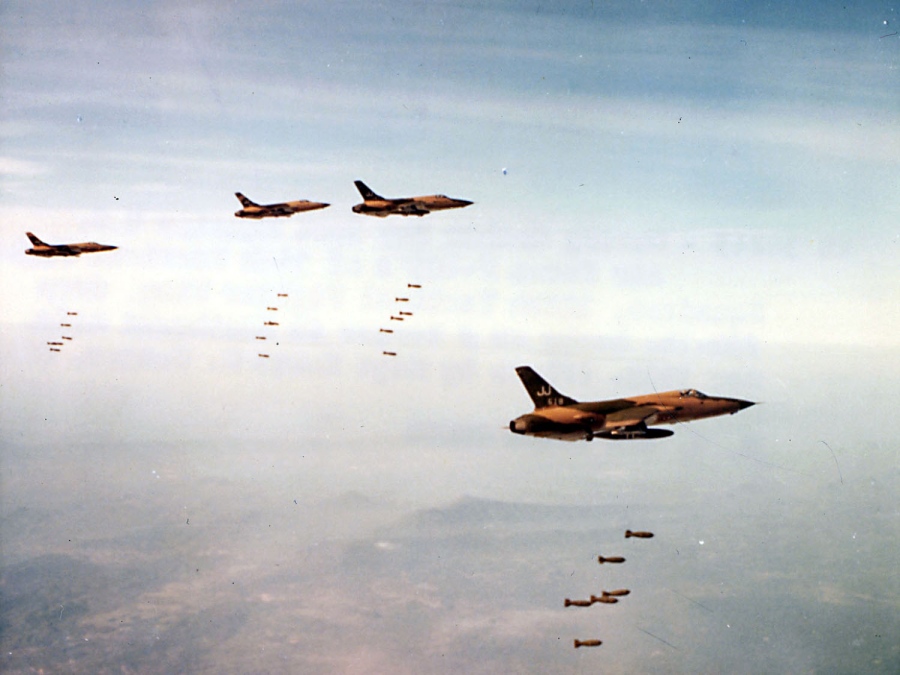
In early 1965, there were 22,000 US Special Forces advisers, pilots, and support personnel in South Vietnam assisting the Republic of South Vietnam in the war against the communist National Liberation Front insurgents aka Viet Cong (VC), and their backers in North Vietnam. The situation in South Vietnam steadily deteriorated over the previous two years and the chaos reached a crescendo in February 1965. The Army of the Republic of South Vietnam (ARVN) was recently defeated in two conventional battles against the VC and regular North Vietnamese Army (NVA). Also the civilian government of South Vietnam endured a successful coup by the ARVN Army Chief of Staff, Gen Nguyen Khanh and his Buddhist supporters, only to be immediately followed by another failed coup by communist sympathizers on the Armed Forces Council (The Vietnamese version of the Joint Chiefs of Staff). Furthermore, the South Vietnamese village pacification program was recognized as a complete failure in February. Additionally, Viet Cong terror bombings became increasing common in South Vietnam’s major cities. But the final straw was the attack on Pleiku Air Base which killed eight Americans, wounded 128 others and destroyed 20 aircraft in the first large scale attack directed solely at Americans.

In response to the chaos, on 2 March 1965, President Lyndon Johnson authorized Operation Rolling Thunder, a sustained bombing campaign against the Viet Cong’s supply routes aka the “Ho Chi Minh Trail”, and military and industrial targets inside North Vietnam. Rolling Thunder was a major escalation to the war. The operation was scheduled to last eight weeks; it would go on for three years.

In order to protect the Rolling Thunder airbases from further Pleiku style attacks, the Military Assistance Command – Vietnam commander, Gen. William Westmoreland, requested American ground combat troops. The first of these arrived on 8 March 1965 when two battalions of US Marines landed on the beach at Danang, where they assumed security of the US airbase there. They could have flown directly to the airbase, but Westmoreland thought it more dramatic for the cameras if they landed on the beach like their fathers did in the Pacific War.

95,000 more American troops followed over the course of 1965.

The Bridge at Remagen

In early March 1945, German forces in France and the Low Countries were flooding back across the Rhine with American forces in close pursuit. Hitler intended to use the swift, deep, and wide Rhine River as a moat to stop the Allies while he concentrated on defeating the Russians in the East. He ordered all of the bridges blown before they were captured by the Americans.

In early March 1945, all of the Rhine bridges were destroyed except one, the Ludendorff railroad bridge in the German town of Remagen. 75,000 much needed soldiers of the German 15th Army were still on the west side of the Rhine, and the US First Army was still 20 miles away, so the bridge was left standing to allow them to escape. On the morning of 7 March 1945, reconnaissance elements of TF Engeman of Combat Command B of the 9th Armored Division pushed to the Rhine River near Remagen in an attempt to find sites for a possible assault crossing in support of Field Marshal Montgomery’s Rhine crossing operation farther north.

When the scouts crested the ridge outside of town, they were surprised to see the bridge intact and thousands of civilians and soldiers attempting to cross into Germany. They called up the commander of their supporting tank company, LT Karl Timmerman. (All ground scouts eventually realize they need tanks to stay alive. That “snooping and pooping” shit in jeeps and armored cars only works in the movies. You ALWAYS end up fighting for good information)

LT Timmerman took one look at the bridge and ordered his scouts and tanks to attack. He radioed the situation to his commander and requested support. Within ten minutes, Timmerman’s company was attacking; within 20 minutes, TF Engeman; within the hour the rest of Combat Command B; and by the next: the entire 9th Armored Division. In less than two hours, 8,000 soldiers were assaulting Remagen. Before midnight, five divisions of the US First Army were converging on the Ludendorff Bridge, much to the consternation of Eisenhower and Montgomery’s planners. (Omar Bradley sarcastically asked Ike’s operations officer “What the hell do you want us to do, pull back and blow it up?”)

The Germans attempted to blow the bridge with Timmerman’s troopers on it but although some of the charges detonated, most didn’t. American artillery fire cut some wires, TF Engenan’s engineers hastily cut more as they crossed, and slave laborers sabotaged some of the explosives, which were industrial grade, and those that exploded were incapable of demolishing the bridge. Timmerman managed to get 120 troopers across by nightfall. The small bridgehead was very exposed but tank fire from across the river broke the only German counterattack that day.

As engineers tirelessly worked through the evening and night to repair the bridge enough for it to support the weight of the tanks, every soldier in Combat Command B who could hold a rifle crossed into Germany. At dawn on 8 March, there were 9 tanks and 800 soldiers on the east bank. By noon, the entire 9th Armored was across, and within 72 hours 25,000 men of six divisions were inside Germany.

Hitler belatedly threw everything the Germans had left at the bridgehead, including V2 rockets and what remained of the Luftwaffe, but to no avail. The attacks on the Ludendorff Bridge were the last gasp of the Luftwaffe. Most of the American air defense artillery was cannibalized to provide infantry replacements, but every remaining gun in the First Army protected the bridge. Of the hundreds of Luftwaffe sorties, only a single bomber managed to drop its payload near enough the bridge to do damage.

The Americans were across the Rhine in force and nothing could keep them from driving into the heart of Germany. When Stalin learned the Americans were across the Rhine, he authorized a resumption of the Soviet offensive. Stalin halted it along the Oder River in late January because he did not believe the Allies had the ability to force the Rhine and he refused to invade Germany proper alone. That was no longer the case on 7 March. From the moment the Americans crossed the bridge, Germany was doomed.

All because a 23 year old 1st Lieutenant decided to attack.

“Here I Am”

Napoleon landed in France on 1 March 1815 after escaping from his exile on Elba. He and his 1000 strong staff and honor guard took a circuitous route north through the French Alps to avoid the royalist sympathizers in the Riviera.

On 5 March 1815, the small army approached the pass at Laffra, just outside of the city of Grenoble. Directly to its front was the veteran 5th Infantry Regiment, six ranks deep, led by royalist officers, completely blocking the pass.

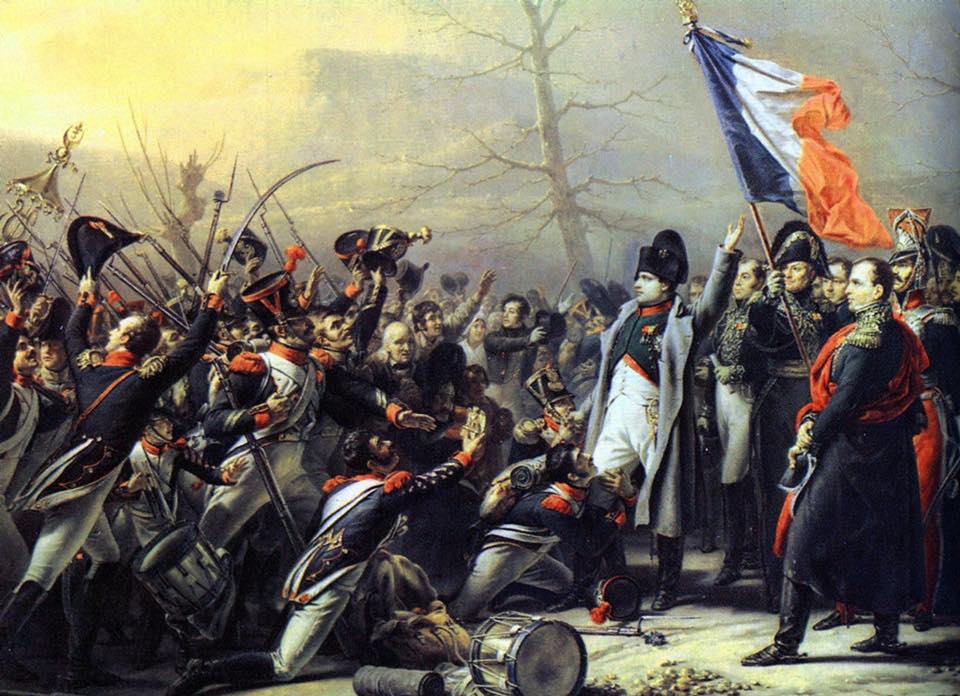
For five tense minutes, the regiment silently faced off against Napoleon’s troops. Then the ranks of the lancers and guards parted as Napoleon himself approached the 5th. One royalist officer gave the order to fire but none did. Napoleon moved closer. At 50 meters he stopped and said,

“Soldiers, I am your emperor. Know me! If there is one of you who would kill his Emperor, here I am”.

He then threw open his great greycoat and invited them to shoot.

The solders of the 5th abandoned their weapons and rushed Napoleon shouting ‘”Vive l’Empereur!”. They deserted the recently restored Bourbon monarchy en masse.

The event was stage managed to a degree. Staff officers and soldiers went forward the night before to let the 5th Infantry Regiment know what would happen if Napoleon was shot. It was an offer they neither could nor would refuse.

Two days later the 7th Regiment went over and soon Marshal Ney, Napoleon’s “Bravest of the Brave”, joined with an army of 6000. Thousands more flocked to the march every day. Though many were new recruits, many tens of thousands were former prisoners of war captured by Napoleon’s enemies over the past 20 years and recently repatriated back to France. King Louis XVIII and his court fled the country and Napoleon entered Paris on 20 March at the head of an army 100,000 strong.