The Funeral of Pope John Paul II

On 8 April 2005, four million people packed into Rome, St Peter’s Square, and the Vatican to attend the funeral of Pope John Paul II, the greatest Roman Catholic Pope of the modern age. His funeral is the single largest gathering in the history of Christendom. It was attended by over 90 heads of state, and in a historical anomaly, was attended by the spiritual leaders of 14 of the world’s largest religions, including Islam, Judaism, Eastern Orthodoxy, and the various Protestant denominations. It was the first time the Archbishop of Canterbury attended Catholic Mass since the 16th Century, and the first time the Patriarch attended a papal funeral since the Great Schism between the Roman Catholic and Eastern Orthodox Churches a thousand years before.

Born Karol Wojtyla outside of Krakow, Poland, he was the son of a Polish Army noncommissioned officer and attended university in Krakow where he studied history and languages until German National Socialists closed it down in 1939. By 1941, his entire family was killed by the Germans, but Wojkyla survived by taking jobs in factories that got him exempted from the random detention and execution of Polish civilians. He spent his free time studying at an underground seminary while protecting and hiding Polish Jews from the Nazis.

After the war, Wojtyla was ordained a priest and spent the next 30 years in the difficult position of an outspoken Roman Catholic in a country dominated by Communism. His unpretentious demeanor and wise counsel earned him the nickname “Uncle” which his parishioners and peers used until he was elected Pope in 1978, when he took the name John Paul II.

Pope John Paul II was the first non-Italian pope in 500 years, and one of the youngest and healthiest. He had a worldly view that contrasted greatly with previous popes. Pope John Paul II spoke eight languages fluently and was the most widely traveled pope in history. He spent much energy repairing relations with the other world religions and was the first Pope ever to pray in a mosque. Pope John Paul II was not against contraception for health reasons i.e. to prevent the spread of HIV, and routinely affirmed Catholicism’s stance that evolution and creationism are not mutually exclusive. He publicly apologized for many of Roman Catholicism’s historical sins, and the first ever papal email was sent apologizing for the church sex abuse scandals.

Despite this, Pope John Paul II was hated throughout much of the world due to his staunch and outspoken nature against totalitarianism. He specifically decried Apartheid in South Africa, the Mafia in southern Italy, Latin and South American dictators, Socialist Liberation Theology, and was the one of the few world leaders with the courage to call the fighting in Rwanda what it was: genocide. He was a consistent opponent of war in general, but more importantly, Pope John Paul II was the world’s moral leader against Socialism and Communism. Pope John Paul II routinely spoke on socialism’s corruption of the soul, destruction of the basic building block of society — the family, and that life is too complicated for simple and radical secular “one size fits all” solutions. For this he was despised by socialists and communists around the globe.

He survived numerous attempts at humiliation and two assassination attempts, one of which was bankrolled by the KGB, due to his voracious anti-communism. His homilies and sermons on the evils of Communism gave hope to hundreds of millions of oppressed people around the world, particularly in Eastern Europe. Most historians agree with Polish Solidarity leader Lech Walesa and former Soviet Premier Mikhail Gorbachev, both of whom said that without Pope John Paul II there would have been no Solidarity, and without Solidarity there would not have been the Fall of the Iron Curtain and Berlin Wall in 1989.

In 2004, Pope John Paul II was diagnosed with Parkinson’s Disease and died in the Vatican on 2 April 200

The Battle for Okinawa: Operation Ten’ichigo

At dawn on 7 April 1945, the crews of the fourteen remaining ships of the Japanese 2nd Combined Fleet were assembled on their decks and briefed on Operation Ten’ichigo, “Heaven One”. Now commonly known as Operation Ten-Go, the plan was a naval Kamikaze attack on the American Fifth Fleet off of Okinawa.

The last remnants of the 2nd Combined Fleet centered on the mighty battleship Yamato, which was still the largest and most powerful battleship in history. Once there, the Yamato and his escorts were to beach and become unsinkable shore batteries, with the Yamato’s massive 18” guns destroying the American invasion fleet. Each sailor was given the opportunity to stay behind, and of course none did. The Japanese task force departed Yokohama with all of the remaining fuel in port for the one way trip to Okinawa. Hundreds of aircraft Kamikaze from the second wave of Operation Kikusui No. 1 were to keep the Americans busy while they were in transit.

Fortunately for the Allies, the 2nd Combined Fleet never made it to Okinawa. Two submarine’s spotted them departing but could not engage because of the TF’s speed. The Japanese, with no air cover, planned to avoid submarine and air attack by traveling at flank speed and violently zig-zagging for the entire trip. The tactics worked for about five hours, until the first planes of three waves of over 400 American and British torpedo and dive bombers finally found them and attacked just after noon. For two hours Japanese gunners and damage control crews valiantly kept the ships afloat, but by 1400 the one sided contest was over. All of the ships were sunk and the Yamato took twelve torpedo hits and eight bomb hits before he went down. Operation Ten-Go was the last significant action in the Second World War by the Japanese Navy, which three short years earlier was the terror of the Pacific.

The Battle for Okinawa: Operation Kikusui No. 1

In 1336, Japanese warrior Kusunoki Masashige fought a brave but futile defense at the Battle of Minatogawa. The moment before his inevitable defeat, Masashige committed seppuku, ritual suicide, in front of his attackers rather than surrender or be taken prisoner. Masashige became a legend in Japanese history and his emblem, the kikusui or floating chrysanthemum, became the symbol for Japan’s struggle to death with the Allies in 1945.

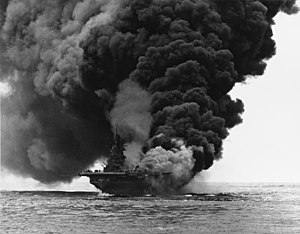
On 6 April 1945, the Japanese launched the first of ten massed airborne Kamikaze strikes against the US Fifth Fleet off Okinawa. Operation Kikusui, No 1 consisted of almost 700 aircraft including 355 Kamikaze. US codebreakers knew of the attack and every fighter in the Fifth Fleet was airborne to meet them. Nonetheless, the Allied fighter patrols could only shoot down 200 or so before they reached the fleet. The northern most destroyers on radar picket took the brunt of the initial attacks. Notwithstanding orders to bypass the destroyers and hit the vulnerable carriers closer to Okinawa, most Kamikaze struck the first ships they came across. Once a “gap” was made in the picket line, Kamikaze continued on toward the fleet. 200 more were shot down by antiaircraft gunners. It wasn’t enough.

180 Kamikaze and normal strike aircraft slammed into the fleet. Despite hours and even days of epic damage control efforts, two destroyers were sunk, and four more so damaged that they were sent to scrap after the day’s battle. Four other destroyers and two destroyer escorts were so badly damaged that they required more than 30 days of repairs. One LST and two ammunition ships were destroyed, and one fleet carrier, the USS Hancock, was sent back to Pearl Harbor for repairs.

The Japanese were not pleased with results considering the resources expended. The Americans’ mastery of the fundamentals: damage control, disciplined anti-aircraft fire, radar direction, combat air patrols, intelligence, and fleet logistics provided the fleet a resilience that had prevented a disaster.

Unfortunately, the worst was yet to come.

Toshiro Mifune

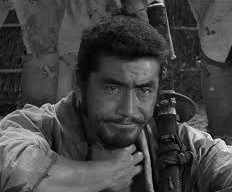
On 1 April 1920, Japan’s greatest actor, Toshiro Mifune, was born. Born to Mehodist missionaries in Shadong, China during the Japanese occupation of German colonial possessions seized in the First World War, Mifune spent most his childhood in Manchuko, the Manchurian puppet state of the Empire of Japan. At age 20 he was drafted into the Imperial Japanese Army, where he was a photographer and photographic analyst in an aerial reconnaissance unit.

After the war, Mifune became a photographer. He first got noticed for his on screen presence after stumbling into an acting audition and flying onto a rage. Famed Japanese director Akiro Kurosawa was impressed by Mifune’s fury, and his imposing visage after Mifune sat in front of the judges and stared them down. 1948’s Drunken Angel was the first of 16 collaborations with Akiro Kurosawa that catapulted both into international superstardom.

Akiro Kurosawa was a master of cultural appropriation. Kurosawa took Shakespeare, Film Noir, and Classic American Westerns, gave them a Japanese twist and unleashed them on the world. Toshiro Mifune was Kurosawa’s favorite actor, and Kurosawa, Mifune’s favorite director. Through Kurosawa’s mentorship, Mifune’s tough and imposing exterior and natural ability to impart emotion was adapted into an impressive range. No emotion seemed beyond his ability to convey it to the audience. Kurosawa once said, Mifune could express in “three feet of film what other actors needed ten feet of film”. Mifune said of Kurosawa, “I am proud of nothing I have done other than with him.”

Mifune’s performances created archetypes that last to this day. His portrayal in the Drunken Angel of a young reformed Yakuza enforcer, Matsunaga, ushered in the Yakuza subgenre of film noir; a genre he excelled in on both sides of the law. Mifune specialized in gruff against-archetype samurai and ronin, single handedly creating the noble, wise, tough, stoic, quiet, drifting warrior anti-hero archetype, made famous by Clint Eastwood’s Man With No Name. The Kurosawa and Mifune collaborations of Drunken Angel, Hidden Fortress, Seven Samurai, Ran, Yojimbo, Rashomon, and Sanjuro are cinema classics and there is no mistaking Toshiro Mifune in any of them – he steals every scene he is in.

Though he fell out with Kurosawa, Mifune became the go to actor for Japanese national heroes. Mifune played Miyamoto Musashi in four different films. He played Ieyasu Tokogawa in films and his thinly veiled fictional counterpart in the American adaption of Shogun. And Mifune played Isoroku Yamamoto in several films, including the 1976 American blockbuster Midway.

Mifune was the original method actor, and dove into the preparation for his roles. He played the Japanese submarine captain in Steven Spielberg’s hilarious ground breaking comedy, 1941, where he trained the entire crew to act like Japanese sailors. He mastered foreign roles in foreign films. He famously learned to speak his Spanish lines fluently for his role as a Mexican bandit in Anamus Trujano, and studied the movement of lions for Rashomon and Seven Samurai. He turned down the roles of Tiger Tanaka in Bond film You Only Live Twice, Obi Wan Kenobi in Star Wars, and Mr. Miyagi in The Karate Kid. He was close friends with American actors Scott Glenn, Charlton Heston, and William Holden.

Toshiro Mifune (and Akiro Kurosawa) did more to heal the post war rift between two bitter enemies, Japan and America, than any others in the twentieth century.

So next time you’re watching Speed Racer, know that there’s a reason Speed Racer is named “Go Mifune” and the M on his helmet does not stand for “mach” but “Mifune”.

Happy 100th birthday, Toshiro Mifune.

Operation Iceberg: The Battle of Okinawa

On 22 March 1945, the last of the 180,000 men of the US Tenth Army, under US Army Lt Gen Simon Bolivar Buckner were loaded onto transports. The final ships bearing the US 1st, 2nd, and 6th Marine Divisions, and US Army’s 7th, 27th, 77th, and 96th Infantry Divisions departed the Ulithi atoll on the 1400 ships of the US Fifth Fleet that afternoon for the trip to Okinawa in the Ryukyu Islands. The US Tenth Army was the largest land force under direct US Navy command in American history. On 26 March, the US Fifth Fleet arrived off Okinawa. That morning, the US 77th Infantry Division seized the Kerama Islands just west of Okinawa for an anchorage to support the main landings, and protect the vulnerable transports from small Kamikaze suicide boats.

On Easter Sunday, 1 April 1945, the US Army XXIV Corps, and US Marine III Amphibious Corps landed on the eastern shores of Okinawa to complete silence.

On paper the Japanese 32nd Army under Gen Mitsuru Ushijima had over 150,000 soldiers to defend the island of Okinawa, including tens of thousands of drafted Okinawan civilians, and thousands of school children shamed into volunteering. The number wasn’t nearly enough to cover the entire island as the Japanese did at Iwo Jima. Okinawa is 22 times the size of Iwo Jima, so Ushijima decided to defend, Peleliu style, at choke points and successive fortified lines across the southern half of the island. The Americans landed against no opposition.

The Americans seized the Kadena and Yontan airfields by nightfall. The US Tenth Army was the only US Army in the war to have its own dedicated air force, and it flew off of those air fields every minute of day light for the next 80 days. By 4 April, the Marines controlled the northern half of the island, with only small Japanese stay behind troops conducting guerilla warfare in the Marine rear areas. The Marines only finally defeated the guerillas once all Okinawan civilians in their sector were herded into internment camps. Without civilian support, the Japanese hold outs were all hunted down by the end of the campaign. The last organized Japanese force in northern Okinawa fought to the death on Mount Yae Take on 20 April.

On 16 April, the 77th Infantry Division conducted another amphibious invasion, this time the island Ie Shima. The fighting on Ie Shima was fiecre and included hand to hand combat with Japanese civilians, including women and children, armed with spears. Famed war correspondent Ernie Pyle was killed on Ie Shima when a Japanese machine gun ambushed his jeep as he drove to the front with one 77th’s regimental commanders. A burst caught him in the forehead and he was buried on the island with the rest of the 77th’s casualties. The 77th erected a small monument, which still stands, that reads, “At this spot the 77th Infantry Division lost a buddy, Ernie Pyle, 18 April 1945.”
Though the fighting in the north was tough, the battle for southern Okinawa was in an entirely different level of Hell. The XXIV Corps was stopped cold in the broken ground north of Shuri. The defenses extended the width of Okinawa and there was nowhere for the Americans to go except into the teeth of Ushijima’s defenses. The Americans only took the Japanese advanced line when its defenders retired to the main line of resistance just a bit further south. The Army divisions were fought out by 24 April and the relatively fresh Marines of the III Amphibious Corps were sent south.

On 2 May, the skies turned cloudy and it started raining. It would stay that way until July. That same day, the Marines went on the offensive. They made almost no progress despite fierce fighting and several potential breakthroughs. The Japanese didn’t just defend, they counter attacked using tunnels and defilades in the broken terrain to move troops to the flank or even behind the Marines. Ushijima had thousands of fresh troops that were guarding southern beaches which were obviously not going to see a landing. Several Marine companies were cut off and nearly annihilated before they fought their way out of their entrapments.

The successful defense on 2-3 May against the Marines convinced Ushijima’s subordinates to pressure him into a large scale attack with tanks and beach landings behind the Marines. Ushijima knew he could not win the Battle of Okinawa, but he did believe that every day he held the Americans on Okinawa was another day that the Home Islands could prepare for their inevitable invasion. He had an entire veteran division in reserve and wanted to use them bleeding the Americans in the naturally defensible terrain of the island. But his subordinates demanded that they attack lest they lose face. Ushijima gave in.

The Japanese counter offensive was initially a complete surprise, but the landings and assaults were quickly isolated and destroyed. As Ushijima had foreseen, the offensive was a complete waste of men; men he had no way to replace. Nonetheless, for the next 45 days, the Americans ground down the Japanese in brutal attritional warfare. The superior Japanese positions endured a seemingly inexhaustible supply of American firepower. An example of the brutal and ruthless nature of the fighting was Sugar Loaf Hill, a bare 15m high bald hill that was initially a company objective for the 29th Marines. Sugar Loaf anchored the far end of the Shuri Line. Eleven assaults over seven days, 12-18 May, by three different marine regiments consumed nearly 5000 American casualties, and killed 2500 Japanese. Most American wounded at Sugar Loaf never saw a Japanese soldier. But every American casualty could be replaced while the quality of the Japanese defenders declined. On 29 May the Shuri Line was broken when the Marines secured Shuri Castle.

The remaining 30,000 troops of the 32nd Army withdrew to the Kiyan peninsula for a last stand. By this point in the battle, cut off Japanese troops were committing suicide by the thousands. A Marine landing on the peninsula resulted in nearly 1200 Japanese sailors committing suicide when they were cut off below ground. As the situation for the Japanese became untenable, the Japanese soldiers began demanding of Japanese civilians that they too commit suicide. Corrupted by propaganda that the American were going to rape and kill them anyway, many did. The sound of a grenade going off in an underground bunker was a common occurrence, and thousands of Japanese civilians jumped from the southern cliffs to avoid capture. Of the 300,000 pre-battle civilian population of Okinawa, over 100,000 were dead by mid-June, mostly by suicide.

On 18 June, while checking on troops, Buckner was killed by Japanese artillery fire and became the highest ranking American officer killed by enemy fire in the war. He was replaced by Marine Major General Roy Geiger before he was replaced by Gen Joseph Stilwell, who was in the Philippines returning from China when Buckner was killed.

On 21 June, Ushijima ordered his remaining troops to disperse and conduct guerilla operations. He committed seppuku the next day, but not before ordering his aide, Colonel Yahara, to stay alive to tell the Japanese side of the story. Yahara was the senior Japanese officer to survive Okinawa. About 14,000 Japanese soldiers surrendered during the Battle for Okinawa, but almost all were Okinawan or Japanese mainland civilians drafted just before the battle. The Americans suffered 14,000 dead and 50,000 wounded in the Battle of Okinawa, more than in the Battle of the Bulge in Europe, the largest American battle in history.

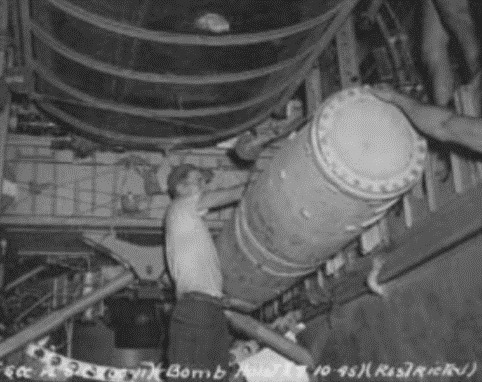
The ferocity of the Japanese defense, the American casualties, and the mass suicide of Japanese civilians on Okinawa (and the specter of a post war conflict with the Soviet Union) convinced President Truman to authorize the use of atomic bombs against Japan in lieu of direct invasion. The planners of Operation Downfall, the invasion of the Japanese Home Islands, and its two subordinate operations, Operation Olympic: the invasion Kyushu, and Operation Coronet: the invasion of Honshu had projected more than a million Allied casualties subduing Japan. Truman said, “I do not want another Okinawa from one end of Japan to the other.” The first atomic bomb was dropped on Hiroshima on 6 August, 1945, and another on Nagasaki three days later on 9 August. Emperor Hirohito announced Japan’s surrender on 15 August 1945.

The Great Heathen Army

In 793, the raid on the island of Lindisfarne on Northumbria’s east coast began the Viking Age. For the next 70 years, Viking raids terrorized the Angle, Jute, Saxon, and Celtic settlements and petty kingdoms of the British Isles. Seasonal raids by Danish and Norwegian Vikings arrived off the coast in the longships and plundered any settlement within riding distance of the coast. Most settlements paid them the “danegeld” or ransom for their lives which the Vikings accepted enthusiastically. It was safer, and destruction of a settlement was counterproductive. Raiding was more lucrative if the inhabitants were able to pay again next raiding season. You do not kill sheep, you shear them. In any case, by the time the local eorl or military leader assembled a force large enough to defeat the raiders, the Vikings loaded back on their ships and disappeared. With rare exceptions (King Aethelwulf of Wessex defeated a large Viking raid in 851), this pattern remained unchanged until 865.

In 865, the Vikings no longer came to the British Isles to raid but to conquer and settle. The land was so much richer than their own in Scandinavia. They stole vast wealth from there every year; it seemed more efficient to just work and lord over the land themselves for the riches. That year, the sons of the semi-mythical Ragnar Lothbrok gathered a massive force to invade the British Isles. With hundreds of ships and 3000 warriors, Ivar the Boneless (he was either crippled or impotent, historians have evidence for both) Halfdan Ragnarrson, Bjorn Ironside, and famed warrior Ubba, gathered a coalition of Viking warbands from all lands bordering the North and Irish Seas to defeat the inhabitants of the petty kingdoms of the Anglo-Saxon Heptarchy.
Since the Germanic invasions of the British Isles in the 500s, the Angles, Saxons, and Jutes established seven Germanic kingdoms among the Celtic remains and rump states formed after the departure of the Romans. In the north was Northumbria. In the east, East Anglia, Essex, Kent, and Sussex, whom took the brunt of the Viking raids. In the west was Wessex. And the most powerful was in the center, Mercia. The kingdoms were fierce rivals and abhorred the Viking raids, but nevertheless used Viking mercenaries in the wars against each other. The divided nature of the Anglo-Saxon Heptarchy left them vulnerable to the Viking army, which they deemed “The Great Heathen Army”.

The Great Heathen Army landed in Kent on 26 March 865. They ravaged the small kingdom and spent the winter enjoying the spoils encamped on an island off the coast. In 866, they invaded East Anglia and establishing a permanent danegeld, known as the Danelaw, in Kent, effectively turning it into a puppet kingdom. King Edmund of East Anglia bought off the Viking horde by stripping his kingdom of horses and bribed the Vikings to ride north, against Northumbria. According to legend, King Aella of Northumbria killed Ragnar Lothbrok (or worse, converted him to Christianity) and the sons exacted revenge. They captured York in 867 and again established the Danegeld. The Great Heathen Army turned south and invaded Mercia later that year. They captured Nottingham, but were in turn besieged by a combined army from Mercia and Wessex under the King of Wessex and Lord of Eastern Mercia, King Aethelred. At Nottingham, both sides were fought out, and Aethelred bought off the Vikings, who returned to Northumbria. In 868, the Great Heathen Army returned to East Anglia to establish the Danegeld, and were met by King Edmund again. But this time he wasn’t there to bribe them but to fight them. The East Anglian army was defeated and Edmund was captured. He was tied to a tree and told to renounce his faith. Edmund refused to the Vikings used him for archery practice. King Edmund was later canonized St. Edmund the Martyr and became the first patron saint of England, until St. George was chosen a hundred or so years later.

In 869, the Great Heathen Army was weakened by casualties, so consolidated the Danelaw for the rest of the year to gather their strength. In 870, the Great Heathen Army was joined by Viking warlord Bagsecg and the Great Summer Army. The Great Summer Army was comprised of the usual seasonal Vikings, but when Bagsecg heard of the Great Heathen Army’s massive success, he convinced them to band together and join the sons of Ragnar. The reinvigorated Great Heathen Army invaded Wessex and set up a joint camp at Reading with Bagseg and Halfdan sharing command. A local force under Ealdorman Aehelwulf defeated a Viking foraging party at the Battle of Eanglefield, which gave the Aethelred the confidence to attack the Vikings’ main camp at Reading. With the main West Saxon Army, Aethelwulf, King Aethelred and his little brother Alfred initially defeated the Vikings outside the main camp at Reading. But once they reached the camp gates, they were struck by Vikings who rushed out. Defeated, but not decisively so, the West Saxon army withdrew. Under Alfred, the West Saxon army turned and defeated the pursuing Great Heathen Army at the Battle of Ashdown four days later on 7 January 871, while his brother the king heard mass, killing Bacsecg and a number Viking chieftains. Aethelred died three months later, and newly crowned King Alfred of Wessex bought off the Vikings. The Great Heathen Army rushed north to put down a rebellion in Northumbria.

Alfred could only play for time. The Vikings wouldn’t settle until they were crushed or took all of the British Isles. Over the next eight years, the Ivar the Boneless, Halfdan Ragnarsson, Ubba, Bjorn Ironside and the Great Heathen Army conquered six of the seven kingdoms of the Anglo-Saxon Heptarchy, with only King Alfred and Wessex resisting by 878. Nonetheless, the Great Heathen Army reduced the Kingdom of Wessex to a single hut in the Sommerset swamps, where Alfred and his retinue fled after the Vikings defeated him at Chippenham. For a brief period in 878, almost the entirety of the British Isles were effectively part of Scandinavia. That they are not so today is the reason that there is only one monarch in England’s history with the epithet “the Great” – King Alfred the Great.

But that’s a story for another time.

Operation Starvation

The large, mountainous, and over populated Japanese Home Islands relied upon an inter-island convoy system for a functioning economy, and most importantly, food distribution. As early as the capture of the Mariana Islands in the summer of 1944, Admiral Nimitz floated an idea to disrupt this system by mining the choke points, but was unable to execute it. His carrier based planes had too short a range and the carriers would be subject to land based air and Kamikaze attack. Also, his submarines could not operate effectively in the narrow confines of the Japanese Home Islands. He turned to General Hap Arnold and the XX Air Force in an unheard of request for inter-service cooperation. He wanted the B-29s of Curtis LeMay’s XXI Bomber Command to slow down their wildly successful firebombing campaign against Japan’s wooden cities, and fill their bombers with sea mines. He wanted to drop them on inter-island convoy choke points identified by naval intelligence. It took until January 1945 to get the permission.

The US Army Air Force’s leadership in the Pentagon went into near apoplexy at this grievous breach of their domain. They were busy looking to the future and preparing the US Army Air Corps to become an independent branch of the United States Armed Forces. They finally had the numbers of bombers (This time for sho!) to put Italian airpower theorist Giulio Douhet’s theories into practice. And this close to the end of the war they didn’t want to be seen as subservient to any other branch. That they were during the invasion of France and the Battle of the Bulge was already being erased from institutional memory. The future was a post war US Air Force dominated by a Strategic Bomber Command, and nothing was going to get in the way, including ending the war faster.

However, they didn’t take into account LeMay’s determination to bring the war to Japan worse than they brought it to Pearl Harbor. Like the little girl shrugging her shoulders meme, LeMay saw no reason why he could not both firebomb Japan’s cities and choke them out of the war simultaneously. Although his men were about to get busy burning Japan’s cities to the ground, he also saw the value in starving them to death. Even before Washington and Arnold gave their approval, LeMay directed his planners to make it happen.

On 27 March 1945, B-29s dropped the first of more than 12,000 sea mines into the many straits and narrows of the Japanese Home Islands, in the aptly named Operation Starvation. Nimitz’ intelligence planners had correctly identified the Achilles Heel of Japan’s economy, and it ground to a halt. In the last four months of the war, mines shut down 37 of the 45 critical convoy lanes the Japanese relied upon for a functioning modern economy. Operation Starvation is credited with sinking a staggering 680 ships for the loss of only 15 B-29 bombers. It was more ship tonnage, 1.2 million, than all other Allied methods combined in the time period. Operation Starvation would have assuredly starved Japan out of the war by 1946.

The Battle for Okinawa: Kamikaze

On 26 March 1945, the US Fifth Fleet arrived off of the coast of Okinawa. Within hours, the first airborne “Special Attack Weapons”, better known as Kamikaze suicide planes, attacked. Kamikaze came in all types of aircraft: fighters, bombers, trainers, and even specially designed piloted bombs. Over the next 90 days, 1,465 Kamikaze attacked the fleet during the Battle for Okinawa, or more than 16 a day. These were in addition to the normal bombing raids by the Japanese Air Force. Ship crews were at battle stations from 16 to 18 hours a day, from the first bluish haze of BMNT til well after the last trace of evening twilight.

The Kamikaze initially concentrated on the destroyer pickets, then shifted to the escort carriers off of the island. American gunners quickly found out that the .50 calibre anti-aircraft guns could not bring down the Kamikaze before it struck its target. Only dedicated 40mm batteries, and more effectively, the five inch guns firing proximity rounds, could break up the planes before they struck the ship. Pilots on combat air patrol or intercept had to engage the Kamikaze as close to Japan as possible, in order to put enough rounds into the plane to prevent even a heavily damaged Kamikaze from reaching its target. Even so, 33 Allied ships were sunk and 258 more were damaged. The US Navy took more casualties off Okinawa than in any other naval battle in the war.

Dante Takes A Walk

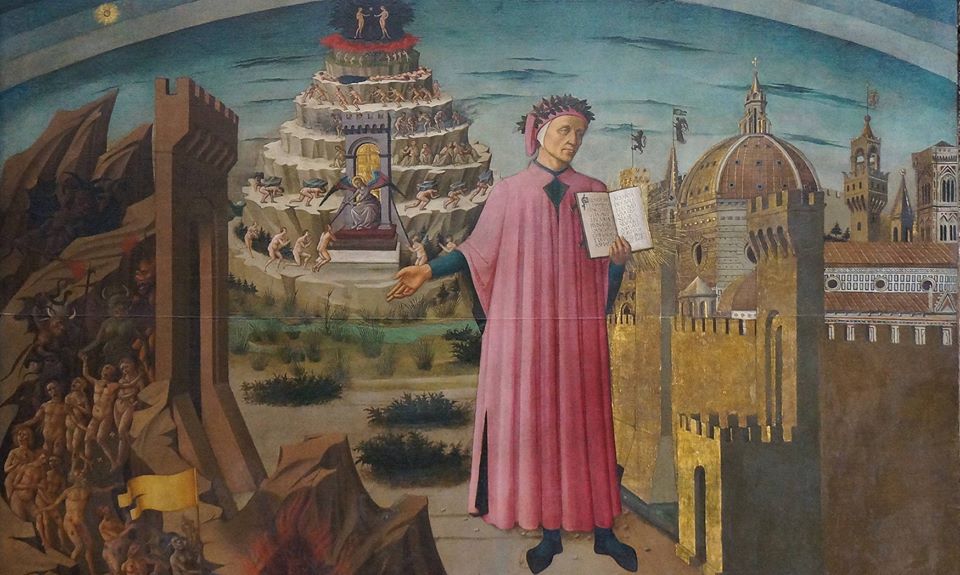
On Holy Thursday in the Year of Our Lord, 1300, the disgraced soldier, pharmacist, politician, and poet, Dante Alighieri – a Renaissance Man before there was a Renaissance – took a stroll through the woods outside his beloved Italian city of Florence. He soon became lost and was fell upon by a lion, a leopard, and a she-wolf. Dante was frightened and fled. In trying to escape, he ran deeper and deeper in the dark wood and became more and more lost. As the sun was setting, Dante met the spirit of the Roman poet Virgil. Virgil took him down the original “rabbit hole” to the underworld.

So began Dante’s journey into Hell. Over the next three days, he would need to explore its Nine Circles before finding the path to redemption through Purgatory and into Heaven…

Dante’s epic poem “Divine Comedy” was written from 1308 to 1320 and is the greatest Italian literary work. The Divine Comedy is a drama in modern terms, but in medieval Italy there were only two types of stories: Tragedies and Comedies. Their designation was based not on the form of the story like today but the ending. If the story ended poorly for the protagonist it was a tragedy; if it ended well it was a comedy.

The Divine Comedy consists of three books, Inferno (Hell), Purgatorio (Purgatory), and Paradiso (Heaven). The entire work is an allegory for sin and redemption, and forms accurate depiction of the medieval world view. Dante’s fictional journey began on Holy Thursday, which in 1300 was the 25th of March.

Operation Varsity

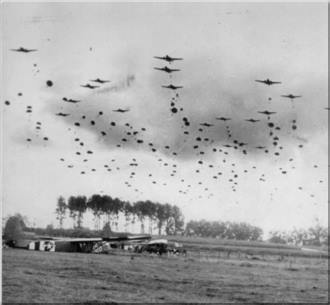
Operation Plunder was Field Marshal Montgomery’s plan to cross the Rhine River that he had been working on since October, 1944, after the failure of Operation Market Garden. Operation Varsity was the airborne component of that plan. Operation Varsity was the last and most successful airborne operation of the war.

Operation Varsity called for the US 17th Airborne and the British 6th Airborne Divisions to make a daylight drop on the east bank of the Rhine to seize German artillery positions and bridges over the Issel River. The two divisions landed simultaneously making Varsity the largest single airborne drop in history.

Operation Varsity had complete operational and tactical surprise. Varsity commenced 13 hours after Operation Plunder, had complete air superiority, perfect weather, and was supported by masses of dedicated artillery from tubes safe on the west bank of the Rhine. Finally, the airborne troopers only faced two understrength, undertrained, and underequipped German divisions.

Despite a miss drop with most of an American airborne regiment landing in the British drop zones, both airborne divisions secured their objectives by early afternoon on 25 March. However, they took horrible casualties in the process. 97 planes were shot down; and of the 16,000 Allied paratroopers who took part in Operation Varsity, 3,000 were killed, wounded or captured in the battle. Operation Varisty was the final and most successful Allied airborne operation of the war.

Unfortunately, “success” in this case is also relative. Operation Varsity was the only brigade sized or larger airborne operation of the war that actually accomplished its objectives. Contrary to what the fanboys will tell you, all airborne operations of World War II were either A. A complete and miserable failure (North Africa, Sicily, Italy, and Market Garden) or B. A miserable failure that accomplished limited objectives and was saved only through the herculean efforts on the part of its paratroopers (Normandy and Southern France) with Varsity on the east bank of the Rhine the exception that proves the rule… and even that is debatable.

Airborne!