More Cowbell

By the end of the 1990s, American late night sketch comedy and variety show Saturday Night Live was still basking in the glow of its peak ratings in the mid-90s but was slowly declining. One of the few breakout stars in SNL’s post early 90s comedic nexus was cast member Will Ferrell. Over the years, every time Ferrell heard the hauntingly beautiful Blue Oyster Cult song “Don’t Fear the Reaper”, he wondered what life was like for the band member whose sole duty was playing the cowbell. In 1999, he wrote a skit about it.

The skit was written for host Norm MacDonald and pitched seven times in 1999, but producer Lorne Michaels wasn’t sure. Ferrell tweaked the script for upcoming host Christopher Walken and it was finally approved. The More Cowbell skit aired toward the end of the 8 April 2000 SNL show. Most of the offbeat and experimental skits appeared in the last third of the show, when the audience was usually too drunk or high to notice any issues and forgiving of content.

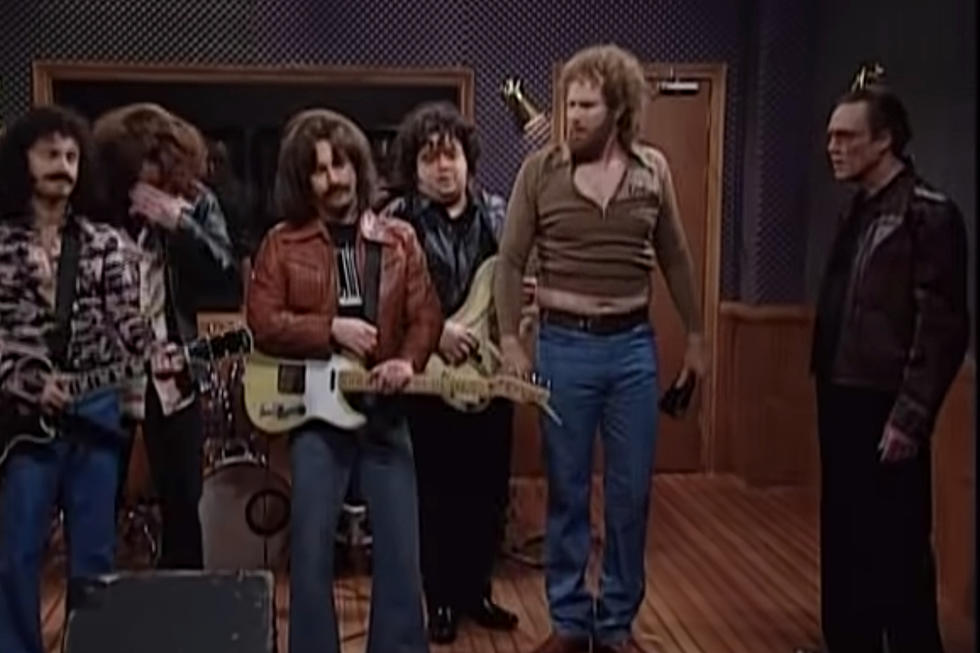
The More Cowbell skit follows a documentary style recording session of “Don’t Fear the Reaper” with Ferrell in the role of a fictional cowbellier “Gene Frenkle”. Walken played producer “The Bruce Dickinson” (not to be confused with Renaissance Man and Iron Maiden front man Bruce Dickinson). And the rest of the cast filled out the remaining band members by accurately portraying Blue Oyster Cult at the time of the original recording.

Ferrell’s tight clothes and overzealous cowbell, Walken’s deadpan delivery, and the fact that the rest of the cast can’t keep from laughing made More Cowbell an instant fan favorite. The best SNL skits in its history are the ones where it’s obvious the cast is having fun on stage, and More Cowbell tops that list. If you watch the non-speaking cast they can’t keep a straight face, and several seamlessly switch from laughing to their speaking parts, well, except for Jimmy Fallon…

Christopher Walken, a veteran of dozens of serious movies like The Deer Hunter, The Prophesy, Biloxi Blues, and Pulp Fiction, credited Ferrell with “ruining my life”. “All everyone wants is More Cowbell,” said Christopher Walken with a slight smile, according to Wil Ferrell in November 2019. “The other day I went for an Italian food lunch and the waiter asked if I wanted more cowbell with my pasta Bolognese” Blue Oyster Cult members credited Walken and Farrell with “sabotaging” the song previously well known for its creepy tone and serious subject matter, though the band members were excited of their song’s new status in American pop culture.

Twenty years ago Walken’s gave his legendary line, “I’ve got a fever. And the only prescription is… more cowbell”

You know you said it in his voice. The world could use a little more cowbell, baby.

The Cambodian Civil War and The Killing Fields

After being replaced in power by a soft coup in 1967, the Soviet faction inside North Vietnam led by Võ Nguyên Giáp was forced to watch impotently as the Chinese faction prepared to engage in large scale battles against the US, Allied, and South Vietnamese units. Led by Le Duan, the Chinese faction believed that the Americans could be beaten by large scale pitched battles, just as the French had been defeated the decade before, not through guerilla warfare as Giap proposed. Though a political victory in the United States for the Communists, the General Offensive/General Uprising, aka the Tet Offensive of 1968, was a complete disaster for the North Vietnamese and their Viet Cong allies in South Vietnam. The Tet Offensive thoroughly discredited the Chinese faction. Giap returned to power.

Throughout the late 60s, Prince Sihanouk of Cambodia believed in inevitable Chinese Communist domination of the Indochinese peninsula and was firmly allied with the Chinese faction in North Vietnam. Cambodia was all but a formal North Vietnamese and Chinese ally. Eastern Cambodia was essentially a North Vietnamese colony with the Ho Chi Minh trail and large areas along the border of South Vietnam under PAVN’s (People’s Army of North Vietnam) control. Soviet and Eastern Bloc ships routinely used Cambodian ports, and most of Cambodia’s rice harvest went to PAVN troops. The Cambodian Communists, the Khmer Rouge (Red Khmer) were a small indigenous guerilla auxiliary of the PAVN.

By 1969, Sihanouk was caught up in complicated plots while attempting placate all sides in the conflict. Cambodia’s support for the Vietnamese communists was one sided and destroying Cambodia’s economy. Sihanouk thoroughly supported the Chinese faction and had purged most urban i.e. Soviet supporting communists from the country. In 1970, Cambodian nationalists overthrew Sihanouk when they felt he wasn’t going far enough to restore Cambodian autonomy from Vietnam. The coup created an unholy alliance between the Sihanouk monarchists, the discredited Chinese faction of the PAVN, intellectuals outside the capital of Phnom Penh, and the agrarian peasants of the Khmer Rouge led by the unassuming and nondescript Pol Pot, to oppose the pro US Khmer Republic.

As Giap reconsolidated his hold on the PAVN in the wake of the Tet Offensive, the PAVN and the Khmer Rouge launched an offensive into north eastern Cambodian to continue the Maoist struggle against the Khmer Republic. In 1972, when Giap and the Soviet faction finally regained control of North Vietnamese leadership, the Khmer Rouge, like a petulant teenager who ran away from his parents, broke with their Vietnamese socialist brothers, and sought direct support from the Chinese Communist Party. By the end of 1973, all Sihanouk loyalists were purged. The agrarian-intellectual Khmer Rouge was greatly expanded by support from Mao Zedong’s CCP. The Khmer Rouge became the dominant force in the war against the Khmer Republic and Pol Pot the most powerful man in Cambodia.

Pol Pot was the General Secretary of the Communist Party of Kampuchea (CPK), the official name of the Khmer Rouge, since 1963. Known “First Brother” to his socialist allies, Pol Pot was born in French Cambodia and an early French Communist. Pol Pot patterned the Khmer Rouge on the secretive French Maquis in the Second World War and Maoist agrarian socialism, combined with a Cambodian cultural distinctiveness. Pol Pot exploited the Khmer cultural divides between urban and rural, Heaven and Hell, civilization and the wild to create an indisputable boundary between the Khmer Rouge and its enemies, whomever they may be. Sihanouk’s purge of Soviet communists i.e the proletariat, in Phnom Penh left no place in the Khmer Rouge for industrial workers, just an ideal of happy and ignorant peasants lorded over by their supposedly intellectual superiors. Pol Pot’s ideology was especially effective on teenagers and younger children. Hundreds of thousands of Khmer children were indoctrinated and desensitized to violence. They were given power of life and death which their developing minds were incapable of handling. The CPK controlled areas were “Lord of the Flies” on an exponential scale. Pol Pot’s volatile political concoction led to an ideological violence seen only in the darkest depths of socialist and pseudo religious identity politics.

With declining support from America, the Khmer Republic declared a unilateral ceasefire with the Khmer Rouge when the United States signed the Paris Peace Accords with North Vietnam. Pol Pot and the Khmer Rouge saw no reason to abide by the terms. Throughout 1973 and 1974, they launched continuous offensives that eventually took them to the gates of Phnom Penh, the “Pearl of Asia”. After a yearlong siege, Phnom Penh fell to Pol Pot and the Khmer Rouge on 17 April 1975, just a few days before Saigon fell to the North Vietnamese.

The Khmer Rouge’s popular slogan at the time was “The Rotten Must Be Purged”. They killed anyone that did not fit their ideal. These included:

-Anyone associated with the former Cambodian government, their extended families and neighbors.
-Anyone with foreign connections or even knew the basics of a foreign language.
-Intellectuals. The Khmer definition “intellectual” included students who did not drop out of school to fight for them, anyone who could read, anyone who owned a book, or even anyone who wore glasses.
-The sick and infirm, and any caretakers.
-Anyone who owned a business or employed people.
-Anyone who displayed any signs whatsoever of individualism.
-Anyone who resisted, did not support the party, or offended a member of the party.

The punishment for being an enemy of Pol Pot and the Khmer Rouge was swift, brutal, and agonizing.

The Khmer Rouge forcefully evacuated all three million residents of the city. Phnom Penh went from bustling metropolis to ghost town in less than a month. What was left of the population of the city went on a weeks long Death March into the Cambodian countryside. Anyone who stopped moving or fell out of the march was killed. Way stops became torture centers. The Khmer Rouge played god with people’s lives just because they could. Once there they were used as slave labor on the collective farms.

20,000 mass grave sites were later identified, results of Khmer Rouge’s capture of Phnom Penh in 1975, the subsequent Death March, and the atrocities born from forced collectivization. At least 1.7 million Cambodians were murdered during Pol Pot’s and the Khmer Rouge’s Chinese sponsored reign in Cambodia.

Cambodian journalist Dith Pran coined the term “Killing Fields” to describe the clusters of skeletons and corpses he encountered on his forty mile journey during his escape from Cambodia in 1978.

Paul Revere’s First Ride

On 14 April, 1775, the military governor of Massachusetts, British Army General Thomas Gage received instructions to seize members of the Massachusetts’s Provincial Assembly, disarm minuteman militias, and arrest prominent Sons of Liberty leaders known to be hiding in the countryside outside of Boston. Gage had on several occasions already attempted to seize American militia stores and forcibly disband American militias, but this was the first time he had received specific instructions from London to do so. Originally written in January, the instructions authorized Gage to break up the illegal provincial assembly and arrest its members, even its loyalist members. However, every Massachusetts town had its own militia. Isolated, these were not too much of an issue since he assumed they would never fire on British regulars. Together though, they could form a rebel army that could possibly challenge his command in Boston. To form this army, the rebels would need vast stores of powder, supplies, and cannon. British spies reported that the rebels were amassing exactly that at Concord, about twenty miles west of Boston.

Concord was a crossroads town a day’s ride from the city that connected towns west, northwest, and southwest to Boston. It was a natural meeting place for the rebels to coordinate their activity and stores arms and equipment for future use. Due to the hostility of the American populace in the countryside, Gage didn’t want to have his men overnight outside of Boston. Seizing the stores at Concord was the first step in neutralizing the countryside long enough to seize the members of the provincial council. Concord was twenty miles away, a one day’s forced march and back for good troops, but only just. On the morning of the 15th, Gage relieved the light and grenadier companies of each of his regiments, the best troops he had, of all upcoming duties “til further orders”. This tipped off American spies who immediately sent word to rebel leaders of an impending British advance into the countryside. Concord was the obvious target.

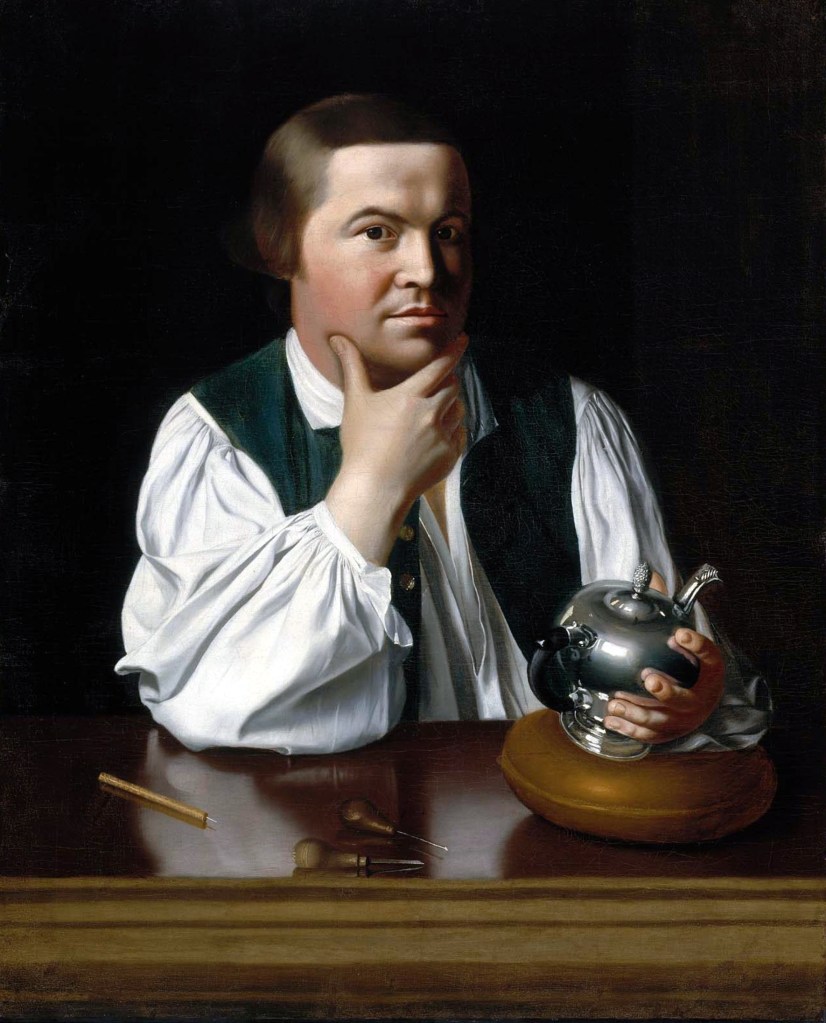
On the night of 15 April, Paul Revere, a silversmith and engraver and a courier for the Son’s of Liberty Committee of Public Safety in Boston set off to warn the American rebels. He stopped first at Lexington where Samuel Adams and John Hancock were hiding in the parsonage to warn them of the impending British attempt to arrest them. Revere then proceeded to Concord where he warned its leaders that the British were coming to seize the rebel stockpile. Revere then turned around and headed home to Boston. On the way back, he stopped at Charlestown. There he coordinated with the local patriots a lantern signaling system in the Old North Church, whose belfry was the tallest in Boston. When the British operation began, one lantern would signal the British were marching across the Neck to Roxbury, two if they were moving by boat to Cambridge or Charlestown.

At Concord, Revere’s message set off a flurry of activity. Since the stores of weapons, equipment, cannon, and powder were scattered in fields, swamps, cellars, barns, attics, and yards of the town, moving the stores would take some time. On the 16th the residents of Concord began a frenzy of digging and uncovering, then dragging and moving the stores to towns further away from Boston.

The Ship That Would Not Die

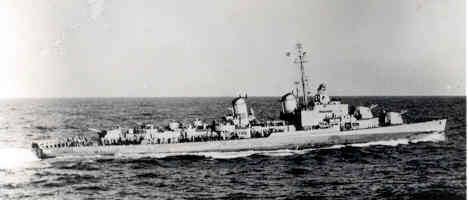
On the morning of 16 April 1945, US Sumner class destroyer DD-724, the USS Laffey, was assigned the most dangerous job in the US Navy: radar picket for the Fifth Fleet off of Okinawa. The USS Laffey was expected to identify Japanese air attacks originating from the Japanese Home Islands and direct American fighters to intercept. The problem was that many Kamikaze attacked the first American ships they saw, which invariably were the radar pickets.

Just after dawn while most men were in breakfast chow line, the first Japanese bomber was spotted radar and the crew raced to battlestations. The single D3A Val divebomber with its distinctive fixed landing gear retreated from the Laffey’s anti-aircraft fire. An obvious scout, the Val was a harbinger for the hell about to descend on the Laffey.

At 0825, the Laffey identified a large raid of 320 Japanese aircraft. They directed the fighters to intercept. At 0830, four Val divebombers attacked. Twelve minutes later, 50 planes broke off from the main formation to attack the Laffey, including 22 Kamikaze. The Laffey had just four older FM2 Wildcat Fighters from the escort carrier USS Shamrock Bay flying top cover.

The captain, Commander Frederick Becton, ordered the Laffey to flank speed while the helmsman made frequent radical course corrections to disorient the attacking Japanese. The first Kamikaze hit started a fire that the flank speed exacerbated. Becton slowed the ship down to contain the flames, but this just convinced the Japanese that the Laffey was crippled and ready to sink. After several more strikes, Becton increased the speed and the crew fought the flames, flooding, and Japanese simultaneously.

The Laffey, the four Wildcats, and eventually twelve F4U Corsair fighters desperately fought off the Japanese attacks for over 80 minutes. In that time, the Laffey took serious damage: she was hit by six Kamikaze, four bombs, strafed three times, and was even clipped by a Corsair whose daring pilot prevented an attacking Val dive bomber from slamming into the bridge. By 1030, the Laffey was on fire and out of ammunition, listing to port, and the stern was almost underwater due to flooding. She had all of her 5” guns knocked out, half of her 20mm and 40mm AA mounts destroyed, all of her masts knocked down, and the American flag hung off of a makeshift pole.

When asked if they should abandon ship, Becton replied, “No! I’ll never abandon ship as long as a single gun will fire.” He did not hear a nearby lookout who said under his breath, “And if I can find one man to fire it…”

At 1033, 24 more Corsairs and F6F Hellcats arrived and shot down the last of the attackers to much jubilation from the remaining crew. The USS Laffey suffered 32 dead and 71 wounded in two hours of fighting.

The USS Laffey is now a museum ship off of Patriots Point, outside of Charleston, South Carolina.

The Liberation of Bergen-Belsen

Rumors about the extent and horrors of German concentration camps had been circling among the Allies for about two weeks, mostly from news stories about the Soviet discovery of Auschwitz-Birkenau camp system, and the American liberation of the camp at Buchenwald on 4 April. On 15 April 1945, the British 11th Armored Division became the next initiates into the horrific and insanity inducing fraternity of soldiers who first discovered a National Socialist concentration and extermination camp when they liberated the camps at Bergen-Belsen.

The camp at Bergen-Belsen was originally a Wehrmacht prisoner of war camp, and an exchange camp where Jewish civilians were held so they could be traded for German prisoners of war captured by the Allies. About 50,000 Jews, Polish and Russian pows died in the overcrowded camps before Bergen-Belsen was turned over to the SS in 1943. After the Wannasee Conference, Bergen-Belsen was expanded into concentration and extermination camps. Jews from across the Third Reich were sent Bergen-Belsen based on their potential ransom. The Jews were either exchanged for prisoners or sold to Allied and neutral nations for hard currency. Jews that didn’t sell quickly enough or got sick were shot. As the Russian armies closed in from the east, prisoners from the camps in Poland were sent west and many ended up in Bergen-Belsen.

By 1945 disease was rampant. Typhus, tuberculosis, typhoid, and dysentery ravaged the overcrowded camps. Anne Frank died of typhus at Bergen-Belsen in February 1945. On 11 April the typhus outbreak was so bad the SS created an exclusion zone around the camps and handed them over to British without a fight. Unfortunately, the peaceful transfer of the camps enabled time for the National Socialists to destroy the very meticulous records of their atrocities.

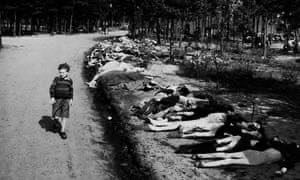
When the Brits arrived on 15 April 1945, they found 64,000 half starved and sick prisoners in camps designed to hold 10,000. They also found 19,000 unburied corpses. The captives had not eaten for days and madness and chaos engulfed the camps. The British troops restored order and trucked in food, water, and medical supplies and personnel to deal with the survivors. Medical specialists were flown in from Britain to assist. Despite their best efforts, about 500 prisoners died everyday for next the few months, mostly from disease. One of the last Luftwaffe attacks of the war occurred at Bergen-Belsen on 20 April which killed three British medical orderlies and several dozen prisoners.

The British forced the camp staff and civilians from nearby Celle to bury the dead. Correctly assuming that future generations would deny the Holocaust and National Socialist atrocities, the British command documented the Bergen-Belsen camps. No. 5 Army Film and Photographic Unit (like todays combat camera detachments) thoroughly covered Bergen-Belsen and interviewed as many survivors and liberators as possible.

The madness inducing pictures and recordings are available on the Imperial War Museum’s website.

The camps at Bergen-Belsen were so thoroughly riddled with disease that the camps were completely evacuated in August and burnt to the ground to prevent further spread. In the end, about 100,000 prisoners died at Bergen-Belsen from torture, medical experiments, disease, malnutrition, or execution, including about 14,000 after it was liberated, most to disease or complications in feeding.

The Battle of Formigny and the End of The Hundred Years’ War

After the Battle of Hastings in 1066, Duke William of Normandy gained the English Crown and became King William of England, aka William the Conqueror. This technically made the King of England a vassal of the King of France. However, England under the House of Plantagenet was considerably more powerful than France under the House of Capet. This was particularly true when England added Gascony, Anjou, Aquitaine (basically all of western France) and parts of Ireland, Scotland and Wales, (and allied to Burgundy) to become the Angevin Empire in the 12th century. (Angevin because it was ruled by the royal line of Anjou of whom King Richard the Lionheart was its most famous member). The Capetian Kings of France wouldn’t stand for it and made it their mission over the next 250 years to enlarge the Kingdom of France at the expense of the Angevin Empire and the Kingdom of England. This led to the Hundred Years’ War in the 14th and 15th Centuries.

The first 91 years of the Hundred Years’ War: The naval battle of Sluys, chevauchee, knights, longbows, the Black Prince, the Dauphin, Battle of Crecy, the Black Death, Battle of Portiers, the Black Death, King Henry V, St Crispin’s Day, Battle of Agincourt, and the English declare victory.

The next 21 years: Joan of Arc, Siege of Orleans, The Sudden but Inevitable Betrayal by Burgundy, and the English lose everything except Normandy and a toehold in Gascony.

Toward the end of the war in 1449, King Charles VII of France violated the Treaty of Tours and invaded the last significant English possession on continental Europe, Normandy. The English gathered a small army and in March 1450 crossed the channel. The English army was mostly yeoman archers, which is how they won most of their battles in the last 100 years.

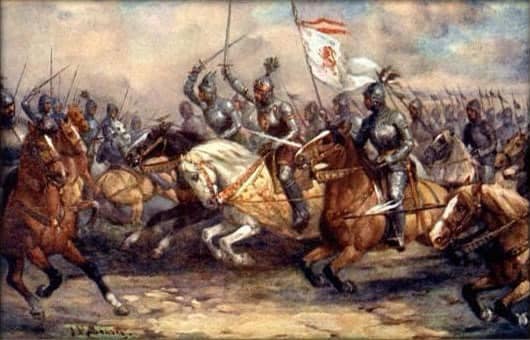
However, this time the French maneuvered them into a position where they could be attacked on three sides, so the English and Welsh bowmen could not concentrate their fire. The low number of heavily armed and armored knights and men-at-arms couldn’t adequately protect the the lightly armored archers. On 15 April 1450, the French knights, professional men at arms, and mercenary companies handily overran the English outside of the town of Formigny, on the road between Caen and Bayeux. As a result of the battle, all of Normandy except Calais would be ceded to the Kingdom of France, and effectively ended the Hundred Years’ War.

The formal peace treaty was not signed for another 20 years, but after the Battle of Formigny, the English no longer sought territorial possessions on the continent and turned their attention to the sea.

Operation Babylift

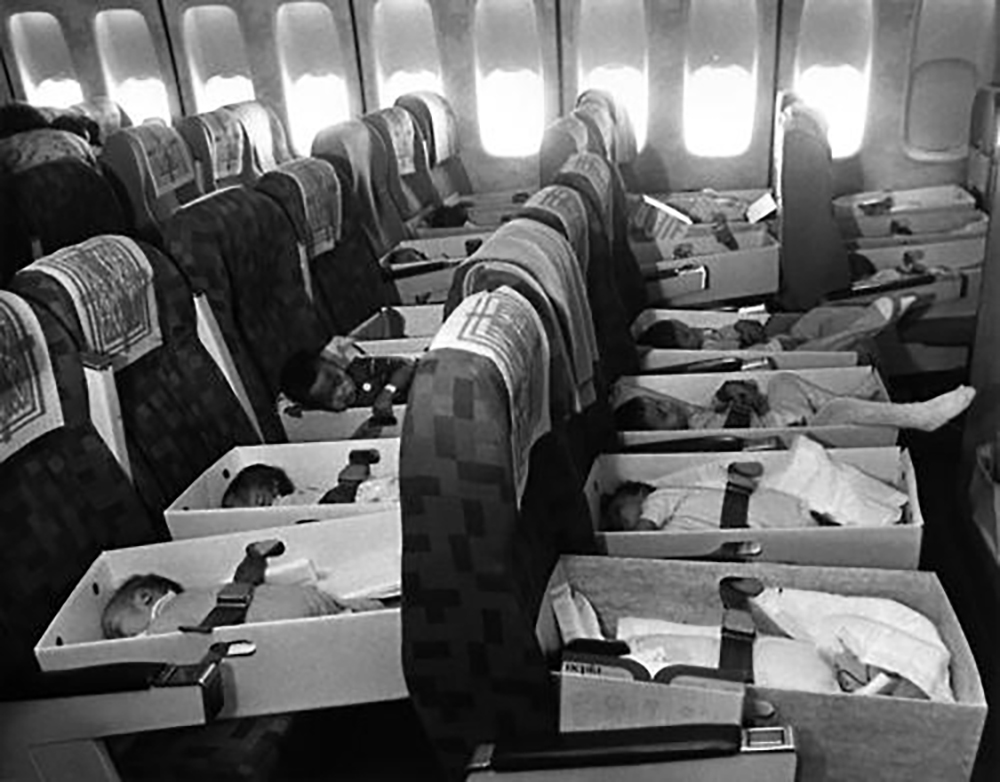
In January 1975, the United States Congress refused to further fund the war in South Vietnam. Emboldened by America’s refusal to assist its ally, Communist North Vietnam launched the Ho Chi Minh campaign, a massive conventional invasion of South Vietnam. On 3 April 1975, the first shells from communist artillery slammed into South Vietnam’s capital, Saigon. The next day, President Gerald Ford authorized Operation Babylift to evacuate Vietnamese orphans from South Vietnam to prevent them from abuse, exploitation, and/or murder at the hands of the oncoming North Vietnamese troops.

Operation Babylift got off to an inauspicious start. On 4 April, a C-5A Galaxy crashed twelve minutes after takeoff from Tan Son Nhut airport when an unknown explosion rocked the rear of the aircraft. The first sortie of Operation Babylift killed 138 people, including 35 Saigon embassy personnel and 70 children. Nonetheless, Operation Babylift continued in coordination with international and Catholic non-governmental organizations.

The number of orphans vastly outweighed the capacity of the military transport planes assigned to the operation. When American businessman Bob Macauley heard it was going to take more than a week to evacuate the children, he sold his house and chartered a World Airways 737 to assist the US Air Force. Over the next ten days, Operation Babylift evacuated 3300 Vietnamese orphans to Guam or the Philippines. There they joined the nearly 130,000 Vietnamese refugees who had previously fled the communists.

The 3300 Operation Babylift evacuees found foster homes in the United States, Australia, France, Canada, and West Germany after the war.

The Demise of U-1206

By 1945, the Battle of the Atlantic was won by the Allies. However the Germans clung to the hope that wonder weapons and superior technology could somehow turn the tide. U-1206 was a brand new Type VIIC boat that could travel faster and stay submerged longer than U-boats before it.

Part of the reason U-1206 could stay submerged for long times was the toilet system. Unlike Allied submarines where human waste went into a holding tank, waste on German U-boats was flushed directly into the sea. The lack of a holding tank allowed more space for other critical necessities, like fuel and batteries. This also meant that the waste couldn’t be flushed out while submerged too deeply, an unfortunate olfactory situation for a submarine if it was submerged for too long. The Type VIIC boats fixed this problem, not with a holding tank, but a complicated high pressure valve system that permitted a crew member to flush while deeply submerged. The valve system was so complicated that “Toilet Specialists” were needed to operate it.

On 14 April 1945, the captain of U-1206 was taking his daily constitutional while submerged off Scotland. He didn’t want to bother the toilet specialist to flush, so he broke out the manual to do it himself. In the process, he stuffed up the toilet. Swallowing his pride, but not too much, he called the boat’s engineer to fix the problem instead of the junior ranking toilet specialist. While trying to unplug the toilet, the boat’s engineer opened the wrong valve and seawater flooded into the boat. The water eventually reached the boat’s batteries and the chemical reaction caused a cloud of chlorine gas. The crew brought the boat to the surface so they could open the hatches to air the gas out. While on the surface, U-1206 was promptly sunk by the RAF.

The Katyn Massacres

In accordance with the Molotov-Ribbentrop Pact, National Socialist Germany and the Union of Soviet Socialist Republics invaded and divided Poland in September 1939 as de facto allies. After a chaotic winter stabilizing eastern Poland (Western Belarus and western Ukraine today), the Soviet Union began an organized and deliberate campaign to ethnically cleanse Poles from its conquered territory. In early 1940, the NKVD (the Soviet secret police, the forerunner of the KGB) was holding over 500,000 Polish prisoners. On 5 March 1940, Laventry Beria, the head of the NKVD proposed the execution of all possible Polish leadership in captivity. The execution order extended to any person formerly of the Polish Army officer corps and any civilian leadership, including anyone who showed any signs of leadership ability. The proposal was approved by the Soviet Politburo and Josef Stalin.

Starting 3 April 1940, hundreds of Polish Army officers, government workers, land owners, school teachers, university professors, police officers, “intelligence agents”, lawyers, scientists, Polish Jews, factory managers, writers and publishers, business owners, Boy scouts and scoutmasters, and priests and clergy were murdered every night in their camps. The subject was usually grabbed from a prison gathering, had his or her credentials checked against a list of undesirables, led to a cell lined with sandbags, forced to kneel, and then shot in the back of the head or neck. The shots were muffled by the sandbags and the use of machinery and fans to prevent rioting among the prisoners. The executions were usually carried out using .25 ACP Walter Model 2 pistols obtained from Germany through prewar trade deals. Since the Walter Model 2 had significantly less recoil than the Russian made 7.62 Nagant M1895 revolvers in Soviet service at the time, more executions could be made in less time. Soviet executioners found that the Nagant’s recoil began to make executions difficult after the first dozen; there was no such problem with the smaller, but equally effective round of the Walter. The executions were carried out in camps all over Western Russia, Eastern Poland, Belarus, and Ukraine. The corpses were carried onto trucks and then taken to mass graves deep in the forest.

In June 1941, National Socialist Germany stabbed its erstwhile ally in the back and invaded the Soviet Union. In late 1942, captive Polish railroad workers heard from locals that mass graves of Polish soldiers were located in the Katyn Forest. A few months later, a German intelligence officer became aware of the rumor and had it investigated. A mass grave filled with 3000 bodies was discovered on Goat Hill in the Katyn Forest. Further investigation found more mass graves in the area, totaling more than 22,000 bodies. Nazi propaganda minister Josef Goebbels seized upon the discovery to show “the horrors of Bolshevism and Anglo-American subservience to it”. The European Red Cross formed the “Katyn Commission” of forensic experts, neutral journalists, and Allied prisoners of war, who were brought in to observe to investigations and excavations. The Soviets denied the accusation that they were responsible. After the Soviets overran the sites in 1943, the London based Polish Government-in-Exile asked Stalin to investigate. Stalin immediately broke off relations with the Poles and accused them of being Nazi collaborators.

With the Soviet Union bearing the brunt of the fighting against Nazi Germany, the United States and Britain accepted the official Soviet explanation that the mass graves were Polish construction workers murdered by the Nazis in 1941. President Roosevelt had his own commission look into the massacre and when it came back conclusively that the Soviets were responsible, Roosevelt ordered the report destroyed and the lead investigator exiled to American Samoa for the rest of the war. The Soviets denied responsibly until 1990. After the Cold War, about a dozen sites similar to the one in Katy Forest were identified, a testament to the extent of the murders of Polish leadership by the Soviet Union in 1940.

On 10 April 2010, Polish Prime Minister Lech Kaczyński, his wife, and Poland’s top military and political figures flew to Smolensk, Russia to attend the 70th anniversary memorial ceremony of the Katyn Massacre. On approach to the Smolensk airport, their plane crashed and everyone on board was killed. Russian Prime Minister Vladimir Putin was put in charge of the investigation and he concluded “pilot error”. Poland disputes the findings. As of April 2020, Russia has yet to turn over any evidence, including the plane’s wreckage and black boxes, for independent Polish or international investigation.

Operation Weserubung: The Invasions of Denmark and Norway

During the “Phony War” between the Western Allies and Germany in 1939 and early 1940, both sides eyed Norway as a potential area of operations. The Allies wanted to cut off Germany’s supply of Swedish iron ore that was shipped thru the Norwegian port of Narvik, and ship arms and supplies to Finland who was at war with Germany’s de facto ally, the Soviet Union. (Finland surrendered in March before the plan came to fruition) Germany wanted to use Norway’s fjords for U-boat bases, and use airfields on the Norwegian Sea to secure the iron ore shipments. In early April 1940, both sides struck near simultaneously but where Allied operations (and the Norwegian response) were characterized by confusion and timidity, the German attack was characterized by decisiveness and audacity.

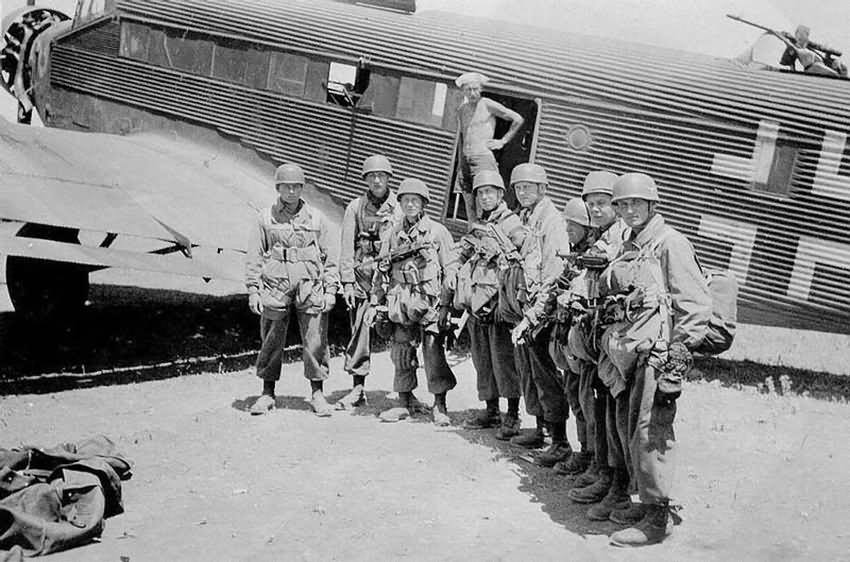
In the early hours of 9 April, 1940, two hundred German transport planes approached the various Scandinavian coasts. Each of the distinctive three engine Ju-52s carried a “stick” of 18 German Fallshirmjaeger (paratroopers) and a canister containing their weapons and ammunition (The Germans jumped unarmed and retrieved their weapons on the ground). The lightly armed paratroopers had to hold out against a possible overwhelming Allied response before any help could arrive by troops carried by the Kriegsmarine (German Navy) The fallshimjaegers’ vital mission was to seize five airfields that constituted the all-important initial objectives for the first contested airborne operation in history: Operation Weserubung.

Operation Weserubung was the German codename for the invasions of Norway and Denmark. It was a complicated and flawed, but tenaciously executed joint, interagency, and multinational (well, two anyway) surprise attack that had little reason to succeed, and every reason to fail. It required independent simultaneous successful actions against a series of linear unsupportive but logistically connected objectives. The plan required airborne troops to seize airfields for future Luftwaffe dominance of the sky. Simultaneously and underneath the nose of the British Home Fleet at Scapa Flow, the Kriegsmarine landed troop at five spread out target cities along the Norwegian Atlantic coast. Due to troop transport shortages, the ground troops available were woefully understrength for the tasks assigned to them. A serious failure at any point would have caused the failure of the entire operation. However, German diplomatic and informational efforts more than made up for the troop shortfall.

During the military attack, the German Foreign Ministry convincingly continued to negotiate with the Norwegians and prevented a timely full mobilization. Additionally Norwegian fascists under Vidkun Quisling sabotaged any response and assisted from within their socialist cousins from the south. Fortunately for the Germans, individual initiative from their junior officers mitigated any temporary Allied successes, and most importantly, Allied indecisiveness assured German victory.

The Allied invasion fleet was actually off of Narvik on 9 April but was recalled to Scotland in order to not offend the Norwegians, despite reports of German planes and ships nearby. It was turned around and sent back five days later. Unfortunately for the Norwegians, this five day delay meant any Allied assistance arrived long after they could be used to attack the vulnerable German enclaves in the southern portion of the country. Through dishonest and duplicitous negotiations, the Nazi Foreign Ministry prevented a full mobilization of the Norwegian Army. The Norwegian delgation continued to negotiate in good faith for days, all the way up until Gestapo agents arrested them. Furthermore, the Quislings in the government, particularly the bureaucracy, prevented the partial mobilization from being carried out efficiently. Instead of two days, it took a week for the Norwegian Army to mobilize. By then it was too late and air landed German troops poured into the country through the secured airfields.

The only Allied successes in the first few days were at sea. On the night of 9 April, five British destroyers attacked and scattered the German’s Narvik invasion force, whose ships were then hunted down and sunk by a larger task force centered on the battleship HMS Warspite. In the south, the Oslo Invasion Force but halted by Norwegian cannon protecting the entrance to the fjord, which allowed time for the Norwegian royal family, the parliament, and the treasury to escape capture. But the captain in charge of the German embassy’s security, on his own initiative, commandeered a few Norwegian Army trucks and a company of German paratroopers, and chased the Norwegian decision makers out of the country, which further delayed Norway’s response to the German invasion.

90% of German objectives were seized within 24 hours, if tenuously. Denmark fell in six hours. But even with the German’s amazing initial successes, the British, French, Polish and Norwegian troops resisted and even advanced over the next two months, especially around Narvik. It took the fall of France in June and the impending invasion of Britain for the Allies to evacuate their troops and finally surrender Norway.

The only positive outcome for the Allies was the near total annihilation of all of Germany’s destroyers and troop transports in the two months of battles against the Allied navies in the North and Norwegian Seas. Their loss forced Germany to require total control of the air over the English Channel to compensate for the lack of escorts for the slow invasion barges destined for Operation Sealion, the invasion of Great Britain.