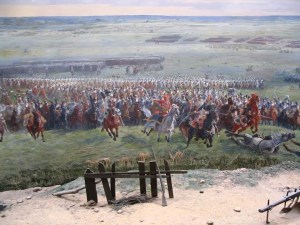
The Battles of Connecticut Farms and Springfield

Washington described his time at the Continental Army’s encampment at Morristown, New Jersey from 1779 to 1780, as “The Hard Winter”. American logistics had broken down, so the Continental Congress abdicated their responsibility and told the states to supply their own troops. Many troops went weeks without seeing meat or bread, sometimes days without seeing anything at all. Washington resorted to foraging the countryside to prevent his army from starving to death. The weather was colder than the winter at Valley Forge, with 23 major snow storms, including one that dumped four feet of snow on the encampment. Of the 12,000 Continental soldiers that entered winter quarters at Morristown in December 1779, 4000 had deserted by June, and of the remainder, 1/3 were unfit for duty.

British General Henry Clinton, whose troops were snug in New York City for the harsh winter, sought to take advantage of the Continental Army’s weakness. With the focus of the war moving elsewhere, the Southern colonies and the Caribbean for instance, Clinton surmised that he had one last shot at Washington, before other theaters made demands on his resources in New York. Washington, however, did not choose Morristown for its amenities, but for its tactically and operationally favorable position.

The encampment at Morristown was close enough to bottle up the British in New York but far enough away to permit Washington some reaction time when Clinton sortied. Furthermore, the only approach was via Newark Bay, and Morristown was screened from any landing there by the Great Swamp and Watchung Mountains. Any British landing force would have to make an amphibious landing in marshland, then a long approach march through hostile New Jersey countryside only to force one of the passes through the mountains just to fight a battle on the other side in constricted terrain against a dug in enemy under proven leadership. Clinton sent the Hessians.

In early June, 1780, Hessian General Baron Wilhelm von Knyphausen took the cream of Clinton’s army and crossed from Staten Island to bring Washington to battle. Knyphausen’s army consisted of the best of the Prussian regiments, the British Guards regiments, the Highlanders, the Royal Artillery, dragoons, the Queen’s Rangers, and two regiments of New Jersey Loyalists. Knyphausen’s 6000 men were thought to be more than enough to defeat Washington’s famished and mutiny wracked army.

On 7 June 1780, Knyphausen’s army landed at Elizabethtown Point in New Jersey. He planned on making the 11 mile march to Hobart Pass and be through the mountains before Washington could react. It was not to be. Knyphausen was spotted and the cry went up throughout New Jersey, not unlike Lexington and Concord five years before. A brigade of New Jersey militia formed at Springfield on the near side of Hobart Pass. Knyphausen met them at the small hamlet of Connecticut Farms just outside Springfield.

Stiffened by the presence of Washington and his personal guard, the militiamen made the British and Hessians pay for every foot they moved forward. They turned every house into a fortress, and every tree into a firing position. Nonetheless, Knyphausen took the village, but could see even more Americans forming in the pass. Disorganized, and bit surprised at the strength of the resistance thus far, Knyphausen impotently burned Connecticut Farms to the ground, and withdrew back to Elizabethport.

Two weeks later, Knyphausen tried again, however he knew he’d never be able to force the pass. Washington would know within minutes of his assembling to march. Clinton devised a trap. This attempt was a feint to draw Washington into a battle to the west of the mountains. Knyphausen would again march on the Hobart Pass, this time with a diminished force, and engage the militia around Springfield. He’d be the bait. Washington had spent the entire war trying to bring the British to decisive battle on his terms, and Clinton planned to give him one. As the battle against Knyphausen was fought at Springfield, Clinton expected Washington to march around the British flank and cross the mountains west of Newark. Clinton would then destroy him with a strong reserve as Knyphausen quickly disengaged from Springfield and turned on Washington. On 23 June 1780, Knyphausen marched on Hobart Pass. But this time, he met not only a horde of New Jersey militia, but also Continentals under Nathaniel Greene.

Greene had John Stark’s composite New England Brigade, “Light Horse” Harry Lee’s Legion, and William Maxwell’s New Jersey Brigade. Greene met Knyphausen at Elizebethtown, far forward of where the Hessian expected. Knyphausen attacked and Greene deftly withdrew fighting a running battle all the way back to Springfield. With Washington nowhere on the battlefield, Clinton and Knyphausen assumed their plan was working.

Washington knew of Clinton’s reserve, and had no intention of falling for the trap. The Continental Army was in no condition to attack in any case. The times were desperate, but not as desperate as they were when he pulled off the miracle at Trenton. The British were going to have to come to him. If Knyphausen wanted to make a fight of Springfield and Hobart Pass, Washington had Greene oblige.

Knyphausen fought up the Galloping Hill road toward Springfield, with Green fighting him every step of the way. The ruins of Connecticut Farms was an apt reminder to the New Jersey militia of what waited for their homes if the British won. At the bridge across the Rahway River, the Americans made a stand, and an artillery duel developed. When the Americans began to run out paper wadding, the Continental Army’s head chaplain, Reverend James Caldwell, who lost his wife in the Battle for Connecticut Farms, ran into Springfield and came back with box of hymnals. The hymnals were published by English clergyman Issac Watts. Caldwell and the gunners tore them up, and stuffed them in barrels with the cannon balls. The chaplain exclaimed, “Give’ em Watts, boys!”

The spirited defense of the Galloping Hills Bridge forced Knyphausen to send a column on the Vauxhall road to outflank the Americans. As the column got further away, it was threatened with being isolated and destroyed. The column eventually reconsolidated back on Galloping Hill road after its commander became concerned with the number of militia organizing on Newark Mountain and in the Short Hills, out in the open but just out of range. Fortunately for Knyphausen, the Queen’s Rangers found a ford and the British and Hessians crossed. Greene withdrew back into Springfield where again the Americans made the British, Hessians, and Loyalists fight for every building and street.

When Knyphausen was sufficiently bloodied, Greene pulled everyone back into the Hobart Pass, taunting his opponent to follow. But by late afternoon, it was obvious Clinton’s plan had failed and Washington wasn’t coming. Knyphausen called off the attack and declined to pursue. Clinton’s reserve was too far away to be of any use forcing the pass even if he wanted to, and there seemed to be thousands of additional American militia converging on the battlefield from all over northern New Jersey. Dead mercenaries can’t spend their pay.

In a last act of defiance, Knyphausen fired Springfield as he withdrew. He left only four buildings standing, because he was informed they belonged to Loyalists. All he did was signal to the Americans who the Loyalists were, so they just tore them down for building materials, completing the destruction of Springfield. Clinton withdrew his army back to Staten Island the next day.

The Battle of Springfield provided a significant boost to the flagging American morale after the disastrous winter. The destruction of Connecticut Farms and Springfield solidified American resolve against the British and proved an effective recruiting tool, not to mention increased the American population’s generosity towards supplying the Continental Army. The Battle of Springfield was the last major battle in the northern theater of the American Revolution. Greene’s experience in New Jersey — fighting, withdrawing, and fighting again, would come in useful when he was assigned to take command of the Southern Department later in the summer.
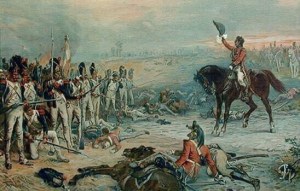
The Battle of Waterloo: The Final Assault by the Imperial Guard

Napoleon’s Imperial Guard was comprised of three groups and at the time of Waterloo, nearly 22,000 strong counting the Guard Cavalry (with Ney) and Guard Artillery (in the Grand Battery). They were the Young Guard, the Middle (Aged) Guard and the Old Guard. (The Old Guard are who most people are familiar with). The Young Guard were the pick of the litter of the 1810-1815 campaigns and draft classes, and those not good enough for the Middle Guard. The Middle Guard were the best veterans from Napoleon’s 1805 to 1809 campaigns. The Old Guard consisted of the best soldiers in Europe, and were veterans of most of Napoleon’s campaigns, from as far back as the Italian campaign in 1790s. The Imperial Guard, particularly the Old Guard, had better pay, better rations, and the most senior were permitted to fight in their dress uniforms (back when awards actually meant something). They never retreated and they never surrendered. Napoleon knew each guardsman by name. They were the only soldiers outside of the Marshals permitted to disagree with or even complain in front of Napoleon, thus earning them the nickname “Les Grognards”, “The Grumblers.”

Thirty minutes after Ney’s request for the Guard, and a personal inspection by Napoleon himself, the remainder of the Imperial Guard, the last uncommitted French troops, stepped off into the attack at 1930. But that thirty minutes proved fatal. In that time, Wellington was able to reorganize his lines and bring over troops from the now inconsequential fight at Hougamont, or units pinched out of the fight by the Prussian advance near Pappelote. Nonetheless, the Old Guard had never been committed unless victory was assured. When the other French troops saw them in the attack, a great hurrah echoed across the battlefield, and any troops not engaged at Hougamont or Plancenoit, surged forward. Stragglers, wounded, staff, the lost, and the remnants of shattered formations joined in the attack. Everyone wanted to be a part of the last glorious charge of the battle; the Old Guard was in the van.

The final assault by the Imperial Guard was not enough. The Guard were too few, and the reorganized Allied firepower and numbers too great. One Middle Guard battalion took 20% casualties from a single volley from a British line that popped up 25 feet in front of them. The second volley caused even more damage. The same resulted wherever the Guard met the line, but still they came on or engaged in furious point blank musketry exchanges.

In a curious historical irony, it wasn’t the renowned disciplined firepower of the British that first broke the Guard, but a Dutch brigade led by Gen David Henrik Chasse. Chasse had fought against Wellington at Talavera in 1809 as a subordinate of D’Erlon. Chasse’s troops did not exchange fire with the Guard like the British but crashed into them with their bayonets, and overwhelmed the Imperial Guard with superior numbers. Chasse’s target was the unit whom a French soldier said of, “La garde recule ! Sauve qui peut!” or “The Guard retreats, save yourself!” Within minutes the rest of the Middle Guard broke. Other French units watched in horror as the unthinkable happened: the Guard fell back. With the Guard and consequently the French morale broken, individual British, Belgian, Dutch and German units advanced, just as the Prussians emerged from Planceoit. Wellington, sensing the battle won and ever the politician, raised his hat and signaled the general attack, lest Blucher get the credit for the victory.

By 2050, the only French units not destroyed or in full rout were the two of the four most senior Old Guard regiments, the 1st and 2nd Chasseurs. They escorted Napoleon from the field and when he was safely on a carriage to Paris, they turned and fought. First in a line, and when they were out-flanked, a square. When casualties were so high they couldn’t maintain a square, they formed a triangle. Finally the Allies brought up cannon and threatened to finish them with a bayonet charge. Before they fired, a young German Osnabrucker, Sgt Conrad Fuerhing, asked their commander, Gen Pierre Cambronne, if he wanted to surrender. Victor Hugo wrote that he replied, “La Garde meurt, elle ne se rend pas!” or “The Guard dies, it does not surrender!” But what the hard drinking, hard fighting, tough as nails, soldiers’ general actually said was,

“Merde.”

In literal English, “s**t”. In the figurative,

“F**k off.”

The reply was an apt end to the Napoleonic Era.

The Battle of Waterloo: The Prussian Attack and the Fall of La Haye Sainte

Wellington got his wish, though while he was stuck in a square fending off Ney’s cavalry, he didn’t know it. Blucher kept his promise from the night before. Von Bulow’s IV Corps slammed into Lobau’s understrength corps at Plancenoit and D’Erlon was forced to commit much needed units to keep Zeiten’s I Corps from rolling up his flank. Furthermore, Napoleon had to commit part of his reserve just to stabilize the situation, the least senior battalions of his Imperial Guard, the Young Guard.

The Young Guard was part of Napoleon’s personal command, the Imperial Guard, and could only be committed by his own words. Despite their lack of seniority, the Young Guard were some of the best troops in Europe and temporarily checked the Prussians, but the fighting in Plancenoit was fierce. It was the reverse of Hougamont and La Haye Sainte with the French barricaded in the buildings and courtyards and is considered by most historians as the worst urban fighting of the Napoleonic Era. Just after 1800, Blucher paused his attack and began to reorganize for a final push.

At 1830, Maj Baring could no longer defend La Haye Sainte: his troops were out of ammunition. They had fired everything they brought, everything they were given, and everything they could scrounge. D’Erlon finally threw them out. At 1850, the nimble horse artillery batteries began to pound Wellington’s vulnerable squares from near point blank range and soon they were joined by the big guns from the Grand Battery. It was at this point the mounted Earl of Uxbridge approached the Duke of Wellington and just that moment a cannon ball took his leg. Completely unperturbed, he said,

“By God, Sir, I’ve lost my leg.”

The Duke coolly replied, “By God, sir, so you have.”

Despite the pounding the Allies were receiving, the Prussian attack, Baring’s defense, and six hours of near constant fighting severely depleted D’Erlon’s Corps. Moreover, a reformed Dutch brigade attempted to retake La Haye Sainte. Even worse Wellington reformed most of his men back into lines. D’Erlon would need more men to even attempt to break through. And he needed them ricky tick: the Prussians renewed their attack on Plancenoit at 1900 with the near assurance of quick victory, and the French artillery was almost out of ammunition.

After a personal inspection by Napoleon himself, the remainder of the Imperial Guard, the last uncommitted French troops, stepped off into the attack at 1930, 18 June, 1815.

The Battle of Waterloo: Ney’s Cavalry Charge.

By 1500, Lobau confirmed that the Prussians were only five miles away and would be in a position to attack in less than two hours. Napoleon was now on the clock. A Prussian appearance would destroy morale, so he quietly started the rumor that the troops to the east were Grouchy’s. This bit of “command disinformation” had to hold up until Grouchy did show up, or Ney broke Wellington’s weak point, his center, and La Haye Sainte was its key.

Around 1530, D’Erlon threw the full weight of his reformed corps at the tiny farm compound, but the French numbers worked against them and Major Baring’s troops held out. Again trying to make up for his previous failure, Ney had assembled 12,000 (one, two, plus three zeroes) French cavalry to support him once he struck the ridge. Ney was expecting D’Erlon to steamroll the farm. Meanwhile, the Grand Battery continued to pound the remainder of Wellington’s line, then completely exposed on the forward slope after the counterattack.

By 1600, the Grand Battery was inflicting serious damage on the Allied troops, so Wellington pulled everyone not engaged around La Haye Sainte back to the reverse slope. Cavalrymen in the best of times are an impatient lot, and the fiery Ney with thousands of his brothers were no exception. To the great mass of cavalrymen, it looked as if the Allies were retreating. A great cry went up, and unwilling to wait any further on D’Erlon, Ney ordered the charge. Napoleon was furious but could do nothing to stop the impetuous Ney. The cavalry surged forward and easily overran Wellington’s cannon. But as they crested the ridge they ran not into retreating columns, but dozens of hollow infantry squares.

The infantry square is a formation that provided all around protection against a cavalry attack and relies on simple animal instinct: a horse will not throw itself against a wall of sharp objects, in this case bayonets. All the cavalrymen could do was ride up or around and whack the bayonets with their sabres, or shoot the Allies with their carbines and pistols. The square is horribly vulnerable to cannon shot and infantry attack, but with D’Erlon occupied with the fight on the reverse slope, no square would be broken that day.

But that didn’t stop Ney from trying and he personally led many of the attacks. While rallying a group of cuirassiers, he yelled, “Come and see how a Marshal of France can die!” He had five horses shot out from underneath him but he survived. Still, Ney wouldn’t stop and the Allies were hard pressed. If La Haye Sainte or Hougamont fell, and that infantry came to Ney’s aid, the game was over.

Around 1730, Wellington, stuck in a square and oblivious to anything beyond it, kept looking at his watch and saying, “Give me night, or give me Blucher.”

The Battle of Waterloo: The Attack on the Center

At 1300, Napoleon’s artillery was finally in position, and the 80 guns of the “Grand Battery” opened on Wellington’s line. Napoleon, a former artillery officer (imagine that), had made a career of smashing a portion of an adversary’s line with cannon and then following the through the rupture with dense columns of infantry acting as a human battering ram. Wellington knew this and placed the majority of his troops on the reverse slope of the Mont St Jean ridge, which protected them from the worst, but not all, of the cannon fire. The casualties began to mount.

At 1320, D’Erlon’s I Corps stepped off on the long march through the wet wheat fields, and finally Wellington’s artillery returned fire. For the next 30 minutes, the Allied troops stoically stood in formation and took it, while the French slowly marched forward and took it. On both sides, whenever holes appeared in the line, men from the rear ranks stepped into them. About 1345 pm, Wellington, fully within range of Napoleon’s guns (most of his staff would be casualties by the end of the day), commented,

“Hard pounding, gentlemen. Let’s see who pounds the longest.”

D’Erlon’s Corps first encountered the walled farm at La Haye Sainte and detached 7000 troops to assault it, as the rest continued on. The farm was held by 700 line infantry of the King’s German Legion. King George III of Britain (yes, that one) was not actually English, but German; his other title was King George of Hannover. The King’s German Legion were soldiers who fled Hannover to Britain when Napoleon conquered it in 1803 and they formed some of Wellington’s best troops. Major Georg Baring and his battalion proved a thorn in D’Erlon’s side for the next six hours.

Weathering round shot, canister shot, double canister, rifle fire, and finally the renowned disciplined musket fusillade from British infantry, D’Erlon’s 17,000 strong columns struck the British lines at 1400. D’Erlon knew his enemy though, and he concentrated his heaviest attacks on the least reliable of Wellington’s troops, the Belgians and Dutch. Wellington acknowledged this weakness and interspersed British and German units to stiffen their lines (just as he had done on the peninsula with the Portuguese and Spanish). However, the Dutch were hastily mobilized for this campaign and many of the Belgians fought for Napoleon previously, some for over ten years. After just 15 minutes, their lines cracked and then broke.

The rout of Wellington’s Belgians and Dutch in the center was Napoleon’s high watermark of the battle. Had D’Erlon had more troops, from any source, to secure the breach and prepare for the inevitable counterattack, the battle would almost certainly have been over. But after the long march under fire and the furious fight on the ridge, D’Erlon’s men by themselves couldn’t withstand a determined counter attack. Around 1430, the top hat and great coat clad Sir Thomas Picton led the 5th Division in a counterattack. Soon after, the British heavy cavalry moved forward to exploit the highlanders’ assault. Just after Picton unleashed his highlanders, the Earl of Uxbridge released the Household Brigade and the Union Brigade against the French. With La Haye Saint Sainte still under Allied control, the French had nowhere to rally, and the British cavalry swept the D’Erlon’s men from the field. The British cavalry was only stopped by French lancers and cuirassiers in a countercharge. Some of the British horsemen made it all the way to the Grand Battery.

D’Erlon was furious. His first attack nearly successful, and he inquired Ney as to why he wasn’t supported. His men would be forced to make the same attack again. Their ordeal was for nothing. Where was the cavalry? Bad staff work had them too far from the breakthrough. Where was the Imperial Guard? Napoleon jealously guarded their use. Where was Lobau and VI Corps? They were investigating a body of troops spotted six miles to the east.

The east? Blucher had arrived.

The Battle of Waterloo: The Assault on Hougamont

On 18 June, 1815 Emperor Napoleon I of the French faced Arthur Wellesley, the Duke of Wellington, and his Anglo-Dutch-Belgian-German Army just south of the town of Mont St. Jean. Napoleon planned on attacking the Duke at 9 am, but heavy rains the night before prevented his artillery from getting into position in time and, in any case, the soggy ground would greatly reduce their effectiveness. So Napoleon issued his orders and waited for the ground to dry. As he waited, the very sick Napoleon took a nap. At 1130, Marshal Michel Ney, Napoleon’s commander on the ground, wanted to make up for his failure to be aggressive at Quatra Bras and grew impatient. He gave the order for General Reille’s II Corps to begin their attack on the walled chateaux of Hougamont in order to draw away some of Wellington’s reserves in preparation for the main attack on the center of the British line.

Wellington knew the importance of Hougamont, and sent his best unit to hold it: the Brigade of Guards, backed by the best of the King’s German Legion: the Nassau and Hannoverian jaegers (German for “hunters”), light infantry whose accurate rifles made every tree precious. But Reille threw almost the entire veteran 6th Infantry Division, led by Gen Jerome Napoleon, the Emperor’s little brother, along with the 9th Infantry Div, at Hougamont. After fierce fighting on the approach, the French reached the gates and walls of the compound. But the chateaux and courtyard itself were held by the senior regiment in the British Army, the Coldstream Guards, led by the indefatigable Lieutenant Colonel James MacDonald, and there was an impasse. But make no mistake – the brawl for Hougamont was a still bitterly contested swirling maelstrom of a melee, in which no side had an advantage.

That is until 1230, when a monster-of-a-man, Sous-Lieutenant Legros, of the 1st Legre of the 6th Division, physically hacked through the northwest gate at Hougamont with an axe he found in the orchard. Thirty Frenchmen managed to storm through, and the entire battle hung in the balance. But LieutCol MacDonald personally led a counterattack during which Captain Henry Wyndam and Corporal James Graham managed to shut the gate. The thirty Frenchmen were all bayoneted, including Lieut Legros. The only survivor was a young unnamed drummer boy, whom was saved by Pvt Mathew Clay, and escorted to the chapel.

Though he didn’t know it, Wellington’s first crisis had passed.

Although the fighting around Hougamont raged all day, Jerome and Reille would get no closer to capturing it than they did at 1230. In an ironic twist, the fight for the chateaux and orchard would occupy almost a quarter of Napoleon’s Army. Like the campaign in Spain, the supposed feint at Hougamont, was a bleeding ulcer for Napoleon that consumed men and leadership, much needed elsewhere on the battlefield at Waterloo.

The Battle of Waterloo: the Narrative

Today on the “bicentennial plus five” of one of the most famous battles in history, I am hoping to lay this one out for you like TA-50. Before we begin our journey, there is something you must understand first that is kind of a pet peeve of mine: the loss of context within the narrative. And the writers about the Battle of Waterloo are the worst at it.

The vast majority of non-scholarly work on the battle break it up into “The Five Great Acts of Waterloo”. They are:

-The Assault on Hougamont
-The French Attack in the Center
-Ney’s Cavalry Charge
-The Fall of La Haye Sainte and the Prussian Attack
-The Final Assault by the Imperial Guard

It is a readymade narrative that makes a great story. But it loses a bit of the scope of what was happening in those few square miles of fields, forests and buildings, between the Inn at LaBelle Alliance, Napoleon’s headquarters, and the “Butte du Lion”, “The Mound of the Lion”, the immortalized position where Wellington spent most of the battle. Many authors and film makers portray them sequentially, and I will be no different since I’m confined to my self-imposed limits of a blog post.

But they weren’t just sequential, they were sequential and then simultaneous. Think of a wave hitting a beach. The wave doesn’t actually hit the beach all at one time; it crests and rolls down the beach, as other waves follow behind it and strike where the first wave (and then second and then third…) had already subsided.

The Battle of Waterloo acts in the same way: Each act happened sequentially but each continued on throughout the day. The battle began with the assault on Hougamont, and after its initial failure the French began the attack on the center. But that doesn’t mean that the French gave up on Hougamont, the battle for the chateau and orchard continued all day, likewise with the attack in the center. This continued in a rising crescendo for more than eight hours until the climax of the battle, the final assault by the Napoleon’s Imperial Guard. It would be a disservice to everyone if you, gentle reader, thought that any single event was the only thing happening on the battlefield. Eight hours after the battle started, as Napoleon’s grenadiers were rockin their kickass bearskin caps forward, D’Erlon was still pushing from La Haye Sainte into Wellington’s center, Lobau was in the fight of his life against the Prussians at Plancenoit, Ney’s cavalry was still attempting to break squares, and poor Jerome was still feeding the meat grinder that was Hougamont.

The Battle of Bunker Hill

On 13 June 1775, Rebel spies learned of a British plan to sortie out of Boston and break the American siege. Newly named Continental Brigadier General William Prescott devised a plan to fortify the Charlestown peninsula, the only logical place that the British could land.

On the night 16 June, Prescott, and another newly minted brigadier general, Israel Putnam, along with Colonel John Stark, and Dr. Joseph Warren (who should have had command but fought as a private out of respect for the Continental Congress’ 14 June decision) led 1400 men to fortify Bunker Hill, just past the Charlestown Neck. Whether by design or error, the Patriots fortified Breed’s Hill further down the peninsula, and then did not inform anyone at the Cambridge camp of the change. The decision would have grave consequences on the future battle.

The British were surprised (and would continue to be throughout the war) at the American ability to heavily fortify a position overnight, but it didn’t matter. With the Americans on Breed’s Hill, all the British had to do was land near Bunker Hill to win the battle. If the British occupied Bunker Hill, they would cut off Prescott’s force from the American siege lines, and then all they had to do was wait for them to run out of food and water and the Americans would surrender. British Major general Henry Clinton, actually proposed this course of action but was overruled by his peers. Major general William Howe, the new British commander who had just recently replaced General Gage, wanted nothing to do with an American surrender: He wanted to use the might of the British Empire of the to crush the rebels. He didn’t just want to defeat the Americans, he wanted to send a message about the futility of resistance. Fear was to keep the rebels in line – fear of the British Army and Royal Navy.

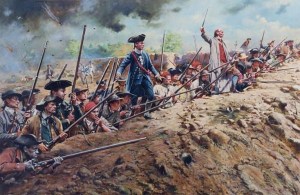
On the morning of 17 June 1775, Howe landed 3,000 men on the peninsula while the Royal Navy bombarded the Americans. The British initially didn’t attack, they sat on the beach and drank tea waiting for reinforcements. This gave time for Prescott to notice another flaw in his defense, Breed’s Hill could be outflanked to the north, and the entire Rebel position turned. Fortunately, Howe’s dithering allowed John Stark and New Hampshiremen to quickly scrape out a trench along a rail fence which blocked any movement north of Breed’s Hill. When Howe finally did attack, he sent a feint against Breed’s Hill and his main effort slammed into Stark, and was promptly defeated. Howe’s attack would have been successful had it occurred an hour earlier during morning tea time. In any case, when the British advanced up the hill Israel Putnam gave the famous order, “Don’t fire until you see the whites of their eyes”, a common order in the age of the musket, while John Stark used a more practical series of painted stakes in the ground 100 paces out.

The American’s inflicted heavy casualties on the initial British attack and they retreated back to landing area, much to the jubilation of the defending American militiamen. Howe tried again, this time reversing the attacks, with the main attack on Breed’s Hill and the feint against Stark, but with the same result. The defeated British streamed back to the landing area, leaving their dead and screaming wounded littering the hill. After the second attack, the Battle of Breed’s Hill was a resounding American victory. Had the battle not occurred on the Charlestown peninsula, the names “John Prescott”, “Israel Putnam” and “John Stark” would be household names in America.

The Battle of Bunker Hill occurred on the Charlestown peninsula, and that fact was the reason the British could reform for another attack. Howe refused to allow the boats to transport his defeated troops back to Boston. Stuck on the beach with nowhere to go, Howe and his staff and subordinate general officers rallied the British troops. They reorganized the formations, their staffs filled in for the fallen officer the Americans deliberately targeted, and Howe personally led the third attack.

As the situation stood the Americans couldn’t defeat a third attack. They impotently watched the British reform on the beach. Prescott couldn’t attack due to the untrained nature of his militia, but more importantly the American were running out of ammunition. The main army at Cambridge was continuously feeding troops and supplies onto the Charlestown peninsula, but the situation to the west of Breed’s Hill was chaotic, to say the least. Many American troops and most of the powder and shot stayed on Bunker Hill, and never made it to Prescott. When He departed the night before, Prescott said he was going to defend bunker Hill, so that’s where his supplies and reinforcements stayed. Few American officers marched their men to the sound of the guns, and only went where they were told. Furthermore, Prescott left no one on Bunker Hill to coordinate the reinforcements and desperately needed supplies. Finally, the Royal Navy was shelling the Charlestown Neck and Bunker Hill to isolate Breed’s Hill. Many American militiamen got their first taste of cannon fire there, and wanted no more of it. Hundreds turned around and went home.

The Americans had few casualties so far in the battle and if Prescott had the men, powder, and shot sitting on Bunker Hill, he could have defeated Howe’s third attack. But he didn’t, the Howe’s third assault carried the earthworks at bayonet point. The Americans just couldn’t stand against the British bayonet (…yet). They retreated off the peninsula. The retreat was disorganized, but several units surprised the British with their dogged and orderly fighting withdrawal, especially John Stark’s New Hampshire regiments. Many British officers were impressed with the fighting quality of the Americans when they were obviously properly trained. Nonetheless, most of the American casualties were during the retreat, including both William Prescott and Dr. Warren, whose deaths were a grievous blow to the American cause.

All was not lost though. Howe refused to follow up his victory, and continue the attack into the disorganized and defeated Americans. The newly coined Continental Army was shaken by the losses at Bunker Hill and its defeated defenders streaming back into camp. In any case, it did not have the powder for another battle. The vast majority of the Continental Army’s powder was used up or lost at the Battle for Bunker Hill. Had Howe pushed, the entire Continental Army may have broken up.

Fortunately for the Americans, Howe didn’t, and he settled the Pyrrhic victory at Breed’s and Bunker Hills. Howe had defeated the Americans, but he had so many casualties, Howe would not be able to lift the siege anytime soon. Clinton remarked in his diary, “A few more such victories would have shortly put an end to British dominion in America.” The Battle of Bunker Hill was a propaganda victory for the Americans. The amateur Americans had stood up to the mightiest army in the world and threw it back twice with horrendous casualties. The British recognized that Americans were serious, and capable. The defeat at Bunker Hill had far reaching repercussions on American operations. For the next three years, American planning would be dominated by “Trying to create another Bunker Hill.”

The Battles of Quatre Bras and Ligny

“Where was Ney?” That was the question on everyone’s mind at Ligny on the afternoon of 16 June 1815. Excellent staff work by the Prussians, and poor staff work by the French (massive traffic jam at Charleroi) allowed Blücher’s Prussians to outnumber Napoleon, 85,000 to 63,000. Nonetheless, Napoleon attacked and caused great damage to Blücher, particularly by his cannon which found the Prussian formations excellent targets. But he couldn’t destroy him without Ney. Ney had orders to seize Quatre Bras the night before, hold it with a minimum force and then march on Blücher’s right this morning. (Napoleon had no idea that the crossroads were not in French hands yet.) D’Erlon’s I Corps, closest to Napoleon, should have been there hours ago. Napoleon would send another order, this time directly to D’Erlon.

D’Erlon was still enroute to Quatre Bras, as per Ney’s orders. At those vital crossroads Ney was locked in a bitterly fought struggle where every time he thought he won, fresh British or Dutch units arrived. Ney had orders to take the crossroads the night before, and was in contact with Dutch units there since then, but for some reason lost to history, didn’t engage with his main force until the afternoon of the next day. Even though Ney started the battle much too late, the French could still destroy Wellington’s Anglo-Allied army if D’Erlon’s 20,000 men fell on Wellington’s left. When D’Erlon was about an hour from Quatre Bras and just about to move into his assault columns, Napoleon’s message arrived.

Napoleon’s plan was to defeat the British first, or at least fix them, then destroy the Prussians. So D’Erlon still marched to where he thought he was needed. Napoleon’s message changed that even though the British were not yet defeated. But Napoleon’s intent was to isolate and destroy one army and then the other. And that opportunity was there for the taking, just not in the same order as in the plan. To D’Erlon, it simply came down to a question of defying Ney or defying Napoleon. That wasn’t really a question.

Much to Ney’s astonishment, D’Erlon turned around and headed back the way he came… and missed both battles.

That night Blücher’s battered Prussians retreated from Ligny: thoroughly defeated, but not destroyed. It was close, though: over the night of 16-17 June, the Prussians suffered 28,000 desertions, mostly Saxons and Rhinelanders whom had previously fought for Napoleon. Nearly a third of Blucher’s army was gone. At Quatre Bras, Wellington, especially his Dutch, had a won a great victory, though it would go down in history as a defeat. The Anglo-Allied Army still held the field, but upon learning of Blucher’s retreat, Wellington fell back the next morning from the now untenable position. During these retreats, both armies were at their most vulnerable.

Napoleon allowed them to escape. He had just won his first victory since his abdication and indulged himself early on 17 June in those activities that endear commanders so much to their men: He visited the wounded, ensured their care, chatted with the troops, and toured the battlefield with his favorites. Although there is definitely a time and place for these things, the morning of 17 June was not it. By the time Napoleon got his army on the move, heavy rain began to fall, Wellington successfully parried any attempt by Ney to fix him in place, and Grouchy had lost contact with Blücher.

The Prussians disappeared because instead of retreating east towards their supplies as they were expected, his staff recommended they retreat north in order to maintain contact with Wellington, and the wily Blücher agreed. With no French contact, he had an entire day to reorganize his army. That evening Wellington sent a message that said he planned on defending the ridge near Mont St. Jean if he could be supported by one Prussian corps. If Blücher could not, Wellington planned on withdrawing further. He needn’t worry though.

Blücher replied, “My greatest friend Duke, I will not send just one corps: I will send my entire army.”

The Battle of Waterloo: The Duchess of Richmond’s Ball

At dawn on 15 June 1815, Napoleon’s 135,000 man army began their march on Belgium, specifically to isolate and destroy both the Duke of Wellington’s Anglo-Dutch-German Army, and Field Marshal Gerhard Von Blucher’s Prussian Army.

Both Allied armies were spread out below Brussels so they could more easily procure supplies from the local population and cover the many avenues of advance Napoleon could take into the country. However, Napoleon’s sudden advance went completely unnoticed. It would be six hours before the first Prussian cavalry reported the French movement; and most of Ney’s wing, whom marched on the British, had escaped observation altogether. It would be 3 pm before the first of Blucher’s couriers reached Wellington with the news. By then he had received his first report from the Prince of Orange that a single Dutch Brigade was in contact with French cavalry and infantry at the vital crossroads of Quatre Bras.

Wellington was left in a dilemma. If Napoleon was attempting to split the Allied armies and defeat them in detail (he was), the crossroads at Quatre Bras was key terrain: any attempt by Blucher to reinforce Wellington or Wellington to march to Blucher must pass through Quatre Bras. A French force there would isolate both Allied armies, even though that French force would be isolated and open to its own destruction. Nevertheless, the capture of Quatrain Bra was the obvious French course of action because it would sacrifice that force for the eventual destruction of both allied armies. However, Napoleon rarely did the obvious, and a French advance on Mons would be disastrous for Wellington because it would cut him off from the sea and his supplies. To Wellington, the French at Quatre Bras still might be a feint (It wasn’t, Wellington just overthought it like the Sicilian in the Princess Bride).

Nonetheless, increasingly desperate messages arrived from the Prince of Orange whom was convinced 320,000 French troops were opposite him (it was actually 33,000). At 4 pm, Wellington realized the magnitude of the impending disaster and said, “Napoleon has humbugged me, by God; he has gained twenty-four hours’ march on me!” By 6 pm, he had the initial orders written for much of his army to concentrate on Quatre Bras the next day. But he didn’t send them.

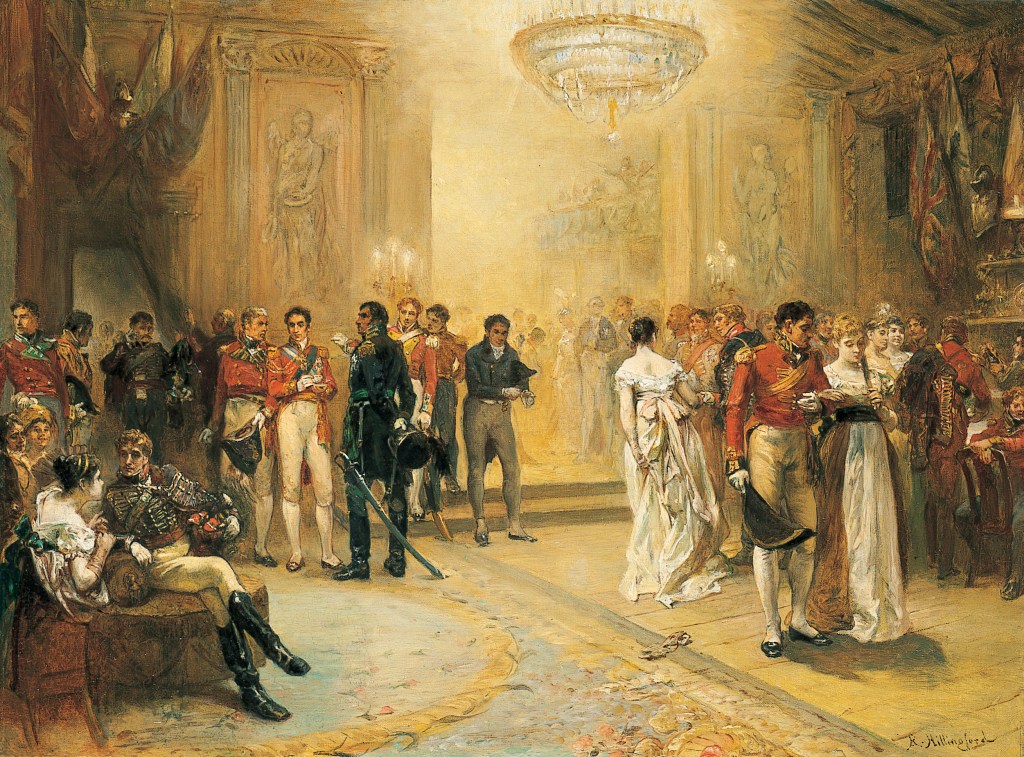
On the evening of 15 June 1815, Wellington and his senior officers were attending a ball in Brussels. The ball, hosted by Charlotte, the Duchess of Richmond, promised to be the gala event of the year. The who’s who of Dutch and Belgian society were in attendance. A flurry of horsemen galloping desperately from the estate were sure to be seen by the guests. Wellington’s Anglo-Allied Army in the Netherlands required Dutch and Belgian civic stability and cooperation. A sizeable portion of his army was Dutch, and he required the support of the Dutch population for recruits and replacements. Their support kept provision prices down, which lessened the burden on the Royal Navy, and precluded foraging. The majority of his troops were British, German, and Indian, and Dutch goodwill was required to smooth over “cultural misunderstandings.” Wellington was further dependent on his hosts for information to monitor the precarious political situation and wage the undeclared war against French leaning subversives, many of whom were in attendance. Wellington wanted to portray that all was in order and taken care. Spooking the most important Belgian and Dutch civilian influencers in the two countries, even for a seemingly good reason such as a French invasion, would do him no good. In any case, the riders probably wouldn’t find Wellington’s subordinates: they were all assuredly on the road to the ball themselves.

Wellington was already late for the dinner portion and if he did not show soon, panic would inevitably take hold of the guests, especially once they learned that Napoleon had crossed the Sambre River and was engaged with their champion, the Prince of Orange. For the next five hours, between the toasts and dances with the crème of Belgian and Dutch society, Wellington issued his orders to his commanders. He would fight Napoleon at Quatra Bras in order to maintain contact with the Prussians at Ligny, and if either Allied army faltered, Wellington would fall back to a low ridge south of the Belgian town of Mont St Jean, where he and his staff had spent an enjoyable afternoon the year before. Contact with the Prussians must be maintained at all costs, lest Napoleon destroy them in detail. Wellington was under no illusion that he could defeat Napoleon by himself, he needed Blucher and his Prussians.

Wellington’s subordinates’ aides raced back to their units to prepare for battle the next day, while the senior officers continued to dance and drink as if nothing was amiss, much to the delight of the British, Belgian, and Dutch ladies. Around 1 am on 16 June 1815, Wellington locked himself in a backroom with his corps and division commanders, and with a borrowed map, confirmed his orders, ensured his commanders understood his intent, and worked through a short map rehearsal.

As rumors began to make their way into the ball of Napoleon’s invasion, tearful goodbyes replaced merrymaking, but by that point Wellington had achieved his desired effect. At 2 am, on the morning of the inevitable showdown with Napoleon, Wellington and his men emerged from the room. He took his leave from the Duchess of Richmond, while his staff and subordinates said farewell to the remaining guests. Once off the estate, Wellington, his staff, and his commanders raced back to their headquarters.

The Duchess of Richmond’s Ball was the most famous, and no doubt enjoyable, orders group in history.

Many officers rode into battle still wearing the finery in which they attended the ball. Eleven of the Duchess’ of Richmond invited guests would be dead in the next few days, and many more wounded.