The Battle of Thermopylae

After the Achaemenid Persian defeat under Darius at the Battle of Marathon ten years before, his son Xerxes decided, under pressure from his advisors, to invade Greece overwhelmingly by land with an accompanying supply fleet offshore. In the summer of 480 BCE, Xerxes’ Persian Army conducted the largest seaborne invasion of Europe until the Normandy landings in 1944, 2500 years later. And then in one of the engineering marvels of the ancient world, the Persians constructed two 1,300m pontoon bridges across the Hellespont (the modern Dardanelles) and marched the rest of his massive army across over a total of seven days and seven nights.

The Athenian General Themistocles suggested that the Greeks make a stand at the narrow pass at Thermopylae (or “Hot Gates”, named after a warm spring nearby) and the adjacent straits of Artemesium. The narrow confines of each would mitigate the Persians’ greater numbers. Themistocles, an Athenian, would lead the Greek navies at Artemesium, while King Leonidas of Sparta led the Greek armies. On his march to the pass, Leonidas collected various contingents from other Greek city states, but due to the Olympic Games, during which fighting is prohibited, he could only collect limited forces. Nonetheless he planned to delay the Persians long enough for the rest of the Greeks to mobilize after the games. From Sparta, he brought only his personal bodyguard of 300 hoplites, and 900 other squires and armed retainers. The remaining Spartan army would fight with the main Greek army when it formed. Along the march he collected 4000 hoplites and 3000 more armsmen from the city states of Phocia, Trachis, Arcadia, Corinthia, Tegea, Mantinea, Thebes, Thespia, Malia, and Locria.

On 19 August 480 BCE) the 400,000 strong Persian Army under Xerxes I arrived outside of the narrow pass of Thermopylae and met the 8000 Greeks under King Leonidas. A Trachian lamented that the Persians were so many that their arrows would blot out the sun. A Spartan file commander, Dienekes, responded, “Good, then we will fight in the shade.” Hoping that the show of force sufficiently cowed the Greeks, the Persian herald demanded Leonidas surrender his weapons in a show of subservience to Xerxes. Leonidas responded “Molon labe”, “Come and get them.”

It took three days for Xerxes to organize an assault and on 22 August he attacked. The Greeks were armored in their traditional heavy bronze breastplate, helmet, and greaves, and armed with a large bronze shield (hoplon), an 8 ft stabbing spear (dory) that they used overhand, and a short sword (xiphos). They fought in their traditional densely packed shoulder to shoulder formation called a “phalanx” which was amazingly effective in the narrow Thermopylae Pass. The Persians were many and varied and from different provinces of Near Eastern Asia but few were as heavily armed as the Greeks. The only equivalents in the Persian army were Thessalian hoplites from already conquered Greek city states who were forcibly conscripted during the Persian advance. Persian arms and armor were meant for speed, mobility, and ranged attacks in the deserts, steppes, and mountains of their homelands. They could not withstand the rigors of close quarters combat in the narrow valleys of Greece. Their cane arrows and javelins couldn’t pierce the bronze armor; and their cloth, wooden or leather armor, and wicker shields, provided no protection against the iron weapons. Furthermore, the Greeks were soldiers in the Western tradition and valued discipline and maintaining position where their large shields could protect the man next to him. The Persians were warriors in the Eastern tradition which valued the personal kill. The Persian warriors continually broke formation making them easier to kill by the disciplined mass of Greek spears. Even Xerxes’ own bodyguard, the elite Immortals, known so because they always maintained a number of 10,000 due to casualties immediately replaced, could not break the Greek phalanx. Leonidas and his small army held the pass against overwhelming numbers for two days under constant assault.

In the early hours of the third day, a Greek traitor named Ephaliates led the Immortals on a little known mountain track which out flanked Leonidas. The small Phocian force sent to hold it was pushed aside. That morning, the Greeks met to discuss the new situation, and only the Spartans and Thesbians volunteered to remain and fight. The Thebans also stayed, but Herodutus said it was against their will. The rest of the army fell back to join the Greeks mobilizing after the Olympic Games. That afternoon the Persians attacked from both sides of the pass and overwhelmed the remaining defenders. The Thebans, bitter rivals of both the Spartans and Athenians, surrendered to the Persians. Leonidas and the remaining Spartans and Thesbians fought to the death.

Over the next few weeks, Xerxes went on to conqueror Phocis, Boeotia, Euboea, and Attica, to include the city of Athens, which was sacked. However, the time bought with the lives of Leonidas’ Greek defenders at Thermopylae was well spent. In September, Themistocles lured Xerxes fleet into battle in the straits of Salamis, where the Persian navy was decisively defeated. With no way to supply his huge army in Greece, most of it returned to Persia, including Xerxes himself. Xerxes turned the army over to Mardonius, Xerxes most powerful advisor and the newly appointed Satrap of Greece. In 479 BCE, the combined armies of the remaining Greek city states under Leonidas’ nephew, the Spartan regent Pausanias, defeated Mardonius and the Persian army at the Battle of Plataea. The victories of Salamis and Plataea cemented Greek freedom from Persian domination to this day. The Greek experiment in democracy was not killed off in the cradle.
The Battle of Musgrove’s Mill

Other raids departed about the same time Sumter and Taylor struck the fords and ferries across the Wateree. One such was Colonel Isaac Shelby’s raid on the Loyalist outpost at Musgrove’s Mill near a ford on the Enoree River. Musgrove’s Mill contained large stores of the area’s grain supply. On 18 August 1780, at the head of about 300 Georgian, and North and South Carolinian partisans, Shelby, the victor at Thicketty Fort, planned to surprise the loyalist militia garrison there, and seize the grain and any other supplies. Shelby was blissfully ignorant of the two recent American defeats at Camden and Fishing Creek.

The element of surprise was lost when Shelby’s men skirmished with a loyalist patrol just as they were approaching Musgrove’s Mill. It was fortunate that they did. The firing from the skirmish alerted a nearby farmer who informed Shelby that the garrison at Musgrove’s Mill was reinforced with several hundred more Loyalist militia and even some British regulars. The reinforcements were on their way to join Major Patrick Ferguson’s future expedition. Shelby was outnumbered more than two to one with no element of surprise. Furthermore, his horses were exhausted, so there was no quick escape.

Shelby decided to force the garrison into attacking him. He withdrew to a nearby hill and threw up make shift breastworks. Shelby then sent Captain Shadrach Inman with 20 Overmountain men down to the ford. When Inman arrived, he engaged the Loyalists on the far bank, and then his men feigned confusion and fell back “in disarray.” The entire Loyalist garrison of Musgrove’s Mill under Lt. Col. Alexander Innis chased after them.

Innis’ regulars weren’t British regulars, but red coated New York and New Jersey provincial regulars. Innis pursued Inman all the way back to Shelby’s defensive position, but Innis’ men didn’t fall for the ambush. However, when they spotted the breastworks, most of the Loyalists ineffectually fired on them. Shelby’s men held their fire. Innis was committed; the momentum of Loyalist advance carried them up the hill. They didn’t, or couldn’t, stop to reload.

Shelby’s North Carolinians, Elijah Clarke’s Georgians, and James William’s South Carolinians unleashed a devastating point blank volley into the advancing Loyalists. Nonetheless, in the brawl that followed, the provincial regulars almost overwhelmed the Patriot right with fixed bayonets. Just as the Americans were on the point of withdrawing, Innis was struck and fell from his horse, which caused the assault to stall. Sensing the moment was right, Inman and his Overmountain men charged into the provincials’ flank. After their feigned retreat, Inman’s men formed Shelby’s reserve, and rested. Screaming Indian war cries and using their tomahawks to devastating effect, the charge of the Overmountain men threw the provincial lines into chaos, and the already bloodied Loyalist militia began to waver. Shelby immediately seized the initiative and ordered his whole command to attack. The charge broke the Loyalist militia, which streamed back to the ford. The regulars surrendered, though some fled. Shelby inflicted nearly 230 killed, wounded, and captured on the Loyalists for just four killed and 16 wounded Patriots.

Shelby couldn’t rest on his laurels long. Soon after the battle ended, he was informed of the losses at Camden and Fishing Creek. Though disconcerting, the more immediate problem was Ferguson was not far off and was on his way to Musgrove Mills. On captured horses, Shelby and his men fled over the mountains into the Watauga Association, where they were temporarily safe from Ferguson. The Watauga Association was a semi-autonomous region of Overmountain Men settlements who had banded together to petition incorporation into North Carolina. (The Watauga Association would be integral to the future defunct State of Franklin, and eventually form the far eastern part of Tennessee.) Ferguson arrived at Musgrove’s Mill 30 minutes after Shelby departed.

The Battle of Musgrove Mills was one of the only battles in the American Revolution where militia defeated regulars, albeit provincial instead British regulars, but regulars nonetheless, in a straight up battle. More importantly, the news of the American victory was received after the losses at Fishing Creek and Camden, and did not get lost in the mix. The victory at Musgrove’s Mill softened the devastating blows that were the previous days’ defeats, and gave hope to the population that there were Patriots still fighting and winning against the British in the South. The American cause was not lost at Camden.

The Battle of Fishing Creek

The American loss at Camden made Colonel Thomas Sumter’s partisans at Carey’s Fort the largest Patriot force in South Carolina. After his victory, Lord Cornwallis advanced to the old American camp at Rugeley’s Mills, which fortunately for Sumter took the British away from hi, for the time being. Nonetheless, when Sumter was informed of Gates’ defeat, he knew he was in danger of being isolated and destroyed. He couldn’t let the British and Loyalists get between him and the nearest rebel base at Charlotte, or from the overmountain men mustering camps across the Blue Ridge Mountains. On 17 August 1780, Sumter’s men departed Carey’s Fort laden with 250 prisoners, 300 head of cattle, a flock of sheep, and 70 much needed wagons filled with supplies.

Moving slowly up the west bank of the Wateree River, Sumter was not counting on Cornwallis wanting those wagons back so badly. (Legend has it one of them contained his dogs and papers.) Cornwallis dispatched most of his cavalry and loyalist commanders to chase down Sumter and specifically retrieve those wagons. In his characteristic aggressive manner, Lt Col Banastre Tarelton’s British Legion made a 30 mile mostly night road march from Rugeley’s Mills to Camden in an attempt to cut off Sumter. Finding Sumter gone, Tarleton planned to cross the Wateree north of Carey’s Fort at Rocky Mount. However, when he arrived, Sumter was camped on the east bank. With the ford guarded, Tarleton waited for the rest of his command to catch up.

Sumter knew about orders to Ferguson to cut him off, but was neither aware of any to Tarleton, the speed of Tarleton’s advance, nor the fact he was just across the river from Rocky Mount. Sumter pushed his convoy as fast as they could go, but they needed a rest. On 18 August, Sumter’s column marched just eight miles to a camp on Fishing Creek.

Tarleton wasn’t going to let Sumter escape. Most of his light infantry and supporting loyalist militia was still strung out on the road behind, but he decided to attack anyway. He had 100 dragoons and sixty light infantry which he doubled up on the dragoon’s horses for the approach march. He crossed at Rocky Mount after Sumter departed. With just 160 men, Tarleton attacked Sumter’s nearly 800 strong camp on Fishing Creek on the afternoon of 18 August 1780.

The surprise was complete. Most of Sumter’s men were swimming in the Catawba River (The Catawba River turns into the Wateree River as it flows south) or were drinking around campfires after a tasty supper courtesy of the captured British provisions. Most of the muskets were stacked neatly near the river, and Tarleton ordered a charge to seize the muskets before the Americans could organize.

The “Battle” of Fishing Creek wasn’t a battle at all. The Americans had no chance to organize a defense. 150 Americans were immediately cut down by dragoon sabers, and over 300 surrendered. Sumter’s force was scattered. A dozing and half-dressed Sumter had just enough time to swing into the saddle and escape. The British prisoners were released and everything Taylor captured at Carey’s Fort was recovered. Taylor himself was captured, but he was so muddy and dirty the British didn’t recognize him. He and another Patriot officer cunningly escaped two days later.

Coming so close on the heels of the British victory of Camden, the news of Tarleton’s victory at Fishing Creek was lost in the mix. Nonetheless, the Americans partisans in the South suffered a major defeat, which would be tough to recover from.

The Battle of Camden

On 25 July 1780, Major General Horatio Gates arrived at Southern Department’s main camp at Deep River, thirty miles south of Hillsboro, North Carolina, to take command of the Continental Army assembled to drive Lord Cornwallis out of South Carolina, recapture Charleston, and put down any Loyalist counterrevolutionaries. “Granny” Gates, as his men called him, was the “Victor of Saratoga” and it was thought he could do the same to Cornwallis as he did to Burgoyne.

Unfortunately, Gate’s reputation was almost exclusively the result of the actions of his subordinates, John Stark, Enoch Poor, Daniel Morgan, and Benedict Arnold mostly, which he, and his sycophants, took credit for. Left to his own devices, Gates would have almost certainly lost at Saratoga. The argument can be made that he stayed out of his subordinates’ way, but that’d be wrong: the battle was won for the most part because they ignored his orders, or disobeyed them outright. In the Southern Department, Gates had few subordinates of the caliber he had in New York, mostly because he refused their services. The exception, of course, was Major-General Baron Johann De Kalb.

De Kalb was a German officer from Franconia, who had served in the French Army, and traveled to America before the revolution. He and his protégé, Marquis de Lafayette, were offered commissions in the Continental Army, and De Kalb was instrumental training the Continental Army at Valley Forge, even though von Steuben got most of the credit. As commander of the Maryland and Delaware Line, some of the best troops in the Continental Army, whom he marched south with, the fiery De Kalb was furious when he learned Gates was given command of the Southern Department instead of him.

As soon as Gates arrived, he ordered DeKalb to march directly on Camden, a supply depot and loyalist mustering center held by Lord Rawdon in command of 1000 troops: Carolina loyalists, volunteers from Ireland, and Banastre Tarleton’s infamous British Legion. Against this force, Gates had DeKalb’s Continental Line and the dragoons of Armand’s Legion. On the way he expected to pick up North and South Carolina and Virginia militia. Gates had no plans to attack Camden, and only wanted to occupy a defensive position north of the town, which would force Rawdon to either evacuate Camden, or attack Gates’ superior force.

The road to Camden was through barren country and mosquito infested swamps which took a toll on the army, which was already low on food and wracked by dysentery. Taking the direct route to Camden was against the advice of all of his officers who knew the country. An alternate route to the west was recommended. It would have taken longer, but it would have been through Patriot friendly territory where they could have requisitioned food. Gates refused. However, by the time Gates reached Rugeley’s Mill, about 15 miles north of Camden, Gates’ “Grand Army” swelled by the addition of 2100 North Carolina militia, 700 Virginia militia, and several hundred more South Carolina militia and dragoons. With almost 5000 troops, he was sure to force the British out of Camden.

Gates’ had no faith in his militia, and still had no intention of attacking despite the odds. At Rugely’s Mill on the morning of 15 August, he found out Cornwallis had reinforced Rawdon with about 1000 additional troops. Cornwallis heard of Gates arrival on 9 August from loyalists along Gates’ route of march. Cornwallis immediately departed Charleston with its garrison, and arrived at Camden on the 13th bringing the British army strength up to 2100. Despite the increase, Gates felt little need to change his plans. Gates sent most of the South Carolina militia away, including a band led Francis Marion, to continuing raiding loyalist outposts, and capture and burn all the boats, bridges, and ferries on the Santee River, to prevent Cornwallis’ escape after the inevitable British defeat. Arrogantly, Gates refused the services of William Washington’s dragoons, who promptly went on to raid independently. Gates assumed he had more than enough troops to defeat Cornwallis.

With battle imminent, Gates wanted to fortify his sick, tired, and weary men with a bit of rum. However he didn’t have any, so he substituted molasses. The molasses just made the dysentery worse, and gave everyone else a severe case of diarrhea. Nonetheless, at 10 pm on the 15th, Gates ordered a night march to cover the 10 last miles, and planned on being in the defensive positions above Camden by dawn.

Unfortunately for Gates, Cornwallis also ordered a night march at 10 pm on the 15th. He planned a surprise dawn assault on the American army which he thought was still at Rugeley’s Mill. The two armies collided in the night about 2:30am north of Camden at Parker’s Old Field near Saunder’s Creek.

The dragoons and light infantry of Armand’s Legion and the British Legion clashed in the darkness, with Armand getting the better of Tarleton after receiving the British charge with pistol fire and counter charging. However, the Virginia militia sent to support Armand had never been in a battle, and, in a harbinger of things to come, withdrew in panic at the first shot. The Virginians sent Armand’s lines into chaos, and only a rear guard action by Armand’s light infantry, led by Lt Col Charles Porterfield, prevented Tarleton from scattering the American vanguard. Both sides withdrew as neither Cornwallis nor Gates wanted to fight a night battle.

At dawn, both armies were lined up against each other, Gates’ 4000 and Cornwallis’ 2100. Both commanders followed the standard 18th century tactic of placing their best units on the right. For the Americans it was the Delaware and Maryland Line under de Kalb, for the British it was the 23rd Royal Welsh Fusiliers and the veteran 33rd Regiment of Foot. Opposite de Kalb was Rawdon in command of the Irish Volunteers and the loyalist militia, and across the field from the Welsh and the 33rd was the unreliable Virginia militia. The same who fled the night before. Gates ordered the entire American line to attack, while Cornwallis ordered just his veteran right to attack.

Gates should have guessed Cornwallis would have placed his best units on the right and not placed his least reliable troops opposite them, but he didn’t. Even worse he ordered the Virginians to attack. Gates hoped to take advantage of the British transitioning from column to line, but all he did was made the militia difficult to control by their officers. At the first sight of a British bayonet, the Virginians broke and ran. They didn’t engage or even get close to the British line. The Virginians didn’t even fire their weapons. They dropped their weapons a fled for their lives. Only three Virginians were even wounded in the battle. The rest ran. They took most of the North Carolina militia in the center of the American line with them. Tarleton and the British Legion gave chase. As the Virginians streamed past, Gates took off. Followed closely by his staff, General Horatio Gates, the Victor of Saratoga, didn’t stop running until he reached Charlotte, North Carolina, sixty miles away.

De Kalb had barely engaged Rawdon to his front before he was out flanked by the British. He took control of the battle and assaulted Rawdon, nearly breaking his lines. But in the process, his left was exposed as the British overwhelmed the only North Carolinian brigade not to run away. He ordered the American reserve, the 1st Maryland Brigade, to support his left, but they couldn’t reach it. The American line was split. Tarleton returned to the field, and charged into the rear of the Continentals which broke them. Several hundred escaped through the swamp to the west where the horsemen couldn’t follow.

In an attempt to rally his men, de Kalb was unhorsed and captured. He had ten wounds – seven from bayonet and three more from musket balls. Baron Johann de Kalb died two days later despite the best efforts of Cornwallis and his personal surgeon. Tarleton pursued the routed American for over 22 miles, ensuring “rout and slaughter ensued in every quarter.”

The Battle of Camden lasted just under an hour and the Americans suffered over 2000 casualties, the British a little over 300. 700 Continentals reformed in Hillsboro a few days later, but the equipment losses were devastating and the American army in the South would lack the essential tools of warfighting for months. Continental Congress called for an inquiry into Gates’ actions at Camden, but his political connections ensured it went nowhere. Nevertheless, Gates never had a command again. Subsequently, the Southern Department was given to Washington’s most trusted subordinate, Nathaniel Greene. But until he and Daniel Morgan could come south from New Jersey and take command, the defense of the American cause in the South fell to Patriot partisans and the overmountain men mustering over the Blue Ridge Mountains.

The Capture of Carey Fort

The war for the Carolina backcountry intensified after the successful capture of Thicketty Fort, as patriot commanders raided Major Patrick Ferguson’s loyalist outposts. Ferguson, with a smattering of British regulars and provincial loyalists from up North, was desperately trying to recruit and train Carolinian and Georgian loyalist militia to defeat the overmountain men gathering in large numbers over the Blue Ridge. An American army led by Horatio Gates had just entered South Carolina and threatened Camden, an important depot town and loyalist mustering center, one of the few that was far too large for patriot partisans to attack. After the victory at Hanging Rock, Patriot Colonel Thomas Sumter’s next targets were the vulnerable fords and ferries on the Wateree River. Sumter wanted to strike them before the inevitable clash between Gates and Cornwallis. Sumter dispatched Col Thomas Taylor to scout one of Camden’s satellite training camps, Carey’s Fort, which also guarded the ferry over the Wateree River about a mile south of Camden behind Cornwallis’ main body.

On the morning of 15 August 1780, Taylor with about two hundred cavalry and militia, found the small British garrison of Carey’s Fort under its namesake, prominent local Loyalist Lt-Col James Carey, fast asleep. Seizing the moment, Taylor’s men quickly stormed the fort, and took the entire 37 man garrison prisoner without firing a shot. Taylor captured about thirty wagons full of supplies, which were supposed to be ferried across the river and sent to Camden that morning. Cornwallis’ army, across the river a mile away, had no idea that anything was amiss. After a quick interrogation, Taylor learned that a supply convoy from another large Loyalist outpost at Ninety Six was also scheduled to arrive that day.

Dressed the same as the loyalists they captured, Taylor’s men posed as the garrison, even waving to curious loyalists on the other side of the river who were sent to find out why the wagons had not crossed yet. Later that morning, the convoy from Ninety Six arrived. The convoy’s thirty wagons were escorted by 70 Highlanders of the British 71st Regiment. By the time the Highlanders figured out the ruse, they were in no position to fight, and were all captured. Upon learning the news of Carey Fort’s capture, Sumter brought his whole command down from his own raid to reinforce Taylor.

The loss of Carey’s Fort, and more importantly, the ferry over the Wateree River, effectively severed Cornwallis’ lines of communication from Camden to Ninety Six and Charleston. And there was nothing the British could do about it: The fort and ferry boats were secure on the west side of the fast and deep Wateree River, and the British were on the east side, impotent and helpless as the Americans taunted them. Furthermore, if the much ballyhooed Gates, with his “Grand Army” defeated Cornwallis in battle north of Camden, Cornwallis would be forced to retreat away from Charleston into the wilderness and swamps of north east South Carolina. The defeated remnants of Cornwallis’ army would then be at the mercy of American partisans. With the fall of Carey’s Fort, the war in the South, and possibly the entire American Revolution, could be won by the Patriots in the next few days.

Gates just had to defeat Cornwallis at Camden; and the Victor of Saratoga outnumbered Cornwallis nearly two to one.

Japan Surrenders

At the Casablanca and Tehran Conferences the Allies and the Soviet Union agreed to fight until the Axis unconditionally surrendered. For months starting in March 1945, Curtis Lemay’s B-29’s firebombed Japan’s primarily wooden cities causing great destruction and massive casualties among Japan’s population. Nimitz’ Navy mined the island channels which destroyed Japan’s economy, and his fast attack carriers raided Japan’s coasts with impunity. Japan’s industry was reduced to ruins, but battle hardened troops from China, many of whom had been fighting there for decades were brought back to Japan. Japan’s fanatical government mobilized the population to defend against the inevitable Allied invasion of the Home Islands.

Operation Downfall, the Allied invasion of the Japanese Home Islands, was scheduled to begin in November 1945. Downfall had two component operations: Operation Olympic, the invasion of Kyushu in November, and Operation Coronet, the invasion of Honshu in March 1946. Based on the Japanese military and civilian resistance on Saipan, Iwo Jima, and Okinawa, Allied planners predicted a million Allied casualties. (So many Purple Heart medals were created for the invasion of Japan, that we are still using them today.) The Allied commanders feared “an Okinawa from one end of Japan to the other”. Planners predicted that “20%” of the “fanatically hostile” Japanese population would die defending the islands.

At the Potsdam Conference at the end July 1945, a declaration was made by the Allies and the Soviet Union threatening “great destruction” unless the Japanese surrendered unconditionally. The Japanese refused, demanding that the Emperor and his administration continue to govern Japan, and no Allied occupation force set foot on Japanese soil.

On 6 August 1945, the B-29 “Enola Gay” dropped the first atomic bomb, the 15Kton “Little Boy” which used uranium for its fission, on Hiroshima. 20,000 Japanese soldiers were killed, and 150,000 civilians died in the initial blast, the immediate fires and destruction, or from radiation.

The Japanese officially ignored the attack, even after Truman announced it to the world. Most Japanese outside Hiroshima did not even know it occurred, so tight was the government’s control of the population, until Allied leaflets told them. The Japanese dismissed the leaflets as propaganda.

On 9 August, 1945, the B-29 “Bockscar” flew to Kokura with the plutonium atomic bomb “Fat Man”. When Bockscar got to Kokura the crew found haze and smoke obscured the city as well as the large ammunition arsenal that was the reason for targeting the city. After three unsuccessful passes, they broke off and headed to their secondary target Nagasaki. Nagasaki, situated in a valley, was difficult to target and relatively unscathed as far Japanese cities went in 1945. Thought safe from bombing, Nagasaki was packed with refugees. 80,000 civilians died as a result of the atomic bombing.

(“Kokura’s Luck” is a common Japanese phrase to describe escaping a terrible occurrence without being aware of the danger.)

Also on 9 August, the Soviet Union invaded Japanese occupied Manchuria.

The Japanese still refused to surrender unconditionally. A third atomic bomb was readied.

On 12 August 1945, Japan agreed to surrender, but again only conditionally. They continued to demand that the Allies agree to Emperor Hirohito’s imperial government remaining in power, and no Allied occupation of the Home Islands before Japan would surrender.

Truman ignored the offer, though he did refuse to authorize the use of the third atomic bomb (“all those kids…”). The next morning, bombers dropped copies of the surrender request all across Japan. In response to the demands, Admiral Nimitz directed his carriers to strike targets around Tokyo on the afternoon of 13 August and General Carl Spaatz ordered another thousand bomber raid on Tokyo for the next day.

With no more word from Japan, on the morning of 14 August 1945, the Allies had had enough of Japan’s procrastination and launched the largest series of raids and attacks on the Home Islands so far in the war, primarily in the Kyoto/Tokyo/Yokohama area. 1,014 B-29s struck Japan along with thousands of smaller bombers and carrier based planes. Anything with wings that could reach the Japan was ordered to attack. Additionally, every surface vessel in the 3rd and 5th Fleets was ordered to shell targets on the Home Islands. They ranged from big Iowa class battleships launching 16” shells twenty miles inland to PT boats shooting up Japanese fishing trawlers and coastal villages with their .50 Cal machine guns.

Iwakuni, Osaka, Tokoyama, Kumagaya, and Isesaki were devastated, and what remained of Tokyo was destroyed.

The leaflets announcing Japan’s surrender offer had a profound effect on the Japanese Emperor and his Imperial cabinet. They could not deny them to the Japanese people. On 13 August, they agreed to offer to surrender with one condition, the Emperor remain on the throne as a figurehead while the Allied occupation force governed Japan after the surrender. The Allies, particularly Truman, were sure to accept, but it almost didn’t matter.

Unbeknownst to the Allies, the Japanese military attempted a coup on the night of the 13th in order to prevent any communication with the Allies. The Emperor had recorded the surrender message that afternoon and the vinyl record was given to the Emperor’s Chief of Seals, Kōichi Kido, to be played the next day to the Japanese people. That night Major Kenji Hatanaka and his conspirators launched the coup. Hatanaka and his men seized the Imperial Palace to destroy the recording, while others fanned across the city. The coup failed by the evening of the 14th, mostly due to the efforts of three men. Kōichi Kido locked himself in a secret vault in the Imperial Palace, which Hatanaka tore the Palace apart looking for the recording. He never found it. Kōichi only emerged from the vault after troops loyal to the Emperor recaptured the Palace. That there were still loyal troops was due to the efforts of General Shizuichi Tanaka, the commander of the Eastern Army, and his chief of staff. Tanaka convinced many of the plotters to go home, and his chief of staff refused the use of the radio for the ringleaders to broadcast their messages to the Japanese people.

On the morning of the 15th (Japanese time) the Emperor accepted the Allied terms of “Unconditional Surrender” and dispatched members of the Imperial family to personally inform the commanders in China, Korea, Southeast Asia, and the South Pacific, who would invariably believe the pronouncements to be Allied propaganda. The Allies acknowledged receipt of the surrender at 7 pm 14 August 1945 (Washington DC time), just Emperor Hirohito was announcing it to the Japanese people. The Allies agreed to let Emperor Hirohito remain on the throne as a figurehead. President Truman made an immediate radio address and spontaneous celebrations broke out across the world. The occupation of Japan began on 28 August and the official surrender documents would be signed on 2 September.

The most destructive war in human history was over. After almost six long years (14 in the case of the Republic of China) the Allies were victorious against German National Socialism, Italian Fascism, and Japanese Racial Militarism, and the totalitarianism and authoritarianism their corrupt ideologies inevitably encouraged.

The war to keep it that way, which had begun as early as the previous year, began in earnest the next day.

The Battle of Britain: 303 Squadron

The invasion of Poland in 1939 was not the walkover portrayed by German National Socialist propaganda, particularly in the air where the Polish air force was portrayed as destroyed on the ground. Poland’s small air force consisted of 400 obsolete planes, but number of flight hours made its pilots some of the best trained in world. The Luftwaffe suffered 900 planes shot down by the Poles before the German 5:1 superiority overwhelmed them. Towards the end of the campaign, thousands of pilots and ground crew escaped to Great Britain or France.

In August 1940, the RAF’s Air Marshal Dowding didn’t want to use the Polish squadrons because their lack of English language skills prevented their effective integration into his early warning system. So for the first 45 days of the Battle of Britain the Polish pilots, dozens of whom were aces and double aces, spent their time learning the proper English language procedures for coordinating with the Sector Control Centers and other fighters in the air.

However, on 30 August 1940 during a training flight over Kent, 303 Squadron RAF encountered a German bomber raid enroute to the airfield at Eastchurch, and one of the Polish pilots attacked. The pilot, a veteran of both the Polish and French campaigns, was frustrated with the RAF’s insistence on more training, and used the time honored tactic of not understanding the radio commands of his British instructor pilot. He shot down a German Bf110 and broke up the formation. Bowing to the inevitable, Dowding made 303 Squadron operational the next day.

303 Squadron was nicknamed the “Kosciuszko Squadron” after the Polish patriot and engineer who fought in the Continental Army during the American Revolution. 303 Squadron was formed on 28 July 1940 from pilots of the former 111 “Kosciuszko” and 112 “Warszawa” squadrons of the Polish Air Force. They were equipped with older Hawker Hurricane fighters, unlike many British squadrons which were equipped with far superior Supermarine Spitfires. Nonetheless, in the first seven days of September, 303 Squadron shot down 43 German planes for only six planes shot down and three pilot losses. The RAF refused to believe the numbers until the British sector commander came down to fly with them on 8 September. They scrambled four times, and shot down five more German planes without loss.

One victory that day was a Bf 109 that the Polish pilot chased over the tree tops. Out of ammunition, the Pole flew just above his target. The German pilot looked up, saw the fuselage of the Hurricane less than a meter from his canopy and instinctively dove away… straight into the ground. (The real life inspiration for Goose’s Polaroid scene in Top Gun? You know, “foreign relations”.) Impressed with their aggressiveness, dedication, technical and tactical expertise, and their “lust for contact”, the RAF never doubted the Poles of 303 Squadron again.

145 Polish pilots in five squadrons took part in the Battle of Britain, by far the largest contingent after the British. In early September, when the Germans had bombed Fighter Command’s airfields almost into submission, British Secretary of State for Air, Sr Archibald Sinclair noted, the RAF had “only 350 pilots to scramble, of which nearly 100 were Poles.”

The scarlet scarves of 303 Squadron would go on to shoot down 126 German planes in six weeks with the loss of only 13 pilots. This was the largest number of any of the 66 RAF fighter squadrons that fought in the Battle of Britain. Sgt Josef Frantisek, a Czech member of 303 Squadron who fought for the Poles after his country was given away by Neville Chamberlain in 1938, had the most kills of any pilot in the Battle of Britain with 18.

Pic notes: Note the cavalry czapka in the center of the 303 “Kosciuszko” Squadron emblem. The 13 stars around the outside of the red and white stripes was Kosciuszko’s heraldic device which he adopted after the American Revolution. (It was also a medal for gallantry in the Republic of Poland between 1919-1939). Also note the traditional Polish “war-scythes” on the emblem. “War-scythes” were made by uprighting normal scythe blades to make a form of fauchard. “Uprighting the scythe” was the traditional sign that the Poles were going to war. (You can’t harvest grain with an uprighted scythe; you can only harvest Germans, Russians, Swedes, Turks, and Communists.) The war-scythe is also a symbol for Polish independence, and “scythemen”, “Kosynierzy” in Polish, are roughly equivalent to “minutemen” in American culture. That was particularly appropriate during the Battle of Britain when the pilots had only a few minutes to get airborne to engage the Luftwaffe.

The Miracle on the Vistula

At the end of the First World War, three great empires collapsed in Eastern Europe: Germany, Austro-Hungary, and Imperial Russia. Out of that chaos, two states, of many, arose: the Republic of Poland and the Soviet Union. The Soviet Union was born in the “Red” October Revolution of 1917 sparked by the initially successful then disastrous Brusilov campaign of 1916. By 1918, Russia was out of the war, and locked in its own brutal civil war between the Anti Bolshevik or “White” armies, and the Bolshevik Socialist i.e. Communist, “Red” armies. In 1919, Vladimir Lenin’s victorious Red Army invaded the newly independent Republic of Poland, formed from the pieces of the Central Powers at the end of World War One. Lenin’s intent was to spread the Communist International (COMINTERN) to a defeated Germany, which was ripe for Communist revolution.

The Polish-Soviet War was the last of an era, with the first glimpses of the next. Trenches, inexperienced peasant militias, armored trains, massed artillery barrages and vast sweeping maneuvers by hordes of lance and saber wielding cavalry coexisted with airplanes, tanks, armored cars, motorized infantry, and highly experienced professional soldiers. By mid-1920, the Red Army, under the brilliant 27 year old Marshal Mikhail Tukhachevsky, was poised for a final offensive to capture Warsaw. Warsaw’s fall would end the war and allow Tuchachevsky a clear path to Berlin. Standing in his way was the massively outnumbered remainder of the Polish Army under Marshal Josef Pilsudski.

The advancing Red Army had five million men, Pilsudski had but one million under arms.

Pilsudski knew that his forces could not win in a protracted attritional fight: the Soviets were too many. Only a bold counterattack could disrupt the Bolshevik offensive. Pilsudski planned to make a stand along the Vistula River with Josef Haller’s “Blue Army” reinforced by almost the entire population of Warsaw. The “Blue Army” was named so because they were Poles whom fought for France in the First World War and wore old blue French uniforms. Among the Blue Army was a division of Polish-American volunteers recruited from recent immigrants to the United States. Pilsudski’s plan was for Haller to fix Tuchachevsky in front of Warsaw, as the Red cavalry to the north of the city inevitably took the path of least resistance and raced west on the North German Plain. General Wladyslaw Sikorski’s Fifth Army held the shoulder. Below the city to the south, Pilsudski secretly organized a 20,000 strong “Strike Force” under Gen Edward Smygly-Rydz, for the counterattack.

On 12 August 1920, Tuchachevsky arrogantly launched his armies directly at Warsaw. Despite bitter hand to hand fighting in the trenches against overwhelming odds, and much to the surprise of the French and British observers, Haller held the Wkra/Vistula River lines. The Soviet Cossacks and cavalry raced west as expected, which caused great panic, but they completely overextended themselves. Even worse for the Soviets, the Red cavalry victoriously galloped further away from the important battle in front of Warsaw.

On 14 August, Sikorski counterattacked north of city (in probably the first use of “blitzkrieg” style combined arms breakthrough tactics), cutting off the cavalry to the west and occupying Tuchachevsky’s reserves. Two days later, Pilsudski launched his coup d’eclat – Smigly-Rydz’s cavalry, tanks, and armored cars tore into the Soviet flank, as they were occupied fighting for the city and containing Sikorski. The Polish counterattack threw the Red Army into chaos. Unleashing his division commanders to operate independently in the breakout, the Poles tore deep into the Soviet rear areas. They captured the vital fortress city Brest-Litovsk, 70 miles behind the lines. In order to prevent the complete encirclement and destruction of the Red Army, Tuchachevsky ordered a general retreat. As the Communists withdrew, Pilsudski ordered a general offensive, but it was superfluous: Haller, Sikorski, and the population of Warsaw had already surged forward. The Communist retreat turned into a rout on 18 August.

The COMINTERN was stopped at the Polish border and the Red Army, with its commissars and secret police, wouldn’t advance that far west for another 25 years. The Miracle on the Vistula spared vulnerable western and central Europe, severely weakened by four years of the First World War, from Communism, an ideology so heinous that it is responsible for 150,000,000 deaths and untold suffering by billions.

Had the Poles failed at the gates of Warsaw in August of 1920, we would be living in a different, and darker, world today.

“For our freedom and yours” – The motto of Polish revolutionaries and unofficial motto of Poland

The Battle of Britain: Adlertag

By the first week of August 1940, it was obvious to the Germans that the costal convoy and port attacks were not going to lure the RAF into a battle over the channel where it could be destroyed. Herman Goring ordered the Luftwaffe to attack targets in Southern England which he believed would bring the RAF to battle. He was correct and Air Marshall Dowding unleashed his fighters on the Luftwaffe.

The revised plan was named Adlerangriff, or “Eagle Attack” and 13 August 1940 was designated Adlertag or “Eagle Day”. Luftwaffe bombers struck a variety of targets including airfields, radar stations, and aircraft factories in order to bring the RAF up to fight. Adlerangriff’s climax was actually very early in the battle: 15 August was declared Der Groesste Tag or The Greatest Day because of the sheer number of German sorties flown and the number of casualties on both sides. Nonetheless, it was a straight attritional battle, and although the Germans had more planes, the flaws in Adlerangriff became readily apparent.

Dowding’s early warning system proved to be much more resilient than expected. The radar towers were very difficult to damage much less destroy, and their ancillary and supporting systems were not targeted, such as telephone exchanges and power stations. Also, the slow Ju87 Stuka dive bombers were massacred in the air, and any bombers escorted by the big and ungainly Bf 110 fighter/bombers were likewise swept from the sky. Furthermore, since the battles mostly took place over England, any downed Allied pilots could be back with their squadrons in hours, unlike German pilots whom became POWs. Finally, the scattershot nature of the targets severely limited the effectiveness of the bombers, and did not complement the many victories scored by the fighters. It would take two weeks before the Luftwaffe High Command figured out that the key to defeating the RAF was not shooting down its planes but destroying its airfields.

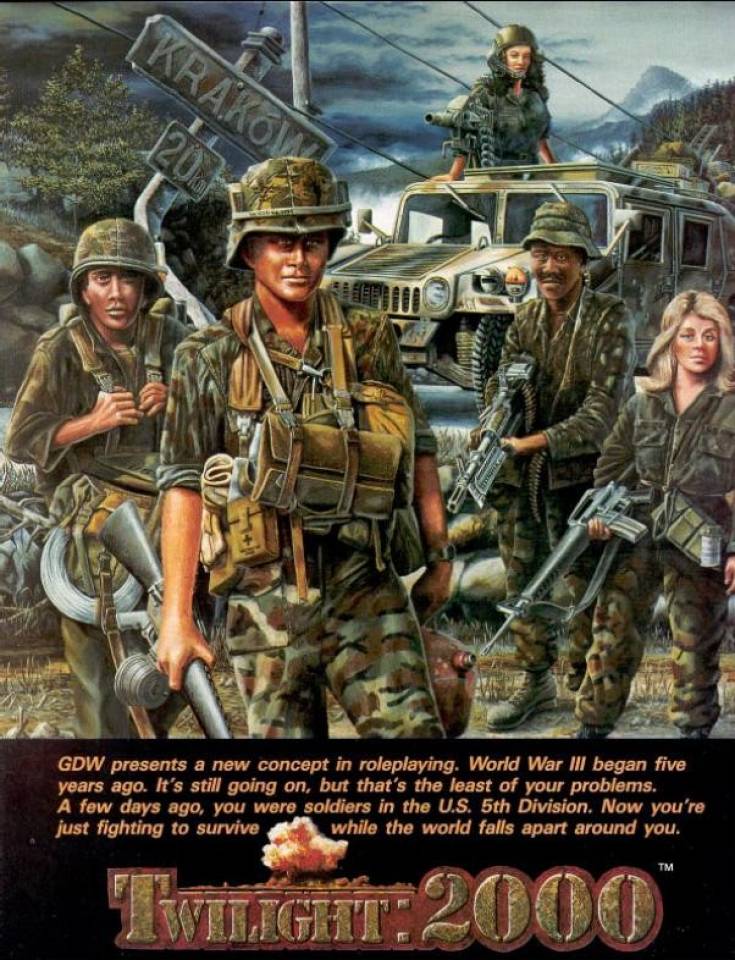
The Death of a Division

(Beware! Fiction post follows!)

The successful Soviet coup in 1991 saw Boris Yeltsin summarily executed in the Kremlin courtyard. The coup eventually led to a war – a war that engulfed the globe.

By the new millennium, society might have broke down, but the war continued. After the spring harvest was planted in the year 2000, the German 3rd Army left its cantonment areas to conduct the last strategic offensive of what would later be called “The Twilight War”. Spearheaded by the US XI Corps, the allied remnants of NATO were to clear Soviet and Polish communist formations from along the Baltic coast, seize the Vistula river basin for its vital, lifesaving supply of fresh water, and make contact with Polish Free Legions operating against vicious bands of marauders terrorizing the population in the interior.

Exploiting a gap in the Soviet lines near the radioactive ruins of Bydgoszcz, the 5th US Infantry Division, the Red Diamond, broke out southeast along the south bank of the Vistula. German and American commanders congratulated themselves on the victory. There were no communist formations reported between them and the remains of Warsaw. The veteran 5th Infantry Division of the newly constituted XI Corps, was long used to local recruiting in the struggle to maintain any semblance of numbers, but they fortunately received the last shipment of replacements and heavy vehicles from the former United States of America before it descended into a brutal civil war the previous winter. Armed with new M1A2E3 Abrams main battle tanks, Cadillac Gage Stingray light tanks, and LAV-25 armored personnel carriers (originally destined for the Marines of the Rapid Deployment Force in Iran), the 5th US Infantry Division was one of the most powerful armored formations remaining in the world. Or so it was thought.

The division’s fuel reserves were grossly inadequate for the new vehicles. The new tanks unfortunately overwhelmed the division’s logistics system, which normally managed just the cantonment areas behind the stabilized front where the Division spent the last year. The new tanks burned fuel at a rate unknown in the previous iterations of M1s. Consequently, the 5th Infantry Division spent a better part of a week around Torun distilling ethanol to replenish the thirsty vehicles and the big 5000 gallon tankers.

With Polish Free Legion guides, the division cavalry squadron, the horse mounted 4-12 Cavalry, scouted as far south as Lodz, one of the few remaining intact cities left in Poland. The troopers identified only a weak Polish border guards brigade holding the city. The commander of the 5th, the indefatigable Brigadier General Pat Dudley, call sign Red Diamond Six, chose Lodz as the objective for the next leg of the offensive.

In an intelligence failure akin to missing the surprise Italian offensive that almost captured Munich, the tactical situation around Lodz was not as it appeared. The first sign of trouble were the hordes of marauders in the pay of Soviet cavalry who overwhelmed 4-12 CAV’s observation posts. 4-12 CAV withdrew southwest, and just barely missed being annihilated by a fast moving Soviet motorized rifle division, which emerged from Lodz as if conjured by a wizard. Just as the 256th Brigade of Louisiana National Guard, the 5th’s “round out” brigade and main effort against Lodz, pulled out of their assault positions, they were struck by two motorized rifle divisions and tank division of the Soviet 4th Guards Tank Army.

The 4th Guards Tank Army was last reported deep in the Belorussian wilderness. Only the quick counterattack by the 2nd Brigade Combat Team prevented the complete destruction of the Tiger Brigade, but both formations took a beating. One incredulous report even mentioned a Soviet MI-8 Hip spotting for the Soviets! Against this overwhelmingly powerful formation, Red Diamond Six ordered the 1st Brigade to secure the bridges over the Warta River to the west and prepare to defend the crossings. The Division Trains, and the 2nd and 256th Brigades would pass through their lines to escape the well-armed, well supplied, and fully mobile 4th Guards Tank Army.

The plan fell apart almost immediately. The Polish 10th Tank Division was spotted west of Kalisz by the 1st Brigade’s reconnaissance troop, which forced the brigade to launch a hasty attack to seize the town lest the communists threaten the rear of the Warta river line. Under great pressure, the 2nd Brigade managed to get across the river, and set up roadblocks at the bridges. But the grievously wounded 256th was cut off, pinned against the river and destroyed, with only remnants fleeing south into the woods and out of contact. In desperation, Red Diamond Six had the Warta bridges blown, but their destruction provided only a temporary reprieve: another Soviet motorized rifle division appeared behind 4-12 CAV having crossed the river to the south of where the 256th was destroyed.

Red Diamond Six ordered the division to consolidate on Kalisz. 1st Brigade parried the Polish tanks to the west and southwest. 2nd Brigade moved to prepare a defense against the approaching Soviets from the south and east. On fumes, the last ten Abrams tanks of 3-70 Armor pulled into defilade positions overlooking the Kalisz-Sieradz road, just as the main body of the Soviet 124th MRD drove into their engagement area. In ten minutes, 30 Soviet vehicles were burning on the road, a counter attack defeated, with 3-10 Infantry narrowly stopping another counterattack into 3-70 AR’s flank from the south.

The victories didn’t change the fact that Kalisz was a poor refuge. One motorized rifle division was destroyed but there were two more crossing the Warta to the north and east. The Polish 10th Tank to the west was strangely silent, but nonetheless its existence threatened the division rear. Moreover, there were marauding mercenaries everywhere, and a Soviet tank division was unaccounted for since its clash with 2nd Brigade outside Lodz. Red Diamond Six decided to take advantage of the mauling 3-70 AR and 3-10 IN handed the Soviets to the southeast, and ordered the division to break out of the rapidly shrinking Kalisz perimeter toward the Free City of Krakow. Krakow had declared independence from everyone, and it was thought the division could reorganize there, or at worst, work for the city…

The Division and Brigade trains issued the last of their supplies, ammunition, and fuel. Then with the engineers, they were broken up and attached to the nearest combat units. The DIVARTY would pound Ostrow with its last remaining shells, spike their guns, and follow the brigades out. 1-40 AR would hold Kalisz as the Division attacked south. They weren’t expected to follow.

Again the Communists proved more agile than expected. This time it was the Polish 10th Tank to the west. The Poles weren’t dithering, as intelligence suspected, but rehearsing a night assault with infrared spotlights. Just after midnight on 18 July 2000, Polish communist tanks and APCs struck the empty positions of 1-61 Infantry, who had pulled out of their assault positions for a BMNT jump off to the south. There had been no time to wait for a company of 1-40 AR tanks to take over the sector, and the risk seemed reasonable since the chances that the Poles would attack before dawn were deemed small. They were wrong.

The scouts left to screen withdrew in the face of the communists’ IR lights, and the tank division overwhelmed the nine Stingrays enroute to 1-61’s old fighting positions. An hour later, 1-40 AR was struck from the north by the fresh 21st MRD, then west, and eventually the south, by the Polish 10th Tank. The American tankers died a tragic death, albeit one taking many times their number. Their thermal sites gave them a qualitative edge over their IR equipped foes, but quantity has a quality all its own.

By dawn, chaos reigned in Kalisz. Free Legionary Poles fought communist Poles in the streets for the soul of the town. The American attack broke down as Communist vehicles struck the rear of the Division’s attack positions. Many units broke and fled, or commenced their attack early only to die in Ostrow to friendly artillery. Fighting spread to the Division Command Post. The commander’s personnel security detachment and the division staff were heavily engaged with Polish T-55s, Soviet BMPs, and marauding cavalry. Firing could be heard over the radio. Red Diamond Six’s last message was broadcast in the clear:

“In has been my honor to serve you. Good Luck – you’re on your own now. Diamond Six, out.”

Shit.

(Thanks to Game Designers Workshop for their awesome “Twilight: 2000” post-apocalyptic setting. Writing this took me back to my childhood. I wrote this because a friend wanted a summary of the setting as a preview before he backed a Kickstarter, and I wanted to save what I wrote. Virtually all of this post is adapted from GDW’s Twilight: 2000 alt-history background information found in game materials published in 1984, 1990, and 1993.)