The Forty-Seven Ronin

The late seventeenth and early eighteenth centuries were the height of the Tokagawa Shogunate in Japan, and were characterized by self-sufficiency, foreign isolationism, and strict social order. It is personified by the samurai, the warrior caste of the land. In 1701, one of the 300 daimyo (samurai lords) of Japan, Asano Naganori, was grievously insulted by a minor bureaucrat of the shogunate, Kira Yoskinaka, and in his rage, attacked him (Kira called him an ill-mannered country boor for not bribing him enough). Kira survived and, backed up by the power of the shogun, ordered him to commit hari kari or ritual suicide. Asano, as a matter of honor, did so on 6 February, 1701.

As a result, his lands and retainers immediately became forfeit. His samurai became ronin, literally “wave riders” or masterless, and they were expected to die trying to avenge their master. Many tried and were slain, but 46 banded together with one of Asano’s junior councilors, Oishi Kuranosuke Yoshio.

Oishe was determined to kill Kira despite what was expected of former samurai to a disgraced master, i.e. to die immediately. Kira was heavily guarded, expected an attack, and Oishe knew their death would serve no purpose. He became a drunk, and over the next year many others took inconspicuous jobs as servants, merchants, or artisans. The Forty Seven were despised by society for lacking the honor to die trying to avenge their master.

But Oishe convinced the others to bide their time: it was all part of the plan to lure Kira into complacence. In the course of their new employments, the 47 Ronin infiltrated Kira’s household: they delivered his food, cleaned his stables, and one even married the daughter of his butler. One evening in December of 1701, Oishe and the Forty Seven Ronin attacked Kira’s compound and slaughtered his retainers, sparing only the women and children. They initially could not find Kira, who was hiding in a closet, but eventually he was recognized by the scar left by Asano. Kira, in a great disgrace, refused to commit hari kari, so Oishe beheaded him. The Forty Seven took his head to their master’s tomb and laid it reverently outside. They then awaited their fate.

The shogun could not tolerate the death of one of his officials, even one as minor as Kira, so he ordered the Forty Seven to commit suicide for their crime against his rule.

Without hesitation they committed hari kari, and all were buried outside of their lord Asano’s tomb.

Today, they are emblematic in Japanese culture of dedication, loyalty, sacrifice, and honor.
Des Deutches Afrikacorps

At the beginning of 1941, Adolf Hitler was furious at Italian dictator Benito Mussolini and his failing adventures in the Balkans and Africa. The Italians simply couldn’t hold onto any territory they took: they invaded Greece in the autumn of 1940, and in the process they were not only thrown out of Greece but also lost a third of their colony in Albania. The British were pushing on Italian Somaliland, just landed to retake British Somaliland, and were pounding into Eritrea. Finally, and most disconcertingly, the Australians stormed Tobruk, and British armor was spotted just east of El Alghelia in Libya.

These Italian failures threatened the flank of Hitler’s upcoming invasion of the Soviet Union in the late spring. As part of a deception plan to hide his intentions in the East, he just railed against Britain and spoke of the upcoming amphibious invasion of the British isles. So seizing Greece and shoring up the Italians in North Africa would help that effort (or so the logic went).

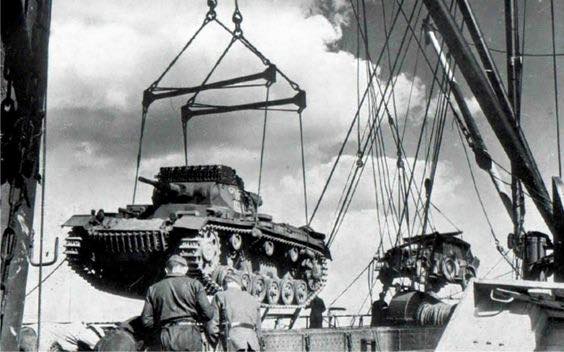
As part of Germany’s Southern strategy was the Deutches Afrikacorps, or the German Africa Corps or DAK. On 5 February 1941, MajGen Erwin Rommel was given command and tasked with forming the DAK, transporting it to Libya, and securing North Africa. It was really just a sideshow of a sideshow at the time. The DAK would be formed around the the 3rd and and 15th Panzer Divisions. For the next week, Rommel organized the two divisions for rail movement to Southern Italy. In the process, he fast tracked (ha!) the 5th Panzer Regiment, an infantry battalion, and engineer, medical, anti aircraft, and water purification companies for immediate transport and told his executive officer to follow with the rest. Newly promoted LieutGen Rommel flew to Tripoli on 12 Feb 1941 ahead of the world’s first brigade combat team, where he met them two weeks later. (The rest of the DAK would arrive over the course of the next three months .)

Rommel, with the first units of the Africa Corps, would attack the British as soon as the 5th Panzer Regiment was off the ships.

American Universities Declare War on Military History

American Universities Declare War on Military History: Academics seem to have forgotten that the best way to avoid conflict is to study it.

“Many, indeed most, academic institutions across the continent are infected with an intellectual virus that causes them to reject study of subjects that seem to some faculty members distasteful. This represents a betrayal of the principles of curiosity, rigor and courage that must underpin all worthwhile scholarship.”

“MacMillan demands: “Do we really want citizens who have no knowledge of how our values, political and economic structures came into being?”

“Unfortunately, many in the academic community assume that military history is simply about powerful men — mainly white men —fighting each other and/or oppressing vulnerable groups.”

“North America’s great universities should be ashamed of their pusillanimity. War is no more likely to quit our planet than are pandemics. The academics who spurn its study are playing ostriches. Their heads look no more elegant, buried in the sand.”

The Space Shuttle Challenger Explodes

Every generation has a “Where were you when…” moment. Until 9/11, that moment for Generation X was 28 January 1986, when the Space Shuttle Challenger exploded a minute or so after take off, killing the entire crew, including the first “Teacher in Space” Christa McAuliffe.

For a brief moment in time, space travel was open to normal people and the childhood dream of living in space in the 21st Century was a step closer to reality.

That dream came crashing down at 11:39am 28 January 1986 while sitting in my grandparent’s living room watching the launch on TV.

The Sack of Panama

On 18 January 1671, the notorious Captain Henry Morgan with an obviously ill disciplined pirate army of about thousand defeat a Spanish army of more than 6000 and capture the second largest city in the New World, Panama. After the usual orgy of rape, murder, and torture, Morgan burned the city to the ground. He then betrayed his own men, escaped with the loot, and left his army to the mercy of the vengeful Spanish. The Sack of Panama is the high water mark of the first, or “buccaneering”, phase of the so called “Golden Age of Piracy”.

Desert Storm: Prelude

In the fall and winter of 1990, you couldn’t turn on the news and not hear the word “Vietnam”. America’s war in South East Asia was front and center in the minds of the country since almost 500,000 Americans were deployed to the other side of Asia in Saudi Arabia. For months Operation Desert Shield, the Coalition plan to defend Saudi Arabia, was the hot topic on the evening news, and more importantly, virtually the only topic on the world’s first 24 hour news channel, the new Cable News Network, or CNN, which by broadcasting all day, essentially drove the narrative.

On paper, America’s involvement in South West Asia in 1990 did look like a folly: Iraq had the 4th largest army in the world, and arguably the most experienced. Iraq’s entire military had just emerged from an eight year blood bath with Iran: every one of its soldiers was battle hardened. The Iraqi Republican Guard was on every pundit’s list of the top ten most feared and respected military formations in the world. And after overrunning Kuwait in a day in August, they had had months to dig in. America had fought some small engagements in the 80s, but had only last seen large scale combat eighteen years before in 1972, when it seemed that it was ignobly run out of Vietnam. America had air power for sure, but four years before Muammar Gadhafi had easily weathered that and survived.

None of this was lost on GEN Norman Schwarzkopf, the Coalition commander. For months he had shepherded a fragile coalition of longtime friends and former adversaries, developed a plan of unheard of audacity, and dealt quickly and severely with interservice rivalry and meddling from the Pentagon. Desert Shield was the first real test of former President Ronald Reagan’s new upgraded military, the new AirLand Battle Doctrine, and the much needed reforms and forced jointness of 1986’s Goldwater-Nichols Act. Even though the US military was built to fight the Soviets, Schwarzkopf knew the stakes were greater than the liberation of Kuwait. On 12 January 1990 in a conference with his staff, and corps and division commanders, he said, “America is watching, we can’t fuck this up.”

On 15 January 1991 Schwartzkopf received the final approval from Pres HW Bush to commence offensive operations on the 17th. That afternoon outside of Riyahd Saudi Arabia, Schwarzkopf told the press that he had almost a million soldiers, sailors, airmen and marines from America and 33 other countries, and more importantly, that he was prepared to take offensive action to oust occupying Iraqi military forces from Kuwait. The press conference was part of an information campaign to give Iraqi dictator Saddam Hussein one last chance to leave Kuwait.

He didn’t take it.

The Battle of Al Khafji

As coalition air power pounded Iraqi military and infrastructure, Iraqi dictator Saddam Hussein needed to force a ground engagement before his army disintegrated, if only for the propaganda value.

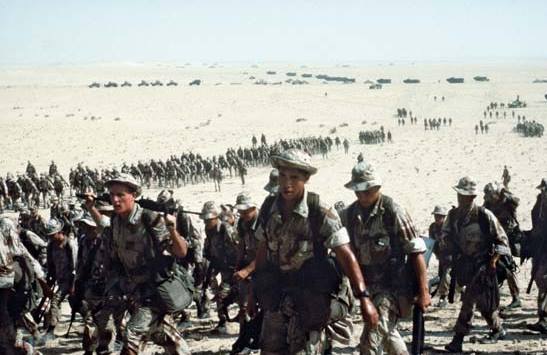
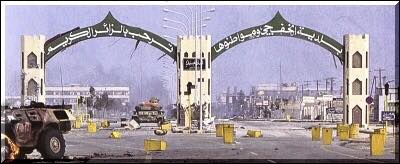
On 29 January 1991, three severely attritted Iraqi mechanized and armor divisions attacked the Saudi port town of Khafji, just across the border from Kuwait. They overran a US Marine observation post and routed a Saudi Arabian battalion. Coalition commanders knew the attack was imminent but the US Air Force would not deviate from the air campaign plan and the US Navy carriers and naval gunfire were unavailable due to a lack of flexibility and integration into the coalition operations (the air tasking order had to be printed out, put on a plane, and flown to the carriers in Persian Gulf for coordination, approval, and execution daily. The US Navy had no communication systems compatible with the US Army and Air Force systems).

Most of the attack was defeated but the Iraqi army still occupied the town on the night of 29-30 Jan. However, a US Marine Force Recon team stayed behind in the town and from a roof top began to coordinate air and artillery fire on the Iraqi forces the next morning. In order to strengthen the coalition unity and allow the Saudis to redeem themselves, Gen Norman Schwarzkopf decided that the town should be recaptured by the Arab coalition forces in the area.

Starting on the night of 30 Jan, Saudi infantry and Qatari tanks assaulted into the town supported by US Special Forces and USMC artillery. Though there was some heavy fighting initially, coalition firepower would eventually force the Iraqis out. The Saudis and Qataris cleared the town by 1 Feb.

The Battle of Khafji was the first ground engagement of the Gulf War. The Iraqi Army lost three of its best regular divisions and the Coalition casualties were relatively light. And were mostly due to a friendly fire incident with the US Marines on the night of the 29th, an unsupported initial attack by the Qataris on the 30th, and an AC-130 that was shot down on the 31st. Additionally two US soldiers were taken prisoner when their HET (military tractor trailer) made a wrong turn and inadvertently drove into town. Saddam Hussein wanted to force “The Mother of All Battles”, but found out quickly that Coalition air power, once properly allocated, made short work of his armor and mechanized troops.

Operation Compass: The Aussies Capture Tobruk

In December 1940, the British launched Operation Compass against the Italians in the Western Desert. What started as a spoiling attack transformed into a full fledged offensive once the Italians started surrendering en masse around Sidi Barrani, Egypt. On 5 January, 1941 and to much acclaim, the 6th Australian Division broke through the Italians making a stand at Bardia in Libya and raced towards the big prize in the Western Desert: the city of Tobruk. The Western Desert Campaign was a three year see saw struggle where success was based almost entirely on the supply situations of the respective sides. And there was no more important city logistically in the area than Tobruk.

Tobruk was the mid-way point on the coastal highway between the two gateways to the Western Desert, El Agheila in the west and El Alamein in the east. It also has a deep water harbor that allowed an occupier to receive vast quantities of supplies that would otherwise have to be trucked hundreds of miles overland. Finally it was at the base of the “Cyrenaican Hump” and forces there could be used to cut off anyone at Benghazi or Derna. The advantages of Tobruk were not lost on the Italians and they turned it into a fortress.

On 21 January, the Australians cleared paths through the wire and minefields outside Tobruk for 18 British Matilda tanks and several captured Italian tanks. Once inside the city, the tanks with the supporting Australian infantry were unstoppable. Lacking any effective anti tank weapons, the defenders surrendered in droves. The Australians took 25,000 prisoners, and forced the Italians to abandon all of Cyrenacia. For the rest of January and into February, the race was on: Could the British capture Libya faster than the Italians could abandon it? If they could Tunisia laid defenseless and the campaign in North Africa would be over.

The Penguin: German Pirates in the Antarctic

The years long struggle between the Royal Navy, and the U-boats and surface raiders of the German Kriegsmarine to cut off Great Britain of supplies from the Americas and Asia during the Second World War is usually known as the Battle of the Atlantic. However, this is misleading because that fight took place across the world’s oceans, and nowhere fiercer than the southern reaches of the South Atlantic and Indian Oceans. The shipping lanes around South America and South Africa were prime targets, not for the resource heavy U boats, but for the hilfkreuzers, or auxiliary cruisers, essentially fast merchantmen armed with guns scavenged from obsolete First World War warships. They were the scourge of the South Seas. Though they were no match for any proper naval ships, they preyed on the merchantmen far from the naval bases of the North Atlantic. Ton for ton they were the most effective commerce raiders in the German Navy. And none was more feared than HK 2 “Pinguin”

By early 1941, the Pinguin had already sunk or captured over 100,000 tons of shipping, and sent more than few back to Nazi occupied France with prize crews. She had two seaplanes for scouting, a plethora of cannon, two torpedo tubes, and carried more than 300 mines. She survived almost exclusively on the captured stores of her victims and routinely posed as a Norwegian freighter to evade the Allied navies. (The Norwegian navy and merchant marine were under the control of Great Britain after its occupation by Germany in the summer of 1940.)

On Christmas Eve 1940, while prowling the seas near South Georgia Island, the Pinguin intercepted a message between two Norwegian ships on a whaling expedition off of Antarctica. Posing as a supply ship on 14 January 1941, the Pinguin appeared out of the fog and slipped next to the whaling fleet’s factory ships. Her crew quickly and quietly boarded and overtook them. Then with a bit of speed, subterfuge, and distributed decisive action, took control of all of the whalers and the supply ships. In a bloodless victory, the Pinguin captured the entire Norwegian national whaling fleet of 14 ships, totaling 36,000 tons of shipping, 10,000 tons of fuel oil, and enough whale oil to supply the German Navy for a year. Additionally, prize crews would take all but two of the ships back to France where the factory ships were converted into auxiliary cruisers, and the whalers into minelayers.

In Berlin, Admiral Raeder was ecstatic at the news, and immediately issued orders for other German surface forces to break out into the Atlantic. (If a slow, lightly armed merchantman could do such damage, imagine what a real cruiser, of even a battleship, could do? …or so the thinking went.) In early February the battlecruisers Scharnhorst and Gneisenau made a successful foray into the Atlantic. Although the shipping sunk was limited, their sortie threw the convoy system into chaos as the Royal Navy reacted. Buoyed by the success, Raeder began planning an even bolder sortie to unleash the most powerful German battleship into the Atlantic: the Bismarck.

Common Sense

During the American Revolutionary War, it is generally agreed that 1/3 of the population of the Thirteen Colonies supported independence from Great Britain, 1/3 did not, and 1/3 were on the fence, falling on whichever side seemed to be the most advantageous at the time. On 10 January, 1776, a small pamphlet, Common Sense, was published in Philadelphia by an anonymous author which immediately unified the 1/3 that supported independence from Great Britain, and a good many of the fence sitters, if only temporarily.

Penned by Thomas Paine, an English born recent immigrant to America, Common Sense provided an easily digestible and, pardon the pun, common sense argument on why American independence was not just desirable for the Thirteen Colonies, but for mankind itself, particularly those that languished under a dictatorial absolute monarch. (Which, to be fair, the British monarchy wasn’t, but perception is reality.)

Unlike most Enlightenment treatises, which targeted other scholars, Paine’s target audience was America’s lower and middle classes. He eschewed the appeals to authority to obscure Greek and Roman thinkers, as Voltaire, Rousseau, and even Franklin were wont to do, and made his case, convincingly, through straight logic emphasized by Bible quotes for his primarily devout Protestant working class audience.

Common Sense flew off the printing presses and is the bestselling book in American history. It is the high water mark of Enlightenment literature and so influential that the future Declaration of Independence, US Constitution, Polish Constitution of 1791, and the French Declaration of the Rights of Man and Citizen were direct results of the mere 48 page pamphlet.

There are no asterisks, and Common Sense is just as relevant today as it was 245 years ago.

Thomas Paine’s Common Sense is Required Reading for Humanity.

Some Quotes:

“I offer nothing more than simple facts, plain arguments, and common sense.”

“Some writers have so confounded society with government, as to leave little or no distinction between them; whereas they are not only different, but have different origins. Society is produced by our wants, and government by wickedness; the former promotes our happinesspositively by uniting our affections, the latter negatively by restraining our vices. The one encourages intercourse, the other creates distinctions. The first is a patron, the last a punisher.”

“The World is my country, all mankind are my brethren, and to do good is my religion.”

“In England a king hath little more to do than to make war and give away places; which in plain terms, is to impoverish the nation and set it together by the ears. A pretty business indeed for a man to be allowed eight hundred thousand sterling a year for, and worshipped into the bargain! Of more worth is one honest man to society and in the sight of God, than all the crowned ruffians that ever lived.”

Society in every state is a blessing, but government, even in its best state, is but a necessary evil; in its worst state an intolerable one: for when we suffer, or are exposed to the same miseries by a government, which we might expect in a country without government, our calamity is heightened by reflecting that we furnish the means by which we suffer.

“A long habit of not thinking a thing wrong, gives it a superficial appearance of being right, and raises at first a formidable outcry in defense of custom. But the tumult soon subsides. Time makes more converts than reason.”

“Small islands, not capable of protecting themselves, are the proper objects for kingdoms to take under their care; but there is something absurd, in supposing a continent to be perpetually governed by an island.”