The Raid on Columbus

In the winter of 1915/16 Mexican counter-counter-revolutionary (I think), Pancho Villa, was on the losing end of his fight against “Primer Jefe” First Chief Venustiano Carranza. The “Villistas” as Pancho Villa and his men were called, were holed up in the Chihuahua Mountains and were desperate for supplies to continue. Three miles across the US/Mexican border was the town of Columbus, New Mexico, which could provide the necessary guns, horses, food, and blankets.

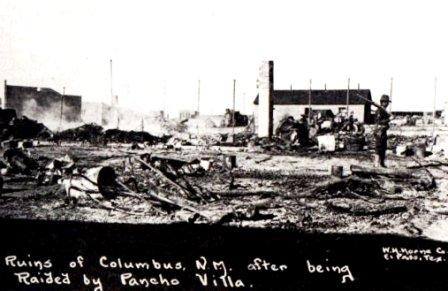
Before dawn on 9 March, 1916, Pancho Villa and 500 Villistas attacked Columbus and Camp Furlong just outside of town where 120 troopers of Headquarters, H, and F Troops of the 13th Cavalry were stationed. The garrison at Camp Furlong was saved by the actions of two lieutenants, one barefoot, who organized a defense around the post’s guard shack with the headquarters troop’s machinegun platoon. Once the Villistas were beaten back at the camp, F troop moved into Columbus where the civilians were fighting back from the brick schoolhouse while Pancho Villa and his men looted and burned the rest of the town. They arrived just in time to prevent the Villistas from robbing Columbus’ bank when a well-placed Hotchkiss machine gun prevented any attacker from crossing Broadway, Columbus’ main street.

The raid was successful, if at a heavy cost, as Pancho Villa stole hundreds of horses, rifles and pistols, and much needed food and blankets from the town at the cost 90 casualties, 70 of whom were killed. But he wasn’t counting on the natural aggressiveness of the United States Cavalryman. As Pancho Villa raced to the border, and then 15 miles into Mexico, the regimental executive officer with 40 men dogged them for the next 8 hours, killing or wounding another 250 Villistas, and forcing Pancho Villa to abandon much of his booty.

In the end Pancho Villa suffered over 300 casualties and the Americans eleven troopers and ten civilians killed and another dozen wounded in the Battle of Columbus. The raid sent shockwaves through the United States, particularity the death of the pregnant Mary James, who was killed by the Villistas fleeing the burning Hoover Hotel. President Wilson would authorize a punitive expedition into Mexico led by LTG John J. “Blackjack” Pershing to capture or kill Pancho Villa.
The Paris Commune

After the French Second Empire fell in its defeat in the Franco-Prussian War of 1870, Paris demanded more representation in the interim Third Republic ruled by the National Assembly at Versailles. Paris was administered directly by the Assembly the same way Washington DC was administered the US Congress for many years. Furthermore, many Parisians felt that they were not adequately represented in the Assembly (they weren’t) and that the Assembly was going to bring back the monarchy (they weren’t). On 18 March 1871, the Paris Commune, or city council, revolted against Republican rule with the support of the National Guard which was not disarmed by the Prussians at the end of the war as was the French army.

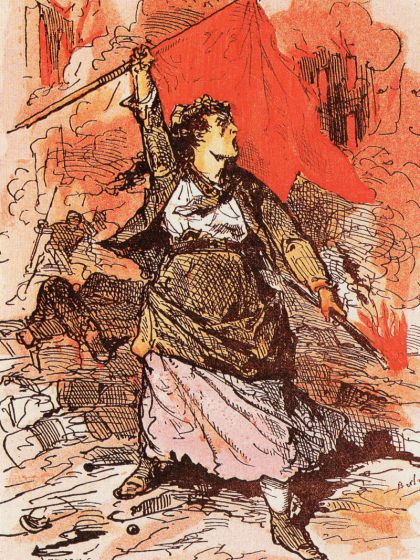
The “Communards”, as they were known, were very progressive minded and even managed to put some reforms into place, such as women’s suffrage, the separation of the church and state, pensions for widows of National Guardsmen, and some worker’s rights, particularly the abolition of shift work and worker’s fines. But by the same token, many radical ideas were forced upon the Parisians at the barrel of a gun, such as banishment of rent, debt, and interest, and workers forcibly taking over their employer’s enterprises. The Commune ruled by decree and acted as the three branches of govt: executive, legislative and judicial, backed by the guns of the National Guard. The French Tricolor was immediately abandoned for the Socialist Red.

Like any organization with absolute power, absolute corruption soon followed. And the “Tyranny of the Majority” became progressively worse over the next two months. First they came for the Catholics, then the businessmen, then the managers, then the property owners, then finally anyone deemed “Enemies of the People”. Within two weeks, social order broke down and culminated in early May with the establishment of the Committee for Public Safety, which was just as brutal as it was during the Reign of Terror in the French Revolution. But instead of guillotines, the preferred method of executing “undesirables” was firing squad.

By mid-April, the chaos descended to the point that the units of the National Guard, which were recruited and based on Parisian neighborhoods, became mere neighborhood gangs and protection rackets against the excesses of rival neighborhoods and their National Guard units, or muscle to prevent spurious denunciations of its members as “Enemies of the People”. This prevented the National Guard from coordinating the defense of Paris against the rearmed French Army supported by the Prussians. On 21 May, the “Versaillier” Army entered the city through an unguarded gate and began seizing neighborhoods. The Communards had no organized defense, so like their grandparents in 1830, and their parents in 1848, the Communards resorted to the time honored barricade, where furniture, bricks, carts and wagons formed impromptu ramparts across Parisian streets. But the French army was prepared for this and bypassed the barricades by blowing through or knocking down walls inside the buildings along the street. As the French army steadily pacified each neighborhood in turn, they shot any Communard that was found with a weapon, or had powder stains on their person. 21-28 May 1871 was known as “Bloody Week” and tens of thousands more were killed and much of Paris burned to the ground.

Future communists, socialists and anarchists would see the Paris Commune as a model. Karl Marx praised the Paris Commune, calling it the “Dictatorship of the Proletariat”, but felt that the Communards did not go far enough fast enough. Marx would later write that Communards should have immediately eliminated all undesirables, and in the moment of the initial fervor, formed the supporters into an army to export the revolution, or at the very least defeat and “reactionaries and their armies”. Marx’s disciples: Lenin, Trotsky, Stalin, Mao, Ho, Kim, Castro, Mugabe, Chavez, and many others would put the lessons of the Paris Commune into action to great, and deadly, effect in the 20th Century.

A Fortuitous Snowstorm

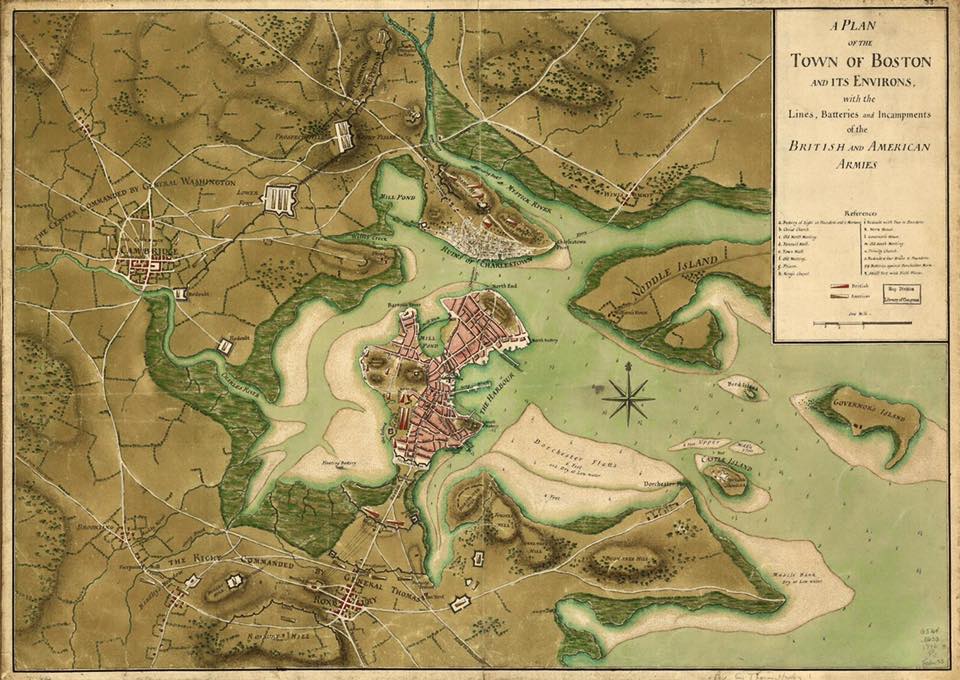
The fortification of Dorchester Heights by the Continental Army made Boston untenable for the British: Henry Knox’s cannon dominated the city and the harbor. On 5 March 1776, Gen Howe prepared 2500 redcoats to seize the Rebel position just as he had done ten months before at Bunker Hill. The operation would commence at dawn the next day.

General George Washington expected the attack and placed 6000 troops on Dorchester Heights to repel it. But he also knew that if the British managed to close and come at his poorly trained and poorly disciplined troops with the bayonet, no amount of continentals would matter – they would break. Even a Pyrrhic victory for the British like Bunker Hill would spell the end of the siege of Boston. Washington’s critical shortage of powder would be exposed to all the world, and without the cannon the British navy could supply Howe indefinitely. That would leave Washington just one remaining option: Storm the city.

Washington couldn’t chance a loss of the Dorchester Heights without possession of Boston – It would be the end of the Revolution. And he couldn’t storm the city while the navy was in the harbor… Unless it was distracted.

Which it would be supporting Howe’s assault.

Washington decided to gamble everything on a single throw of the dice. While Howe and his best troops were busy south of the city supported by the British Navy, Washington’s best regiments would assault over the Boston Neck, overwhelm the redoubt with sheer numbers, and seize the city. The casualties would be excessive, but a loss at Dorchester would be fatal to the Revolution if he didn’t already have Boston. He would lead the attack the moment Howe’s men were committed on the peninsula and unable to reinforce the Boston neck.

On the night of 5/6 March 1776, Rebel spies reported British assault troops were loading flatboats for transport across the harbor. Washington brought up his best regiments, including the fishermen from Marblehead that proved so critical in the year ahead, to assault positions before the neck. The morning of 6 March was expected to be the bloodiest of the war.

But it wasn’t to be: A fierce and blinding, but unexpected, snowstorm hit Boston around midnight and continued throughout the morning. About noon it stopped as quickly as it started. But by then Howe couldn’t attack. His flatboats would be easy targets for Knox’s guns. He knew surprise was lost and Washington would reinforce the heights. Losing a large part of his army in another Bunker Hill just to be bottled up on another peninsula would gain him nothing. (Remember he didn’t know about the shortage of powder.) The next day Howe drafted a note to Washington offering not to burn Boston to the ground if he was allowed to evacuate unmolested.

Washington quickly agreed. On 17 March as the last Redcoat and loyalist were boarding ships in the harbor, Washington triumphantly entered Boston. As he was traversing the Boston Neck, he eyed the British redoubts and fortifications he planned to personally assault on the morning of 6 March 1776.

No amount of troops could have forced the Neck: The Americans would have been massacred, and Washington would have undoubtedly been killed leading the charge. It wasn’t the last time Washington and the Continental Army was saved by the weather.

The Fortification of Dorchester Heights

On 2 and 3 March 1776, Henry Knox’s cannon from Ft Ticonderoga opened fire on British positions around Boston. They did the same on the late afternoon of 4 March. But as the British were safely tucked away riding out Knox’s bombardment, LTG George Washington put in motion his plan to fortify Dorchester Heights, which overlooked Boston and the harbor.

As soon as the sun sank below the horizon, thousands of Continentals trudged up the heights with hay bales. With these they created a wall in the darkness that obscured their movements and muffled the sound of thousands of soldiers digging. Then they dug trenches and gun pits for cannon throughout the night. By 4am, the last of Knox’s guns were in place. The hay bale wall was dismantled and the bales were used to reinforce the position. The guns on Dorchester Heights dominated Boston Harbor. Admiral Shuldham informed Gen Howe, the commander of the British army in Boston, that the city was untenable. The stunned Howe replied, “The rebels have done more in one night than my whole army would have done in a month.”

But it was all a bluff: Washington barely had enough powder to hold the heights if the British attacked as they did at Breed’s Hill, much less clear the British Navy from the harbor.

The Raid on Nassau: America’s First Amphibious Assault

In the early months of 1776, George Washington was desperate for gunpowder. So the Continental Congress dispatched the fledgling US Navy to seize British stores along the Carolina and Georgia coasts. In secret, they also authorized Commodore Esek Hopkins to raid into the Caribbean.

On 3 March, 1776, Hopkin’s and his small flotilla appeared off the coast of the British colony of Nassau. Captain Samuel Nichols and 200 Marines landed on the island in the first amphibious assault in Marine Corps’ history, and bloodlessly seized the fort.

The next day the Marines seized the town on the other side of the island only to find that the British governor and the townsfolk worked all night loading most of the powder onto ships. The ships departed at first light and slipped by Hopkins.

The Tripartite Pact and the Eastern Mediterranean

In a diplomatic coup, Bulgaria signed the Tripartite Pact with Germany, Italy, Japan, Slovakia, and Romania on 1 March 1941. This made seven of the eight countries bordering Jugoslavia hostile to the British. A “Grand Balkan Alliance” against Germany with Jugoslavia, Greece, and Turkey became a pipe dream of the British Foreign Office. Additionally, German troops crossed into Bulgaria the same day making the invasion of Greece a near certainty. Winston Churchill, sensitive to German propaganda and an American perception that Britain does not help her Allies, ordered three of General O’Conner’s best units from the Western Desert in North Africa to Greece: the 2nd New Zealand Division, the 6th Australian Division, and the 1st UK Armoured Brigade.

Opposite O’Conner, LtGen Erwin Rommel organized every German soldier in Africa around the newly arrived 5th Panzer Regiment and created the 5th Light “Afrika” Division, which along with picked Italian motorized and armored units, prepared for an immediate offensive.

On 1 March 1941, the 33rd Flak (anti-aircraft) Regiment unloaded on the docks of Tripoli, Libya. The 33rd was equipped with 88mm flak 18 cannons which were designed to fire at high altitude bombers, but it’s high velocity projectiles proved equally effective against Allied tanks. The 33rd would provide Rommel with a much needed advantage against the heavier Allied armor.

“The Murder Mill of Verdun”

The German Chief of Staff, Field Marshal von Moltke the Younger was replaced by his rival FM Erich von Falkenhayn after the failure of the Schlieffen Plan in the autumn of 1914. In 1915, von Falkenhayn chose to solidify the trench lines stretching from the Swiss border to the North Sea and focus on defeating the Russians. After vast gains in the East that year, von Falkenhayn decided to focus back on the West and defeat the French in 1916.

His plan was to “bleed the French white” in a battle of attrition for the emotionally significant city of Verdun. Von Falkenhayn knew the French would never allow the Germans to keep Verdun, so he planned to destroy the counterattacking French with a concentration of artillery unseen in history. Moreover, the terrain around Verdun favored the Germans: the area was littered with natural choke points that could be exploited. The most significant being the single road the French had to use to supply their armies, and the location of Verdun on the east bank of the Meuse river, forcing the French to rely on just seven bridges, all within range of German artillery. Finally the French forts protecting the city, robust and built after the French loss in 1870, were criminally undermanned after being stripped for fighting in Flanders the year before. The centerpiece of which were the massive twin forts of Vaux and Douaumont.

At 0715, 21 February 1916, Unternehmen Gericht (Operation Execution Place) began with a 10-hour artillery bombardment by 808 guns. The German artillery fired over a million shells along a front just 19 miles long by 3 miles wide. Twenty-six super-heavy, long-range guns, up to 420 mm (16.5 in), fired on the forts and the city of Verdun; a rumble could be heard 99 miles away. The bombardment was paused at midday, as a ruse to prompt French survivors to reveal themselves. The main German attack was launched that afternoon. The Germans used flamethrowers for the first time and the infantry followed closely with rifles slung, to use hand grenades to kill the remaining defenders. The battle would eventually last ten months and cause almost a million casualties on both sides throughout the year.

1916 was one of those seminal years in Western history, comparing only to 440 BCE, 34 CE, 410, 843, 1066, 1096, 1492, 1648, and 1776. It can be argued (convincingly imo) that the culmination of 2500 years of recorded history occurred at the Battle of Verdun, and it’s two incestuous offspring: the Battle of the Somme and Brusilov’s Offensive. These battles pitted the four great Christian, rational, progressive, technologically advanced (all by the standards of the time) Westphalian states in an irrational, emotionally driven, nationalist, suicidal, industrial slaughter the effects of which our great great great grandchildren will still deal with.

Everything before Verdun led to it, and everything after Verdun was because of it. If Western civilization continues its slow slide back into barbarism, historians in the far distant future will look at 0715, 21 February 1916, as the moment the descent began.

Henry Knox Fires his Guns

In the autumn of 1776, the Siege of Boston was at a perceived stalemate. The British could sortie and end the American Revolution anytime it wanted: LTG George Washington did not have enough powder to fight a battle, and the Continental Army didn’t have the discipline to retreat; the army would disintegrate. But Washington did have more than 20,000 militiamen and the lack of powder was a closely guarded secret. However, even though Washington had few pieces of artillery, which made the lack of powder less obvious, he still needed more cannon to end the siege. Henry Knox would change that.

Henry Knox was a bookseller from Boston. He was never a soldier but Washington was impressed with his military expertise, obtained solely from reading, and made him his chief of artillery. In September of 1776, Henry Knox set off with a motley crew of engineers, artillerists, and backwoodsmen to Ft Ticonderoga which Ethan Allen and Benedict Arnold had captured that summer. It was packed with cannon.

Knox had no way to transport the cannon, so he waited for the harsh New England winter and created a “Noble Train of Artillery” by placing the cannon on sleds drawn by oxen. They cut their way for 300 miles over the snowy Berkshire Mtns. The trek took three months and by the end of January, 60 tons of cannon were at Washington’s disposal.

By mid February the gun carriages were complete. On 19 February 1776, Henry Knox, personally siting each gun, unleashed a furious barrage on British positions around Boston. It was ineffectual but it reinforced the perception that the Continental Army had plenty of gunpowder.

However, firing on British positions wasn’t going to end the siege. The guns needed to fire on the British Navy supplying Gen. Gage in the city. They could do that from the unoccupied Dorchester Heights to the south of the city, but the heights were a no mans land because the British fired on any American attempt to fortify the position. Washington needed a way to occupy the Heights with the cannon and dig in before the British cleared it with fire.

Colonel Henry Knox figured that one out too.

Dreadnought

On 10 February 1906, HMS Dreadnought, the world’s first modern battleship, was launched. The Dreadnought was a revolution in military affairs so rarely seen in history. The moment the Dreadnought slid into Portsmouth Harbor, every fighting ship in the world was immediately obsolete. Upon learning of it, US President Theodore Roosevelt sent America’s battle fleet, “The Great White Fleet” (because it was painted white, you bigot) to circumnavigate the world ostensibly to show America’s global commitment. But in reality because America’s pre-dreadnought battleships were no better than scrap metal in an actual fight, and only useful for showing the flag against colonies and nations whose resident professional naval personnel were ignorant of the new paradigm in naval warfare. It’s telling that the Great White Fleet only made one stop in Europe, Gibraltar.

At the turn of the century, naval battles were characterized by slow battleships initially firing at long range by a small amount of big guns in order to damage the enemy enough to put him out of position. Then the object was to close the range so many more smaller guns with higher rates of fires could do the killing damage. Advances in metallurgy meant the smaller guns had to get closer to penetrate. And the larger guns’ splashes couldn’t be identified among smaller guns’ splashes making correction difficult and marginalizing the bigger guns at close ranges. In any case, the widespread use of the torpedo in destroyers and cruisers kept distances long (in order give the ships time to avoid them). By the Russo-Japanese War, long distance gunnery reigned supreme and the first combatant to gain position usually won (as seen clearly in the Battle of Tsuchima).

The HMS Dreadnought was the first ship built specifically to these new realities. She had a uniform battery of ten 12” guns in five turrets and forewent the medium range 6” and 8” guns of her predecessors. She was the first ship with steam turbines which nearly doubled her speed. She had the latest fire control, and her armor was impenetrable to all but the largest guns and torpedoes of the day. (Shit quality steel was used in passenger liners… like the Titanic.)

The HMS Dreadnought was as fast as a cruiser, had as many torpedoes as a small destroyer squadron, had the long range fire power of five pre-dreadnought battleships, and the armor of Cthulhu. She set off a naval arms race across the world that wouldn’t slow down until after the First World War.

The Battle of Beda Fomm

In early February 1941, the Italian Army was retreating through Cyrenaica to eastern Libya as fast as possible while trying their best to slow down the Australian advance along the coast road. On the 6th, the Aussies overwhelmed their blocking force at Benghazi and the Italian retreat turned into a rout.

Cutting across the base of the Cyrenacian Hump were the Desert Rats of the British 7th Armored Division, who were determined to prevent the Italian escape. But the realities of fighting in the unforgiving Western Desert far from their supply depots in Egypt had slowed the advance considerably. All the necessities of modern mechanized warfare: fuel, water, ammunition, spare parts, lubrication etc, had to be convoyed hundreds of miles in trucks that were using most of the very fuel they were tasked to move forward. The Desert Rats’ Matilda and Crusader tanks could go no further, and the division stopped to reoganize and conduct maintenance at Mechilli, about 150 miles from cutting off more than 40,000 men of the Italian X Army.

But the division commander, MajGen Creagh, was not going to abandon his mission. He formed an ad hoc force from all of his brigades’ armoured car battalions, two infantry battalions and some engineers in trucks, and a few towed batteries of field guns and anti-aircraft guns. It was desgnated “Combeforce” after it’s commander Lieut. Col. J.F.B. Combe.

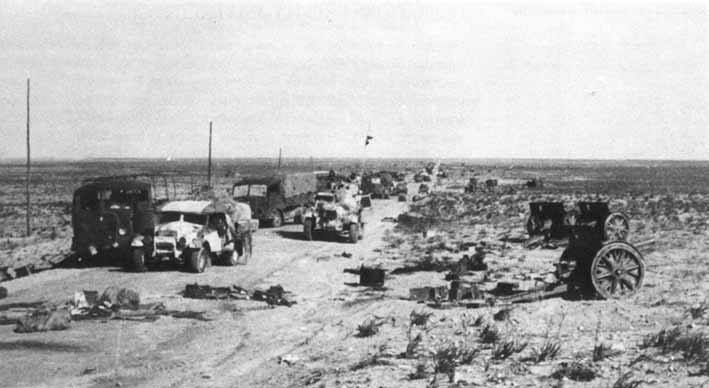
Combeforce raced ahead (at an average of 5mph) for 30 hours over brutal terrain and arrived at Beda Fomm on the coast road in the late afternoon on 7 Feb. They immediately set up a hasty ambush, and fortunately for them they did so because the Italians appeared less than 30 minutes after they arrived. Combeforce attacked and forced the shocked Italians back north. The trap was sprung.

The next morning the Italians conducted a series of increasingly desperate combined arms attacks to breakout. The British armored cars were clearly outmatched by the Italian tanks, and the infantry lacked any viable anti-tank weapons, short of climbing on the tanks and throwing grenades in them. In many instances, they just let the Italian tanks roll over them to engage the supporting Italian infantry at close quarters. The final Italian attack was only stopped by Combeforce’s battery of 25pdrs firing point blank over open sights, in one case, at less than 30 yds.

Unable to break through the British to their south and with the Australians bearing down on them from the north, the Italian X Army surrendered the next day: 25,000 men, and over two hundred tanks and artillery pieces.

The road to Tripoli was open, but the Brits and Aussies were wrecked in the process. The Battle of Beda Fomm is the classic case of culmination – the Allies were spent and they wouldn’t get any closer to Tripoli, or throwing the Axis out of Africa, for another two years.