
Category: Professional Development
The Last Jedi

*SPOILERS* Don’t read any further if you haven’t seen the movie. I mean it – Go see the movie first.
*SPOILERS*
.
.
.
.
If you are reading this sentence then I am assuming that you know that Luke died, Leia sort of died, Snoke died, Phasma died (WTF!), Ackbar died (Seriously WTF!) the galaxy is ruled by a whiny, petulant, and incompetent child (actually, that *is* pretty scary), The Finn is now a character straight out of the Diary of a Wimpy Kid, the fate of the Rebelistance is on the shoulders of a Mary Sue who was sand-sledding a few weeks before (and she probably needs to wash), and in that time the Jedi have developed unbelievably new force powers that even the Jedi at the height of their training and scholarship didn’t have.
But at least we still have Poe, Rose, DJ, BB-8, and hopefully a few more from the Rebelistance survivors to carry the series forward (I kinda liked that A-Wing pilot too. I can’t remember her name though). But no decent Imperial characters are left alive except Ren, and he’s problematic.
But for some reason, the movie worked for me, even the second time when I knew what was going to happen. It was a fun movie even if it had issues. Like I said before, it’s no Rogue One. Rogue One with a John Williams score would be in my top five favorite movies of all time. But alas, we got John Williams-lite. There are three types of Star Wars Fans: Lightsaber fans, Blaster fans, and Turbo Laser fans. I am the latter. I love Star Wars’ space battles, and it’s going to take a long time for me to forgive Disney for what they did to Ackbar. And I love a good blaster fight as long as they get in their ships at the end. The Force is just a Deus Ex Machina for lazy writers and ruined The Extended Universe for me in the mid-2000s. And well, that’s what’s looking to happen with Star Wars after seeing The Last Jedi.
So let’s get what I didn’t like out of the way. The biggest problem with the The Last Jedi is the Force. I don’t care what the Force can do, but it has to be consistent. Consistency is key. Consistency leads directly to integrity, and without integrity there might as well be nothing. The Force has to follow the in-universe rules of its existence, and anything new has to retroactively fit. If it doesn’t the franchise dies. The Terminator franchise died because the time travel didn’t follow the in-universe rules established in the first and second films. If a plot device has no integrity, then there is no tension, because the audience will subconsciously say, “The writers will just add a new Force power. They’ve done it before”. The Last Jedi made this mistake twice. Once with Dead Yoda affecting the real world (which has never happened before even in the wildest fever dreams of the EU writers). And the next was with the Jedi telepathic/telekinesis/Force holes (which has also never happened before).
First, Dead Yoda lit the tree on fire. No Dead Jedi has ever affected the “real world” with anything except words before. We know the Dead Jedi are always watching. So if they can affect the real world (“world” as in universe created by George Lucas), why didn’t Dead Obi lightning the Death Star’s exhaust port in the original Star Wars? Or Dead Qui Gon come back and lightning Jar Jar before he fucked the galaxy? There’s a thousand examples over the previous seven movies when the Dead Jedi could have affected the world as Yoda did with that tree. Why didn’t they? At least it can possibly be explained away by saying Yoda forced (Ha!) Luke to channel the lightning without his consent. But again, no dead Jedi, or even a live one, has ever forced another Jedi to use the Force against his or her will before. That’d be “Force Rape”, wouldn’t it?
The bigger Force inconsistency in The Last Jedi were the telepathic/telekinesis/force induced worm holes. That’s never happened before. It was hinted at between Leia and Luke, and Luke and Vader in Empire, but until the big reveal that Leia was force sensitive, it was a liability and required proximity. In TLJ it’s plot centric and they have entire conversations. So why didn’t the Jedi use it before this? Was the power only learned from the ancient texts in the tree, that Rey never read? Surely Yoda and Sam Jackson knew about it when the Jedi for all intents and purposes ruled the galaxy? So why wasn’t it used when Order 66 was executed, when a simple “Beware” to the Jedi would have saved them? Or during the Clone War? The communication aspects alone would have made it a game changer: A person to person instantaneous communication system that doesn’t rely on connecting infrastructure or line of sight? And we know from the water on Ren’s hand that physical objects can be transported. That’s a whole other dimension to warfare. The Jedi could have formed an agile command, control, communications, computers, intelligence, information, surveillance, reconnaissance, targeting, and force (C4I2SRTF…) architecture and infrastructure that would be exponentially more powerful than a bunch of warriors wielding laser swords. The Separatists could never have competed. That’s the very definition of a Revolution in Military Affairs. Robert Jordan’s Wheel of Time did it with Tel’aran’rhiod but it had to at least follow its own logic. If Fake Luke could touch Real Leia, and Real Rey could touch Real Ren, why can’t Real Ren touch Fake Luke or Real Luke? The best Fantasy and Science Fiction follow their own internal logic, as whacked as it may be. The Last Jedi did not.
OK, enough about Hokey Religions, let’s talk about what Star Wars was always about, characters and relationships. As I alluded to in the beginning, most of the main characters at worst suck, or are irritating at best.
Rey is the very definition of a “Mary Sue”. If you don’t know, a “Mary Sue” is an annoying literary trope where a lead female character is perfect in every way, surpasses the other main characters in every way, is beloved by all who see her, and has no flaws that are not endearing. Rey is a better pilot than Poe, a better Jedi than Luke, a better shot than Han, a better gunner than Finn, a better swordsman than Vader, etc etc. And she learned this all in a week or so. She hasn’t even had time to change from what she was wearing as a slave, scavenging wrecked star destroyers on Jakku. Luke might have been a whiny bitch that almost put a lightsaber blade through his eye the first time he was given one, but he was just a moisture farmer and bush pilot. He was relatable. How could Rey learn to fly when she scavenged all day for a cinnabun? Take a shower, Wish Fulfillment.
The rest of the characters aren’t nearly as bad, though some were wasted. Phasma most of all. She could have been The New Boba Fett. But she’s like the last remaining stormtrooper from the original trilogy who were always getting knocked out, beaten up by teddy bears, or not hitting anything. I’d be pissed if I was Brienne. She was to the First Order what Finn was to the Rebelistance. I do not like the direction Finn is headed. He fucks up everything he touches. He’s like a TV dad with few redeeming characteristics. In Force Awakens, he was a great gunner, had intimate knowledge of the First Order, and tried to take care of Rey, even if she didn’t need it (I still consider that a positive, it’s the Romantic in me). In The Last Jedi he was a bumbling fool just along for the ride, literally. He contributed nothing after the first few minutes after waking up. He has been demoted to sidekick.
At least he was a sidekick to Rose, one of the better newly introduced main characters. Like I said before, I have a soft spot for supporters rising to the occasion. Too bad the occasion she rose to (Ha!) meant absolutely nothing. I mean, the trip to Monaco allowed Hollywood to get some preaching in. It’s 2017, I get it. When Hollywood isn’t raping itself, it’s virtue signaling, and you aren’t going to get a good rating on entertainment’s worst monopoly, the Tomato Meter, without some virtue signaling. But Finn and Rose’s mission was absolutely meaningless. Unless of course, it was meant to introduce some new tension in the form of a Twilight-Style love triangle. If it did then consider me on TeamRose (You heard it here first). TeamMarySue can suck it.
But again, their mission, though exciting, was a waste. In fact if it wasn’t for BB-8, who did all the actual work, and DJ’s magically convenient appearance, they’d still be rotting in jail waiting to be rescued, or frozen in carbonite hung up as a decoration to cover a hole in a casino wall. Actually, that would be awesome and make a great transition to the next movie, just like Empire and Jedi. And they would have accomplished more in the plot.
So I might be on TeamRose, but I also have a soft spot for magenta based short haired women, especially when they know how to handle a squadron of star cruisers. I was furious when my main Mon Calamari, Admiral Ackbar, died in the same explosion that caused Leia to go Michaelangelo. (Seriously, Disney, you did Ackbar wrong) But he was quickly replaced with Amiliyn Haldo. For a fleeting moment Vice Admiral Amilyn Haldo replaced Princess Leia as my favorite female character in the Star Wars franchise. I’ll be in ma bunk. Then she immediately went toxic and incompetent, even if she did have the baddest-ass scene in the movie (I wonder why no one thought of that for the Death Stars?). What a waste.
Poe said, “So what’s the plan”? And she didn’t tell him. “Do what you’re told and like it, peasant”. (That’s my exact quote that I said out loud at that moment). This isn’t the Empire, this isn’t the First Order. This isn’t a division headquarters or the State Department. This is the Rebelistance. This is the Republic. We have Flat Organizations. There was absolutely no reason Haldo shouldn’t have told Poe the plan. He deserved to know. Hell, the whole crew deserved to know. A simple, “Thanks for asking Poe, but I was just about to brief the crew. Please take a seat. Attention everyone. This is Vice Admiral Yummy Hot. We are going to fuel up these small transports that are magically equipped with super rare cloaking devices, and escape to a secret hideout on a nearby planet that doesn’t show up on anyone’s scanner. (*eyeroll*) When we are safely away, the First Order will destroy this ship and assume we are dead. Then we will rebuild.” And Poe will say, “Thanks, ma’am. Great plan; I’m proud to be a part of it. I was wondering when we were going to use these cloaking devices. Need me to do anything? No? Mind if I buy you a drink while we wait?” *They adjourn to the bar* Now, admittedly Rose would then just be the foil to prevent Finn’s plan to escape. But we would still have our Twillight-style love triangle when Poe and Finn try to out complement each other in front of Haldo at the bar. In that case, consider me TeamPoe.
But all we got were four of the five most interesting new characters in the franchise acting like morons with no effect on the plot at all. Their shenanigans did introduce us to Benicio Del Toro’s DJ. Can’t wait to see him in the next one. Is he a Lando or a Boba Fett? Only time can tell. Speaking of time, how about Snoke? Ha! That was a quick reign… what a waste. I’m still saying he was the whiny kid from Star Wars Rebels all growed up. At least Kylo Ren had a semblance of a character arc.
Thank God Ren ditched the helmet. (Oh, did you catch the references to Baby Jesus in this movie? That’s never happened before either) I hated his helmet. And getting rid of it alone saved him in my eyes. I might have bitched before about the fact that the new Jedi telepathy exists, but the actual content of the conversations was great acting and writing. And Rey and Ren had the best lightsaber battle in the franchise. I honestly wanted more Crimson Guard to burst into the room just so the fight wouldn’t end. And now he’s the supreme leader of the First Order. Kylo Ren is a suitable villain for this generation: An evil spoiled child with delusions of grandeur and wielder of a nearly unlimited power who has no leadership or teambuilding experience and has to rule through brute force, coercion, and intimidation. I think I might dig up the cache of blasters in my back yard and join the Rebelistance myself.
Just about everything else I really liked. BB-8 is a great character and a Hero of the Republic. Chewie stole every scene he was in but I still think he should have eaten the Cornish hen. Chewie rips people’s arms off! Screw your plush doll. Rawwwwrrrr! Leia were awesome and Carrie swirled the dust in the room. Mark Hamill did the best he could with the stupid direction Luke was headed, but that’s more a criticism for Force Awakens. They’re going to be missed. Great space battle in the beginning, Hollywood is obviously setting us up for the Eighth Air Force miniseries. I loved that the Cruiser was named after the admiral in Rogue One. I loved Maz’ extended cameo. I really thought she was talking about Chewie though. That would have been awesome. All of the other supporting characters were great and I really hope some of them get bigger parts in the next movie.
Now it may seem like I didn’t like the movie, but I am a bitter and cynical old man hardened and numbed by decades of After Action Reviews where my every action was a disaster mitigated only by the cross talk of my junior leaders and NCOs. Pointing out the negative is all I know how to do. If you got a “good job” from me you probably more than deserved it. I am not going to tell you why you did a good job because I’ve learned I probably don’t understand why anyway, and to be honest I don’t really care. I’m just glad you did a good job. So, that being said.
Good job, Disney. I’ll probably see it again tomorrow
The Border Battles: The Battle of Dak To
The Great Emu War
Learning from Our Military History The United States Army, Operation Iraqi Freedom, and the Potential for Operational Art and Thinking
“The Army University Press is pleased to publish “Learning From Our Military History: The United States Army, Operation Iraqi Freedom, and the Potential for Operational Art and Thinking”, another book in The Art of War Series.
LTC Aaron Kaufman examines how the US Army was successful in Operation Iraqi Freedom. He notes that some tactical organizations, companies included, learned and adapted, whereas others accomplished little and made the environment worse.
The interviews conducted and personal reflections
confirmed that a deeper and more historical understanding is required. He concludes that OIF demonstrated the need for operational art and thinking, particularly in commanders of relatively junior rank. This work offers an explanation on how we learned and adapted in OIF, not for the purposes of a definitive military history, but only as an intellectual way point that may lead us to useful military history for the future of the Army.”
How Dangerous Ideas Crumbled France in Six Weeks: The results of relying on the wisdom of man
“As British historian Paul Johnson wrote, ‘The study of history is a powerful antidote to contemporary arrogance. It is humbling to discover how many of our glib assumptions, which have been to us novel and plausible, have been tested before, not once but many times and in innumerable guises; and discovered to be, at great human cost, wholly false.’
“How Do We Learn From the Past?”
Via The Cove
“This video titled ‘How do we learn from the past?’ via YouTube is from the ‘What is War Today?’ series of panel discussions presented by the University of Cambridge. The panel discussion is chaired by Professor Sir Hew Strachan who is featured across a number of our #BreakIn subjects. The opening suggestion is that we do in fact learn from the past, and that studying past wars can generate both positive and negative outcomes. There is an upfront acknowledgement that no two conflicts are exactly the same so history alone will never provide an exact answer to current and future problems. At the same time, the lessons and principles from studying the past will give people the tools they need to analyse problems as they move forward.
The 4 panelists are:
- Gill Bennett, OBE: Former Chief Historian of the Foreign and Commonwealth Office and Senior Editor of the FCO’s official history of postwar foreign policy, Documents on British Policy Overseas, 1995-2005. She was a Visiting Fellow at Corpus Christi College, Cambridge, 2002-03 and formerly Assistant Editor of Documents on British Foreign Policy 1919-1939.
- Professor Andrew Preston: A Canadian historian, who focuses on American history and won the 2013 Charles Taylor Prize for his book Sword of the Spirit, Shield of Faith: Religion in American War and Diplomacy. He is also a fellow at Clare College, Cambridge where he acts as a director of studies in history.
- General Sir Roger Wheeler, GCB, CBE: A retired British Army officer who served as Chief of the General Staff from 1997 to 2000. During his career he was involved in the Cyprus Emergency, directed military operations in Northern Ireland and led the UK’s forces deployed on NATO operations in Bosnia.
- Rear Admiral Christopher Parry, CBE: A former Royal Navy officer who was an observer in the Fleet Air Arm, and involved in the Falklands War. He held a number of command appointments including HMS Gloucester, the Maritime Warfare Centre and HMS Fearless in January 2000. As a commodore, he was Director Operational Capability in the Ministry of Defence and then Commander, Amphibious Task Group.”
PODCAST: Dr. Bruce Gudmundsson on Military History
PODCAST: Dr. Bruce Gudmundsson on Military History
Secretary of Defense James Mattis once wrote, “Thanks to my reading, I have never been caught flat-footed by any situation, never at a loss for how any problem has been addressed (successfully or unsuccessfully) before. It doesn’t give me all the answers, but it lights what is often a dark path ahead.” He wrote this to impart how important it is for military professionals to study history. In this episode, Dr. Bruce Gudmundsson, a historian at the Marine Corps University in Quantico, VA, talks about why the study of history is important and how an earlier reform effort has shaped current military reform in the United States.
The Battle for Wireless Ridge
The British 3rd Commando Brigade “yomped” across East Falkland Island and successfully assaulted and occupied the five hill masses that surrounded Port Stanley to the west. The 3rd Battalion of the Parachute Regiment (3 Para) seized Mt Langdon with some difficulty, but was fixed by accurate Argentine artillery fire and could not continue on to seize its eastern most spur, Wireless Ridge, whose occupation would render Argentine defenses on Mt Tumbledown untenable, and isolate Port Stanley from the north. The task to seize Wireless Ridge was given to 2 Para, who was fifteen kilometers away on the slopes of Mt Kent as the brigade reserve.
On the evening of 13 June 1982, 2 Para yomped the 15 km to its assault positions north of Wireless Ridge. 2 Para’s new commander, Lt-Col David Chaudler who was recently flown in from Britain (!) and replaced the former commander killed at Goose Green, vowed that the battalion would not attack without adequate fire support again. So in support, 2 Para was allocated a generous allotment: two batteries of 105mm tube artillery, 3 Para’s mortars, two Scimitar tanks (skinny), two Scorpion light tanks (stubby… you know what I am talking about… The cards, man, the cards) from the Blues and Royals, and the 4.5 in deck gun of HMS Ambuscade (One of my favorite words. We need to get the term “ambuscade” into doctrine).
Just after midnight, 2 Para assaulted on line after a diversionary attack on Mt Tumbledown by the Scots Guards, and a short but vicious preparatory bombardment on the dug in Argentine positions. D Co would actually assault Wireless Ridge, while other companies seized the small hillocks to the north. The assault on Wireless Ridge was tactically polar opposite from Goose Green. Argentine resistance was systematically rooted out by superior firepower, by the light tanks, artillery, mortars and machine guns, upon contact. The Argentinian soldiers of the 7th Infantry Regiment usually broke before they were engaged in close combat with 2 Para infantry. There were four notable exceptions.
The first was not by 7th Inf Regt soldiers, but by a platoons worth of troopers from the Argentinian 2nd Airborne Regiment on their way to Mt Longdon, who counterattacked west directly into D Co as it assaulted east. D Co fought them off over the next several hours. The second exception was a dismounted counterattack by the crews of an armored car squadron (read “troop” or “company”), which was annihilated by heavy machine guns and the Scorpions and Scimitars. The third attack by the Argentinians was by a bypassed 7th Infantry Regiment platoon who struck the flank platoon of D Co. The Argentinian platoon leader was furious after hearing his friend was killed, and rallied his men to counterattack. The surprised defenders were led by a brand new lieutenant fresh from school. The Argentinians nearly overran their adversaries, but were brought under intense and accurate fire support by the British platoon commander, who had to drop down to the fire support net in the confusion and coordinate his own support. D Co (the main effort) didn’t have a forward observation officer (?), and the other FOO’s were prioritizing their missions. The young platoon commander just asserted himself into the net, and probably saved D Co a very bad morning.
The fourth and final Argentine counterattack came as the sun came up. 200 Wireless Ridge survivors and staff officers were rallied by the 10th Brigade operations officer and formed a hasty defense on the west side of Port Stanley. Since about 4 am, the remaining Argentine artillery fired on Wireless Ridge. As dawn broke about six, 50 members of the ad hoc defense, led by the 7th Inf Regt executive officer and regimental chaplain, assaulted the ridge with fixed bayonets under cover of the bombardment. The Paras were initially flabbergasted at the lines of Argentinian infantry singing as they advanced, but they were eventually beaten back with great losses.
The failure of the impromptu Argentinian dawn assault broke the Argentine defenses and the Argentinian infantry to the south and west on Mt Tumbledown routed and fled back to Port Stanley. That evening the Argentinian commander in the Falkland Islands, with no further help from the mainland, recognized the futility of the situation and surrendered. The British reoccupied the South Sandwich Islands, the last Argentinian conquest in the South Atlantic on 20 June, and both sides declared an end to the hostilities.
A History of Warfare by Field-Marshal Viscount Montgomery of Alamein
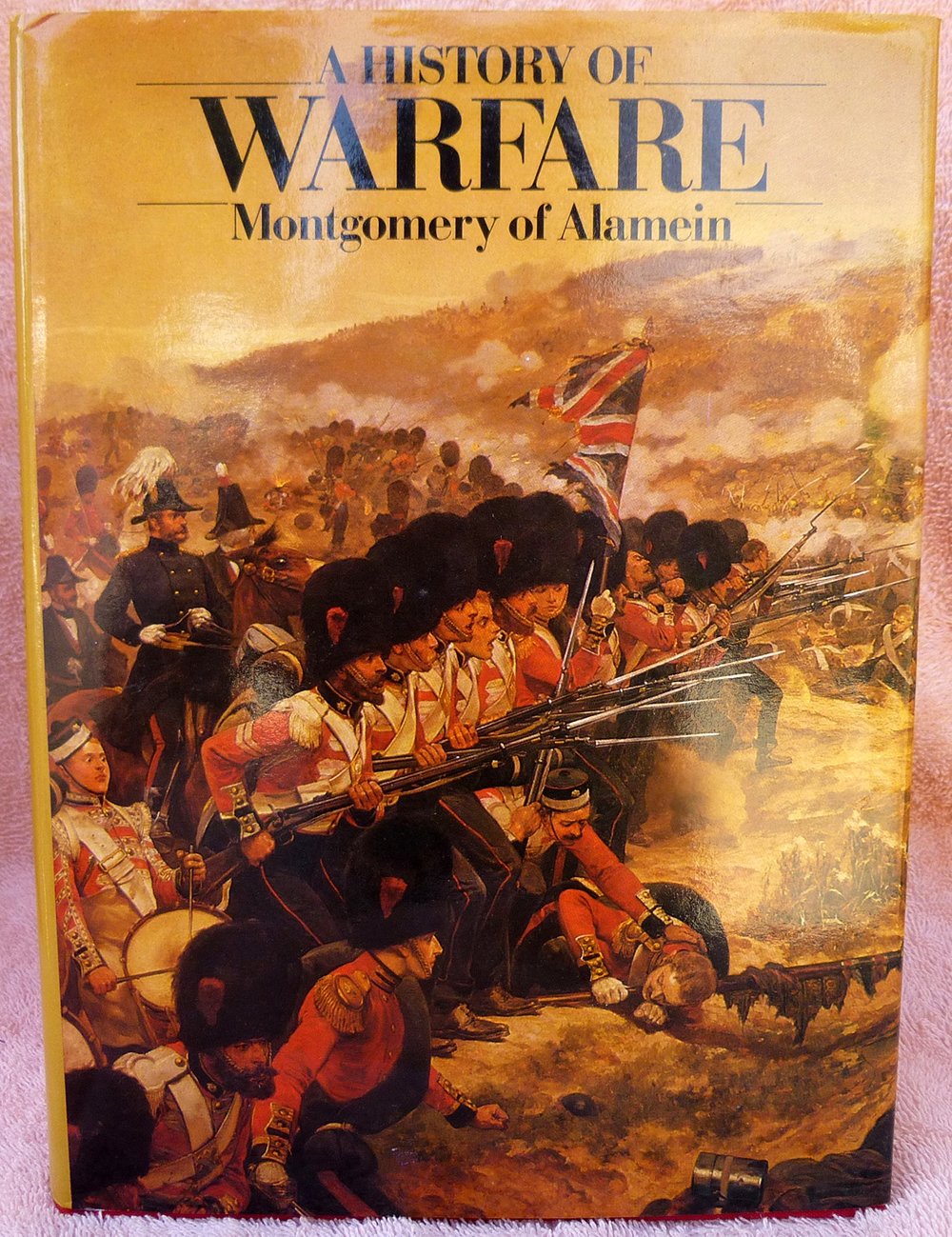
A History of Warfare. Field-Marshal Viscount Montgomery of Alamein. London: Book Club Associates, 1982.Field-Marshal Viscount Montgomery of Alamein led the British Eighth Army across North Africa in pursuit of Rommel. In 1944 he commanded the Allied land armies in the invasion of Normandy, eventually leading the 21st Army Group. Despite this experience, few give him…
The Essence of Command, Field Marshal William Slim
This is a video of a lecture that Field Marshal William Slim gave at the US Command and General Staff College on 9 April 1952, called The Essence of Command.
Edit: Here is the text version Higher Command.
 Buk's Historical Ad Hockery
You must be logged in to post a comment.