
Category: History
Rommel Retreats
Rommel’s counterattack on 25 November reached to within four km of the Eighth Army’s fuel depots just on the other side of the Libyan-Egyptian border wire, literally a single inter-visibility line away. But the Brits and Poles in Tobruk finally launched their attack out of the besieged city on 2 December. The next day, he pulled the 21st Panzer Division out of the dash to the wire to contain them. With only three days of fuel and supplies left for offensive operations, he pulled the rest of the Afrika Korps out of the meat grinder along the wire in a bold move to destroy the garrison now in the open and seize Tobruk. It didn’t work, The Auk waited a day, which he needed to just to reorganize and then pursued. Like three punch drunk WWF wrestlers in a broken tag team match, Rommel traded blows with both the Tobruk garrison and the pursuing Eighth Army until his supplies ran out.
On 7 December 1941, Rommel had to face the reality that Aukchlinek would not be out lasted, and he pulled back ten miles to Gazala where he hoped to refuel and resupply quickly enough to take advantage of the Allied confusion. On 10 December the Siege of Tobruk was lifted and the Eighth Army pursued. For four more days the Afrika Korps remaining forty tanks would plug gap after gap in the Gazala Line due to incessant Allied attacks. But Auchlinek wouldn’t stop, and on 15 December Rommel ordered Cyrenaica abandoned.
The chase was on.
The End of an Era
Britain was the most affected by the Washington Naval Treaty of 1922, which prevented a post war arms race by limiting capital ship construction, and placed a 10 year moratorium on new capital ships. It eased the effects of the bad post war economy, but the British shipbuilding industry atrophied, and the specialized knowledge required of the big ships disappeared. When the Treaty limits were completely dropped in 1936 in the face of German and Japanese aggression, a shipbuilding boom happened, but unlike their adversaries whose capital ship industries started from scratch, the British just recycled and updated Great War designs (They won, why change?).
With the Battleship Admirals still in control of the Royal Navy, the battleship was seen as the means by which deterrence was measured. But the Admiralty had a huge problem: the shipbuilding industry couldn’t produce the required numbers of battleships vis a vis their potential adversaries (much less the much more important carriers, cruisers, and especially destroyers, frigates, and corvettes). And they were all lower quality. After the 1940 and early 41 battles with the German capital ships, the Admiralty couldn’t rely on parity, they needed superiority, at least 4 to 1 against Bismarck’s sister ship, the Tirpitz. The latest British design, the King George V, was simply no match for the Bismarck (The Prince of Wales, a KGV design, had to run away from the Bismarck after the Hood blew up, and the KGV herself couldn’t sink the Bismarck even though the Germans couldn’t maneuver and could only sail ten knots.) And to make matters worse, the Italian designs were far superior, so battleships needed to stay in the Med in case the Italians decided to sortie (the Italian problem was leadership, not design). Britain didn’t have enough ships for its current commitments let alone enough ships for her other global commitments, especially after the losses suffered over two years of war.
When Japan occupied Indochina in the summer of 1941, the Admiralty planners’ worst nightmare came true: a likely maritime war with three major naval powers in three distinct areas: Germany in the Atlantic, Italy in the Med, and Japan in the Far East. Up until then the Far East question was an academic exercise, but now it needed an answer. The old French, now Japanese anchorage at Cam Ranh Bay was only a short three day sail from Britain’s main, if neglected, naval base in the East, Singapore.
But Singapore had no fleet, and this was not lost on Australia, New Zealand, Burma, East Africa, South Africa, and India, all of whom were particularly vulnerable to Japanese aggression. The combined Commonwealth navies barely amounted to a few cruisers and destroyers, but tens of thousands of Commonwealth troops were fighting the Germans and Italians vast distances away from home. They expected a British fleet to come to their defense, but the British simply didn’t have one to send.
In late November, after Australia and New Zealand threatened to pull their troops out of North Africa for home defense, Churchill ordered the two largest and most modern warships in the Royal Navy to Singapore: the battleship HMS Prince of Wales, and battlecruiser HMS Repulse, with four destroyers, as a deterrent (it didn’t matter, the Japanese were already committed to the attacks on Malaya and Pearl Harbor, but the Kiwis and Aussies felt better.) They were expected to pose a threat similar to the Tirpitz and Bismarck and tie up Japanese assets. But the Japanese were keen observers of the last two years, and saw little threat from the two British ships, given their lack of cruiser support (especially the lack of a Dido class specialized antiaircraft cruiser, all of whom were needed for the Malta convoys) and Britain’s piss poor naval–air coordination (a product of RAF Coastal Command’s red headed step child status compared to Bomber and Fighter Commands)
On 10 DEC 1941, Prince of Wales and Repulse, with supporting destroyers, moved north from Singapore to intercept Japanese landings on the east coast of Malaya. They were both sunk by Japanese torpedo bombers in less than three hours. Afterwards, the Japanese ignored the destroyers, and even signaled that they wouldn’t be molested if they stuck to picking up survivors. The Prince of Wales and Repulse were the first major warships sunk by planes on the open sea. Combined with the American disaster at Pearl Harbor two days before, it became clear airpower now defined seapower, even to the eldest and most hardheaded battleship advocate. The Age of the Battleship was over; the Age of the Aircraft Carrier had begun.


The Wild Run of Victory Begins
The Japanese struck Pearl Harbor on Sunday, 7 Dec, Hawaii time, but due to the vast distances involved and the international dateline, the strike occurred on Monday 8 Dec local time in Tokyo and across the Western and Southern Pacific Ocean. The Japanese did not actually begin their war with the Western Allies with the raid on Hawaii. It began with landings in Malaya and Thailand that occurred about 90 minutes before Fuchida dropped the first torpedo into the USS Nevada.


“Tora Tora Tora”: The Raid on Pearl Harbor
When the 183 Japanese planes of the first wave approached Pearl Harbor from the north without any resistance from the Americans, LtCmdr Mitsuo Fuchida, the commander of the Japanese air strike, signaled to Adm Nagumo the code words “Tora Tora Tora” (tiger, tiger, tiger) which indicated the attack began with complete surprise. Five minutes later, Cmdr Logan Ramsey, Ops officer of Patrol Wing Two, attempted to get the tail number of a plane he thought was flying recklessly. But he recognized the red “meatball” on the plane’s wing and immediately sent out the radio message in plain English, “Air Raid Pearl Harbor. This is no drill.”
Fuchida had six objectives for the first wave. The first five were Pearl Harbor’s air defenses: Wheeler and Hickham Army Airfields, Ford Island and Kaneohe Naval Air Stations, and Ewa Marine Air Station. Most of the planes on these airfields were destroyed before they could get off the ground. And many even before the ammunition could be distributed to the anti-aircraft defenses, which despite repeated war warnings was still locked up in distant armories. Nevertheless, in the chaos, men fought back, including mechanics on Wheeler who threw wrenches at the low flying Japanese. Or more effectively, Chief Petty Officer John Finn, who pulled a .50 Caliber machine gun from a damaged PBY and fought through 21 separate wounds to earn the first Congressional Medal of Honor of the Second World War. Or an unknown marine at Ewa who stood in the middle of the runway firing his pistol at the low strafing planes. The official Japanese records of the attack refer to him at “The Bravest American”. The Japanese pilots specifically targeted him, like jousting knights, but as far they knew the young marine survived the attack. A large portion of the Japanese casualties at Pearl Harbor came by way of that most mocked and denigrated Army and Marine rank, the second lieutenant; eight of whom courageously took off into the teeth of the Japanese onslaught in far inferior planes to take them on at 20-1 odds.
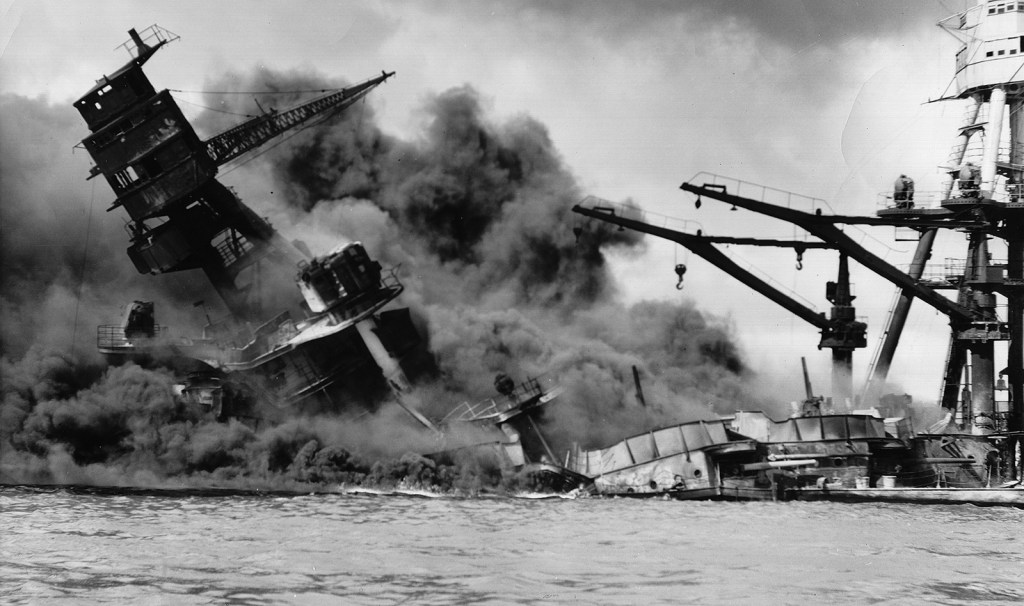
While the Japanese bombed and strafed the airfields, Fuchida personally supervised his pilots at his sixth and primary objective – Battleship Row. There the eight battleships of the US Battleship Divisions 1, 2 and 4 sat. The surprise attack caught the ship’s crews preparing for the day. On the USS Nevada, the band played for morning colors just as the Japanese attacked. They finished despite being strafed because, “It was inconceivable to break formation during the Star Spangled Banner.” Specially designed low draft Japanese torpedoes struck the Nevada moments later, along with her sisters the USS Arizona, California, West Virginia, and Oklahoma. The torpedoes sank the West Virginia and capsized the Oklahoma. In spite of the surprise, the sailors were a bit more prepared to fight than their land based brethren as they had their ammunition on board. During Sunday morning mass on the cruiser USS New Orleans, the chaplain Lt.jg. Howell Forgy blessed his gunners, and told them to “Praise the Lord and pass the ammunition.” On the West Virginia, Messmate Third Class Doris Miller manned a .50 Cal in the conning tower, a weapon he was unfamiliar with, until his ammunition ran out. Miller would receive a Navy Cross for carrying many of his wounded comrades to safety before the West Virginia sank.
After the torpedo bombers, Japanese dive bombers dropped specially converted 16in armor piercing battleship shells on the giant American targets. They would damage every battleship on the Row, but one hit in particular caused nearly half of the American casualties that day. Like her sisters, the Arizona was a battleship developed for the last war. Her armored citadel, the area that protects the vital areas of the ship, could withstand a hit from largest shell of that time, 14”. One of the dive bombers managed to place its converted 16in shell right above the forward magazine, where it penetrated. Seven seconds later a catastrophic explosion destroyed the ship, killing 1100 sailors instantly.
The entire island seemed to be on fire. In 90 minutes, four battleships and three other ships were sunk, four more battleships, and nine others damaged, 300 aircraft destroyed, and 3700 soldiers, sailors, marines, and civilians were killed or wounded by two waves of Japanese carrier based aircraft. It was still less than what was expected. On the outset, Fuchida gave a flare signal for an hastily planned conventional attack, one configured for an expected American defensive preparedness, instead of the planned signal for the attack in case surprise was complete, which it was as signified by the famous “Tora, Tora, Tora” broadcast. Fuchida’s signal prompted the torpedo bombers to wait a few critical minutes before attacking Battleship Row while the dive and level bombers plastered the airfields. Those few minutes were key: they allowed the crews to secure battle stations and close water tight doors. The torpedo bombers as a result took more casualties and their hits less devastating than they could have been. Consequently, Fuchida wanted a third attack: to destroy the fuel farms, dockyards, and repair facilities, and probably also to correct the sub par, though still devastating, results. But he was overruled by Adm Nagumo: most of the Japanese losses occurred during the second wave, and the American carriers were not in port and therefore an unknown threat. Also, the fuel situation would be critical if the Kido Butai lingered which it would have to do all day if a third strike was launched. By noon, all aircraft were recovered, and the Japanese were racing home.
Nagumo would regret his decision for the rest of the war.
The Day Before

The 6th of December, 1941 was a typical American Fall Saturday. College football ruled the radio waves. UCLA played their big rivalry game against USC. Tens of thousands tuned in, and were disappointed when the game finished tied at 7-7. There was another big game that day: the Evergreen Bowl in Tacoma, where Texas A&M upset Washington State in a 7-0 nail biter. When the games ended, there was a better than even chance that the first song to emit from the speakers was Glenn Miller’s smash hit, “Chattanooga Choo Choo”. That evening, kids and adults alike flocked to the theater to see the new Tom and Jerry short, “The Night Before Christmas”. And when the kids went to bed the adults saw John’s Huston’s genre launching classic, “The Maltese Falcon” starring Humphrey Bogart, Mary Astor, and Peter Lorre which was still huge at the box office, despite it’s premier over a month before. The newspapers were filled with bad news: Moscow and Alexandria were about to fall, Japan moved more troops into Indochina, the “Flying Tigers” were having a tough time in China, and U boats were sinking American ships in the Atlantic. So people couldn’t get enough of the Maltese Falcon: it was a dark movie for dark times, and unlike anything they’d ever seen.
That afternoon, about the time Tom was playing on the piano and Jerry, unusually by his side, singing, President Roosevelt made an appeal directly to the Japanese emperor to continue negotiations, which had stalled since the 25th of November. Down the street from the White House, US code breakers were furiously decoding the first thirteen parts of a “14 Part Message” detailing Japanese grievances against the US and Western nations. They had cracked the Japanese “Purple” code months before but this message was to be delivered to President Roosevelt promptly at one pm the next day by the Japanese ambassador, Kichisaburō Nomura. They had to get the text to Secretary of State Cordell Hull before that happened.
Meanwhile, across the world, five Japanese I-boats launched five midget submarines off of Oahu who then began the painstaking process of infiltrating the mouth of Pearl Harbor. Further north, another I-boat, I-72, reported no American ships at Lahaina Roads which removed the last possibility of the Americans detecting the Kido Butai before it launched, as it sailed behind a rain squall. Below decks of the six Japanese aircraft carriers, crewmen rolled the large specially modified torpedoes and armored piecing bombs toward their planes, while pilots continued with ship identification games and route rehearsals for the upcoming attack.
 Buk's Historical Ad Hockery
You must be logged in to post a comment.