
Category: History
The Battles to the Sunda Strait
After the battle of the Java Sea finished the night before, the remaining Allied ships hastily refueled, and set sail to make their way to safety. The four destroyers of DESRON 58 went east, and out of ammunition, barely avoided a patrolling Japanese destroyer in the Bali strait. The ships that sailed west were not so lucky.
The USS Houston, HMAS Perth, and a Dutch destroyer sailed west for the Sunda Strait, hoping to make it through before the sun came up. As they were passing Bantam Bay on the northwest corner of Java they stumbled upon the transports of the Japanese invasion fleet landing troops. Capt Rooks of the Houston ordered the ships to attack the vulnerable transports. While doing so they were spotted by the escort of Japanese destroyers. For thirty furious minutes the ships were locked in a confused melee amongst the transports. In the end, all three of the Allied ships were sunk, but so were five transports and a Japanese minelayer, all but one transport to Japanese torpedoes. The surviving crew members would spend the next three years in Hell.
Later that night, the Exeter, now able to make 23 knots due to superhuman efforts by her crew to repair the damaged boiler, with her own escort of two destroyers, (one American and one British), also made her way towards the Sunda Strait. Though her captain wanted to head east, she had been ordered to make for Ceylon (Any ships that went west would inevitably come under American control for the rest of the war, and the Exeter was desperately needed in the Mediterranean). Out of contact and trying to avoid the battle in Bantam Bay, the Exeter steamed a more northerly course towards the Sunda Strait. They ran smack into Takagi’s cruisers. 18 months before, the Exeter took the best that the German pocket battleship Graf Spee could send, but outside the Sunda Strait on the morning 1 March 1942, she was hammered by Takagi and sank. The American destroyer managed to enter a rain squall, but her respite was short lived, and she was sunk by Japanese aircraft later in the day.
The Japanese conquest of the “Southern Resource Zone” was all but complete. The Java Sea was a Japanese lake. The surviving allied crew members would spend the next three years in labor camps in which 60% would die in captivity. All of the escaping Allied ships were either gone or sunk.
Well, except one…
The Battle of the Java Sea
On the morning of 26 February 1942, the forlorn sailors on ships of four nations, America, Britain, Australia, and the Netherlands, dejectedly listened to the words of the Adm Ernest King, the American Chief of Naval Operations, tell the world that the United States would concentrate on Germany first, then Japan. About that time, the last B-17, packed with US Army Air Corps ground crew, departed Surabaya on Java for Australia, never to return. The sailors were being sacrificed, and they knew it.
Later that morning, Adm Karel Doorman, the Dutch commander of the remaining Allied ships, received a report that the long awaited Japanese invasion fleet destined for Java had set sail from Borneo. One hundred Japanese transports were escorted by a light aircraft carrier, six heavy and five light cruisers, and over forty destroyers. Doorman had a motley crew of three British, four American, and two Dutch destroyers; one Australian light cruiser, the HMAS Perth, and two Dutch, the HMNLSs Java and DeRuyter; and two heavy cruisers, HMS Exeter (of Graf Spee and River Platte fame) and USS Houston (“FDR’s Fishing Yacht”, whose polished teak wood decks carried the Commander in Chief on many an overseas voyage).
Doorman’s task force was ragged. They had just returned from another fruitless sweep of the Java Sea, sighting only Japanese planes, and no ships. All of his ships were in various states of repair. One of the Houston’s turrets was destroyed by an air attack, which reduced the firepower of her big 8” guns by a third. The crews were exhausted, and at sea they had to man double watches in order to have any warning at all of air attack. Communications in battle were especially hard, as the majority of his force spoke English which he did not. Any orders he gave had to be translated, which took time. Moreover, he had to work with three sets of code, so most transmissions were in the clear. Furthermore, his flagship, the DeRuyter, could only communicate via radio with the Houston; its sets incompatible with the rest of the non-Dutch fleet. So in order to do a simple maneuver, Doorman gave an order, have it translated, sent to the Houston, who then transmitted it to the other ships. During battle, this was not a satisfactory state of affairs.
Doorman set sail to find the Japanese and stop the invasion of Java. All day and into the evening of 26/27 February he searched but could not locate them. Meanwhile the sailors on the heavy swells caught the occasional glimpse of Japanese reconnaissance planes through the low overcast skies in the worsening weather. That night, Doorman decided to turn back and refuel, and try again the next day.
They were only in port that morning for a few hours, before a frantic report was received which sighted the Japanese fleet only 90 miles northwest. Doorman ordered all the ships back to sea, no matter the state of refueling.
Adm Takeo Takagi was driving for them. He sent his transports to the north, on first sighting, and closed with the Allies as fast as he could. They were the last obstacle between Japan’s conquest of Java, and Japan was down to two months’ worth of oil reserves. Days mattered.
The two fleets spotted each other on the afternoon of 27 February 1942 at 30000 yards. At 28000 yards the Japanese cruisers opened fire; they missed but the rounds straddling the Allied ships astonished their crews. The Japanese were still well outside the range of even the big guns on the Exeter and Houston. Doorman closed but ordered a turn so as to not get the Allied “T” crossed, which unfortunately kept the Japanese out of range of the light cruisers quick firing 6” guns, his most numerous and dangerous weapons. Then a round penetrated the Exeter, the second cruiser in line behind Doorman, which didn’t explode but cut a steam line and blew out a boiler. Her speed was cut in half. She turned to starboard so as to not get hit by the Houston speeding at her from behind, but the Houston just slowed down and followed to maintain formation. She in turn was followed by the rest of the light cruisers and rearward destroyers, while Doorman and the forward destroyers sailed on ahead. The mistake was only corrected as the Exeter, unable to make more than 13 knots, turned about with the nearest two destroyers for escort, to head for Surabaya, but the formation was by this point broken. About this time a dud shell knocked out the Houston’s TBS radio, the ship-to-ship set that passed the communications from Doorman on the DeRuyter. For the rest of the battle, orders had to be relayed by blinker light, in high seas, from great distances, and across patches of oily smoke from fires or laid by screening destroyers. The Japanese had no such problems.
Takagi had clear communications with his ships, longer ranged guns on his cruisers, and spotting planes which greatly increased his fire control. Furthermore, his Long Lance torpedoes had twice the explosive power and twice the range of the Allied equivalents, and he had more of them. In the chaos caused by the Exeter’s damage and the breakdown of Allied command and control, the Japanese closed in for the kill.
However they only managed to sink one Dutch destroyer, the Kortenaeur, which was hit by a torpedo, “went up in a great flash of light, and a thunderclap”, then “broke in two, jack knifed, and sank” in less than fifteen seconds, and a British destroyer, the HMS Electra (the ship that rescued the only three survivors from the destruction of the HMS Hood nine months before), who went dead in the water and took her punishment for a much longer time. The chaos actually worked in the Allies’ favor. The four American destroyers of DESRON 58, out of contact with everyone but themselves, on their own initiative made a torpedo run (that didn’t hit anything), laid smoke, and then, nearly out of fuel, turned back for Surabuya. The smoke gave Doorman just enough time to turn back around and miraculously gather up the other cruisers before nightfall, but he would never again see the four American destroyers.
Later that night, Doorman attempted several times to sneak around Takagi and engage his true objective: the transports. But without air reconnaissance he would need a miracle, and Japanese night fighting superiority did not allow for Allied miracles. Japanese ships fired star shells and planes dropped flares. They routinely spotted his ships, now down to only four cruisers, after his last remaining destroyer was sunk in an unmarked Dutch minefield. Takagi closed in time and again, and each time Doorman withdrew into the darkness for another attempt to get around him. But Takagi eventually cornered the Allies, and to much better effect than the afternoon before. He sank both the Java and DeRuyter just before sunrise on the 28th. Doorman, ever the courageous and duty bound romantic, went down with his ship. His last order was for the Houston and Perth not to stop to pick up survivors, and make a run for Australia.
The Japanese through superiority in almost all areas, sunk or scattered the last remaining obstacle before their successful conclusion of the East Indies campaign. They only needed to prevent the remaining Allied ships from escaping. The Japanese were now free to go east to New Guinea and America’s possessions in the Pacific, south to Australia, or west to India and Ceylon (modern Sri Lanka)…
Or as they have so ably demonstrated over the last three months – all three directions at once.
The Zimmerman Telegram
Imperial Germany knew that Unrestricted Submarine Warfare would eventually bring the United States into World War One on the side of the Allies. Their economic ties to Britain and public outcry over the sinking of the Lusitania and the Housatonic virtually guaranteed it. But it was hoped that it wouldn’t immediately bring America into war, and that Britain would be well on her way to starving into surrender before the Americans turned the tide in Europe.
The Founding Fathers’ caution of overseas, particularly European, entanglements, had done America well in the 19th Century. Many Americans didn’t feel Europe was worth spending American blood and treasure on, and that what happened in Europe did not affect America. Moreover, the German and Irish American immigrant communities, the two largest in the country at the time, were vehemently anti-British. In late February 1917, America was making threatening gestures and had broken off formal diplomatic relations with Germany over Unrestricted Submarine Warfare but the population wasn’t quite ready to declare war yet.
Britain knew that America had to enter the war soon, or the Allies would lose: both Russia and France were having serious internal issues in the winter of 1916/17 and Britain could not fight Germany alone. To make matters even more frustrating, Britain was sitting on a key piece of information that was sure to infuriate America against Germany. But they couldn’t release it without embarrassing themselves, and more importantly, revealing that they were reading America’s mail.
Britain had cut Germany’s transatlantic telegraph cables at the outbreak of war, but Germany asked to use America’s for diplomatic traffic. President Woodrow Wilson agreed, if only to keep a line of communication opened for peace negotiations. The Germans would deliver their messages to America’s embassy in Denmark where it would be transmitted via stations controlled by America and neutral Sweden to Washington DC. To make the long jump across the Atlantic, the message had to go through a signal boosting station at the westernmost point on the British Isles at Land’s End. Unknown to the Americans, every transmission that went through that station Britain was reading.
On 19 January 1917, the German Foreign Minister, Arthur Zimmerman, sent a coded telegram to the German embassy in Mexico via America’s diplomatic cables, which the British intercepted. The telegram was an offer for Mexico to ally itself with Germany, for which it would receive financial and economic compensation, and Arizona, New Mexico, and Texas would be ceded to Mexico after the war. (Mexico thought about it for a week. However, war would severely strain relations with Argentina, Brazil and Chile who needed a peaceful Mexico to trade with the US. Mexico, fractured by its own civil war, couldn’t defeat America if it wanted to, and even if it could, would never be able to occupy a large swath of territory populated by a people that were better armed than the Mexican Army. They politely declined.) Zimmerman’s Telegram was sure to sway American public opinion against Germany, if it could be released, and once released, believed to be genuine.
British agents investigated the route that the message would have traveled from Washington DC to Mexico City, and found that it had not gone directly to the German embassy, but to a Mexican telegraph office down the street. The British concocted a story that an agent “Mr. H” acquired a copy from that office. This was enough cover for their operation at Land’s End (which would continue for another 25 years), and furthermore, force the Germans to suspect a spy in their embassy. Convincing the Americans it was genuine would be trickier: to do that they would have to acknowledge they broke Germany’s code. Fortunately, Germany came to the rescue, and changed their codes on 1 February with the beginning of Unrestricted Submarine Warfare. Britain was now free to release the telegram, the cover story, and the older code for verification to America.
On 19 February 1917, the British released the Zimmerman Telegram to the American embassy in London, and on the 25th it was given to President Wilson. Wilson was furious, and on the 28th leaked it to the press.
The American people were predictably outraged, but anti British sentiment called it a forgery, or pushed that outrage against Mexico. Blackjack Pershing was already chasing Pancho Villa, and the Carranza government in Mexico didn’t want any more American troops on its soil. On 3 March, in one of those ironic and unintended consequences on which history seems to turn on occasion, Zimmerman was forced to verify the authenticity of the Telegram in order to maintain Mexico’s neutrality with Germany. This all but silenced the anti-British sentiment in America. It was one thing to avoid getting entangled in Europe’s affairs, but quite another when Europe tries to entangle itself in American affairs first. Germany “needed to be punished”.
It wouldn’t be long before Wilson would break his campaign promise to keep America out of the war.
The Battle of Los Angeles
On the night of 23 February 1942, the Japanese submarine I-17 crept along the coast of California; lookouts desperately trying to identify their captain’s very specific target – the Ellwood Oil Fields. Commander Kozo Nishino had an intensely personal reason for the target of the first Japanese attack on the Continental United States: The Americans laughed at him there.
Nishino was a naval reserve officer, and as a civilian he was an oil tanker captain. A few years before the American embargo, he sailed through the Santa Barbara strait destined to pick up a load of oil from Ellwood. On his way to the docking ceremony, he tripped and fell into a cactus, and his crew had to pull needles from his posterior. He never forgave the snickering Americans.
At 7 pm, the I-17 spotted the oil fields, and Nishino ordered his 5.5” deck to fire. On the choppy seas, the Japanese gunner was not very accurate. But each of the 21 rounds fired landed within about a hundred yards of the spot where Nishino had the cactus spines removed from his ass, so his honor was satisfied. I-17 sailed away to look for merchant ships. The bombardment did about $500 worth of damage, and slightly lowered property values.
The psychological effect was much greater. Pearl Harbor was only 80 days or so previously. The US Army had recently established black out and civil defense procedures and drills. But this was No Drill: those were real explosions, made by real Japanese shells, fired by real Japanese guns, from a real Japanese ship, by really real Japanese sailors shouting “Banzai”. After dutifully blacking out his hotel, a local innkeeper near the oil fields called the sheriff to report explosions nearby. More drmatically, the ship was spotted by a reverend in Motecito, who also called the police. From those two initial reports rumors snowballed across southern California: The Japanese were going to invade.
The next night the entire 37th Coast Artillery Brigade, responsible for Los Angeles and the surrounding area, went on alert. A total blackout was ordered and they prepared to repel the invaders. Nothing happened until 3:14 am on the morning of the 25th, when someone thought they heard something above. Search lights pierced the night sky, then someone fired. Soon, everyone began shooting. For the next hour, Angelinos and their defenders in the 37th blazed away into the darkness above. They fired 1400 large caliber anti-aircraft gun rounds, and tens of thousands of small arms ammunition, before order was restored. Seven civilians were killed: three from heart attacks caused by the stress of the situation, and four from descending rounds, because what goes up must come down.
The Japanese later denied any forces in the area besides I-17. The official US Army investigation concluded that the incident was “a case of war nerves”, and the object sighted at 3:14 in the morning was an “errant weather balloon”, which led many conspiracy theorists to believe that the object was actually a UFO.
The Battle of Fishguard
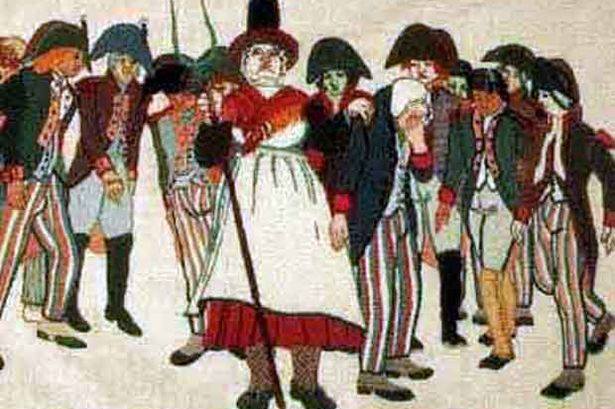
Most learned scholars would say the last invasion of Britain occurred in 1066 when William of Normandy kicked the living shit out of the Anglo-Saxon King Harold Godwinson at the Battle of Hastings in 1066. This is not correct. The Norman attack was the last *successful* invasion of Britain. The *last* invasion of Britain was by the French, during the French revolutionary wars, and was led by an American (because after 700 years, only an American would look at the moat that is the English Channel and dismissively say, “Pshaw, I got this”.)
Col William Tate was an Irishman born in America, and had fought in the American Revolutionary War. An avowed Francophile, he fell out of favor with the United States when he was involved in a plot to seize New Orleans for France from one of America’s other allies in the American Revolution, Spain. In the 1790s, the Mississippi trade was booming and the new country did not want to lose the use of New Orleans’ docks and warehouses. Tate escaped to France, one step ahead of American G-Men (such as they were), before he could be made an example of for Spain. In France, he joined the revolutionary army, where he quickly rose to command a regiment because of his experience in the American Revolution. (French officers of the time were mostly aristocrats, and French aristocrats were only good for one thing: filling the baskets at the bottom of French guillotines.)
In 1796, blood soaked French revolutionary zeal hadn’t engulfed the rest of Europe only because Great Britain was the financier of France’s continental enemies. General Louis-Lazare Hoche knew the source of the bourgeois and royalist resistance had to be eliminated. He figured the best way to do that was through Britain’s nearby, and most troublesome, possession – Ireland. He eradicated Royalist opposition in Brittany, itself a Celtic nation, and then with Tate, devised a plan to export that Revolution to Ireland. He raised an army and his plan was for a large expedition to land and link up with the United Irishmen, then rebelling against British authority. Britain invaded the island 150 years ago, and was still smarting from Oliver Cromwell’s massacres of that time (among other things). It was believed the Irish proletariat (before Marx made the term sexy) would rise up against the British, and join them. Once Ireland was liberated, Franco-Irish revolution could be brought to Britain. But the British were sure to react to a French landing, so two smaller expeditions were planned to prevent them from interfering: one in Scotland, and one in Wales. It was hoped the oppressed Celtic proletarians of Wales and Scotland would also rise up to fight their hated British overlords.
In late 1796, the Royal Navy sailed south to blockade Spain (see the previous Battle of Cape St Vincent), and Houche launched the three expeditions across the Channel. Now there is a phenomenal (Ha!) reason why the English Channel is the most effective of moats: it basically has its own climate system, and the weather essentially pushes an invader back against the French coast. In the Age of Sail, this is a problem. (William of Normandy had to wait three long weeks just to cross the Channel at its narrowest part in 1066, and was still scattered and almost didn’t arrive.) The fickle Channel weather defeated the Irish and Scottish expeditions, but it didn’t defeat the Welsh one, which was led by Col William Tate. On 22 February 1797, Tate landed on the rocky headland at Carreg Wastad on the Welsh coast.
Tate unloaded his 1400 men, and sent a ship up the coast to reconnoiter the port of Fishguard, three miles away. But all it accomplished was to inform the Welsh of the invasion when the fort there fired a warning shot at the unknown ship. The ship quickly returned and surprise was lost. Soon thereafter, Tate’s squadron departed, because their captains didn’t want to be caught by the weather and stranded in Wales (There’s an omen…) This was disconcerting for many of Tate’s men, as this was their only means of escape should the expedition fail.
Tate’s army was a mixed bag. On one hand, 600 were from his own regiment, the professionals of the French 2nd Legion, known as the “Le Legion Noir”, or the Black Legion because they were clothed in captured British uniforms, whose original red would only take black dye (which turned them a sickly dark brown color, but “The Black Legion” sounds cooler). On the other were 800 Republican volunteers, mercenaries, pirates, former royalist prisoners, and convicts on parole, mostly under Irish officers who sure as shit didn’t want to be in Wales. Like all Revolutionary armies, Tate’s lacked any sort of effective logistics system and was expected to live off the land. He had unloaded a vast quantity of weapons and ammunition, much of it to arm the Welsh, but he had no rations. So that evening, he sent his men out on foraging parties to confiscate provisions for the expedition.
Now there are many famous military blunders, the most famous of which is “Never get involved in a land war in Asia”. Slightly less well-known is this: “Never go in against a Sicilian when death is on the line!” But only slightly less well-known than that is, “Never antagonize a Welshman in Wales” (I personally learned this the hard way in Bristol, which I have since been reliably informed is not really Wales, lines on a map be damned). Many of Tate’s foraging parties that weren’t of the Black Legion weren’t exactly disciplined. One group broke into St Nicholas Church, and in a drunken rage born of sacramental wine, burned Bibles and hymnals as secular revolutionaries are wont to do. Furthermore, many had just got out of prison, and were more interested in booze and women than they were in scavenging supplies. The combined effect on the population was not one that encouraged it to rise up in one’s favor.
Once the stories spread, the population literally turned out with their farming implements to repel the French. On the morning of 23 February, the formidable cobbler Jemima Nicholas, attacked one of the drunken parties, gave them a good “what for”, captured 19, and locked them in St. Mary’s Church. Hundreds more rallied and marched on the French with pitchforks and torches. Like Mrs. Nicholas, the women wore the traditional Welsh red skirts and tall black felt hats, and to the drunk Frenchmen, they were mistakenly reported as elite “Grenadier Guards” to Tate. However, pitchforks, sickles, garden hoe’s, and those funny little hedge clippers, a contemporary army does not make. The furious Welsh farmers and townsfolk were reinforced by their husbands, sons, brothers, and cousins in the unofficial and semiofficial militia of the area.
The last Under-Secretary of State for the American Colonies, William Knox, who after being tossed out of the Thirteen Colonies in 1783 learned that to oppose a revolutionary army you needed your own loyal, and local, militia, which he formed as a result of the French Revolution. His Newport Volunteers, and Fishguard and Pembroke Militias marched and assembled at the Fishguard Fort. They in turn were reinforced by sailors from the ships in Goodwick Bay, on which Fishguard sat. They were further aided by the energetic action of LtCol Colby of the Harfordshire militia, who mobilized his men at the first reports of the French and forced marched to Fishguard. Thirty miles away, Lord Cawdor, the Baron of Pembroke, received word of the invasion and immediately set off with his men from the “Castlemartin Troop of the Pembroke Yeomanry Cavalry” whom had been assembled by Cawdor for a funeral for one of their own on the 23rd. By that evening, a thousand Welsh and English militia and sailors, dragging cannon from the ships in the harbor, backed up by a swarm of Welsh civilians, confronted Tate on the high ground outside Goodwick, a mile away, which overlooked Tate’s HQ.
Tate’s officers took one look, and got drunk. On the morning of the 24th, Tate, thinking he was facing a superior force of angry militia backed by British regulars, walked into Carford’s headquarters at the Royal Oak pub, and surrendered his disorganized force.
The Last Invasion of Britain was defeated.
Operation Junction City
After Operation Cedar Falls, Gen Westmoreland’s staff felt that the Central Office of South Vietnam (COSVN), the Viet Cong’s primary headquarters in the south, escaped into the Tay Ninh province along the border with Cambodia, with the VC battalions that weren’t found in the Iron Triangle. Furthermore, due to the movement to contact-esque and adhoc nature of Operation Attleboro in November, Westmoreland felt that, though the 9th VC Division and 101st NVA Regiment were mauled, their base areas in Tay Ninh weren’t completely destroyed. So he ordered the II Corps commander, LTG Seaman, to “think big”, and plan a deliberate operation to clear the Tay Ninh province, and complete the destruction of the Communist main force units. The problem was they weren’t there.
As per Giap’s orders after Operation Attleboro, the relatively unpopulated Tay Ninh, known as War Zone C to the Americans and South Vietnamese, was used strictly as a transit area for men, weapons, and supplies for guerilla operations in the much more densely populated area around Saigon, known as War Zone D. COSVN was firmly established in the Fishhook in Cambodia, where it would remain, except for a brief period in 1970, until 1975. COSVN did have the equivalent of a tactical command post in Tay Ninh, but it was just a clearing house for reports from inside South Vietnam. The VC that escaped the Cedar Fall’s cordon around the Iron Triangle, were either in the Cu Chi tunnels near Saigon, or were used to reconstitute the 9th VC Division, which was in Cambodia. The only Communist troops in Tay Ninh in mid-February 1967 was an understrength local VC battalion primarily used to watch potential landing zones. LTG Seaman’s next big search and destroy operation, Operation Junction City, named after Fort Riley’s ville, was seemingly destined to find little and destroy less.
Operation Junction City was massive: Sixteen battalions from the 1st and 25th Infantry Divisions, and the 196th Infantry Brigade, established the eastern and western cordons. In the only airborne operation of the Vietnam War, a battalion of the 173rd Airborne Brigade dropped in to form blocking positions to the north, after the brigade commander lobbied Westmoreland, himself a paratrooper, to include a combat jump in the operation. With the anvil set, the hammer would again fall to the 11th Armored Cavalry Regiment supported by a brigade from the 25th Infantry Division, both assaulting into the pocket from the south.
At dawn on 22 February 1967, B-52’s pounded suspected Communist positions inside War Zone C. They hit nothing but earth and just alerted the small COSVN TAC to escape. At 9 am, paratroopers drifted down into drop zones, and enormous armadas of helicopters and trucks delivered the anvil battalions to their positions. They trapped virtually nothing, certainly not the twelve VC and NVA main force battalions Westmoreland expected to be there.
Fortunately, Gen Nguyen Thi Thanh, the COSVN commander and Giap’s rival, wanted to engage the Americans in battle. Unlike Giap, he felt that engaging the Americans would increase the likelihood of a general uprising in South Vietnam, and increase the morale of his men. If the Americans wanted a fight, he would oblige them.
It was the VC that would save Westmoreland and Seaman from embarrassment, cover up one of the biggest intelligence failures of the war, and prevent Operation Junction City, the largest Allied operation so far, from being a complete waste of resources.
The Battle of Timor
The island of Timor was split between Dutch and Portuguese halves, and Portugal was so far neutral in the Second World War, if only because Ferdinand Franco, the ruler of Fascist Spain, didn’t want to give Hitler a reason for occupying the Iberian peninsula. Nonetheless, the administrators of the Portuguese Far East colonies weren’t blind to Japanese atrocities and were sympathetic to the Allied cause. In accordance with a secret Dutch and Portuguese agreement, Australian troops occupied the island in January 1942, with the Portuguese governor taken “prisoner” to give the appearance of neutrality.
On 20 February, 1942, Imperial Japanese forces simultaneously landed on both the Dutch and Portuguese halves of Timor, with an airborne landing to capture the airfield. The defending “Sparrow Force”, a mixed formation of Australian and Dutch infantry, Australian commandos, and Timorese irregulars slaughtered the Japanese on the beaches and annihilated the airborne landings so thoroughly that the Japanese would never again attempt it in such numbers. But the Allied forces, out of respect for the Portuguese, didn’t cover all possible landing zones. A victorious fixed force defending a beach is still a fixed force, and within three days the overwhelming number of Japanese infantry, tanks, and aircraft, landed on the Portuguese half of the island, forced the Sparrow Force’s surrender. However, dozens of Australian commandos and Timorese irregulars escaped into the mountains to carry on resistance.
For the next six months, the commandos carried on a guerrilla war against the Japanese. The Japanese responded by slaughtering Dutch, Portuguese, and Timorese civilians, which only drove them to cooperate with the Australians. Australian and Dutch ships and planes ran supplies and replacements to the commandos, the sum total never exceeded 500. They tied down a division of Japanese, much needed elsewhere.
In the fall of 1942, the Japanese knew they needed to change: Timor was an unholy vortex sucking men, weapons, and material from the New Guinea campaign. They changed their tactics. They shipped reinforcements to Timor and ordered the Japanese troops there to separate the Australians and Timorese fighters from the population, and recruit Timorese civilians to inform on the resistance. A natural byproduct was an end to the atrocities, and a velvet glove handling to Portuguese and Timorese civilians.
The new Japanese approach worked, and the Allied commandos were forced into a smaller and smaller pocket of mountainous Portuguese Timor. On 10 February, 1943, nearly a year after the invasion, the last Australian and Dutch troops were evacuated from the island. They tied up nearly 30,000 much needed Japanese troops for almost a year.
The Japanese tactics were only a matter of convenience. Once the Japanese were sure the Allied troops were gone, they turned on the Timorese, Dutch, and Portuguese civilians. They slaughtered anyone suspected of assisting the commandos. By the beginning of March, 1943, more than 20,000 were murdered.
O’Hare
The Raid on Darwin
Japan’s plan to conquer the strategically important oil fields, tin mines, and rubber plantations of the Dutch East Indies entered its final phase with the surprise assault on Bali in order to establish a forward air base in the middle of the Allied defenses. The main attacks fell on Java and Timor later in the month, but before they could happen the main Allied base at Darwin, on the north coast of Australia, had to be neutralized.
The defunct ABDACOM’s main logistical chain for men, weapons and material was India to Singapore, and then Singapore to Surabaya. This was cut with the fall of Singapore the week before. Darwin was the Australian equivalent of the Dutch Surabaya, and the main base for Australian logistical support for Allied, primarily Australian, forces in eastern Dutch East Indies, such as Timor, and New Ireland, New Guinea, New Britain, and the Solomon Islands. It would replace Singapore for Allies still fighting the Japanese. In order to seize the remainder of the Dutch East Indies, Adm Nagumo’s Kido Butai struck Darwin on the morning of 19 February 1942.
The aircraft from the aircraft carriers, Soryu, Hiryu, Akagi, and Kaga (the Shokaku and Zuiakaku were trying find Halsey after the Marshall/Gilbert raids) launched 242 aircraft in the largest naval air raid since their raid on Pearl Harbor, and the biggest attack on mainland Australia in history. The initial attack was a mirror of Pearl Harbor and the woefully inadequate Australian air defenses were crushed. The Japanese aircraft then had free rein to work over the ships in the harbor. A second wave of land based bombers from the Celebes arrived over the defenseless port later that morning and added to the carnage. Eleven Allied ships were sunk and thirty more severely damaged. There would be no chance, if there ever was, of stopping the conquest of the last island chain north of the Australian mainland.
The psychological damage was worse, and Australia became gripped with invasion paranoia. The Japanese Navy, especially the Kido Butai, were seen as the Masters of the Sea, and attributed almost mythical levels of danger and invulnerability.
Executive Order 9066
From 1936 to 1941, the FBI, Office of Naval Intelligence, and US Army Military Intelligence collected information on Japanese, German, and Italian immigrant communities in the United States and compiled lists of potential “troublemakers” that would be put into concentration camps in the event of war with the Axis powers. In mid-1941, FDR ordered a comprehensive investigation of the Japanese American communities on the West Coast. The “Munson Report” released a month before Pearl Harbor, stated that though some Japanese retained loyalty to Japan and its emperor, “the Japanese (American) problem didn’t exist”, and there was a “remarkable, even extraordinary degree of loyalty among some of this generally suspect ethnic group…” FDR ignored the report.
With war tensions high and a general civilian paranoia of a potential Japanese invasion of the West Coast, FDR issued Executive Order 9066, which gave the Secretary of War the authority to “prescribe military areas . . . from which any or all persons may be excluded” and to “provide for residents of any such area who are excluded therefrom, such transportation, food, shelter, and other accommodations as may be necessary . . .”
Three weeks later Congress passed legislation which funded Executive Order 9066 after the briefest of discussions. Opposition to the obvious unconstitutionality and potential for abuse in the bill made strange bedfellows. The minority Republican leadership in Congress was muted under their pledge to FDR in December to not let domestic politics interfere with the conduct of the war, so they found their champions in the only two of FDR’s cabinet members that opposed the EO, Attorney General Francis Biddle and Interior Secretary Harold Ickes. Biddle and Ickes would eventually get Executive Order 9066, and related later EOs, to the Supreme Court and have them declared unconstitutional. But after a decade of the courts and Congress acquiescing to FDR’s expansion of executive power during the Great Depression, it would take three long years for that to happen. However, just after Pearl Harbor that didn’t matter – on 9 March 1942, FDR signed Public Law 503 into law, and the legal justification for one of the greatest tragedies in American history was established.
Surprisingly, Executive Order 9066 was not used as justification for exclusion of the largest Japanese American community in the US on one of the few pieces of American soil under actual threat of Japanese invasion: Hawaii. US Authorities there had arrested 2500 Japanese illegal aliens under FDR’s Alien Enemies Act in December. The other 100,000 Japanese Americans in Hawaii were not deemed a threat, too important to Hawaii’s economic well-being, and their internment not a military necessity citing the Munson Report, and a separate Naval Intelligence report which found “no evidence of ‘fifth column’ activity among Japanese Americans”. This was not the case for the American West Coast.
Shortly after EO 9066’s funding by Congress, Arizona and California, and Oregon and Washington were in their entirety designated as two military districts by LTG John DeWitt, the commander of the Fourth US Army and the Western Defense Command. DeWitt applied EO 9066, probably against its spirit, to the entire Japanese American community on the West Coast. DeWitt wanted to relocate anyone of Japanese American ancestry out of the two West Coast military districts. But there were 120,000 Japanese Americans in his area, so DeWitt, through the Sec of War Henry Stimson requested additional funding for quasi permanent internment camps throughout the US and a separate organization to coordinate and administer the relocations. FDR signed Executive Order 9102 on 18 March 1942, and Congress funded it. 9102 created the War Relocation Authority. Moreover, the racialists and Eugenicists in FDR’s administration reared their ugly heads and the EO was applied to anyone with 1/16th Japanese blood, or in practical terms one great-great-grandparent born in Japan. These also included Koreans and Taiwanese whose lands were Japanese colonies since the 1880s. EO 9066 could be argued as not racial in character and just an abuse of eminent domain; EO 9102, DeWitt’s proclamations, and the administration’s and army regulations pertaining to both, cannot.
In April, flyers from the Western military district headquarters began appearing in Japanese American communities advising not only Japanese resident and illegal aliens but also Japanese American citizens to prepare for relocation. Flyers also appeared in German and Italian American communities, but the racial character of DeWitt’s proclamations, and the easily identifiable stereotypical facial features of Japanese Americans meant that few Caucasians were interred, and those that were, were already identified on FDR’s lists. The director of the War Relocation Authority, Milton Eisenhower (Dwight’s younger brother), attempted to mitigate and limit the relocations through various means, including limiting them to just adult males, but was thwarted by DeWitt and administration officials.
Throughout the end of April and through the summer, more than 120,000 Japanese Americans, 2/3rds of whom were US citizens, were ordered to report to assembly areas in parks, stadiums, and even racetracks. They were permitted to bring one suitcase and the clothes on their backs. The rest of their possessions were left behind, and left at the mercy of their communities. Many families lost everything: land, pets, furniture, cars, and savings were all gone when they returned three years later. The internees were packed into buses and trains for long journeys to ten hastily and poorly constructed internment camps, two as far away as Arkansas, each surrounded by barbed wire, and armed guards.
In late April, the frustrated and defeated Eisenhower wrote, “when the war is over and we consider calmly this unprecedented migration of 120,000 people, we as Americans are going to regret the unavoidable injustices that we may have done…”
 Buk's Historical Ad Hockery
You must be logged in to post a comment.