
Category: History
The Battle of Hampton Roads
On 9 March 1862, during the American Civil War, the first clash of ironclad warships took place. After the CSS Virginia, a Confederate ironclad built from the remains of the USS Merrimac, easily sunk two Union ships blockading Richmond, the USS Monitor, a Union ironclad with a rotating turret, sortied to protect a third: the USS Minnesota which had run aground fleeing the Virginia. The Monitor and Virginia fought inconclusively off Hampton Roads, VA, for about three hours before darkness halted the fight. Navies around the world, including the two largest: France and Great Britain, immediately halted all construction on wooden ships. The Age of Sail was over.
The Canine Corps
On 13 March 1942, the US Army Quartermaster Corps established the Canine (K-9) Corps to train dogs for a variety of wartime duties. The dogs went through “basic training” for 8 weeks and then, based on performance, would be assigned a specialty: sentry, scout, messenger, or mine dog. The program was so successful that K-9 “recruiters” had sought “volunteers” to fill the burgeoning need for the dogs, and quickly separate programs were established in the Navy and Coast Guard. Originally, over thirty breeds were accepted into the K9 Corps but by 1944 only 7 were accepted: German Shepherds, Doberman Pinschers, Belgian Sheep Dogs, Siberian Huskies, Farm Collies, Eskimo dogs, and Alaskan Malamutes. The most famous WWII K9 was a sentry trained German Shepherd named Chips who was assigned to the 3rd Infantry Division. In 1943, Chips single pawedly attacked four Germans in a machine gun nest after they wounded his handler and forced them all to surrender.
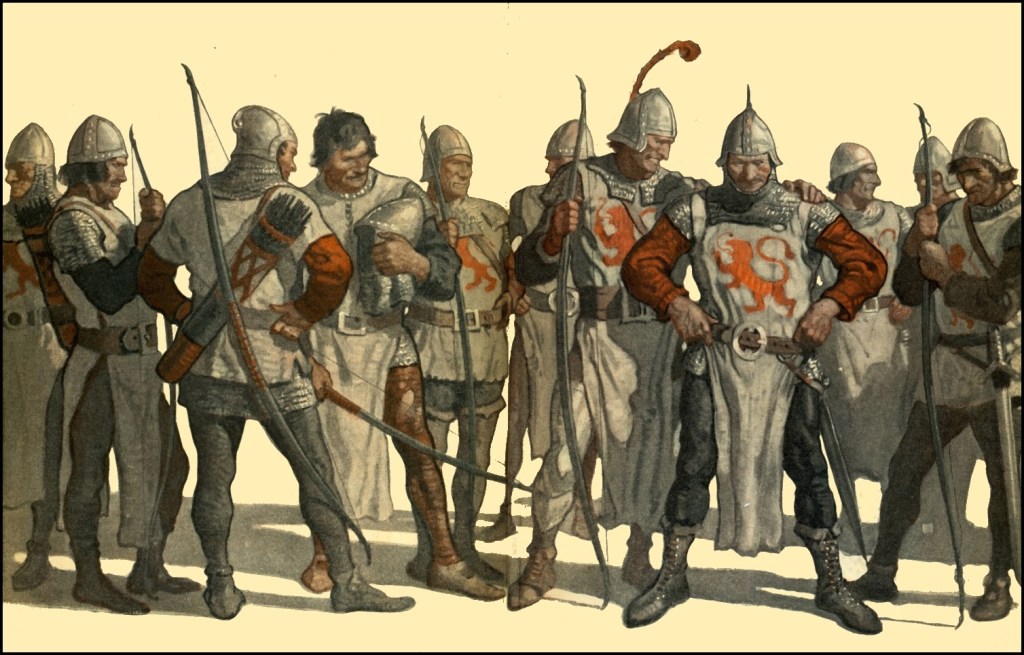
The Battle of Castagnaro
MacArthur Departed
For weeks, Douglas MacArthur had been sending reports from the Philippines about how the badly outnumbered, neglected, abandoned, and under supplied American and Filipino forces (…) were holding the line against the Japanese only because of his sheer tactical genius and infallible leadership. His messages in mid-February were completely divorced from reality, but they nonetheless cemented the perception that he alone “was worth five corps” (written by a sarcastic Eisenhower who as MacArthur’s former aide, saw through his bombastic proclamations).
One of MacArthur’s biggest fans was Australian Prime Minister John Curtin. With the collapse of ABDACOM, Curtin demanded the three divisions of the Australian Corps back from the Western Desert and the Middle East for home defense against an expected Japanese invasion. (He would get two, the third was sent to Ceylon/Sri Lanka. The Allies completely overestimated Japanese amphibious capability, capacity, and operational reach). With all supplies and reinforcements from the MidEast diverted to India and Burma, Curtin correctly surmised that Australia was being left to fend for itself by Britain (Its defense was “desirable” but not “critical” to Allied victory). He couldn’t take the chance that the Americans would do the same: an erroneous, if understandable assumption, since Adm King had just announced the “Germany First Policy”. Like the American public, Curtin was besotted with the imaginary and hagiographic newspaper accounts of MacArthur’s prowess in the Philippines. But unlike the American public, he knew the cause at Bataan was lost. Neither he nor Churchill wanted to see MacArthur, “a good and occasionally brilliant general” languish in a Japanese prison: he would serve a much more strategic purpose defending Australia. At the very least, America would never abandon the Southwest Pacific with MacArthur in charge. After an intercession with Churchill, FDR ordered MacArthur on 22 February to depart for Australia and assume command of the growing Allied forces in theater.
FDR directed MacArthur to depart at a time of his own choosing, but the Japanese invasion of New Guinea made abundantly clear that that time was already well passed. He could no longer avoid the public relations hit that would ensue with abandoning his troops, whether he was ordered to or not. On 10 March, he transferred command of Allied Forces in the Far East to MG Johnathan Wainwright in a small ceremony on the island of Corregidor that guarded the entrance to Manila Bay.
Instead of departing by submarine, the claustrophobic MacArthur wanted to use the smallest US Navy craft in its arsenal to escape Bataan “to settle a score” with the Navy for not coming to his aid in the Philippines, whose inevitable fall he blamed on Nimitz. The next day, 11 March, 1942, 22 members MacArthur’s staff and household, including his wife, 4 year old son, and his son’s Filipino nanny loaded onto the patrol torpedo (PT) boats of Motor Torpedo Boat Squadron Three commanded by Lieutenant J. D. Bulkeley. His four remaining worn down PT boats would carry MacArthur and his party on the six hundred mile trip through Japanese patrolled waters to Mindanao, where a B-17 would take them to Australia. Bulkeley would have to leave 32 men to fight as infantry on Bataan to accommodate the passengers and their luggage. When his family was boarded, MacArthur told those whom came to see him off, “Keep the flag flying; I’m coming back.”
At dusk the heavily laden PT boats departed for Tagauayan Island, where they would rendezvous if separated, and refuel. Though by all accounts the extremely seasick MacArthur and his family were no problem on the trip, the generals and colonels of the staff caused considerable difficulty for the crews of the PT boats, and subsequently were left out of many official accounts of the voyage. Furthermore, in the heavy swells and bad weather, the blacked out PT boats became separated in the night, and only two arrived at the appointed time, including Bulkeley’s with MacArthur on board. A third PT boat limped in and was judged not seaworthy enough for the second leg of the 600 mile trip, and their passengers transferred to the others. Considerable animosity ensued when some of the staff felt that they were going to be left behind instead of more members of the already shorthanded skeleton crews, but space was found for everyone. The two seaworthy PT boats departed, and only by luck were they not spotted by a nearby Japanese cruiser. The fourth PT boat arrived shortly thereafter, and quickly sailed on once the skipper found out the other two were gone. A US submarine would eventually pick up the stranded PT boat’s crew and take them back to Corregidor.
The harrowing journey of the three PT boats ended when they straggled into the harbor at Cagayan on the north coast of Mindanao on the morning and afternoon of the 13th. MacArthur told Bulkeley, “You’ve taken me out of the jaws of death, and I won’t forget it.” And to his credit, he did not. MacArthur eventually recommended silver stars for each of the crewmembers, and became a tireless advocate for PT boats during the war. He even had Buckeley and his officers flown to the States to oversee their expansion and training.
On 21 March, MacArthur flew to Australia where he met reporters there and told them, “I made it through, and I shall return”.
The Invasion of Salamaua–Lae: the New Guinea Campaign Begins
By early March 1942, the Japanese had turned Rabaul on the island of New Britain and Simpson Harbor whom it overlooked, into their primary forward base and logistics hub in the South Pacific. In less than 45 days, Rabaul’s naval and air capacity rivaled any comparable American base in the Pacific, and was the lynchpin in the Japanese perimeter defense for the next two years. Rabaul was also the spring board for further operations to the south and west.
On 8 March 1942, Japanese forces that overran Rabaul landed at Salamaua–Lae on the eastern coast of Papua New Guinea. New Guinea is the second largest island on the planet, but in 1942, control of the island required the Australian colonial capital of Poet Moresby on the southeastern coast. The speed at which the Japanese moved from Rabaul to the landings at Salamaua–Lae took the Allies completely by surprise. After the collapse of ABDACOM (the now nearly unknown seminal event of the first six months of 1942 in the Pacific after Pearl Harbor), FDR personally ordered MacArthur out of the Philippines to take command of American and Australian forces in the Southwest Pacific. He hadn’t left yet, but the reports of Japanese landings on New Guinea convinced him he was way behind the power curve and needed to leave, no matter what it looked like to his troops on Bataan and Corregidor.
The landings at Salamaua–Lae were not contested by the minuscule Australian garrison, which destroyed its equipment and retreated into the interior. However, the American carriers Yorktown and Lexington, on their way to raid Rabaul, diverted and with American and Australian land based bombers, attacked the anchored invasion force on 10 March. They sank three transports and damaged several others. But by then the Japanese were already established.
MacArthur would later regret handing Salamaua–Lae to the Japanese with so little resistance. It was the only suitable, and obvious, place to land on Northeastern New Guinea, and its capture (along with Timor far off the west coast) rendered all but the southeast corner of the island untenable to the Allies. But the Allies continued to underestimate Japanese operational agility. It would take 18 mos of bloody jungle fighting to regain the area from the Japanese.
More immediately, the airfields at Salamaua–Lae provided a perfect forward base for air domination over the real prize in New Guinea: Port Moresby on the Coral Sea.
The Battle of the Taukkyan Roadblock
The Disaster at the Sittang River
The British, Burmese, and Indian defense of Burma was hindered from the start. If there was ever a backwater to the British Empire, it was Burma (modern Myanmar). Traditionally, Burma was governed from India but in 1938 the British government chose (for various reasons) to administratively separate it from India and govern it directly from London. This change literally put Burma last in priority for defense spending leading up to war with Germany, and eventually Japan, and ham strung the defense of India, to whom Burma was inextricably linked. Only in late 1941 was Burma switched back to India, but by then the neglect was substantial. In any case, there was no thought of a Japanese land invasion: east of Burma lay Chiang Kai Shek’s Nationalist China, Japanese occupied French Indochina (specifically modern day Laos), and the (relatively) friendly Thailand (known as Siam until 1939) .
The Chinese relied on the Burma Road that ran from Rangoon in the south on the Bay of Bengal, north through Mandalay, and then to Wanting in China. The Burma Road was Chiang’s lifeline, virtually all of his foreign support in China’s decade long war against Japan came via that route. Though it was obvious that Japan wanted it cut, the only direct land approach was from Laos through the Shan States. This was where the bulk of the 1st Burmese Division was located, and it was populated by indigenous minorities intensely loyal to the British. When the 17th Indian Division arrived to reinforce Burma, the bulk went there. Air attack against the Burma Road was expected, and airfields lined it, running from north to south. When the Japanese attacked Malaya on 8 December, the airfields were extended further south, as the southernmost airfields on the “Tenasserim Tail” (the long narrow spit of land extending south down the Malay Peninsula) could still support Singapore. The defense of Burma had one fatal flaw: it relied on the assumption that Thailand would, at best, resist a Japanese invasion, and at worst, provide enough warning of Japanese forces crossing the country to shift forces southward. This was not the case.
Japanese forces actually invaded a small corner of neutral Thailand on 8 December, but only to quickly cross into Malaya from an unexpected direction. The Thai Army was overwhelmed, but gave a good account of itself and inflicted serious casualties on the Japanese. This was seen as definitive proof that Thailand would resist. But the Thai government knew that an invasion of Burma to cut the Burma Road was inevitable, and the Japanese were going to cross with or without Thai cooperation, and the neglected Burma would be of no help. A month later in a diplomatic coup, Japan signed a treaty of friendship with Thailand, and within days, Japanese forces were massed on the Burmese border. With no intelligence network in the until-recently friendly Thailand, the British in Burma were caught surprised.
The invasion began with air attacks all along the north/south string of airfields from Japanese airfields just a short distance to the east in Indochina. Two divisions of Japanese infantry and tanks crashed into the single Indian brigade that defended the border with Thailand along the Tenasserim Hills southeast of Rangoon. It was a surprise assault at the least likely spot along the least likely portion of the Burmese border for an attack.
The invasion of Burma was a repeat of Malaya: the road bound British would set defensive positions along the main avenues of approach, all the while looking over their shoulder and into the sky. The Japanese air superiority was complete, despite Chiang Kai Shek releasing a squadron of American Volunteer Group, better known as the Flying Tigers, for the defense of southern Burma and Rangoon. But “quantity has its own quality” works both ways, and a single squadron, no matter how good, is not enough to turn an air campaign around, particularly with the Japanese advantages in position, initiative, quality, and numbers.
Air strikes followed by banzai charges backed up by tanks would hammer the defending British, Burmese, and Indian positions while fast moving infantry columns supported by bicycle fueled logistics maneuvered on jungle tracks to establish blocking positions behind them. The first report of such a blocking position was enough to cause the forward defending unit to withdraw, lest it be cut off. Inevitably it had to conduct a hasty attack to break out. For a month the British did as much attacking to the rear as it did defending to the front.
On the 18th of February, 1942, the 17th Indian Division withdrew from the outflanked positions along the Bilin River to establish a hasty defense in depth along the last natural obstacle before Rangoon, the Sittang River, 30 miles away. There they would be reinforced by the Honey tanks of the 7th Armoured Brigade, the “Desert Rats” which were being unloaded in port after being released from the Eighth Army in the Western Desert. (the Brits had a habit in the MidEast of juggling units between theatres after a modestly successful operation, inevitably ensuring there would be no follow through. They did this after Compass, Brevity, and Crusader, all to disastrous results, though they probably had no choices at the time. It’s to Montgomery’s credit that he stood up to Churchill and the IGS and put a stop to it.) The plan was to hold the Japanese at the Sittang River, and counterattack.
However, orderly withdrawal while in contact with the enemy is the most trying of military operations, and the British had been doing it for a month. Command and control began to break down. Forward Japanese patrols were spotted nearly at the river, while 2/3rds of the 17th Indian Division was still on the far side. This created a panic at the Sittang Railroad Bridge as units clamored to get across before the main body of the Japanese arrived. On the night of 22/23 February, the division commander, who hadn’t slept for four days, was excitedly roused within minutes of putting his head down and told that the eastern bridgehead could hold no longer, and the Japanese were about to seize the bridge. This was not the case, but he didn’t know that based on the hurried and emotional reports. In order to keep the bridge from falling into Japanese hands, he ordered it blown, which trapped two full brigades on the east side of the river.
The thunderous explosion of the heavy railroad bridge was heard in Rangoon, and by every soldier and civilian within thirty miles. An eerie quiet descended on all of southern Burma, as both sides knew exactly what it meant. For the Japanese, there was no immediate reason to continue attacking, as a deliberate operation would be needed to cross the river, and the remaining Allies could be mopped up at their leisure. For the two Allied brigades, it meant there was no reason to defend: they were trapped, and their capture was inevitable… unless they swam the river.
British command and control broke down immediately and thoroughly: it was every man for himself. Thousands of British and Indian troops abandoned their equipment and streamed back towards the river bank in a rout. Only the units that were physically required to assault through Japanese roadblocks to get to the bridge retained any semblance of organization. And even they broke down upon reaching the river. Those men who could swim stripped off their uniforms and dove in. Those that couldn’t, emptied out water jugs and petrol cans to use as flotation devices or in improvised rafts. Hundreds drowned in the swift flowing water.
By the morning of the 24th, two thousand soaked men managed to make it to the far bank, few with equipment, none with boots, and most just in their underwear.
There would be no stopping the Japanese from taking Rangoon and cutting the Burma Road to China. Rangoon was ordered to be evacuated, and the remaining Allied troops withdrew north towards India.
The Seabees
Admiral Ernest King, the US Chief of Naval Operations, and indefatigable advocate of an Allied “Japan First” policy, saw that the inevitable American counterattack in the Pacific would require a US Navy capability and capacity to build multiple naval facilities on captured Japanese islands in order to prepare for further operations. In late 1941, the US Navy had no such capability. The interwar system for building facilities relied on designated naval officers who outsourced the work to civilian, native, or colonial contractors and then oversaw the project to completion. This method was used for all of America’s overseas possessions, and was fine for peacetime. But the use of civilian labor for constructing wartime infrastructure could be construed as a violation of the laws of warfare, and the civilians labeled as “unlawful combatants”. Furthermore, the use of civilian contracts was too time consuming for wartime when facilities would be required within weeks, and sometimes days and hours, of a landing on a Japanese held island. The Navy’s proposed solution, “naval construction battalions”, would need to follow close behind, if not accompany, the Marine Corps’ assault forces. In January 1942, Adm King authorized the formation of a Naval Construction Regiment of three battalions that could not only provide infrastructure support for the US Navy and Marines in remote locations, but also defend themselves if need be.
Though they could find sailors that could defend themselves, they couldn’t find many in the active duty navy, or even naval reserve, that had the necessary skillsets to provide the infrastructure support. For obvious reasons, the sailors were required to be master journeymen in over 150 different trades, such as electrician, mason, carpenter etc. There were few resident in the force, and those that were, were immediately sent to Tongatabu and Effate in the South Pacific to build critical convoy refueling stations between the United States and Australia. By February, the US Navy realized they couldn’t man the construction battalions, or “CB”s for short.
On 5 March, 1942, Rear Admiral Ben Moreell, the Chief of the Navy Bureau for Yards and Docks authorized the direct recruiting of civilians into the “SeaBees”, a term he allowed for use by the recruiters. The recruiters were unleashed on the big construction sites across the US looking for those skilled enough and between the ages of 18 and 50 (Though the recruiters didn’t look too hard at the ages: the oldest in that initial recruiting drive was 62, the average 37). By April, the need was so great that SeaBee recruits went through a short basic training of just three weeks before they were assigned to an adhoc detachment and shipped overseas.
The SeaBees would be with the Marines during the first air attack on Midway, endure the shelling of Henderson Field on Guadalcanal, and participate in every American naval campaign in the Pacific. By the end of the war, 191 US naval construction battalions were created.
Construimus, Batuimus
“We build. We fight”
The Eisenhower Studies
After Pearl Harbor, an unknown and recently promoted brigadier general, Dwight Eisenhower, was assigned to head the Pacific and Far East Plans Division of the War Department. Eisenhower had spent a significant amount of time in the Philippines as a military adviser to the Filipino government. As a former aide to MacArthur, it was expected that he was the most knowledgeable man in the US Army about how best for America’s forces in the Pacific to assist the inevitable defense of the Philippines. However, in conjunction with the Navy Plans Division, it was decided that the remaining US forces in the Pacific couldn’t come to the aide of the beleaguered garrison of Wake Island, much less the Philippines.
On 14 February 1942, the same day Gen Wavell recommended the dissolution of the ABDA Command (the formation of which consumed the entirety of Eisenhower’s time through the Arcadia Conference and into January), Eisenhower was made Chief of the entire War Plans Division by General Marshall, who had a penchant for spotting talent.
The War Plans Division was supposed to put the Army’s detail into the general grand strategy that the Combined Chiefs of Staff (the combined American Joint Chiefs of Staff and British Chiefs of Staff, and their multitude of joint and multinational committees) that was approved by Churchill and FDR. But the staffs inside the CCS couldn’t agree on anything: Germany vs Japan, Britain vs America, Atlantic vs Pacific, Britain vs Australia, the MidEast vs India, Army vs Navy, Army Air Forces vs everybody. Eisenhower wrote in his diary, “The struggle to secure the adoption by all concerned of a common concept of Strategical objectives is wearing me down. Everybody is too much engaged with small things of his own”. The infighting within the CCS was so bad and the various factions so irreconcilable, that by late-February the CCS had to issue two papers regarding strategy, both majority and minority opinions.
Since the War Plans Division couldn’t plan anything concrete anyway, Eisenhower began his own study into the grand strategy of the Allies, either on his own, or more likely, at the exasperated Marshall’s request. Just two weeks later (!), with a significant amount of input from his contacts in the Navy Plans Division, Eisenhower submitted his formal studies to Marshall.
The studies began with three propositions of grand strategy that the staffs and committees of the CCS couldn’t even agree on:
“[1] . . . in the event of a war involving both oceans, the U.S. should adopt the strategic defensive in the Pacific and devote its major offensive effort across the Atlantic.
[2] . . . we must differentiate sharply and definitely between those things whose current accomplishment in the several theaters over the world is necessary to the ultimate defeat of the Axis Powers, as opposed to those which are merely desirable because of their effect in facilitating such defeat.
[3] The United States interest in maintaining contact with Australia and in preventing further Japanese expansion to the Southeastward is apparent. . . . but . . . they are not immediately vital to the successful outcome of the war. The problem is one of determining what we can spare for the effort in that region. without seriously impairing performance of our mandatory tasks.”
Eisenhower would then go on to specify the proposed “necessary” objectives (assuming the security of the Hawaii, and North and South America):
“a. Maintenance of the United Kingdom, which involves relative security of the North Atlantic sea lanes.
b. Retention of Russia in the war as an active enemy of Germany.
c. Maintenance of a Volition in the India Middle East Area which will prevent physical junction of the two principal enemies, and will probably keep China in the war.”
Then the “desirable” objectives:
“a. Security of Alaska.
b. Holding of bases west and southwest of Hawaii.
c. Security of Burma, particularly because of its influence on future Chinese action.
d. Security of South America south of Natal.
e. Security of Australia.
f. Security of bases on West African coast and trans-African air route.
g. Other areas useful in limiting hostile operations and facilitating our own.”
The studies then went into great detail the reasons for these objectives. Marshall was impressed, and that day took the Eisenhower Studies to Adm Ernest King, Secretary of War Henry Stimson, and to FDR. They approved and Marshall would use the studies to deftly bludgeon the CCS into submission. Within a day, the Eisenhower Studies completely circumvented the JCS’ own staffs and committees, and became the official US Grand Strategy for the Second World War. Furthermore, they would be the basis for King to announce the “Germany First” policy to the world (that would demoralize the crews on Java). King, the greatest advocate for a “Japan First” policy, was chosen to announce the Germany First policy specifically to show solidarity. However, he was savvy enough to recognize the threat to Australia was much more immediate than any possible invasion of German occupied Europe in 1942, and he’d get a defacto Japan First policy anyway (he was right).
The proposed invasion of occupied France was covered under the “Retention of Russia” objective as “We should at once develop, in conjunction with the British, a definite plan for operations against Northwest Europe. It should be drawn up at once, in detail, and it should be sufficiently extensive in scale as to engage from the’ middle of May onward, an increasing portion of the German Air Force, and by late summer an increasing amount of his ground forces.” The invasion of Europe in 1942 made logical sense in that it synergized with several objectives: maintaining Russia, the UK, and the North Atlantic sea lanes. Moreover, Atlantic distances allowed for shipping, the Allies’ greatest limitation by far, three times more efficient. But it vastly underestimated the ability of the German Army to concentrate quickly at any point on the continent. Something that was not lost on Eisenhower’s soon-to-be good friend Winston Churchill, who received a nearly unedited copy of the Eisenhower Studies (along with the majority and minority opinions of the CCS, which he didn’t even read) on 5 March 1942, less than a week after Eisenhower submitted it to Marshall .
Churchill would eventually get his way, and with the exception of the proposed Allied invasion of Europe in 1942, the Eisenhower Studies would be the foundational document for Allied Grand Strategy for the next two years.
The HNLMS Abraham Crijnssen Escapes
The HNLMS Abraham Crijnssen was a Dutch minelayer, and found herself in the unenviable position as the last Allied ship in the Java Sea. She was supposed to accompany the Exeter for antiaircraft protection but once the boiler was fixed, the Crijnssen was left behind because she could only muster 15 knots at top speed. Her captain pulled her into a cove among some small off shore Javen islands. He knew that the Japanese planes would all be searching for the ships near the Sunda Strait for the rest of the day, but after that they would search for small craft attempting to flee, just like his. The Crijnssen’s slow speed meant she was sure to be spotted and promptly sank.
The captain called the 54 men of the crew together to discuss options. Surrender was out of the question; no rising sun ensign would fly from a Dutch ship. Scuttling was also out; the crew would still be stuck on Java and eventually captured. And everyone knew what the Japanese did to captives. For about an hour they brainstormed ideas. The eventually decided they would stealthily make their way to Australia by night, and hide among the thousands of small islands of the Indonesian archipelago during the day. To do so they needed to camouflage their ship.
So they turned her into an island.
They spent the day cutting down trees and arranging them on deck to look like the jungle. Any exposed portions were painted to look like rocks or cliff faces. On 1 March 1942, the Crijnssen started her long, slow, tortuous, and nerve wracking journey west then south to Australia. At night she steamed at full speed, and during the day she pulled as close to shore as possible and sat motionless. A single sighting by an inquisitive pilot as to why there was a new island where there wasn’t one yesterday, would have doomed the crew. During the eight day journey, the Japanese flew over at least two dozen times. They never noticed the new island below them.
On 9 March 1942, the Crijnssen steamed into the harbor at Freemantle, Australia: the last survivors of the Dutch East Indies campaign.
 Buk's Historical Ad Hockery
You must be logged in to post a comment.