
Category: History
The Battle on the Ice
In the late 12th century, the Hanseatic League colonized the upper Baltic around Livonia (modern day Estonia and Latvia), and began converting the pagan Finnic and Ugric peoples there to Christianity. They formed the crusading order The Swordbrothers of Livonia to forcibly convert the pagans. But after a serious defeat in 1236, the Livonian Order merged with another order, the Teutonic Knights.
The Teutonic Knights, who were the most dedicated to the Baltic Crusades (or Northern Crusades, as opposed to the earlier crusades in the Middle East) were themselves defeated by the Mongols along with their uneasy Polish allies at the Battle of Liegnitz in 1241. Checked in the south by the Mongols and the already Catholic Poles, the Teutonic Knights turned north to lands adjacent to their Livonian brothers, and sought to expand their conquests at the expense of the only Russian entity that did not fall to the Mongols, the merchant republic of Novgorod.
Novgorod was not Roman Catholic, but Eastern Orthodox and a legitimate, even preferred target for the Baltic Crusades. The mid-13th Century was the high point of the schism between Orthodoxy and Catholicism; the Fourth Crusade captured Constantinople in 1204 from the Byzantines and in 1242 the city and a large portion of the Byzantine Empire was still part of a Roman Catholic state ruled by a transplanted French born nobility. A Teutonic conquest of rich Novgorod would be a serious blow to the primacy of Orthodoxy in Eastern Europe.
However, Novgorod was led by the young and energetic Prince Alexander Nevsky, who even at the age of 21, was a proven battle leader and adept politician. As the last remaining unconquered Kievan Rus holding, he knew the Teutonic Knights would take advantage of its weakness and attack the city. With the main Mongols army temporarily stymied by the vast marshlands to the east, he gathered his militia, some Mongol mercenaries who were left behind and bored, and the households of his boyars, or nobles, and attacked Livonia in the west, before they could do the same to him.
The raiding into Livonia in the cold March of 1242 brought the Teutonic Knights out of their castles before many of the “summer soldiers” (the crusaders, adventurers, and mercenaries that arrived every spring to loot and rape their away across the Baltic until it got cold.) could arrive. Nonetheless, the Teutonic Knights could muster 100 heavily armored brothers (easily the best trained and best equipped knights in Eastern Europe at the time), 800 superior German and Danish knights, and about 1800 Estonian, German, and Danish infantry.
Nevsky greatly outnumbered the Teutonic Knights but most of his army was of much lower quality. His best troops were the druzhina, the body guards and household companions of the boyars. That thousand was (very) roughly equivalent to the German and Danish knights if a bit more eclectic and not nearly as disciplined. His most numerous troops were the city militia of Novgorod and Finnic-Ugric tribesmen who knew the Teutonic Knights all too well. Though unarmored for the most part, combined they were a formidable mass at nearly 3500 men. Finally, Nevsky had 600 Mongol horse archers.
When the Teutonic Knights attempted to put an end to the embarrassing raids, Nevsky withdrew. The Teutonic Knights assumed that although Nevsky greatly outnumbered them, the poor quality of his troops wouldn’t be able to withstand a charge by the heavily armored knights. But Nevsky was just executing the time honored Russian tactic of withdrawing until turning and facing their attacker on the ground of their own choosing (See every invasion of Russia ever). On 5 April, 1242, Nevsky stopped marching and formed on the east bank of the frozen Lake Peipus.
By withdrawing to the east bank of the frozen lake, the Teutonic Knights were forced to charge across the ice to reach the Russian army. Nevsky drew up his men in three ranks with the tribesmen in front, the city militia behind, and the cavalry in the third, screened by the first two. The knights thundered across the lake and charged directly at the Russian infantry. Their target was Nevsky, as the army would disintegrate without him. However, their slipping and sliding on the ice lessened the blow significantly. The tribesmen and militia held despite horrendous casualties. In many places the ice broke under the immense weight of the charging knights. Fortunately for them Lake Peipus was shallow at the point where the battle was fought, so they didn’t drown. But many knights found it difficult to maneuver in the freezing water up to their stirrups or even knees, whether while engaging the spear and polearm wielding infantry dancing about the unbroken ice, or attempting to force their way through the unbroken ice to engage the infantry on shore. The surviving accounts of the battle describe the knights growing exhausted just from killing infantry, but they never broke. Moreover, the Knights never got close to Nevsky: he commanded from a position behind where he could effectively direct the battle in the Eastern tradition, unlike the Teutonic commander who was in the thick of the melee.
Once the Knights were committed, Nevsky then released some of his cavalry to flank the Knights to the south, while the horse archers did the same to the north. He kept the cream of the druzhina to await a suitable moment for a devastating counterattack. The Teutonic Knights saw the maneuvers, but the ice and the numerous infantry kept them from responding effectively. The horse archers in the north were particularly effective as the lighter horses were much more nimble on the ice, and the heavily laden knights could not effectively come to grips with the Mongols, who picked off the Danish knights at their leisure. The northern flank of the Teutonic line broke.
Nevsky ordered the remaining druzhina to charge into the gap. The Teutonic Knights were surrounded, and it was clear to everyone on the “field” of battle that the Knights’ cause was lost. Individually, then in groups, they began to cut their way out. The infantry routed and “countless Estonians were killed”. In their haste many perished when they traversed patches of thinner ice to avoid the pursuers and plunged into the icy water, which was much deeper the further they were away from the eastern shore.
Alexander Nevsky’s victory at the Battle on the Ice ended the Teutonic Knights’ ambitions on Russian territory. Once the Mongol threat subsided, they would eventually turn on Lithuania and Poland. Ten years after the battle, Nevsky was crowned Grand Prince of Vladimir, the supreme ruler of all Russians, and in 1547, he was canonized by the Eastern Orthodox Church. In 1938, the campaign and battle was immortalized in Sergei Eisenstein’s Soviet propaganda film, “Alexander Nevsky” which became very popular during the Second World War, even though it was taken out of circulation when Nazi Germany and Stalin’s Soviet Union were allies between August 1939 and June 1941.
The February Revolution and the Return of Lenin
In the autumn and winter of 1916, Tsar Nicholas II of Russia faced a series of problems, most of which he was aware of, but like most autocrats, did not believe his advisors or thought they were exaggerating. In late 1915, the Tsar took control of the army and moved to Mogilev (in modern day Belarus) where he established his Imperial headquarters. He left the day to day administration of the Russian Empire to his wife the Tsarina Alexandra. Alexandra was despised by her Russian subjects, because she was German and increasingly under the influence of her most hated advisor, Grigori Rasputin, who seemed to be the only one who could comfort the sickly heir to the Imperial throne, Alexei. The Russian government was so inept in this period that most ministers changed hands three and four times, resulting in a complete abdication by the government of its responsibilities. In any case she didn’t have (or didn’t want) the power to make the sweeping changes demanded by the Duma (the powerless Russian parliament), and in several instances, Nicholas disbanded the Duma when it got too close to taking the situation into their own hands, only to reform it when he needed their support.
Additionally, Russia’s domestic situation during the First World War was grim from the beginning. The Ottoman entry into the war in 1914 cut off the last trade routes for exports from the greatly expanding Russian economy that was finally moving to a modern industrial economy after the long and painful transition post freeing the serfs in the 1860s. Inflation soared and soon the farmers supplying the cities with food began to have their shipments confiscated, so they in turn hoarded their crops and moved to subsistence farming. By March 1917, food protests began to spring up in Petrograd (the former “St. Petersburg” sounded too German). On 8 March (23 February in the old Julian calendar, which the Russians still used. You would have thought they would have learned after showing up late to the 1908 Olympics), thousands of women in Petrograd, many widows of the six million Russian dead so far in the war, took to the streets because of the shortage of bread and necessary household goods, and the impending rationing. In the afternoon hundreds went to get their husbands working in the Putilov factory that made rolling stock and artillery for the Tsar. By the end of the day 50,000 were protesting in the streets.
The next day, the crowds swelled to 150,000 and 250,000. The Tsarist police and Petrograd garrison could not stop them, despite frequent clashes throughout the day. From Mogilev, Tsar Nicholas II ordered the commander of the garrison to fire on the protesters, but most units refused. By 11 March the tone of the protests was no longer about food, but about the removal of the Tsar and his autocratic government, especially after it was found that the Tsar ordered the troops to fire on the people. Unfortunately the Duma, which was on recess (for lack of a better word) and could not return to their duties without permission of the Tsar, refused to take a leadership position in what was now clearly a revolution.
On the 12th, the garrison mutinied, including the Cossack units that the Tsar relied on for times such as these, and their officers were shot. The rioters and revolutionaries killed anyone that “looked wealthy”, and most of the city was looted. Tens of thousands of rifles fell into their possession. Any symbol of the Tsar’s authority was burned to the ground. The Duma decided to take action, but not before the worker’s councils, or “soviets” coalesced into the Petrograd Soviet, which took control of the revolutionaries. The Duma formed the Provisional Committee to restore law and order in the city, and on the 13th declared itself the ruling body of Russia. The Tsar attempted to return after being reluctantly convinced of the situation’s severity but never made it, as the revolutionaries controlled the railroads.
On the 14th, Nicholas II, coming to terms with inevitable, abdicated the throne. He tried to leave it, not to his young son, but to his brother Michael. The Grand Duke Michael declined. The Russian Provisional Government would be the legitimate governing body of Russia, but they would have to share power with the Petrograd Soviet, which controlled most of the armed revolutionaries in the city. The rest of the country soon followed suit.
The Petrograd Soviet made immediate demands on the Provincial Government to include elections for a proper governing body (ironically the soviets were elected but the Provisional government was not). The Provisional government was very reform minded and laid the groundwork for a new Russian government, but in its weakness left the mutinous units and workers’ militias of the Petrograd Soviets armed, which was not conducive to their rule.
In late March, the Provinional Govt decreed the release of all political prisoners, including those Bolsheviks whom had been in exile in Siberia (Stalin), New York (Trotsky) or Switzerland (Lenin). Additionally, the Russian Provisional Government still wanted to pursue the war with Germany, so Germany decided to hasten the return of these far Left radicals back to Russia, in order to sow chaos in their advesary’s home front. (They succeeded). Soon thereafter, the leader of the Russian Social Democratic Party, Vladimir Lenin, was allowed to leave Switzerland via Germany for Russia. In a speech to Parliament in 1919, Winston Churchill said of the transit,
“Lenin was sent into Russia by the Germans in the same way that you might send a phial containing a culture of typhoid or cholera to be poured into the water supply of a great city, and it worked with amazing accuracy.”
Vladimir Lenin would arrive in Petrograd on 3 April 1917.
The “Dual Power” between the Russian Provisional Government and the Petrograd Soviet would last until Oktober.
The Battles of Prome and Toungoo
In 1534, King Tabinschwehti of the small landlocked Toungoo Kingdom in the Sittang valley conquered his father’s former liege’s liege, the much larger but disunited neighbor to the west, the Hanthawaddy Kingdom. The Hanthawaddy ruled over the lands of the mighty Irrawaddy and Chindwin river basins. The Sittang is a mere stream in comparison but both river valleys dominate each other where they spill into the plains of Central Burma: whoever is strongest in one, inevitably will control both. The Toungoo Empire was Southeast Asia’s largest empire and lasted for 300 years.
Four hundred years later in March 1942, the two river valleys were again in an imminent symbiotic relationship where control of one meant control of both. In the Irrawaddy river valley, the newly minted Burma Corps, consisting of the remains of the 17th Indian Division, the 1st Burma Division, and the 7th Armoured Brigade, attempted to reorganize and rally around its newly promoted commander, LieutGen William Slim, who had just arrived from duty in East Africa and Iraq. Slim attempted to concentrate and rally the Burma Corps at Prome on the Irrawaddy after its narrow escape from Rangoon. The Japanese, who usually only operated with nine or ten days of supply (something Slim learned from a Chinese general, and would make use of over the next few years), had out run their logistics. This provided Slim with an opportunity to regroup, but he had several severe difficulties: Morale in the rear areas was collapsing and the civil government was disintegrating. The combat units were understrength and without hope of replacements. He had no direct line supply to India, while the Japanese were already making good use of the port at Rangoon. All of his units were roadbound, and in any case, lacked any jungle warfare training. The tanks of the 7th Armoured were in desperate need of maintenance. And with the destruction of the RAF on the ground in early March (after the short sighted removal of radar and radio detection equipment back to India), he had no air reconnaissance or intelligence network to speak of. He mitigated this last problem by organizing British and Burmese businessmen into an effective, if static screen line between Prome and Toungoo. Furthermore, the Burma Corps was spread out and its subordinate units, specifically the 1st Burma Division away to the east, were not mutually supporting. The 1st Burma was holding Toungoo until it was relieved by Chinese divisions making their way from Lasio and Yunnan. The relief would take almost the entire month of March.
Chiang Kai Shek knew the Burma Road was his lifeline, and in January sent the Chinese 6th Army (equivalent to an understrength Western corps) to reinforce the British in Burma. They would be part of a larger Expeditionary Force of three Chinese Armies, but the rugged terrain and single road prevented the deployment of the force in mass. That the Chinese even arrived at all in Burma was due to the newly appointed commander of the Chinese in Burma, the American LTG Joseph “Vinegar Joe” Stillwell (and to get the lead elements where they were needed most, at Toungoo, Slim used a humorous method by which he had his logisticians place supply dumps farther and farther south on the Mandalay-Tougoo road. The Chinese followed like mice on a trail of cheese until they were finally in position). The irascible and Anglophobe Stillwell was nominally placed under British command, but he was also Chiang’s Chief of Staff, and routinely used his position to circumvent British orders he didn’t agree with. The unity of command was further diluted by the Chinese’s own Byzantine command structure which featured two other Chinese generals who were peers of Stillwell’s: the commander of the Chinese Expeditionary Force in Burma and the Commander of the Chinese Mission to Burma. So the lone unit that finally arrived in Toungoo, the Chinese 200th Division, had five immediate commanders that they were officially subordinate to: one Brit, one American, and three Chinese, and one that they should have been subordinate to, Slim and the Burma Corps, at least until the rest of the Sixth Army arrived across the mountains and from the north. Nonetheless, the 200th Division was one of the toughest, best equipped, best led, and best trained divisions in the Chinese Nationalist Army. They took over the defense of the Sittang Valley at Toungoo while the 1st Burma slowly made their way to their assembly areas north of Prome.
Slim couldn’t wait for them to concentrate, and needed a victory, even a small one to restore some morale to the Burma Corps. The Japanese managed to resupply quicker than expected, and were reinforced by two divisions released from the successful operations in Malaya and the Dutch East Indies. Slim ordered the 17th Indian to attack south of Prome. The attacks were mildly successful, especially against hastily formed units of the Burmese Independence Army under Japanese officers. But traitorous Burmese ambushed isolated British units, and the reinforced Japanese launched their own attack despite the limited British counterattacks. The familiar cycle of Japanese roadblock-British counterattack-British withdrawal, which characterized much of the campaign, initiated. The British finally broke back through at the Battle of Shwedaung but in the process of the withdrawal several units were overrun and massacred. The British again saw to the defense of Prome.
As the British were fighting their way back to Prome, the reinforced Japanese attacked Toungoo. They were in for a rude surprise. The Chinese 200th Division were the only soldiers in Burma that had defeated the Japanese before, and with a week’s preparation were determined to do so again. When the Japanese attacked Toungoo on 20 March, they ran straight into deliberately prepared and well camouflaged defensive positions and were massacred. However, Chinese divisions were understrength compared to their western and Japanese counterparts (only about 9000 troops, of which 3000 are porters) and the weight of numbers began to tell. The convoluted command structure prevented any further Chinese from reaching Toungoo in time. Still, the Chinese fell back to prepared positions inside the ancient walls of the Toungoo Dynasty and made a good fight of it. It looked as if they could hold, at least until Burmese guides brought columns of Japanese through the dense mountainous jungle around the city. The Chinese were forced to withdraw.
The fall of Toungoo to a superior force made Prome and the lower Irrawaddy Valley untenable, as the Hanthawaddy belatedly found out 400 years before. Slim and the Burma Corps retreated further north up the valley where hopefully they could form another defensive line around Mandalay with the Chinese coming over the mountains from Yunnan. But Burma widens significantly after the Prome-Toungoo bottleneck (such as it is) and the successful prospects for such a feat were drastically diminished.
The Easter Offensive
In late 1971, North Vietnam was terribly worried about the situation in South Vietnam. Although the political situation was well in hand with the peace movement in the US, the military situation was dire, even though the US troops were pulling out in great numbers. The war in the south was being waged almost exclusively by North Vietnamese regular troops, not the native South Vietnamese Viet Cong. The indigenous Viet Cong had all but been wiped out by failed spring offensives over the last several years, the most famous being the Tet Offensive of 1968. Vo Nguyan Giap, the head of the North Vietnamese military, gambled that since the Army of S Vietnam (ARVN) and the US defeated the insurgency, they were not prepared for a conventional attack. On 30 March 1972, virtually the entire People’s Republic of Vietnam Army, 200,000 North Vietnamese troops including 300 tanks swept into S Vietnam. However, Giap underestimated the ARVN, which by 1972 was relatively well trained and equipped, and the destructiveness of American firepower. By June the offensive had ended in failure. It had made some territorial gains but the PAVN had suffered horrendous casualties, over 100,000 and 250 tanks by their count.
The Essence of Command, Field Marshal William Slim
This is a video of a lecture that Field Marshal William Slim gave at the US Command and General Staff College on 9 April 1952, called The Essence of Command.
Edit: Here is the text version Higher Command.
Operation Chariot: The Raid on St. Nazaire

It was almost as if the British went back in time: a year ago German U-boats and surface raiders sank merchant ships faster than they could be replaced and nearly forced the British into submission. In March 1942, it was happening again. With America’s entry into the war, the German Navy had another “Happy Time”. The Americans refused to put inter-city shipping along the Eastern Seaboard and the Caribbean into convoys before a committee review was completed by the US Navy on the hard learned and freely given British convoy experience. As the Americans flailed about with ineffectual “Hunter/Killer” groups, a surprisingly small number of U-boats were massacring isolated merchantmen against the backdrop of a well-lit US mainland. Churchill was back to counting down the months until the population of the British Isles was starved into submission.
Eleven months before, toward the end of the first “Happy Time”, the German battleship Bismarck broke out into the Atlantic. Only by the luck, specifically a one-in-a-million torpedo drop from an ancient and obsolete biplane, did the Royal Navy manage to slow the Bismarck down before she reached the safety of the French coast. And even then the Bismarck was more than a match for the battleships of the British Home Fleet, who nearly couldn’t sink the crippled ship despite their best efforts. The Admiralty didn’t want to go through that again, but in the winter of 1942, feared they would have to: the Bismarck’s sister ship, the Tirpitz, became operational and was spotted in Norway.
Bismarck didn’t sink any convoys, but still caused significant damage to the Atlantic shipping by its presence alone, mostly through convoy reroutes and delays. If the Tirpitz broke out, and actually sank some merchantmen, it could break the British before the full weight of America’s industry could be brought to bear. Before the Bismarck was sunk, it was heading to the French port of St Nazaire. The drydock there was built for the luxury liner Normandie and was the only drydock large enough on the Atlantic seaboard where the Bismarck could be repaired. The Tirpitz would require the same facilities. If the Normandie drydock was destroyed, the Tirpitz would have to return to Germany for repairs. If it was in the Atlantic that meant via the English Channel or around Scotland, and the British learned their lessons from the Channel Dash. If the drydock at St Nazaire were somehow disabled, the chance of the Germans unleashing the Tirpitz into the Atlantic would be significantly reduced, if not gone altogether. (They wouldn’t risk it. The Tirpitz was the last battleship Germany produced, plans for more were scrapped in mid-1941).
But the Normandie drydock was notoriously difficult to damage, much less destroy. The RAF ruled out bombing it, the bombers weren’t accurate enough. The battleships of the Home Fleet were tied up around Norway protecting Arctic convoys and preventing the Tirpitz from breaking out in the first place. Even if they headed south to bombard the drydock, St Nazaire was six miles up the Loire Estuary, and the Luftwaffe and shore batteries would have their way with them before they could get accurate fire on the target. They couldn’t afford further battleship losses to airpower; the experience of the Prince of Wales and Repulse was too fresh in everyone’s mind. Finally, a submarine couldn’t get close enough; the estuary was very shallow, except for a narrow channel that was dredged deep enough for ships to navigate up the river. But it was blocked by numerous anti-torpedo and anti-submarine nets. The mission was turned over to Vice Adm Lord Louis Mountbatten, the commander of the Combined Operations Headquarters to figure out.
The Combined Operations Headquarters was the British joint headquarters responsible for commando operations against mainland Europe and was comprised of the best from all branches of the British military. They determined that if commandos could approach up the Loire undetected they could carry enough explosives to destroy the drydock facilities, such as the pump house, power station, and wheel house, but something larger was needed to damage the massive 350 ton gates. They were so large the British referred to them as “caissons”. One ingenious planner suggested the use of a small ship packed with explosives to ram them.
The Royal Navy balked at the inevitable loss of one of their precious convoy escorts, but the thought of the Tirpitz in the Atlantic overruled those fears. The ship chosen was the HMS Campbeltown, the obsolete former USS Buchanan which was given to Great Britain by the United States in 1940 in the “Destroyers for Bases” agreement. The Campbeltown was a “four stacker” destroyer and over twelve days in mid-March, was significantly modified to look like a German “Mowe” class torpedo boat, at least at a glance… in the dark… by a German sentry that didn’t know any better. She was stripped of all excess weight, fitted with additional armor to protect the commandos and crew on board from the shore batteries, and packed with four and a half tons of explosives set in concrete, fitted with a timed fuses.
The plan called for the Campbeltown and an accompanying fleet of small craft to infiltrate up the Loire Estuary to St Nazaire where the disguised destroyer would ram the gates to the drydock, commandos would disembark and destroy the facilities, and then they would load onto the remaining small craft and escape. The planners didn’t expect them to succeed, but it had to be tried. Since the majority of the force was from the Royal Navy, the operational commander was Cdr Robert “Red” Ryder. To accompany the Campbeltown, Ryder had one motor torpedo boat, which would launch its torpedoes into the gate if the Campbeltown was incapacitated, one motor gun boat, which would serve as the floating headquarters, and 16 mahogany motor launches to carry the rest of the commandos.
The actual raid would be carried out by 265 men mostly from 2 Commando led by LtCol Charles Newman, though his superiors wanted to give experience to picked men from other units so men from six other commandos were attached (Operation Chariot was The Big Show, and everyone wanted in on it. The decision would significantly affect commando operations for the rest of 1942). While the Campbeltown was being modified, Newman and his men conducted rigorous rehearsals on the battleship King George V’s drydock in Southhampton. On 25 March they had a final rehearsal against a company of the Home Guard acting as the German defenders. The rehearsal was a disaster, and the elderly gentlemen of the Home Guard massacred the commandos. The operation was almost called off. If a company of old men could defeat the raid, how would they fare against the brigade of German infantry that was St Nazaire’s garrison? But the tide and moon meant they had to execute now, or they would have to wait a month before they could try again. Lord Mountbatten felt they could do the job, but doubted they could get back out. He had actually written them off, feeling that the objective was worth the lives of 611 of the British military’s best men. Operation Chariot was a “go”.
Just after midnight on 28 March 1942, Ryder’s small flotilla of wooden boats and iron men, and one very explosive tin can, entered the Loire Estuary for the long six mile trip under the noses of the Germans to the Normandie Drydock at St Nazaire.
Just before midnight 35 RAF bombers appeared over St Nazaire, on France’s west coast. Lord Mountbatten, the commander of Combined Operations, asked for 100 bombers, but Bomber Command couldn’t give more “without prejudicing ongoing operations”. The RAF mission commander was told simply to “create a diversion”, but not for what. He assumed the diversion was for another bombing raid, not for a small raiding force who was just about to enter the Loire Estuary. The bombardiers were told specifically not to bomb their usual target, the submarine pens in the basin of the port, so the bombers flew in circles over the town, and dropped a single bomb every minute or so, (to reduce civilian casualties in the surrounding area. Bomber Command still cared about civilian casualties at this point in the war) just to let Germans know they were there. All they did was alert the Germans that something was up. At 0100, the garrison commander declared, “Some deviltry is afoot”.
That “deviltry” was in the form of 265 commandos and 346 Royal Navy sailors aboard a destroyer converted into a floating bomb, the HMS Campbeltown, and 18 small wooden craft. Their mission: destroy the Normandie Drydock at St. Nazaire.
The Campbeltown’s hasty modifications to look like a German torpedo boat worked to a point. More importantly, they worked in conjunction with a stolen code book, which gave LtCdr Stephen Beattie, the captain of the Campbeltown, the correct challenge and password, which he blinked to any inquisitive German battery on shore as they sped past.
The Campbeltown was significantly lightened specifically so it didn’t have to follow the dredged channel which was too close to the northern shore. Nonetheless the Loire Estuary was only ten feet deep in many places, even at high tide. This was expected by the navigator, who, using a Loire pilot’s stolen depth chart and maps, plotted a meticulously detailed route up the estuary using a stop watch. However, he planned the run with the expectation of a constant speed of 14 kts, and LtCdr Beattie kept increasing the speed, so he had to redo calculations on the fly. (French Loire pilots would later say the run was a most impressive display of seamanship on the part of the navigator. Tom Clancy would use this as the basis for the “trench run” scene in “Hunt for Red October”, “Too fast, Vasily… too fast”). The Campbeltown struck and powered through more than one sand bar.
The Campbeltown continued on its nerve wracking journey up the Estuary passing dozens of guns ranging from quad 20mm anti-aircraft guns to massive 170mm ship cannon meant to deal with battleships, cruisers, and destroyers just like her. She bluffed her way past three coastal artillery batteries without incident. On two more occasions, the Germans opened fire on the speeding ship, only to be assuaged by frantic blinking of “friendly fire”. The raiders had made it 4 ½ of the six miles up the Loire Estuary without casualties. Unfortunately, about 2000 meters out the gig was up.
The garrison commander correctly surmised the form of deviltry once he’d been informed of the mystery ship, and ordered the shore batteries to ignore the blinking and open fire. Searchlights immediately illuminated the river, and were soon joined by the multitude of dual purpose anti-aircraft guns who were equally as deadly against ships and wooden boats as they were against bombers attempting to destroy the submarine pens. And they were much more accurate against the former.
Tracers of all types crisscrossed the estuary. Beattie, no longer willing to play the part of a German ship, lowered the Kriegsmarine ensign and ran up the Royal Navy’s battle ensign. The Campbeltown would either go down or ram the gate under her own colours. He ordered flank speed, a face melting 22 kts an hour, and raced for the lock gates of the drydock. It took the small fleet seven long minutes to get there.
It was seven minutes of Hell. The wooden motor launches were particularly vulnerable, especially with the exposed extra unarmored long range fuel tanks fitted on them specifically for this mission. Any accurate fire what-so-ever set them aflame and forced their crews of ten sailors and fifteen heavily laden commando passengers to jump into the oily flaming river if they weren’t killed in the inevitable explosion. Even so, the Campbeltown was the focus of most of the fire, and dozens of sailors and commandos on the deck were wounded or killed. LieutCol Newman, later commented “The weight of fire caught one’s breath. Her sides seemed to be alive with bursting shells.”
The up armored bridge was particularly targeted, and helmsman after helmsman fell wounded or killed. Eventually the helm was taken by Lt Nigel Tibbets, the brilliant explosives expert who fitted the 4 ½ tonnes of amatol into Campeltown’s hull. He was on the ship to make sure it exploded and found himself steering the ship under the unflappable Beattie. After a near miss of a lighthouse caused by the glare of the searchlights, Beattie calmly told the crew to “Stand ready to ram”, and at 0134 on 28 March 1942, the Campbeltown smashed into the southern lock gate of the massive Normandie Drydock. She crumpled 36 feet of her bow and was pointed slightly up, as if the ship tried to climb over. Tibbets’ amatol was placed directly above the gate. A smiling Beattie quipped, “Well there we are, four minutes late”.
Now was the time for Newman’s commandos to spring into action. Only 113 of the 265 were able to jump off the Campbeltown or land from the motor launches, the rest were either dead, too wounded to move, or drowning and burning to death in the river. Assault teams cleared antiaircraft positions and German defenders. Bren crews ran off to hold choke points against the overwhelming numbers of German troops converging on the area. And demolition teams, most of whom carried just a pistol and 90 lbs of explosives, raced off to the power stations, winch houses, and the all-important pumping station.
After clearing the defenders from each of the objectives, the commandos set their charges in the darkness with the cool efficiency of those who had rehearsed the task hundreds of times, which they had on the accurate mock ups in Southhampton. In the pump house, two severely wounded commandos had just 90 seconds to scale forty feet of scaffold stairs in the pitch black before they were killed by their own explosives. They made it with mere seconds to spare.
In just 25 minutes, all of the secondary objectives were destroyed, to include a German harbor patrol ship whose crew was so terrified of the commandos’ assault, they scuttled it to keep it from being captured. But the 25 minutes was too long for the remaining motor launches waiting at the Old Mole for the commandos. The guns of the wooden boats pounded the Germans, but they got much worse in return. Those that remained had to escape lest they were sunk. In any case, a particularly stubborn German pillbox on the quay itself separated the commandos from the flaming hell at its end. There would be no escape by sea.
About 70 remaining commandos rallied around Newman at the near end of the Mole. He gave them the bad news, and that they were to break up and head for neutral Spain, 350 miles to the south. They were not to surrender while they still had ammunition, and that the commando’s signature dagger was considered “ammunition”. They fought their way into the town and then split up. But by this time nearly 4000 Germans swarmed the area. One by one the small teams of commandos were killed or captured in small vicious fights, sometimes in alleys, sometimes in gardens, sometimes in basements, and sometimes in fields far away from St. Nazaire. Despite it all, six commandos made it to Spain and safety without being captured. Three more would escape and make it there later in the year.
Seven motor launches covered in blood and packed with wounded eventually limped back to the Atlantic. There they found their covering force of two British destroyers at the tail end of a successful engagement with four much larger German destroyers. The awaiting destroyers loaded up the survivors and sailed back to England.
Four other motor launches attempted to sail back to England on their own. Three would make it, despite incessant Luftwaffe attacks. The fourth ran into a much larger German torpedo boat. The men of the motor launch refused to surrender and even tried to board the German boat. One gunner kept up accurate fire for the entire hour long engagement despite being wounded 23 times. Once the fight came to its inevitable conclusion the impressed German captain sailed back to St Nazaire and found the highest ranking British officer he could find. He told him about the gunner’s exploits and demanded they he be given the Victoria Cross. The astonished Brit told him to write it up and after he recovered and escaped he would submit it. The astonished officer was Newman.
Both Newman and Beattie had been captured while trying to escape and were being held fairly close to the Campbeltown, which had not yet exploded. The damaged facilities would render the drydock unusable for months, maybe even a year, but it could still be repaired. The ship still hadn’t exploded at 1030, three and half hours after it was supposed to go off. By this time it was crawling with German engineers and souvenir hunters, even some officers with their French mistresses. All of the prisoners knew of the bomb, and couldn’t say anything lest the Germans find it and figure out a way to diffuse it. Those prisoners near the gates and clearly within the blast radius should have gotten Oscars for their fine acting, “They couldn’t look pleased that Germans were all over the ship. They couldn’t look quizzical as to why it hadn’t exploded yet. And they couldn’t look afraid because it could explode at that very second.”
Around noon, a German interrogator who spoke excellent English admonished Beattie for underestimating the strength of the gates and thinking that the flimsy ship would ever permanently damage them. At that moment, the Campbeltown exploded, the gates destroyed, and the flooding waters pushed the remains of the ship into the now useless drydock. Beatty commented, “Perhaps we didn’t underestimate the targets”.
No one knows why the Campeltown didn’t explode until much later than planned. At least one British officer was taken into the ship. Legend has it that he set off the unreliable, unpredictable, and sensitive acid fuses. The official history is that the notorious fuses just took longer to burn through due to the impact. But in any case, whomever the Germans took inside had to have giant stones to show them about the ticking time bomb, without alerting them.
Of the 611 raiders, 168 were killed and 215 were captured. The Normandie drydock wouldn’t be repaired until 1947, two years after the end of the war. The Tirpitz never ventured into the Atlantic. In fact, it never ventured anywhere, it was too precious to German prestige to risk in action. The Tirpitz was ingloriously sunk in a Norwegian fjord by a bombing raid in November 1944, without having sunk anything. Despite the losses, Winston Churchill would call Operation Chariot, the Raid on St. Nazaire, “The Greatest Raid of All.”
The Combat of the Thirty
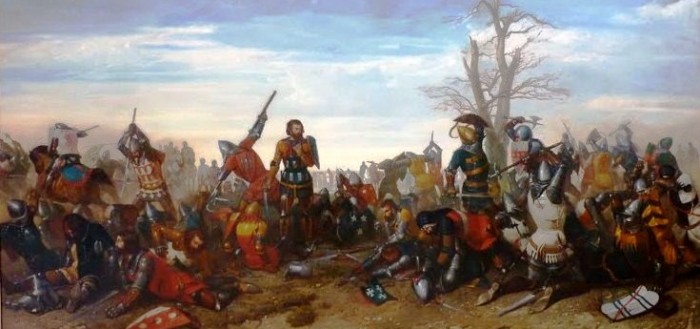
With the death John III, Duke of Brittany (in today’s northeast France), the Houses of Blois and Montford fought for control of the Duchy in the Breton War of Succession, a “subwar” of the Hundred Years War between England and France. On 26 March 1351, thirty Breton knights and squires from French aligned House of Blois, and thirty English, Breton, and German knights, with squires and men at arms from English aligned House of Montford met at the “Place of the Midway Oak”.
The field was located between the castles of Plomeril and Josselin in Brittany. The arranged chivalric melee was to end the bitter raiding that plagued the lands of both Houses. After hearing Mass together, the two groups exchanged pleasantries and small talk for several hours before lining up to fight on trodden ground. The first clash was an inconclusive brawl in which many were wounded. Both sides broke off combat to tend the injuries, mingle, and share wine with their foes.
The second melee was much bloodier than the first and the wounded included the Blois leader, Jean de Beaumenoir. When he asked for water and a stop to the combat, his second replied “Drink thy blood, Beaumanoir; thy thirst will pass”. The combatants of Blois eventually broke the Montfords after killing their leader, the Englishman Robert Bramborough, and riding down the unhorsed Germans who attempted to form a shield wall on the open ground. Seven were killed on the Montford side, three on the Blois side (including the leaders of both) and everyone else was wounded, most seriously.
Everyone captured recovered from their wounds and were released after a small ransom. House Blois would eventually control Brittany, or “Little Britain”: one of the Six Celtic Nations. Up to that point, Brittany was much more culturally aligned with their liegemen across the channel, the Cornish of the southwest Kingdom of England. However the House Blois renounced any ties to England and became part of France, where it remains today.
The Second Battle of Sirte
On 18 March 1942, Malta suffered its 1600th air attack by the Italian air force and German Luftwaffe. That is one attack every ten hours for 21 months on the tiny island 60 miles off of Sicily. Most fell on the ships and airfields around Valetta and the Grand Harbor, but no place was safe above ground and the Maltese civilians could only find refuge in the vast system of medieval catacombs cut into the rock. Since Italy entered the war in June 1940, the planes, ships, and submarines from Malta sank nearly 2/3rds of the Axis supply ships destined for Italian and eventually German operations in North Africa. But in December of 1941, winter weather on the Eastern Front precluded Luftwaffe operations there, and the planes of Luftflotte 2, commanded by Gen Albert Kesselring (we will hear his name again) were sent south to Sicily. They pounded Malta’s defenses into submission. By mid-February, Malta was no longer an offensive base. By March, all of its defending fighters were shot down, anti-aircraft ammunition was dangerously low, spare parts had to be brought in by submarine, fuel oil for the port was low, and its coastal defenses wrecked. Via Ultra, the British knew of Operation Herkules, the proposed German-Italian invasion of the island was coming soon. Malta needed help, and needed it immediately.
However, with the loss of the Cyrenaican airfields to Rommel’s riposte after Operation Crusader, every convoy required a massive undertaking by the Royal Navy’s Mediterranean Fleet. Along with protecting the freighters from the ubiquitous Axis aircraft, the convoy escorts also had to worry about the Italian Navy, which in March 1942, had a substantial qualitative and quantitative advantage over the Royal Navy, at least in regards to ships. In December, Italian frogmen infiltrated Alexandria harbor and severely damaged the only two remaining British battleships in the Eastern Mediterranean, leaving just light cruisers and destroyers to defend the convoys should the Regina Maria sortie from its port in Taranto to intercept. But there was no longer a choice.
On 20 March, 1942, convoy MW-10 (Malta West-10) consisting of just three fast freighters and a fast tanker, departed Alexandria escorted by every available ship in the British Mediterranean Fleet, whether from Malta or out of Alexandria: four light cruisers, one special anti-aircraft cruiser, twelve destroyers, and six destroyer escorts. Italian submarines spotted the departure, and a few hours later the Regina Maria departed Taranto to intercept.
The British commodore, Rear Admiral Phillip Vian was as tough as they came: it was he and his men who boarded the Altmarck in 1940, made near suicidal torpedo runs on the Bismarck, survived numerous Arctic convoys, and made the run to Malta several times in 1941. But he was no fool. The Italian sortie was his enemy’s most likely and most dangerous course of action. His numerous but lightly armed force could not win a long range gun duel with Italian heavy cruisers and battleships. He had to force the Italians to close the distance, and then flee, while still protecting the convoy from direct fire. All the Italians had to do was get between him and Malta, and then they could just conduct a gunnery exercise, only with live targets. He decided not to attack the Italian ships, but their leadership.
On the early afternoon of 22 March, the British spotted two Italian heavy cruisers in the Gulf of Sirte off of Libya. In fine Nelsonian tradition, most of the British escorts charged through the heavy Mediterranean winter swells “to engage the enemy more closely”. The convoy itself turned south with the antiaircraft cruiser and the destroyer escorts. But the Italians weren’t looking for a fight just yet. Soon they returned with the rest of their force: another cruiser, ten destroyers and the modern battleship, the Littorio.
The Littorio and the two heavy cruisers out ranged and out gunned everything Vian had by a wide margin. To compensate for this he divided his force into five divisions which in perfectly rehearsed fashion laid smoke at 45 degree angles to the Italians. This created corridors of smoke from which the British divisions could emerge, fire, and when the bracketed Italian salvos grew close, to retreat to without fear of colliding with friendly vessels. The radar-less Italians would be forced to close the distance if only to prevent the convoy from slipping past in the confusion. He could then assault the Italians with his most potent weapon: the short range torpedoes on his destroyers. If they didn’t, Vian would wait behind the smoke until nightfall, when his radar would give him a significant asymmetric advantage. The appearance of just the Littorio also simplified his plan to attack the Italian leadership. He had expected all three remaining Italian battleships (the Italian commander didn’t want to risk all of his battleships. That should tell you something right there). When there was just one, it was clear where the admiral was.
With the smoke laid, the British ships began a game of cat and mouse with the Italians, albeit with much more serious consequences. Through the high seas that soaked even observers in the range towers, the British concentrated their fire on the Littorio to the most reasonable extent possible, even though no British ship could penetrate its armor at even medium range.
By late afternoon the plan was working. The Italians kept heading west to get between the convoy and Malta, but they couldn’t spot the freighters even though they were well within range. The strong westward wind kept the vulnerable convoy screened by the smoke until nightfall, with Vian’s cruisers and destroyers darting in and out, pounding on the Littorio. Vian expected the Italian commander to go east and around the smoke screen, from where he could have run down the slower convoy. However, this would have exposed the Italians to close contact with the aggressive British, and this was a risk Italian commander was not prepared to take.
By sundown, the Italians had had enough. They had damaged three British cruisers and at least five destroyers, but they couldn’t close with and destroy the ships carrying the vital supplies for Malta. Not wanting to risk the Littorio in a night action (and Mussolini’s wrath if it was sunk), the Italian commander sailed north back to port.
It was a great victory against overwhelming odds, but with an asterisk.
Vian’s tactical success at the Second Battle of Sirte unfortunately had serious operational consequences. The Italian ships may not have been able to fire on the convoy, but the delay caused by the battle meant that they would not arrive in Malta during darkness. When the sun rose on the 23rd, they were still many miles from Valletta. The Luftwaffe pounded them that next morning. Two of the four ships in the convoy were sunk along with three destroyers. The other two freighters were sunk while they were being unloaded. 80% of their cargo was lost.
Malta was on life support.
The Battle of Suoi Tre, aka The Battle for Firebase Gold
Operation Junction City: Thanh Attacks
In late February 1967, Operation Junction City was the largest American and Vietnamese operation of the war: 24 American infantry, cavalry, and artillery squadrons and battalions, two tough South Vietnamese marine battalions, and untold numbers of engineers and support troops swarmed the Tay Ninh province, known as War Zone C, to search for and destroy the Central Office of South Vietnam, or COSVN, the main Viet Cong headquarters, and the base areas of the 9th VC Division. They found almost nothing.
The massive operation did uncover numerous caches of rice and ammunition, and even COSVN’s photo lab, but actual contact with the VC was almost nonexistent. This was greatly disappointing for the LTG Seaman, the US III Corps/II Field Force commander, and Gen Westmoreland, the US Military Assistance Command – Vietnam (MAC-V) Commander. Westmoreland had seen the South Vietnamese Army nearly wiped out by Communist main force units in 1964-65 while they conducted village pacification (hence increased American involvement in 1965), and he wasn’t about to make the same mistake. He needed to find and destroy the big communist units before he could disperse his battalions into the countryside and protect the population. Junction City was supposed to isolate and destroy the largest Communist formation threatening Saigon: the 9th VC Division and its attachment of regular North Vietnamese Army troops, the elite 101st Infantry Regiment. But they were gone.
Gen Nguyen Thi Thanh, the COSVN commander, pulled them back into Cambodia after the serious losses they took during Operation Attleboro the November before. Upon their return to South Vietnam, he wanted to engage the Americans again. His rival, Gen Vo Nguyen Giap, the commander of the North Vietnamese Army, wanted them to cease the wasteful and “suicidal” attacks on American units, and conduct a guerilla campaign in the South. Thanh did not, and thought Giap “soft” for not wanting to engage the Americans: the French were thrown out of North Vietnam precisely by targeting French army units whose destruction greatly increased Vietnamese morale, and led directly to a popular uprising in North Vietnam. Furthermore, the American casualties would inflame the burgeoning Soviet sponsored American antiwar movement, which would ultimately lead to America’s withdrawal, as it had the French. Thanh wanted to do the same. Fortunately for Thanh, Giap wasn’t his commander: Thanh reported directly to the Party in Hanoi. He would get his chance to attack the Americans.
After the initial first few days’ disappointment, American engineers began building firebases and Special Forces’ camps in War Zone C to hold the area, and prevent further Communist infiltration from Cambodia. Thanh saw this as an opportunity to defeat the spread out American battalions in detail. On 27 February, the 101st NVA Regt infiltrated into Tay Ninh and the next day assaulted the 1/16 Infantry battalion of the 1st Infantry Division on a search and destroy mission outside of Prek Klok. Though the American fought off over four hours several assaults by the Vietnamese, casualties on both sides were heavy. On 3 March, the COSVN’s own security battalion attacked a paratrooper battalion of the 172nd Airborne Brigade, the short 30 minute fight killed 25 Americans and wrecked two entire infantry companies, and only superior firepower prevented the battalion’s complete destruction. A week later the 101st came back for Prek Klok, and again were fought off. On 19 March, the entire 273rd VC Regiment locked horns with the tanks and armored personnel carriers of the 3rd squadron of the 5th Cavalry in the Battle of Ap Bau Bang II. It was a bold move to fix the 11th Armored Cavalry Regiment, which was ultimately successful, though devastatingly costly. All along the border, the now static American battalions were assaulted, and more importantly fixed, by the increasing numbers of VC infiltrating from Cambodia.
Westmoreland wanted his big unit fights and though these weren’t exactly as big as he was hoping, they would do for the time being.
But as the old saying goes, “Be careful what you wish for” – These were just Thanh’s opening moves.
 Buk's Historical Ad Hockery
You must be logged in to post a comment.