
Category: History
The First Battle of Puebla

In 1862, the French Army, which invaded under the pretext of collecting on Mexico’s defaulted external debt (but actually to fulfill Napoleon III’s dreams of empire) was defeated by a much smaller Mexican army led by 33 year old General Ignacio Zaragoza at the Battle of Puebla. The large, professional, and well equipped French force arrogantly attacked strong Mexican fortifications, anchored by the twin forts of Fort Loreto and Fort Guadalupe on the approaches to the town of Puebla. The French were repulsed multiple times, despite a significant advantage in artillery and a two to one advantage in troops. During their retreat, Mexican cavalry pursued and inflicted debilitating casualties. The survivors retreated back to Vera Cruz, where they held against the victorious Mexican pursuers.
The defeat prompted Napoleon III to send massive reinforcements, who eventually took Puebla and Mexico City. However, the Mexican victory at Puebla provided a morale boost to the Mexican people and united, at least temporarily, the various factions that had fought each other so bitterly just the year before in the Reform War. The Mexicans would fiercely continue their fight against Napoleon III’s puppet, the Hapsburg Emperor Maximilian’s Second Mexican Empire, until 1867 when the United States began enforcing the Monroe Doctrine after the end of the US Civil War. With America’s support, the Mexicans drove the French and the Imperialists out of Mexico and established the Mexican Republic.
The Mexican victory at Puebla, which happened on 5th of May, is today celebrated as Cinco De Mayo in the Mexican State of Puebla and more generally in the United States as a celebration of Mexican heritage.
Operation Ironclad: the Invasion of Madagascar
After the fall of France in June of 1940, France’s overseas colonies declared for either De Gaulle’s Free French or Germany’s puppet Vichy Regime. The large island of Madagascar off the East African coast declared for the Vichy.
The island sat astride the Mozambique Channel, through which vital shipping transited that the Allied forces in India, Egypt, and the Western Desert depended upon. Though the Vichy were technically German allies, the French on Madagascar left the British and American convoys that passed by alone. However, British codebreakers discovered that the Japanese were in negotiations with the French to use one of the many ports in Madagascar as a secret submarine base, if not seizing one outright. The largest of which was the port of Diego Suarez on the very northern tip of the island. After the Japanese raids into the Indian Ocean in April 1942, the possibility of Japanese submarines severing the Eighth Army’s lifeline through the Mozambique Channel was too likely to ignore.
Just seven weeks after its first proposal, a joint Combined Operations’ Commonwealth/British task force arrived off of Diego Suarez. Such importance was given to the operation, codenamed Ironclad, that the invasion force consisted of ships and troops urgently needed in the Mediterranean, Western Desert, or Burma. The large force sailed from Britain in late March and assembled along the way in Sierra Leone and South Africa. It consisted of the old battleship Ramilles, the carriers Indomitable and Illustrious, an almost excessive assortment of support ships, and carried three British infantry brigades and the No 5 Commando to take on the 8000 odd Vichy French defenders, mostly Senegalese and Malagasy tirailleurs.
Utilizing copious amounts of South African photo reconnaissance, the landing craft expertly navigated the coral reefs and disgorged their troops on shore about ten miles from the port in the early hours of 5 May 1942. The landings were generally unopposed, but just inland the brigades ran into tenacious and well planned French resistance which lasted all day and into the next. Despite advantages in almost every category, including airpower, the British advance was stopped cold by the French and the tirailleurs. The deadlock was only broken when the old destroyer HMS Anthony pulled alongside the Ramillies and embarked its compliment of fifty Royal Marines who until then were destined to listen to the fighting on shore in between watches on the big ship. That evening, the Anthony sailed around to the east end of the island and approached Diego Suarez from behind, past French defenses completely surprised by the audacious maneuver. Despite heavy incoming fire, the destroyer pulled up to the quay with guns blazing and the fifty Royal Marines swarmed ashore. They rushed into the port and created a “disturbance in the town out of all proportion to their numbers”. They stormed the French commandant’s house and headquarters, the naval barracks, and rounded up and captured every Frenchman they could find. When news of the naval commandant and garrison commander’s surrender reached the front lines and fighting some miles away to the west, the French resistance crumbled. However, their surrender only affected the fixed French fortifications around the port, and the French governor maintained control of most of the tirailleurs. They withdrew into the interior of the large island where they would continue resistance for another six months. The governor only surrendered after receiving news of the Vichy French capitulation in North Africa after the Operation Torch landings in November.
Operation Ironclad was the first successful large scale Allied amphibious invasion of the Second World War. After the disaster of the invasion of Norway in 1940, the Allies came a long way in amphibious operational competency, mainly through the tactics, techniques, procedures, and specialized craft and equipment employed and improved upon by Lord Mountbatten’s Combined Operations and commandos. The lessons learned during the planning, preparation, and execution of Ironclad paved the way for larger and more successful (and not so successful) operations in 1942, such as the Raid on Dieppe, the Watchtower landings on Guadalcanal, and the Torch landings in North Africa.
The First Americans Arrive in Europe
The Battle of the Coral Sea
In the spring of 1942, there were three competing factions in Tokyo: The first, the Japanese Army, wanted to concentrate on the war with China. The second, Admiral Yamamoto and his coterie of naval commanders, wanted to concentrate on the destruction of the American Pacific Fleet, especially the aircraft carriers that escaped Pearl Harbor. And the third, the naval staff officers of the Imperial General Staff, wanted to continue the glorious conquests in the Pacific. The Imperial General Staff believed, not unreasonably, that the American carriers would eventually respond, and then subsequently be dealt with. Yamamoto disagreed, and felt they needed to be dealt with immediately. While the former two factions were busy actually fighting the war, the latter, the naval officers of the Imperial General Staff, like staff officers on overblown and bloated staffs anywhere far from any actual fighting (who have time for careerism, politicking, and pet projects) convinced the Japanese Emperor and Prime Minister Tojo to support further operations in the South and Southwest Pacific against the sage advice of Yamamoto.
The next offensive would be Operation MO – a complicated plan to seize New Guinea, the Eastern Solomon Islands, and eventually raid bases in eastern Australia and capture isolated American possessions in the South Pacific which would provide defense in depth for their main South Pacific naval base at Rabaul, and cut the direct sea lanes between Australia and the US. The attack had two parts. The first was a large naval task force with troop transports to seize Port Moresby on the southeast coast of New Guinea, which would effectively end all Australian resistance on the island. The second was a smaller naval task force to seize Tulagi, a small island off a then unknown larger island named Guadalcanal in the Solomon Island archipelago, as a staging base to seize Fiji, New Caledonia, and American Samoa.
These advances would be far from land based air cover and required a third part: the Kido Butai, Admiral Nagumo’s Carrier Strike Force, in order to prevent disruption by MacArthur’s bombers or Nimitz’ carriers. But the Doolittle Raid changed the dynamics of the faction politics in Tokyo. The Americans had done the unthinkable and struck at the heart of the Empire and threatened the Emperor himself. Yamamoto convinced the Emperor that the American carriers had to be destroyed lest they strike at Japan again (or inflict some other nasty surprise that the Japanese had not foreseen, but he didn’t say something so blasphemous to the Emperor). He had his operation against Midway approved and it became the priority for the Japanese Navy. But Operation MO was already in the final stages of preparation.
The Imperial General Staff, with their outsized influence, managed to get a compromise approved. The sticking point between the two operations was always the Kido Butai. Nagumo’s six carriers had reigned terror over one third of the globe for almost five months. But 24 hour combat operations took its toll. The crews were tired, and more importantly, no amount of Bushido or extolling from their officers could change the fact that the carriers and planes themselves were in desperate need of refit and maintenance. Yamamoto would need the Kido Butai at its peak proficiency to take on Nimitz’ carriers in their own waters. The Imperial General Staff recommended that the “A team” of the Kido Butai, the 1st and 2nd Carrier Divisions consisting of the big fleet carriers Akagi, Kaga, Soryu, and Hiryu return to Japan to refit for the Midway operation, while the “B team”, the 4th and 5th Carriers Divisions consisting of the light carrier Shoho and more modern fleet carriers Shokaku and Zuihkaku sail south to take part in Operation MO in the Coral Sea. The rivalry between the carrier divisions offers a unique insight into the Japanese mentality of the time. Though the light carriers and the Shokaku and Zuihkaku were more modern, they were newer and therefore younger and deserving of less respect than their elders. The best pilots and crew went to the older carriers which were referred to as “the sons of the wives” while the newer ships were referred to as “sons of the concubines”. This also meant that the crews and pilots of the newer ships had to work harder to gain face. So in that light, the General Staff was doing them a favor by letting them participate in MO and then immediately move north to take part in the Midway operation without respite. Of course all of the carriers and their pilots wanted to do this, but Yamamoto understood there was a limit to the military efficacy of honor and determination in modern naval warfare. He wouldn’t permit more than two fleet carriers skip the desperately needed maintenance and refit. The end result was that for the first time in the War in the Pacific, the Kido Butai, the mailed fist of the Japanese Navy, was split into its component parts.
This was exactly what the Americans needed to happen. With Halsey, and the Enterprise and Hornet still returning from the Doolittle Raid, Nimitz only had two carriers left, the Yorktown and the Lexington. (The Saratoga was in drydock after being torpedoed, and the Wasp was delivering fighters to Malta at the ardent behest of Churchill). Unfortunately for the Japanese, American and British codebreakers knew of the Japanese plan and Operation MO was at the tail end of a long supply chain back to the Home Islands. For the first time in the war, the Allies would be able to engage the Japanese fleet with near parity in resources.
American aircraft carriers Yorktown and Lexington under Rear Admiral Frank Fletcher were dispatched to the area. On the morning of 3 May 1942, the Japanese landed on the island of Tulagi and the next day aircraft from the Yorktown savaged the eastern Japanese task force. But the Japanese carriers weren’t there. In fact it was the smallest and least important of the five Japanese task forces lurking nearby. Ship identification was the biggest culprit, and the pilots reported 14 cruisers, destroyers and transport ships sunk, when the actual toll was just a destroyer, a few small gunships, and a freighter. Even worse, this action alerted the Japanese to the presence of the American carriers in the area and the Japanese fleet carriers entered the Coral Sea with the purpose of finding and destroying the targets they missed at Pearl Harbor. For the next two days, air patrols from ADM Fletcher’s aircraft carriers searched the Coral Sea for what he believed to be four Japanese carriers supporting the Port Moresby invasion force and the Japanese did the same for what they thought were two more American carriers in the area.
However, neither side had ever faced their adversary’s carriers with their own carriers before. And the limitations of air reconnaissance, radio communications, and sea navigation over great distances against fast moving fleets with their own inherent air cover in variable weather were keenly felt by both sides. Furthermore, each side approached from an unexpected direction: the Japanese from east around the southern tip of the Solomons and not north from Rabaul, and the Americans from the south instead of the east.
For the next few days, both sides flailed about like blindfolded boxers listening to sighting reports from their trainers in the corner. First, the Americans spotted the invasion force but reported it as the striking force with the fleet carriers and launched their full complement of aircraft against the wrong target. Fletcher was livid with the scout when he returned to confirm no carriers but when confronted with his report realized he transmitted the wrong code. Fortunately for the scout, a carrier was spotted nearby but it was only the light carrier Shoho with the invasion’s covering force. The massive strike put eleven torpedoes and six 1000 lb bombs into the poor Shoho, but it was mostly wasted effort as the strike still left the Yorktown and Lexington vulnerable to the Shokaku and Zuikaku prowling nearby. But the Japanese had their own problems with identification: the next day they spotted and sank an oiler and destroyer that Fletcher dispatched away from the fleet to keep them safe, which was reported (and eventually showed up in Japanese newspapers) as an aircraft carrier, a cruiser, and one American and one British battleship sunk. The attack actually flew over Fletcher and his carriers who were obscured by low clouds. On the return trip, the Japanese spotted them, and launched a limited late afternoon attack with their most experienced pilots in which they couldn’t find the Americans. That night they all got lost and ditched. Nine of them even mistook the American carriers for their own and tried to land. The Japanese lost more pilots to the sea in one evening than they had to American guns so far in the war.
That night the two task forces passed within 70 miles of each other in search of their respective foes going opposite directions.
But both sides knew each was close by. The 8th of May would be decisive. The victor would be the one to strike first. But that was not to be the case. On that morning, they both struck simultaneously. Fletcher spotted and heavily damaged the fleet carrier Shokaku, but missed the Zuihkaku in a rain squall just 12 miles away. At almost the same time, the Japanese struck the Lexington and so severely damaged the Yorktown they believed she was sunk. The crew of the Lexington thought they had her damage under control, but leaking fuel fumes ignited when they reached the engine compartments. Over the next six hours, the Lady Lex was wracked by increasingly worse explosions as uncontrollable fires slowly engulfed the beloved ship. She was abandoned that evening. Both sides took heavy aircraft losses but repair crews managed to keep the Yorktown afloat and whatever American planes were left in the air were able to land. The same was not true for the smaller Zuihkaku; Japanese crews had to push aircraft off the deck in order to make room for the Shokaku’s planes. The Americans might have lost more tonnage in ships in the battle, but the Japanese lost many more aircraft, most by their own hand.
With only one wounded carrier remaining, Nimitz ordered Fletcher to withdraw from battle and head for Pearl Harbor for repairs. Both admirals believed there were still three Japanese carriers about (there was only one, the Zuiakaku), and without any way to refuel, the Yorktown would have to severely curtail her ability to maneuver. Fortunately for the Americans, the Japanese commander, ADM Inoue at faraway Rabaul, had taken such heavy losses in aircraft he did not believe he could take Port Moresby without air cover and also withdrew, defaulting victory to the Allies.
For the first time since America entered the war, the Japanese had been stopped. Australia was saved from invasion or eventual death by strangulation. Additionally, the Shokaku and Zuihkaku would be unavailable for the upcoming operations against the American carriers around Midway. The Battle of the Coral Sea was the first naval battle in history in which the opposing ships never actually sighted each other or exchanged direct fire. It would not be the last.
The Ride of Sybil Ludington and the Battle of Ridgefield
In late 1776, the Continental Congress established a supply depot at Danbury, Connecticut to support American efforts to repel the inevitable British invasion down the Hudson Valley from Canada. After the capture of New York, the British learned of the depot from loyalists. With near complete command of the sea they sent a raiding force to destroy the cache, before the Americans massed too many troops in the area which would surely happen after the snows melted in New England. (In fact, MG David Wooster, and BGs Benedict Arnold and Gold Silliman were in the area to do just that.)
On 25 April 1777, a Royal Navy flotilla landed a British/loyalist raiding force which marched on Danbury, not unlike the march on Concord two years before. That evening, a wounded and exhausted messenger arrived at the house of COL Henry Ludington, the local militia commander. Ludington immediately began organizing his men but the messenger could not go on, and like Paul Revere’s and Williams Dawes’ ride in 1776, it was necessary to alert the countryside to fully assemble the militia.
The task fell to Ludington’s sixteen year old daughter, Sybil, who mounted a horse and rode off into the rainy night to warn of the British advance. She first alerted Danbury, and then rode through Putnam and Dutchess counties in New York. Unlike the rides to warn of the British advance on Concord, Sybil’s ride was made in the face of constant loyalist danger. In all she rode 40 miles over eight hours (twice as long as Paul Revere), rallied the militia, avoided loyalists, and in at least one instance fought them off as she did so. 400 minutemen responded to Sybil’s call to arms, and she alerted the Continental Army generals.
Wooster’s Continentals and Ludington’s militia arrived in Danbury too late to save the depot. On the 26th, the raiding force destroyed the giant cache, and to teach the rebels a lesson they fired the town, completely destroying it. This infuriated the countryside, and more men flocked to Wooster and Ludington, who vowed to destroy the redcoats or chase them out of Connecticut.
The next day, several small skirmishes were fought with the withdrawing British, as more men descended upon the coast. Wooster caught up with the rear guard outside the town of Ridgefield. As the 67 year old Wooster led the attack, he yelled the famous last words of “Come on my boys! Never mind such random shots!” and as fate would have it, was mortally wounded. The unsuccessful attack however, did slow the British enough for a flanking party led by Benedict Arnold to establish a road block in town. The redcoats scattered the defenders with cannon fire, but Arnold took up command and with his characteristic energy drove the British out in disorder with a running gun battle down Main Street. After sniping and probing the British march the entire way, Arnold made one last attempt to attack the British on the beach, but the waiting ships’ guns and a timely bayonet charge allowed the British to escape.
The British destruction of Danbury and the use of cannon on Ridgefield infuriated the citizens of Connecticut and upper New York, whose population was previously divided evenly between rebels, loyalists, and undecideds. The destruction of the depot was a blow to Continental efforts in the area, but was quickly replaced with donations by patriots and fence sitters who were now dedicated to the American cause, and stores confiscated by patriots as the loyalists were driven out. Over 3000 Connecticuters volunteered for service in the Continental Army in early 1777, more than three times what Arnold was expecting to recruit from the area for the upcoming Hudson Valley campaign. The redcoats would no longer be able to raid so far inland in Connecticut. Future raids would be confined to the coastal towns.
The Battle of Muehlberg
In 1517, Martin Luther nailed his 95 Theses to the door of the Wittenburg castle church and began the Protestant Reformation and over the next 15 years, many Germans inside the Holy Roman Empire converted to Lutheranism. In 1531, several of the small principalities and electorates forged a defensive alliance, the Schmalkaldic League (named for the town in Thuringia where the pact was signed) against the inevitable backlash by the Catholic Holy Roman Emperor Charles V.
In the early to mid sixteenth century, Charles V was the most powerful man in Europe. In addition to being the Holy Roman Emperor which conferred significant authority over most of Central Europe, he was the sole inheritor of three of the largest dynasties of Europe: Hapsburg Austria, Valois-Burgundian Netherlands, and Trastamara Spain, including most of Italy, the Balkans, and the New World. To keep these possessions, he was constantly at war with his archenemies Francis I of France and the Ottoman Sultan Suleiman the Magnificent, among many others in this age of rapidly shifting alliances.
However, as long as the Schmalkaldic League confined its activities to matters of religion, e.g. converting the population, confiscating Church property, murdering priests, nuns, and monks etc., Charles had little issue with Protestantism. He had fought more than one war against the Pope. However, by the mid-1540s, the defeated and humiliated Francis I was actively supporting the Schmalkaldic League even as he was slaughtering Protestants in France. Eventually, the League turned political with the goal of creating a Protestant entity to supplant the Holy Roman Empire. This Charles could not tolerate. In 1547, Charles V invaded Saxony to capture the ecclesiastical center of Lutheranism, Wittenburg, and defeat the League’s army under the Elector of Saxony John Frederick I, and Landgrave Philip I of Hesse. The rest of the free cities and smaller states of the League would then fall into line.
The League’s army was small, unprofessional, inexperienced, and lacked any unity of command as each contributing state, no matter how small, had an equal say in command. Charles’ army was the exact opposite. His army was composed of veterans almost to a man. They had fought nonstop for twenty years. They halted the Ottomans at the Gates of Vienna, threw the French out of Italy, and nearly captured Paris. Furthermore, his was a multicultural army that reflected his dominion: He had German landsknechts and Catholics, Protestant soldiers from loyal Imperial electorates, Italian condottieri, and Dutch musketeers and armsmen, all centered around and organized by the steely and tough Duke of Alba, the commander of the premier shock troops in the early Age of Pike and Shot: the Spanish tercios.
The tercio was the first formation in Europe specifically designed to combine the firepower of gunpowder in the form of arquebuses, the defensive power of the pike or polearm, and the counteroffensive power of a heavily armed swordsman to defeat a charge of armoured knights, like the French gendarmes. Named a “tercio” because theoretically it was composed of 1/3 of each. The formation mixed companies of the three arms into combined columns, or in Italian, “colonna”, led by a “coronel”, which is Spanish for a senior (and noble) commander of a column of companies. (The combination of the two words gives us the modern word “colonel” and its unique pronunciation.) The Spanish tercios were the most feared, dangerous, and professional heavy infantry on the planet in the 16th and early 17th centuries, and they were led by arguably the best commander of the age, Fernando Alvarez de Toledo, the Duke of Alba. The army of the Schmalkaldic League didn’t stand a chance.
On 24 April, 1547, the ailing Charles V (who was carried into battle on a litter, not majestically on a horse as in Titian’s famous portrait) and his Imperial army led by the Duke of Alba reached the Elbe River opposite Muehlberg. Elector John Frederick with the Schmalkaldic Army outside the town, thought he had time to organize. But his pickets on the far bank were forced to retire by the longer range of the Spanish and Dutch arquebuses and his men lost visual contact with Imperial Army, though this wasn’t reported to him.
While he went about attempting to assemble his bickering army, the Duke Alba was well on his way to crossing the river without using the obvious stone bridge. Some enterprising Spanish veterans swam the river and collected boats, which they used to build another bridge. Additionally, Maurice of Saxony, a Protestant who hoped to gain from John Frederick’s loss, convinced a discontented peasant to identify a ford. Maurice then took all of the cavalry across the river, with each rider carrying an additional arquebusier. By the time John Frederick knew what was happening, he had light cavalry behind him, was under fire from the woods to his flank, with the tercios approaching from the front, and missed the only opportunity to even conceivably win the battle by attacking the vulnerable river crossing. The Schmalkaldic Army broke after a quick fight and the cavalry ran down the defenders, killed thousands, and captured the leadership.
John Frederick and Philip lost their electorates, and the rulers of the other states were replaced. Wittenerg was captured and the majority of the influential Protestant thinkers fled to other parts of Europe, where they would continue to proselytize. The Battle of Muehlberg and the end of the Schmalkaldic War shattered Protestantism, but inadvertently caused it to spread, most notably to England, where German refugees became influential members of the English Reformation under King Henry V. Protestantism would not only spread, but fragment as a result.
The sick and exhausted Charles eventually settled for the Peace of Augsburg in 1555 with the Protestants, which allowed each electorate to choose its own religion as long as they accepted the Holy Roman Emperor’s authority. After the Peace of Augsburg, Charles V ruled over the largest (mostly) willing multicultural European empire not seen until 458 years later with the signing of the Lisbon Treaty in 2009 which established the European Union as a legal entity. He would die shortly afterwards and wouldn’t live to see it fall apart.
War Song for the Army of the Rhine
In 1792, the War of the First Coalition pitted the monarchies of Europe against Revolutionary France in a war to prevent the spread of the Enlightenment ideas of self-rule by its citizens. The US Constitution, the French Declaration of the Rights of Man and of Citizen, and the recent Polish and French Constitutions of 1791, were direct threats to their authority. So the armies of Great Britain, Prussia, Russia, Austria and Spain invaded France.
With the loss of so much of their officer corps (who were mostly noblemen), the War of the First Coalition began poorly for the French. The armies of her enemies descended upon the traditional invasion corridors into the country. In Alsace/Lorrarine, the Prussian army approached, and the French were not prepared. The mayor of the fortress city of Strasbourg asked a young captain, Claude-Joseph Rouget de Lisle, to write a song to rally the troops of the garrison. On 24 April 1792, he composed the “War Song for the Army of the Rhine”. The song was a bloody and zealous anthem to the revolution and quickly spread across the country.
Toward the end of May, Provencal volunteers for the French National Guard arrived in Paris from Marseille. The desperately needed troops marched into the city singing Rouget’s song. They were such a sight and sang with such gusto that the song acquired the name we know of it today, the French National Anthem,
La Marseillaise
A History of Warfare by Field-Marshal Viscount Montgomery of Alamein
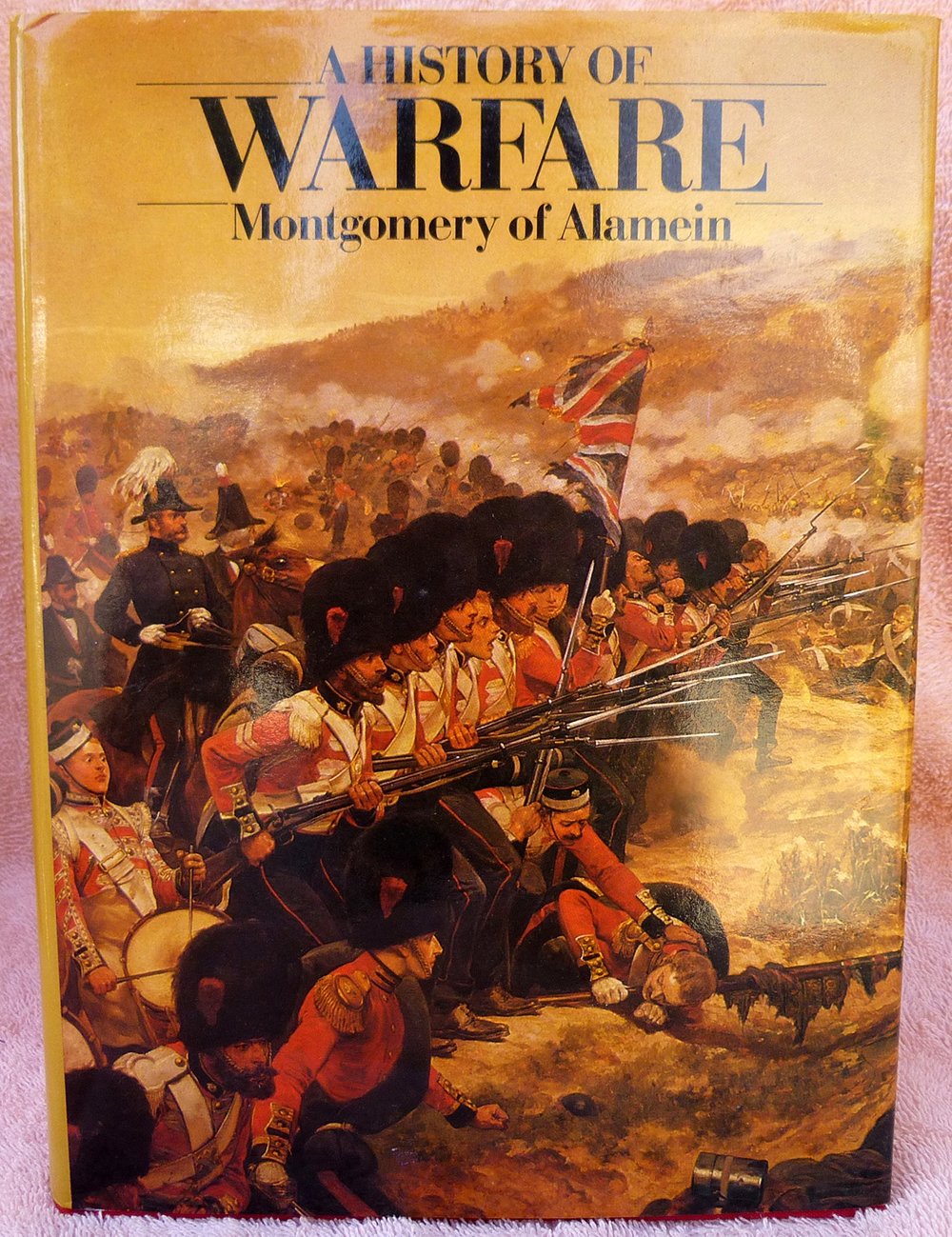
A History of Warfare. Field-Marshal Viscount Montgomery of Alamein. London: Book Club Associates, 1982.Field-Marshal Viscount Montgomery of Alamein led the British Eighth Army across North Africa in pursuit of Rommel. In 1944 he commanded the Allied land armies in the invasion of Normandy, eventually leading the 21st Army Group. Despite this experience, few give him…
The “Second” Battle of New Orleans.
On April 24, 1862 Union Admiral David Farragut, an aggressive Virginian in command of the West Gulf Blockading Squadron, boldly ran his ships past the Confederate forts and batteries protecting the approaches to New Orleans at the mouth of the Mississippi River. With the main defenses of Forts Jackson and St. Philip bypassed, the undefended city fell to Farragut without a fight on the 29th. It was one of the Union’s most important victories in the “Anaconda Plan” to economically strangle the Confederacy into surrender and a big step in controlling the Mississippi River which would split the Confederacy in half.
The Relief of the Demyansk Pocket
Operation Typhoon, the failed German offensive to capture Moscow in the autumn of 1941, was defeated not only by bad weather and improved Soviet defenses in front of the capital, but also by massive Soviets counterattacks by hundreds of hastily trained, poorly equipped, and poorly led Soviet divisions all along the entire front. The Soviet casualties were enormous, but they relieved the pressure on Moscow, the cultural, economic, communications, and administrative center of the Soviet Union, and forced back the freezing German troops at the tail end of overwhelmed supply lines that stretched thousands of miles. In order to prevent a collapse of the front and the loss of too much hard won territory, and more importantly hard won prestige, Hitler issued the controversial “No Retreat Order”.
The No Retreat Order prevented the collapse of the front but only because the Soviets bit off more than they could chew. The order also placed significant hardship on the German soldiers, particularly those at the forward edges of the battle area. In several places, Germans held strongpoints as the Soviets streamed past. One such was at Demyansk, which controlled the rail line from Moscow to Leningrad. There the front resembled a finger jabbed directly into the Soviet lines. A combination of tenacious German resistance, bad weather, and defensible terrain prevented the Soviet Rzhev-Vyazma Offensive from capturing the vital town. However after a bitter fight the Soviets encircled Demyansk on 8 February 1942 and cut off the II Corps of the German 16th Army.
The 10th Army and the remainder of the 16th Army couldn’t break through to the defenders, but Herman Goring assured Hitler that the pocket could be sustained by airlift. The 90,000 trapped men needed at least 300 short tons of supplies daily. The Luftwaffe never approached that number. Nonetheless for two months, the embattled Germans fought off wave after wave of Soviet assaults. In one instance, the German 12th Infantry Division urgently requested ammunition and a livid II Corps supply officer refused, citing that the division was using too much ammunition. The 12th Division commander replied, “You calculations are of no consequence”. The fighting was so fierce that the commander of the SS Totenkopf (Death’s Head) Division, made a direct appeal to Himmler for replacements and material, and for the Luftwaffe to step up the number of sorties, lest his division be annihilated. They were fighting Soviet Guards divisions and it became an ideological imperative that the Totenkopf SS not be destroyed for fear that National Socialism seem inferior to Soviet Communism. (The Soviets awarded “Guards” status to divisions that distinguished themselves in battle and afterward received better pay, supplies, equipment, and replacements as a result.) Despite a maximum effort by Luftwaffe, 2/3rds of the encircled German troops were either dead, wounded, or no longer fit for duty by mid-April.
On 14 April 1942, German attacks to break the siege of the Demyansk Pocket reached the point where the troops inside could attempt to break out. That day, an ad hoc assault group consisting of the SS Totenkopf Division and about a kampfgruppe (an ad hoc battalion to regiment sized battlegroup) from each of the other divisions, attacked towards the German lines and on 21 April, broke through the Soviet encirclement. The Germans would hold Demyansk for another year.
Although the defense of the Demyansk Pocket was successful, it was a near run thing as the Luftwaffe didn’t deliver nearly the supplies needed. It also came at a great cost: all of the German divisions, including the SS, were combat ineffective by the end and would have to be reconstituted in their entirety. The defense was due more to the training, discipline, and quality of the average German soldier and leader than it was to the Luftwaffe’s aerial resupply. Additionally, the Luftwaffe lost nearly 250 JU-52 transport aircraft that weren’t easily replaced. German industry was not on a full war footing in early 1942 and the loss of so many transport aircraft (on top of the loss of so many in Crete in May 1941) was crippling. Nonetheless, the operation was a success, and gave the impression to Goering, and more importantly to Hitler, that encircled troops could be resupplied by air. This was not the case on the Eastern Front. Goering provided well below the bare minimum to the Demyansk Pocket; he would utterly fail trying to resupply another pocket four times its size months later at Stalingrad.
 Buk's Historical Ad Hockery
You must be logged in to post a comment.