
Category: History
On Grand Strategy
“A gap has opened between the study of history and the construction of theory, both of which are needed if ends are to be aligned with means. Historians, knowing that their field rewards specialized research, tend to avoid the generalizations upon which theories depend: they thereby deny complexity the simplicities that guide us through it. Theorists, keen to be seen as social “scientists,” seek “reproducibility” in results: that replaces complexity with simplicity in the pursuit of predictability. Both communities neglect relationships between the general and the particular—between universal and local knowledge—that nurture strategic thinking. And both, as if to add opacity to this insufficiency, too often write badly.”
The Battle of Sullivan’s Island
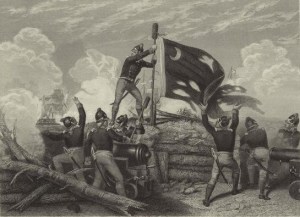 While the British regulars were locked up in Boston throughout late 1775 and early 1776, Americans in the remaining colonies threw out most of the British and loyalist officials. When Howe evacuated Boston, two large expeditionary forces were made available to Howe: one under Gen. John Burgoyne that went to lift the siege of Quebec, and another under Gen. Henry Clinton, which sailed south.
In June 1776, Britain’s only friendly harbor north of the Caribbean was in Nova Scotia. And another was needed to effectively subdue the colonies. With only 4000 men New York and Virginia were out of the question, so Clinton headed south to the supposedly friendlier Carolinas and Georgia.
Clinton sought to link up with Scottish loyalists from the backwoods of North Carolina. However, when he arrived off of Cape Fear, he found out that the Scots were defeated at the Battle of Moore’s Bridge two weeks before so he headed further south to Charleston, South Carolina.
In colonies that were prepared to fight against the Crown, South Carolina was close to the top of the list. Charleston was the third largest city in the colonies, the center of patriot resistance in the south, and home to most of the arms manufacturers in the Southern colonies. Thousands of Scots-Irish patriot militia poured into the city from the backwoods, and fortifications defending the city were started in late March 1776. Unfortunately, they were not completed when Adm Peter Parker’s flotilla of eight warships appeared off the coast in June with Clinton’s men. The northern entrance to Charleston Harbor was guarded by a half finished fort on Sullivan’s Island commanded by COL William Moultrie with 500 men and thirty pieces of artillery. Only two walls of the “fort” we’re started. But they were thick and consisted of palmetto log retaining walls filled in with sand, and had firing platforms for the guns.
On 28 June 1776, Clinton’s men attempted to march on the rear of the fort by fording from nearby Long Island while Parker destroyed the it with cannon fire and landed marines. But the ford was chest deep, and a small blocking force prevented Clinton from ferrying across. Nonetheless, Parker was confident he could complete the task himself.
Parker opened fire and Moultrie responded in kind. To make up for a relative lack of gunpowder, Moultrie’s gunners made every shot count, greatly damaging the fleet. Parker’s fire was continuos and heavy but the spongy palmetto logs absorbed the shot. Most accounts of the battle note the logs of the fort “quivered” when hit instead of splintering. But that didn’t help the men on the platforms whom took a terrible pounding. The high watermark of the fight came just before dusk when the flag Moultrie designed was struck down fell outside the walls. SGT William Jasper yelled “We shall not fight without our flag!” and ran through the fire to grab it. He fastened it to a cannon swab so the city could see it since the flag staff was broken. The act inspired the defenders and they increased the rate of fire, so much so that when dusk fell, Parker decided that any further bombardment would just get his barely floating ships sunk.
Unable to force the narrows, Clinton’s men reboarded. Parker returned to the bigger Long Island to join with Howe’s substantially larger invasion of New York later in July.
The Assassination of Dr. Martin Luther King Jr.
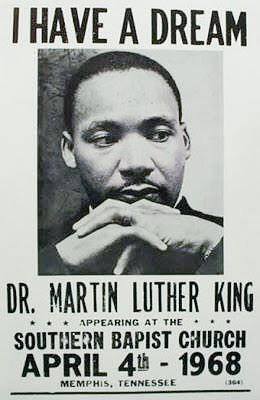
The passage of the Civil Rights Act of 1964 and the beginning of serious American involvement in Vietnam in 1965 began a new and more volatile phase in America’s Civil Rights Movement. The booming post war economy of the 50s and early 60s couldn’t keep up with the competing fiscal requirements of enforcement of the CRA, Johnson’s Great Society Programs, and the Cold War. A combination of Southern Democrats (for mostly racial reasons) and Northeastern Republicans (for mostly economic and political reasons) consistently steered money away from urban programs creating a widening economic gulf in America. In response to this, Dr. Martin Luther King Jr, at the forefront of America’s Civil Rights Movement, organized the Poor People’s Campaign in late 1967 and early 1968, focusing on jobs and income for America’s urban poor.
As part of this campaign, Dr. King traveled to Memphis Tennessee in March 1968 to give support to the plight of black sanitation workers who received unequal pay and benefits compared to their white counterparts. Memphis was no stranger to Dr. King: he was there often and routinely stayed in the same hotel, even the same room. At 6pm on 4 April 1968, a gunman, James Earl Ray, took advantage of this situation. Ray shot and killed Dr. King as he stood on the 2nd floor balcony of his usual room in the Lorraine Hotel. Ray would escape, but would be captured in London two months later.
Later that evening, at a campaign stop in Indianapolis, Senator Robert Kennedy learned of Dr. King’s assassination. He had one last campaign speech to make that day but he tore up his remarks. During this impromptu address he gave one of the most memorable speeches in American history. He focused on Dr. King’s belief of non-violence and abhorrence of racial divisiveness. He concluded by saying,
“What we need in the United States is not division; what we need in the United States is not hatred; what we need in the United States is not violence or lawlessness, but love and wisdom, and compassion toward one another, and a feeling of justice towards those who still suffer within our country, whether they be white or whether they be black.”
History isn’t a ‘useless’ major. It teaches critical thinking, something America needs plenty more of
Kaiserschlacht: The Spring Offensive
By 1918, the British blockade forced a near famine on the German population. Imperial Germany would be starved into submission by 1919. However, the peace treaty with the Bolsheviks at Brest-Litovsk formally took Soviet Russia out of the First World War and freed up hundreds of thousands of German troops for the Western Front. Since the early winter, American troops arrived in French ports at the rate of 200,000 a month. Erich Ludendorff, ostensibly known as the First Quartermaster-General of the Imperial German Army but in reality the brains behind the entire German war effort, devised a plan to defeat the British and French before American numbers, and industrial and agricultural capacity could be brought to bear.
Using the divisions released from the Eastern Front, Ludendorff’s offensive sought to split the British and French armies by driving for the English Channel. Once the surrounded British Army was rolled up from the south or its ports captured, the British Army would assuredly surrender, and the French would be forced to sue for peace. The “Kaiserschlacht” or “King’s (Caesar’s) Battle” would consist of three separate offensives: Operation Michael launched on the Somme to split the British and French Armies, Operation Georgette near Ypres to seize the Channel Ports, and Operation Blücher–Yorck to draw French and American reserves south.
The Spring Offensive used “Stormtrooper” tactics perfected against the Russians but on a much larger scale. Whereas previously the best and fittest German troops in a division were specially trained and formed into stormtrooper battalions to infiltrate the enemy trenches and seize strongpoints at the outset of the attack, for the Kaiserschlacht Ludendorff formed entire Stormtrooper divisions. On paper, this seemed a good idea, but actually encouraged the wasteful use of these elite troops against unimportant targets. Being specialist formations, the Stormtrooper divisions forced the basic tactical formation i.e. the lowest level where a single commander controls all of his combined arms formations and specialist attachments, back to the corps level. Since the advent of gunpowder, the basic tactical unit became increasingly smaller: In 17th and 18th century, it was the army. In the 19th, the corps system allowed Napoleon to conquer Europe. By 1918, the smallest combined arms formation was the division. In a First World War division assault zone, not every strongpoint or trenchline was a key piece of terrain, where the stormtroopers were needed. Normally, whatever positions the stormtroopers bypassed were reduced by regular line infantry. By having entire stormtrooper divisions, this forced the elite units to assault positions that could have been taken by regular units, incurring unnecessary casualties and tiring them out. The entire offensive was a gross misuse of a limited resource.
On the foggy morning of 21 March, 1918, Operation Michael unleashed Ludendorff’s Stormtroopers in the Cambrai sector after a short vicious bombardment of key terrain and strongpoints, artillery positions, and Allied command and control centers. In a single day, the Germans recaptured all of the terrain that the British had spent the last three years taking. Within two days, the British Army was in full retreat.
However, the assaults wore down the all-important stormtrooper units. Moreover, the British retreat wasn’t a rout, and the British just withdrew from tactically insignificant terrain, while reinforcing vital areas. Furthermore, Ludendorff “reinforced success”, while nominally a great idea, in the context of the Western Front in 1918, all it lead to were meandering uncoordinated forward advances along paths of least resistance. Within days, the important British defenses had to be reduced by the line divisions (who were stripped of their best men for the stormtroopers) in costly frontal assaults while the exhausted stormtrooper divisions continued the advance over ground mostly abandoned by the British. The Germans had no exploitation force and the speed of a man walking was simply not fast enough to break out before the British and French reacted, who were mostly operating on interior lines (Breakthrough Theory would come to fruition 15 years later with improvements to the tank, motorized transport, and “Blitzkrieg”). The British defended these key points for many reasons, most of which had to do with logistics. While the Germans advanced unprecedented distances which made for great headlines, their supplies couldn’t keep up. Finally, and not insignificantly, the British blockade effectively grounded the German air force for lack of fuel, giving the Allies an immense advantage in reconnaissance.
Operation Michael cost the Allies and Germans 250,000 casualties each, but could not isolate and destroy the British Army. Operation Georgette got to within 15 miles of the Channel ports, but was slowed by last stands from the Portuguese Expeditionary Force, and British, French, and Australian reinforcements that poured in later. Operation Blücher–Yorck was blunted by French and American troops, including the US 1st Division, after some initial success, but failed to draw away significant troops from the main effort, Operation Michael, to the north. In these operations the Allied and German casualties were about the same, a combined 300,000. However, the Allied casualties were replaced in a few months by American troops; the German casualties were irreplaceable, especially in the Stormtroopers divisions who took a disproportionate percentage of losses.
By the end of June, Ludendorff simply ran out of men. There were more in the East which could have been available, but they were “Germanizing” and “civilizing” the vast tracts of Poland, the Baltic States, and Belorussia seized from the Russians. There was no time to reorganize them and bring them west. In July, Ludendorff called off the offensive. The Kaiserschlacht was a body blow to the Allies, but one from which they quickly recovered. The German Army was hollowed out, and unable to conduct further large scale offensives. The conclusion of the war was just a matter of time. The end of The Great War was in sight.
The Battle of Phou Pha Thi: The Fall of Lima Site 85
In 1962, the Geneva Accords declared Laos a neutral country in the fight for Vietnam. US and SEATO (South East Asia Treaty Organization, the Pacific’s NATO) pulled out immediately, but North Vietnam kept about 7000 troops in the north of the country to support the Pathet Lao, the Laotian Communist insurgents. Unwilling to accept the political costs of sending troops back into Laos, Kennedy and later Johnson supported the Royal Laotian government with cash, mercenaries, and covert support. The war in Laos became the purview of the CIA. The “Secret War in Laos” was the largest CIA covert operation of the Cold War until Afghanistan in the 80s.
In 1965, the monsoon disrupted US bombing campaigns against the Communists, specifically Operations Rolling Thunder in North Vietnam, Steel Tiger on the Ho Chi Minh Trail in the Laotian panhandle, and Barrel Roll against the Pathet Lao in northern Laos. So a navigational station was put on top of Phou Pha Thi, a jagged and steep mountain in the Hmong dominated area of Laos. The Hmong, like the Montagnards in Vietnam, were a tough mountain people who had been fighting Communists for a decade. A tactical navigational aid (TACAN) transponder was placed at Landing (Lima) Site 85 on the very top of Phou Pha Thi, a Hmong sacred mountain whose summit was thought to be impenetrable to anyone who hadn’t lived in the area their entire lives.
Lima Site 85 was just one of hundreds of landing sites for the CIA’s proprietary airline in Laos, Air America. Also, LS-85 was quickly discovered to be the perfect place for radar to cover the North Vietnamese heartland, and its height gave a straight shot to cover Hanoi and Haiphong, just 175 miles away to the east. The site was expanded but still small, just a landing pad, and three small buildings for commo, operations, and living quarters. However, the TSQ-81, a portable version of the venerable and reliable MSQ-77 radar, required a team of 12 US Air Force technicians to operate. This posed a problem: No US military personnel were allowed in the country. So the CIA “sheep-dipped” them. Sheep Dipping is the practice of asking for military volunteers for a covert mission, discharging them from the service, hiring them through a civilian company, in LS-85’s case Lockheed Aircraft Service Corp, and when the mission was over they releasing themd back into the service.
By the end of 1967, Lima Site 85 directed nearly a quarter of all US airstrikes in theater. The North Vietnamese knew of the site and in mid-1967 began a concerted effort to break into Hmong territory and seize Phou Pha Thi. By 1968, almost half of LS-85’s airstrikes were in support of Royal Laotian troops or CIA led Hmong militia. In January 1968, the first direct assault on LS-85 occurred when two North Vietnamese Antonov-2 Colt biplanes attempted to bomb the site. But the slow moving planes were shot down by Air America Huey crewmembers with small arms, a submachine gun in one case.
With the failure of their air attack, the North Vietnamese and Pathet Lao began ground operations against LS-85 in earnest. They were close enough to shell and rocket the site, but its position meant almost all of the incoming rounds either hit the side of the mountain or flew harmlessly overhead. Nonetheless, the indicators were ominous. The CIA brought in several companies of Hmong militia and a Thai Army infantry battalion that were under cover as “mercenaries” to defend the base of the mountain.
The Hmong were excellent guerrilla fighters but they were unsuited for a static defense against a deliberate attack by North Vietnamese regulars and a swarm of Pathet Lao. On 18 February 1968, a North Vietnamese officer was captured five miles south east of the site. On him were papers that indicated an imminent attack on the site by four battalions of the veteran 766th PAVN Regiment and one PL battalion, supported by a battalion of artillery. However, LS-85 was integral to the air campaign and would not be evacuated. The authority to evacuate rested solely with the American ambassador in the Laotian capital of Vientiane, and then only at the sole request of the Air Force. Furthermore, no more troops were brought in to defend the site as air power and the terrain were thought to be sufficient.
On 9 March, 1968, the Communists attacked. Despite massive American airstrikes, the North Vietnamese and Communist Laotians pushed the Hmong and Thai soldiers with their CIA commanders slowly up the mountain. Even during the attack, the Air Force did not want to request evacuation as the inclement weather in North Vietnam made the radar exceptionally valuable. But for the first time, they did issue the technicians M-16s, who up to this point had been unarmed because they were posing as civilians working for Lockheed. Only the senior NCO, CMSgt Richard Etchberger, knew how to competently operate the weapon. On 10 March, the fighting was dangerously close to the site, but even as late as 9pm the Air Force thought they could hold out. The ambassador authorized a dawn extraction by Air America for the technicians and the remaining Thai and Hmong soldiers. The CIA station chief immediately commented that it “was a day too late.”
The Air Force might have been correct, the Communists sustained significant casualties assaulting the mountain and looked to suspend attacks. But they were just waiting on their trump card – Communism is nothing if not dangerously seductive and a dozen local Hmong mountaineers volunteered to scale the northern cliff face to show their dedication to the cause. At 3 am on the morning of 11 March, the Hmong sappers attacked the compound from the rear. They killed several Air Force technicians in the barracks and surprised several more exiting the ops building fumbling with their weapons. The technicians weren’t ignorant of their precarious situation and knew they couldn’t rely on the ambassador and their own command for a timely evacuation. So they prepared ropes to rappel down the mountain to safety. The off-duty shift immediately did this, but the sappers killed them on the shelf below the cliff face. That any Americans survived the initial attack at all was due to Etchberg fighting from the commo building.
Upon hearing firing from the top of the mountain, the senior CIA commander, a former Green Beret Huey Marlow, took his Hmong radio man and trotted toward the site’s buildings. With his shotgun and some gratuitous close combat, he killed a sapper machine gun crew positioned to stop any counterattack from below, and scattered the remaining sappers. However, his missing presence from the fight at the base of the mountain was the final straw that broke the Hmong and Thai resistance from the unceasing Communist attacks.
After dawn Air America helicopters evacuated 8 of the 19 Americans on Lima Site 85, and as many Hmong and Thai soldiers as they could in four chaotic landing attempts. The last American brought off was the wounded TACAN technician Jack Starling, who had been playing dead underneath one of the buildings. At 9:46 am, nearly four hours after dawn and six after the sapper attack, an MH-53 Jolly Green Giant returned for him after a friend said he was probably still alive. Starling sprinted and jumped into the helicopter hovering off the cliff face while the door gunners returned fire against the multitude of Communists then at the site. Hollywood has nothing on reality.
Eight of the eleven remaining Americans were known to have been killed in the attack and three were initially thought captured. Later in the day, it was determined that they also were killed, and the Air Force bombed the hell out of the site to prevent the equipment from being analyzed by the Communists.
The surviving technicians of the Battle of Phou Pha Thi returned to Air Force service. Marlowe received an Intelligence Star for actions on the mountain during the night 10/11 March 1968. In 2003, a Joint POW/MIA Accounting Command expedition to Laos found the remains of one technician and the equipment of four more, whose bodies were thrown off the mountain by the North Vietnamese. CMSgt Etchberger’s widow (he was killed in the evacuation from ground fire that penetrated his helicopter’s floorboards) received a Medal of Honor from President Obama at a small White House ceremony in 2012.
The Fall of Lima Site 85 was a grievous blow to Operation Rolling Thunder. Without the TACAN and the radar, the bombing had to be severely curtailed during the monsoon season. Politically, ending the operation became more useful than any military effect it had when the monsoon arrived. President Johnson suspended Operation Rolling Thunder in May, 1968, and cancelled it completely in November.
Operation Loincloth
In India, British Field Marshall Archibald Wavell and Lt Gen William Slim began an intensive retraining program of British and Commonwealth troops after being unceremoniously thrown out of Burma by the Japanese in 1942. The training focused on how to survive and operate effectively in the jungle and dispel the myth of Japanese maneuverability and dominance in jungle warfare caused by the fall of Singapore and Rangoon the year before.
One of Wavell’s commanders took the training concept to a new level. Brigadier Orde Wingate, a tough and brilliant, but thoroughly eccentric officer (he spent hours combing his back hair, as just one example) worked for Wavell and with Slim in East Africa. He was convinced his concept of large scale brigade sized “Long Range Penetration” raids to destroy Japanese rail and supply hubs would force the Japanese to withdraw from Burma. These columns would be supplied completely by air, leaving no ground supply lines for the Japanese to sever. These columns were to operate as if they were cut off and surrounded at all times.
Unlike the Gideon Force in Ethiopia two years before, Wingate’s units did not volunteer for the arduous training required for such an operation but were assigned to him seemingly at random. Wingate received a mix of British regulars and commandos, older British reservists, Indian units of various castes, Burmese, and Gurkhas. They spent most of 1942 training to operate on foot deep behind Japanese lines for months at a time supplied by only mules and resupplied only by air. With this diverse group, he formed the 77th Indian Infantry Brigade, nicknamed the ”Chindits”. A “chindit” is the corrupted spelling of “chinthe”, which Wingate couldn’t pronounce correctly. A “chinthe” is a mythical Burmese beast that is part lion and part dragon and are usually seen in pairs guarding sacred Burmese sites. The term was meant to let the Burmese know the Chindits were fighting as protectors of Burma, symbolize the marriage between ground and air operations, and give the impression there was always a second unseen column or bombing mission ready to strike.
Early in February 1943, 3000 Chindits crossed into Burma for Operation Loincloth. They marched in two battalion groups broken up into 300 man columns. The Chindits successfully penetrated deep behind Japanese lines and caused chaos for several weeks. They cut Japanese rail lines and attacked isolated outposts. Local Burmese flocked to assist the Chindits, mostly because they were paid in parachute silk, and cloth was extremely difficult to come by. However by mid-March the Japanese recovered and steadily increased pressure. On 12 March 1943 in a typical example of a Japanese response, one of the Northern Group’s columns was ambushed and nearly annihilated, saved only by Gurkhas with a kukri charge that drove the Japanese off. By late March, Wingate accepted the inevitable, and ordered everyone back to India. It would take two more months of constant marching for the Chindits to return to friendly lines.
By any statistical measure Operation Loincloth was a dismal failure. The Japanese supply lines were cut for less than a week. 1/3 of the force was killed or captured and another third was so debilitated that they had to leave service. Most of the remaining third moved on to other units after spending months, and sometimes years, recovering from the four month and 1500 mile march through the jungles and mountains of Burma. However, the Chindits captured the imagination of the British and American publics, and Winston Churchill ordered Wavell and Wingate to prepare another raid. Moreover the Americans went on to create their own Chindit-style organization: the 5307th Composite Unit (Provisional), more commonly known as Merrill’s Marauders. Most importantly, and far out weighing any material damage they did, the Chindits shattered the perception of Japanese invincibility in jungle warfare.
The Evil Empire Speech

The first year of President Ronald Reagan’s first term was dominated by the economy and domestic politics. Even in 1982, he only gave one important foreign policy speech, at Westminster to the British House of Commons. For several years, the Soviet Union had moved more SS-20 intermediate range nuclear missiles into Eastern Europe. Reagan and NATO leaders wanted to counter this with a “dual-track” policy of arms control negotiation and deployment of US Pershing II missiles to Europe. However, the Soviets stonewalled the negotiations, and encouraged a “freeze” of nuclear weapons in Europe, which of course they could violate much more easily. Reagan’s domestic opposition, and European anti-nuclear parties supported the freeze as a step toward “de-nuclearizing” Europe.
In early 1983, the “freezniks” were making inroads into a core element of Reagan’s base: religious leaders. Several prominent religious organizations had already publically come out in support of the freeze, including the National Conference of Catholic Bishops and the Synagogue Council of America. On 8 March 1983, Reagan made a speech in Orlando, Florida at a convention of the National Association of Evangelicals to clarify the stakes of the Cold War in Europe.
The televised speech was 32 minutes long, but it was one large 72 word sentence, toward the end of the speech, that sent shockwaves throughout the world:
“So in your discussions of the nuclear freeze proposals I urge you to beware the temptation of pride – the temptation to blithely declare yourselves above it all and label both sides equally at fault, to ignore the facts of history and the aggressive impulses of an evil empire, to simply call the arms race a giant misunderstanding and thereby remove yourself from the struggle between right and wrong and good and evil.”
For the first time in the Cold War, an American leader had the courage to use the word “evil” in a public forum to describe the totalitarian nature of world Communism. Up to this point in Reagan’s presidency, speech censers excised the word, which was originally supposed to appear in the Westminster speech, or removed it at behest of Reagan’s domestic opposition as a “sign of respect” for the Soviet Union.
The New York Times derided the speech as “primitive and dangerous”, but the “Evil Empire Speech” galvanized dissidents in Communist countries. Millions of people around the world that suffered under Communism and state socialism felt that finally someone understood their travails. In Poland, the Solidarity Movement was reeling under the Communist marshal law, and Lech Walesa credited the speech as breathing new life into the movement. The speech broke the tradition of “détente” with the Soviet Union and cemented the Sino-Soviet split. The crusade to end Communism led by Ronald Reagan, Lech Walesa, Margaret Thatcher and Pope John Paul II had begun, and would hasten the end of the Soviet Union by decades.
No one in 1983 would have predicted, even in their wildest fever dreams, that the Soviet Union would fall just seven later.
The Spanish Flu
The rapid spread of disease among the cramped conditions of military cantonment areas has been a problem for armies since time immemorial. The unprecedented scale and rapidity of the US military’s expansion in the wake of the America’s entry into the First World War made it especially susceptible. The US Army and Marine Corps, to include the National Guard began the war with 218, 265 men in uniform. Just 16 months later there were more than four million. Every one required the creation of brand new facilities to house, feed and train them. The cramped and sometimes unsanitary condition were ripe for outbreaks of disease.
In 1917, several outbreaks of the flu ravaged American training camps. Not especially noteworthy at the time, on 4 March 1918, company cook Pvt. Albert Gitchell reported to sick call at Camp Funston, Kansas with the flu. But Pvt Gitchell contracted a new strain dubbed H1N1, and he was first documented case of the virus. Unlike previous flu outbreaks which were generally only fatal to young children, the previously sick or the elderly, H1N1 targeted healthy adults, and was highly contagious. More than 500 cases were reported at Camp Funston and nearby Fort Riley over the next few days
The H1N1 flu virus quickly spread across the country with the troop trains. Just a week later on 11 March, the first case was diagnosed in Queens New York, where troops prepared to depart overseas for France. From New York, it spread to all parts of the globe.
Wartime censors kept the flu outbreak out of the newspapers and off the radio in countries that were fighting. However, the morale of the civilian population was not a concern in neutral countries, such as Spain. The flu epidemic dominated the headlines of Spanish newspapers, especially after Spain’s ruler, King Alfonso XIII, contracted the sickness. With the greater press attention, the world began referring to it as the “Spanish Flu”. A second deadlier wave broke out in August of 1918.
The H1N1 “Spanish Flu” pandemic infected nearly 1/3 of the world’s population between March and November, 1918. Reported cases dropped off dramatically that winter. But in the space of just nine months, nearly 80 million people succumbed to the Spanish Flu, or about 5% of world’s population.
The Battle of the Bismarck Sea
The flip flopping Japanese focus between New Guinea at the expense of Guadalcanal and then Guadalcanal at the expense of New Guinea was the single greatest air/land factor in the eventual Allied victory at Guadalcanal. With the Americans firmly established at the bottom of the Slot, the increased threat to their main base in the South Pacific at Rabaul convinced the Japanese that they needed to win New Guinea so they could focus back on the Americans in the Solomons.
The Japanese brought two divisions from China and Korea to reinforce the area. They established the next chain of island fortresses up the Solomon’s from Guadalcanal. They were to buy the time necessary so Imperial Japanese Headquarters could focus on stopping, and eventually rolling back, the American and Australian advances up the Kokoda Track in New Guinea.
On 2 March 1943, 7000 Japanese soldiers loaded onto nine transports, which would be escorted by eight destroyers. They were reinforce the troops facing MacArthur on New Guinea, and to land behind Allied lines near Kona, which would cut off the Allied advance. That area was chosen because it was the site of the first Japanese land defeat to the Australians the year before and they needed to erase that stigma of defeat.
Unfortunately for the Japanese, American and Australian code breakers knew of the plan and US BG Ennis Whitehead’s 5th Air Force was waiting. The heavy and medium bombers of the 5th Air Force had not been particularly effective against naval targets up to this point in the war. However,in the past six months, they made widespread organizational, tactical, and mechanical changes to their tactics and doctrine. Among many other changes, they put multiple heavy machine guns in the noses of the bombers, and perfected the tactic of “skipping” bombs into their targets like you would skip a stone across a pond. The changes proved very effective. On 3 and 4 March 1943, Whitehead’s air crews sank all of the transports and all but two of the destroyers in the Bismarck Sea between the islands of New Britain and New Guinea.
The Battle of the Bismarck Sea was the last time the Japanese would attempt to move large amounts of troops via sea transport without complete air superiority. Regrettably, the aftermath of the battle was ugly for both sides: Japanese machine gunned surviving American and Australian bomber crews and the Allies did the same to Japanese seaman and soldiers awaiting rescue in the sea. The Battle of the Bismarck Sea’s legacy became the arch-example of the dehumanizing ferocity that could characterize the War in the Pacific during WW II.
 Buk's Historical Ad Hockery
You must be logged in to post a comment.