
Category: History
Studying History is More Important Than Ever in Today’s Economy
‘Studying history is more important than ever in today’s economy
“History is not just about which battle took place on what day. On top of what happened, it also seeks to understand why these events unfolded as they did. On top of collecting historical data, it involves explaining the past.
To do so, it investigates why certain deeds had the consequences that they had. And this — the study of the results of different decisions in different contexts— places the study of history in the very center of our daily lives. For, if there is one thing we all have reasons to be interested in, it is why our acts give rise to the sequence of follow-up reactions that they cause.
Understanding the motivations and upshot of human behavior is no easy task…we need to think about how larger contexts impinge on the impact of behavior.
Doing so will improve our understanding of why things happen as they do, without having to undergo the events ourselves. We gain practical knowledge, ‘for free’.
Studying history, then, helps in acquiring a solid trunk for our knowledge-tree of life…”
The Battle of Rocroi
In 1643, the Thirty Years War raged across continental Europe for the past 25 years. In 1635, Catholic France joined with the Protestant Germans, Dutch and Scandinavians against their political rivals the Catholic Hapsburgs of Austria and Spain. The indomitable Cardinal Richelieu of France had been bankrolling Sweden and the Protestants for years, but after the disastrous Swedish defeat at Nordlingen, entered France into the war directly to prevent Hapsburg hegemony in all of its surrounding lands on the continent. In 1640, Richelieu started war against Spain “by diversion”, funding Catalan, Basque, Portuguese, and Dutch insurgents which he hoped would force Spain to sue for peace. By 1643, the plan was working.
Spain needed to defeat France quickly. Moreover, Cardinal Richelieu died that winter and Louis XIII fell horribly ill. So in the spring, a combined Spanish, German, Italian, and Walloon army marched on France through the Ardennes Forest to avoid the main French armies in Flanders, (I wonder if that would ever happen again…) and capitalize on the political confusion associated with the transfer of power and royal succession in Paris. The Spanish Army of Flanders under Francisco de Melo had invaded France through the Ardennes before and defeated the French at the Battle of Honnecourt in 1642. However, Melo decided not to proceed to Paris due to the training and suspect loyalties of his Walloon cavalry. He vowed not to make the same mistake again.
But this year the French were prepared. Melo stopped and invested the French fortified town of Rocroi to secure his line of communication back to Flanders. The garrison sent frantic messages that they could withstand the siege for but two days. Fortunately, the French army was at Amiens under the young 21 year old Louis II Duc d’Enghien and Prince de Conde, placed just so to stop any future penetration of the Ardennes (…). D’Enghien rushed to Rocroi to break the siege before a reinforcing column of Spanish arrived. During the march, D’Enghien learned via secret courier that the King died that evening, and the throne passed to four year old King Louis XIV and his regent, the Queen-mother Anne of Austria. He wisely kept the news from his men: the death of the king would shatter the morale of his army and a loss at Rocroi would send France into chaos.
On the evening of 18 May, both armies lined up opposite each other outside of Rocroi. That night, Melo infiltrated a thousand arquebusiers under his most trusted subordinate, General Baltasar de Mercader, to ambush the French when they inevitably attacked in the morning. However, D’Enghien might have been young, but he was not inexperienced. The Princes of Condé campaigned for the Bourbons since the day they could keep themselves in the saddle. D’Enghien encouraged deserters and exploited his coreligionist Spain’s use of Catholic Walloons, Germans, and Flemings in invading France, instead of fighting Protestants. The French were neighbors, the distant Spanish were not; one of the first signs of the rise of nation-state codified five years later in the Treaty of Westphalia. Deserters from Spain’s allies were rampant, and Melo’s ambush was discovered and annihilated before dawn. Those troops, and more consequently Mercader, Melo’s best infantry commander, were sorely missed the next day.
At dawn, the battle was joined. D’Enghien attacked with his pikemen, musketeers, and arquebusiers in the center, and with his cavalry on the right. The cavalry on his left he held back due to the marshy terrain. The infantry fight in the center devolved into a stalemate that favored the Spanish tercios. The Spanish tercios were the scourge of Europe for the last 150 years, virtually unbeatable on the battlefield in a head to head melee.
A tercio was a Spanish infantry formation that combined the defensive power of a phalanx of pikes with the offensive power of sword and buckler men and the firepower of protected arquebusiers. But the tercio required professional or highly trained troops to operate effectively, especially on the offense. After 25 years of constant warfare, the Spanish no longer had enough veterans, and had to rely on less disciplined and trained proxies to fill out their formations. This was compounded by technical advances in arquebuses, cannon, and the recent introduction of rifled barrels and early flintlock muskets.
The tercios’ density gave it an unquestionable resilience on the defensive, but that same density limited the amount of troops able to engage the enemy. In contrast, the French, Dutch, and most famously the Swedes, experimented with line and block formations: lines of musketeers supported by blocks of pikemen. The line and block formations were relatively easy to control, and allowed a much greater percentage of the formation to engage, albeit at the expense of depth. The French flexibility and firepower offset the Spanish durability. Unfortunately for the Spanish, the proud commander of the center, Paul-Bernard de Fontaines was bed ridden and had to be carried on a litter. Without an aggressive commander to push them forward, the fight in the center stalemated, something that rarely happened to the tercios. The question became, who would break first?
On the left, the impetuous French cuirassiers attacked without orders through the marsh, became disordered and were smashed by a counter charge of German cavalry. However, the commander of the Spanish right wheeled his men to attack the French center, and exposed his own flank in the process. D’Enghien promptly dispatched his reserve and stabilized his left.
On the right, the French cavalry was under command of Louis XIII’s most experienced, energetic, and finest cavalry tactician, and mentor and kindred spirit to D’Enghien, Jean de Gassion. Gaisson crushed the suspect Walloon horse of the Spanish left. But instead of wheeling to attack the center as the Spanish had, Gaisson and D’Enghien led the superior French cavalry and charged the weak and novice German and Italian tercios of Melo’s reserve. The inexperienced tercios promptly routed and Gaisson seized all of Melo’s cannon. The Spanish center was surrounded.
Melo, rushing hither and yon about the battlefield trying to rally his broken cavalry, had to seek refuge among his tercios lest he be captured by the marauding French cavalry, who had free rein of the battlefield beyond the thrust of a pike around the Spanish center. Melo joined an Italian tercio, where he vowed to “die with the Italian gentlemen.” However, before they broke and he died, he led them away in a fighting retreat, and escaped.
Fontaines and the Spanish center was attacked on all sides by the French and was down to just one Burgundian and four Spanish tercios. Despite the merciless pounding they received from the French musketeers, Fontaines decided to stay and fight. His remaining men were the hard core of the Spanish Army of Flanders and they would die before breaking. Fontaine would fight it out and wait for the reinforcing column. The 6000 fresh troops would break D’Enghien’s weary men and rescue Fontaines. However, the reinforcing column stopped just three miles from the battlefield when it was met by the routed Germans and Walloons who told the commander the day was lost. Instead of confirming the information, the commander withdrew, leaving Fontaines to his fate.
An hour or so later D’Enghien brought forward all of the French and captured Spanish cannon and turned them on the remaining tercios. They pounded the unflinching Spaniards and Bugundians. Fontaines was shot and killed soon thereafter. The senior Spanish colonel offered D’Enghien terms to surrender, but when D’Enghien came forward under a flag of truce to negotiate, he was accidentally fired upon. This enraged the proud French whom massacred the offending tercio to a man. The remaining Spanish and Burgundians quickly surrendered to avoid the same fate.
The Battle of Rocroi signaled the beginning of the end of the Thirty Years War, and the weary belligerents signed the Treaty of Westphalia in 1648. More importantly, the battle heralded French dominance in continental European affairs that ended only with Germany’s rise two century’s later. The Battle of Rocroi was seen as a good omen for the new king, the four year old Louis XIV whose ascendance to the throne was announced simultaneously with the victory by Richelieu’s replacement and protégé, Cardinal Mazarin. Fears of the Queen-mother, Anne of Austria being a Hapsburg puppet were ill founded. She was as dedicated to France as she was to her son, the future “Sun King”. Louis XIV would reign over France’s Golden Age. D’Enghien, soon named the “Grand Conde”, was one of his greatest commanders.
The Battle of the Ruhr and the Dambusters Raid
Marshal of the Royal Air Force Arthur “Bomber” Harris wanted to make sure the German people understood that elections had consequences.
Harris was Douhet’s most dedicated acolyte. Giulio Douhet was an influential interwar Italian airpower theorist that coined the term “the bomber will always get through.” Douhet felt that breaking the enemy’s civilian’s will to fight through strategic bombing was the key to future military victory. Harris was determined to shape the RAF into Douhet’s ideal. If it would have been up to him, Britain would have produced nothing but heavy bombers. At the outbreak of the Second World War, Harris launched the RAF bombers at Germany… and they were promptly shot down by the German 88s. And the ones that got through were wildly inaccurate. British Bomber Command was forced to switch to ineffective night time bombing. By any objective measure, Douhet’s concept of strategic bombing was a complete failure between 1939 and 1942. Directly attacking civilian targets just hardened civilian resolve. But Harris didn’t care, even when confronted with the negligible morale effects of the Luftwaffe terror bombing of the British Isles. He just blamed “distractions” such as the British Army or short range fighters for pulling resources from building bombers. He believed he could break the German people if he just had more. In 1944 and 45, Harris would have his planes, and he would turn the destruction inflicted by the Germans on London and Coventry at the height of the Battle of Britain into a random Tuesday over Germany by the end of the war. But he didn’t have enough bombers in 1943, and even worse, most of those bombers were American.
Fortunately for German cities in 1942, the British bomber industry was still not producing enough for Harris. But the American Eighth Air Force was finally engaged in Harris’ bombing campaign in force. However, the Americans believed that attacking German industry was the key. With the Norden bombsight (which “could drop a bomb in a pickle barrel”), they believed they had the accuracy to do so. After all, the Eighth Air Force was bombing by day, while the British Bomber Command was still mostly flailing about at night.
By early 1943, the Americans were slowly becoming the senior partner in the war and were steadily gaining influence in strategic decisions. Marshall agreed to the British insistence on invading North Africa and Southern Europe instead of an immediate cross channel invasion, but as a compromise, Bomber Command had to switch to an American lead attacking industrial targets in Germany. Albert Speer had finally convinced Hitler that Germany needed to ramp up war production in late 1942. The Americans wanted to stop it. Harris would have to wait a bit.
For a decade, Hitler’s National Socialists had protected the German people from the effects of their policies. Hitler felt that Germany lost the First World War because the blockade forced a collapse of the civilian will to fight, not from military defeat. He vowed not let it happen again. Even the effects of the war on the economy weren’t felt in the early years. The losses of civilian workers to the Wehrmacht, Luftwaffe and Kriegsmarine were offset by imported slave labor. And any dip in consumer goods was made up by the outright looting of occupied countries. Many a German child received a slightly used pair of shoes for Christmas; don’t mind the smell of piss and Zyklon-B. Life was much better in Germany in 1941 than in Britain with its severe rationing. But the German economy couldn’t keep with the losses on the Eastern Front. By late 1942, Speer ramped up production of war material significantly – the German economy literally doubled in 1942. And no more so than in Germany’s industrial heartland, the Ruhr.
The Ruhr was Germany’s industrial center because it sat on top of Germany’s industrial center of gravity: the vast coal fields that powered the country and the economy. Up to this point Allied bombers were terror bombing civilian targets, striking synthetic oil factories, or military targets such as u-boat pens and aircraft factories. The intelligence officials wouldn’t figure out the importance of the Ruhr’s coal for several months and the Combined Bomber Offensive didn’t directly target coal (and more importantly: the railroad stations critical to transporting it) until November. So in March 1943 the Combined Bomber Offensive initial objectives for the Ruhr campaign were ammunition factories, synthetic oil plants, iron works, hydroelectric dams, and steel mills, and because Bomber Harris was still in charge of the RAF, the workers who manned them.
Harris believed, correctly as it turned out, that if workers were worried about where to live, they wouldn’t be very effective in the factories (he never really gave up on trying to break German civilian will). He made sure part of the Ruhr campaign was to “dehouse” its German workers, preferably with them still inside. One of the quickest ways to “dehouse” German workers wasn’t to bomb their houses, but flood them. And the Ruhr was packed with dams.
Dams were difficult targets. And in the early war, damn near impossible to damage (hehe). The accuracy wasn’t there and the bombs weren’t big enough. The logical solution was a torpedo but the Germans emplaned heavy torpedo nets. And to actually hit a dam with a bomb dropped from a level bomber such as Lancaster or B-17 required a stroke of luck equivalent to hitting the lottery. And if it did, a 500 lb bomb would just take a small chuck out of the reinforced concrete, and then most certainly above the waterline. The juice wasn’t worth the squeeze. The British pioneered a concept of “skipping” bombs like a rock into the dams and over the torpedo nets. It didn’t work: the bombs either bounced off before they exploded, or if they did explode on the dam, the untamped explosion did little damage, and again, the damage was always above the waterline. There had to be a better way.
There was. After extensive testing, British scientist Barnes Wallis found that they could skip bombs in to a target with a “backspin”. When the skipped and backspun bombs hit the target they bounced off and sank directly to the base of the dam (a concept not unfamiliar to basketball players). There the specially produced bombs would explode like a depth charge, and smash the structural integrity of the dam. The problem was that to backspin the bombs the bombers had to drop the specially designed bombs at a specific angle, a specific height, a specific speed, at a specific distance from the dam and at a specific, very low altitude. Any deviation resulted in a failure to backspin, a premature detonation, or even a bomb that bounced back up into the bomber. Moreover, this had to be done at night, without fighter interference, and down the narrow winding trench-like valleys. But if everything happened perfectly, the dams could be destroyed. If.
The mission to destroy the Ruhr Valley dams was given to No 5 Group of Bomber Command who handpicked a squadron from their best bomber crews. The elite crews were comprised of men from Britain, Australia, New Zealand and Canada, led by 24 year old Wing Commander Guy Gibson. Gibson and 617 Squadron practiced for weeks at night with inert bombs on British dams. (Imagine that risk assessment.) On the night of 16-17 May, 1943, Gibson and 617 Squadron flew Operation Chastise against the Moehne, Scorpe and Eder Dams.
617 Squadron attacked in three waves. Unfortunately the first wave successfully infiltrated but alerted the anti-aircraft crews around the numerous German airfields near the Dutch coast. The second and third waves suffered several planes shot down or damaged so badly they had to return before they even reached their targets. The first wave successfully breached the Moehne Dam but only after one bomber was destroyed by its own bomb and several missed attempts whom then drew flak away from the three successes. The Eder Dam was undefended by flak batteries, but only because the winding and narrow “trench run” (where do you think George Lucas got the idea?) lured the Germans into a false sense of security. Moreover, the valley was filled with thick fog and there was a hitherto unknown church steeple just before the release point, which required even more difficult split second precision maneuvering in order release the bomb properly. But since the valley was undefended the planes just kept doing practice runs until they felt confident enough to release their bombs. One aircraft made six practice attempts. The bomb of the last run by the last aircraft breached the Eder Dam. The aircraft that attacked the Scorpe Dam failed to breach its massive earthen ramparts. One aircraft diverted to Scorpe’s secondary target, the Ennepe Dam but due to the fog ended up attacking the Bever Dam. In any case both dams were structurally sound in the morning.
Not so for the Moehne or Eder Dams. Their destruction unleashed Biblical floods on their respective valleys. And the rising water was felt far downstream. The bomb damage assessment aircraft that flew the next morning reported only the tops of trees and steeples peaking above the water. Most German civilians reached safety before their towns were destroyed, but 1600 were killed, mostly Soviet prisoners of war used as slave labor who were locked up and couldn’t escape. The devastation to the towns and farms was complete though. The “Dambusters Raid” knocked out hydroelectric power to the Ruhr Valley for two weeks, and Speer estimated that coal production dropped by 400,000 tons because of the raid. It would have been more had the RAF followed up with additional conventional attacks on the repair parties. Speer’s “Operation Todt”, a Reich-wide quick reaction repair and construction system, gave the German infrastructure a resilience that American and British planners didn’t expect. The Raid’s greatest effect was on local food production, British civilian morale, and the thinning of the limited German manpower and resources which could be dedicated elsewhere. Every German anti-aircraft crewmember, fireman, or Todt member was one less fighting on the Eastern Front. Every 88 aimed skyward was one less aimed at a Russian tank and ditto for the fighters prowling the Dutch, Belgian, French and German airspace.
The three month Battle of the Ruhr was a “catastrophe” (in the German Armaments Inspectorate’s own words) for the German economy, nearly a million tons of lost production, and more importantly, halted Speer’s upward surge of German economy. By the end of 1943, nearly 20,000 anti-aircraft guns, 10,000 defensive fighters, and almost a million men were dedicated to defeating the Allied bombing campaign. This came at a price though: 50% of all Allied bomber crews were killed in action, and 25% wounded or captured, a 75% casualty rate.
The Harlem Hellfighters and Black Death

In late April 1918, the German troops opposite the French in the Argonne Forest began a series of trench raids and reconnaissance patrols in preparation for the third phase of the Spring Offensive – Operation Blücher–Yorck, whose objective was Paris. The Germans were surprised to find not French troops but African American soldiers of the 369th US Infantry.
Formerly known as the 15th Regiment of the New York National Guard, the 369th was re-designated when they got to France in the First World War. The 369th was recruited primarily from Harlem, where 50,000 of New York’s 60,000 African Americans lived. When they landed in France on New Year’s Day 1918, the regiment was assigned supply, labor and support jobs because many of the American regiments from the South refused to train with them. When the Germans launched their Spring Offensive in March, the French were in need of men to fill their trenches. However, the commander of the American Expeditionary Force, General John “Black Jack” Pershing, was under orders from President Wilson that American troops were to fight together, and not used as replacements for British and French casualties. Pershing recognized that because of the discrimination, it would be difficult to assign the 369th to an American division. By assigning the 369th to the French, under the strict provision that they fight as a regiment, Pershing was assisting his distressed French allies and getting the 369th into the fight, while still adhering to the letter of Wilson’s orders, if not the spirit.
In early April 1918, the 369th was assigned to the 16th French Infantry Division. Because American equipment would be difficult to get while attached to the French army, the 369th turned in all of their American equipment, except their uniforms, and drew French equipment, including weapons. They were then assigned to partner, man for man, with a French regiment for three weeks of grueling training behind the front. In the mid-April 1918, the 369th took their place in the trenches opposite the Germans.
On the night of 15 May, a 24 man German patrol crept through No Man’s Land opposite the 369th. In a small listening post to the front of the American trenches, Pvts Henry Johnson and Needham Roberts heard the distinct clip of wire cutters. Johnson told Roberts to run back to the trenches to warn the rest. Just as he departed the first German grenades landed. Johnson was wounded by shrapnel in the hip and back, but Needham was nearly killed. Johnson threw his own grenades. Then as the Germans charged, he shot three with his French rifle, the last with the muzzle directly in the chest of the German. Johnson then noticed two Germans trying to carry off Needham. With no time to reload (the French Lebel Rifle only had a three-round magazine), Johnson pulled his US Army issue bolo knife, essentially a Filipino machete, disemboweled one German, and then sunk the heavy blade into the skull of the other. At this point the rest of the German patrol arrived, so Johnson attacked them too. His aggressiveness and ferocity came as a terrible surprise. In the ensuing melee, Johnson suffered 21 separate wounds, but drove the Germans off and saved Needham.
The German patrol stated later that they had been assaulted by “Black Death”, and the name showed up in propaganda specifically directed at Johnson. The name stuck.
The French awarded both Johnson and Needham the Croix de Guerre, the first American soldiers to receive the honor in the First World War. Over the 191 consecutive days of combat the 369th fought in, their French partner referred to the unit as the “Harlem Hellfighters”. That name stuck too.
The Harlem Hellfighters hold the honor of having served the most time in combat of any American unit in the First World War. President Obama awarded a posthumous Medal of Honor to Henry Johnson on 2 June 2015. The medal was received by the New York National Guard, since there was no next of kin.
“Don’t Tread On Me, God Damn, Let’s Go!”
The End of the Desert War
On 7 April 1943, the Americans and British of Eisenhower’s Allied Expeditionary Force, advancing from the west met Montgomery’s Eighth Army advancing east, forcing the Germans and Italians into a pocket ringed by mountains around Tunis. A month of hard fighting pushing the passes commenced. However, with both the American capture of Bizerte and the British capture of Tunis on 6 May, the Axis forces in North Africa were doomed. Allied air and sea superiority, mainly operating from Malta, cut off all paths of escape for the Rommel’s Panzer Armee Afrika. (Though Rommel was recalled before that could happen and he turned over command to GenLt Hans-Jürgen von Arnim.) On 13 May 1943, 270,000 of the best and most experienced, not to mention irreplaceable, German and Italians troops surrendered to Allied forces in Tunisia. This was the largest surrender of German troops so far in the war (Only 90,000 surrendered to the Soviets at Stalingrad, although the German casualties there were much higher).
The Allies were not prepared for the large amount of prisoners. General Eisenhower would remark, “Why didn’t some staff college ever tell us what to do with a quarter million prisoners so located at the end of a rickety railroad that it’s impossible to move them and where guarding and feeding them are so difficult?” In spite of the difficulties, they were cared for and transported, and most would end up in prison camps in the continental US.
In the two and half months since the American rout at Kasserine Pass, the U.S. Army came of age in the mountains and passes of Tunisia. The hard lessons of basic discipline, warfighting, and soldiering dearly paid for by their fathers and grandfathers in the Philippines, Mexico, and on the Western Front in the Great War were relearned at the cost of much blood, treasure, and time in North Africa. The US Army that made the Run for Tunis was a very different animal than the peacetime army that landed in Morocco and Algiers six months before during Operation Torch. Moreover, the Tunisian campaign solidified the military senior leadership that, for the next two long years, would lead the Allied armies on the difficult road to Germany. They would become household names by the end of the war: Eisenhower, Alexander, Montgomery, DeGaulle, Patton, Bradley, Horrocks, Harmon and Juin, among many others.
The War for North Africa was over and the War for Sicily and Italy began.
The Battle of Attu
On 11 May 1943, the 17th Infantry Regiment of the US 7th Infantry Division invaded the Aleutian island of Attu which had been occupied by the Japanese a year earlier. The rocky terrain, fanatical resistance, and arctic weather conditions caused thousands of casualties on both sides. On 29 May 1943, the 1200 remaining Japanese defenders banzai charged their attackers and broke through the American lines. The Japanese attack was only stopped after vicious hand to hand combat with the regiment’s rear echelon troops. The Japanese secretly withdrew from the nearby island of Kiska shortly thereafter. The Battle of Attu was the only battle fought on US territory in North America during the Second World War.
The Warsaw Ghetto Uprising
When the Germans conquered Poland in late 1939, they rounded up everyone “with Jewish blood” and forcibly moved them into walled off ghettos. In the Polish city of Warsaw, 400,000 Polish Jews and other National Socialist undesirables were packed into an area of only 1.3 square miles. In the autumn of 1942, Nazi Germany began “liquidating” these ghettos by rounding up a set daily quota of the inhabitants and sending them to the gas chambers. In Warsaw that number was as high as 5,000 a day to the Death Camp at Treblinka.
At first, the Jewish leaders thought that those collected were just being transferred to labor camps and didn’t fight the arbitrary detentions. But eventually the truth became known. By 1943, less than 100,000 Jews were left in the Warsaw Ghetto, many of whom were in hiding. In response, Jewish resistance groups formed with support from the Polish Home Army and eventually fought back against the quota detentions in January. The surprisingly fierce and widespread resistance caused the Germans to stop the deportations until sufficient strength could be gathered to crush them.
On 19 April 1943, the liquidation of the Warsaw Ghetto resumed. 2,000 SS troops backed up by tanks and 5,000 policemen arrogantly marched into the seemingly quiet and deserted streets. On a pre-arranged signal Jewish ambushes were sprung on the unsuspecting Nazi’s. The initial German assaults were repulsed by the fierce Jewish defenders. They were armed with Molotov cocktails, homemade grenades, small arms, and the fanatical resistance of people who have nothing left to lose. Defeat meant immediate execution, and for their families, hiding in homemade bunkers around the Ghetto, a cattle car to Treblinka. That afternoon, the resistance raised the red and white Polish flag and the blue and white flag of the ZZW (the largest Jewish group in the Ghetto) over Muranowski Square. Embolden by this show of defiance, other Polish resistance groups came to the aid of the Jews by attacking the Germans in other areas of Warsaw and smuggling supplies into the Ghetto. However, the approximately 1,000 Jewish defenders were under no illusions that they could save themselves. Their only hope was that the news of the uprising would make its way to the outside world, and expose the National Socialists for what they really were.
The Germans continued to attack and the battle in Warsaw raged for the next 11 days. The uprising was a great embarrassment to National Socialism: for the Germans to be stymied by “untermensch” or “sub-humans” was contrary to all of their racial propaganda. Hitler authorized the subjugation of the Ghetto his highest priority and flooded Warsaw with additional troops and supplies. With practically unlimited support, it was only a matter of time before the Germans overcame the resistance. Nevertheless, the Germans had to resort to using poison gas and burning down the entire Ghetto before they declared victory in May. The German commander, Juergen Stroop, marked the end of the operation with a small twisted ceremony in which the highlight was his personal pressing the detonator button demolishing the Great Synagogue of Warsaw.
Stroop reported killing “about 13,000” and capturing 56,065 Jews at the end of the operation to “cleanse” the Ghetto. 7,000 were immediately sent to Treblinka and gassed over the next few days. Because Treblinka could not “process” so many prisoners so fast, the remainder were sent to other camps in the General Government (Germany’s official name for Poland, since the word “Poland” was outlawed.), primarily the Majdanek Concentration/Death Camp inside the city of Lublin. Those not immediately gassed were eventually murdered when the Nazi’s liquidated that camp in November.
The outside world ignored the Warsaw Ghetto Uprising, despite a frustrated Jewish member of the Polish Government-in-Exile committing suicide over the British unwillingness to do anything concrete to help the defenders. However, the Uprising was a great inspiration to the Polish Home Army and led directly to the general Warsaw Uprising a year later. The Polish Home Army managed to rescue about 400 Jews from the Ghetto, and several hundred more continued to hide in the rubble, sometimes for weeks, until they could escape.
After the war the survivors would form the Lohamei HaGeta’ot kibbutz (literally “Ghetto Fighters” in Yiddish) in northern Israel.
Military History For All (1962)
The immediate reaction is that if I as an officer can and will only suffer an excursion into the realms of history under the prod of promotion, how can our subordinates be persuaded to indulge? I believe that if we look back after the smoke and fog of the examination battle has cleared we will admit that our studies weren’t really that difficult and in some instances to our amazement our military history texts were fascinating and illuminating. I recall that when I was studying for a set of examinations in Wainwright in 1957 I put off reading Chester Wilmot’s Struggle For Europe time and again because it appeared at a glance to be such heavy going, until I could delay no longer Military History was to be written the next day. I forced myself page by page into the maze until suddenly I was caught up by the spirit and enthusiasm of the author. I read all night, completely fascinated, berating myself for having neglected such a magnificent treatise for so long. I suspect that the reluctance I did played in my studies is not uncommon. It was probably built up over the years by listening to unhappy examination aspirants and by reading a few obtuse texts on compulsory reading programmes. This reluctance to pursue the study of military history is understandable but will not bear up under exposure to the enlightened reading list available to any of us today.
Operation I-Go, Operation Vengeance, and the Death of Admiral Yamamoto
Japan needed to regain the initiative after the losses of Guadalcanal and eastern New Guinea and the defeat in the Bismarck Sea. It was painfully obvious to the Imperial General Staff that the Allies were attempting to neutralize the critical Japanese base at Rabaul by island hopping up the Solomon chain to New Georgia.
Throughout early April 1943, Japanese Army and Navy conducted Operation I-Go from bases in the northern Solomon Islands to counter the Allied build up. The plan was developed over the month of March by Japan’s master strategist and architect of the Attack on Pearl Harbor, Admiral Isoroku Yamamoto. I-Go was a massive joint aerial offensive against Allied shipping and airfields that was to prevent further Allied landings in the Solomon Islands. It was exceptionally successful in severely damaging Allied logistics infrastructure and much needed shipping, which significantly delayed Allied preparations. However, without any amphibious operations to retake Guadalcanal and the southern Solomons, I-Go would ultimately not stop any operations.
On 14 April, Adm Yamamoto’s staff began preparations for him to visit outlying fighter squadrons in order to congratulate them on a job well done. However the Americans knew the exact times and routes of Yamamoto’s movements because American code breakers deciphered the radio transmissions. Japanese army intelligence suspected the navy’s code was compromised, but the “Divide and Conquer” method of governance by Japan’s totalitarian and militaristic system precluded them from warning the Japanese Navy. Moreover, Japanese commanders in the area were worried about these visits but they didn’t want to lose face caused by any perceptions that they couldn’t protect Yamamoto. Yamamoto himself knew the mission was too dangerous, but refused to lose face in the eyes of the pilots who were already told to expect him.
Over the next two days (!?!?!), a miraculous and singular, never-to-be-repeated episode of US government operational security and efficiency happened when the entire American chain of command up to FDR was briefed, and approved Operation Vengeance to assassinate Yamamoto. On the morning of 18 April 1943, 18 US Army P-38 “Lightning” fighters, with drop tanks for extended range, took off from the new Kukum Field on Guadalcanal and intercepted Yamamoto over the island of Bougainville. That the P-38s intercepted Yamamoto’s aircraft is a testament to the Lightning pilots’ skills in navigation (helped by Yamamoto’s legendary punctuality). Adm Marc Mitscher, (We will hear his name again) the air commander in the South Pacific, commented that, “It’s a thousand-to-one that they even see him.”
Yamamoto was in a G4M2 “Betty” bomber and had six “Zero” fighters for an escort. Another Betty carried the rest of his staff. In the ensuing dogfight, both of the bombers were shot down, killing everyone on board both aircraft. Adm Yamamoto was Japan’s best naval strategist, but more importantly he was the only officer in the Japanese military with sufficient respect to force coordination between the near violently rivaled Japanese Army and Japanese Navy. The Japanese would not be able to successfully coordinate a joint Army/Navy operation for the rest of the war.
The Battle of Pork Chop Hill
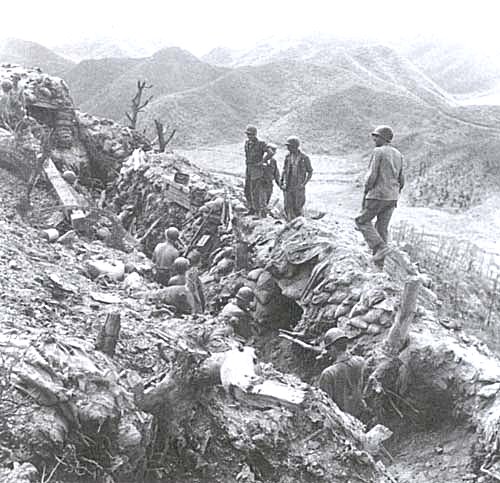
By 1953, the Korean War’s front lines had stagnated roughly half way down the Korean peninsula just north of Seoul. 800,000 dug in Chinese and North Korean troops looked across miles of heavily fortified hills at 650,000 dug in American, South Korean and United Nations’ troops to the south. At this point, the Korean War had more in common with World War I than the recent fight with Germany and Japan, and neither side could launch a major offensive without unacceptable losses. Constant patrolling and artillery duels were the norm, with the occasional attack on isolated outposts to draw media attention. These small scale battles over hilltops reminded the people at home that the war in Korea was still being waged. These company and battalion-sized actions had dramatically out sized propaganda significance compared to any meager military value the hills conferred from changing hands.
In April 1953, Easy Company, 1/31st Infantry Regiment, 7th Inf Division held Hill 255 opposite a battalion of 141st Chinese Infantry Division. The hill was previously garrisoned by a Thai battalion who had nicknamed it “Pork Chop” because of its shape on the topographical maps. The name stuck. Pork Chop Hill was exposed to attack from three sides because of the loss of “Old Baldy”, a hill to the north, to a Chinese attack on its Colombian defenders several weeks before. However, Pork Chop couldn’t be abandoned without appearing weak at the peace talks in Pannmujom. The Chinese waited for a stall in these talks before launching any attack in order to make the most use of its propaganda effect. The stall came on 16 April. That night the Chinese launched a massive artillery bombardment and attacked Pork Chop Hill with two infantry battalions.
The Chinese surprised and quickly overran the trenches of Easy’s forward positions and methodically cleared the Americans from the remaining bunkers with grenades, flamethrowers and sheer numbers. In a desperate last stand, First Lieutenant Thomas Harold rallied about a dozen men at the Command Post bunker on the reverse slope, thus preventing the Chinese from capturing Pork Chop Hill outright.
Alerted by LT Harold, Love Company and King Company of the 1/31st Inf, led by 1LT Joseph Clemons (K Co’s Commander), prepared to retake Pork Chop. (A young first lieutenant was the senior officer on the ground for a two company assault. Think about that for a second.) At 0430 on 17 April they began their assault up the hill. Love Company was destroyed by Chinese artillery, but King managed to recapture the southern third of Pork Chop and relieve Easy, who numbered exactly eight men at this point. However the Chinese sent another battalion into the fight. For the rest of the day, King Co and the remnant of Easy fought to retain their toehold on the back slope of Pork Chop, without any reinforcements or resupply except for the 12 remaining men of Love Co who staggered in later in the morning. Fortunately, the Chinese were having their own difficulties penetrating the ring of fire that American artillery rained down around Pork Chop preventing them from attacking King Co en masse.
In the late afternoon, George Co 1/31st Inf was sent to “mop up” and was surprised to find the fight raging, supplies low and casualties high. Due to a misunderstanding, George was pulled off the hill almost immediately, much to LT Clemons’ dismay. He was now down to 25 men, including the remnants of Easy and Love. He pulled them all to the top of the hill and waited for the inevitable final Chinese attack just after dusk. They had been in close contact, including hand to hand combat, for almost 20 hours. Most of the men were using captured Chinese weapons.
At 0100, 18 April 1953, the Chinese finally attacked. They forced Clemons’ and his remaining die hards into the Chow Bunker, where the Chinese prepared to use satchel charges and flamethrowers to finish them off. Luckily for the defenders, George Co’s commander convinced his and Clemons’ superiors of the gravity of the situation on Pork Chop and they finally authorized more reinforcements. Just as the Chinese nighttime attack started, Easy Company 17th Inf Regt, sprinted up the rear slope of Pork Chop without consideration of Chinese artillery fire and struck the Chinese attack head on. Although they took casualties, their bold move was probably all that saved Clemons and the remaining defenders from an inevitable death in the confines of the Chow Bunker.
The battle raged for another two days and consumed five more American companies and ten Communist battalions before the Chinese conceded. Of the 500 men in Easy, King and Love Companies of the 1st Battalion 31st Infantry, who fought on Pork Chop Hill between 16 and 18 April 1953, only 12 would walk off the hill, including LT Clemons.
 Buk's Historical Ad Hockery
You must be logged in to post a comment.