
Category: History
Operation Cherry Blossom: The Invasion of Bougainville
The overarching Allied operation in the Solomon’s Campaign was Operation Cartwheel, the isolation and eventual capture of Rabaul on the island of New Britain, Imperial Japan’s main base in the South Pacific. The previous capture of New Georgia and other northern Solomon Islands placed Rabaul within heavy and medium bomber range, but shorter ranged fighters and naval bombers needed airfields closer. The island of Buka, just north of Bougainville was the obvious choice, but Adm Halsey decided that the flat areas of the much larger Bougainville were enough to provide the airfields necessary for the eventual isolation of the islands, while doing the same to Rabaul.
On 1 November 1943, Halsey launched Operation Cherry Blossom, the invasion of Bougainville. The initial landings at Torokina on the west coast of the island were virtually unopposed: only a single Japanese platoon was in the area. Gen Hyukutake of the Japanese 17th Army gambled that Halsey would invade Buka off the northern tip of Bougainville and bypass Bougainville entirely. He chose wrong. Nonetheless, he and the naval commander at Rabaul, Adm Kusaka, rushed men and ships to the area to seal the beachhead and eventually reduce it with naval gunfire and ground attack. They knew from their experience at Guadalcanal that if the Allies got a secure beachhead with a functioning airfield, the Americans were almost impossible to dislodge, especially as American naval surface warfare proficiency had come leaps and bounds since the precious year. The Americans knew it also.
In the shadow of Mt Baranga, an active and smoking volcano, Allied transports rushed to unload. 30% of the initial 3rd Marine Division landing force, including three SeaBee battalions, assisted with unloading the transports in order to get them safely away before the inevitable Japanese naval sortie arrived. The Japanese attempted to imitate their success at Savo Island the year before, but Adm Aaron Merrill’s Task Force 39 was waiting for them and savaged the Japanese at the entrance to Empress Augusta Bay off the west coast of Bougainville. Nevertheless, Halsey was concerned.
Though a brilliant operational commander and leader of men, he still thought in year old archaic terms for naval superiority, i.e. CV>BB>CA>CL>DD. He, and to be fair the rest of the US Navy, still hadn’t grasped that the Japanese’ most damaging weapon was the Long Lance torpedo on their small destroyers, and that the quick firing radar controlled 6” guns on the American light cruisers were far superior to the big manual 8” heavy cruiser guns. He saw the reports that the Japanese had heavy cruisers and that he didn’t so he ordered Task Force 38, his only carriers, to strike Rabaul and sink any shipping that could interfere with the invasion of Bougainville. He specifically tasked them to drive away the heavy cruisers to protect his transports and their escorts and to prevent another “Hell Night” as had happened on Guadalcanal. He was successful in his gamble, but only because he was ignorant of the Japanese lack of carrier-borne pilots. Halsey thought he might be sailing into a “reverse Midway”, but Kusaka had no way to strike Halsey’s carriers and the land based planes were committed over Bougainville. Kusaka withdrew his ships back to Truk, the main Japanese anchorage in the South Central Pacific and out of the fight. No further Japanese attempts to interfere with any Solomon Island were to occur for the rest of the war. The Naval Battles of the Solomon Island, which began so ignobly off Savo Island 17 months before, ended in a decisive American victory.
After the failed Japanese attempts to destroy the beachhead by sea, the US 3rd Marine and US Army 37th Infantry Division expanded the beachhead over the next few weeks. Navy SeaBees started construction of an airfield literally just off the beach, and quickly began building roads inland. They built them so fast that Marines told them to slow down as their roads were pushing farther forward than the Marine pickets. By the end of November 1943, the Japanese increased their counterattacks, and had occupied the hills around the beachhead with artillery, despite several serious losses against counter-counter attacking Marines in the perimeter. First, the entire initial naval landing force sent by Kusaka at the onset of the invasion was wiped out at Koromokina Lagoon on 7-8 November, and an entire Japanese regiment was destroyed at Piva Forks later in the month.
In December 1943, the 3rd Marine Division was replaced by the veteran US Army Americal Division, and they and the 37th expanded the perimeter to prevent artillery fire from molesting Empress Augusta Bay and the three airfields under construction. The first aircraft to land of the newly operational beach airfield was a corsair from the famed VMF 214, the “Black Sheep” squadron, on 11 December. Within hours, Maj. “Pappy” Boyington and his fighters did a sweep over Rabaul, just because they could, and taunted the surprised Japanese to come up after them. The Japanese knew the Allies were building airfields on Bougainville but completely misjudged the speed at which the SeaBees could construct one under fire. Though until all three airfields were completed, the fighters more often than not flew ground attack missions in support of marines and soldiers fighting a few hundred yards from the flight line. The operational airfields finally convinced Gen Imamura at Rabaul, Hyukutake’s boss, that Halsey’s main effort wasn’t coming at Buka.
Imamura was convinced all throughout November and December that Halsey would attempt to seize Buka, and he wasn’t wrong, he just had the timing incorrect. (Buka was Halsey’s next target after the airfields on Bougainville were completed.) Imamura assumed Halsey knew about the severe Japanese shortage of carrier qualified pilots, and would use his own carriers to support a bold landing on Buka, bypassing and isolating Bougainville and getting that much closer to Rabaul if successful. However, Halsey was unaware of the pilot shortage and assumed the carriers were still out there lurking, waiting to pounce. To Halsey, Buka was too exposed and not worth the risk; a risk which Imamura assumed the legendarily aggressive Halsey would take. Once the Black Sheep and other fighter squadrons did their sweeps over Rabaul, Imamura could no longer ignore the danger the airfields posed. He released troops from Buka and northern Bougainville to reduce the growing Allied perimeter at Torokina. But Imamura’s assault was now substantially more difficult, Halsey’s two US Army divisions had time dig in and stockpile necessary supplies.
Nevertheless, the Japanese troops encountered so far in the battle were relatively few compared to what Imamura had on hand. It took Hyukutake nearly two months to stage Imamura’s reinforcements in their assault positions around Torokina. In March, Halsey’s perimeter on Bougainville would feel the entire weight of Hyukutake’s 17th Army.
To be continued…
Pennsylvanians in the Ardennes: the 28th and 99th Infantry Divisions
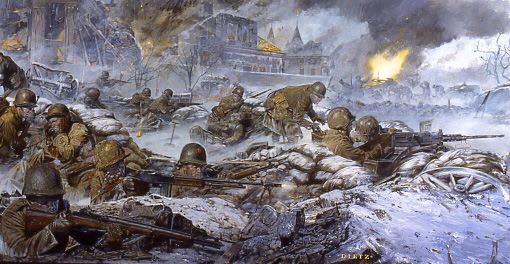
On 16 December 1944, Operation Wacht am Rhein, Hitler’s Ardennes Counteroffensive and the eventual “Battle of the Bulge”, initially crashed into two units originally formed in the Grand Commonwealth of Pennsylvania: the US 28th Infantry Division on the southern shoulder of the Bulge, and the US 99th Infantry Division on the northern shoulder of the Bulge.
In the south, MG Norman Cota’s 28th “Keystone” Infantry Division of the Pennsylvania Army National Guard, aka “The Bloody Bucket”, had its three regimental combat teams (RCTs) on line due to the enormity of its front. Along the Our River which separated Luxembourg and Germany, the 28th unwittingly faced the entirety of both German XLVIII Panzer and LXXXV Corps. Each RCT had more than two German divisions opposite them.
After the initial surprise on 16 December 1944, the 28th’s northernmost RCT, the 112th from Butler and northwestern PA, held the Our River bridge at Ourthe for over two days against overwhelming odds before falling back in good order to St Vith to take part in the critical defense there with the US 7th Armored Division. The Germans expected to capture the Our River Bridge in the first hours of the first day.
In the south, the 109th RCT from Scranton and northeastern PA, defeated the 352nd Volksgrenadier Division and rendered them combat ineffective for the rest of the battle. The 109th only fell back when their positions became untenable because of the breakthroughs to their north in the 110th RCT’s sector. The entire 109th RCT received Luxembourg’s Croix De Guerre for their defense of the small duchy.
In the center of the 28th’s line, the 110th RCT from Uniontown and southwestern PA felt the full weight of three German divisions: the 2nd Panzer, Panzer Lehr and 26th Volksgrenadier divisions. The 110th’s defensive positions didn’t even form a continuous line, but consisted of company strongpoints kept in contact with adjacent units through patrolling. Although the initial attacks were repulsed, sheer weight of numbers broke through the forward defenses along “Skyline Drive”, the north-south highway along which they defended. Still, isolated companies and platoons of the 110th fought the Germans to a standstill for two critical days before they were broken. The 110th’s stand culminated with the defense of Clervaux on the Clerf River where the scouts, cooks, bakers, and staff personnel of the 110th’s HQ Company held the fortified chateaux until they ran out of ammunition. That bridge was another initial German objective that took two full days to capture. The time the 110th bought allowed some of Eisenhower’s only reserves, the 101st Airborne Division, to arrive at the key crossroads town of Bastogne before the Germans. By the 19th, most of the 110th RCT was either dead, wounded, or captured, but the survivors formed the core of “Team Snafu” which palyed a vital role in the 101’s defense of Bastogne.
In the north, the US 99th “Checkerboard” Infantry Division had only recently arrived in Europe, but it was in position just west of the Siegfried Line long enough to adequately dig in, if only to keep warm. The 99th formed in 1942 from mostly Western Pennsylvanians and eastern Ohioans, and took their division insignia from the shield used on the Pittsburgh city crest and the emblem of Pittsburgh’s recently renamed football team, the Steelers.
On 16 December 1944, the division was struck by the vanguard of the 6th SS Panzer Army, and many units broke under the onslaught. However, isolated companies and platoons fought back savagely and prevented a German breakthrough. Though the center collapsed, on the far left of the 99th’s line, three companies of the 395th RCT at Hofen defeated the 396th Volksgrenadier Division. On the far right at the other end of the line, a single Intelligence and Reconnaissance platoon of 22 men under LT Lyle Bouck fought off the entire German 9th Parachute Regiment near the Belgian town of Lanzerath.
On the night of the 16th, the commander of the unit behind the paratroopers, the infamous Jochim Peiper of the 1st SS Panzer Regiment of the 1st SS Panzer Division, stormed into their command post demanding to know why the attack stalled. The commander of the 9th told him there was an entire battalion dug in and fiercely defending the ridge above the town. Peiper ordered the paratroopers to support his Panther and King Tiger tanks in a deliberate attack that night. He was furious to find out that only a single platoon had held up an entire panzer corps for 24 hours.
Although chaos reigned throughout the 99ths sector on 16 December, they held the Germans long enough for LTG Gerow of the US V Corps to unilaterally order the US 2nd Infantry Division to the twin towns of Rocheroth and Krinkelt. On the 15th, the 2nd was attacking the Siegfried Line to the north of the 99th and immediately stopped, turned and headed south to help the 99th. The 2nd held the towns long enough for the remains of the 99th to pass through and set up a new defensive line on Elsenborn Ridge, less than 10 miles from their original positions.
The 6th SS Panzer Army broke out to the west but their objective was Antwerp which was to the north. As Peiper and the 1st SS Panzer Division proceeded west instead of northwest they were increasingly pushed onto roads designated for other German units further to their south, which caused massive traffic jams. The 2nd and 99th Divisions (with the 1st Infantry Division to their right at Bullingen) held Elsenbrn Ridge and the northern shoulder of the Bulge for the rest of the battle despite furious and increasingly desperate German attacks to move forward.
On the 16th of December 1944, surprise was complete and the majority of the American units in the Ardennes collapsed. However some did not, despite the German’s best efforts. By the end of the day the Germans’ strict timetable was already irreparably upset. The Battle of the Bulge was all about roads, road marches, and road junctions. On Day One, the NCOs, and junior and field grade officers of the 28th and 99th Divisions denied the attacking German Army the roads and time they needed to win the battle.
The Death of Captain Waskow
In the Battle for San Pietro Infine, A Company, 143rd Infantry Regiment, commanded by Captain Rufus Cleghorn was responsible for one of the few Allied successes so far in the battle. They had seized the crest of Monte Sammucro, but for their efforts they endured fierce German counterattacks. The Germans threw so many grenades that the Texans used their rifles as baseball bats to hit them back before they exploded.
After four days, Able Company was reinforced by Baker Company, commanded by Cleghorne’s friend, 25 year old Captain Henry T. Waskow from Belton, Texas. On the night of 12 December 1943, B Company, down to about 50 men, moved into assault positions to exploit A Company’s success and clear the ridge above San Pietro Infine between Monte Sammucro and Hill 730.
While the company was in position, Captain Waskow quietly made his rounds among the men, chatting and offering words of encouragement. In a dark, shallow ravine, he spoke to Pvt Riley Tidwell about how when he got “Back to the States, I’m going to get one of those smart-aleck toasters where you put the bread in and it pops up.” Those were his last words. A German machine gunner heard him and opened fire. A fragment from the resulting mortar barrage killed him instantly. A mule train, run by Italian volunteers, took his body down off the mountain two days later.
At the bottom of Monte Sammucro was Ernie Pyle, a war correspondent whose dispatches from the front appeared in over 200 newspapers. He didn’t write about generals or huge battles but wrote about the common soldier in an intimate style that resembled letters home. This greatly endeared him to the soldiers, NCOs and junior officers who wanted their stories to be heard. Ernie saw the beloved company commander’s body come down the trail strapped to a mule, and the experience became the subject of his most famous dispatch, “The Death of Captain Waskow”. It is arguably the finest and most heartfelt expository passage of World War II.
“The Death of Capt. Waskow
By Ernie Pyle
AT THE FRONT LINES IN ITALY, Jan 10 (1944) (by Wireless) – In this war I have known a lot of officers who were loved and respected by the soldiers under them. But never have I crossed the trail of any man as beloved as Capt. Henry T. Waskow of Belton, Tex.
Capt. Waskow was a company commander in the 36th Division. He had been in this company since long before he left the States. He was very young, only is his middle twenties, but he carried in him a sincerity and gentleness that made people want to be guided by him.
“After my own father, he comes next,” a sergeant told me.
“He always looked after us,” a solder said. “He’d go to bat for us every time.”
* * *
I was at the foot of the mule trail the night they brought Capt. Waskow down. The moon was nearly full and you could see far up the trail, and even part way across the valley. Soldiers made shadows as they walked.
Dead men had been coming down the mountain all evening, lashed onto the backs of mules. They came belly down across the wooden backsaddle, their heads hanging down on the left side of the mule, their stiffened legs sticking awkwardly from the other side, bobbing up and down as the mule walked.
The Italian mule skinners were afraid to walk beside dead men, so Americans had to lead the mules down that night. Even the Americans were reluctant to unlash and lift off the bodies, when they got to the bottom, so an officer had to do it himself and ask others to help.
The first one came early in the morning. They slid him down from the mule, and stood him on his feet for a moment. In the half light he might have been merely a sick man standing there leaning on the other. Then they laid him on the ground in the shadow of the stone wall alongside the road.
I don’t know who that first one was. You feel small in the presence of dead men, and you don’t ask silly questions ….
We left him there beside the road, that first one, and we all went back into the cowshed and sat on watercans or lay on the straw, waiting for the next batch of mules.
Somebody said the dead soldier had been dead for four days, and then nobody said anything more about him. We talked for an hour or more; the dead man lay all alone, outside in the shadow of the wall.
Then a soldier came into the cowshed and said there were some more bodies outside. We went out into the road. Four mules stood there in the moonlight in the road where the trail came down off the mountain. The soldiers who led them stood there waiting.
“This one is Capt. Waskow,” one of them said quickly.
Two men unlashed his body from the mule and lifted it off and laid it in the shadow beside the stone wall. Other men took the other bodies off. Finally, there were five lying end to end in a long row. You don’t cover up dead men in combat zones. They just lie there in the shadows until somebody else comes after them.
The uncertain mules moved off to their olive groves. The men in the road seemed reluctant to leave. They stood around, and gradually I could sense them moving, one by one, close to Capt. Waskow’s body. Not so much to look, I think, as to say something in finality to him and to themselves. I stood close by and I could hear.
One soldier came and looked down, and he said out loud:
“God damn it!”
Another one came, and he said, “God damn it to hell anyway!” He looked down for a few last moments and then turned and left.
Another man came. I think it was an officer. It was hard to tell officers from men in the dim light, for everybody was grimy and dirty. The man looked down into the dead captain’s face and then spoke directly to him, as tho he were alive:
“I’m sorry, old man.”
Then a solder came and stood beside the officer and bent over, and he too spoke to his dead captain, not in a whisper but awfully tender, and he said:
“I sure am sorry, sir.”
Then the first man squatted down, and he reached down and took the Captain’s hand, and he sat there for a full five minutes holding the dead hand in his own and looking intently into the dead face. And he never uttered a sound all the time he sat there.
Finally he put the hand down. He reached up and gently straightened the points of the Captain’s shirt collar, and then he sort of rearranged the tattered edges of his uniform around the wound, and then he got up and walked away down the road in the moonlight, all alone.
The rest of us went back into the cowshed, leaving the dead men lying in a line, end to end, in the shadow of the low stone wall. We lay down on the straw in the cowshed, and pretty soon we were all asleep.”
The Historical Profession Is Committing Slow-Motion Suicide
The Historical Profession Is Committing Slow-Motion Suicide
“…Yet as the historical discipline (like much of the American academy) became more professionalized, especially after World War II, it also became more specialized and inward-looking. Historical scholarship focused on increasingly arcane subjects; a fascination with innovative methodologies overtook an emphasis on clear, intelligible prose. Academic historians began writing largely for themselves. “Popularizer” — someone who writes for the wider world — became a term of derision within the profession…”
“…The result of these changes is a discipline that feels remarkably parochial to students or anyone outside the ivory tower. As Harvard’s Jill Lepore, the profession’s leading exception to these trends, recently pointed out, “The academy is largely itself responsible for its own peril. The retreat of humanists from public life has had enormous consequences for the prestige of humanistic ways of knowing and understanding the world.”
The second issue, closely related to the first, is the hostility toward certain kinds of historical inquiry. Decades ago, the subfields of political history, diplomatic history, and military history dominated the discipline. That focus had its costs: Issues of race, gender, and class were often deemphasized, and the perspectives of the powerless were frequently ignored in favor of the perspectives of the powerful. During the 1960s and after, the discipline was therefore swept by new approaches that emphasized cultural, social, and gender history, and that paid greater attention to the experiences of underrepresented and oppressed groups. This was initially a very healthy impulse, meant to broaden the field. Yet what was initially a very healthy impulse to broaden the field ultimately became decidedly unhealthy, because it went so far as to push the more traditional subfields to the margins.
Two historians, Fredrik Logevall and Kenneth Osgood, have noted that “American political history as a field of study has cratered … What was once a central part of the historical profession, a vital part of this country’s continuing democratic discussion, is disappearing.” Political history, however, is a growth industry compared to diplomatic history and military history. Scholars who study strategy and statecraft, diplomacy and policymaking, and the causes and consequences of war are often labeled as old-fashioned, methodologically unimaginative, and ideologically conservative. As a recent chair of a prominent history department recently explained to us, the discipline of history does not consider exploring and understanding the decisions of state leaders or military officials to be interesting, important, or innovative. Not surprisingly, those who study these subjects are a dying breed within major American history departments…”
The Battle of San Pietro
The Battle of San Pietro. In 1941, Director John Huston was basking in the limelight of his Hollywood blockbuster, “The Maltese Falcon”, a ground breaking masterpiece that starred Humphrey Bogart, Mary Astor and Peter Lorre and brought film noir into the main stream. 27 months later, in December of 1943, US Army Captain John Huston and his film crew were attached to the 143rd Infantry Regiment of the 36th Infantry Division. The division was trying to force its way through the Bernhardt Line via the Mignano Gap into the Liri Valley. The last obstacles were in front of them: the village of San Pietro Infine and the flanking mountains of Monte Sammucro and Monte Lungo. The battle raged from 8 to 18 December, 1943.
CPT Huston was there to make documentary films for the US War Department. And in December and January 1943 he would shoot the controversial “The Battle of San Pietro”. If you have an extra half an hour, it’s worth watching.
The film does an excellent job explaining the battle to civilians. The film was originally 55 minutes long but was ruthlessly edited by Gen George Marshall down to 36 minutes so it could be shown in theatres prior to the actual movies. He wanted to make it mandatory viewing so American civilians at home would understand what their Army was doing. However, it was never released to the general population during the war. The War Department suppressed it because of its gritty realism (for the time), the dead bodies, and its “anti-war” tone. Huston replied that if he ever made a pro-war film, he should be shot. It was quietly released to the public in 1946.
Some notes:
-Gen Mark Clark’s intro was filmed while the battles for Anzio and Cassino were fought in January 1944. Was he trying to justify something?
-The failed Italian attack on Monte Lungo was highly publicized because it was the first use of Allied Italian troops fighting alongside Americans. The Italians were rushed into the fight so they could be part of the overly optimistic expected breakout and capture of Rome. They weren’t ready and paid for it.
-About 30% of the film was shot after the fact using “dramatic reenactments” by 36th Division soldiers and Italian civilians in San Pietro Infine. Most of the recreated shots are of soldiers walking around, the shots in the town, and of the civilians. The difference between the actual footage and the recreated footage is obvious.
-All the dead bodies are real.
-The civilians were actual citizens of San Pietro Infine, but they had to be cleaned up first. It took several weeks for them to recover from their hellish ordeal living in the caves outside of town before they were ready to film.
-The only factual inconsistency was the name of the church. In the film it is said to be “St Peter’s”, but the church is actually St Michael’s. John Huston didn’t want to break up the flow of the film with the difference.
-Almost all of the American soldiers in the film would be killed, captured, or seriously wounded during the 36th Division’s failed assault across the Rapido River a month later in January 1944.
Operation Raincoat: the Assault on the Bernhardt Line
In early November 1943, the British Eighth Army reached the Gustav Line and the American Fifth Army reached the Bernhardt Line in Italy. The Bernhardt Line was essentially the Gustav Line’s gatehouse in the west that protected the Mignano Gap, the entrance to the Rapido and Gargliano river valleys which formed the Gustav Line’s main line of resistance on the western slopes of the Apennines Mountains. These valleys were dominated by Monte Cairo with its amazing fields of observation and Monte Cassino at the entrance to the Liri Valley. The Gustav and Bernhardt Lines were part of a larger series of extensive German defensive fortifications across Italy called the Winter Line that were intended to prevent the Allies from reaching Rome, 80 miles to the northwest.
Through these extensive fortifications were only three routes up the Italian boot: Route 5, the old Roman Via Valeria, which ran along the Adriatic coast and up which the British steadily pounded until they reached the Gustav Line. Across the Apennine Mtns was Route 7, the old Appian Way along the west coast of Italy but this route was blocked by Germans’ extensive flooding of the Pontine Marshes. And finally Route 6 which was further inland and traveled through the Mignano Gap, into the Liri Valley, and then to Rome. Route 6 was the only realistic route to Rome, and the Germans would make the Allies pay dearly for every meter.
After a two week pause, the US Fifth Army in Italy began, on 1 December 1943, Operation Raincoat – the assault against the Bernhardt Line, which was defended by the tough and experienced 15th Panzergrenadier Division, heavily fortified and determined to hold the Mignano Gap. The Camino hill masses which formed the pillars of the Mignano Gap were the last stop before Monte Cassino, the Liri Valley and the road to Rome.
The US Fifth Army during operation Raincoat was the epitome of the multinational and varied nature of the Allied armies in Italy. Gen Mark Clark’s command consisted of four US Divisions: the active duty soldiers of the 3rd Infantry Division, and three National Guard divisions, the 34th from the Midwest, the 45th from Oklahoma, and the 36th from Texas. The Fifth Army also had the British Territorials of the 46th and 56th Divisions from London and the Midlands, the French Expeditionary Corps of French Foreign Legionnaires and French colonials from Morocco, North Africa and West Africa (including the ill-disciplined but very effective Goumiers), the lumberjacks, mountain men, commandos and ranchers from the elite and highly trained American-Canadian 1st Special Service Brigade aka “the Devil’s Brigade”, and even units of the resurgent Royal Italian Army, made up of Italians who actively resisted the Germans upon Italy’s surrender two months before.
The fighting was in the bitterly cold, windy, and rainy Italian winter. Mud covered everything. Allied soldiers struggled and fought up jagged cliffs, and slopes and trails so steep that they were impassable even to pack mules. Supplies were hauled up by rope or on the backs of men crawling through the mud, and the wounded were brought down the mountains the same way. German observation posts saw every movement of the Allied troops below and fire swept every conceivable approach. The fight was as much an engineers’ battle as an infantryman’s. One young engineer wrote,
“These things . . . constitute war and battle: rain and mud, cold and discomfort . . . of digging and of sleepless nights and tiring days, of being afraid and of being hungry, of repairing roads and of building bridges, of being lonely . . . of an endless number of little things…”
Mostly forgotten today, the fighting among the mountains and towns forming the Mignano Gap: Monte Camino, Monte Maggiore, Monte La Difensa, Monte Lungo, and Monte Sammucro and the hellscapes that were the towns of Mignano and San Pietro Infine was the largest land operation by Western Allies so far in the Second World War. Operation Raincoat lasted until mid-January 1944 when the Germans withdrew across the Rapido River. The 46 days the Fifth Army took to advance the 16 miles through the Bernhardt Line to the Liri and Rapido Valleys and the Gustav Line cost the Allies tens of thousands of casualties.
The worst was yet to come.
The Battle of Tuttlingen
France’s victory at the Battle of Rocroi in May 1643 allowed France some operational flexibility on other fronts of the late Thirty Years War. French troops in Franche Comte (the “Free County” of Burgundy, Hapsburg territory and a frequent battleground of the war) could advance into the Holy Roman Empire to prevent Austrian and Catholic League reinforcements for the Army of Flanders, support German princes and electors allied with France, and exert some influence on the Swiss Confederacy which had so far sat out the Thirty Years War in relatively prosperous “heavily armed neutrality.” French marshal Josias von Rantzau, a Dane with a long and complicated history in the French court and commander of French troops in Franche Comte, crossed the Rhine that autumn and was reinforced with troops from Saxe-Weimar. Rantzau, a dandy of the French court and more known for his reckless bravery than any military acumen, immediately went into winter quarters in order to prepare for operations in the spring. The weather in late autumn was unseasonably cold, but the French “Army of Germany” was particularly vulnerable in winter quarters spread out in the villages around the Swabian town of Tuttlingen on the Danube. They were, however, within striking distance of next year’s target, the Electorate of Bavaria.
The Catholic Prince-elector of Bavaria, the venerable Maximillian I, spent the last 25 years in a mostly successful attempt preventing the Hapsburgs from subsuming the Catholic League. Bavaria and other Catholic electors in Germany were especially vulnerable to invasion and furthermore had enough problems internally with brigands (*spit*). He saw the Catholic League as a defensive alliance only, and its forces were not to be sent off wherever the Hapsburgs wished. However, a Franco-Weimarian army just across the border to the west was a threat that couldn’t be ignored. Bavaria had the second largest army in the Holy Roman Empire, but it was still small compared to Rantzau’s. Maximillian placed it in the hands of his extremely capable Lorrainer master of ordinance Franz von Mercy and his second Johann von Werth, one of the foremost Imperial cavalry commanders. Mercy and Werth were one of the conflicts most effective command teams and both of whom urged for an immediate attack on Rantzau’s exposed, unprepared, and dispersed army, no matter the weather.
As Rantzau’s 16,000 troops sat warm around their fires in the houses around Tuttlingen, Mercy and Werth gathered 15,000 troops mostly Lorrainers and Bavarians, but included small contingents of veteran Spanish troops from the Army of Flanders and Imperial troops from Austria. They were taking no chances after the defeat at Rocroi and if Rantzau was going to allow them to concentrate, who were they to not take advantage?
Rantzau’s sins did not end there though. His men were settled into winter quarters and most elements were not within supporting distance of each other. Rantzau assumed he would have sufficient time to assemble. If in the unlikely event that any Imperial army approached, his troops in the town of Möhringen to the northeast should have given ample warning.
However, Mercy and Werth didn’t approach as expected, whether down the Danube from the north east, or from Stuttgart in the north. They cut across the low mountains and lowland lakes and streams of the Upper Palatinate to the south east (i.e. through Hohenfels from east to west).
About mid-afternoon on 24 November 1643, Werth commenced the Battle of Tuttlingen with his assault on the outpost of Mühlingen. Surprise was complete and the French troops in the town were overrun in minutes. The French had no pickets out, few guards, and no pre-arranged assembly points. Rantzau and his senior officers were drunk and playing cards when they heard the first shots: those from Bavarian dragoons who scattered the only alert sentries in Tuttlingen: those of the artillery park. Before French could even hope to assemble any of their units, Mercy had already seized all of their cannon.
Rantzau sent riders out to concentrate his army on Tuttlingen but the regiments were so widely dispersed that the battle was over before it even began. Panicking, the vaunted French cavalry fled west as fast as they could ride. What infantry Rantzau was able to muster was subjected to bombardment by their own cannon turned manned by Bavarians. Weimarian cavalry from Mühlheim attempted come to their aid but were intercepted and destroyed. By nightfall, the resistance in Tuttlingen was surrounded and under merciless shelling.
Rantzau surrendered the next morning and the remaining isolated regiments were subsequently defeated in detail. The Weimarians in particular gave up almost immediately as there was little love for their French commander. That the battle lasted almost all of the next day had more to do with the French disorganization and distance between the cantonment areas than any serious resistance or maneuvering on the battlefield. What remained of France’s Army of Germany routed, and quickly fled back across the Rhine into Alsace.
The stinging defeat at Rocroi had been avenged: Mercy and Werth captured the entirety of the French command, all of the artillery and baggage and 7000 irreplaceable troops. The army of Saxe-Weimar ceased to exist and only a remnant of the French army from Franche Comte was available for the spring. However, there’s a reason we remember Rocroi today and not Tuttlingen. Rocroi had massive strategic effects, Tuttlingen did not. Bavaria gained only a temporary reprieve. Winter was there and the battle could not be immediately exploited. Moreover, Maximillian refused to lead the Catholic League on the offensive for the Hapsburgs in the spring of 1644. In 1645, the French again crossed the Rhine but little strategic gain for either side came from the various defeats and victories that year.
The Battle of Chattanooga
In late September 1863, Union Major General William Roscrans’ Army of the Cumberland invaded Georgia from Tennessee and was decisively defeated at the Battle of Chickamauga. Only the personal leadership of MG George H Thomas, nicknamed the “Rock of Chickamauga” by Ulysses S Grant, prevented the Army of the Cumberland’s total destruction. Rosecrans retreated to Chattanooga, Tennessee where Confederate General Braxton Bragg occupied the heights above the city and prepared to starve out the Union troops.
By November 1863, President Lincoln and General Grant realized that the war would only end with an invasion of the Deep South. The first step, and Gateway to the South, was the strategically vital rail hub of Chattanooga, then under siege by the Confederates. On 23 and 24 November, William Sherman’s Army of Tennessee maneuvered on Bragg’s positions but it was a disaster. The only successful action was Joe Hooker’s fight in Lookout Valley which nearly unhinged the Confederate line. However, Sherman’s troops could not capitalize on the near-success. At the end of the day, the entire army was divided and neither Hooker nor Sherman could support each other. The Union Army was in a terrible predicament the next morning. In desperation, Grant asked Thomas (who replaced Rosecrans as the commander of the previously discounted troops inside Chattanooga) for a supporting attack against the heavily entrenched Missionary Ridge in order to take some pressure off of Sherman. Grant wasn’t expected much from the “demoralized” and “defeated”, albeit fresh, Army of the Cumberland.
On Wednesday afternoon, 25 November 1863, Thomas’ Army of the Cumberland stepped out of the sleepy town of Chattanooga to attack Missionary Ridge. Assaulting the entrenched troops at the end of the long open slope was a tough, nearly suicidal, assignment and they knew it. But to the Army of the Cumberland, the entire Union Army was in this position because of their failure. Now they were given a nearly unheard of second chance.
Their Day of Redemption was at hand.
First at the quick step, then at a double, then in ones and twos they sped up and broke ranks toward the Confederate lines. Soon entire regiments were in a full sprint and fixing bayonets on the run. Thomas’ blue tide swept over the first line of trenches as if they weren’t there. Then it clawed its way up the steep slope toward the second, with soldiers shouting “Chickamauga!” at the top of their lungs. The unstoppable Army of the Cumberland soon took the second trenchline and broke the rebels. Not stopping, they continued over the top of Missionary Ridge and down the far slope. In full view of a flabbergasted Grant and Sherman, Thomas’ soldiers impossibly cleared the ridge of Confederates, which forced Bragg to retreat.
The news of the dramatic victory would reach Washington DC the next day, where President Lincoln was celebrating America’s newest national holiday, the first official Thanksgiving Day.
Bloody Tarawa
Nearing the end of the second year of the Pacific War, through hard fighting, tough decisions, and no small amount of luck, the Allies had survived Japan’s initial onslaught with just their pre-Pearl Harbor militaries, and began rolling back Japanese gains. But by November 1943, the losses at Pearl Harbor were replaced and the American economy was in full wartime production. Ships of all sizes, from the mighty Essex class aircraft carriers to the humble patrol torpedo (PT) boats were rolling off of America’s dry docks. In the Solomon Islands, Adm Halsey’s campaign to isolate Japan’s main base in the South Pacific, Rabaul, was about to come to fruition. On New Guinea, Gen MacArthur’s South West Pacific Area was battling across the island, aimed for his eventual return to the Philippines. Adm Chester Nimitz, who did not have a great working relationship with MacArthur, wanted to use America’s new found material superiority to open up a new front, with the objective of Japan itself. He would cut across the axis and beat MacArthur to Japan. The first target of the new Central Pacific Area was the Tarawa atoll, in the British Gilbert Islands, specifically the island of Betio.
The island of Betio was a small pork chop shaped mass of coral and sand about three miles long and a half mile wide. It was surrounded by a coral reef about 400 meters off shore. On it were 5000 elite Japanese marines of their Special Naval Landing Force, fourteen Type 95 tanks and dozens of coastal artillery pieces and machine guns. Up to this point in the war the Japanese generally would allow the Allies to land and then attack with a furious banzai charge as the Americans were organizing on the beach. Tarawa would be different.
The Japanese knew of Betio’s importance in the central Pacific and spent over a year fortifying the island. Eschewing the wasteful immediate banzai charge against the initial landing, they fought in bunkers and pillboxes while the Marines struggled exposed on the beach and in the heavy surf. Their heavy coastal artillery would sink the support ships while the Japanese marines swept the beaches clear with interlocking fields of fire and pre-sighted artillery and mortars. The tanks would counter attack any breakthrough. The Japanese aim was to transfer to the defense the qualities of surprise, tenacity, focus, and ferocity that made their attacks so formidable. It nearly worked.
The US Second Marine Division would lead Operation Galvanic, the assault on Betio. Over the last year the division recovered, and then were reinforced, refitted, and retrained after its eight month fight on Guadalcanal. At 0610, 20 November 1943, 200 ships of the US Navy shelled and bombed the tiny island to little effect. The Japanese were simply dug Into the coral too deep. At 0900, the initial landing force started toward the beaches and the Japanese finally responded with their coastal artillery which sank or severely damaged several ships. The casualties among the sailors were almost as large as the Marines’ over the next several days. The Marines’ assault unfortunately began 30 minutes late, which allowed the Japanese to get to their fighting positions after the bombardment. Even worse, the assault began during an abnormally low tide.
The “Alligator” amphibious tractors managed to make it over the reef and onto the beach, but the subsequent waves in Higgins boats could not. With the initial wave pinned down behind a sea wall, the follow on waves of Marines were forced to wade in waist deep water 400 meters through intense Japanese fire. The casualties were enormous. The seawall was scant cover and to climb over was to court instant death. Throughout the morning Marines were steadily massacred by the dug in Japanese. But nevertheless, they persisted. Fortunately, the Marines were the product of free men in an open society and had spent the last year living, working, training and fighting together. They didn’t lie there, blame others, and wait for their superiors to do something. The junior leaders would win this fight. Individually and in small groups, they hammered then cracked the Japanese defenses. Corporals, sergeants, and lieutenants chose, in defiance of all logic and safety, to rally what Marines they could, and painstakingly maneuvered to engage the Japanese with flamethrowers, satchel charges, grenades, bayonets, rifle butts, helmets and fists. An observant beachmaster used the abnormally low tide to move supplies and men to the beach underneath the long pier which stretched over the coral reef to the beach. Many contemporary accounts attribute the final breakout to the efforts of a single tank “Colorado” from Red Beach 3, which finally allowed the Marines to move inland.
Over the next 77 hours, 4760 Japanese and 1700 Marines and Sailors were killed, with 2000 more Americans wounded.
The initial outcry in America due to the losses was enormous. However, like the Colorado spewing fire and lead at bunkers overlooking the beach, Nimitz cracked the Japanese outer ring of defenses in the Central Pacific. His subsequent offensives over the next 21 months were like a lance aimed straight at the belly of Japan. Finally, the lessons learned from the landing on Tarawa would be invaluable and used to great effect in subsequent amphibious operations, particularly the landings in the Marshall and Palau Islands, and even Italy and France.
 Buk's Historical Ad Hockery
You must be logged in to post a comment.