
Category: History
Solidarity
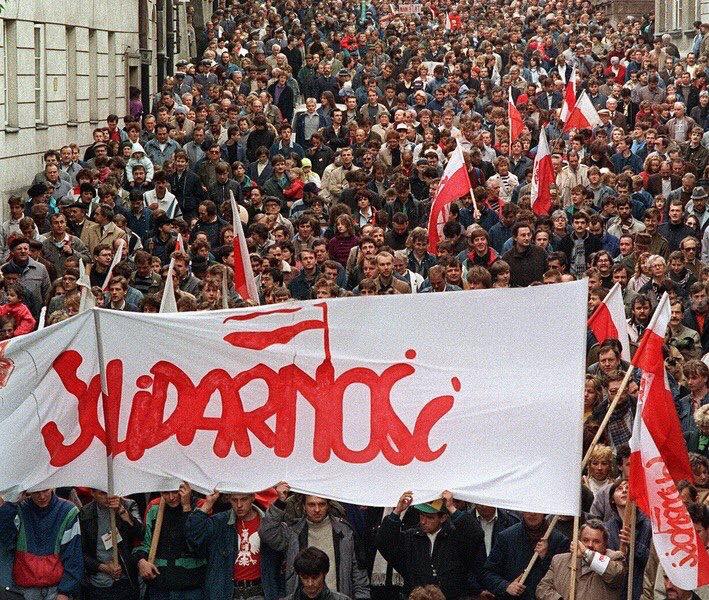
In April 1989, Lech Walesa’s Solidarity movement in Poland won the right to run candidates in the first fairly free parliamentary elections since before Poland was invaded by Germany and the Soviet Union 50 years before. On 4 June 1989, the Polish people headed to the polls (Ha!).
The Communists knew they were not popular, but they had several critical advantages. First, they still controlled the bureaucracy and the election apparatus. Also, their commissars still controlled the Polish military. Furthermore, more than half of the seats were rigged so only communists were allowed on the ballot. And finally, there was still 60,000 Red Army soldiers stationed on Polish soil.
The Communists believed they could not possibly lose the election utilizing these and every plausibly deniable, and not so deniable, electoral dirty trick. And many Solidarity candidates agreed with them. But the Polish people’s dissatisfaction with Communism’s inherent hypocrisy and corruption ran deep. Despite bureaucratic harassment, voter intimidation, and widespread election fraud, observers estimated that 98% of eligible voters turned out, virtually all for Solidarity.
Early ballot counts immediately showed that Solidarity and its allies had won a decisive victory. By the next day, it was confirmed: Solidarity had won 90% of the seats. Even seats where there was only a communist name on the ballot were lost to write-in candidates. It was a stinging rebuke of collectivism.
However, there was still the specter of military intervention. Fortunately, cooler heads prevailed. Polish military units began marginalizing, neutralizing or even out right arresting their commissars after the election, particularly if they attempted to take over units from their commanders. The Polish Army would not influence the election and the Poles did not have to worry about the Soviets. Like everything else about communism, the Red Army in 1989 was a facade. The Soviet 6th Motorized Rifle Division and 20th Tank Division had not received fuel or spare parts in months, because their supply system was so horribly corrupt. They had huge discipline problems and soldier-gangs ruled the barracks, where officers refused to go. What soldiers they did have control of were needed to tend the farms around the cantonment areas, which was the only way the divisions could be fed adequately. The Brezhnev Doctrine was dead, not because Gorbachev disavowed it, but because he had no choice.
Solidarity’s landslide victory was a reality on 6 June, 1989.
In July, the communists managed to hold onto the presidency through a series of back room deals, but a Solidarity candidate became prime minister in August. In September, 1989, the first non-communist government in the Eastern bloc in was sworn in.
The rest of Eastern Europe took notice
Patton’s Speech to the 3rd US Army

After being removed from command of the 7th US Army after the invasion of Sicily for slapping two American soldiers, FDR gave Patton a second chance. In February 1944, he was given command of the 3rd US Army, which was part of the follow on troops for Operation Overlord after the beachheads were secured. Although Patton gave speeches to his troops all of the time, his most iconic speech was given in preparation for the upcoming invasion of France. He gave this speech many times, but the canonical and iconic version was given to the 6th Armored Division on 31 May 1944. This is the speech that George C Scott immortalized in the 1969 film “Patton”. Scott’s version was significantly shorter and less profane.
“Be seated.
Now I want you to remember that no bastard ever won a war by dying for his country. You won it by making the other poor dumb bastard die for his country.
Men, this stuff that some sources sling around about America wanting out of this war, not wanting to fight, is a crock of bullshit. Americans love to fight, traditionally. All real Americans love the sting and clash of battle. You are here today for three reasons. First, because you are here to defend your homes and your loved ones. Second, you are here for your own self-respect, because you would not want to be anywhere else. Third, you are here because you are real men and all real men like to fight. When you, here, every one of you, were kids, you all admired the champion marble player, the fastest runner, the toughest boxer, the big league ball players, and the All-American football players. Americans love a winner. Americans will not tolerate a loser. Americans despise cowards. Americans play to win all of the time. I wouldn’t give a hoot in hell for a man who lost and laughed. That’s why Americans have never lost nor will ever lose a war; for the very idea of losing is hateful to an American.
You are not all going to die. Only two percent of you right here today would die in a major battle. Death must not be feared. Death, in time, comes to all men. Yes, every man is scared in his first battle. If he says he’s not, he’s a liar. Some men are cowards but they fight the same as the brave men or they get the hell slammed out of them watching men fight who are just as scared as they are. The real hero is the man who fights even though he is scared. Some men get over their fright in a minute under fire. For some, it takes an hour. For some, it takes days. But a real man will never let his fear of death overpower his honor, his sense of duty to his country, and his innate manhood. Battle is the most magnificent competition in which a human being can indulge. It brings out all that is best and it removes all that is base. Americans pride themselves on being He Men and they ARE He Men. Remember that the enemy is just as frightened as you are, and probably more so. They are not supermen.
All through your Army careers, you men have bitched about what you call ‘chicken shit drilling’. That, like everything else in this Army, has a definite purpose. That purpose is alertness. Alertness must be bred into every soldier. I don’t give a fuck for a man who’s not always on his toes. You men are veterans or you wouldn’t be here. You are ready for what’s to come. A man must be alert at all times if he expects to stay alive. If you’re not alert, sometime, a German son-of-an-asshole-bitch is going to sneak up behind you and beat you to death with a sockfull of shit!
There are four hundred neatly marked graves somewhere in Sicily. All because one man went to sleep on the job. But they are German graves, because we caught the bastard asleep before they did. An Army is a team. It lives, sleeps, eats, and fights as a team. This individual heroic stuff is pure horse shit. The bilious bastards who write that kind of stuff for the Saturday Evening Post don’t know any more about real fighting under fire than they know about fucking!
We have the finest food, the finest equipment, the best spirit, and the best men in the world. Why, by God, I actually pity those poor sons-of-bitches we’re going up against. By God, I do.
My men don’t surrender. I don’t want to hear of any soldier under my command being captured unless he has been hit. Even if you are hit, you can still fight back. That’s not just bull shit either. The kind of man that I want in my command is just like the lieutenant in Libya, who, with a Luger against his chest, jerked off his helmet, swept the gun aside with one hand, and busted the hell out of the Kraut with his helmet. Then he jumped on the gun and went out and killed another German before they knew what the hell was coming off. And, all of that time, this man had a bullet through a lung. There was a real man!
All of the real heroes are not storybook combat fighters, either. Every single man in this Army plays a vital role. Don’t ever let up. Don’t ever think that your job is unimportant. Every man has a job to do and he must do it. Every man is a vital link in the great chain. What if every truck driver suddenly decided that he didn’t like the whine of those shells overhead, turned yellow, and jumped headlong into a ditch? The cowardly bastard could say, ‘Hell, they won’t miss me, just one man in thousands’. But, what if every man thought that way? Where in the hell would we be now? What would our country, our loved ones, our homes, even the world, be like? No, gawdamnit, Americans don’t think like that. Every man does his job. Every man serves the whole. Every department, every unit, is important in the vast scheme of this war. The ordnance men are needed to supply the guns and machinery of war to keep us rolling. The Quartermaster is needed to bring up food and clothes because where we are going there isn’t a hell of a lot to steal. Every last man on K.P. has a job to do, even the one who heats our water to keep us from getting the ‘G.I. Shits’.
Each man must not think only of himself, but also of his buddy fighting beside him. We don’t want yellow cowards in this Army. They should be killed off like rats. If not, they will go home after this war and breed more cowards. The brave men will breed more brave men. Kill off the gawdamned cowards and we will have a nation of brave men. One of the bravest men that I ever saw was a fellow on top of a telegraph pole in the midst of a furious fire fight in Tunisia. I stopped and asked what the hell he was doing up there at a time like that. He answered, ‘Fixing the wire, Sir’. I asked, ‘Isn’t that a little unhealthy right about now?’ He answered, ‘Yes Sir, but the gawdamned wire has to be fixed’. I asked, ‘Don’t those planes strafing the road bother you?’ And he answered, ‘No, Sir, but you sure as hell do!’ Now, there was a real man. A real soldier. There was a man who devoted all he had to his duty, no matter how seemingly insignificant his duty might appear at the time, no matter how great the odds. And you should have seen those trucks on the road to Tunisia. Those drivers were magnificent. All day and all night they rolled over those son-of-a-bitching roads, never stopping, never faltering from their course, with shells bursting all around them all of the time. We got through on good old American guts. Many of those men drove for over forty consecutive hours. These men weren’t combat men, but they were soldiers with a job to do. They did it, and in one hell of a way they did it. They were part of a team. Without team effort, without them, the fight would have been lost. All of the links in the chain pulled together and the chain became unbreakable.
Don’t forget, you men don’t know that I’m here. No mention of that fact is to be made in any letters. The world is not supposed to know what the hell happened to me. I’m not supposed to be commanding this Army. I’m not even supposed to be here in England. Let the first bastards to find out be the Goddamned Germans. Someday I want to see them raise up on their piss-soaked hind legs and howl, ‘Jesus Christ, it’s the Goddamned Third Army again and that son-of-a-fucking-bitch Patton’.
We want to get the hell over there. The quicker we clean up this gawdamned mess, the quicker we can take a little jaunt against the purple pissing Japs and clean out their nest, too. Before the gawdamned Marines get all of the credit.
Sure, we want to go home. We want this war over with. The quickest way to get it over with is to go get the bastards who started it. The quicker they are whipped, the quicker we can go home. The shortest way home is through Berlin and Tokyo. And when we get to Berlin, I am personally going to shoot that paper hanging son-of-a-bitch Hitler. Just like I’d shoot a snake!
When a man is lying in a shell hole, if he just stays there all day, a German will get to him eventually. The hell with that idea. The hell with taking it. My men don’t dig foxholes. I don’t want them to. Foxholes only slow up an offensive. Keep moving. And don’t give the enemy time to dig one either. We’ll win this war, but we’ll win it only by fighting and by showing the Germans that we’ve got more guts than they have; or ever will have. We’re not going to just shoot the sons-of-bitches, we’re going to rip out their living gawdamned guts and use them to grease the treads of our tanks. We’re going to murder those lousy Hun cocksuckers by the bushel-fucking-basket. War is a bloody, killing business. You’ve got to spill their blood, or they will spill yours. Rip them up the belly. Shoot them in the guts. When shells are hitting all around you and you wipe the dirt off your face and realize that instead of dirt it’s the blood and guts of what once was your best friend beside you, you’ll know what to do!
I don’t want to get any messages saying, ‘I am holding my position.’ We are not holding a gawdamned thing. Let the Germans do that. We are advancing constantly and we are not interested in holding onto anything, except the enemy’s balls. We are going to twist his balls and kick the living shit out of him all of the time. Our basic plan of operation is to advance and to keep on advancing regardless of whether we have to go over, under, or through the enemy. We are going to go through him like crap through a goose; like shit through a tin horn!
From time to time there will be some complaints that we are pushing our people too hard. I don’t give a good Goddamn about such complaints. I believe in the old and sound rule that an ounce of sweat will save a gallon of blood. The harder WE push, the more Germans we will kill. The more Germans we kill, the fewer of our men will be killed. Pushing means fewer casualties. I want you all to remember that.
There is one great thing that you men will all be able to say after this war is over and you are home once again. You may be thankful that twenty years from now when you are sitting by the fireplace with your grandson on your knee and he asks you what you did in the great World War II, you WON’T have to cough, shift him to the other knee and say, ‘Well, your Granddaddy shoveled shit in Louisiana.’ No, sir, you can look him straight in the eye and say, ‘Son, your Granddaddy rode with the Great Third Army and a Son-of-a-Goddamned-Bitch named Georgie Patton!’
The Invasion of Biak
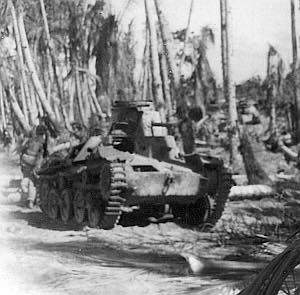
Biak Island, off the northwest coast of New Guinea, was the next step in MacArthur’s relentless march towards the Philippines. The island’s airfields blocked access to Geelvink Bay, which was required to continue the advance across New Guinea. Furthermore, the capture of Biak would put all of northwest New Guinea in range of Allied airpower. The Japanese knew this and planned on holding the island at all costs. The Japanese commander on the island, Col Kuzume Naoyuki, developed new tactics based on the experiences of previous battles. He knew the Americans would expect a Tarawa-like defense of the beach and plan for it. Therefore he had his troops defend inland, and ambush the unsuspecting Americans and Australians on their way to the obvious objective on the island: the three large airfields.
On 27 May 1944, the US 41st Infantry Division, consisting of National Guardsmen from the Pacific Northwest, had an unopposed landing after a furious bombardment by the US Navy. They naively assumed the bombardment destroyed any Japanese, and confidently headed inland. They walked right into Kuzume’s elaborate ambushes in depth consisting of pillboxes, honeycombed into the hills, supported by platoon strongpoints, forward supply depots in caves, minefields, pre-sited artillery and mortars, and tank counterattacks. The Guardsmen were initilly tore apart. The remains of the lead battalion could only be extracted from the kill zone by amtraks and tanks, and then only at night.
The “Sunsetters” were veterans of the two year long march across New Guinea, but this was the worst action they had seen. Every Japanese position had to be taken by close combat, and every Japanese position was inside the kill zone of a supporting position. Kuzume’s “cave defense” slowed the Allied advance across the island to a crawl. Even worse for the attackers, he forced his troops to abandon the suicidally wasteful banzai charges brought about by a perverted Bushido code that saw cowardice in any withdrawal. Kuzume made the Sunsetters pay for every yard they gained as his men slowly fell back from prepared fighting position to prepared fighting position all the way to the western end of the island.
It took the entire division until August to secure Biak using flamethrowers, satchel charges and bayonets. It would then take six more months to reinforce, rebuild, retrain, and refit the division.
Kusume’s defense was a taste of what was to come. His effective reforms became the standard Japanese island defensive tactics for the rest of the war. The Japanese fought for Saipan, Tinian, Guam, Anguar, Peleliu, the Philippines, Iwo Jima, and Okinawa using Kusume’s methods and techniques.
Operation Buffa…Turtle: To Rome!

After four months of stalemate in the shell hole ridden, malaria infested marshlands of the Anzio/Nettuno lodgment, Gen Mark Clark’s Fifth Army was ready to break out. To the south, the Eighth Army smashed through the Gustav Line and brushed aside the Senger Line (aka Hitler Line, which had a quick name change once it was so easily pierced by the Canadians) and were driving into an increasingly desperate German Tenth Army, the last obstacle separating the Fifth and Eighth Armies.
As part of Operation Diadem, the Fifth Army launched Operation Buffalo to tie down German troops and cut off the Germans fighting to the south. All of his troops were making good progress. On 25 May, 1944, MG Lucian Truscott’s US VI Corps, consisting of the US 3rd, 34th and 45th Infantry and US 1st Armored Divisions were within striking distance of their objective: the Valmatone Gap and Route 6. The capture of Valmontone would cut off the German Tenth Army to the south and ensure its destruction.
That night, Clark’s operations officer told Truscott to cease Operation Buffalo and begin Operation Turtle. The main differences were a shift in the main effort, and the mission of the 1st Armored Division. In Turtle, the main effort shifted to the 34th and 45th’s drive into the Alban Hills. Once they broke through, “Old Ironsides” would turn north and drive on Rome instead of Valmontone, while the 3rd ID would continue on alone. Truscott knew about Turtle, his staff had planned it, but that plan was based on the main German strength at Valmontone, not in the Alban Hills. By executing Turtle, the 34th, 45th and 1st AD would be attacking directly into the teeth of the only occupied and entrenched units of the Caesar C Line, while leaving Valmontone to the “hodge podge” of units the Germans had holding the door open for the Tenth Army. Truscott knew that the 3rd ID would never make it there by itself, and even if it did, it would not be able to hold Valmontone from a concerted counterattack when the Germans attempted to break out. He also recognized the vainglorious insanity of capturing Rome at the expense of letting the German Tenth Army escape. He initially refused the order, and demanded to talk to Clark first. But Clark “was not available” to speak with him, and he was told to execute. In a decision he would regret for the rest of his life, Truscott complied.
On 2 June, the Caesar C Line collapsed but by that time some 70,000 German troops of the Tenth Army had already fled north. Almost all of them escaped through the Valmontone Gap within sound of the 3rd ID’s guns. Those veterans formed the hard core of the defenders on the next set of fortifications, the Gothic Line. The Gothic Line, north of Rome, proved to be more formidable than the Gustav Line. The Allies would try to breach it for a long seven months, nearly twice as long as the Gustav Line. The Allies incurred tens of thousands of casualties in the process and didn’t breakthrough until April 1945.
On 3 June, Hitler ordered Rome an “open city”, and its occupiers retreated to the Gothic Line. Clark victoriously entered The Eternal City on 4 June, 1944, like a triumphant ancient Roman consul. He would have his front page headlines for exactly one day. On 6 June 1944, the Allies launched Operation Overlord, the invasion of France, and operations in Italy would be relegated to the back pages of Clark’s beloved newspapers for the rest of the war.
Clark’s decision to seize Rome at the expense of destroying the German Tenth Army is one of the great “What ifs?” of the Second World War. If the Tenth Army was destroyed, the Allies would have pushed through the Gothic Line in August. (Assuming, of course, the Germans didn’t reinforce Italy, but then those troops would have to come from somewhere.) Northern Italy was a historical playground for armies because there’s no defensible terrain. There was nothing to stop the Allies from pushing into Croatia and Slovenia, linking up with Tito, and then pushing into Austria, Hungary, and Romania months before the Soviets, as Churchill envisioned. The Germans would have reacted, but again, those troops had to come from somewhere, and operational reserves for the Germans were a zero sum game by the end of 1944.
“Woulda, Coulda, Shoulda”, though.
The Day Patton Cried

After the successful capture of Sicily, the hard charging Seventh Army Commander, LTG George S. Patton, was easily the most popular American general after Eisenhower. He drove his troops hard and beat Monty to Messina. However, Patton unexpectedly gave up command of his army and was relegated to be the viceroy of Sicily. He went from commanding 100,000 men to less than 5000 a few months later. To put it mildly, civil military relations was something he was not very interested in, and everyone knew it. Very few people knew why the change occurred. The Germans assumed he would command the invasion of France since he was America’s most effective general and not fighting in Italy.
Eisenhower privately wished Patton had Mark Clark’s job. But during the Sicilian campaign, Patton visited two field hospitals where he slapped soldiers suffering from PTSD and called them cowards. At Eisenhower’s request, the press sat on the story for months. In late November the story broke and the American press called for his head. Patton assumed his career was over.
On 9 December 1943, FDR and Gen George C. Marshall were returning from a marathon series of conferences with the Soviets, British, and Chinese in Tehran and Cairo. They stopped in Sicily on the way home. On the tarmac to meet them stood Eisenhower and Patton. While standing there, FDR said that Gen Marshall would stay in Washington and Eisenhower would command the Allied invasion of France. A few seconds later in an offhand comment, he mentioned that Patton would have an army command in France. For the next five minutes, Patton continued the small talk next to the plane but then excused himself.
He walked behind a maintenance building, looked around to see if no one was watching (someone was) and then cried like a baby in joy for two full minutes.
The Naked Truth Of Battle
The U.S. War Department had different motives: the historians were to inform the soldiers and the nation as a whole, as well as the high command. Their narratives were to be comprehensive, impartial, and sufficiently authoritative to form an important source for the studies of future historians. In the meantime, short histories of operations, later called the American Forces in Action series, were to be published for the men who took part.
It was soon discovered that the type of history desired could not be written from the archives alone, despite prodigious record keeping. The paperwork of one division for a single week would fill a filing cabinet. The trouble was simply that the records constituted truth in parade dress. “On the actual day of battle,” Gen. Sir Ian Hamilton once reflected, “naked truths may be picked up for the asking; by the following morning they have begun to get into their uniforms.” The messages, intelligence summaries, field orders, operations reports, and all the other records still left huge gaps in the story of the action; they were often meaningless or misleading on the most vital questions. As a result, officers and enlisted historians were assigned to the battlefronts to see for themselves and write the first drafts of history on the spot.
An Impromptu Staff Ride

In May 1814, Napoleon had abdicated and was in captivity on the island of Elba. King Louis XVIII was on the French throne, and Field Marshal Arthur Wellesley, 1st Duke of Wellington, the victor of the Peninsular War that did so much to sap Napoleon’s strength the previous six years, was appointed Great Britain’s ambassador to France.
On a trip from Paris to Brussels on 19 May 1814, the Duke and his staff stopped to water their horses, and maybe have a drink or two, at the small Belgian hamlet of La Haye. To the untrained eye, the fields to the west of La Haye were not dissimilar to any others in Belgium or northeastern France. But to Wellington, they formed a perfect killing ground, and at the expense of his trip, the Duke spent several hours surveying the beautiful defensive terrain.
As they approached from the south, those fields formed a shallow gently rolling valley that gradually rose northward to a small escarpment, not even high enough to be called a ridge. The road from Paris to Brussels passed right over it. To the right near a marshy creek, the ten stout stone buildings of La Haye and the walled farm of Papelotte marked the valley’s eastern edge. On the western edge of the valley about two miles away, was the imposing compound and chateau of Hougamont and another marshy creek. Any attacker from the south would not be able to go around either of these obstacles. They would have to go straight up the valley and over the escarpment. And just off the road directly in the center of the valley was the walled farm of La Haye Sainte. These obstructions stood like three great bastions of a fortress. If they were properly held, troops could poor fire into any body of men that tried to pass by. At least one would need to be taken, preferably two, before any attacker could confidently proceed north to attack a main defensive line just behind these three formidable obstacles.
That main defensive line would normally be just below the crest of the escarpment, but to Wellington’s delight the ground sloped down again to a quaint village whose chimney smoke could just barely be seen from La Haye. On this reverse slope, any defending troops would be shielded from the worst effects of an attacker’s artillery, and moreover, any movement of reserves would be unseen behind the escarpment. Those chimney’s belonged to the thirty or so buildings in the village of Mont-Saint-Jean. So if an army did seize two of the bastions, survive any counterattacks, crest the inter-visibility line, survive the grapeshot from the cannon, survive the point blank fusillade from the waiting troops, and after all that then finally break through the solid wall of bayonets, those nice stout houses of Mont-Saint-Jean would be there to cover the defender’s retreat. Truly magnificent ground.
Instead of continuing, Wellington and his staff decided to dine at the inn in the village and discuss the “wonderfully delightful” defensive terrain they were on. Even though they talked for several more hours, it was still all theoretical: Napoleon was on Elba, and King Louis XVIII would never invade Belgium. After the impromptu training exercise and dinner completed, Wellington realized he was late for his engagement in Brussels and they hastily galloped north.
Two miles up the road was a larger town where his chief of staff originally wanted to halt for a bit that afternoon. As the Duke passed through he noticed its sign; it read, “Waterloo”.
He would have to stop there again sometime.
The Fourth Battle of Monte Cassino: The Fall of Monte Cassino
By the evening of the 17 May 1944 it was clear to Field Marshal Kesselring that the Gustav Line had been irreparably breached. He ordered his troops to fall back to the “Hitler Line” at the far north end of the Liri Valley, where he hoped to replicate the tenacious defense of the Gustav Line.
Despite the terrible pounding they were receiving from the Poles on Pt 593, the Fallschirmjaeger initially refused to leave Monastery Hill, a position they had occupied and defended for five months, in conditions and battle that many veterans compared unfavorably to Stalingrad. They wanted to make the Poles storm the Monastery proper, which they were obviously going to do at dawn on the 18th. However, Gen Senger, their corps commander, would have none of it. He needed them on the Hitler Line.
About midnight on the night of 17/18 May 1944, the Green Devils of the German 1st Fallschirmjaeger Division reluctantly pulled off of Monastery Hill. Some escaped up the Liri Valley, but many were captured by the British or execueted by the Poles of the Kresowa Division.
Both the British and the Poles intercepted Senger’s heated radio transmissions to the Fallschirmjaeger telling them to abandon the monastery. Suspecting a trap, the Poles ordered the 12th Poldolski Lancers, a cavalry outfit that had left their horses and armored cars at the bottom of the mountain, to recce the monastery before they attacked. In the predawn hours of 18 May 1944, the troopers painstakingly infiltrated their way through the wire, minefields and tortured terrain, where they found the Monastery abandoned. Its only occupants were thirty seriously wounded German soldiers.
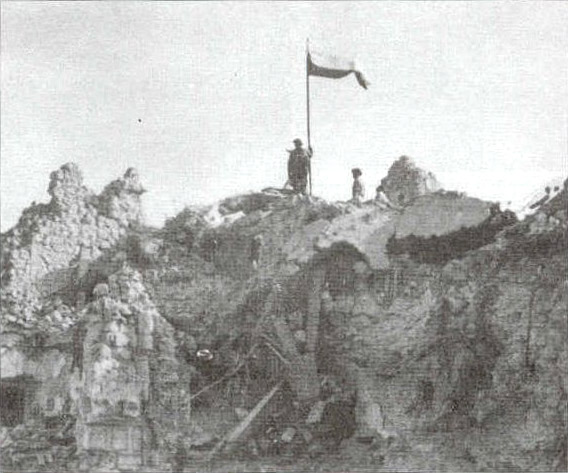
The lancers raised a make shift regimental pennant over the abbey followed closely behind by a Polish flag. At 10:15 am, the regimental bugler, Cpl. Emil Czech, sounded the Hejnał Mariacki from the Monastery to signal to the entire valley that it was in Polish hands. The Hejnał Mariacki, or Call of St. Mary, is played every day at dawn, noon, and dusk off the city walls of Krakow. It commemorates the sacrifice of a lone polish trumpeter in the 13th century who spotted a Mongol force trying to sneak into the town. From the bell tower of St Mary’s cathedral, he sounded the Hejnał Mariacki to warn the town of the approaching danger. The call cuts off abruptly because the trumpeter was shot in the throat with an arrow.
The trumpet echoed down the valleys and could be heard as far away as the Eighth Army Headquarters. The horrifying German and Soviet propaganda that the Poles were unwilling to fight the Germans in 1939 was finally laid to rest. That afternoon, the Poles made contact with the British advancing up the Liri Valley.
The Germans continued to fight on for Colle Sant’Angelo and Point 575 on the north wall of the Liri Valley for another two days, mostly because the Poles weren’t taking prisoners. But with the fall of the Abbey, their fate was sealed.
The Fourth, and final, Battle of Monte Cassino was over.
The Fourth Battle of Monte Cassino: Objectives Secured
By 16 May 1944, the French Expeditionary Corps had broken the Gustav Line in the Aurunci Mountains and outflanked the Germans in the Liri Valley. But what German soldiers could not do, Italian civilians did. The victorious Goumiers sought out every remote mountain village and plundered and abused the “infidels” as they believed they were entitled to as spoils of war. Over the next four days, the Moroccans raped over 7000 men, women, and children ranging in ages from 11 to 86. 800 Italians were murdered. Italy would remember this as the “Marocchinate” or “The Time of the Moroccans”. Though the Germans were confused by the unexpected French delay, they were appreciative, had the French continued, Monte Cassino would have been isolated.
To the French right but far to their rear at the mouth of the Liri Valley, the entire British 78th Infantry Division of the British XIII Corps was across the Rapido and pushing further up the south wall of the valley. One by one, positions systematically fell to the British, Indians, and Canadians as the Germans looked over their shoulders for the French advancing through the mountains behind them. The British were about to do what had almost never been done before in history: proceed up the Liri Valley with Monte Cassino in hostile hands. But that was because the Germans in the Abbey and its surrounding points had more pressing problems than the valley below them; they were clinging to Monastery Hill by the slimmest of margins.
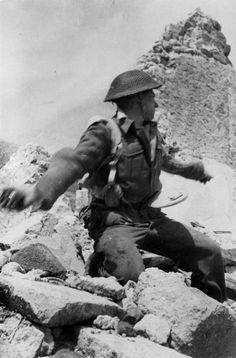
It took two days, under constant fire, for the Polish II Corps to organize the replacements, assign them to the assault battalions, and clear assault lanes through the Fallschirmjaegers’ newly placed minefields. But on the night of 16 May, the Carpathian Division conclusively overran Pt 593 and the expected German counterattacks were defeated. In the after action review Polish junior officers and NCOs credited its capture to their quadruple issue of grenades. Moreover, the Kresowa Division broke through to the Liri Valley from Monte Cairo north of Monte Cassino, where Juin would have broken through in January had Clark supported him. The Germans on the Monastery Hill were not surrounded, but only just so.
When the sun rose of the 17th, the Poles, like the Benedictine monks before them, began to make the monastery defenders’ lives a living hell from Pt 593.
The Battle of Lewes
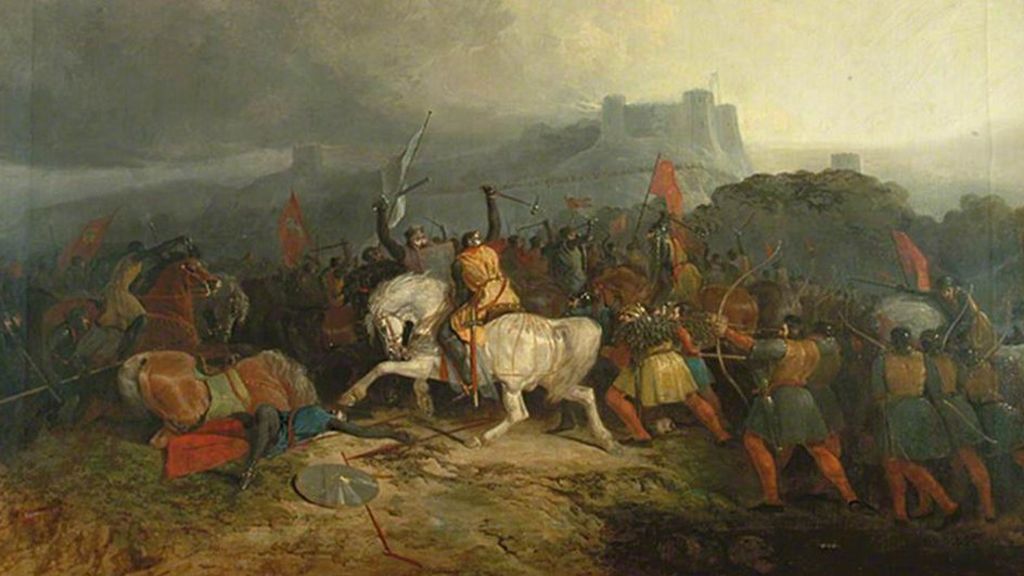
In 1215, King John of England (the Sheriff of Nottingham’s evil boss in Robin Hood) was forced to sign the Magna Carta after his defeat in the First Baron’s War. The Barons revolted due to King John’s autocratic and tyrannical ways, and judicial favoritism for his supporters. The Magna Carta was a historically critical step towards rule by constitutionally bound parliamentary governments. However, the Magna Carta was just the most famous of a series edicts and documents in medieval England meant to limit the power of the king, and establish the rule of law, instead of rule at the king’s whim.
In 1264, King Henry III was the latest Anglo-Norman king to spread his chicken wings and ignore his agreements. In 1258, he and his barons signed the Provisions of Oxford. The Provisions established a permanent Privy Council of baronial and royal advisors for administration of the kingdom, and more importantly, a thrice yearly baronial council to parley with the king (a “parliament” in French) regarding all financial matters. True to form of most tyrants, King Henry III reneged on the agreement at the first opportunity. In 1263, King Henry III unilaterally raised taxes because he wanted to purchase the Kingdom of Sicily (long story). And again, his barons had to force him to comply by force of arms. The Second Baron’s War began when Simon de Montfort, the 6th Earl of Leicester, rallied the barons to force the king’s compliance with the Provisions of Oxford.
On 14 May 1264, Henry III and his son Prince Edward (the future King Edward “Longshanks”) met the barons outside of Lewes castle in Sussex, England. Henry III outnumbered the barons three to one, and Prince Edward was initially very successful leading the first charge which scattered the baronial cavalry from London on the far left of the line. However, Edward’s pursuit of the broken knights left his father uncovered. Forced to assault the baronial line unsupported, Henry’s army broke when Montford’s reserve smashed into Henry’s flank. Upon seeing the assault, the baronial yeomen and levy charged off the hill they were defending, routed the remainder of the King’s army, and seized the king. When Prince Edward’s victorious, but exhausted, forces returned to the battlefield, they were promptly defeated.
King Henry III was forced to sign the Edict of Lewes reaffirming the Magna Carta and the Provisions of Oxford. Prince Edward was held as a hostage to assure compliance and the battle led to the first session of the newly established parliament. However, Edward escaped later in the year and Henry III immediately tore up the Edict of Lewes, and vowed never to call a parliament again. Through Edward’s prowess, Henry III eventually fought the Barons to a negotiated settlement after a costly three years of war. But the barons fought on far longer than Henry assumed possible. This wasn’t lost on the young Edward.
Though successful, the Second Baron’s War taught Edward the hard lesson that he needed his subjects’ input in governing the kingdom. This was especially true if he was going to expand into Wales and Scotland, and retain Plantagenet lands in France. When he was crowned in 1272, King Edward I permanently established the English Parliament, in effect giving more than what the barons demanded, and fought for, during the war.
 Buk's Historical Ad Hockery
You must be logged in to post a comment.