
Category: History
Panzers, Monty, Mother Nature, and the Vikings

The landings on 6 June at Normandy were a complete operational surprise, and the deception plan was so effective that the Germans continued to believe the main invasion would come at Pas De Calais, even well into July. But the ruse wouldn’t last much longer, and most of the German’s reserves were already committed to containing the Allied lodgement.
In the east, Montgomery failed to take Caen on the first day for a variety of reasons, most of which weren’t his fault. The British troops faced the only panzer counterattack on D-Day, and that by their desert nemesis, the 21st Panzer Division. The terrain around Caen is all open fields and river valleys, and this made the counterattack particularly difficult, and Montgomery stopped the 21st Panzer from reaching the beachheads. Unfortunately, the reverse was also true, and Montgomery would launch no less than 6 separate army level offensives to try and take Caen over the next 6 weeks. To counter this, Field Marshal Von Rundstedt committed the bulk of the panzer reserves in the West to face them, including three of the best panzer divisions in the German military: the Panzer-Lehr, the veteran 2nd Panzer Division, and the fanatical 12th SS “Hitlerjugend” Panzer Division made up of Hitler Youth. The British Sherman, Churchill, and Cromwell tanks did not fare well against the Tiger, Panther, and Pzkfw IVs of the panzer divisions. Only British stubbornness and overwhelming material and airpower superiority allowed Monty to capture Caen on 10 July 1944, over a month later than planned.
Monty’s material superiority came at a cost to the other areas of the front because Mother Nature had a say-so. Just after D-Day, the great storm that Group Captain Stagg feared had finally arrived. On 9 June, “The Great Gale of 1944” did damage to the invasion force that the Luftwaffe could only dream of. Several ships were sunk, dozens were beached, all were damaged, and one of the two vital “Mulberry” artificial harbors was destroyed. This created a massive supply shortage for weeks in Normandy, and what supplies were on hand went to either Monty trying to take Caen, or to the Americans trying to capture Cherbourg: a deep water port on the Cotentin peninsula which could do much to alleviate the Allies supply problems. The US VII Corps captured Cherbourg on 26 June, but the Germans did “masterful” work wrecking the harbor. They did such a good job emplacing mines and boobie traps, destroying facilities, sinking ships in the channel, and ruining the docks that it would take three weeks for small ships to get through and eight weeks before it was safe enough for larger ships to unload. There would be no influx of supplies from Cherbourg and what supplies that did come through the one working Mulberry would go to Monty. This was unfortunate because the Americans in the center of the landing zone were facing something unexpected and ancient, and used to deadly effect by the Germans: the bocage, or Norman hedgerows.
Bocage was the French term for the hedge/tree walls that surrounded Norman fields. In the 9th century, Danish and Norwegian Vikings raided the area, and with the collapse of Charlemagne’s Empire, settled it. The better off Vikings established themselves at the mouths of the rivers, such as the Orne and the Seine, primarily in the east. They intermarried with the local population and the Franks named the area “Normandy”, or “Land of the Northmen”. West Normandy was settled by Viking farmers. However, this did not stop future generations of Danish and Norwegian Vikings from continuing to raid just because their forebears settled the area. The Vikings could no longer sail up the rivers to raid the French because of the Norman fortress towns such as Caen, Carentan, and Harfleur. So they beached on the coast and traveled overland to get around the Normans at the mouths of the rivers, frequently by raiding isolated farmsteads in the west and stealing horses and food. The Norman farmers, former Vikings themselves, knew this and combatted it by planting trees around their fields with thick thorny bushes at their bases. This forced the raiding Vikings onto predictable paths where they could be watched and ambushed. Over the centuries, the Norman farmers continued the practice. By the twentieth century, erosion, sunken roads, and a dropping water table exposed the roots of these hedgerows. This formed a four or five foot high impenetrable wall of packed earth and gnarled roots, covered with thorny bushes and topped with a line of thick trees. They couldn’t be climbed over, much less pushed through or seen through.
The bocage itself wasn’t deadly but the Germans used the hedgerows to great effect. They would ambush the Americans on the roads, just as the Normans did to the Vikings, and force them to breach the hedgerows to get around. Once the Americans went through the lengthy and difficult process of breaching the hedgerow walls, they would be met by another German ambush on the other side, usually machine guns and anti tank guns dug into the hedgerow in an opposite corner of the field. They easily covered the beautiful fields of fire that were the enclosed Norman farms. It would take Gen Omar Bradley and US First Army until 25 July, seven weeks after D-Day, to break out of the Norman Hedgerow country.
Operation Bagration: The Death of Army Group Center
 The Red Army on the Eastern Front was not obliging the Wehrmacht in 1944. The Red Army usually did limited operations during the winter snows and spring mud, and this gave the Germans time to dig in and reorganize. But the winter and spring of 1944 were different, very different, particularly for Army Groups North and South.
In the previous six months, Army Group North was forced to lift the two year long siege of Leningrad and was driven back to the Baltic States. And Von Manstein’s Army Group South was chased almost all the way out of the Ukraine in a series of surprisingly effective and overwhelming Soviet offensives. Only the intervention of panzer formations from Army Group Center stabilized the front. The Abwehr, or German Intelligence, thought that the Soviets would continue in the south, so the panzers stayed there. The Abwehr and German High Command were distracted by Soviet deception operations, and the Allied landings in France which were just 1000 miles from Berlin. The nearest Soviets were 1200 miles away and they were opposite Army Group Center, in the very defensible terrain of the trackless forests and swamps of Byelorussia.
But this was only defensible against the Red Army of 1941, 1942, or even 1943. The Red Army of 1944 was a new animal. It finally had the equipment, staff proficiency, specialized training, and mobile logistics to put their “Deep Operations” doctrine into practice. Of which, Von Manstein in the Ukraine was the full dress rehearsal.
Deep Operations was the standard Soviet Doctrine since the mid-30s, but Stalin’s purge of 90% of the officer corps in 1937, the calamitous losses in Finland in 1940 and the German invasion in 1941/42 meant that they had to resort to massed tank and human wave attacks to make up for the lack of leadership and trained manpower. It took three years for the talented survivors, such as Zhukov, Konev, Rokossovsky, Vasilevsky and others to rebuild. By 1944, that situation was rectified.
Deep Operations was the logical end state of JFC Fuller’s influential “Breakthrough” theory during the interwar period. DO relies on specialized troops, with massed rifle and artillery breaking through a defensive line, followed by local heavy tank formations to confirm the penetration. Then this penetration was exploited by huge tank, mechanized, cavalry, or elite Guards armies (mounted in American Lend Lease trucks) who attacked deep operational objectives to cut off and encircle German forces. German pockets of resistance were bypassed. Deep Operations has been likened to a Russian matryoshka doll where a small encirclement is then encircled by a larger one, and then a larger one, and so on, until the offensive culminated. (Glantz, “When Titans Clashed”) The Soviet summer offensive in Byelorussia was the ultimate expression of Deep Operations.
Marshall Zhukov launched Operation Bagration on 22 June 1944, and fell upon an unsuspecting Army Group Center. The penetrations were immediate. Although some panzer formations from the South attempted counterattacks that resulted in apocalyptic tank battles, the Germans never recovered. Hitler declared every city in the area a fortress to be defended to the last man, so the retreating German commanders just avoided them in their quest to escape the overlapping layers of encirclement.
It didn’t help. By August the Red Army was at the gates of Warsaw and German East Prussia, Army Group North was cut off in Courland, Army Group South was cut off in the Ukraine, and Army Group Center ceased to exist. The German army lost 500,000 men and 4000 tanks and assault guns that could not be replaced. 57,000 German prisoners were marched through Red Square, and then the Soviets made a point to wash the streets afterwards.
The Soviets were now much closer to Berlin than the Allies were.
The Great Mariannas Turkey Shoot
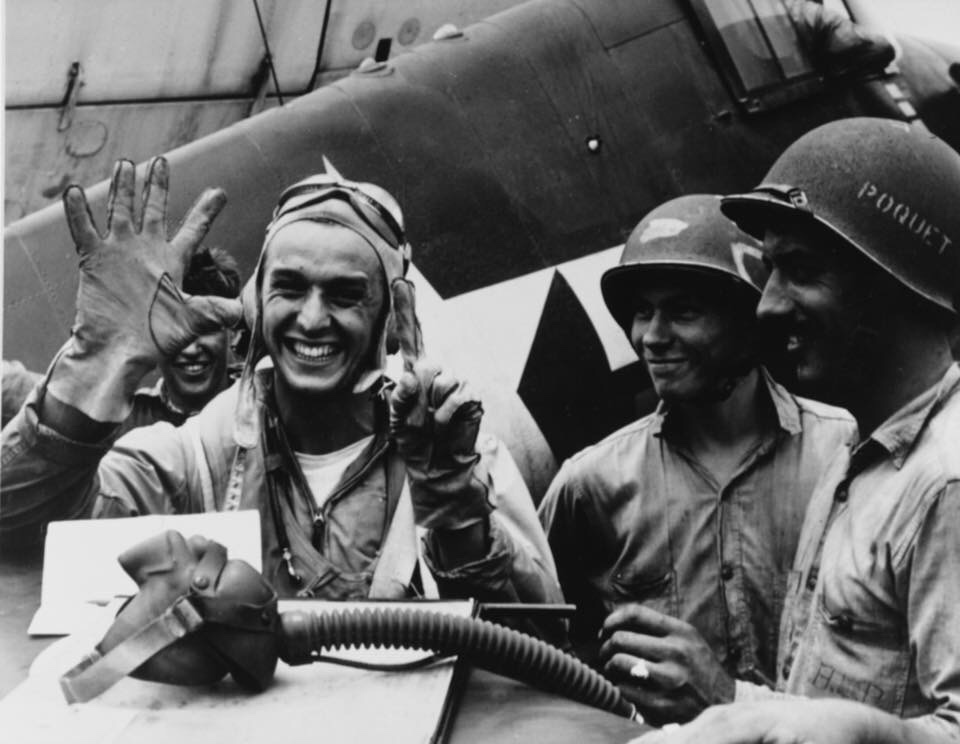 The Imperial Japanese High Command was desperate for a decisive victory over the Allies. After their retreat to the inner circle in late 1943, they looked for an opportunity for the “Kantai Kessen”, or the decisive victory that would end the war. Historically, the Japanese won their wars through a single titanic decisive battle that irrevocably smashed their enemies ability to fight. There was a Kantai Kessen that defeated the Mongols in the 13th Century, one that brought the Tokugawa Shogunate to power in the 17th, and one that defeated the Russians in the early 20th. Admiral Spruance’s 5th Fleet off of Saipan would provide the opportunity to similarly defeat the Americans. The Japanese hoped that destroying the US Navy in the Philippines Sea would be the Pacific War’s Kantai Kessen.
If the Japanese wanted a final showdown with the Allies’ strongest force, they couldn’t have chosen a better target. Their objective was the innocuously named Task Force 58, the carrier task force of the 5th Fleet, led by Vice Admiral Marc Mitsher. TF 58 was the largest and most powerful independent naval strike force in the history of mankind. Mitsher commanded seven big fleet aircraft carriers, eight light carriers, seven fast battleships, 900 aircraft, and dozens of cruisers, destroyers, and submarines. Against this, Vice Admiral Ozama had only five fleet carriers, four light carriers, 400 carrier based aircraft, and five battleships, but two of those were the Yamato and Musashi, the largest battle ships in existence, and he also had 300 land based planes on Guam.
But it wasn’t the numbers that defeated the Japanese, it was the Japanese that defeated the Japanese. By 1944, they were being out produced and out innovated by a wide margin. All but one of Ozawa’s capital ships were commissioned before Pearl Harbor, while virtually none of Mitcher’s were. Ozawa’s ships were 1930’s designs, while Mitcher’s ships reflected the hard lessons learned over the past two years, and his planes even more so. The Japanese A6M Zero was the terror of the skies in 1941 and 42, but by 1944 it was obsolete. The US Navy F6F Hellcat and the US Marines’ distinctive gull winged F4F Corsair had more power, more armor, and more guns. The Zero was still more maneuverable but to take advantage of that, you needed experienced pilots.
Bushido, or at least the perverted version of Bushido pushed by Imperial Japan in the Second World War, destroyed the once vaunted Japanese naval air arm well before the Battle of the Philippines Sea. Specifically the “No Retreat” rule. Fear of being shamed, Japanese aircrews would not come off the line to train the next generation of airmen. The victors of Pearl Harbor fought until they died. The Battles of Coral Sea, Midway, Guadalcanal, and the Solomon’s saw thousands of irreplaceable aircrews shot down, and there was no one to train the replacements. Furthermore, Allied submarines created an oil shortage, so very little fuel was allocated for training. What fuel there was available was wasted by bad instructors, whom were usually the worst flyer of the previous class who was left behind to train the next class. There was no honor in training new flyers, only in engaging the enemy and dying for the emperor. Most Japanese airmen in 1944 had fewer than 60 hours in the air, were poorly trained, and had no combat experience.
When the Japanese attacked TF 58 on 19 June 1944, the outcome of the largest carrier air battle in history was already a foregone conclusion. The Americans did lose over one hundred aircraft but the majority of them were due to empty fuel tanks, not Japanese bullets. It would have been more, but Mitcher ordered his whole task force to turn on their lights during the night of the 19th, defying every, risk management worksheet, safety officer, and OPSEC notice on his wardroom bulletin boards, in order to bring his flyers back home in the dark. Ozawa lost two carriers, but more importantly, he lost 700 pilots, never to be replaced. An American anti air gunner on a destroyer said, “It was like shooting fish in a barrel”, but it was a Hellcat pilot’s quote that would stick; he said,
“It was like going to a turkey shoot back home.”
The Invasion of Saipan
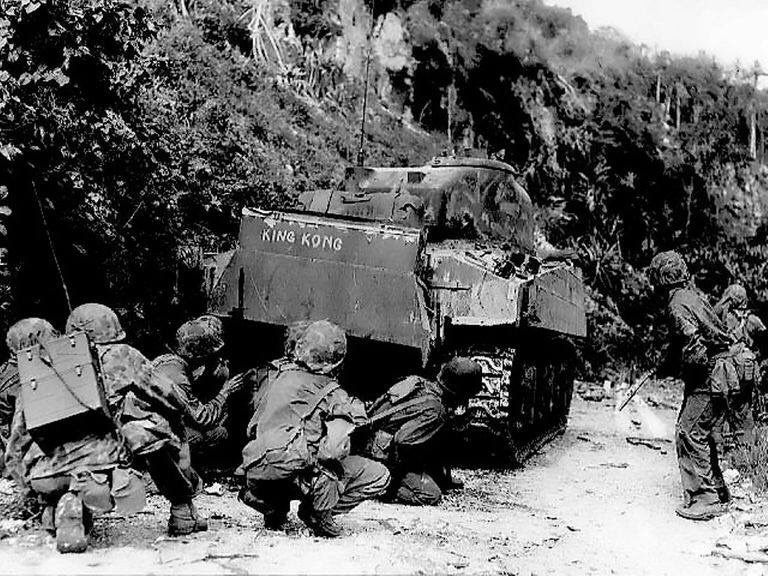 Admiral Nimitz’ Central Pacific Fleet was like a spear driving straight into gut of the Japanese Empire. While MacArthur aimed at the Philippines for his return, Nimitz was cutting across the axis. His next targets were the critical Marianna’s Islands, which included Guam, Tinian and Saipan. These were the first islands in the Japanese “Inner Defense Ring” and the Japanese planned to make a fight of it. The Americans had to be stopped.
On 15 June, 1944 Lieutenant General Howland “Howling Mad” Smith’s 2nd and 4th Marine Divisions and US Army 27th Infantry Dvision, stormed ashore on Saipan, through lanes cleared of obstacles by the first use of UDTs or Underwater Demolitions Teams (forerunners of the SEALS), and met three times as many Japanese as Naval Intelligence predicted. And they also met everything left in the Japanese navy that could float or fly.
The Americans knew the Marianna’s were important, but only the Japanese truly knew how critical they were. First, they both knew Allied planes flying from the Marianna’s would effectively cut off all Japanese possessions to the west and south: Indonesia, the Philippines, Singapore, Java, Borneo, Malaysia, and New Guinea. Supplies would not get south, and raw materials would not go north. Allied wolfpacks were already wreaking havoc with Japanese shipping, if they were directed by reconnaissance planes from Saipan, they would be devastating. Also, they both knew American bombers from the Marianna’s would be in range to bomb the Japanese home islands. This would be even more alarming once the Japanese discovered a new Allied weapon, first used on Saipan, which would be catastrophic to Japan’s wooden cities: napalm. Finally, most importantly and unbeknownst to the Americans, the Imperial Japanese High Command had been lying to the people for years regarding the conduct of the war. The people and most of the government of Japan thought the war was being won. Their propaganda machine would not be able to hide the loss of Saipan, a prewar Japanese territory, nor the clouds of B-29s that were sure follow. They would have to admit they were losing the war.
The Marianna’s Islands were extensively reinforced, particularly Saipan. The Japanese planned on fighting for the whole island from the surf to the last dug in bunker, effectively combining the old and new defensive techniques. Also, two of the Japanese’ best commanders were in charge of the island, through under different circumstances. Lieutenant General Yoshitsugu Saito was one of the army’s best and was hand-picked to lead the defense of the first prewar Japanese territory to see invasion. His navy counterpart, Vice Admiral Nagumo, the victor of Pearl Harbor and easily the Japanese’ best carrier admiral, was there in disgrace, commanding the island’s cruiser and destroyer defense flotilla for losing the battle of Midway. (He influenced the battle on land but had no effect on the wider naval battle in the Marianna’s, although he was sorely needed.) Finally, the cream of what was left of the Japanese Navy was committed to the defense of the islands.
For the next three weeks, the fighting on Saipan was fierce but the issue was never in doubt. The inter-service political battles between the US Army and the US Marines that erupted because of the fighting would eventually garner more attention. The Japanese finally got their Kantai Kessen, decisive battle, with the US Navy in the Philippine Sea, but were soundly annihilated by Allied quality, quantity and professionalism. By the beginning of July, Japanese naval airpower was destroyed, never to return. The first recon planes were spotting for the submarines before the fighting was completed, and the first B-29s arrived soon after. In a glimpse of what was to come, most of the Japanese civilians on the island committed suicide by jumping off the southern cliffs, to the horror of the watching US soldiers and marines.
With the loss of Saipan, the Japanese government began preparing the Japanese people for the worst: the invasion of the Home Islands. To the Americans the turning point of the War in the Pacific was Midway and Guadalcanal. To the Japanese, it was Saipan.
The Diary of Anne Frank
 On 12 June 1942, a young Dutch girl received a red and white plaid covered diary from her father for her 13th birthday.
She would start recording her thoughts in it a week or so later. Her father picked the diary out based on her pointing it out on one of their walks along the streets of Amsterdam. That walk would be one of their last.
Otto Frank and his daughter, Anne, were Jews. In July 1942, the Netherlands’ German National Socialist conquerers and their Dutch collaborators would place great restrictions on them in preparation for the implementation of the Final Solution of the Jewish population in the country.
The plight of the Dutch Jews was a difficult one. Unlike other countries, the huge population density of the Netherlands meant there were few places to escape to. There were no vast forests for refuge as there were in Eastern Europe. Also, the advanced Dutch civil bureaucracy had records on the entire Jewish population of the country and the Germans quickly identified and located them all. Moreover, although the Dutch people were sympathetic to the Jewish plight under Nazi domination, the Dutch government was unwilling to publicly intervene on their behalf, even passively. Unlike in other countries, the Dutch administration did the bidding of their National Socialist overseers with cold efficiency. In exchange for continued employment, pay, and benefits, the supposedly apolitical Dutch civil service ushered the Jewish population to its death. Few Dutch Jews were detained by Germans: they were identified by Dutch census data, rounded up by Dutch police who went directly to their homes based on Dutch tax files, held in Dutch camps run by the Dutch civil servants and held there by Dutch guards, and sent East to the death camps on Dutch trains run by Dutch engineers and Dutch rail crews.
Anne Frank and her family went into hiding to escape the Nazis and their own countrymen. They hid in a small three story room concealed behind a bookshelf in her father’s workplace. They were taken care of by several of her father’s sympathetic coworkers who visited once a day to deliver food and stay for a visit.
Anne chronicled each day in the cramped space in her diary. Her diary was her escape. She wrote of the dreams of a teenage girl, the boredom and difficulties of their existence, her love for and exasperation with her family, the terror of the listening to German soldiers and Dutch police searching the premises, her budding romance with the son of another family in hiding, and most importantly the hopes of survival in one of the darkest periods in human history.
The Frank family survived in hiding for more than two years, almost each day chronicled by Anne. They were arrested by the Gestapo after being betrayed in August 1944, by whom is unknown and subject to much debate. Anne and her family were sent to Auschwitz where she was separated from her father, but was not sent to the gas chamber with the rest of the children because she just turned 15 two months before. Nevertheless, Anne and her sister were transferred to Bergen Belsen Concentration camp to be worked to death. They both died of typhus in March 1945.
Anne Frank’s diary was saved by one of her family’s helpers after their arrest and recovered by her father who survived after being separated from his family. Anne Frank’s unedited record of her family’s existence behind the bookcase was published in 1947 as “The Diary of a Young Girl”.
The Diary of Anne Frank is one of the most poignant documents of the Holocaust, and Required Reading for Humanity.
Buk’s Battle of Waterloo Theory

So I was writing the Waterloo posts, and I found myself explaining the same concept over and over. And only because the narrative style, especially my amateurish campfire version of it, doesn’t accurately convey the story. Or for the purposes of this post, how close the story came to being significantly different, at all levels: tactically, operationally, and strategically. I was saying the same thing, over and over again, every time one of the events happened that shouldn’t have, but did anyway. It breaks up the story when I have to stop and explain every time that the world would be a different place when someone didn’t do something that they would normally do, and moreover, didn’t really have a good reason why they didn’t do it. It’s one of the many reasons the Battle of Waterloo is so interesting because it simply has so many WTF moments.
Bernard Cornwell, the author of the the Sharp’s series of Napoleonic historical fiction, said if the Waterloo campaign was written as historical fiction, it would be unbelievable, and critics and readers would have savaged the author for massive, implausible, and unexplained plot holes.
So I’m going to break with tradition and lay my thesis statement out now and build toward it later posts: The Waterloo Campaign, including the battles of Quatre-Bra and Ligny, was one of those inexplicable flukes of history, and only through uncharacteristic human error and poor command climate did it actually happen, and then happen in a way that is directly responsible for how Western Civilization evolved (for better or worse).
The Waterloo Campaign was Napoleon’s to lose. The Imperial French culture defeated Napoleon. All Wellington had to do was maintain contact with the Prussians and not interfere with the French making mistakes.
Anyway, just after the battle, Wellington said it was,”the nearest run thing you ever saw in your life”. That was more accurate than he actually knew at the time. The Battle of Waterloo is a massive case study for the effects of bad staff work, poor command climate, general indecisiveness, or not following commander’s intent, and almost all on the French side.
For context, In May, 1815, four Allied armies were sent to defeat Napoleon. In June two were in Belgium, the British and Prussian, and two were in Bavaria, Russian and Austrian. Napoleon’s army was large enough to defeat any single Allied army in battle, easily. 50/50 with two. It was just mathematically impossible for him to lose against any single one. Therefore he couldn’t let them consolidate, so his plan was divide and conquer. Napoleon launched a surprise invasion of Belgium on the night of 14 June to keep Wellington’s Anglo-Dutch-Belgian Army and Blucher’s Prussians separate. He had complete surprise and on 16 June fought the Battle of Quatre Bra against the British and won, and the Battle of Ligny against the Prussians and won. Unfortunately for him, they weren’t followed up and failed to isolate either army. This directly resulted in the Battle of Waterloo, which Napoleon lost on 18 June 1815.
During these critical four days, there were quite a few events that are simply inexplicable, but are also absolute necessities for Waterloo to occur and have had the effect that it had. Furthermore, they occurred and there was NOTHING Wellington or Blucher did to influence them: they simply benefitted. Most importantly, if any ONE was different, the world we live in would be a different place and two of these four outcomes would have been reality:
- The Battle of Waterloo would not have happened, or
- Wellington and Blucher would have lost the battle,
and
3. The Russians and Austrians would have had to defeat Napoleon (thereby gaining prestige which would have grave repercussions on the 19th Century). or
4. The Russians and Austrians do not continue the fight, since Blucher held the alliance together. (Wellington leaves the continent, and Napoleon resurrects the French Empire)
So as I go through the narrative over the next few days, these are the “anti-seminal” events of 15-18 June 1815 to look for. During that time, these are the critical and inexplicable French missed opportunities in chronological order:
-Ney fails to capture the crossroads at Quatre Bra on the night 15 June when it was held only by 4000 inexperienced Dutch troops. He had 55,000 veterans. (No clue why he didn’t and Ney was shot before he could explain. Capturing it would have inexorably separated the Allies. Prevailing theories are he was waiting for Wellington to attack or was intimidated by Wellington’s reputation. Both are uncharacteristic of Ney, the “Bravest of the Brave”. (See 1, 3 or 4 above)
-Ney fails capture the crossroads at Quatre Bra on the morning of 16 June when Wellington had less than 15,000 troops there. (Same as previous)
-D’Erlon’s Corps fails to outflank either the British at Quatre Bra, or the Prussians at Ligny on the afternoon of 16 June (bad staff work caused them to march and countermarch, missing both battles 1, 3 or 4).
-The French fail to attack anyone of 17 June. (The French took the day off. No good explanation. 1, 4)
-Grouchy fails to gain and maintain contact with the defeated Prussians on 16, 17, or even early 18 June. (No good explanation. 1, 2, 3, 4)
-Grouchy fails to march to the sound of the guns of the Battle at Waterloo on 18 June. (No good explanation. 2, 3)
-The French fail to take Hougamount on the morning 18 June. (Napoleon for some unknown reason left the attack to his notoriously fickle little brother Jerome, then took a nap. 2, 3)
-D’Erlon fails to consolidate and prepare for a counter attack after breaking the Allied center on the morning of 18 June. (Completely out of character for D’Erlon, no good explanation. 2, 3)
I just want to reiterate that any one of these would have completely changed history. Not “could” – “would”. Now, I also want point out that after these, the French could still have won but Wellington or Blucher would have needed to make some mistakes. Also, there were many little episodes which would have greatly improved the chances of French victory, or placed the possibility of a French victory in Wellington’s or Blucher’s hands, but I’ll cover those in the narrative. But these were “no-brainers” that in hindsight, should have happened, had every reason to happen, were expected to happen, but for some reason lost to history, didn’t.
Truly the “nearest run thing”.
Finally, many people and even some great historians have put a silly amount of time and ink into saying that Waterloo didn’t matter, that even if Wellington lost the Austrians or Russians would have finished the job. That’s an argument for the comments. But I will point out some undeniable facts: the two big winners of the 19th Century, and the two decision makers of the first forty years of the 20th Century, were Great Britain and Germany (Prussia).
Their ascendancy began on 18 June 1815.
The Sun King

On 7 June, 1654, Louis the XIV was crowned King of France. Louis the Great would go on to rule France for 70 years, the longest of any European monarch. More importantly, he would have an assemblage of advisors and subordinates of such remarkable economic, military, and political ability and talent that it is only seen so very rarely in history. (Only the Diadochi, Genghis Khan’s generals, the Founding Fathers, and Napoleon’s Marshals come to mind.) His advisors included Cardinal Richelieu’s protégé Cardinal Jules Mazarin, the engineering mastermind Vauban, two of the best commanders of the 17th century the Great Conde and Marshal Turenne, the Queen-Mother Anne of Austria, and the diplomatic and financial geniuses of the Colbert brothers, Jean-Baptist and Charles. Led by Louis, they ruled France through her Golden Age. “French” would become the first “lingua franca” of Europe.
In the first half of the 17th Century, great changes were happening in Europe and the people wanted more say in how they were governed. In both England and France horrible civil wars occurred between those who supported royal power and those who supported parliamentarian power. In the English Civil War the Parliamentarians won and left a legacy of self-rule. But in France, the Fronde, as their civil war was called, the parliamentarians and their noble allies were crushed in 1653. A young Louis did not forget its lessons. He would be crowned king the next year.
Louis and his inordinately talented advisors spent the entirety of his reign expanding the power of the monarch. He blamed the Parliament of Paris for the Fronde and limited its power every chance he could, until he could abolish it permanently. He couldn’t do the same with the nobility so he neutralized them. He built the magnificent palace of Versailles, and then forced all of the heads of the noble families to live there. This effectively separated them from their lands and power, and prevented them from expanding any further. The competent ones he used to form Europe’s first bureaucracy, and the others he gave titles and duties, such as “The Royal Glovebearer” or “the Royal Cupbearer”. Louis kept the historically troublesome nobles close by, out of trouble, and carefully watched.
Louis the Great’s transition to absolute monarchy only succeeded because of his and his advisors complete dedication to France. He “gleamed like the Sun” through France’s Golden Age, but also sowed the seeds of its destruction. The Sun King slowed the development of parliamentary rule in Great Britain, and Louis’ dedication to France was not shared by his successors. The inevitable corruption and incompetence that results from absolute rule eventually brought about the French Revolution, the Reign of Terror, and the Napoleonic Wars.
The Disasters of D-Day

The successful invasion of Normandy may seem predestined today, but it certainly wasn’t on the morning of June 6th, 1944. The Germans and the weather weren’t the only problems for the Allies. In many cases, the Allies were their own worst enemies. For every Ponte Du Hoc, there was a Vierville Draw; for every Pegasus Bridge there was a Merville Battery, if not more, many more. The question isn’t really how the Allies won, but how did they not lose despite themselves? Laziness, greed, incompetence, ignorance, poor staff work, etc, these were obstacles that were far different than German machine gun nests, but had to be overcome nonetheless.
These are the D-Day stories we don’t like to talk about, because they are the stories we fear to repeat. They are the tragedies that we inflicted upon ourselves.
The disasters of D-Days started even before the final go-ahead by Eisenhower. The airborne landings, though absolutely necessary, were catastrophic. The SOE Jedburgh Teams dropped in on the night of the 4th found that many of their supplies parachuted in with them were stolen before they could be recovered, undoubtedly by the French Resistance who were the only ones who knew they were coming. Most Jedburgh teams were reduced to the role of poorly equipped cut off infantry, not unlike the paratroopers who followed them.
Almost none of the pathfinders of the airborne divisions marked their drop zones, and if they did, it was usually in the wrong spot. Only the chaos of the actual jump masked it. History has recorded that chaos as a positive for spreading the German defenses out, but it wasn’t so for the paratroopers that night. Far fewer made it into the fight than myth and legend tells us. The fire in Sainte-Mère-Église caused the destruction of an entire airborne company after a pilot mistook it for the lights of the drop zone. And Sainte-Mère-Église, celebrated as the first town liberated in France, was only secured after the Germans pulled out to more defensible terrain: terrain that 82nd Airborne was originally supposed to secure in the first place, but couldn’t because it lacked the men to do so. Almost another entire airborne company drowned when its jumpmasters pushed them out over the flooded area. Another group of twelve paratroopers, lost, broke into a wine cellar and were found drunk two days later. Another pilot flew so low that the parachutes of his charges couldn’t open and one soldier on the ground, cursing the pilot, noted that they sounded like “pumpkins splatting on the ground”.
The most celebrated unit in the airborne invasion was E/1/506 who fought D-Day with just 14 men, out of 140. More joined later, but that doesn’t change the fact that Captain Dick Winters had to seize the Breucourt Manor guns, a company if not a battalion objective, with just 11 men.
Even those paratroopers that didn’t hide or wander and took the initiative, weren’t immune to human fallibility. One enterprising German unit captured over 50 paratroopers by using their cricket against them. When the challenge of “one click” got a response of “two clicks”, the American was quietly taken prisoner. Another group of 19 Americans was taken prisoner behind Utah Beach and subsequently killed in the invasion bombardment.
One can only imagine the stories that haven’t been recorded.
The invasion itself was an unmitigated disaster for the French population of that stretch of the Norman coast. De Gaulle’s refusal to address his people over semantics in Eisenhower’s draft request undoubtedly caused thousands of casualties among French civilians who ignored Eisenhower’s pleas to evacuate the coast. For every French civilian who proudly waved the tricolor during the bombardment, dozens, if not hundreds were killed or wounded. In Caen, the Gestapo executed every French civilian in the prison. The Hotel D’Normandie in Ouisterham collapsed upon its inhabitants and those who survived were nearly all killed ten minutes later when their cover was struck by the bombardment.
As the bombardment continued, the movement at sea from the transfer points to the beaches was beyond chaotic, much of it self-inflicted. In their arrogance, the Americans refused British help with navigational aids marking the beaches, such as prepositioned midget subs that successfully guided British troops to the correct destinations. They relied on patrol cutters to guide the landing craft in, almost all of whom got lost. A coxswain bringing in the rangers to scale Pont Du Hoc got lost and the rangers arrived 30 minutes late, well after the first waves hit Omaha. The rising tide was almost lapping the base of the cliff by the time the rangers scaled the heights. That there were no guns at the top was all that prevented a greater disaster on the Omaha and Utah beaches below.
Of the first three waves to hit the beaches at Omaha and Utah, only a single company, A/1/116th of the 29th Division landed at the beach they were assigned, and they were massacred for it. Tens of thousands of pages of orders and timetables and millions of man hours: useless and wasted. 8 of the 16 landing craft that carried Omaha Beach’s duplex drive tanks refused to land the tanks directly on the beach, even though the swells further out would obviously swamp the tanks. That the DD tanks would never make the 5000 yard swim to shore was obvious to all. Thirty tanks and their crews were forced out of the landing craft because the sailors refused to deviate from the plan. Not a single tank made it more than hundred yards out to sea, most just drove off the ramp and sank.
The 4th Infantry Division’s entire assault wave landed a mile and quarter south of where they should have been due to their coxswains following a lost patrol cutter.
The landings on the beaches, at Omaha in particular, were horrific, and the opening scene from Saving Private Ryan is tame in comparison. The entire bombardment over shot the beach defenses, despite spotter planes continually calling in “on target”. One British observer watched as an entire formation of B-17’s and B-26s drop their loads into the fields behind the beaches. “That’s a fat lot of use, all it’ll do is just wake them up.”
American and British intelligence missed the movement of the entire German 352nd Infantry Division into the beach defenses opposite Omaha until the 4th of June, and then decided not to tell the assault troops. Until the moment the ramps dropped, the men of the 1st and 29th Divisions expected to face the green conscripts of the 716th Division, not the tough and experienced 352nd battle hardened on the Eastern Front. One amazed German sergeant looking down on Omaha commented, “They must be crazy. Are they going to swim ashore right in front of our muzzles?”
One German private estimated he fired his rifle 400 times that morning, and hit someone more than half the time.
A single German MG42 gunner, Heinrich Severloh, claimed he hit, “at least 1,000 men, most likely more than 2,000. But I do not know how many men I shot. It was awful.” Though his account is considered exaggerated by historians today, that Severloh alone caused dozens, if not hundreds, of casualties on Omaha Beach’s Easy Red and Fox Green sectors is beyond doubt.
An entire LCI was destroyed when a single errant bullet struck a flamethrower tank and exploded. Men carrying a hundred pounds of equipment quickly found out that the weight doubled when it was soaked with sea water: something those who mandated the combat load would never have to experience. Many men drowned because they couldn’t get out of the water fast enough or were crushed when a swell pushed a landing craft violently forward. Most craft were stuck on a sand bar initially but as the tide rose they became increasingly stuck on the beach obstacles. The assault waves landed at low tide, but the rising tide became a problem: the landing craft and debris were inadvertently pushed into the mines.
Men who were too wounded to move forward quickly drowned. The flotsam and jetsam, and bodies, along the beach began to accumulate as the tide pushed it forward: crushing some, but forcing all into German fields of fire. An LCI was destroyed by a mine, and then became a plow as the tide pushed it forward onto the beach. The arrogant American refusal of the British offer of specialty engineer vehicles was paid in blood. Engineers got into fights with soldiers seeking scant cover behind beach obstacles they were supposed to blow, and in several instances detonated them anyway. Entire groups refused to move until the tide forced them to. There was at least one mutiny on the beach. Men spent hours digging in only to have the tide swallow them whole. Unwounded men got high on their own morphine, and waited for the water to end their existence before the Germans did.
On the relatively calm Utah, several men found a small remote controlled Goliath. They played around with the controller, amused by the little tank. Unbeknownst to them, it was packed full of explosives and they accidentally set it off, killing everyone watching.
On the British beaches, many troops landed, neutralized the beach defenses… and then dug in, awaited orders, and brewed tea. One unit even reveled in the fact that they were first British unit to brew tea in France. Lt James Doohan, the future Montgomery Scott of Star Trek, had to pull his pistol on his coxswain to get him to move toward the beach. Barrage balloons were set up on the beaches, which only acted as markers for German artillery. It would take hours, and dozens of casualties later, before someone had the moral courage to cut them loose. Just off of Sword Beach, the Merville Battery was taken at great cost, then abandoned for fears of friendly naval gunfire, and subsequently reoccupied by the Germans. It wouldn’t be recaptured for another seven weeks. Allied bombers destroyed Caen, killing a thousand French civilians, and inadvertently turned it into a fortress for the Germans.
By noon, General Omar Bradley seriously considered sending troops from Utah to Omaha, or even pulling off of Omaha altogether.
Along the shingle on Omaha, one soldier wrote in his diary, “I prayed for the fourth time today, asking God, “Why do these things have to be visited upon men?”
Thankfully, some of those men persisted.
Greek philosopher Heraclitus once said, “Out of every one hundred men in battle, ten shouldn’t even be there, eighty are just targets, nine are the real fighters, and we are lucky to have them, for they the battle make. Ah, but the one, one is a warrior, and he will bring the others home.”
When teaching history, we tend to celebrate Heraclitus’ fighters and warriors. They make a good tale, but since they’re the only tales told, we also tend to ascribe their uniqueness to the mass. For every junior NCO or officer who led a few stalwarts up the hill on Omaha and cracked the German defense, there were a hundred down below just trying to survive. The stories of the others make us uncomfortable at best and embarrassed at worst. However, very little is ever learned in victory. And even worse, to ignore those stories does a disservice to the fighters and warriors that had to endure beside them. It also does a disservice to the system that produced them both as internal factors are almost always more important than external factors. The difference between a good unit and a great unit, between victory and defeat is sometimes as small as one or two more willing to fight. The fighters and warriors rose to the occasion despite themselves, their comrades, even those supposedly their betters.
As the memory of D-Day passes into history, to tell only 10% of the story is a travesty, and dishonest. One cannot fully appreciate their resilience unless you have something familiar to compare it to, that those stories are difficult to talk about should be immaterial. Those that didn’t live up to the almost impossible standards of conduct we set for June 6th 1944 nonetheless still showed up that day.
The disasters of D-Day are reminders that soldiers, sailors, and airmen are human and are subject to the same human fallibility as any other. Leaders, and historians, tend to fall into the assumptions that subordinates always followed orders, the plans were always perfect, and that luck was always in their favor. This is rarely, if ever, the case. Errors happen. Humans break, sometimes easily.
Egos have killed more people than bullets and shells.
But the fighters and warriors succeeded despite those working against them, even their own.
Tank Man

For seven weeks starting in April 1989, university students occupied Tiananmen Square in Beijing and the Communists were terrified. Though there were some hardliners, the Communists understood the need for economic reforms. They did not want a repeat of the disastrous Cultural Revolution of the 60s when Maoists doubled down on statism and socialism, and 30 million people died as a result. The Chinese people remembered this devastation from a scant twenty years before. In the spring of 1989, they would not stand for it again. In support of the students, millions protested across China for market reforms, free speech, free press, and a way to remove the intolerably corrupt politicians of the Communist government.
But unlike the Soviets and the communists of Eastern Europe, the Chinese Communists were under no illusions about what would happen if they held elections. However, they did have one advantage that the other communist governments did not have: the People’s Liberation Army was not state controlled as in the Soviet Union and Eastern Bloc, they were party controlled. They could be relied upon for use against the Chinese people. First subjugation, then economic reforms. In early May 1989, a concerted effort was made to mobilize and bring formations up to fighting standard, and on 20 May 1989, the communists declared martial law.
250,000 PLA soldiers descended on Beijing. However, by 24 May, they were stopped cold by millions of peaceful protesters. For a week there was an impasse, but on 3 June, the communists had had enough. They ordered the PLA to use force to remove the protestors. Although some units refused to shoot civilians, thousands were killed when communist soldiers opened fire that night and into the next day. Almost immediately, vicious street battles broke out after students and shopkeepers banded to together to fight tanks and machine guns with rocks and fists. By the end of 4 June at least three thousand lay dead, and many more wounded. The fighting was largely unnoticed by the outside world.
The communists, like all tyrannical governments, feared scrutiny and transparency so they either coopted or coerced the domestic media into submission. But their censors did not apply to foreign journalists so they had placed severe restrictions on them, including harassment, isolation, and cutting their communications. Nevertheless, on 5 June 1989, those journalists locked in the Beijing Hotel witnessed an amazing event from their balconies. As a column of Type 59 tanks approached Tiananmen Square on Chang’an Avenue, an unnamed man crossed the broad street carrying two bags of groceries. The lead tank came to a stop just before hitting the man. The man, looking up, stood in front of the tank and then refused to move. The driver attempted to go around him, but the young man moved with it. The driver eventually stopped and shut down his engine, and soon the entire column did the same. For a long moment, it seemed that this one courageous individual had defeated the communist regime. The young man talked with the tank crew for a while, but was eventually seized by two goons from the People’s Security Bureau. The column continued on. Tank Man was never identified, nor was he seen or heard from again.
Despite the international exposure that the photos of Tank Man gave the events in China of early June 1989, the PLA successfully dispersed the protestors by 7th of that month. Afterwards, the communists rounded up and arrested anyone with connections to the protests. The People’s Republic of China is one of the few communist regimes that survived 1989. Today, due to censorship, Tank Man is unrecognized and unknown in China.
The Invasion of Normandy: Prologue
On 1 June 1944, the BBC broadcast the first lines from Paul Verlaine’s 1866 poem “Chanson d’automne” (“Autumn Song”)
“Les sanglots longs / des violons / de l’automne” (“Long sobs of autumn violins”).
The lines were a message to the French Resistance that the Allied invasion of France would begin in less than two weeks.
Two days later on 3 June, in the pouring rain, 150,000 men of the six assault divisions, the US 1st, 4th and 29th, the British 3rd and 50th, and the Canadian 3rd, and three airborne divisions, the US 82nd and 101st, and the British 6th finished moving into their staging areas all along the southern coast of England. The next day, they would load the LSTs and troop transports, and in the case of the airborne divisions, wait in huts on airfields next to the gliders and planes that would take them across the channel to Normandy. 800,000 more soldiers would take their place and wait their turn to cross in the coming days. On the afternoon of the 4th, Gen Eisenhower postponed the invasion at least one day due to weather. Many of the soldiers would not disembark and had to stay on their ships in the choppy seas and six foot swells.
That night, in the poor weather, the first Allied troops to invade Normandy parachuted in. Three teams from the British Special Operations Executive (SOE) and three teams from the Office of Strategic Services (forerunner of the CIA) landed in order to mark the drop zones for the pathfinders and airborne forces that were scheduled to arrive the next night.
100 miles and world away in Normandy, the German commanders took a look at the poor weather and the low tide, and were convinced that the Allies would not invade. And if they did, it would be farther up the coast at Pas De Calais. Rommel, the Army Group commander on the Atlantic Wall, departed on a drive back to Germany to spend some leave with his wife for her birthday on June 5th. His corps and division commanders prepared to depart for a map exercise at the chateau at Rouen, and they planned to be away from their HQs for the next few days.
In the early morning of 5 June, 1944, Gen Eisenhower met with his 14 most senior staff members and commanders to make the final decision whether or not to go ahead with the invasion of France in June. Group Captain James Stagg, the senior meteorologist on the staff, briefed that 6 June’s weather would briefly clear but the conditions would be still be well below what was thought to be the minimum necessary for safe and successful operations. Eisenhower looked around the room and asked for everyone’s opinion. It was most definitely not a vote. Seven wanted to go, and seven wanted to postpone until later in the month when the moon and tides were synced again.
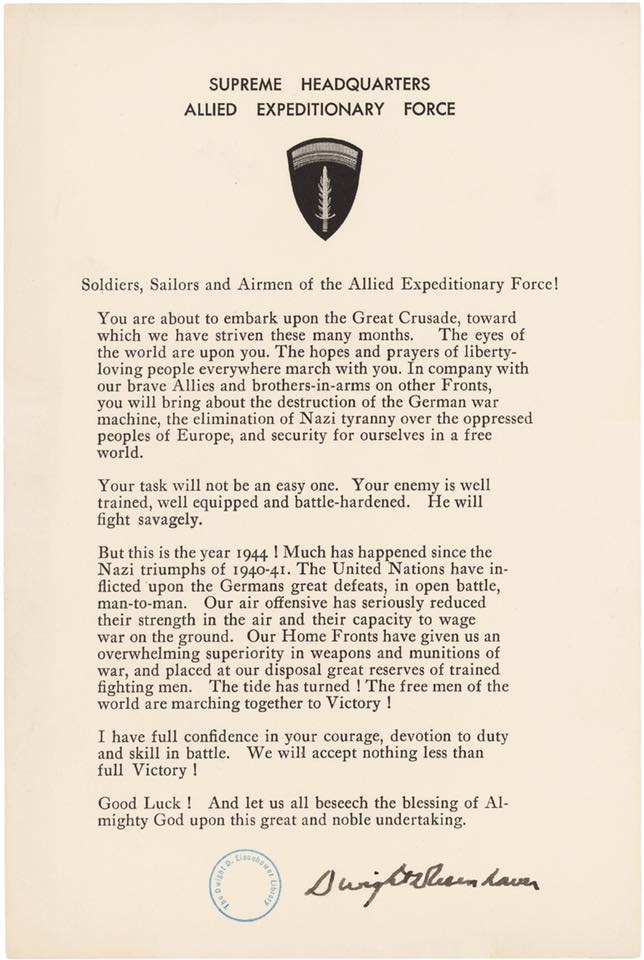
After a long moment (Everyone in the room would describe it later as the longest moment of their lives), Eisenhower simply said, “Ok, let’s do it”, and stood up and walked out of the room. One of his last official acts was authorizing the 6 June 1944 Order of the Day for release. Known today as the “Great Crusade” speech, one copy was issued to over 175,000 soldiers, sailors, and airmen of the assault force that night.
Within 20 minutes of “Ok, let’s do it”, 5000 ships, 12,000 aircraft, and 200,000 men began their journey across the English Channel. The ships first rendezvoused at “Area Z”, known colloquially as “Piccadilly Circus”, before heading south to Normandy. Operation Neptune, the invasion of Normandy, and a component part of Operation Overlord the invasion of France, was the largest amphibious invasion of Europe since the Persian king Xerxes invaded Greece in 480 B.C.
Eisenhower went on to say that the next 24 hours were the most difficult of his life because now that decision was made he could no longer affect anything, and could do nothing except wait. To pass the time for those 24 hour he received reports, drank coffee, smoked five packs of cigarettes, played draughts with his aide, briefed reporters (!) on the next day’s events so they could start their stories, and wrote a short speech accepting responsibility if the invasion failed. That evening, he met with member of the 101st Airborne at their staging areas. A few chatted with Eisenhower, the far bigger crowd was around Kate Sommersby, Eisenhower’s driver and former model.
At 7:30 pm, the BBC broadcast the next lines to Verlaine’s poem:
“Blessent mon coeur / d’une langueur / monotone” (“wound my heart with a monotonous languor”). They were a code to the French Resistance that the invasion would begin in 48 hours, and that that they should begin sabotage operations, particularly the rail network.
At 8:30 pm, Churchill sent a coded telegram to Stalin simply stating, “Tonight, we go”.
About an hour later he wished his wife a good night, who told him not to worry. He shot back, “Do you know that when you wake up tomorrow morning, 20,000 men may be dead?”
At exactly 11:00 pm, Eisenhower, with his aide, and driver, watched the first C-47 transports carrying the 101st take to the sky.
“Well, it’s on. Nothing can stop it now.”
 Buk's Historical Ad Hockery
You must be logged in to post a comment.