
Category: History
The Battle of Balaclava
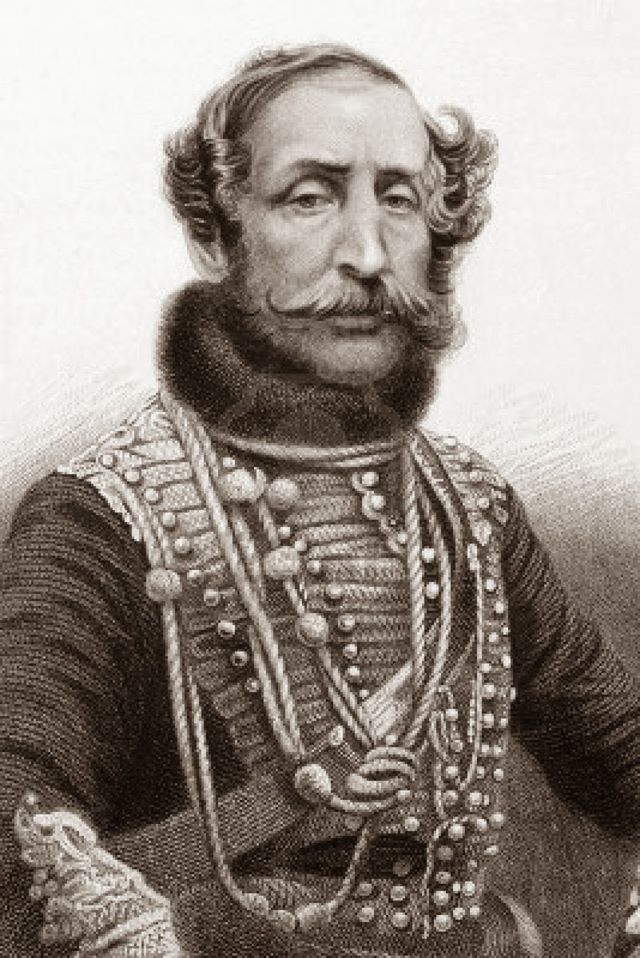
In the early part of the Victorian Age, and about six years before the American Civil War, Great Britain and France fought the Crimean War against Russia. In October of 1854, they were besieging the Crimean city of Sebastopol. On the 25th, the Russians reinforcements arrived and attacked the Allies’ main port of supply, Balaclava. Although the battle lasted until sundown, it didn’t affect the outcome of the Crimean War in any way. The Battle of Balaclava is mostly remembered for three separate engagements.
In the South Valley, Russian Prince Ryhozv’s cavalry advanced in two columns. The first column, 3000 strong, came over the Great Causeway and surprised the British. The nearest British unit was General James Scarlett’s Heavy Brigade of cavalry. The 900 troopers of the Heavy Brigade charged the Russian column, and in four minutes routed them thoroughly. The Charge of the Heavy Brigade was an outstanding success.
Ryhozv’s other cavalry column, a thousand strong, came upon the 93rd Regiment of Highlanders. With only the Black Sea and the supply depot behind them, the Highlanders could not retreat. The 93rd, with their red jackets, green kilts and tall bearskin hats, formed up only two deep to extend their line so they could not outflanked. The “Thin Red Line Tipped in Steel” held strong and defeated the Russian charges. The newspapers back in Britain eventually shortened it to “The Thin Red Line” for consumption back home.
Finally in the North Valley, the commander of the British, Lord Raglan, ordered the Light Brigade to secure some guns about to be overrun by the Russians. When the Light Brigade’s commander, Lord Cardigan (he invented the cardigan sweater: it was cold in the Crimea) received the order, he couldn’t see the guns that he needed to secure. But he did see Russian cannon a mile away at the other end of the valley. He mistakenly thought that was what he needed to secure. He was about to question the order but decided not to: no one was going to call him a coward. So
“Theirs not to reason why,
Theirs but to do and die:
Into the Valley of Death
Rode the six hundred.”
First at a walk, then a trot, then a gallop, and finally at a charge, the Light Brigade, with Lord Cardigan in the van, attacked down the valley with Russian cannon firing at them from three sides. The rest of the Allied army watched in horror. Against all odds, they seized and spiked the Russian guns, routed the defenders, and fought off several Russian counterattacks before Cardigan ordered a retreat once it was clear no one was coming in support. 2/3rds of the Light Brigade was killed or wounded, and Lord Cardigan, a martinet of such stature that only Victorian High Society could produce, rode straight from the charge back to his private luxury yacht, so he wasn’t late for his champagne dinner.
The Charge of the Light Brigade was the subject of Alfred, Lord Tennyson’s famous poem of the same name and became the embodiment of foolhardy courage for no reason.
A French officer who witnessed the charge, Gen Pierre Bosquet, said “C’est magnifique, mais ce n’est pas la guerre: c’est de la folie.”
“It is magnificent, but it is not war: it is madness”.
The Battle of Leyte Gulf: Act III.3, The Battle off Samar
Even though she only made one hit, the Heerman launched the most perfect and effective torpedo spread in history. Her ten torpedoes fanned out at the four Japanese battleships as if it were an exercise. The day before, the Musashi, the Yamato’s sister ship, took 47 aerial torpedo and bomb hits before sinking. But the fear of those ten torpedoes from a surface combatant caused the Yamato to take such radical evasive maneuvers that she ended up steaming AWAY from the battle. The American torpedoes’ inferiority ironically assisted the Heerman, as their slow speed actually extended the chase. In the confusion, the Yamato, and the Nagato who blindly followed her, never regained contact. That torpedo spread damaged one battleship, the Haruna, and effectively took two other battleships, the Yamato and Nagato, including the Center Force’s commander Admiral Takeo Kurita, out of the fight.
It wasn’t over for the Heerman though. She neutralized two battleships, now she locked horns with two more, the Kongo and the Haruna, both six times her size. She darted in between both of them as her 40mm anti-aircraft batteries raked their superstructures while her five 5” guns spewed 20 rounds a minute. The battleship’s turrets couldn’t traverse fast enough, and the Japanese gunners tried to use the concussion from the big guns to capsize the Heerman. The Heerman quickly ran out of her armored piercing shells, and switched to HE. She then expended all those and fired her anti-aircraft shells, which was like launching beehives of shrapnel at the battleships. Eventually, she was reduced to firing bright illumination rounds to cause confusion. But the star shells weren’t for naught, their burning magnesium set the battleships aflame and the high temperatures melted through armor. She sprinted through, around, and then back to the jeep carriers when she was out of ammunition. For an hour, it seemed as if the Heerman was everywhere in the battle.
The Hoel suffered a different fate. As she charged at the Chokai and the Haguro, she took over twenty hits from 6” up to 14” guns. It took an hour, but the Japanese finally decided to use their high explosive shells instead of the armor piercing ones that went right through the thin skinned American ships. The quick destruction of the Hoel gave a glimpse of what would have happened had the Japanese fired high explosive shells from the beginning of the battle. But like in all totalitarian systems, the Japanese loaders and gunners refused to challenge their superiors and switch unless given the order. Dozens of gunners knew exactly what they were looking at in their scopes: Fletcher class destroyers and Casablanca class carriers, not Iowa class battleships and Essex class fleet carriers. They weren’t stupid, they just refused to change. This obstinacy in the face of overwhelming evidence to the contrary went on for over an hour to disastrous consequences for the Japanese.
The Hoel was the first victim of the switch to HE shells, but she managed to launch her spread of torpedoes before she went down. One hit the Chokai in the stern, and ruined her steering. 275 of the 325 men on the Hoel died, but they were avenged by the solitary 5” stern gun of the jeep carrier White Plains. As the Chokai circled out of control, the White Plains’ solitary gun got a lucky hit on the Chokai’s torpedo magazine. The Chokai exploded and sank.
Further south, the wrecked Johnston pulled double duty: as the cruiser Tone closed in on the Gambier Bay, the Johnston engaged her with her stern guns to draw fire from the carrier. But approaching from her bow were a Japanese light cruiser and five destroyers. The Johnston’s three bow 5” guns scored hit after hit on the cruiser and the lead two destroyers. Miraculously, they all turned and retreated.
The victory was short lived. The next Japanese destroyer division was made of sterner stuff. Another light cruiser and six more Japanese destroyers made it their personal mission to sink the Johnston and the indomitable Commander Evans. The Johnston damaged two more destroyers before she went down. Cmdr Evans was last seen severely wounded on the stern conning the ship by yelling commands to the crewmen manually turning the rudder. As the Japanese destroyers steamed past the sinking Johnston, their crews didn’t machine gun the American survivors as they always had in similar situations. They saluted them. It was the only recorded instance of that happening in the Pacific War.
Just to the east, the jeep carrier Gambier Bay was dead in the water and on fire. The heavy cruiser Chikuma closed in for the kill. But before she could launch the coup de grace, she had to deal with the destroyer escort, USS Samuel B Roberts “The Destroyer That Fought like a Battleship”.
The Samuel B Roberts engaged the Chikuma with her two 5” guns at point blank range for over an hour. She was so close that the Chikuma’s guns couldn’t depress far enough. The Samuel B Roberts melted both of her 5” barrels. Nothing on the Chikuma was safe from the Samuel B Robert’s anti-aircraft guns whose gunners targeted individual Japanese sailors, on the logic that that was an exposed chink in the armor. The Samuel B Roberts even rolled her depth charges to add to the confusion. For over an hour she kept this up, but eventually the Chikuma prevailed when her own 5” guns, finally firing high explosives, sent the Samuel B Roberts to the bottom.
The Japanese were severely bloodied, but the Johnston, Hoel, Samuel B Roberts, and Gambier Bay were sunk. The Heerman was out ammunition and all she could do was lay smoke. The Kongo, Haruna, Haguro, Tone, Chikuma, a light cruiser, and six destroyers were within knife fighting distance of the rest of the jeep carriers. Although the Battle off Samar was more difficult than expected, Kurita was still about to win the battle.
It was as if the Chikuma paused to catch her breath after her fight with the plucky little destroyer escort. She slowed down, leisurely traversed her guns on the rest of the jeep carriers… and then exploded.
While the ships were fighting for their lives, the flyers from Taffy 2 and those from Taffy 3 that landed on the airstrip at Tacloban on Leyte (where they initially procured fuel and ammo from the US Army at gun point) had returned. And this time they had proper ship killing ordnance – torpedoes and armored piercing bombs. The Chikuma was the first, but soon all of the Japanese ships were taking substantial hits from the furious, and well-armed, aircraft.
It was too much for Kurita.
He had been awake for over thirty hours. He had had his flagship sunk from underneath him the day before at the Battle of the Sibuyan Bay, and then he was ignominiously fished out of the water. For the last two hours, he had suffered attacks from what he thought were over a thousand planes. He had steamed in the wrong direction and was no longer in direct control of the battle. And because of the damage done to his ships, he was convinced that the destroyers and destroyer escorts of Taffy 3 were actually Halsey’s battleships and heavy cruisers. His subordinate commanders did not want to lose face so they had not reported otherwise. The effectiveness of the newest air attacks convinced him that the 3rd Fleet was launching a massive raid to destroy him.
At 0911, 25 October 1944, 132 minutes after the Battle off Samar started, Adm Takeo Kurita radioed to the Center Force:
“Rendezvous my course north. Speed 20.”
And with that, the Japanese Center Force, on paper one of the most powerful forces of surface combatants in the history of mankind, disengaged.
The Battle off Samar was the most lopsided naval victory in history.
…
Kurita’s withdrawal wasn’t the end of the battle, though. In a rare example of Japanese Army-Navy cooperation, a new, and horrifying, Japanese weapon appeared just an hour and a half later.
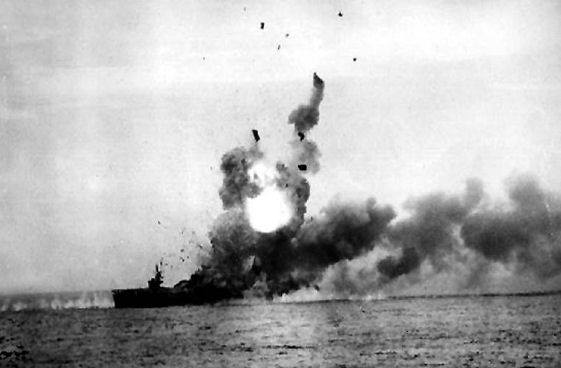
At 1050, just as Kurita was assembling the Center Force to the north, twelve Japanese aircraft unexpectedly attacked Taffy 3 from the west. But these aircraft were different, they didn’t break off their attacks when they were damaged or when the flak was too great. They tried to fly straight into the American ships. Only one got through. It struck the jeep carrier USS St Lo, which had barely survived the morning. The St Lo was at the bottom of the Philippine Trench by noon. The USS St Lo was the first American ship sunk by the Kamikaze.
The Battle of Leyte Gulf: Act III.2, The Battle off Samar cont
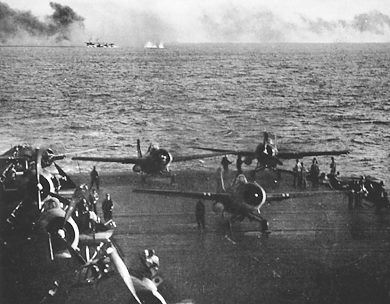
About the time of Evans’ suicidal lone wolf attack against the two lead Japanese cruisers, aircraft from Taffy 1 and Taffy 2 entered the fray. Ships of Taffy 2 were briefly sighted by Japanese destroyers far to the south, but were lost when the sighting destroyer division moved to escort their battleships on the far side of the formation. (Kurita’s attack in place order only applied the cruisers and battleships. The destroyers were still expected to escort their charges. This blind obedience to orders caused the Japanese closest to the Taffy’s 2 and 3 to actually move away from the Americans, caused a significant amount of confusion, and inadvertently put the Americans outside of the dreaded “Long Lance” torpedo range.) Soon, the American planes swarmed about the Center Force like angry hornets. They still lacked proper armor piercing bombs and torpedoes, but the exposed parts of the Japanese ships took a pounding. Every busted gunwale, every strafed bridge, every officer that dove for cover, every turn to avoid a dive bomber, every conflagration started by napalm, and every observer mesmerized by a flurry of propaganda leaflets bought Ziggy Sprague and Taffy 3 precious seconds to escape.
With the Johnston already in the attack, Sprague ordered the rest of Taffy 3’s escorts at the Japanese, “big boys on the right, little fellas on the left, prepare for torpedo runs.”
After the Johnston’s successful run which destroyed the Kumano, Evan’s turned around and headed back toward the rest of Taffy 3 to take up his escort position and provide smoke for the carriers. At that moment the Johnston was struck by numerous 8”, 14” and 16” shells from two different cruisers and the battleships Kongo and Nagato. Because the Japanese were still using armored piercing rounds, only one exploded when it hit the engine, the rest passed clean through the ship. Nonetheless, the Johnston was reduced to 17 knots and the ship was severely damaged when it entered its own smoke screen.
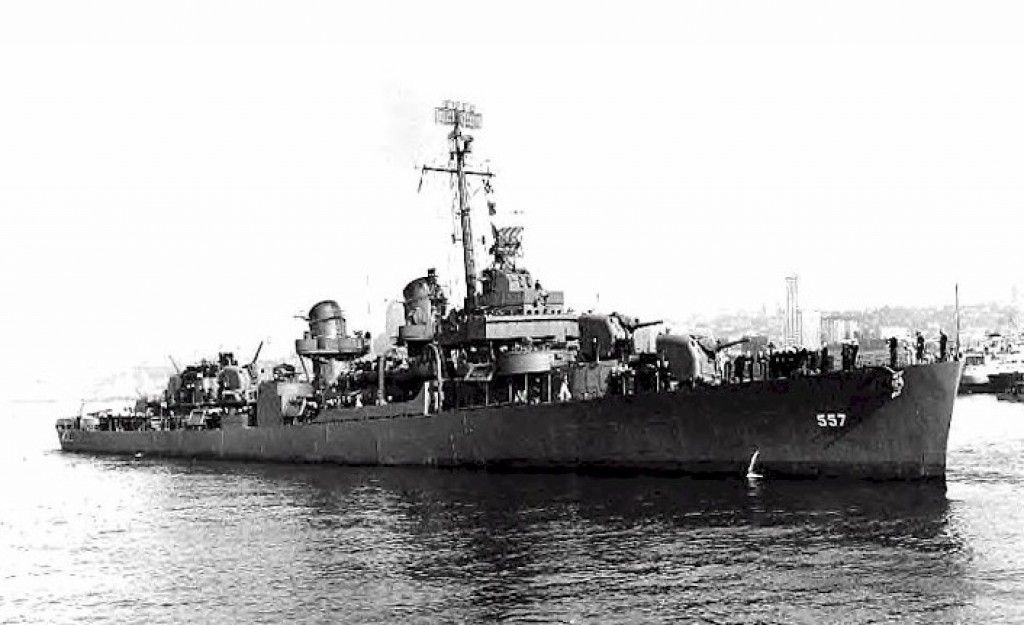
Also pumping out smoke were the destroyers USS Heerman and USS Hoel, followed by the plucky little destroyer escort USS Samuel B Roberts, who didn’t want to wait for the other “little fellas” on the far side of Taffy 3. In any other navy in the world the Roberts would be known as a frigate. Uniquely suited for anti-submarine warfare, destroyer escorts only had two 5” guns and a single triple turret of torpedo tubes for surface action. Nevertheless, the Samuel B Robert’s skipper, LtCdr Robert Copeland, put out on the ship’s loudspeaker, “This will be a fight against overwhelming odds from which survival cannot be expected. We will do what damage we can.” And he pulled in behind the Hoel and Heerman.
The three ships were heading forward as they passed the Johnston heading back.
One third of the Johnston’s crew was dead or wounded. She had just taken on two cruisers, both three times her size, and sank one and severely damaged the other. She had only one engine, no electrical power, and she was listing to port because the pumps couldn’t keep up with the numerous holes in her belly.
But the Johnston had five working turrets and plenty of ammunition.
Evans hoisted his giant sack, turned the Johnston around and followed the other ships back into harm’s way.
By 0800 the other Japanese cruisers were dangerously close to the jeep carriers. So close that the Gambier Bay was on fire and engaging them with her own single stern mounted 5” gun. The Farshaw Bay and White Plains were taking a steady stream of hits.
Their aircraft were causing some damage and quite a bit of confusion but only the torpedoes of the destroyers and destroyer escorts would send Japanese iron to the bottom of the sea.
The Samuel B Roberts launched herself at the two cruisers nearest the Gambier Bay, the Tone and Chikuma.
Evan’s did a quick gun run through the smoke on the lead battleship, the Kongo (he couldn’t miss) and then positioned the Johnston to cross the “T” of an approaching light cruiser and five Japanese destroyers.
The Hoel began her torpedo run against the next pair of cruisers, the Chukai and Haguro.
And the Heerman charged forward at 36 knots… straight at Kurita’s four battleships — the Kongo and her sister ship the Haruna, the Nagato, and the mighty Yamato.
To be continued.
The Battle of Leyte Gulf: Act III.1, The Battle off Samar
The first indications for most of the sailors of Rear Admiral Clifton “Ziggy” Sprague’s Task Force 77.4.3, that “Taffy 3” was under attack were the sound of hurtling trains, followed by splashes that shook the small jeep carriers and knocked sailors off their feet and out of their bunks. Because the Japanese still used visual fire control techniques each of the splashes were color coded so the observers high in the “pagoda”, as the Allies called the tall Japanese superstructures, could adjust their ship’s fire. The Haruna’s green shells, the Kongo’s yellow, Nagato’s orange, and the Yamato’s distinctive red splashes fell among the jeep carriers and escorts. Each red dyed splash caused by the Yamato indicated a near miss from a 3,200 lbs shell. In fact, the Yamato displaced more tonnage by itself than the combined weight of Taffy 3. And so did the next largest ship, the Nagato.
Within minutes the Japanese were registering hits, but the Americans only saving grace was the armored piercing rounds didn’t hit anything substantial enough for the fuses to ignite, so they passed right through their ships. Kurita’s initial assessment that he faced the six fleet carriers, four battleships, and three cruisers of Mitscher’s TF 38 was wrong. What he actually faced were the six smaller escort or “jeep” carriers, four destroyers and four smaller destroyer escorts of Taffy 3. Kurita, who would have been astonished to know how close he was to the Americans, thought he was further away than he was, and thus the ships bigger than they actually were.
The Americans were clearly surprised and Kurita hoped to overwhelm them before they could organize a coherent defensive formation. His own ships were in the midst of changing formation from a nighttime cruise to a daytime anti-aircraft formation, and his order to immediately attack at all speed no matter a ship’s position caused some confusion among the Japanese captains. Nonetheless, Kurita was convinced this maritime banzai would overpower the American surface ships and he could exact revenge on the hated American aircraft carriers before they could launch a strike.
Ziggy Sprague was under no illusions about what he faced. The most powerful independent surface action fleet in the history of mankind was speeding straight at him. And Halsey’s TF 34 was nowhere to seen. All he could do was make a run for nearest rain squall to hide. With that in mind, it wasn’t Kurita’s four battleships that were the most immediate concern but the eight Japanese cruisers. Sprague’s jeep carriers were only slightly slower than the battleships, but the Japanese cruisers had a 13 knot advantage. They had to be slowed down. Sprague did the only thing he could do: he launched all of his aircraft at Kurita, no matter their fuel or weapon status. During the short 15 mile trip to the Japanese, the aviators were surprised to see a single destroyer, the USS Johnston by herself, laying a smoke screen and charging directly at Kurita’s Center Force.
Commander Ernst E Evans, the Cherokee-American captain of the USS Johnston and veteran of the defeats of the Bismarck Sea and the naval battles in Solomon’s, knew exactly what was happening as soon as heard the first telltale train engine sound of the large battleship caliber shells streaking overhead. Evans, with the closest destroyer to the Japanese, without orders turned the Johnston around, moved to flank speed, attacked, and made smoke to obscure his charges. The problem with making smoke on a destroyer is that it billows behind the ship: it doesn’t obscure the destroyer making the smoke, it highlights it. This is what the flyers saw as Evans desperately tried to close the distance to engage.
Taffy 3’s pilots attacked with whatever ordinance they were carrying: anti-personnel bombs, napalm, rockets, .50 cal machine guns, and the gunner’s stern mounted .30 cals. There was even a recorded instance of an Avenger flying past the astonished bridge crew of the battleship Kongo with his canopy open and the pilot firing his pistol at them. And when they ran out of bombs and ammunition, the flyers continued making attacks: for every Japanese gunner who was shooting at them was one that wasn’t shooting at someone who could do some damage.
The Japanese swerved to avoid the attacks: some real, some imaginary. And every turn slowed them down.
At 10,000 yards, the Johnston was miraculously not hit. Like the Death Star’s turbo lasers, the Japanese gunners were under compensating for the small and fast target. The Johnston’s guns had no such problem: her five 5” guns swung into action guided by radar and the new Mark 1A firing computer. She put 43 rds into the lead cruiser, and 34 into the second cruiser, setting them on fire.
At 4,000 yrds, she launched all eight of her torpedoes.
Three hit the lead heavy cruiser, the Kumano, and it was dead in the water.
To be continued.
The Battle of Leyte Gulf: Act II, The Battle of Surigao Strait

On 24 October 1944, Vice Admiral Jesse Oldendorf’s Task Force 77.2, the 7th Fleet Support Force, i.e “MacArthur’s Navy”, fired its last few high explosive shells at Japanese positions on Leyte and then steamed south. A sharp eyed observer on a PBY flying boat spotted Japanese battleships in the Sulu Sea off the Philippine island of Negros. The only place Admiral Nishimura could enter the Leyte Gulf was the Surigao Strait, and Oldendorf planned on meeting him there.
Oldendorf’s battleships were, no pun intended, old. They were all commissioned during the First World War and they were the backbone of the US Navy prior to World War Two. They were the centerpiece of War Plan Orange, America’s interwar contingency plan in case of hostilities with Japan. War Plan Orange was scrapped after Pearl Harbor because the Japanese targeted these battleships to deadly effect: The Arizona and Oklahoma were total losses, the West Virginia and California were sunk, and the Maryland, Tennessee, and Pennsylvania were badly damaged. Only the Wisconsin escaped damage that day. For the next six months, maintenance, recovery, and salvage crews worked frantically to get them battle ready as the carriers held the line at Coral Sea and Midway. Once America counterattacked, the carriers were now the premier platform of sea power, but the big, slow, resurrected battleships of Battleship Row found their place again: this time as mobile fire support platforms.
Oldendorf’s battleships shelled every island the marines or soldiers landed on for the last two years, from Guadalcanal to Leyte. But they had never fired their armored piercing shells in anger. In the early morning of 25 October 1944, they would.
At 0200, Nishimura’s Southern Force of two battleships, six cruisers and ten destroyers slipped into the confined waters of the Surigao Strait. For the next two hours, 32 American PT boats harassed the formation causing much confusion. Then, in a prelude to what would happen the next day, Oldendorf’s destroyers made torpedo runs that disoriented the Japanese formation and destroyed the battleship Fuso. The Fuso didn’t sink… but she broke in half and the two pieces floated around the strait for two days, burning. When Nishimura exited the Surigao Strait into the Leyte Gulf, Oldendorf and his old battlewagons were waiting. Nishimura’s “T” was crossed in a fashion that would have made Lord Nelson proud. Oldendorf’s six battleships and four cruisers pummeled Nishimura’s remaining ships. None escaped. It was the last time in history battleships would fire their guns at another ship. It was the end of an era.
Just west of the San Bernardino Strait off the island of Samar, Rear Admiral Thomas Sprague’s Task Force 77.4 Escort Carrier Group prepared for another day in support of the soldiers and guerrillas fighting the Japanese on Leyte. On the USS Gambier Bay, the USS St Lo and the four other small escort carriers of Rear Admiral Ziggy Sprague’s (No relation) Task Force 77.4.3, “Taffy 3”, the crews readied their aircraft for close air support of MacArthur: attaching rockets, napalm canisters, fragmentation bombs, and even some canisters filled with leaflets that a PSYOP officer needed dropped. The crews of the USS Hoel, USS Johnston, USS Samuel B Roberts, and Sprague’s other destroyers and destroyer escorts huddled around their radios listening to “The Big Game” going on between the battleships.
It seemed the naval Battle of Leyte Gulf was over. It was time to get on with MacArthur’s land Battle of Leyte. Taffy 3’s escort carriers launched their first close air support missions at dawn.
Thirty miles to the west, Adm Kurita’s massive Center Force of four battleships, eight cruisers, and eleven destroyers slipped unimpeded through the San Bernardino Strait separating the big island of Luzon and the island of Samar. As Adm Kurita looked east into the rising sun, he thought he saw Halsey’s six fleet carriers, three battleships and four cruisers of TF 38. He actually saw the six jeep carriers, three destroyers, and four destroyer escorts of Ziggy Sprague’s Taffy 3.
Kurita immediately ordered the mighty Yamato, and the rest of the Center Force, to attack.
The Battle of Leyte Gulf: Act I, The Battles of the Palawan Strait and the Sibuyan Sea

On the morning of 24 October 1944, the Japanese Operation Sho-Go I was already falling apart. The one Japanese Task Force that needed to be spotted by the Americans, Adm Ozawa’s decoy Northern Force, was the only task force that was not spotted by the Americans. Ozawa needed to lure Halsey away from the Philippines, but despite his best efforts to be detected, the Americans had no idea his four carriers were closing in from the north. (Ozawa commented later that if he had planes and trained pilots, he would have destroyed the entirety of TF 38, so ignorant the Americans were of his location.)
Unfortunately for the Japanese, the Americans knew the precise locations of both the Center and Southern Forces. On 23 October, Adm Nishimura’s Southern Force was spotted by a PBY flying boat and the Americans planned to ambush the Southern Force in the Surgiao Strait. There they would be met by Vice Adm Jesse Oldendorf’s battleships. Oldendorf’s Task Force consisted of the venerable battlewagons that were sunk or damaged at Pearl Harbor, and then resurrected and repaired. They were thought to be worthless for anything except pre-invasion bombardments and fire support for MacArthur’s troops. His six pre-World War Two Pennsylvania, New Mexico, and Colorado class battleships sailed south to the Surigao Strait. There they would get their revenge.
Also on 23 October, two American submarines, the USS Darter and USS Dace, ambushed Adm Kurita’s Center Force that night in the Palawan Strait. They sank two heavy cruisers, including Kurita’s flagship, and damaged a third which was escorted back to Borneo by two destroyers. Kurita was pulled out of the water and transferred his flag. He was under no illusions about what was going to happen to him in the morning.
Once Kurita was spotted by the submarines and had not received any reports that the Northern Force was detected, he knew Halsey’s carriers were going to destroy him. On the morning of 24 October, when Kurita was in the Sibuyan Sea short of the San Bernardino Strait, Halsey’s fighters and dive bombers attacked. All day, wave after wave of TF 38’s planes bombed and strafed the massive Japanese battleships and heavy cruisers. In the late afternoon, the Musashi, one of the two largest battleships on the planet, was sunk after she was hit by 47 torpedoes and 500 lbs bombs. With many of his other ships damaged, Kurita turned around, accepting defeat. The Americans had “won” the Battle of the Sibuyan Sea.
Then a miracle happened for the Japanese: one of Halsey’s reconnaissance planes finally spotted Ozawa’s Northern Force. The air attacks immediately stopped. To Halsey, the Center Force was defeated and now he got to do what God placed him on this earth to do: sink Jap carriers. He made a plan to create TF 34 with TF 38’s accompanying fast North Carolina and Iowa class battleships to cover the San Bernardino Strait, but once the matador Ozawa waved his red cape, Bull Halsey charged north with everything he had, including the battleships.
Kurita, with eleven remaining destroyers, eight cruisers, and four battleships, including Musashi’s sister ship — the mighty Yamato, turned his Center Force back around and resumed his course toward the now undefended San Bernardino strait off the Philippine Island of Samar.
They would be able to engage the troop transports, supply ships, and the escorting destroyers, and small “jeep” carriers of MacArthur’s invasion fleet at dawn the next morning.
The Battle of Leyte Gulf: Prologue, Operation Sho-Go I

The capture of the Philippines by the Americans would ring the death knell for the Imperial Japanese Navy. The shipping lanes to Java and the Dutch East Indies, already under constant air and submarine attack, would be finally and definitively cut. All of Japan’s remaining naval strength would be committed to the coming battle. They had no choice: any ships remaining north of the Philippines would be without fuel, and because naval shells were only manufactured in Japan, any ships remaining south of the Philippines would be without ammunition.
Coordinating the far flung Japanese naval task forces necessitated a complex plan, named Sho Go I by the Imperial Japanese General Staff. (Operation Sho-Go I was a branch of Operation Sho-Go, the defense of the Home Islands.) Though complicated, if Sho-Go I was successful, the American 7th Fleet would be destroyed, the 3rd Fleet would be hamstrung, and MacArthur’s forces would be thrown back into the sea. America would suffer a huge strategic loss and (it was thought) be compelled to come to a negotiated cease fire. The importance of Sho-Go I was not lost on the Japanese Navy’s bitterest rival, the Japanese Army. In a rare moment of interservice cooperation, Sho-Go I was made even more complicated by including the Japanese Army on Leyte and Luzon. Tomoyuki Yamashita, the commander and governor of the Japanese occupied Philippines, reinforced Leyte with every aircraft he had left, and enough troops to drive the Americans back into the sea after they lost their supporting ships offshore.
The Americans were convinced that carriers were the key to naval warfare (they were) but in the narrow confines of the Philippine archipelago, the Japanese could use their remaining battleships to force this Kantai Kessen, or decisive battle to end the war. But the battleships had to get there first and America’s carriers were in the way. The key to Sho-Go I was Admiral Marc Mitscher’s powerful Task Force 38 which consisted of all of America’s big fleet carriers. It was this TF that smashed Japan’s remaining carrier airpower at the Battle of the Philippine Sea aka The Great Mariana’s Turkey Shoot. For the Japanese plan to have any success, TF 38 had to be neutralized.
Lacking any carrier air power at all, the Japanese chose to neutralize TF 38 through deception. The Japanese Northern Force consisted of their remaining four carriers, but almost no planes, and definitely no trained carrier pilots. But it would be a target the carrier-mad Americans could not resist. The Northern Force was the bait to lure TF 38 away from the Philippines. Once they were spotted, the Northern Force would race back north, away from the Philippines, with TF 38 in pursuit.
Once TF 38 was gone, the Southern Force, steaming north from Java would enter the Leyte Gulf via the Surigao Strait. At the same time, the powerful Center Force under Vice Admiral Takeo Kurita, consisting of eight battleships, including the super battleships Yamato and Musashi, was steaming east from Formosa, and it would enter the Leyte Gulf via the San Bernardino Strait off the island of Samar. Together they would smash MacArthur’s invasion fleet. Yamashita would then be free to destroy an outnumbered and cut off US Sixth Army on Leyte. On 22 October 1944, all three Japanese task forces were converging on Leyte. They were under radio silence, and the plan could not be altered.
TF 38 had to take the bait for Sho-Go I to work. The fate of the entire Imperial Japanese Navy depended on it. Luckily for the Japanese, sailing with TF 38 was the key to any success they would have in the upcoming operation: American Admiral Bull Halsey. Bull Halsey was America’s greatest carrier admiral, but he was proud, and his lack of any big Jap fleet carrier kills was a sore point in the wardroom. He always seemed to just miss them: He and his carriers were too far away to intervene at Pearl Harbor. Though Coral Sea was a victory, his carriers only sank one small escort carrier. Halsey missed Midway because he was in the hospital with a bad skin rash. The Japanese carriers were not an important target with all the important Japanese bases in the Solomon’s. And finally, he was away from TF 38 during the Great Mariana’s Turkey Shoot. The Northern Force was the last opportunity for Halsey to sink a Japanese carrier in the war. The Japanese were convinced Halsey would not pass it up and based their entire plan on it.
They were right.
Sheridan’s Ride
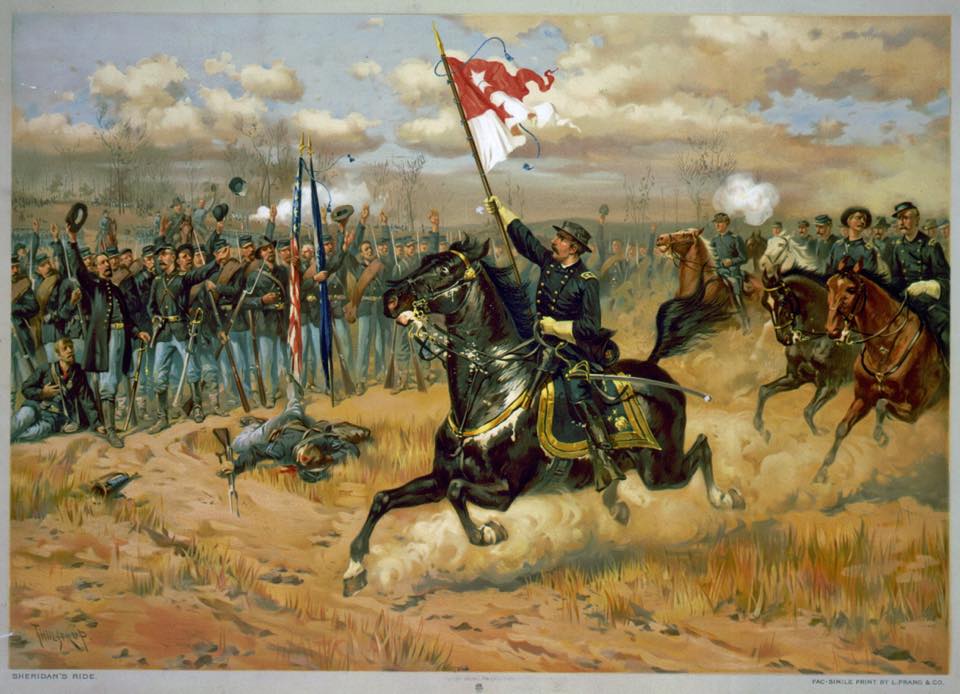
In the summer of 1864, the Union was winning the battles but losing the war. In the presidential race of 1864, war weariness was working against Republican incumbent Abraham Lincoln, and his Democratic challenger George B McClellan was significantly ahead because he promised to make peace with the South and end the war. That changed in September when Sherman seized Atlanta, which greatly increased Lincoln’s popularity. But by October, Lincoln was still only tied in the polls with McClellan because Ulysses S Grant was stuck in a bloody stalemate besieging Robert E. Lee around Richmond, and the morale crushing casualties were high.
In order to break the stalemate around Richmond, Grant needed troops. The only troops available were those defending Washington DC from attack. Washington DC was constantly threatened over the years because of its proximity to Virginia’s Shenandoah Valley, the gateway to the North and Breadbasket of the South. Because the Valley runs southwest to northeast, i.e. away from Richmond, it previously didn’t made sense for Grant to clear it.
In September 1864, Grant needed those troops and dispatched Major General Phil Sheridan with 20,000 men to clear the valley of Rebels, thereby removing the threat to Washington. Sheridan pinned down Confederate Major General Jubal Early, but could not destroy him. So in a prelude to Sherman’s March to the Sea, Sheridan began a scorched earth policy in the Shenandoah Valley to deny supplies to the Confederates. Thinking everything was going well, and that Early would be forced to leave the valley or starve, Sheridan left his army to attend a conference in Washington DC in mid-October.
On 18 October, Sheridan was on his way back from the conference and stayed the night in Winchester, Va, twenty miles from his army. Also that day Jubal Early decided not to retreat but to attack. He marched his army all night and surprised the Union troops encamped on Cedar Creek, just as Sheridan woke to the distant sound of guns. Like all good commanders, Sheridan mounted up and rode toward the sound of battle. To his astonishment, he encountered the shattered and routed remnants of his army retreating from Cedar Creek to Winchester.
Sheridan spurred his horse on and raced down the road towards the sounds of fighting, inspiring his troops and admonishing his officers, but never slowed below a gallop. Sheridan arrived at the still raging Battle of Cedar Creek within minutes of it being lost. His presence on the battlefield electrified the remaining defenders, and more importantly, behind him a came a steady stream of recently rallied reinforcements. That evening, Sheridan counterattacked and swept Early’s exhausted troops from the field.
The news of Sheridan’s Ride was exactly what Lincoln needed. Sheridan was an immediate national hero and Lincoln’s popularity soared. McClellan’s antiwar campaign collapsed and Lincoln would handily defeat him in November. There would be no peace treaty with an independent Confederate States of America.
The First Battle of Ypres
With the German failure at the First Battle of the Marne, both the Allies and the Germans began “The Race to the Sea” with each army moving north from Paris in an attempt to outflank each other, all the while leaving a line of trenches to their rear. The race came to an end at the Flemish city of Ypres (pronounced “ee-priss”), near the channel coast.
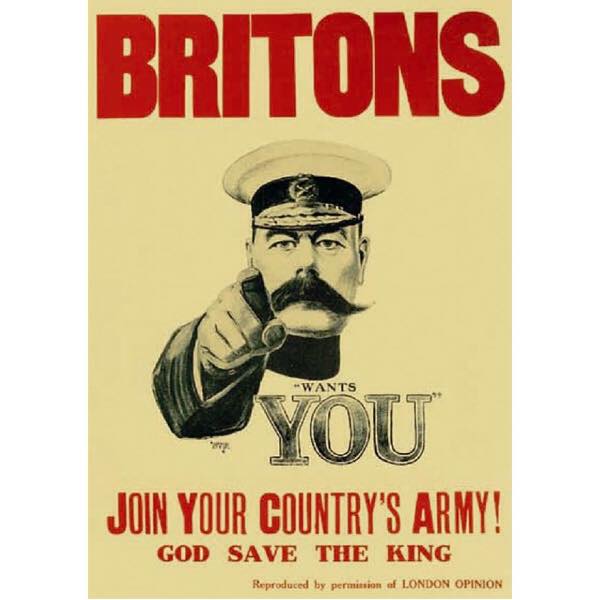
The French Army was overextended occupying the trenches all the way to the Swiss border so the inevitable battle was fought by the Belgian Army which had just recently escaped the capture of Antwerp, a single French army, and “The Old Contemptibles” of Sir John French’s British Expeditionary Force (Kaiser Wilhelm made an offhand comment that he would “destroy French’s contemptible little army”, the name stuck.) The highly trained and experienced British Expeditionary Force was comprised of all volunteers, seasoned veterans from colonial campaigns, and reinforced by tough Indian troops.
In mid-October 1914, French Marshal Ferdinand Foch, Sir John French, and German Field Marshal Erick Von Falkenhayn all came to the same conclusion: this was the last chance to maneuver before winter set in and the trenches solidified. Both sides attacked.
On 19 October 1914, the Allies struck first and ran directly into German troops staging in their assault positions. The two sides hammered at each other for a month. The First Battle of Ypres was characterized by failures of command and control, leadership, logistics, fratricide, and tactics. It was confusement of the highest order. The First Battle of Ypres was the wake up call that 19th century systems could not keep up with 20th century warfare. Veterans on both sides referred to it as “The Battle” for the rest of their lives, including a young Austrian corporal in the German Army, Adolf Hitler, who received the Iron Cross 2nd Class during the battle for rescuing a comrade under fire.
The British, Germans, Belgians and French were spent by the middle of November. Von Falkynhahn had done the Kaiser’s bidding and destroyed the Old Contemptibles, but he had not broken through. British veterans of “The Battle” were disbanded and they formed the cadres for a larger British Expeditionary Force with Lord Kitchener’s “New Armies”. The battle cost the four armies nearly 300,000 casualties, or almost 9,000 a day. The British, Belgian, Canadian, German, Indian, and French soldiers spent the rest of the cold and wet maritime winter in the brown, barren, and bleak moonscape around Ypres digging the trenches that became a symbol of what they would call “The Great War”.
The next spring the soldiers were greeted with what would become another of the First World War’s symbols: the poppy flower. In those Flanders’ fields, the first flower to bloom every year is the poppy. In May 1915, the shattered fields around Ypres were a sea of blood red poppy flowers. Canadian Lt Col John McCrae was inspired by the sight to write the hauntingly beautiful poem “In Flanders Fields” that would come to define the war. It begins:
“In Flanders fields the poppies blow
Between the crosses, row on row…”
MacArthur’s Return
Just after Pearl Harbor, the Japanese invaded the Philippines and overran the islands by April, 1942. In March 1942, FDR ordered the Commander of the Philippine Department and Field Marshal of the Army of the Philippines Gen. Douglas MacArthur to Australia in order to prevent his capture by the Japanese. Upon arriving in Australia he said, “I came through and I shall return”.
Over two years later on 20 October 1944, Gen Krueger’s US Sixth Army splashed ashore on the Philippine Island of Leyte and linked up with Col Ruberto Kangleon’s various American and Filipino guerilla organizations. Later that afternoon, MacArthur staged a dramatic and meticulously scripted personal landing on Leyte, where he announced, “People of the Philippines, I have returned! By the grace of Almighty God, our forces stand again on Philippine soil.”
Taking advantage of the bad October weather, Gen Tomoyuki Yamashita, the commander of all Japanese forces in the Philippines, heavily reinforced Leyte, and planned on making a fight of the island in order to force MacArthur’s invasion fleet, and the US Fifth and Seventh Fleets to concentrate. In the coming days, the still powerful and numerous battleships of the Imperial Japanese Navy used the cover of the monsoon to try and close with and destroy the US ships in the close waters of the Leyte Gulf. Operation Sho I was the Imperial Japanese General Staff’s last chance at Kantai Kessen, or the final decisive battle to end the war on terms favorable to the Japanese.
 Buk's Historical Ad Hockery
You must be logged in to post a comment.