
Category: History
America’s First St. Patrick’s Day
In the 18th century, Ireland chaffed under Great Britain’s rule, specifically Poyning’s Law, the Declaratory Act, and the various anti-Catholic laws imposed and enforced by the state controlled Anglican Church. Poyning’s Law, passed in 1498, denied the Irish the ability to call a parliament unless it was approved by the King of England and his Privy Council. The Declaratory Act, better understood by its official name the Dependency of Ireland on Great Britain Act of 1719, declared that the British House of Lords was the final appellate court for all Irish court cases and that the British Parliament could pass legislation for the Kingdom of Ireland. Finally, through Parliament and the King, the Anglican Church enforced the Penal Laws which were a collection of restrictions and discriminatory laws, such as the Popery Act of 1698, against Roman Catholics. Since Ireland was predominately Roman Catholic, most Irishmen could not hold office, be a lawyer, own firearms or enlist, buy land, vote, intermarry with Protestants, adopt children, convert to Catholicism, buy a horse worth over 5 pounds, and Irish priests were forced to register (1698) in order to preach. Six years later in 1704, Irish priests were outlawed and bounties placed on their heads for their arrest. The register made their arrests quite convenient and lucrative for Protestant bounty hunters.
In 1778, Catholic France allied with the nascent United States of America in her fight against Great Britain. The British feared an invasion of Ireland as French support for dissident minorities on the British Isles, particularly Catholic minorities, was a time honored tradition. The British formed Irish Volunteer companies from Anglican Irishmen to fight any potential French invasion and uprising. However, as more British regiments were sent to the Caribbean and North America, the Irish Volunteers began to take Catholics upon an oath of loyalty. By 1778, the threat of French invasion was minimal, but the Irish Volunteers didn’t disband. With the emerging middle class consciousness caused by the Industrial Revolution, the Irish Volunteer companies morphed into political organizations more concerned with popular local causes, and there was no more popular local cause in Ireland than Irish Catholic emancipation. In 1778, the companies gave an Irish voice to those who advocated for the repeal of the harsh Penal Laws, deemed passé and obsolescent in the Age of Enlightenment. Later that year, the Papists Acts of 1778 mitigated much of the official discrimination against Catholics, but the backlash was severe. By late 1779, Irish Catholics were forced to defend themselves against Anglican riots and violence. The Irish Parliament, called in defiance of Britain, deliberated on how to break the British and Anglican hold on Ireland.
That same winter at Morristown, New Jersey, the Continental Army was enduring “the coldest winter in North America in 400 years”. New York Bay froze solid. General George Washington referred to the winter of 1779/80 as “the hard winter” and worse than the one at Valley Forge two years before. By March, one third of the 12,000 strong Continental Army had deserted, and one third more were not fit for duty. Furthermore, the logistics’ system of the Continental Congress had collapsed upon itself and the states were told to supply their own soldiers at Morristown. Morale was rock bottom.
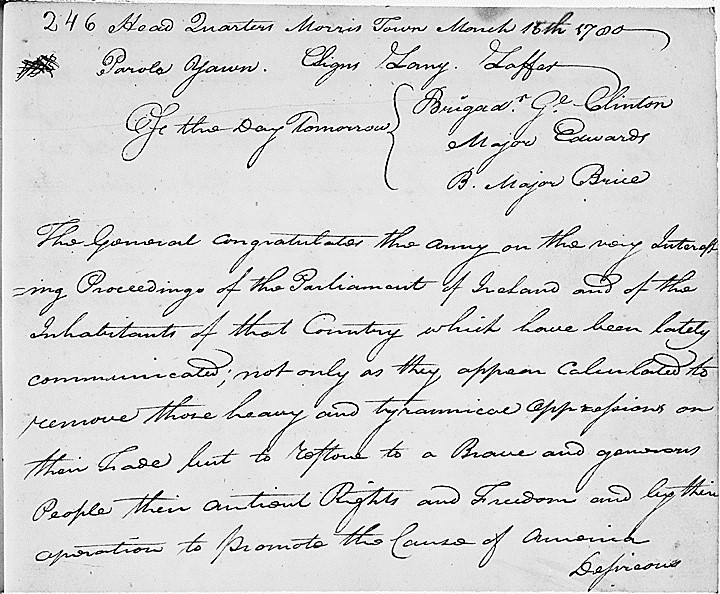
Washington needed to improve morale, prevent a mutiny, give his men some respite to the ceaseless drilling and camp labor, and hopefully prevent more desertions. Irish and Scots-Irish immigrants made up a significant percentage of the Continental Army, about two fifths, with the ratio of officers being larger. Encouraged by his wife Martha who spent most of the winter with her husband, Washington planned something special for his men. On 16 March 1780, Washington a member of Philadelphia’s Friendly Sons of St. Patrick, issued a general order recognizing the Irish quest for freedom from British rule. More practically, Washington gave the Continental Army the next day off to show solidarity with the Irish fight for independence. The next day was the seventeenth of March, St Patrick’s Day.
“Head Quarters Morris Town March 16th, 1780
General Order
The general congratulates the army on the very interesting proceedings of the parliament of Ireland and the inhabitants of that country which have been lately communicated; not only as they appear calculated to remove those heavy and tyrannical oppressions on their trade but to restore to a brave and generous people their ancient rights and freedom and by their operations to promote the cause of America.
Desirous of impressing upon the minds of the army, transactions so important in their nature, the general directs that all fatigue and working parties cease for tomorrow the seventeenth, a day held in particular regard by the people of the nation. At the same time that he orders this, he persuades himself that the celebration of the day will not be attended with the least rioting or disorder, the officers to be at their quarters in camp and the troops of the state line to keep within their own encampment.”
In the Pennsylvania Division, the division commander, Major General Baron Von Steuben, and his two brigade commanders, Brigadier Generals Anthony Wayne and Mordecai Gist, each bought a “hogshead” of rum (63 gallon cask) for their men to celebrate.
Happy Saint Patrick’s Day
The Ho Chi Minh Campaign: The 1975 North Vietnamese Spring Offensive

Almost ten years to the day after the first US combat troops entered South Vietnam, Communist North Vietnam launched their war winning conventional offensive against South Vietnam.
In 1964, the South Vietnamese Army was almost completely combat ineffective and had to be rebuilt. To buy the time to do so, General William Westmoreland, the commander of the US and SEATO Military Assistance Command- Vietnam (MAC-V), brought in US airpower and US combat troops. Between 1965 and 1968, Westmoreland used US and Allied troops to search for and destroy VC and NVA main force units, while relying on special forces, indigenous militias and the ARVN for counter insurgency and security. These tactics proved effective to a point, but didn’t play well on TV and certainly weren’t quantifiable, though Westmoreland tried with “body counts”. When Westmoreland was denied the authority to cut the Ho Chi Minh Trail and seize communist base camps in the Laotian panhandle and the Fishhook in Cambodia, the war was militarily unwinnable for the US and South Vietnam. North Vietnamese Minister of Defense and commander of the North Vietnamese Army, General Võ Nguyên Giáp, took advantage of this reality and advocated for a slower insurgency campaign that avoided costly big unit engagements. This approach would empower the VC, increase US casualties, embolden the US anti-war movement, and allow time for the Soviet propaganda machine to work over America.
This slower, but inevitably successful, course of action was backed by the Soviet faction inside the North Vietnamese Communist Party, led by Giap and Ho Chi Minh. In 1967, when Ho was ill and Giap at a conference in Moscow, the Chinese faction in the government and armed forces staged a soft coup. The Chinese faction, led by COSVN commander Tran Van Tra and North Vietnamese politician Le Duan, came to power and demanded big unit battle with the Americans, because that was how the French were defeated previously. Returning to Vietnam, Giap was forced to accept the new strategy.
In January 1968, the NVA and VC launched the “General Offensive/General Uprising” i.e. the Tet Offensive, which shocked the Americans and South Vietnamese. However, though the General Offensive portion of the plan was executed, the General Uprising of South Vietnamese was nonexistent. The South Vietnamese populace on the whole refused to support the communists. The NVA and VC were defeated in a few weeks, the VC decisively so. Although the communists suffered extremely heavy casualties, the Tet Offensive turned the US public opinion against the war. The scale of the offensive gave lie to the official Johnson and Westmoreland position that there was a light at the end of the tunnel. Gen Westmoreland was replaced that spring by General Creighton Abrams.
The Tet Offensive destroyed the Viet Cong as a viable military entity, and forced Giap to move NVA regular units into South Vietnam to take their place, setting the insurgency back years. This gave Abrams the opportunity to implement new tactics in Vietnam dubbed the “Inkblot Strategy”. American and ARVN troops secured the cities, town, hamlets, and then the countryside of S. Vietnam through counterinsurgency tactics the way ink blots spread on a piece of paper. Combined with targeted strikes on high value targets and partnering and training of South Vietnamese troops and irregulars, the “inkblot strategy” proved effective. Dubbed “Vietnamization” the strategy was successful, and the ARVN took over security of the country with most American combat troops out of Vietnam by 1972.
Though Abrams’ strategy was successful, the four years of lost time under Westmoreland meant that the South Vietnamese still needed American advisors, air support, supplies, and financial assistance to deal with the increasingly conventional NVA attacks. With American assistance, the ARVN held its own against the NVA coming out of Cambodia and Laos. On New Year’s Eve 1972, Giap conceded that “We have lost the war” (his words) after Operation Linebacker II and the disastrous Easter Offensive, both of which prompted the North Vietnamese to accept the Paris Peace Accords in early 1973. South Vietnam repelled North Vietnam’s 1972, 1973, and 1974 spring offensives, without American combat troops.
As usual for modern American peace deals, the United States kept its part of the bargain and its adversaries did not. In February 1975, the US public was tired of the war. The newly elected Democratic congress cut off all funding to South Vietnam, while North Vietnam was awash in funds and supplies from various Communist bloc countries. On 10 March 1975, Giap launched the spring offensive, named after the deceased former leader of North Vietnam Ho Chi Minh, with hundreds of tanks and artillery pieces. “The Ho Chi Minh Campaign” was the fourth massive conventional spring offensive in as many years against South Vietnam. Giap had reached the bottom of his manpower pool, but unfortunately South Vietnam had neither the resources nor the will to properly defend. The NVA broke through within days and Saigon fell on 30 April.
Contrary to popular historical opinion, South Vietnam did not fall to a popular insurgency, but a conventional attack that would not have been out of place in the Second World War.
130,000 South Vietnamese fled the country and 200,000 more were be murdered by the North Vietnamese over the next month. Hundreds of thousands more were forced into re-education camps. Following their victory in Vietnam, Cambodia fell to the Khmer Rouge, and Laos fell to the Pathet Lao. A further 1.6 million men, women, and children were murdered by the Communists.
The Battle of Auerstadt

During Napoleon’s invasion of Saxony and Prussia in October 1806, both the Grande Armee and the Prussian Army were moving north on opposite banks of the Saale river. On 13 October 1806, Lannes V Corps came into contact with Prussian troops at Jena. Napoleon correctly concluded that the Prussian Army under King Frederick Wilhelm III and the Duke of Brunswick was to the west of the Saale River and ordered his corps to cross the Saale. Napoleon wished to bring the Prussian Army to battle on the Landgreffenburg, the plateau west of the Jena. Most of the Grande Armee crossed the river at Jena, but two of Napoleon’s corps, Davout’s III and Bernadotte’s I Corps, were to cross downstream at Koessen. From there, they were to surprise and strike the Prussian Army from the north.
Boldy falling upon the flank of Napoleon’s adversaries in battle after a long forced march was a task in which Davout was not a stranger. He executed the exact same mission with aplomb the previous year and assured the destruction of the Austrian and Russian armies at Austerlitz. If there was anyone in the Grande Armee that Napoleon could trust with such a difficult mission, it was Davout.
Louis-Nicholas Davout was born of minor French nobility from Burgundy. Despite his noble heritage, he survived the French Revolution when most of his peers were sent to the guillotine. A trained cavalryman, he thrived in the ranks of the French Revolutionary Army through unimpeachable integrity, uncompromising discipline, unmatched military skill, and frankly just being a bit ‘arder than his contemporaries. Davout didn’t look the part: he was prematurely balding and disdained the foppery of French officers. Davout had no time for anything that didn’t directly affect military efficacy. Napoleon, like most French senior officers, despised him at first meeting, mistaking Davout’s self-confident competence for arrogance, aloofness for pride, and utilitarian uniform for shabbiness. However, Napoleon quickly recognized that Davout was not one for the salon, but for the battlefield. When the Revolutionary government forced Davout out of the army due to his noble family, Napoleon overrode them and promoted him to general of division. He arranged Davout’s marriage to his sister in law, just to get him into the family. For these acts, Napoleon gained Davout’s undying loyalty. When Napoleon became emperor in 1804, Davout was one the few generals raised to Marshal of the Empire despite being the younger (34) than his contemporaries and one of the least experienced. He was one of the few Napoleonic commanders who saw the difference between “looting” and “foraging”, punished the former with death, correctly surmising that looting just slowed the columns down. For his tough and exacting training standards, moral incorruptibility, and unrelenting discipline, Davout quickly became known as the “Iron Marshal”.
Napoleon’s confidence in Davout was not misplaced though it would be tested during the invasion of Prussia. Davout was already passed Jena and was 15 km to the north when Lannes made contact there with the Prussian Army. The Grande Armee’s turn west put Davout’s III Corps on the far right but in a position to turn the Duke of Brunswick’s flank, if possible. To do so, III Corps would have to march north to cross the Saale at Koessen then turn south and take the Prussians from the flank and rear. Davout’s men would have to march all night to complete the 50 kms route. Come dawn on 14 October 1806, II Corps was making good time on the road from Koessen toward Auerstadt and Apolda to decisively affect the Battle of Jena.
However, Davout would never make it there. He and his 27.000 strong corps were marching southwest on the same road that the 70,000 strong Prussian main army was marching on northeast towards Leipzig. In the same dense fog that affected every movement at the Battle of Jena, neither side was aware of the other, but a clash was inevitable.
At the village of Hassenhausen, Davout sent his aide-de-camp Colonel Jean-Raymond-Charles Bourke with a detachment of light cavalry to assess the road ahead. They spotted Brunswick’s advanced guard, General-Lieutenant Gerhard von Blucher’s division of cavalry with the King of Prussia Frederick Wilhelm III at its head as if he were a Roman Consul riding in a triumph. About the same time, Prussian cavalry, considered at the time the best in the world, spotted Davout’s 3rd Division, under Gen Charles Gudin advancing on Hassenhausen. Blucher convinced Brunswick that he should immediately attack. The fog would allow his cavalry squadrons to surprise the French and defeat them before they could form squares. Blucher advanced with ten squadrons and brushed aside the Gudin’s screening light cavalry
Unfortunately for the Prussians, Bourke’s reconnaissance and Gudin’s retreating cavalry gave just enough warning for the veteran French infantry to form squares. In less than a minute, Gudin’s exposed columns were a patchwork of immobile bayonet tipped squares, and a minute after that surrounded by Prussian cavalry. A horse, no matter how well trained, won’t charge a wall of bayonets. The Prussians were reduced to riding past firing their pistols or attempting to slash their way through with sabers, all the while receiving volleys from the back ranks and canister from the guns at the corners. One square was broken up by dismounted dragoons and horse artillery but most of its inhabitants managed to withdraw to another square. The sole Prussian success of the engagement was the exception that proved the rule that mounted cavalry couldn’t break an established infantry square. Every time the cavalry reformed amidst the squares, they were hammered by French volleys. Blucher’s cavalry was forced to fall back. The massive casualties among the Prussian cavalry neutralized them for the rest of the battle.
The defeat of the feared Prussian cavalry skyrocketed the morale up and down Davout columns.
Brunswick orders his infantry forward to engage the French and closed with Gudin’s men. However, Gudin was in a strong position. His men occupied Hassesnhausen and turned it into a stronghold with defensive lines to the north of the village. More Prussian troops followed behind, but since Brunswick rode up and down the Prussian line inspiring his men, their officers couldn’t find him in the confusion of the battle. So they stopped and waited for instructions as to where to place their men in the line. Brunswick was forced to place them himself while the French filled in the line as needed. Furthermore, Gudin’s men in Hassenhausen had a better line of sight over the battlefield and could observe Prussian movement. The Prussians could not do the same.
Anchored on Hassenhausen, Gudin took on all comers but, even disorganized, the Prussian numbers began to be felt. Gudin had no troops to the south of the town and the Prussians were slowly enveloping the French left. Davout’s 2nd Division, under Gen Louis Friant formed his men to the right of Gudin and caused a panic among the Prussians as Brunswick was pushing the French left. However, the sight of French troops to the north of Gudin and French cavalry even further northwest, threatened his own left flank. Brunswick sent his highly capable chief of staff, Gehard von Scharnhorst, to sort out the north while he continued to individually place regiments in the south. Though the Prussians vastly outnumbered the French, Davout’s commanders were simply quicker to get into the line. Two thirds of Davout’s corps were fighting the Prussians while barely one third of Brunswick’s army was in the fight.
At 9:30 am, disaster struck the Prussians. The Duke of Brunswick was shot in the head and taken from the battlefield. The king took personal command. There was a reason Brunswick was in tactical and operational control of the army, King Frederick Wilhelm III was not an able military mind. He knew his limits, but with Brunswick mortally wounded he felt honor bound to take command. With Scharnhorst out of contact to the north, and the Brunswick’s subordinate commanders unwilling to step up and assist the king, paralysis wracked the Prussian Army.
Brunswick’s last commands were carried out and a massive Prussian force attempted to bypass the town to the south, but it was spotted from Hassenhausen and Davout diverted troops to block it. Nonetheless, by 11 am Davout’s two divisions were hard pressed. Morand’s division was still enroute and Bernadotte’s corps was nowhere to be seen. Because of his control of the commanding views from Hassenhausen, Davout knew he was facing the Prussian main army and accurate numbers of what he faced. He sent a report to Napoleon at Jena, who curtly told the Colonel Falcon, Davout’s aide and messenger, that “Your marshal is seeing double!”
The arrival of Morand’s 1st Division to the south of Hassenhausen around noon provided much needed relief for the Gudin in the town, then fighting on three sides.. The Prussians on the right were expecting to be reinforced from the Prussian reserve, 15,000 men under Count von Kalkreuth. However, one of Friant’s brigades along with Davout’s corps cavalry turned the Prussian right and seized the town of Poppeln, far behind the Prussian lines. In an army with outstanding division commanders, Davout trained his hardest, and Friant was by far his best. The Prussian line bent dangerously backwards under Friant’s relentless assault. Kalkreuth, with two fresh divisions at Auerstadt, but without orders, recognized the danger and decided to retake Poppeln instead of reinforcing the line. With the Prussian reserves occupied elsewhere, the sight of the fresh French troops of Morand’s division broke the Prussians opposite Hassesnhausen who had been fighting for nearly four straight hours without reprieve. Like Napoleon, the Prussian king thought he faced his adversary’s main army, so he ordered a withdrawal to reorganize his own army, identify a new commander, and fight at a better location.
Davout sensed the Prussian weakness and ordered all of his units to immediately attack. What began as a small trickle of Prussian troops fleeing to the rear became a flood. Any semblance of Prussian order dissolved in the narrow streets of Auerstadt. The Prussian retreat tuned into a rout as the king’s army encountered the remains of Hohelohe’s army fleeing west and north after being defeated by Napoleon at Jena. Only French exhaustion prevented Davout’s men from pursuing the Prussians. Not that it really mattered, even Prussian formations who had no contact with the French broke and fled for their lives.
That Davout did not show up to the Battle of Jena was one of the final indicators that Napoleon was not fighting Prussia’s main army. Bernadotte made the same mistake and instead of supporting Davout, turned around and headed toward Jena, missing both battles. It was rumored that Bernadotte deliberately chose not to support Davout who was clearly Napoleon’s favorite after the Battle of Austerlitz. A defeat for Davout at Austerlitz would have brought him down a notch and not affect Napoleon at Jena since Bernadotte could block any Prussian advance south. Whatever the case, Davout won a great victory against the odds, while Bernadotte got an ass chewing that many believe began his road to betrayal.
Davout didn’t need Bernadotte, but his casualties would have been lighter had the future King of Sweden followed and supported. Davout’s III Corps endured 7500 casualties, about one quarter of his corps, but he defeated over 70,000 Prussians, almost twice what Napoleon faced at Jena. Napoleon, ever the narcissist, attempted to downplay Davout’s victory at Auerstadt in favor of his at Jena in official dispatches back to Paris. But Davout’s victory was so overwhelming and against such great odds that even Napoleon couldn’t deny it. He awarded Davout the title of “Duke of Auerstadt”. When the Grande Armee triumphantly marched into Berlin ten days later, it was Davout’s III Corps that marched in the van.
It was said later that “Napoleon won a victory that he could not lose and Davout won a victory that he could not win.” The quote overly simplified a series of complicated engagements. The Battle of Jena was far closer than it seemed with the fog limiting Napoleon’s understanding of the battle. It was Napoleon’s corps system and his subordinates’ proclivity to concentrate and march to the sound of the guns and the Prussian hesitation to do the same that won Jena. The Battle of Auerstadt was far closer than the numbers suggest. Whereas Davout and superstar subordinates efficiently and effectively got the most out their men, Prussian disorganization and paralysis negated their superior numbers.
The French pursued the surviving elements of the Prussian Army across the country, isolating them and never giving them a chance to reorganize. Hohenlohe surrendered after the Berlin fell, Ney captured Magdeburg after a short siege of its garrison reinforced with Jena/Auerstadt refugees, and Blucher was pushed out of Lubeck in a last desperate stand by the remains of the Prussian Army. The Battle of Lubeck was a taste of what the Prussian Army was capable of in competent hands.
The French victories at the battles of Jena and Auerstadt thoroughly humiliated the Prussians and laid to rest once and for all who was the true heir of Frederick the Great. The defeats shattered the idea of Prussian invincibility and directly led to a series of reforms and retirement of the elder Prussian officers. The mass exodus of Prussian officers that came of age in the mid-18th century gave way to a new generation of dynamic reformers. Led by Scharnhorst and Blucher, and consisting of great military minds such as Neidhardt von Gneisenau and Carl von Clausewitz, among many others, the reformers identified the reasons for the Prussian losses and French victories. They remade the Prussian Army into one that defeated Napoleon in the battles from 1813 to 1815. Their contributions to military theory are still felt today.
Operation Rolling Thunder and the Ground War in Vietnam
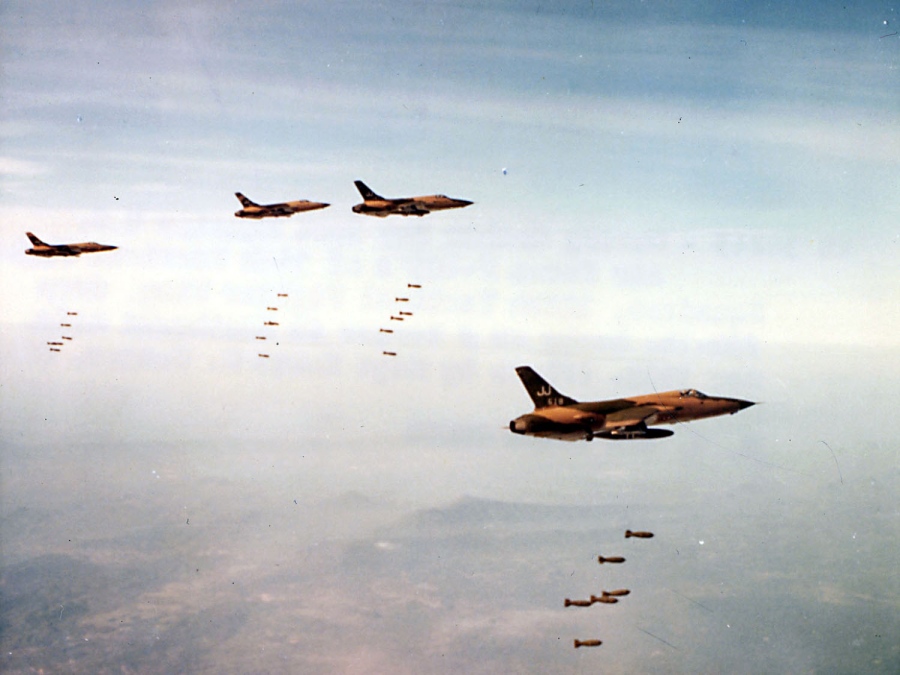
In early 1965, there were 22,000 US Special Forces advisers, pilots, and support personnel in South Vietnam assisting the Republic of South Vietnam in the war against the communist National Liberation Front insurgents aka Viet Cong (VC), and their backers in North Vietnam. The situation in South Vietnam steadily deteriorated over the previous two years and the chaos reached a crescendo in February 1965. The Army of the Republic of South Vietnam (ARVN) was recently defeated in two conventional battles against the VC and regular North Vietnamese Army (NVA). Also the civilian government of South Vietnam endured a successful coup by the ARVN Army Chief of Staff, Gen Nguyen Khanh and his Buddhist supporters, only to be immediately followed by another failed coup by communist sympathizers on the Armed Forces Council (The Vietnamese version of the Joint Chiefs of Staff). Furthermore, the South Vietnamese village pacification program was recognized as a complete failure in February. Additionally, Viet Cong terror bombings became increasing common in South Vietnam’s major cities. But the final straw was the attack on Pleiku Air Base which killed eight Americans, wounded 128 others and destroyed 20 aircraft in the first large scale attack directed solely at Americans.
In response to the chaos, on 2 March 1965, President Lyndon Johnson authorized Operation Rolling Thunder, a sustained bombing campaign against the Viet Cong’s supply routes aka the “Ho Chi Minh Trail”, and military and industrial targets inside North Vietnam. Rolling Thunder was a major escalation to the war. The operation was scheduled to last eight weeks; it would go on for three years.
In order to protect the Rolling Thunder airbases from further Pleiku style attacks, the Military Assistance Command – Vietnam commander, Gen. William Westmoreland, requested American ground combat troops. The first of these arrived on 8 March 1965 when two battalions of US Marines landed on the beach at Danang, where they assumed security of the US airbase there. They could have flown directly to the airbase, but Westmoreland thought it more dramatic for the cameras if they landed on the beach like their fathers did in the Pacific War.
95,000 more American troops followed over the course of 1965.
The Bridge at Remagen

In early March 1945, German forces in France and the Low Countries were flooding back across the Rhine with American forces in close pursuit. Hitler intended to use the swift, deep, and wide Rhine River as a moat to stop the Allies while he concentrated on defeating the Russians in the East. He ordered all of the bridges blown before they were captured by the Americans.
In early March 1945, all of the Rhine bridges were destroyed except one, the Ludendorff railroad bridge in the German town of Remagen. 75,000 much needed soldiers of the German 15th Army were still on the west side of the Rhine, and the US First Army was still 20 miles away, so the bridge was left standing to allow them to escape. On the morning of 7 March 1945, reconnaissance elements of TF Engeman of Combat Command B of the 9th Armored Division pushed to the Rhine River near Remagen in an attempt to find sites for a possible assault crossing in support of Field Marshal Montgomery’s Rhine crossing operation farther north.
When the scouts crested the ridge outside of town, they were surprised to see the bridge intact and thousands of civilians and soldiers attempting to cross into Germany. They called up the commander of their supporting tank company, LT Karl Timmerman. (All ground scouts eventually realize they need tanks to stay alive. That “snooping and pooping” shit in jeeps and armored cars only works in the movies. You ALWAYS end up fighting for good information)
LT Timmerman took one look at the bridge and ordered his scouts and tanks to attack. He radioed the situation to his commander and requested support. Within ten minutes, Timmerman’s company was attacking; within 20 minutes, TF Engeman; within the hour the rest of Combat Command B; and by the next: the entire 9th Armored Division. In less than two hours, 8,000 soldiers were assaulting Remagen. Before midnight, five divisions of the US First Army were converging on the Ludendorff Bridge, much to the consternation of Eisenhower and Montgomery’s planners. (Omar Bradley sarcastically asked Ike’s operations officer “What the hell do you want us to do, pull back and blow it up?”)
The Germans attempted to blow the bridge with Timmerman’s troopers on it but although some of the charges detonated, most didn’t. American artillery fire cut some wires, TF Engenan’s engineers hastily cut more as they crossed, and slave laborers sabotaged some of the explosives, which were industrial grade, and those that exploded were incapable of demolishing the bridge. Timmerman managed to get 120 troopers across by nightfall. The small bridgehead was very exposed but tank fire from across the river broke the only German counterattack that day.
As engineers tirelessly worked through the evening and night to repair the bridge enough for it to support the weight of the tanks, every soldier in Combat Command B who could hold a rifle crossed into Germany. At dawn on 8 March, there were 9 tanks and 800 soldiers on the east bank. By noon, the entire 9th Armored was across, and within 72 hours 25,000 men of six divisions were inside Germany.
Hitler belatedly threw everything the Germans had left at the bridgehead, including V2 rockets and what remained of the Luftwaffe, but to no avail. The attacks on the Ludendorff Bridge were the last gasp of the Luftwaffe. Most of the American air defense artillery was cannibalized to provide infantry replacements, but every remaining gun in the First Army protected the bridge. Of the hundreds of Luftwaffe sorties, only a single bomber managed to drop its payload near enough the bridge to do damage.
The Americans were across the Rhine in force and nothing could keep them from driving into the heart of Germany. When Stalin learned the Americans were across the Rhine, he authorized a resumption of the Soviet offensive. Stalin halted it along the Oder River in late January because he did not believe the Allies had the ability to force the Rhine and he refused to invade Germany proper alone. That was no longer the case on 7 March. From the moment the Americans crossed the bridge, Germany was doomed.
All because a 23 year old 1st Lieutenant decided to attack.
“Here I Am”
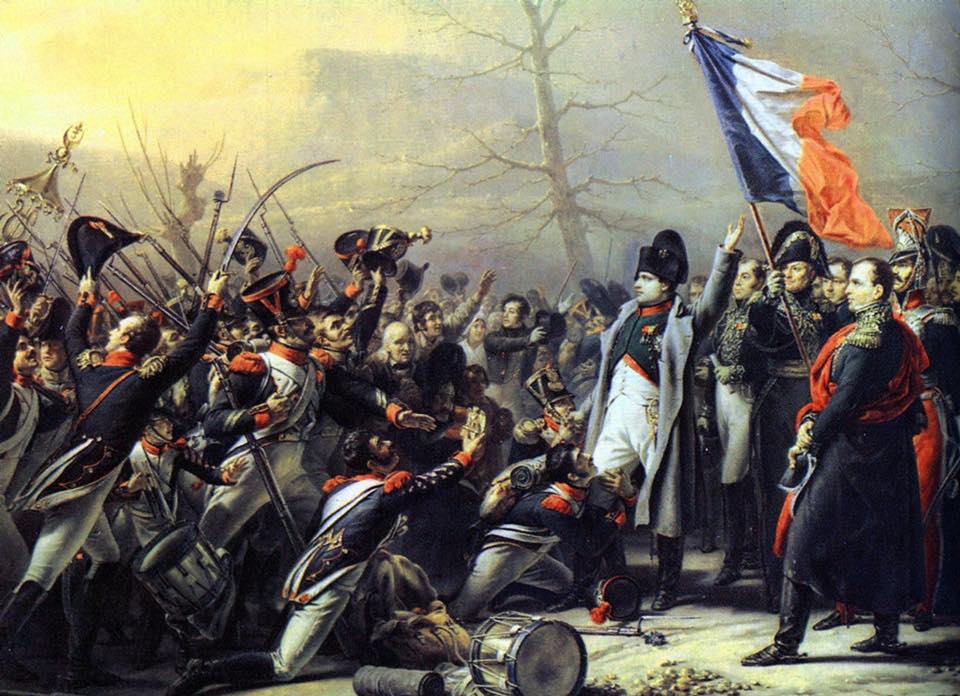
Napoleon landed in France on 1 March 1815 after escaping from his exile on Elba. He and his 1000 strong staff and honor guard took a circuitous route north through the French Alps to avoid the royalist sympathizers in the Riviera.
On 5 March 1815, the small army approached the pass at Laffra, just outside of the city of Grenoble. Directly to its front was the veteran 5th Infantry Regiment, six ranks deep, led by royalist officers, completely blocking the pass.
For five tense minutes, the regiment silently faced off against Napoleon’s troops. Then the ranks of the lancers and guards parted as Napoleon himself approached the 5th. One royalist officer gave the order to fire but none did. Napoleon moved closer. At 50 meters he stopped and said,
“Soldiers, I am your emperor. Know me! If there is one of you who would kill his Emperor, here I am”.
He then threw open his great greycoat and invited them to shoot.
The solders of the 5th abandoned their weapons and rushed Napoleon shouting ‘”Vive l’Empereur!”. They deserted the recently restored Bourbon monarchy en masse.
The event was stage managed to a degree. Staff officers and soldiers went forward the night before to let the 5th Infantry Regiment know what would happen if Napoleon was shot. It was an offer they neither could nor would refuse.
Two days later the 7th Regiment went over and soon Marshal Ney, Napoleon’s “Bravest of the Brave”, joined with an army of 6000. Thousands more flocked to the march every day. Though many were new recruits, many tens of thousands were former prisoners of war captured by Napoleon’s enemies over the past 20 years and recently repatriated back to France. King Louis XVIII and his court fled the country and Napoleon entered Paris on 20 March at the head of an army 100,000 strong.
Prepared and Loyal
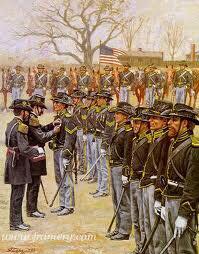
On 3 March 1855, the US Army constituted its fourth regiment of mounted troops.
After the Mexican War and the various Indian wars against the Fox, Kickapoo, Dakota, and Sauk American Indians, the US Congress recognized a need for more regular mounted soldiers on the frontier. At the time the US had three mounted regiments: the 1st and 2nd Mounted Dragoons and the 1st Mounted Rifles. On 3 March 1855, the US constituted a fourth mounted regiment, the 1st Cavalry Regiment at Jefferson Barracks, Missouri under the command of Colonel Edwin Voss Sumner to augment the other troops on the frontier. After they were organized and training completed, the 1st Cavalry Regiment maintained law and order in the Kansas Territory and protect settlers from Indian attacks.
After the attack on Ft Sumter in 1861, the troopers and officers of the 1st Cavalry Regiment parted ways to fight on their respective sides during the US Civil War. 27 of those troopers became general officers during the war, including George C McClellan, Jeb Stuart, and Robert E. Lee, the commander of the regiment at the outbreak of the war.
Two months later, the US Army’s mounted regiments were re-designated by seniority. The 1st and 2nd Mounted Dragoons became the 1st and 2nd Cavalry Regiments, the 1st Mounted Rifles became the 3rd Cavalry Regiment, and the 1st US Cavalry Regiment became the 4th United States Cavalry Regiment.
Prepared and Loyal!
Napoleon Escapes Elba
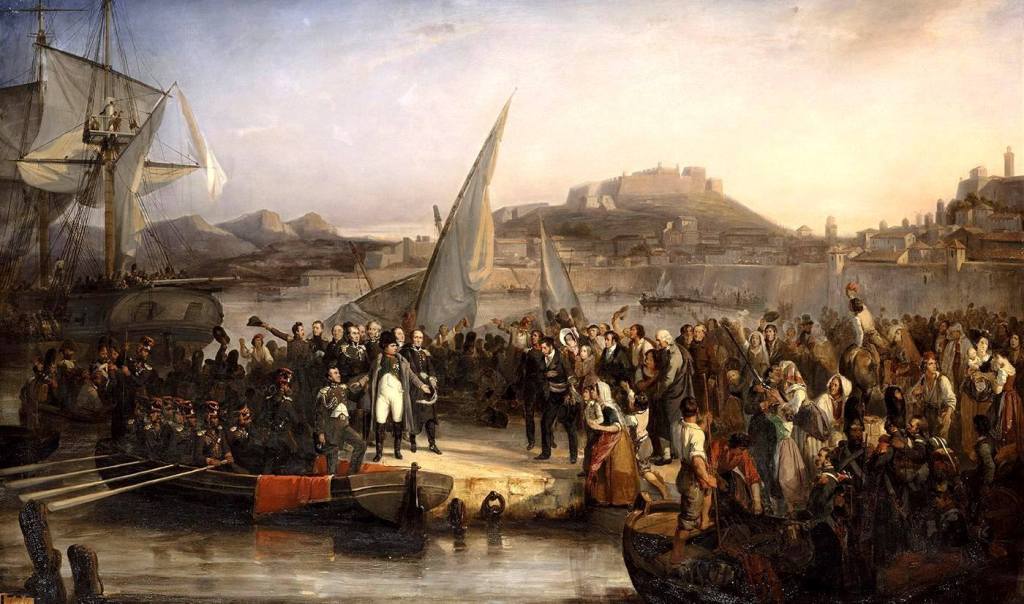
Napoleon went into exile after his defeat and abdication from the throne of France in 1814. In the ensuing nine months, the victors: Great Britain, Austria, Prussia, Russia, and Sweden, squabbled among each other and nearly went to war several times over the spoils of the French Empire. Furthermore, the restored Bourbon monarchy wasn’t paying Napoleon his stipend as per the Treaty of Fortainbleu and Elba simply wasn’t producing enough in taxes to maintain his household. In early 1815, with political chaos on the Continent and financial difficulties on Elba, Napoleon thought the time was ripe for his return to power.
On the night of 26 February 1815, Napoleon slipped away from his exile on the small Mediterranean island of Elba. He departed on the brig “Le Inconstant” and a small flotilla of ships with his staff and the 800 strong honor guard that he was allowed to keep on the island. His British minders on the island didn’t find out until two days later.
On 1 March Napoleon landed near Cannes on the French Riviera and marched on Paris, carefully avoiding Royalist strongholds particularly Provence, while simultaneously gathering troops along the way.
The Battle of Jena
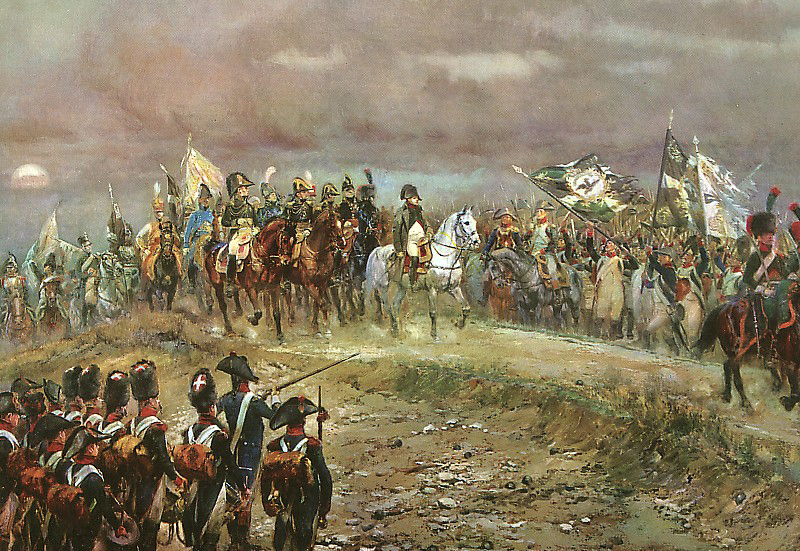
In 1805 during the War of the Third Coalition, Emperor Napoleon I decisively defeated the Austrians and Russians at the Battles of Ulm and Austerlitz resulting in the Treaty of Pressburg, which ended Austria’s participation in the war. Without Austrian protection, the Kingdom of Naples was vulnerable and a combined French, Swiss, Italian, and Polish Army of Italy under French Marshal Andre Massena invaded. The Anglo-Russian forces in Italy abandoned the Kingdom of Naples and the Neapolitan Army was crushed at the Battle of Campo Tenese. Bonapartist rule replaced Bourbon on the Italian peninsula until the end of the Napoleonic Wars.
With the end of the War of the Third Coalition, Napoleon turned his attention to creating a German buffer state between France and his traditional enemies, Austria, Prussia, and Russia. Napoleon created the Confederation of the Rhine of German states nominally part of the Holy Roman Empire. The Confederation states withdrew from the Holy Roman Empire and the French Empire formally became known as the “Protector of the Confederation of the Rhine.” Napoleon elevated the two largest, Bavaria and Wurttemberg, to vassal kingdoms within the French Empire and removed them as Electors of the Holy Roman Empire. Napoleon forced Austria, defeated and dejected, to dissolve the Holy Roman Empire, which had stood for a thousand years since its creation by Charlemagne in 800. The creation of the Confederation and the dissolution of the HRE were slaps to the face of the proud Prussians.
Napoleon overran Austria and defeated Russia so quickly that Prussia stayed neutral in the War of the Third Coalition. In recompense for their loss of influence with the dissolution of the HRE and loss of some territory to the Confederation, Napoleon gave the lands of former British ally Hannover to Prussia. In the summer of 1806, Napoleon was caught negotiating the return of Hannover to Great Britain without including Prussia in the negotiations. It was the final insult for the Prussian war faction, led by Queen Louise, and they convinced Kaiser Frederick Wilhelm III to mobilize the army. Not wanting to wait, the Duke of Brunswick convinced the king to attack the French cantonment areas before the French could invade, supported only by the army of the small Kingdom of Saxony. After the Prussian Army mobilized it moved into Saxony and the king issued an ultimatum to Napoleon to withdraw all French troops from the German states.
Napoleon’s Grande Armee was garrisoned in the Confederation of the Rhine. Napoleon refused the ultimatum, and the Prussians invaded. The armies of Prussia’s ally Russia were still far to the east, and unable to come to Prussia’s aid. Napoleon ordered his marshals to advance their corps into Saxony and Prussia immediately. The rapidity with which the French troops assembled from their garrisons and moved across the frontier into Saxony astonished the Prussians, who planned to fight the French in Bavaria and Württemberg, not Saxony or Prussia.
Napoleon’s corps were standardized, self-sufficient, combined arms formations of about 25,000 men consisting of infantry divisions, and cavalry and artillery brigades, with supporting specialists such as engineers, pontoon bridges, and supply trains, all under a trusted subordinate capable of independent command. These commanders were Napoleon’s chosen ones: the Marshals of France, and they were promoted strictly on merit and military efficacy. Generals could be political appointees or promoted because of birth, such as Napoleon’s brother Jerome, but never a marshal. The 26 men chosen over the years by Napoleon to be Marshals of France came from all walks of life, and were a collection of talent and ability rarely seen in history. Only the Diadochi, the Apostles, the Genghis Khan’s generals, the viziers of Suleiman, the Sun King’s advisors, and the Founding Fathers occupy the same historical pedestal. Napoleon trusted his marshals implicitly to carry out his mission orders and did not micromanage them with directives. With the self-sufficiency and inherent initiative of the corps system, and without the burden of a supply tail due to the French Army’s liberal use of foraging, the Marshals and their corps maneuvered much quicker and with more agility than France’s enemies.
Prussia, like the Russians and Austrians, still maintained the army-level unit, an unwieldy formation of about 100,000 men, as the lowest level of synchronization and integration between combined arms. The Prussian Army of 1806 was nearly the same army created by Frederick the Great sixty years before and they had been riding on that reputation ever since. As Carl von Clausewitz pointed out, “Behind the fine façade, all was mildewed.” King Frederick Wilhelm III himself commanded though he had the Duke of Brunswick make all of the tactical and operational decisions. The size of all of the King’s subordinate commands were based on their commander’s rank and noble title, with the cavalry’s disposition and composition based solely on its commander’s noble title. Through some misguided half-reforms, the Prussians created divisions but they had too much cavalry and artillery since their composition was based on the prestige of the commander. This over compensation i.e. more is better, made the divisions difficult to move, and diluted the striking power of the cavalry and artillery, thus the need for army level coordination. With no standardization in units above brigade, these commands were unwieldy and their movements ponderous and use of the road network inefficient. The Prussian staffs were overly bureaucratic, and riven by poisonous rivalries common in staffs accustomed only to garrison operations. There were two generals staffs, one established for decades that ran administration and the recently approved operational staff. Neither had priority over the other and saw each other as rivals. Both of the staffs worked at cross purposes. Senior commanders, most nearly twice the age of their French counterparts, spent much time untangling the mess, usually by committee since Brunswick wanted to stay above the fray. The result was a Prussian army more concerned about internal politics than fighting the French. In September 1806, the combined Prussian and Saxon armies advanced on the Thuringian Forest to invade the Confederation of the Rhine, but by then the French were prepared. The Prussian dithering cost them an entire month, which was more time than Napoleon needed to mobilize the Grande Armee.
Simultaneously with the Prussian invasion, Napoleon’s Grande Armee advanced into Saxony threatening Leipzig, and from there, Magdeburg, which would cut off Berlin. On three parallel routes, each of its seven corps moved north within a day’s march of each other over routes carefully reconnoitered by scouts. The seven corps advanced in a rough arrowhead with three corps on the middle road, two each on the east and west roads, and Napoleon and the Imperial Guard in the middle. Napoleon famously called it “a gigantic battalion box”. The Prussian Army was not capable of this feat of disciplined cohesive movement born of precise and efficient staff work. Several days into their march south, the Prussian Army was forced to concentrate on Erfurt for the final push into Bavaria. There, Brunswick learned of Napoleon’s nearby invasion of Saxony. Napoleon was pushing north to the east of the Prussians as the Prussians, to the west of the French, were passing the French while pushing south.
Brunswick hoped to threaten Napoleon’s flank and defeat him piecemeal as he passed, but the speed and agility of Napoleon’s corps left him out of position. The Grande Armee moved too quickly and any opportunity to attack passed. So Brunswick ponderously turned his army back north to find somewhere to defeat Napoleon, he had no choice but to fight. Through just good staff work, the French Army severed communication between Brunswick and his capitals, and more importantly, from any assistance from the Russians.
The first battles with Prussians at Auma, Schleitz and Saalfeld in early October 1806 were the first indications that the Prussians were to the west across the Saale River. The aggressive assault by the Prussian vanguard at Saalfeld by the unusually competent Prince Louis Ferdinand convinced Napoleon that the main Prussian Army was west of the Saale. On 13 October, Lannes’ V Corps made contact with a large Prussian force at Jena, which they forced back across the river. Napoleon, assuming Lannes found the Prussian main body, concentrated the Grande Armee. Napoleon’s seven corps quickly shifted toward the river crossings to seize and cross before the Prussians could defend them. Napoleon wanted to bring the Prussian Army to battle, but not force the river. If the Grande Armee moved quickly enough, it could catch the Prussians by surprise on the Landgrafenburg, the plateau west of Jena, which was where they had to camped. Napoleon, Soult, Augereau, and Ney, led by Lannes’ V corps crossed the Saale at Jena, while Davout supported by Bernadotte were to cross further downstream and fall on the Prussians from the north.
Jena was a university town and home of the German romanticists, and the home of the nascent unified German culture. The town was generally pro-Napoleon and saw La Grande Armee as the vanguard of the modernizing French Revolution come to rescue Germany from feudalism. The French sacked the town and accidentally burned it to the ground while foraging.
The Prussian Army had to be found. But before that could even happen, Napoleon’s corps needed to occupy the Landgrafenburg, the high plateau west of Jena to form a proper battle line. To get there, a perpendicular narrow ridge needed to be traversed by the French and this formed a natural choke point. On the morning of 14 October, 1806, Lannes already had a toehold on this ridge, which his men seized the night before. Neither this ridge nor Jena and its vital bridge over the Saale were defended by the nearby Prussian force under the Prince of Hohenlohe, nor were the French attacked while in this vulnerable position. These failures were even more unconscionable since the Prussians knew the French were in Jena the night before. Unhindered, Lannes’ scaled the ridge and formed a battle line on the Landgrafenburg.
The fog on the morning of 14 October 1806 was all pervasive. Lannes’ light infantry and cavalry scouted further west and found Prussian troops of von Tauentzien’s reinforced flank guard division. Lannes immediately attacked and destroyed von Tauentzien’s divison which fled west, while a detachement under Holtzendorff retreated north. Lannes succeeded in making room for the four more corps and the Imperial Guard coming up behind him.
The French attack came as a surprise to Hohenlohe. One of his subordinates, Gen-Lt Gravert marched his division to the sound of the guns but was halted by Hohenlohe and chastised. Hohenlohe, from his headquarters in the Kappelburg Castle, was not prepared to fight a major engagement yet and his staff had not prepared the necessary orders. Gravert convinced Hohenlohe that he was in a battle whether he liked it or not. The Prussians deployed in a battle line opposite the town of Vierzehnheilegen which they thought (correctly) was between Napoleon and themselves.
After the destruction of the flank Prussian division, Napoleon also halted his attack. He knew the rest of the Prussian Army was to the west of him but not where – the fog was too thick. As Augereau’s VII Corps arrived to the left of Lannes and Soult’s IV Corps to the right, Napoleon ordered forward his light infantry and cavalry to find the Prussians while the rest of the army waited in the fog. Napoleon’s light infantry occupied the town of Verzehnheilegen and watched Hohenlohe’s columns ponderously turn into a line facing the town.
(I honestly can’t adequately convey the complexity of this Prussian maneuver. The training time to execute this parade ground drill on command must have been massive. It’s a combination of column right by file from the left into a right facing line. Whereas the French did a simple “right flank, march”, the Prussian method maintained that the first file (on the left) must always be the file facing the enemy, thus the complicated drill when the enemy was on the right.)
Hohenlohe’s orders from Brunswick were to not become decisively engaged as his mission was to screen the flank of the main army 30 km away. Brunswick headed north on a parallel route to Napoleon to find another position to fight the French. When Napoleon agilely crossed the Saale at Jena, he thought that the main army was to the west or, optimistically, the Prussian left flank guard. The destruction of Tauentzien’s division and Holtzendorff’s cavalry earlier in the morning lent credence to this theory. But Hohenlohe wasn’t the vanguard or even the left flank guard, but the right flank guard, with the main Prussian army 30 kms away marching north, not south. Moreover, they were marching on roads they just passed over a few days previously going in the opposite direction. The closest Prussian units to Hohenlohe wasn’t the main body but the Prussian reserve bringing up the rear of the main army. Hohenlohe wasn’t going to attack the French, but he wasn’t going to run away either, thanks to Gravert. Unfortunately for Hohenlohe, the Prussian main body was marching further away every minute.
The first indications that the French were nearby since the firing stopped were Tauentzien’s routed formations streaming through the line. The broken men did little for the morale of Hohenlohe’s battle line but iron Prussian discipline held the men in formation. Hohenlohe advanced the formation forward until they came within sight of Versehnheilegen. Astonishingly, the French light infantry, or voltigeurs, spread out in the meadows just outside of the town. Unlike the Prussian line infantry, or French line infantry in close formation, the French light infantry used all of the cover and concealment that the town and gently rolling fields offered. Every copse of trees, every fold of ground, every orchard tree, every hedge, wall, building, and window hid voltigeurs, who weren’t going to stand and receive the disciplined Prussian volleys.
The Prussians had no effective counter as the concept of light infantry was practically alien to them. They understood the need for open order skirmishers but unlike the French, the Prussians light troops were trained in highly ritualized and rigid open order formations, which were almost never used. Open order troops were seen as diluting the decisive firepower of the line. The initiative and trust needed by a light infantryman was an anathema to the harsh and rigid discipline required by the line. To Prussian officers in 1806, placing that much trust in infantry in open formation was tantamount to obliging them the opportunity to desert. The Prussians did form a “jaeger” regiment armed with rifles who were trained to fight in open order, but they were considered an elite, and recruited from the upper and professional classes. Their loyalty was never suspect, but there was only a single regiment of them in the entire Prussian Army of 1806. In the Grande Armee, there was one specially trained voltigeur company per regiment, but all French infantry were expected to competently perform in any formation, whether column, line, line, or square, or open or closed. Revolutionary fervor, meritocratic officers, and the daily realities of foraging ensured that French infantry operating in an open formation would not desert, at least in 1806. Napoleon said later that La Grande Armee of 1806 was his finest.
The French voltigeurs took a terrible toll on the Prussian line, particularly the officers. Hohenlohe formed a vanguard to clear the menace, and hearing them being shot to pieces, pushed artillery forward to sweep the fields and town with canister. The Prussian infantry could nothing but impotently fire ineffectual volleys to their front, as the voltigeurs aimed and shot at a mass that they couldn’t miss.
By 11 am, both the literal and figurative fog of war crippled both sides ability to understand what was happening. Hohenlohe, with orders not to become decisively engaged, knew he had lost a division, but only had light infantry to his front and no idea where the French main body was, or even if it was nearby. With less than 30,000 men under his command, he needed to be sure what was in front of him, lest he be flanked and destroyed. Napoleon had three full corps coming on line, Soult, Lannes, and Augeraeau, the Imperial Guard (corps equivalent) in reserve with Murat’s cavalry corps and Ney’s corps moving into position. Nevertheless, the fog prevented Napoleon and his commanders from understanding what they faced. The integral corps cavalry was desperately groping about in the fog trying to find more Prussian infantry than the 30,000 or so opposite Vierzehnheilegen. Lannes, in the center, attempted to shake things up around the town by probing the Prussian line, but was repulsed. In the fog, Napoleon couldn’t commit his now 96,000 man army until he knew where the Prussian main body was. He assumed it was close, not marching north away from Jena.
The Battle of Jena was at an impasse. The late autumn Central European fog, which didn’t seem to dissipate in the midday sun, gave the battlefield an otherworldly glow. In the bright fog, Napoleon couldn’t attack until he found the Prussian main body and Hohenlohe couldn’t attack because he wasn’t the Prussian main body. The Grande Armee continued to arrive.
Ney’s VI Corps was the Grande Armee’s rear guard and the last to arrive at Jena. Augereau was shifting to face the Saxon division idling at Innerstedt on Hohenlohe’s far right. The situation in front of Vierzehnheilegen was chaotic but the Saxons were a tangible threat. Augereau didn’t know that the Saxons didn’t have the propensity move. They weren’t in the best of spirits, their supply lines were cut with Leipzig and the Prussian supply trains were in administrative chaos. The Saxons were last in priority. In accordance with the gentlemanly rules of 18th century limited warfare, the Saxons and Prussians were forbidden to forage. Some of the Saxon regiments hadn’t eaten in two days. They were content to hold Innerstedt and allow Augereau to build up to their front.
Marshal Ney arrived with his advanced guard and cavalry ahead of his main body about 10 am, leaving his infantry to come up as fast as they could. He was seething to get into battle. Napoleon told him to place his corps to the right of Lannes in the gap with Soult. But Lannes and Soult were already in contact, Napoleon just couldn’t tell in the fog. So Ney rode over the battlefield looking for a place for his corps, he found one in the gap between Augereau and Lannes south of Vierzehnheilegen. Without telling Napoleon, he rode directly for the ground he unilaterally decided his corps was to occupy.
The fog induced stalemate would shortly end at the hands of Napoleon’s fiery red headed marshal.
As Augereau shifted, the impetuous Ney took his cavalry forward and immediately got mixed up in the light infantry fight in front of the town. Most of his corps was still marching through Jena, while his cavalry was cutting and slashing its way through the fog. One chasseur squadron broke a Prussian cavalry squadron covering several batteries of artillery firing on the town, and then turned the guns on the Prussian line. The Prussian line was ordered to fire on the cavalrymen, the disorganized Prussian cavalry and the French cavalry looked similar in the fog, and many Prussians refused to fire. They had standing orders to fire on any Prussian “deserters” but the French cavalry that looked like Prussians weren’t deserting, and the retreating Prussians weren’t obviously deserting. No one could tell where the artillery was coming from, whether their own captured guns, or French guns in the distance. And all of that with the simple reality that death could emerge from the mist at any time, and regularly did so to their comrades all around them. The situation was massively confusing for Prussians.
The confusion caused by Ney’s aggressive “reconnaissance” of his self appointed position in the line had two major effects. First, the entirety of the Prussian cavalry was neutralized. To avoid further confusion, Hohenlohe moved his squadrons into the line, as if they were infantry. The cavalry was ill-suited to the task of static defense, but were easily controlled, extended his line further, and could be used to clear light infantry when the Prussian line advanced. Ney’s provocation convinced Hohenlohe he had to stabilize the Vierzehnheilegen situation or he wouldn’t have any officers left. The Prussian Army was uniquely dependent on officers to control the men. Hohenlohe realized the need to act or the situation would spiral out of control and his command would be destroyed in the fog by light infantry and cavalry. He decided to attack. He ordered his cannon to fire incendiaries on the town to prevent the French from turning each building into a stronghold. And once the town was in a significant conflagration, he ordered his command to advance and clear everything to their front.
The order to advance was welcomed by the Prussian line. For two hours they impotently fired ineffectual volley after ineffectual volley into the mist toward the town to no noticeable effect on French fire. The flames in the village and the Prussian advance forced the French light infantry and cavalry to withdraw and an eerie calm descended on the battlefield. It wouldn’t last.
The first reports of the Prussian advance flowed up the Dornberg Heights to a relieved Napoleon who spent the last several hours anxiously scanning the horizon for a glimpse of the Prussian main body. The Prussians wouldn’t advance without the main body, or so Napoleon’s believed. Not wanting to hand the Prussians the initiative, he ordered all of his corps to attack.
Nearly 50,000 Frenchmen crashed into 30,000 Prussians and Saxons in the fog. Ney with his vanguard and cavalry were briefly cut off. It was neither the first time nor the last time Ney would be surrounded; he formed a square and waited out the Prussian attack, fully confident that Napoleon would soon attack and save him. Ney’s faith in Napoleon was well founded.
The French and Prussian attacks devolved into a long firefight as neither side had the mass of men to break each other’s lines. Both Napoleon and Hohenlohe were waiting on more men to arrive on the battlefield. Napoleon’s arrived first. The bulk of Soult’s Corps and entirety of Ney’s infantry divisions arrived with Murat’s cavalry close behind. The Prussian reserves were still on the road from Weimar, miles away. The influx of men gave Napoleon another 50,000 troops to push into the attack. He ordered all commanders forward, and all reserves forward but the Imperial Guard.
The standard three deep line, three lines deep Prussian closed line formation could fire at most two rounds before the massed French columns, some battalions 20 men deep, were upon them. Moreover, the French line overextended the Prussian. Soult in the north on the French right quickly routed those to his front. He was struck in the flank by the remains of Holtzensdorff’s force that Lannes defeated earlier, but a timely charge by his light cavalry routed them again. Instead of pursuing the twice defeated Holtzendorff, Soult turned towards Vierzehnheilegen to envelope Hohenlohe’s attack.
In the center, Napoleon, ever the artilleryman, personally commanded the grand battery that blasted massive holes in the astonished Prussians. Augereau ground down the Saxon division at Innerstedt to his front. Lannes pushed forward and retook Vierzehnheilegen. The Prussian infantrymen, and their Saxon little brothers, retired with discipline when they could, and their famed reloading drill caused quite a bit of damage. Though outdated, Prussian tactics and harsh discipline could still show its best in the defense. But faced with overwhelming numbers and firepower, the Prussian line had no choice but to give way. Sensing weakness, Murat ordered his recently arrived heavy cavalry into the attack. The Prussian and Saxon lines broke.
Advancing west, the French juggernaut was stopped briefly at Gross Romstedt by the 15,000 strong Prussian reserve under General Ernst Ruechel which was slowly on its way from Weimar at the request of Hohenlohe. A Prussian’s Prussian, Ruechel chose to attack the massive force to his front. Lannes quickly brought up his cannon and shot massive holes in Ruechel’s lines as his and Soult’s infantry flanked flowed around them. When Ruechel attempted to withdraw, Lannes’ eager light cavalry turned it into a rout.
About this time, Napoleon finally realized that he hadn’t faced the Prussian main body under the Duke of Brunswick, but just Hohenlohe’s strong detachment.
The Duke of Brunswick was 30 kilometers away, in the midst of his own battle, where he outnumbered his French opponent nearly three to one.
The Battle of Abu Klea

In 1881, the Sudan was a protectorate of Egypt, which was an autonomous province of the Ottoman Empire. Citing oppression by “their Turkish overlords”, the Muslim imam Mohammad Ahmad declared himself the “Mahdi” or “Guided One” (The Mahdi is the Islamic term for the messianic herald or redeemer. In Christian terms, he would be John the Baptist. Today, Muqtada al-Sadr in Iraq considers himself the Mahdi) and declares Jihad against the Egyptian-Turkish administration of the country. Ahmad’s Mahdism, was a very strict, literal, and fanatical version of Islam that had fallen out of favor in Islamic lands since the height of the Ottoman Empire and the failure to capture Vienna two hundred years before.
As the Mahdists grew in strength, they defeated every army sent by the Egyptians to put down the revolt. With no support from Istanbul, the Egyptians increasingly fell under British influence. Exasperated, the Egyptians decided to let the Mahdists have the Sudan and asked for British assistance extracting their garrisons. The British government sent the popular, competent and aggressive General Charles “Chinese” Gordan (he made a name for himself in the Opium Wars in China). Gordan captured Khartoum in March 1884, but he recognized the danger of Ahmad’s radical version of Islam and determined to force the Mahdists to battle.
Ahmad immediately surrounded Gordan’s 8000 British and Egyptian troops, and besieged Khartoum. Gordan planned to use the relief column as the hammer to his anvil to destroy the Mahdists. However, the British government refused for six months to send a relief column and only did so at Queen Victoria’s insistence. In January of 1885, Sir Herbert Stewart’s Desert Column of mostly camel bound troops, entered the Sudan.
The Mahdi sent his own column to intercept and on 16 January 1885 they met at the oasis at Abu Klea. Stewart’s 1400 soldiers, eight cannon and one machine gun formed a square, and the Ahmad’s 13,000 warriors attacked. With the development of the rifle and horse artillery, most Western armies had abandoned the square formation, but Britain continued to use it because of its effectiveness against indigenous armies. (Six years before, the Zulus, easily the best indigenous army in Africa, accomplished the rare feat of breaking a British square at Isandlwana, but they had 4000 killed in the process, and did so only after the British ran out of ammunition.)
The “dervishes” as the British mistakenly called them, couldn’t withstand the massed firepower of the square, even after the machine gun jammed due to sand. The Mahdists took over a thousand killed and wounded, and the Battle of Abu Klea was over in fifteen minutes. Stewart had less than 200 casualties.
Unfortunately, Stewart was too late to relieve Khartoum. On 25 January, the Mahdists stormed the city, and Gordan’s troops, weakened by disease and starvation were overrun. Gordan and all 8000 of his British and Egyptian soldiers were massacred, along with 4000 residents of the city. Many thousands more were sold into slavery. Stewart’s Desert Column arrived just two days later on 27 January, and seeing that the city fell, quickly returned to Egypt.
Ahmad ruled Sudan as a fundamentalist Islamic state for the next 13 years. Although the Mahdists only ruled Sudan for a short time, it proved an incubator for radical Islam, particularly the aggressive and expansionist Wahhabist sect. The Mahdists would provide inspiration to a young Wahhabi, Abdul Aziz bin Saud, the founder of the Kingdom of Saudi Arabia in 1902.
 Buk's Historical Ad Hockery
You must be logged in to post a comment.