
Category: History
Jack Cade’s Rebellion
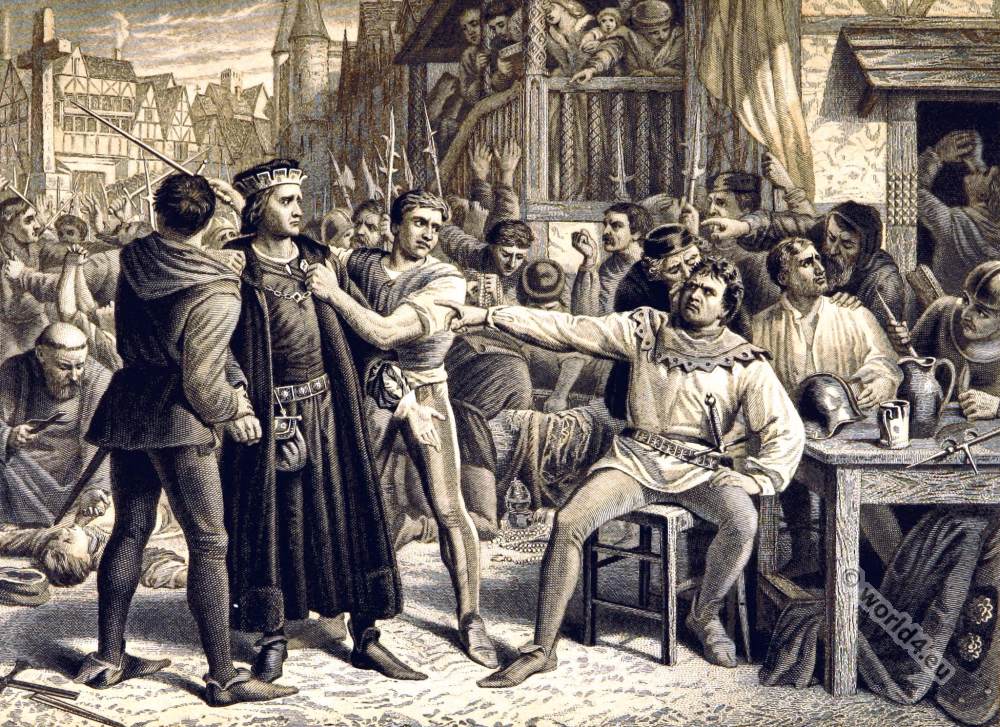
England’s loss of Normandy after their defeat at the Battle of Formigny against France in April 1450 during the Hundred Years War crushed the morale of the English people. England’s impending loss in the war unleashed French and Norman raiders on English coasts. However to the people of Kent and Sussex, their enemies across the English Channel were the least of their worries.
Corruption in Lancastrian King Henry VI’s court was already legendary, but the loss at Formigny exposed the corruption and incompetence for all to see. There was no longer a war to hide behind. Nobles long used to abusing their Norman and French charges, returned to England and thought they could do the same with their own countrymen. The actions of the soldiers sent by the King to protect the coastal communities from the Norman raiders greatly exacerbated the situation. The cure was worse than the disease. The soldiers looted, raped, and devastated the towns and farms they were sent to defend. Sheriffs and magistrates, King’s men who held their offices through fraudulent elections, sided with the soldiers against the people. The final straw was the death of the Duke of Suffolk.
The Duke of Suffolk was the King’s best friend and closest advisor. Some say he ruled England while the mentally infirm Henry was just a puppet. The Duke was the most corrupt of king’s privy council, all of whom were the most corrupt men in England. His murder was part of the vicious, bitter, and petty internecine squabbles that wracked Henry VI’s court. The Duke of Suffolk’s body washed up on the shore of Kent and the people immediately assumed the King would blame them. Rumors abounded that the Royal Army would march across the countryside with fire and sword expelling the people and turning the entirety of Kent into the King’s personal hunting preserve.
On 8 May 1450, a man named Jack Cade proclaimed himself “Captain of Kent” and vowed to make the people’s demands heard by the king. He declared himself a “Mortimer”, which was the name of Henry VI’s Yorkist rivals. He wrote up a list of complaints and demands, “The Complaint of the Poor Commons of Kent”, outlining the King’s transgressions against the people of Kent. The first point was a declaration of innocence for the Duke of Suffolk’s murder. The remainder of the Complaint detailed the rampant corruption of the King’s men, including unfair taxation, extortion, “perversion of justice”, ruination of the economy, and election fraud. Cade called for an army to give the demands the force of arms. 5000 beggars, shopkeepers, artisans, peasants, destitute soldiers, and outlawed knights and nobles responded.
Initially, the King didn’t take the uprising seriously. He dispatched a small force of knights and men at arms to put it down, but they were ambushed and destroyed in June. Shortly thereafter, the King’s attitude changed when his personal confessor, the Bishop of Salisbury, was tortured and killed by a Kentish mob, as Jack Cade and his army marched on London. The Bishop of Salisbury was the second most powerful man in England, since he knew all of the King’s dirty secrets, and there was no telling what he told rebels. King Henry VI and his court fled London.
Jack Cade struck the London Stone, declared himself the mayor, and set about finding King’s men to try and punish. Cade’s rebels and the people of London existed harmoniously for but a few days. Cade couldn’t keep control of his men. Despite assurances that the rebel army would respect the people of London and their property, Cade’s men began to get drunk and loot. The Londoners understood the behavior of the king’s men better than most, but lost their sympathy for the rebels quickly. On 8 July 1450, the Londoners marched across the London Bridge determined to storm the White Hart Inn where Cade lived and oversaw his tribunals. Cade’s men met them half way. The bloody Battle of London Bridge saw the defeat of Cade’s rebels, and they retreated from London.
Despite the rebel loss, the next day the Lord Chancellor convinced the King to issue pardons and accede to the rebel’s demands in The Complaint of the Poor Commons of Kent. The King did so and the remainder of Cade’s army dispersed. King Henry VI revoked the pardons almost immediately. His men hunted down Cade and the rebels now that they were no longer an army. The King’s men were largely successful. On 12 July, Cade was wounded fighting his pursuers, and died before he could be brought to trial. Henry didn’t care though: he gave the body a mock trial in which Cade was found guilty. Cade’s body was then hung, drawn, quartered, and beheaded, with the parts displayed publically all over Kent until they fully decomposed.
Cade’s Rebellion was unsuccessful but the king’s duplicitous behavior inspired numerous smaller uprisings across England. Worse, the king’s double cross confirmed to his rivals that there was no negotiating with him. If there was any justice in England, it was not going to come from king and his lackeys. Support for the king evaporated in the countryside. The wronged people of England began looking for a new monarch to support, and they found one in the Lancaster’s bitterest rival, the banished House of York. A few weeks after Cade’s Rebellion, Richard of York returned from his exile in Ireland. In 1455, Richard’s White Rose of York was in open rebellion against the Red Rose of Henry VI’s House of Lancaster, in what later became known as The War of the Roses.
Germany Surrenders to the Allies
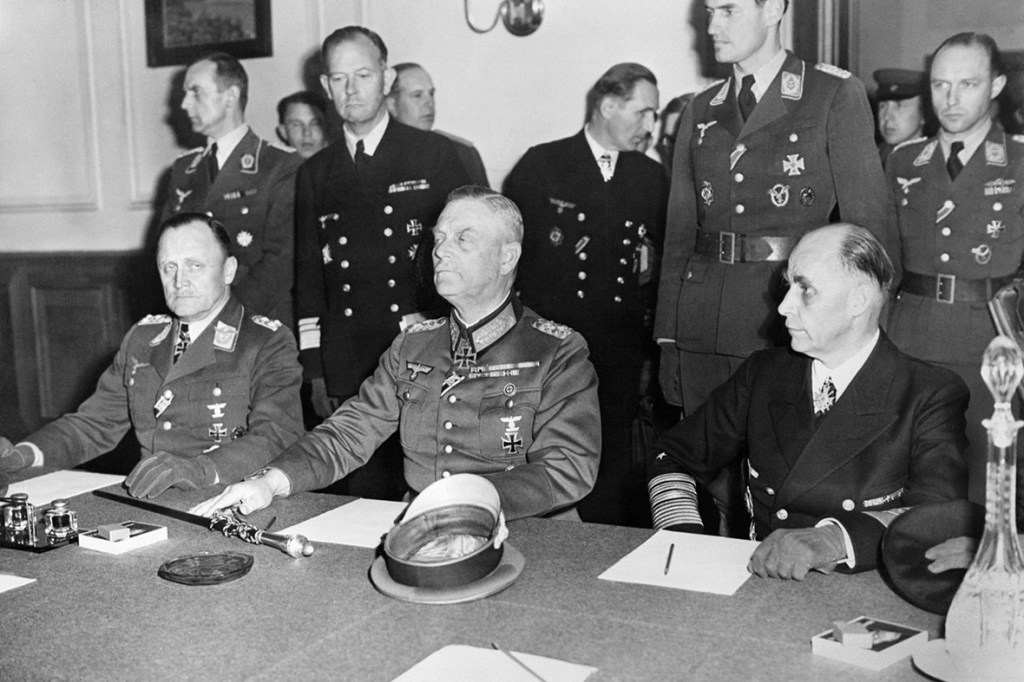
Before Hitler committed suicide on 30 April 1945, he appointed Grand Admiral Karl Dönitz his successor as National Socialist Germany’s head of state. On 2 May, Dönitz sent Admiral Hans-Georg von Friedeburg to Field Marshal Montgomery’s headquarters to negotiate the surrender of the three German armies still fighting the Soviets in northern Germany. Montgomery, unwilling to offend the Russians, said the Germans had to surrender to the Soviets. The only other option was if all German forces in Northern Germany and Denmark surrendered to him. If that happened, the capitulation would look like a tactical surrender to Monty’s 21st Army, which shouldn’t upset the Soviets. Friedeburg said he didn’t have the authority to surrender everyone Monty demanded, but he’d ask. He returned the next day and acquiesced. 1,000,000 German troops surrendered to Monty. After the details were worked out, Friedeburg asked for passage to negotiate directly with Eisenhower for the surrender of all German forces facing the Western Allies.
Bad weather kept Freideburg from flying directly to SHAEF headquarters at Reims, France, but he eventually arrived on 5 May. Eisenhower told Friedeburg to pound sand. There would be no conditions on the German surrender. There would be no partial surrenders, either he negotiates the surrender of all German forces, including those facing the Soviets to the Soviets, or none at all. Eisenhower’s chief of staff LtGen Bedell “Beetle” Smith showed Friedeburg the situation maps confirming Germany’s hopeless position, including a fake one with arrows continuing the Allied drive east, deep into Czechoslovakia and the Balkans. With tears in his eyes, Friedeburg again professed that he didn’t have the authority. He cabled Dönitz for additional instructions.
The next day, the SHAEF staff wrestled with itself trying to create the surrender documents. There were several competing versions. The first was by the European Advisory Commission, signed in the summer of 1944 and approved by all of the Allies and the Soviets. But there was also a Yalta Conference version that wasn’t officially approved by all parties, specifically France. And everyone knew how touchy DeGaulle was. He could ruin the whole thing, maybe even restart the war just out of pride. Smith compromised – he created a new one.
The Stars and Stripes newspaper recently published the Italian surrender document in its entirety. Smith used the wording of the Italian document, which the French had approved, and inserted “Germany” where “Italy” had been. One of his staff officers updated it. At the hysterical urging of the US Embassy in London, he inserted an “enabling” clause at the last second, stating that the Allies can add conditions in the future as needed. The final version was still being translated when a new German negotiator finally arrived that evening.
General Alfred Jodl was the OKW operations chief, and only departed for Reims after his own awards ceremony in which Dönitz awarded him a Knight’s Cross of the Iron Cross. After Friedeberg’s message, Dönitz felt that Jodl, a member of Wehrmacht, might convince Eisenhower to accept the surrender of just the German forces facing the Western Allies. Or maybe even convince Eisenhower to join the Germans in fighting the Soviets, for the sake of the German population. The Soviets were raping and looting their way across Germany, and “You’ll have to fight them eventually”, as Jodl stated matter-of-factly.
Eisenhower angrily reiterated unconditional surrender. Jodl, now fully aware that it was all or nothing, began to stall. Eisenhower told him he had 48 hours to sign the freshly produced surrender documents, or he was going to close his lines to any Germans, military or civilian, and force them to surrender to the Soviets. Jodl, aghast, said he didn’t have the authority. Eisenhower just looked at him and said the clock was ticking. Jodl quickly cabled Dönitz, and just after midnight, received permission to sign the documents.
At 2:40 am on 7 May 1945, General Alfred Jodl signed the capitulation of Nazi Germany. The surrender ceremony took just ten minutes. No one said a word, and Eisenhower didn’t even attend. When Jodl finished signing, he asked that the victors treat Germany with generosity. Smith took Jodl to Eisenhower’s office. Ike asked if he understood what he did and that he was personally responsible. Jodl nodded, saluted, and left.
Ike and Smith broke out a bottle of champagne. Ike told the staff to quickly compose a suitable message to send to London, Paris, Moscow, and Washington DC informing them of Germany’s surrender. Every staff officer in the building wanted a piece of the message, and each version was longer and more grandiose than the last. Ike took out a piece a paper, wrote a single line and told Smith to have it sent. It said,
“The mission of this Allied force was fulfilled at 0241, local time, May 7, 1945, Eisenhower.”
The RMS Lusitania

In 1915, the British Royal Navy’s blockade of Germany began to have an effect. In response, the Germans attempted to blockade the British Isles with submarines. Previously, German U Boats would surface, stop a target ship, board it, search it, and if it was carrying war materials, allow the crew and passengers to abandon ship. This was known as “Prize Rules” or “Cruiser Rules”. However in the spring of 1915, Germany dropped the traditional Prize Rules, and began unrestricted submarine warfare. U Boat captains no longer had to warn or search their targets beforehand. They could just approach stealthily and fore a torpedo. Furthermore, neutral ships were no longer off limits. Any ships near the British Isles were fair game.
In early May 1915, the passenger liner RMS Lusitania was on her way from New York to Liverpool with 1,952 civilian passengers on board, including 197 Americans, and was secretly transporting munitions for the British war effort. However, her captain, William Turner, did not believe the U Boat threat was serious. The Lusitania didn’t need any escorts because she was fast enough to outrun any U boats, but Turner had only three of his four boiler rooms working to save coal which reduced his speed. He also didn’t zig zag because he felt it was a waste of time. Finally, he neither checked reports of recent U Boat activity in his area, nor avoided their traditional hunting grounds. The stage was set for a disaster.
On the morning of 7 May, U-20 commanded by Kapitanleutnant Walter Schweiger spotted the Lusitania off of the coast of Ireland. He fired a single torpedo which struck the Lusitania’s starboard side. The Lusitania sank in just eighteen minutes and 1198 passengers died, including 128 Americans. It was the second largest loss of life at sea up to that time, behind only the Titanic which struck an iceberg three years before.
In 1915, America was not participating in the Great War and had no plans to. The prevailing mood among Americans was that this war was no different than the many small continental wars that occurred over the last 50 years in Europe, like the Franco-Prussian War of 1870. Furthermore, the largest immigrant group in America at the time was German, and although slim, there was still the possibility that America would join the Great War on the side of Germany. More likely though, their immense political pull would keep America out of the war altogether. They left Germany to escape the continental feuding not get involved in it. The sinking of the Lusitania changed all of that.
International opinion, particularly American opinion, turned irrevocably against Germany after the Lusitania was sunk. Unrestricted submarine warfare kept the Great War on the front pages of American newspapers. As long as Germany continued unrestricted submarine warfare, it was not a matter of if America would join the war, but when.
(I Can’t Get No) Satisfaction
In the mid-1960s, the “Baby Boomer” generation was coming of age and like all teenagers and early 20-somethings, they didn’t understand their parents and the greater world around them. They grew up in the fifties which was an age of unparalleled peace and prosperity in the Western world. This was particularly true in the US which was spared the worst of the death and devastation caused by the Second World War. They didn’t grow up during the Great Depression, and they didn’t have to make the extraordinary sacrifices required by the Second World War. So unlike their parents they were not satisfied (see what I did there) with the orderly two bedroom, one car, 2.5 kids, baseball diamond, soda shop, 9-5 existence that their “square” parents were perfectly OK with. Teenagers found an outlet for their rebelliousness in Rock and Roll.
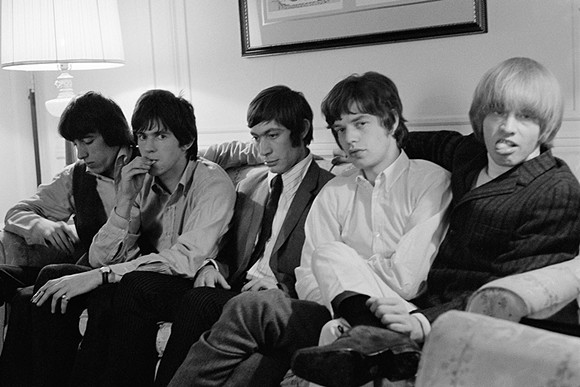
The Rolling Stones was a blues rock band from London who had been riding the British Invasion wave in America behind the Beatles, the Animals, and the Kinks, among others. The Stones’ problem was that most of their songs were old blues tunes sped up and given their own distinctive twist. Rolling Stones’ manager Andrew Loog Oldham recognized singer Mick Jagger’s and lead guitarist Keith Richard’s untapped songwriting talent and creativity, but they were getting too comfortable with the status quo. In the summer of 1964, Oldham realized they were going to run out of old blues covers, and he needed to force the band to write their own music. So he locked them up in a hotel room, and wouldn’t let them out until they wrote a song. In that tiny, hot, and sweaty hotel room, Jagger and Richards wrote “As Time Goes By”. Oldham, a Casablanca fan, had them change the name to “As Tears Go By”. Since it was a ballad, something the Stones weren’t known for, Oldham had their friend Marianne Faithful record it and it peaked at No 6 on the UK charts. The Jagger/Richards songwriting duo had its first of many hits.
However, by early 1965 the Rolling Stones still hadn’t had an international breakout hit, despite the genius of the Jagger/Richards songwriting team. In May, they were on their third North American tour and their popularity was waning. It looked like the Stones were just another British Invasion band riding on the Beatles’ coattails, just another flash in the pan.
After a rowdy concert in Clearwater, Florida on 5 May 1965, Richards climbed into his hotel room bed. When he woke up the next morning, he noticed that his acoustic guitar was on the floor, and the tape recorder that he kept next to his bed, so he could immediately capture inspiration, was full. He replayed the recording, and it contained two minutes of a guitar riff and 43 minutes of his snoring. He didn’t remember playing the riff.
After some shopping, Richards took the recording to Jagger’s room, and he thought the riff would be great for some horns. Jagger and Richards spent the rest of the day writing a song around the riff. Jagger wrote lyrics poolside. While shopping, Richards had bought a Gibson Fuzzbox, which made an electric guitar sound vaguely like a saxophone. Richards incorporated the Fuzzbox in place of the horns. Later that day they got the band together with Richards playing the opening riff with the Gibson Fuzzbox in place of a saxophone. An acoustic guitar part for him was to be added later. Oldham heard the song, which Jagger named “Satisfaction”, and thought they were on to something. Ever one to strike while the iron was hot, Oldham booked flights to Chicago for their upcoming break in touring.
On 10 May 1965, at the famous Chess Records, the Rolling Stones recorded Satisfaction with Richards still playing the saxophone parts with the Gibson Fuzzbox. The band liked the version, but Oldham loved it. He demanded they release it immediately, as is. Jagger and Richards, as the writers, had the final say and declined: Jagger still wanted horns and Richards wanted an acoustic version more in line with what he found on the tape player. Oldham convinced them that since they were in America, everyone in the room should put it to a vote. Jagger and Richards reluctantly agreed and both voted “Nay”. The rest of the band, Oldham, and the sound engineer all voted “Aye”. Jagger and Richards lost, but stood by their promise. Satisfaction was to be released as soon as possible in its then current form.
Two days later, at Richard’s request, the Rolling Stones re-recorded Satisfaction in California using a Maestro FZ-1 Fuzz-Tone in place of the Gibson Fuzzbox. But by then there was no more talk of acoustic versions or horns.
On 6 June 1965, the Rolling Stones released “Satisfaction” as a single. It shot straight to the top of the charts, and stayed in the top ten an unprecedented three months. The version recorded on 12 May 1965 is the one we know today.
The Stones’ Satisfaction, with its teenage angst, sexual innuendo, and dripping sarcasm for their parents’ world, became the theme song for a generation. (I Can’t Get No) Satisfaction touched the soul of discontented people everywhere. Satisfaction is the total package: you can sing it, you can drink to it, you can yell it, you can rock out to it, you can protest to it, you can cover it, and you can dance to it. Keith Richard’s opening riff is instantly recognizable to all of humanity. It is the greatest rock and roll song ever and one of the songs I want played on continuous loop at my wake.
F**k the Man. \m/
The Battle of Schloss Itter

By the beginning of May 1945, the war in Europe was coming to an end. Hitler committed suicide on 30 April, and Berlin fell to the advancing Soviets on 2 May. Wehrmacht units were streaming west to surrender to the Western Allies lest they be captured by the Soviets, an almost inevitable death sentence. The only Wehrmacht units still fighting were those opposite the Soviets, and only so they could buy time for civilians to flee west. However, fanatical SS units still routinely fought the Allies and Soviets, and many SS units even engaged Wehrmacht who sought to surrender and civilians who refused to fight for the Fatherland. In the Austrian Tyrol, the remains of the 17th SS Panzergrenadier Division roamed the alpine countryside, detaining Wehrmacht soldiers, and shooting any civilians who displayed Austrian or white flags.
On 3 May, 1945, the commandant of the Dachau concentration camp system fled to the southernmost of his satellite camps, Schloss Itter. That “camp” was the castle (“schloss” in German) outside the Austrian town of Itter. Castle Itter was a VIP camp, where political hostages were held who were deemed important enough to save for future negotiations. In May 1945, Castle Itter held mostly French prisoners, including former Presidents Reynaud and Daladier, Generals Weygrand and Gamelin, along with French resistance leaders, influential civilians, and members of Free French leader Charles De Gaulle’s family. The prisoners, lounging in their “cells”, converted guest bedrooms in the castle, were startled when two shots reverberated among the thick castle walls. The Dachau commandant killed himself, first by trying to shoot himself in the heart, then when that didn’t work, in the head. After the commandant’s death the guards of Castle Itter saw no reason to stick around.
On the morning of 4 May, the Castle Itter commandant, Captain Wimmer, departed with his wife. He assured the French prisoners he would send help to protect them from the SS. Ironically, Wimmer enlisted the aid of SS Captain Kurt-Siegfried Schrader, who was convalescing in Itter. Schrader regularly went to the castle to catch a ride to the military hospital in Wörgl, where he had his wounded leg checked out periodically. At first glance, Schrader was the typical blonde haired, blue eyed, goose stepping stormtrooper who stepped out of an SS recruiting poster, but his wound and the time spent in Itter brought disillusionment with National Socialist Germany. When he arrived at Castle Itter with his family, he was determined to protect the French prisoners, if only to buy him some gratitude from the Allies upon his inevitable capture.
Schrader found that the eclectic group of French prisoners had already armed themselves and taken control of the castle. In a rare moment of French humility, the proud and normally politiclly divided ex-prisoners realized they needed Schrader’s tactical expertise to survive the imminent arrival of the SS. Schrader noted the defenses, and recognized that they could not hope to repel even a small determined attack by themselves. Several of the prisoners were Eastern Europeans who did the menial tasks around the castle. Schrader dispatched the camp’s electrician, Zvonimir Čučković, a former Yugoslav resistance fighter, to find the nearest Wehrmacht or Allied unit to come to their aid. When Čučković failed to return several hours later, Schrader sent the camp’s cook, a Czech named Andreas Krobot to Wörgl.
Schrader assumed Čučković went to Wörgl which was supposedly still in the hands of the Wehrmacht but he didn’t. Čučković traveled in the opposite direction when he heard the Americans just captured Innsbruck. Čučković informed the 103rd US Infantry Division staff there of Castle Itter’s plight and the importance of its former prisoners. He then stayed with the Americans. The next morning the 103rd dispatched a rescue force. However, the commander eventually forced it to halt after the staff realized it was going to cross a boundary into the 36th Division’s zone, and the staff didn’t want to risk friendly fire. Though Čučković’s efforts were temporarily stymied, Krobot fortunately found troops willing to help Castle Itter in Wörgl.
Wörgl was still held by the Wehrmacht, but in cooperation with the Austrian resistance. Major Josef Gangl brokered a deal to protect the town from the SS while he waited to surrender to the nearby Americans. Kropot told Gangl of Castle Itter. Gangl knew of the SS situation in the area better than most, and knew he couldn’t spare enough troops to secure the castle without endangering Wörgl. But he also believed that securing the French prisoners with American help would go a long way with his soon to be captors. He loaded up a truck with a dozen former Wehrmacht artillerymen, jumped in his staff car, and set off toward the nearest American unit eight miles away in Kufstein.
While Gangl was gone, an understrength SS battalion retook Wörgl, and there they heard of the important French prisoners at Castle Itter.
At Kufstein, Gangl surrendered to the reconnaissance elements of the 23rd Tank Battalion, 12th Armored Division led by 1st Lieutenant Jack Lee. Lee was surprised by the surrendering Germans. He’d been ordered to halt in Kufstein after a grueling weeks’ long advance and let the 36th Infantry Division take over. He was napping on the top of his Easy 8 Sherman tank, “The Besotten Jenny” while his unit and elements of the 36th were in the process of passing lines, when Gangl approached. When informed of Castle Itter’s situation, Lee gathered up an adhoc team and set off to Itter.
Lee could have hidden behind his orders and just passed the information up the chain of command for the 36th to take care of, but Lee wasn’t the type to pass a problem on. He left half his platoon in Kufstein with his commander to follow up later, and then sought volunteers from nearby units. It was going to be a tough sell, the war wasn’t over, but it would soon be, and no one wanted to be the last man killed before the Germans formally surrendered.
Lee convinced his friend, 1st Lt Harry Basse, the battalion motor officer, to come along with a recently repaired Sherman, the “Boche Buster” crewed by his warrants and mechanics. Nearby infantry from the African-American 17th Armored Infantry Battalion climbed up on the two tanks. When Lee’s tanks departed, they were followed by Gangl’s kuebelwagen and truckload of Germans. Five more Shermans from the 36th and supporting infantry 142nd Inf Regiment also wanted in on the action and pulled in behind Lee’s the little column.
Lee got to Wörgl to quickly find out that the SS had recaptured the town and had already departed, presumably to take Itter. He left the 36th’s men to hold the town, and took off with his two tanks, their riding infantry, and the Germans. Just outside Itter, they found the bridge to the town wired for demolition, which they removed. Lee left the Boche Buster under Tech Sergeant William Elliot to hold the bridge, and proceeded into the town towards the castle. Immediately in the town, Lee came into contact with SS setting up a roadblock. The column blew through with the bow machine gun firing and the troops on top and in the truck gunning down any SS they saw. Lee’s column tore ass through the town and sped to the castle (and probably powerslid into the courtyard).
The French were not impressed with the size of their rescuing force. They were expecting columns of tanks and halftracks as far as they eye could see. Reynaud was even less impressed with Lee, whom he called rude and overbearing, and thought if he was a typical example of American leadership, the post war world was going to be difficult. And then there was the issue of command. The French prisoners included numerous officers, including two full generals. Gangl was a major, and Schrader was a captain. Lee was having none of it and the surly New Yorker quickly took command shepherding the French VIPs into the cellar, and saw to the defense of the castle.
Lee had eight African American infantrymen, the crew of the Besotten Jenny, and Basse, who came up from the bridge. He also had ten younger Frenchmen fit to fight, a few Czech and Polish workers (including Krobet) a few Austrian resistance members, and 12 Germans – eleven Wehrmacht including Gangl, and a Waffen SS officer, Captain Schrader. It was as weird a fighting force as had ever assembled with former enemies and current friends fighting beside former prisoners and their overseers with a few odd civilians sprinkled in. Lee marshaled the men and assigned positions.
Castle itter’s gatehouse was the obvious point of attack. The approaches to the castle walls were steep, lined with barbed wire, and easily covered from the parapets. From these directions the prison was just as hard to get in as it was to get out. The Besotten Jenny was placed on the near side of the bridge in front of the gatehouse, and could pull into the gatehouse if need be. It was safer in the gateway, but that position would limit the Jenny’s field of fire to a narrow cone covering the bridge. From inside the gatehouse, the Besotten Jenny would not be able to cover the sally ports, which were also obvious points of attacks. The main defensive line was the gatehouse, since its thick walls would provide some cover from artillery and it provided the only way to cover the castle’s obvious weak point: the ravine abutting it. The defense established, Lee crawled into one of the castle’s guard dormitory beds to continue his nap.
At 4 am on 5 May, 1945, machine gun fire cracked through the darkness. The ripping sound of MG-42s mixed with the staccato of .30 cals, and rhythmic pounding of the the Jenny’s mighty .50 cal. The SS battalion’s reconnaissance unit went straight for the ravine, with MG-42’s providing a distraction. The .50 cal silenced the SS machine guns and the SS troopers attempting to cut through the concertina in the ravine were all killed. However, one of Gangl’s men deserted in the confusion. To him, throwing in his lot with SS was preferable to certain death if they took the castle. The deserter knew precisely how few defenders there were.
The main SS attack of about 150 came shortly thereafter. Lee’s troops broke up the initial attacks, but the SS managed to get the support of 88mm anti-tank gun later in the morning. No one could see the 88, and its rounds pounded the castle. Eventually, the 88 destroyed the Besotten Jenny, and the SS surged towards to gatehouse. Reynaud, Dadlier and other French elders picked up weapons and joined the motely force on the walls. Gangl desperately searched for the 88 from the castle’s tower, it was quickly making the gatehouse untenable.
Lee needed to find help, and fast. But the Besotten Jenny had his only radio. Schrader suggested calling someone on the castle’s telephone. Lee sprinted to the top of the tower and Gangl gave him the number to the gasthaus in Wörgl: the innkeeper, Alois Moyr, was the Austrian resistance leader.
Fortuneately the line wasn’t cut from all the fighting. Mayr couldn’t send much help; he sent two German soldiers and an Austrian teenage resistance fighter, but he could tell the Americans Lee left outside of town. He wasn’t sure who was in charge. It would take time.
By noon, the defenders and the SS were engaging each other through the castle’s loop holes. Gangl was killed in the tower by a sniper. Many of the defenders were wounded and they were nearly out of ammunition. The fanatical SS wouldn’t stop coming on. Lee devised a plan to fall back to the keep and force the SS to fight hand to hand in its corridors, stairwells, and rooms, just as its medieval architects designed them.
Then the phone rang.
It was Major John Kramer from the relief column dispatched from the 103rd Inf Division that Čučković got the day before. He was in Wörgl, albeit without his column. Kramer was so infuriated with his division staff and commander who forced him to halt because of the boundary issues that he left his column behind. Kramer spoke fluent German and had a French liaison officer, a war correspondent, and a photographer with him. They all jumped in Kramers jeep and took off toward Itter alone. Between them they figured they could figure something out along the way. They did.
Kramer arrived in Wörgl just as Mayr was telling the crews and infantry of the five Shermans about Castle Itter’s imminent fall. Kramer took command of the detachment and then also took command of the reconnaissance elements of 142nd Infantry who, at that moment, arrived after finally following up from Kufstein. Kramer called Lee and told him he was on his way but he needed to know more about the situation at the Castle Itter.
Before Lee could tell him, the line went dead.
Solid information or not, Kramer and his adhoc column took off. Just outside of Itter, they encountered the Boche Buster still guarding the bridge. Sgt Elliot, the warrants, and mechanics were having an argument about what to do: they could clearly hear the fighting, but a lone tank and the narrow streets of Itter doesn’t make for a good situation. Kramer’s arrival settled the matter.
With the Boche Buster in the van, Kramer’s column, which consisted of men from three different American divisions – the 36th, 103rd, and 12th Armored, drove into Itter.
The progress was slow. The SS had already been encountered in Itter, and the winding streets made the going difficult. The column actually got turned around in the town. Kramer’s frustration grew until French tennis star Jean Borota trotted up to the Boche Buster. Borota sprinted from Castle Itter through SS fire, avoided SS patrols, and jogged toward Wörgl to guide Kramer in. When Lee’s telephone connection with Kramer died, Borota offered to run to Wörgl with the necessary information on the SS and the surrounding terrain, so Kramer didn’t have to advance blind.
With Borota on the Boche Buster in the lead, Kramer’s column launched an attack from the march on the road up to the castle.
Just as the SS were about to destroy the keep’s gate with a panzerfaust, Boche Buster and the column was spotted charging up the road with all guns blazing. Elliot was hammering away with the .50cal, with Borota in an American uniform and the remaining African American soldiers firing away beside him. The main gun knocked the 88 in the distance, and the bow gun shot into the backs of the SS assaulting the castle. The Boche Buster lived up to its name and line of vehicles behind wasn’t stopping for anything. Kramer’s attack quickly broke the SS. The SS melted away to jubilations from the defenders in half a dozen different languages.
Eliot drove across the castle’s bridge and pulled up next to the destroyed Jenny. Lee emerged from the ruined gatehouse. He looked up at Eliot and said,
“What kept you?”
The Battle of Derna: To the Shores of Tripoli
With the end of the American Revolution, American merchant ships lost the protection of the British Navy. Soon, they became the favorite prey for the Barbary corsairs (Muslim pirates) of the North African coast, particularly the Ottoman province of Tripolitania. Hundreds of American sailors were seized and those not ransomed were either forcibly converted to Islam or sold into slavery. In 1796, President George Washington and Congress paid $900,000 ($15 million today), or 1/6th of the American Federal budget (633 billion with a “b” today), to free 113 American hostages and a yearly tribute of $43,000 (2.5 million today). The hostages were freed, but as ransoms usually go, it was still not enough to stop the depredations.
The US Congress authorized the creation of a navy in 1794, but the initial six frigates weren’t ready until 1798. In 1801, the US declared war on the Barbary States of Morocco and Tripolitania. After three years of blockade and inconclusive fighting during the First Barbary War, President Thomas Jefferson authorized the regime change of Tripolitania, replacing its ruler Jusef Qaramanli with his pro-American exiled brother, Hamet.
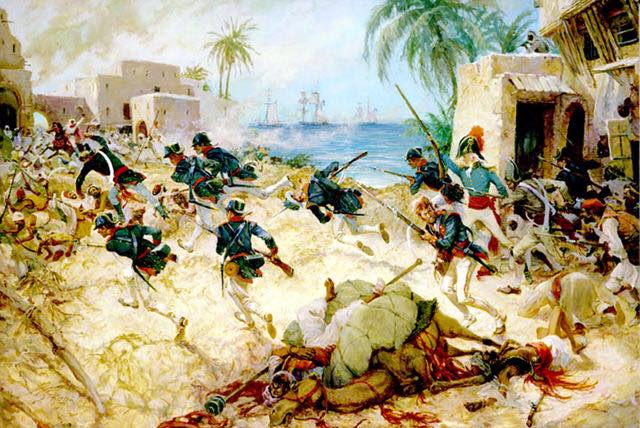
In early 1805, a former army captain and consul to Tunis, William Eaton, traveled to Egypt with a Marine detachment under 1st Lt Presley O’Bannon. They recruited 500 Greek, Arab, and Berber mercenaries. They then made a 600 mile trek to capture Derna, the capital of Cyrenacia and the stepping stone to the capital, Tripoli.
The Marines put down several mutinies during the grueling march and the small expedition finally met a small squadron of US ships off of Derna on 26 April, 1805. The next morning, Eaton demanded the Bey of Derna surrender. The Bey, who thought he was safe behind his 4000 warriors, replied, “My head or yours!”. Eaton and his small army, led the Lt O’Bannon and his eight Marines, stormed the town. At 4 pm, they raised the Stars and Stripes over the fortress protecting the harbor.
It’s the first time the American flag had flown over an overseas foreign territory. Impressed with the professionalism and fighting spirit of the U.S. Marines, Prince Hamet gave his Mameluke sword to Lt O’Bannon as a sign of gratitude and respect.
The Battle of Derna is immortalized in the second line of the Marine Corps Hymn, “to the shores of Tripoli” and USMC officers wear a replica of Prince Hamet’s sword with their Blue Dress Uniform to this day.
East Meets West
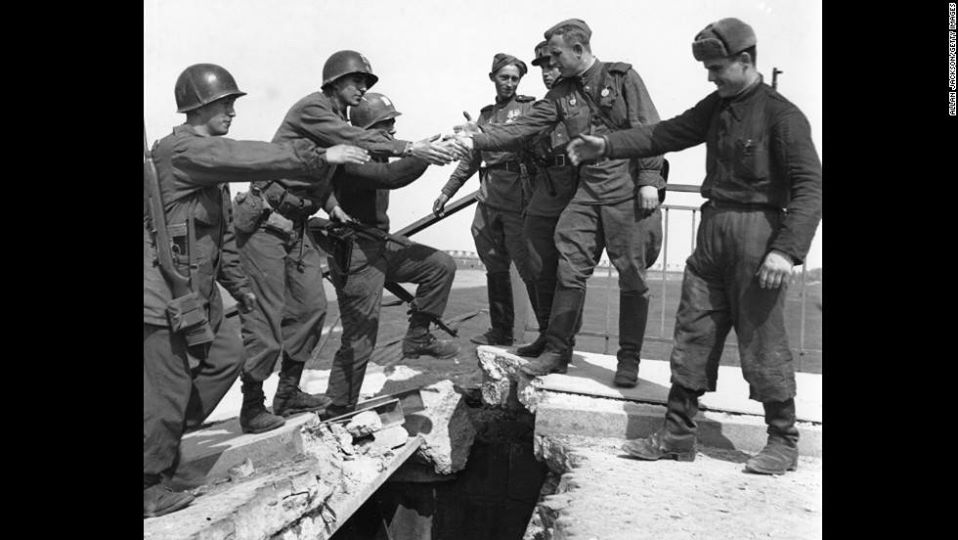
On 25 April 1945, the US 69th Infantry Division met the Soviet 58th Guards Rifle Division at the German town of Torgau on the Elbe River. The Eastern Front met the Western Front. The War in Europe was almost over.
The Armenian Genocide
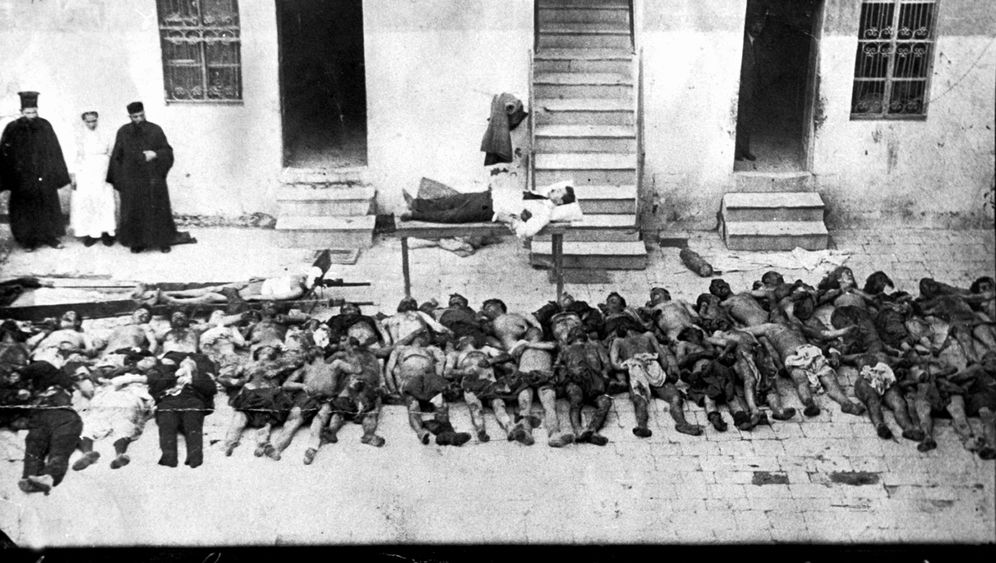
On 24 April 1915, Muslim Turkish authorities of the Ottoman Empire detained 250 Christian Armenian intellectuals and community leaders in the Ottoman capital Constantinople (modern Istanbul). Although there had been many massacres of Armenians in the past, 24 April saw the start of a systematic, well planned, and state sponsored scheme to remove Christians, mostly Armenian, and to a lesser extent Greek and Assyrian, from the Ottoman Empire.
The Armenian Genocide was done under the pretext that they formed a fifth column inside the country after the Ottoman Empire joined the side of German and Austria-Hungary in the First World War. 1.5 million Armenians were murdered or starved to death over the next five years, but most in 1915. The US Ambassador to the Ottoman Empire, Henry Morgenthau, extensively documented the genocide, and routinely called it “race extermination”
Thirty years later, Hitler used the world’s non-reaction to the Armenian Genocide to move ahead with his Final Solution of the Jews and other undesirables.
The Gurkhas Enter British Service

In 1814, the British East Company invaded the aggressive Gorkha Kingdom of Nepal in order to prevent them from distracting the Company from their expansion into the Kingdom of Marathas. During the hard fought Anglo-Nepalese War, the British recognized that their best irregular troops were the wielders of the distinctive inwardly curved knife, the khukuri, whom were actually deserters from the Gorkha Army.
Impressed by their loyalty, courage, stoicism, resilience, and military efficacy, the British formed the Gorkhas into the First Nusseree Battalion on 24 April 1815. By the end of the war (which was fought to stalemate) there was an entire regiment of Gorkhas and an agreement with the Kingdom of Nepal to continue recruitment in the future. Living up their motto “Kayar Hunu Bhanda Marnu Ramro” (Better to die than live like a coward), the Gorkhas quickly formed the backbone of the East India Company’s, and eventually Great Britain’s, Indian Army.
For the next two hundred years, the Gurkhas served faithfully in every conflict involving the Indian or British Army. They were one of the few indigenous units to remain loyal during the Indian Mutiny of 1857. 200,000 served in the First World War, including in the trenches on the Western Front and in the landing at Gallipoli in 1915. At the height of the Second World War, the Gurkhas contributed 250,000 men from their home villages in the Himalayan foothills, which were neither a part of the British Empire nor a protectorate of Great Britain. In 1947, the Gurkha regiments were split between the newly independent Indian Army and the British Army.
Currently 3500 Gurkhas serve in the British Army in the Brigade of Gurkhas. Tens of thousands of young Gurkha men apply during recruitment events in Nepal for the few hundred training slots. They also serve in the armies of India, Brunei and Singapore.
One of my favorite Gurkha stories. From the Second Battle of Monte Cassino:
On the night of 12 February 1944, one of the Gurkha battalions sent out a reconnaissance patrol to identify German positions around the town of Cassino. The small patrol came across six German infantrymen in a house: two awake and alert, and four asleep. The Gurkhas snuck up on the German sentries and slit their throats without waking the others. They then decapitated two of the sleeping soldiers and let the others to slumber so they can find their comrades in the morning.
A friend of mine said of the Gurkhas he worked with in Afghanistan, “They react to contact (with the Taliban) the way my kids react to Christmas morning.”
Jaya Mahakali, Ayo Gorkhali! (Glory to the Great Kali! Gorkhas Approach!) –Gurkha war cry, then and now.
The Second Battle of Ypres: Gas
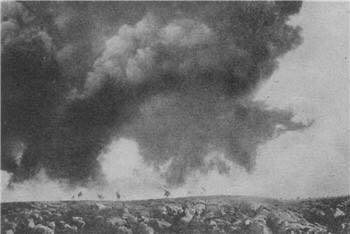
By the end of 1914, the Western Front in the First World War had stabilized, and trenches ran from the North Sea to Switzerland. During the winter the armies dug in even further. A stalemate existed that both sides were desperate to break. On 22 April 1915, the Germans released chlorine gas in front of their trenches and a favorable wind blew it west into the French, Canadian, and British lines at the Ypres Salient. Mild contact with chlorine gas causes irritation to the eyes and chest, a heavy dose causes a person to drown in their own lungs. The gas cloud affected the French sector the worst and soon thousands were killed and tens of thousands more fled to the rear. A five mile gap formed in the Allied lines
Fortunately, the Germans could not exploit the gap fully due to poor staff planning and a lack of reserves to exploit the breach. (The Second Battle of Ypres is one of the great “What if? Moments of history. If they would have broken through, the First World War would have almost definitely ended in a German victory in 1915.) Also, chlorine gas is water soluble. Allied soldiers used improvised masks of cloth, usually handkerchiefs, which soldiers soaked or urinated to protect themselves from the gas. This allowed the Allies to hold the line where the gas was less prevalent. Instead of a breakthrough, the hard fought Second Battle of Ypres raged for almost a month with over 100,000 casualties from both sides.
The attack spawned a chemical warfare arms race that would last for the rest of the war.
 Buk's Historical Ad Hockery
You must be logged in to post a comment.