
Category: History
The Battle of Fishing Creek

The American loss at Camden made Colonel Thomas Sumter’s partisans at Carey’s Fort the largest Patriot force in South Carolina. After his victory, Lord Cornwallis advanced to the old American camp at Rugeley’s Mills, which fortunately for Sumter took the British away from hi, for the time being. Nonetheless, when Sumter was informed of Gates’ defeat, he knew he was in danger of being isolated and destroyed. He couldn’t let the British and Loyalists get between him and the nearest rebel base at Charlotte, or from the overmountain men mustering camps across the Blue Ridge Mountains. On 17 August 1780, Sumter’s men departed Carey’s Fort laden with 250 prisoners, 300 head of cattle, a flock of sheep, and 70 much needed wagons filled with supplies.
Moving slowly up the west bank of the Wateree River, Sumter was not counting on Cornwallis wanting those wagons back so badly. (Legend has it one of them contained his dogs and papers.) Cornwallis dispatched most of his cavalry and loyalist commanders to chase down Sumter and specifically retrieve those wagons. In his characteristic aggressive manner, Lt Col Banastre Tarelton’s British Legion made a 30 mile mostly night road march from Rugeley’s Mills to Camden in an attempt to cut off Sumter. Finding Sumter gone, Tarleton planned to cross the Wateree north of Carey’s Fort at Rocky Mount. However, when he arrived, Sumter was camped on the east bank. With the ford guarded, Tarleton waited for the rest of his command to catch up.
Sumter knew about orders to Ferguson to cut him off, but was neither aware of any to Tarleton, the speed of Tarleton’s advance, nor the fact he was just across the river from Rocky Mount. Sumter pushed his convoy as fast as they could go, but they needed a rest. On 18 August, Sumter’s column marched just eight miles to a camp on Fishing Creek.
Tarleton wasn’t going to let Sumter escape. Most of his light infantry and supporting loyalist militia was still strung out on the road behind, but he decided to attack anyway. He had 100 dragoons and sixty light infantry which he doubled up on the dragoon’s horses for the approach march. He crossed at Rocky Mount after Sumter departed. With just 160 men, Tarleton attacked Sumter’s nearly 800 strong camp on Fishing Creek on the afternoon of 18 August 1780.
The surprise was complete. Most of Sumter’s men were swimming in the Catawba River (The Catawba River turns into the Wateree River as it flows south) or were drinking around campfires after a tasty supper courtesy of the captured British provisions. Most of the muskets were stacked neatly near the river, and Tarleton ordered a charge to seize the muskets before the Americans could organize.
The “Battle” of Fishing Creek wasn’t a battle at all. The Americans had no chance to organize a defense. 150 Americans were immediately cut down by dragoon sabers, and over 300 surrendered. Sumter’s force was scattered. A dozing and half-dressed Sumter had just enough time to swing into the saddle and escape. The British prisoners were released and everything Taylor captured at Carey’s Fort was recovered. Taylor himself was captured, but he was so muddy and dirty the British didn’t recognize him. He and another Patriot officer cunningly escaped two days later.
Coming so close on the heels of the British victory of Camden, the news of Tarleton’s victory at Fishing Creek was lost in the mix. Nonetheless, the Americans partisans in the South suffered a major defeat, which would be tough to recover from.
The Battle of Camden

On 25 July 1780, Major General Horatio Gates arrived at Southern Department’s main camp at Deep River, thirty miles south of Hillsboro, North Carolina, to take command of the Continental Army assembled to drive Lord Cornwallis out of South Carolina, recapture Charleston, and put down any Loyalist counterrevolutionaries. “Granny” Gates, as his men called him, was the “Victor of Saratoga” and it was thought he could do the same to Cornwallis as he did to Burgoyne.
Unfortunately, Gate’s reputation was almost exclusively the result of the actions of his subordinates, John Stark, Enoch Poor, Daniel Morgan, and Benedict Arnold mostly, which he, and his sycophants, took credit for. Left to his own devices, Gates would have almost certainly lost at Saratoga. The argument can be made that he stayed out of his subordinates’ way, but that’d be wrong: the battle was won for the most part because they ignored his orders, or disobeyed them outright. In the Southern Department, Gates had few subordinates of the caliber he had in New York, mostly because he refused their services. The exception, of course, was Major-General Baron Johann De Kalb.
De Kalb was a German officer from Franconia, who had served in the French Army, and traveled to America before the revolution. He and his protégé, Marquis de Lafayette, were offered commissions in the Continental Army, and De Kalb was instrumental training the Continental Army at Valley Forge, even though von Steuben got most of the credit. As commander of the Maryland and Delaware Line, some of the best troops in the Continental Army, whom he marched south with, the fiery De Kalb was furious when he learned Gates was given command of the Southern Department instead of him.
As soon as Gates arrived, he ordered DeKalb to march directly on Camden, a supply depot and loyalist mustering center held by Lord Rawdon in command of 1000 troops: Carolina loyalists, volunteers from Ireland, and Banastre Tarleton’s infamous British Legion. Against this force, Gates had DeKalb’s Continental Line and the dragoons of Armand’s Legion. On the way he expected to pick up North and South Carolina and Virginia militia. Gates had no plans to attack Camden, and only wanted to occupy a defensive position north of the town, which would force Rawdon to either evacuate Camden, or attack Gates’ superior force.
The road to Camden was through barren country and mosquito infested swamps which took a toll on the army, which was already low on food and wracked by dysentery. Taking the direct route to Camden was against the advice of all of his officers who knew the country. An alternate route to the west was recommended. It would have taken longer, but it would have been through Patriot friendly territory where they could have requisitioned food. Gates refused. However, by the time Gates reached Rugeley’s Mill, about 15 miles north of Camden, Gates’ “Grand Army” swelled by the addition of 2100 North Carolina militia, 700 Virginia militia, and several hundred more South Carolina militia and dragoons. With almost 5000 troops, he was sure to force the British out of Camden.
Gates’ had no faith in his militia, and still had no intention of attacking despite the odds. At Rugely’s Mill on the morning of 15 August, he found out Cornwallis had reinforced Rawdon with about 1000 additional troops. Cornwallis heard of Gates arrival on 9 August from loyalists along Gates’ route of march. Cornwallis immediately departed Charleston with its garrison, and arrived at Camden on the 13th bringing the British army strength up to 2100. Despite the increase, Gates felt little need to change his plans. Gates sent most of the South Carolina militia away, including a band led Francis Marion, to continuing raiding loyalist outposts, and capture and burn all the boats, bridges, and ferries on the Santee River, to prevent Cornwallis’ escape after the inevitable British defeat. Arrogantly, Gates refused the services of William Washington’s dragoons, who promptly went on to raid independently. Gates assumed he had more than enough troops to defeat Cornwallis.
With battle imminent, Gates wanted to fortify his sick, tired, and weary men with a bit of rum. However he didn’t have any, so he substituted molasses. The molasses just made the dysentery worse, and gave everyone else a severe case of diarrhea. Nonetheless, at 10 pm on the 15th, Gates ordered a night march to cover the 10 last miles, and planned on being in the defensive positions above Camden by dawn.
Unfortunately for Gates, Cornwallis also ordered a night march at 10 pm on the 15th. He planned a surprise dawn assault on the American army which he thought was still at Rugeley’s Mill. The two armies collided in the night about 2:30am north of Camden at Parker’s Old Field near Saunder’s Creek.
The dragoons and light infantry of Armand’s Legion and the British Legion clashed in the darkness, with Armand getting the better of Tarleton after receiving the British charge with pistol fire and counter charging. However, the Virginia militia sent to support Armand had never been in a battle, and, in a harbinger of things to come, withdrew in panic at the first shot. The Virginians sent Armand’s lines into chaos, and only a rear guard action by Armand’s light infantry, led by Lt Col Charles Porterfield, prevented Tarleton from scattering the American vanguard. Both sides withdrew as neither Cornwallis nor Gates wanted to fight a night battle.
At dawn, both armies were lined up against each other, Gates’ 4000 and Cornwallis’ 2100. Both commanders followed the standard 18th century tactic of placing their best units on the right. For the Americans it was the Delaware and Maryland Line under de Kalb, for the British it was the 23rd Royal Welsh Fusiliers and the veteran 33rd Regiment of Foot. Opposite de Kalb was Rawdon in command of the Irish Volunteers and the loyalist militia, and across the field from the Welsh and the 33rd was the unreliable Virginia militia. The same who fled the night before. Gates ordered the entire American line to attack, while Cornwallis ordered just his veteran right to attack.
Gates should have guessed Cornwallis would have placed his best units on the right and not placed his least reliable troops opposite them, but he didn’t. Even worse he ordered the Virginians to attack. Gates hoped to take advantage of the British transitioning from column to line, but all he did was made the militia difficult to control by their officers. At the first sight of a British bayonet, the Virginians broke and ran. They didn’t engage or even get close to the British line. The Virginians didn’t even fire their weapons. They dropped their weapons a fled for their lives. Only three Virginians were even wounded in the battle. The rest ran. They took most of the North Carolina militia in the center of the American line with them. Tarleton and the British Legion gave chase. As the Virginians streamed past, Gates took off. Followed closely by his staff, General Horatio Gates, the Victor of Saratoga, didn’t stop running until he reached Charlotte, North Carolina, sixty miles away.
De Kalb had barely engaged Rawdon to his front before he was out flanked by the British. He took control of the battle and assaulted Rawdon, nearly breaking his lines. But in the process, his left was exposed as the British overwhelmed the only North Carolinian brigade not to run away. He ordered the American reserve, the 1st Maryland Brigade, to support his left, but they couldn’t reach it. The American line was split. Tarleton returned to the field, and charged into the rear of the Continentals which broke them. Several hundred escaped through the swamp to the west where the horsemen couldn’t follow.
In an attempt to rally his men, de Kalb was unhorsed and captured. He had ten wounds – seven from bayonet and three more from musket balls. Baron Johann de Kalb died two days later despite the best efforts of Cornwallis and his personal surgeon. Tarleton pursued the routed American for over 22 miles, ensuring “rout and slaughter ensued in every quarter.”
The Battle of Camden lasted just under an hour and the Americans suffered over 2000 casualties, the British a little over 300. 700 Continentals reformed in Hillsboro a few days later, but the equipment losses were devastating and the American army in the South would lack the essential tools of warfighting for months. Continental Congress called for an inquiry into Gates’ actions at Camden, but his political connections ensured it went nowhere. Nevertheless, Gates never had a command again. Subsequently, the Southern Department was given to Washington’s most trusted subordinate, Nathaniel Greene. But until he and Daniel Morgan could come south from New Jersey and take command, the defense of the American cause in the South fell to Patriot partisans and the overmountain men mustering over the Blue Ridge Mountains.
The Capture of Carey Fort

The war for the Carolina backcountry intensified after the successful capture of Thicketty Fort, as patriot commanders raided Major Patrick Ferguson’s loyalist outposts. Ferguson, with a smattering of British regulars and provincial loyalists from up North, was desperately trying to recruit and train Carolinian and Georgian loyalist militia to defeat the overmountain men gathering in large numbers over the Blue Ridge. An American army led by Horatio Gates had just entered South Carolina and threatened Camden, an important depot town and loyalist mustering center, one of the few that was far too large for patriot partisans to attack. After the victory at Hanging Rock, Patriot Colonel Thomas Sumter’s next targets were the vulnerable fords and ferries on the Wateree River. Sumter wanted to strike them before the inevitable clash between Gates and Cornwallis. Sumter dispatched Col Thomas Taylor to scout one of Camden’s satellite training camps, Carey’s Fort, which also guarded the ferry over the Wateree River about a mile south of Camden behind Cornwallis’ main body.
On the morning of 15 August 1780, Taylor with about two hundred cavalry and militia, found the small British garrison of Carey’s Fort under its namesake, prominent local Loyalist Lt-Col James Carey, fast asleep. Seizing the moment, Taylor’s men quickly stormed the fort, and took the entire 37 man garrison prisoner without firing a shot. Taylor captured about thirty wagons full of supplies, which were supposed to be ferried across the river and sent to Camden that morning. Cornwallis’ army, across the river a mile away, had no idea that anything was amiss. After a quick interrogation, Taylor learned that a supply convoy from another large Loyalist outpost at Ninety Six was also scheduled to arrive that day.
Dressed the same as the loyalists they captured, Taylor’s men posed as the garrison, even waving to curious loyalists on the other side of the river who were sent to find out why the wagons had not crossed yet. Later that morning, the convoy from Ninety Six arrived. The convoy’s thirty wagons were escorted by 70 Highlanders of the British 71st Regiment. By the time the Highlanders figured out the ruse, they were in no position to fight, and were all captured. Upon learning the news of Carey Fort’s capture, Sumter brought his whole command down from his own raid to reinforce Taylor.
The loss of Carey’s Fort, and more importantly, the ferry over the Wateree River, effectively severed Cornwallis’ lines of communication from Camden to Ninety Six and Charleston. And there was nothing the British could do about it: The fort and ferry boats were secure on the west side of the fast and deep Wateree River, and the British were on the east side, impotent and helpless as the Americans taunted them. Furthermore, if the much ballyhooed Gates, with his “Grand Army” defeated Cornwallis in battle north of Camden, Cornwallis would be forced to retreat away from Charleston into the wilderness and swamps of north east South Carolina. The defeated remnants of Cornwallis’ army would then be at the mercy of American partisans. With the fall of Carey’s Fort, the war in the South, and possibly the entire American Revolution, could be won by the Patriots in the next few days.
Gates just had to defeat Cornwallis at Camden; and the Victor of Saratoga outnumbered Cornwallis nearly two to one.
Japan Surrenders

At the Casablanca and Tehran Conferences the Allies and the Soviet Union agreed to fight until the Axis unconditionally surrendered. For months starting in March 1945, Curtis Lemay’s B-29’s firebombed Japan’s primarily wooden cities causing great destruction and massive casualties among Japan’s population. Nimitz’ Navy mined the island channels which destroyed Japan’s economy, and his fast attack carriers raided Japan’s coasts with impunity. Japan’s industry was reduced to ruins, but battle hardened troops from China, many of whom had been fighting there for decades were brought back to Japan. Japan’s fanatical government mobilized the population to defend against the inevitable Allied invasion of the Home Islands.
Operation Downfall, the Allied invasion of the Japanese Home Islands, was scheduled to begin in November 1945. Downfall had two component operations: Operation Olympic, the invasion of Kyushu in November, and Operation Coronet, the invasion of Honshu in March 1946. Based on the Japanese military and civilian resistance on Saipan, Iwo Jima, and Okinawa, Allied planners predicted a million Allied casualties. (So many Purple Heart medals were created for the invasion of Japan, that we are still using them today.) The Allied commanders feared “an Okinawa from one end of Japan to the other”. Planners predicted that “20%” of the “fanatically hostile” Japanese population would die defending the islands.
At the Potsdam Conference at the end July 1945, a declaration was made by the Allies and the Soviet Union threatening “great destruction” unless the Japanese surrendered unconditionally. The Japanese refused, demanding that the Emperor and his administration continue to govern Japan, and no Allied occupation force set foot on Japanese soil.
On 6 August 1945, the B-29 “Enola Gay” dropped the first atomic bomb, the 15Kton “Little Boy” which used uranium for its fission, on Hiroshima. 20,000 Japanese soldiers were killed, and 150,000 civilians died in the initial blast, the immediate fires and destruction, or from radiation.
The Japanese officially ignored the attack, even after Truman announced it to the world. Most Japanese outside Hiroshima did not even know it occurred, so tight was the government’s control of the population, until Allied leaflets told them. The Japanese dismissed the leaflets as propaganda.
On 9 August, 1945, the B-29 “Bockscar” flew to Kokura with the plutonium atomic bomb “Fat Man”. When Bockscar got to Kokura the crew found haze and smoke obscured the city as well as the large ammunition arsenal that was the reason for targeting the city. After three unsuccessful passes, they broke off and headed to their secondary target Nagasaki. Nagasaki, situated in a valley, was difficult to target and relatively unscathed as far Japanese cities went in 1945. Thought safe from bombing, Nagasaki was packed with refugees. 80,000 civilians died as a result of the atomic bombing.
(“Kokura’s Luck” is a common Japanese phrase to describe escaping a terrible occurrence without being aware of the danger.)
Also on 9 August, the Soviet Union invaded Japanese occupied Manchuria.
The Japanese still refused to surrender unconditionally. A third atomic bomb was readied.
On 12 August 1945, Japan agreed to surrender, but again only conditionally. They continued to demand that the Allies agree to Emperor Hirohito’s imperial government remaining in power, and no Allied occupation of the Home Islands before Japan would surrender.
Truman ignored the offer, though he did refuse to authorize the use of the third atomic bomb (“all those kids…”). The next morning, bombers dropped copies of the surrender request all across Japan. In response to the demands, Admiral Nimitz directed his carriers to strike targets around Tokyo on the afternoon of 13 August and General Carl Spaatz ordered another thousand bomber raid on Tokyo for the next day.
With no more word from Japan, on the morning of 14 August 1945, the Allies had had enough of Japan’s procrastination and launched the largest series of raids and attacks on the Home Islands so far in the war, primarily in the Kyoto/Tokyo/Yokohama area. 1,014 B-29s struck Japan along with thousands of smaller bombers and carrier based planes. Anything with wings that could reach the Japan was ordered to attack. Additionally, every surface vessel in the 3rd and 5th Fleets was ordered to shell targets on the Home Islands. They ranged from big Iowa class battleships launching 16” shells twenty miles inland to PT boats shooting up Japanese fishing trawlers and coastal villages with their .50 Cal machine guns.
Iwakuni, Osaka, Tokoyama, Kumagaya, and Isesaki were devastated, and what remained of Tokyo was destroyed.
The leaflets announcing Japan’s surrender offer had a profound effect on the Japanese Emperor and his Imperial cabinet. They could not deny them to the Japanese people. On 13 August, they agreed to offer to surrender with one condition, the Emperor remain on the throne as a figurehead while the Allied occupation force governed Japan after the surrender. The Allies, particularly Truman, were sure to accept, but it almost didn’t matter.
Unbeknownst to the Allies, the Japanese military attempted a coup on the night of the 13th in order to prevent any communication with the Allies. The Emperor had recorded the surrender message that afternoon and the vinyl record was given to the Emperor’s Chief of Seals, Kōichi Kido, to be played the next day to the Japanese people. That night Major Kenji Hatanaka and his conspirators launched the coup. Hatanaka and his men seized the Imperial Palace to destroy the recording, while others fanned across the city. The coup failed by the evening of the 14th, mostly due to the efforts of three men. Kōichi Kido locked himself in a secret vault in the Imperial Palace, which Hatanaka tore the Palace apart looking for the recording. He never found it. Kōichi only emerged from the vault after troops loyal to the Emperor recaptured the Palace. That there were still loyal troops was due to the efforts of General Shizuichi Tanaka, the commander of the Eastern Army, and his chief of staff. Tanaka convinced many of the plotters to go home, and his chief of staff refused the use of the radio for the ringleaders to broadcast their messages to the Japanese people.
On the morning of the 15th (Japanese time) the Emperor accepted the Allied terms of “Unconditional Surrender” and dispatched members of the Imperial family to personally inform the commanders in China, Korea, Southeast Asia, and the South Pacific, who would invariably believe the pronouncements to be Allied propaganda. The Allies acknowledged receipt of the surrender at 7 pm 14 August 1945 (Washington DC time), just Emperor Hirohito was announcing it to the Japanese people. The Allies agreed to let Emperor Hirohito remain on the throne as a figurehead. President Truman made an immediate radio address and spontaneous celebrations broke out across the world. The occupation of Japan began on 28 August and the official surrender documents would be signed on 2 September.
The most destructive war in human history was over. After almost six long years (14 in the case of the Republic of China) the Allies were victorious against German National Socialism, Italian Fascism, and Japanese Racial Militarism, and the totalitarianism and authoritarianism their corrupt ideologies inevitably encouraged.
The war to keep it that way, which had begun as early as the previous year, began in earnest the next day.
The Battle of Britain: 303 Squadron

The invasion of Poland in 1939 was not the walkover portrayed by German National Socialist propaganda, particularly in the air where the Polish air force was portrayed as destroyed on the ground. Poland’s small air force consisted of 400 obsolete planes, but number of flight hours made its pilots some of the best trained in world. The Luftwaffe suffered 900 planes shot down by the Poles before the German 5:1 superiority overwhelmed them. Towards the end of the campaign, thousands of pilots and ground crew escaped to Great Britain or France.
In August 1940, the RAF’s Air Marshal Dowding didn’t want to use the Polish squadrons because their lack of English language skills prevented their effective integration into his early warning system. So for the first 45 days of the Battle of Britain the Polish pilots, dozens of whom were aces and double aces, spent their time learning the proper English language procedures for coordinating with the Sector Control Centers and other fighters in the air.
However, on 30 August 1940 during a training flight over Kent, 303 Squadron RAF encountered a German bomber raid enroute to the airfield at Eastchurch, and one of the Polish pilots attacked. The pilot, a veteran of both the Polish and French campaigns, was frustrated with the RAF’s insistence on more training, and used the time honored tactic of not understanding the radio commands of his British instructor pilot. He shot down a German Bf110 and broke up the formation. Bowing to the inevitable, Dowding made 303 Squadron operational the next day.
303 Squadron was nicknamed the “Kosciuszko Squadron” after the Polish patriot and engineer who fought in the Continental Army during the American Revolution. 303 Squadron was formed on 28 July 1940 from pilots of the former 111 “Kosciuszko” and 112 “Warszawa” squadrons of the Polish Air Force. They were equipped with older Hawker Hurricane fighters, unlike many British squadrons which were equipped with far superior Supermarine Spitfires. Nonetheless, in the first seven days of September, 303 Squadron shot down 43 German planes for only six planes shot down and three pilot losses. The RAF refused to believe the numbers until the British sector commander came down to fly with them on 8 September. They scrambled four times, and shot down five more German planes without loss.
One victory that day was a Bf 109 that the Polish pilot chased over the tree tops. Out of ammunition, the Pole flew just above his target. The German pilot looked up, saw the fuselage of the Hurricane less than a meter from his canopy and instinctively dove away… straight into the ground. (The real life inspiration for Goose’s Polaroid scene in Top Gun? You know, “foreign relations”.) Impressed with their aggressiveness, dedication, technical and tactical expertise, and their “lust for contact”, the RAF never doubted the Poles of 303 Squadron again.
145 Polish pilots in five squadrons took part in the Battle of Britain, by far the largest contingent after the British. In early September, when the Germans had bombed Fighter Command’s airfields almost into submission, British Secretary of State for Air, Sr Archibald Sinclair noted, the RAF had “only 350 pilots to scramble, of which nearly 100 were Poles.”
The scarlet scarves of 303 Squadron would go on to shoot down 126 German planes in six weeks with the loss of only 13 pilots. This was the largest number of any of the 66 RAF fighter squadrons that fought in the Battle of Britain. Sgt Josef Frantisek, a Czech member of 303 Squadron who fought for the Poles after his country was given away by Neville Chamberlain in 1938, had the most kills of any pilot in the Battle of Britain with 18.
Pic notes: Note the cavalry czapka in the center of the 303 “Kosciuszko” Squadron emblem. The 13 stars around the outside of the red and white stripes was Kosciuszko’s heraldic device which he adopted after the American Revolution. (It was also a medal for gallantry in the Republic of Poland between 1919-1939). Also note the traditional Polish “war-scythes” on the emblem. “War-scythes” were made by uprighting normal scythe blades to make a form of fauchard. “Uprighting the scythe” was the traditional sign that the Poles were going to war. (You can’t harvest grain with an uprighted scythe; you can only harvest Germans, Russians, Swedes, Turks, and Communists.) The war-scythe is also a symbol for Polish independence, and “scythemen”, “Kosynierzy” in Polish, are roughly equivalent to “minutemen” in American culture. That was particularly appropriate during the Battle of Britain when the pilots had only a few minutes to get airborne to engage the Luftwaffe.
The Miracle on the Vistula

At the end of the First World War, three great empires collapsed in Eastern Europe: Germany, Austro-Hungary, and Imperial Russia. Out of that chaos, two states, of many, arose: the Republic of Poland and the Soviet Union. The Soviet Union was born in the “Red” October Revolution of 1917 sparked by the initially successful then disastrous Brusilov campaign of 1916. By 1918, Russia was out of the war, and locked in its own brutal civil war between the Anti Bolshevik or “White” armies, and the Bolshevik Socialist i.e. Communist, “Red” armies. In 1919, Vladimir Lenin’s victorious Red Army invaded the newly independent Republic of Poland, formed from the pieces of the Central Powers at the end of World War One. Lenin’s intent was to spread the Communist International (COMINTERN) to a defeated Germany, which was ripe for Communist revolution.
The Polish-Soviet War was the last of an era, with the first glimpses of the next. Trenches, inexperienced peasant militias, armored trains, massed artillery barrages and vast sweeping maneuvers by hordes of lance and saber wielding cavalry coexisted with airplanes, tanks, armored cars, motorized infantry, and highly experienced professional soldiers. By mid-1920, the Red Army, under the brilliant 27 year old Marshal Mikhail Tukhachevsky, was poised for a final offensive to capture Warsaw. Warsaw’s fall would end the war and allow Tuchachevsky a clear path to Berlin. Standing in his way was the massively outnumbered remainder of the Polish Army under Marshal Josef Pilsudski.
The advancing Red Army had five million men, Pilsudski had but one million under arms.
Pilsudski knew that his forces could not win in a protracted attritional fight: the Soviets were too many. Only a bold counterattack could disrupt the Bolshevik offensive. Pilsudski planned to make a stand along the Vistula River with Josef Haller’s “Blue Army” reinforced by almost the entire population of Warsaw. The “Blue Army” was named so because they were Poles whom fought for France in the First World War and wore old blue French uniforms. Among the Blue Army was a division of Polish-American volunteers recruited from recent immigrants to the United States. Pilsudski’s plan was for Haller to fix Tuchachevsky in front of Warsaw, as the Red cavalry to the north of the city inevitably took the path of least resistance and raced west on the North German Plain. General Wladyslaw Sikorski’s Fifth Army held the shoulder. Below the city to the south, Pilsudski secretly organized a 20,000 strong “Strike Force” under Gen Edward Smygly-Rydz, for the counterattack.
On 12 August 1920, Tuchachevsky arrogantly launched his armies directly at Warsaw. Despite bitter hand to hand fighting in the trenches against overwhelming odds, and much to the surprise of the French and British observers, Haller held the Wkra/Vistula River lines. The Soviet Cossacks and cavalry raced west as expected, which caused great panic, but they completely overextended themselves. Even worse for the Soviets, the Red cavalry victoriously galloped further away from the important battle in front of Warsaw.
On 14 August, Sikorski counterattacked north of city (in probably the first use of “blitzkrieg” style combined arms breakthrough tactics), cutting off the cavalry to the west and occupying Tuchachevsky’s reserves. Two days later, Pilsudski launched his coup d’eclat – Smigly-Rydz’s cavalry, tanks, and armored cars tore into the Soviet flank, as they were occupied fighting for the city and containing Sikorski. The Polish counterattack threw the Red Army into chaos. Unleashing his division commanders to operate independently in the breakout, the Poles tore deep into the Soviet rear areas. They captured the vital fortress city Brest-Litovsk, 70 miles behind the lines. In order to prevent the complete encirclement and destruction of the Red Army, Tuchachevsky ordered a general retreat. As the Communists withdrew, Pilsudski ordered a general offensive, but it was superfluous: Haller, Sikorski, and the population of Warsaw had already surged forward. The Communist retreat turned into a rout on 18 August.
The COMINTERN was stopped at the Polish border and the Red Army, with its commissars and secret police, wouldn’t advance that far west for another 25 years. The Miracle on the Vistula spared vulnerable western and central Europe, severely weakened by four years of the First World War, from Communism, an ideology so heinous that it is responsible for 150,000,000 deaths and untold suffering by billions.
Had the Poles failed at the gates of Warsaw in August of 1920, we would be living in a different, and darker, world today.
“For our freedom and yours” – The motto of Polish revolutionaries and unofficial motto of Poland
The Battle of Britain: Adlertag

By the first week of August 1940, it was obvious to the Germans that the costal convoy and port attacks were not going to lure the RAF into a battle over the channel where it could be destroyed. Herman Goring ordered the Luftwaffe to attack targets in Southern England which he believed would bring the RAF to battle. He was correct and Air Marshall Dowding unleashed his fighters on the Luftwaffe.
The revised plan was named Adlerangriff, or “Eagle Attack” and 13 August 1940 was designated Adlertag or “Eagle Day”. Luftwaffe bombers struck a variety of targets including airfields, radar stations, and aircraft factories in order to bring the RAF up to fight. Adlerangriff’s climax was actually very early in the battle: 15 August was declared Der Groesste Tag or The Greatest Day because of the sheer number of German sorties flown and the number of casualties on both sides. Nonetheless, it was a straight attritional battle, and although the Germans had more planes, the flaws in Adlerangriff became readily apparent.
Dowding’s early warning system proved to be much more resilient than expected. The radar towers were very difficult to damage much less destroy, and their ancillary and supporting systems were not targeted, such as telephone exchanges and power stations. Also, the slow Ju87 Stuka dive bombers were massacred in the air, and any bombers escorted by the big and ungainly Bf 110 fighter/bombers were likewise swept from the sky. Furthermore, since the battles mostly took place over England, any downed Allied pilots could be back with their squadrons in hours, unlike German pilots whom became POWs. Finally, the scattershot nature of the targets severely limited the effectiveness of the bombers, and did not complement the many victories scored by the fighters. It would take two weeks before the Luftwaffe High Command figured out that the key to defeating the RAF was not shooting down its planes but destroying its airfields.
The Battle of Hanging Rock

Like Isaac Shelby’s assault on Thicketty Fort on 30 July 1780, Colonel Thomas Sumter sought to strike the British and Loyalist outpost on the Catawba River at Rocky Mount, South Carolina. Rocky Mount was a sub camp of the main British and Loyalist training camp at Hanging Rock about 15 miles to the east. Garrisoned by New York volunteers, Sumter thought the camp was ripe for the taking. Unfortunately a loyalist spy informed the garrison, and Sumter didn’t collect the men that Shelby did (They went with Shelby). Sumter’s 300 South Carolina militia and Catawba Indians did not surprise the 600 man garrison, though they did manage to set several buildings on fire, but a thunderstorm promptly put them out.
Much more success was had by Sumter’s subordinate, Major William Davie. With a company of dragoons and some smaller militia companies, Davie launched a diversionary attack on Hanging Rock, to prevent its 1600 loyalists and regulars from coming to the aid of Rocky Mount. During his leader’s reconnaissance, Davie found three loyalist companies bivouacked around a house outside the camp. His 40 dragoons approached them as if they were loyalists, and when at the house, opened fire. Cutting off their escape route back to the main camp, Davie chopped them up, looted the house, stole 60 horses and all of their arms, powder, and equipment. Davie and his men got away before anyone in the main Hanging Rock camp reacted.
Sumter, frustrated with the failed attack on Rocky Mount, decided to capitalize on Davie’s success and attack Hanging Rock, especially after he learned they sent reinforcements to Rocky Mount. Himself reinforced by militia who heard about Davie’s successful raid, Sumter set off to surprise Hanging Rock. Based on Davie’s information, Sumter divided his 800 men into three mounted columns to strike the left, center, and right simultaneously. On the morning of 6 August 1780, about two miles from Hanging Rock, Sumter’s army split and the three columns set off on their own.
The British and Loyalists were ready. Their 1400 men were formed up outside their camps waiting. On the British left were the loyalist recruits from the South. In the center, the loyalist provincial militias mostly from the north were formed. Onn the right were the Loyalist and British regulars: detachments from the 63rd and 71st Regiments, part of Tarleton’s British Legion, and the loyalist regulars of the Prince of Wales American Volunteer Regiment. Made up of Connecticut loyalists, the PoWAVR was arguably one of the finest loyalist regiments in North America. In addition to the powerful positions, the British had pickets out further than they had the week before.
In trying to avoid the pickets, all three American columns attacked the North Carolinian loyalists on the left, who were promptly overrun and destroyed. Unengaged on the right, the Prince of Wales Regiment brought the Americans under a wicked crossfire when the Americans advanced to engage the center. However, American marksmen dismounted, and quickly killed almost all of its officers, except for the commander, Major John Carden. Nearly leaderless, the rank and file of the PoWAVR withdrew into the British right. The British right was not engaged and formed a square to protect itself from the rampaging horsemen that seemed to be everywhere. In the confusion they couldn’t tell that many of Sumter’s men stopped fighting and began looting the British camp.
Command paralysis wracked the British square. Carden was the senior officer in the square but didn’t take charge. In fact he lost his nerve, and resigned his commission on the spot. Furthermore, the square was a great target for Sumter’s sharpshooters. While the British and loyalist officers dithered in the center, many of their men fell with alarming regularity, particularly those manning the two three pound cannon. Several attacks by American dragoons on the square were beaten back, and the sharpshooters and militia firing from the trees were deemed much more effective. A pulse charge led by a British Legion captain gave some reprieve, but the British and Loyalists were stuck in the open field, unable to obtain the will to move. Only a lack of water among the Americans on the stifling hot day, and their limited ammunition, prevented the garrison’s complete destruction.
While the British and Loyalists remained in the square, immobilized by command issues and American sharpshooters, the rest of Sumter’s men looted the camp and set it afire. Some of the American militia found the rum ration and got roaringly drunk in the three hours it took to the strip the camps’ buildings bare. In that time, Sumter heard that loyalist dragoons from Rocky Mount were enroute to reinforce Hanging Rock. Laden with loot and supplies, low on ammunition, and more than a few men drunk and unwilling or unable to fight, with more British on the way, Sumter decided to get away while he could. He chose not to continue fighting and his men casually withdrew from the battlefield in full view of the loyalists in the square.
Sumter had about 50 casualties in the Battle of Hanging Rock. Most of the American casualties were in Davies’ dragoons, who were the first to engage the British left, and took the brunt of the Prince of Wales Regiment’s counterattack. Also, Davies dragoons were some of the only Americans to actually attack the square. Davies blamed Sumter for the poor coordination, and the poor discipline among the militia that had looted and drank rather than fight. Davies never forgave Sumter and vowed never to work for him again.
The Battle of Hanging Rock saw about 330 British and loyalists dead, wounded, and captured. Most of the surviving Carolinian and Georgian loyalist militia deserted. The Prince of Wales Regiment was all but wiped out.
When Lord Cornwallis heard of the Battle of Hanging Rock he was furious and then downtrodden. He said later that no battle in the American Revolution was worse for British morale than Hanging Rock, with the exception of Bunker Hill. The British tried to spin the battle as a tactical victory since they still held the field, but no amount of spin could hide the charred and looted camp nor the gross difference in casualties. The British permanently withdrew from the camp at Hanging Rock, which was the largest and most northerly loyalist outpost in South Carolina. It was supposed to be one of the staging points for the campaign against the fiercely patriotic overmountain men.
The Battle of Hanging Rock further emboldened the Americans in the South. It was also the first military action for one of William Davies’ young messengers, 13 year old Andrew Jackson.
The Battle of Tettenhall

In the late 9th century CE, Alfred the Great, King of the Anglo-Saxons, threw the Viking invaders out of the Wessex and Mercia. However, the other five of the seven kingdoms of the Anglo-Saxon Heptarchy East Anglia, Mercia, Kent, Essex, Sussex, and most of Northumbria remained in the hands of the Vikings. Known as the “Danelaw”, the Viking’s ruled over their own petty kingdoms inside the Danelaw.
In 909 CE, Alfred’s son and daughter, King Edward the Elder of Wessex and Aethelflaed, the Lady of Mercia, launched their own raid into the Danelaw to recapture the relics of Saint Oswald. Saint Oswald was a powerful former founder of Northumbria, and saint who converted Northumbria to Christianity. His relics were held in the Kingdom of Jórvík (York), the southern Viking ruled portion of Northumbria. Edward and Aethelflaed’s successful recovery of Saint Oswald’s relics established their legitimacy among the Northumbrian population, who for decades languished under the pagan Danelaw.
In reprisal for the raid, three “kings” of the Danelaw, the brothers Ivarr, Eowils and Halfdan Ragnarsson sought revenge. In 910, they learned Edward was in the south of Wessex and planned to raid his sister Aethelflaed’s weaker lands in his absence. They gathered a large army, and in their longboats struck up the River Severn into the heart Mercia. Scuttling their longboats, they ravaged Mercia with impunity, gathering a great amount of slaves and loot, with Aethelflaed and the Mercian army just out of reach.
Unfortunately for the Vikings, Edward learned of the raid in advance. He marched his West Saxon army to Mercia’s aid and merged with Aethelflaed’s army. Edward maneuvered his army of Mercians and West Saxons between the booty laden Viking army and forced the three brothers to battle outside the village of Tettenhall.
Not much is known of the specifics of the Battle of Tettenhall. What is known is that Edward and Aethelflaed “trapped” the Viking army. “Many thousands” of Vikings died, including Ivarr, Eowils and Halfdan, and potentially the entire army was wiped out. The massacre was “so terrible… no language can describe.” The devastating Viking loss at Tettenhall broke the Danelaw, and laid it open for invasion and re-conquest by the Anglo-Saxons.
The Viking host of Ivarr, Eowils and Halfdan was the last great Viking raiding army to ravage Anglo-Saxon lands. With the northern Danes defeated, Edward and Aethelflaed reconquered the southern kingdoms of the Heptarchy. Edward’s son Aethelstan continued his father’s and aunt’s reconquest by invading and conquering the Kingdom of York. Shortly thereafter, Aethelstan accepted the fealty of the notoriously proud northern Northumbrians. In 927 CE, Aethelstan was crowned the first King of England.
The Battle of Evesham
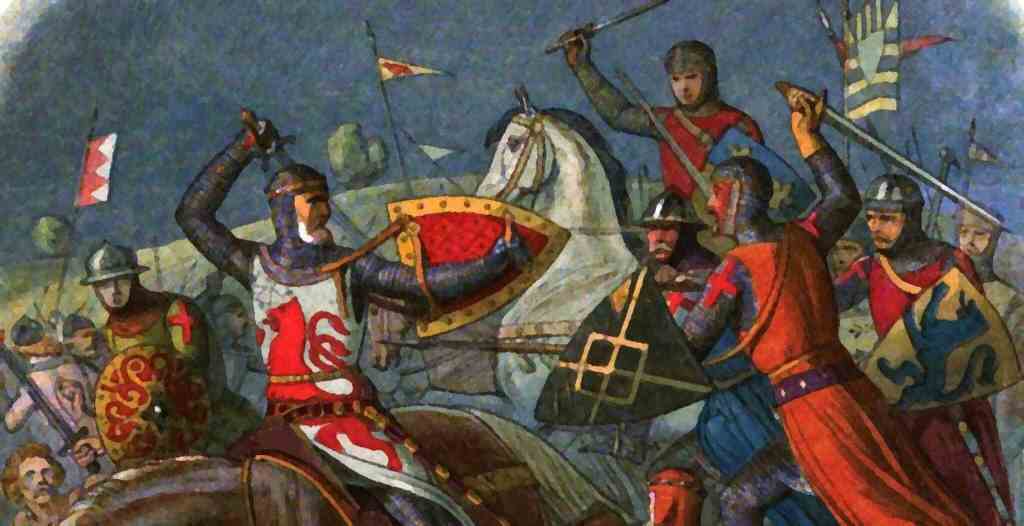
During the Second Baronial War in 13th Century England, Simon De Montfort, the Earl of Leicster, and several prominent barons rose in revolt against King Henry III and his son, Prince Edward (the future King Edward I “Longshanks”, the bad guy from Braveheart). Henry III had violated the letter and spirit of the Magna Carta signed fifty years before by demanding more money to purchase the title of King of Sicily (long story). In 1263, England had a famine and they couldn’t pay the extra money, so the barons revolted just as they had against Henry’s father, King John (the Sheriff of Nottingham’s boss from Robin Hood). Simon De Montfort won the Battle of Lewes in 1264 and captured Henry and imprisoned Edward.
In 1265, the 26 year old Edward escaped, rallied the King’s supporters, and convinced several of Montfort’s allies to defect. On 4 August, Edward outmaneuvered Montfort and trapped his small army in a bend of the Avon River (not far from Stratford-upon-Avon, Shakespeare’s hometown) near the village of Evesham. Edward’s troops outnumbered the Barons’ nearly 2-1 and despite a gallant charge by the Baronial knights, it was not enough to keep them from being surrounded. Bad blood existed between barons’ men and the king’s, and eventually the battle turned into a massacre. Instead of capture and ransom which was the custom for knights and lords, the King’s men outright killed them all, thus breaking the power of the barons for the foreseeable future. King Henry, present at the battle as Montfort’s captive, was only saved from the massacre when one of Montfort’s knights identified him in exchange for his life.
Despite the loss, the barons eventually got what they demanded though it took decades. King Henry III died ten years later and the talent, raw competence, and foresight Prince Edward displayed during the war showed when he became King Edward I. Although despised in Scotland, (Longshanks was nicknamed “Hammer of the Scots”) and Wales (which he conquered and colonized in the 1280s), King Edward I maintained the spirit of the Magna Carta, if not the letter, and reformed England’s administration and Common Law. He was not particularly loved by his subjects but they respected him and he was thought of as the ideal medieval king. He recognized the need for his subjects’ input into the governance of state, if only so they would pay more taxes. i.e. taxation WITH representation. King Edward I formed England’s first permanent Parliament, essentially giving in to the demands of the barons that he slaughtered at Evesham ten years before his reign.
 Buk's Historical Ad Hockery
You must be logged in to post a comment.