
Category: History
Introducing Connery, Sean Connery
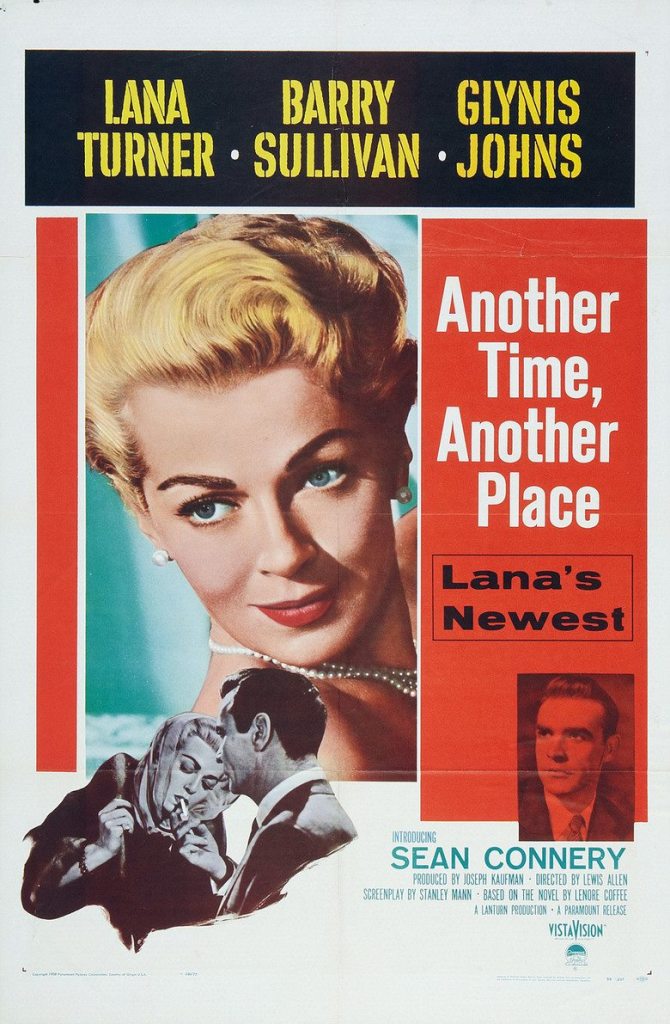
In the late 50s, vicious mob boss Johnny Stompanato owned L.A., and by extension, Hollywood. The stage crew, writers, and actors’ unions were all under his “protection”. He also owned the studios. He made sure the workers showed up on time and didn’t strike, and the studios “loaned” him money, which of course he never had to repay. The Greater Los Angeles’ Metropolitan Area was Stompanato’s personal fiefdom.
Actress Lana Turner was trying to resurrect her career and turned to a relationship with Stompanato, but it was far from ideal. In March 1957, Turner was filming “Another Time, Another Place” with unknown 27 year old British actor, former Mr. Universe contestant, Royal Navy vet, Scottish patriot, and male sexbot template, Sean Connery (OK, I made the last one up. It’s just not true…yet).
Stompanato, being the jealous type, wasn’t happy that Connery was poking Lana Turner (because of course he was), so one day he decided to intimidate him. Stompanato showed up on set waving a revolver around and started yelling at Connery. Connery, unimpressed, disarmed his adversary, pistol whipped Stompanato with his own gun, and beat him to a bloody pulp right there on the set.
Sean Connery just gave a beating to the most powerful and ruthless man on the West Coast. There could be only one result: Sean Connery had to die.
On 4 April 1958, Stomapanato vowed to sneak into Connery’s hotel and murder him, as he had done to others a dozen times before. He was just waiting for dark. But that evening, Lana Turner came home from filming, and Stompanato proceeded to beat her, as he was wont to do. The beating was so vicious, that Turner’s 12 year old daughter, Cheryl, ran into the kitchen, grabbed a knife, and stabbed Stompanato… 12 times, killing him.
Another Time, Another Place released in June and featured credits with “Introducing Sean Connery” as opposed to “Dedicated to…”
Almost exactly three years later, archetypical English gentleman and actor David Niven, by far the favorite, lost the spot for the new role of James Bond to his only real competition: a still nearly unknown Sean Connery.
The Big Kahuna: Duke Kahanamoku
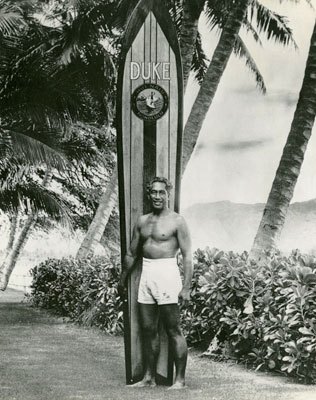
Duke Kahanamoku was born on 24 August 1890 in Honolulu in the Kingdom of Hawaii. Duke Kahanamoku was an Olympic swimming champion, Hollywood actor, lifelong friend and confidant of John Wayne (the “Other Duke”), and the Father of Surfing. Duke Kahanamoku won the gold 1912 Olympics for the 100m freestyle and a silver in the relay, two gold medals in the 1920 Olympics, and a silver in the 1924 Olympics at the age of 31. “The Big Kahuna” is best known for popularizing the Hawaiian traditional wooden “long board” or heavy board, and his amazing rescue of the crew and passengers of a sinking yacht off of Corona Del Mar in 1925.
“Lightning in the Night”

At the height of the Battle of Britain and 16 months before America’s entry into the war, Liberty Magazine, a pop culture general interest weekly out of New York published the prologue of Fred Allhof’s alt-history pulp fiction “Lightning of the Night”. Like other alt-history greats, such as the “The Third World War”, “Red Storm Rising” and “Ghost Fleet”, “Lightning in the Night” was written with the advice and input of leading military and civilian experts of the time, including Lieutenant General Robert Lee Bullard, the first commander of the 1st Infantry Division, who led the Big Red One at the Battle of Cantigny.
Set after the Nazi victory over Europe, “Lightning in the Night” was the story of the German invasion of North America. The prologue began with a surprise air attack on Pearl Harbor…
The Battle of Britain: Airfields

Towards the end of August, 1940, the Luftwaffe High Command realized that they were not shooting down enough British planes. In order to destroy the fighters, or at least force them away from the southern coast, the Germans needed to focus their attacks on fighter specific targets to compound the damage they were already doing in the air. On 23 August 1940, Herman Goring ordered the Luftwaffe to focus on RAF Fighter Command’s airfields of Air Vice Marshal Keith Park’s 11 Group.
11 Group covered Southern England and already bore the brunt of the Luftwaffe’s attacks. Goring’s new focus was devastatingly effective. Park’s airfields were smashed, and although heroic efforts were made to keep them open, aircraft, and more importantly, pilot availability was affected. On paper, the RAF had more assigned fighter pilots than the Luftwaffe, but the attacks on the airfields prevented the critical “battlefield calculus” from occurring: An experienced and awake pilot + a workable plane + enough fuel + loaded ammunition + a flat runway + an id’d target + time to reach it + a place to do it from all over again a few hours later = victory. The Luftwaffe was making that more difficult everyday. And only Herculean efforts by ground and maintenance crew were keeping British fighter pilots in the air.
Furthermore, as Park’s fighter squadrons were intercepting raids, his airfields were supposed to be protected by 12 Group’s fighters from the north, under AVM Leigh-Mallory. But Leigh-Mallory’s tactics were ineffective, and his squadrons routinely missed the Luftwaffe. Whereas 11 Group attacked raids quickly with a single squadron, 12 Group formed “Big Wings” of three or more squadrons, ostensibly to do more damage i.e. the principle of mass. Theoretically, it should work. But the Big Wings took too much time to form up, thereby becoming the classic “exception that proves the rule“ for the principle of mass, in other words “It’s not mass if it isn’t there”.
Finally, the Luftwaffe attacks unknowingly had a great effect on Air Marshal Dowding’s early warning system. One of the two critical vulnerabilities of the system, the Sector Control Centers, were only located on airfields for administrative convenience. (The other CV was the infamous “Filter Room”.) The Sector Control Centers were responsible for communicating directly with the squadrons, and they were smashed along with the airfields. Many RAF squadrons in late August and early September wasted their time flying around looking for the raids when the SCCs couldn’t direct them to one.
In early September, the pilot situation became critical. Shortfalls were made up by dragooning Fleet Air Arm and Coastal Command pilots, in addition to pilots from Canada, Australia, Rhodesia, South Africa, New Zealand, Belgium, France, Poland, Czechoslovakia, and even a Jewish pilot from Mandate Palestine. But even cutting pilot training hours down to the bare minimum could not produce enough available pilots. At the height of the crisis, British Secretary of State for Air, Sr Archibald Sinclair noted, the RAF had “only 350 pilots to scramble, of which nearly 100 were Poles.”
On 5 September, Dowding had to confront the serious possibility that they needed to pull 11 Group north of London to put their airfields out of the range of the Luftwaffe bombers, or they wouldn’t have enough fighters left to repel any invasion. This would effectively cede the English Channel to the Germans. He planned to brief Churchill on the 8th.
The Battle of Bosworth Field

For thirty years in the late 15th century, the War of the Roses raged across England and Wales (The War of the Roses was the real Game of Thrones). By 1483, the House of York, whose symbol was a white rose, had forced the remaining members declared for the House of Lancaster, the red rose, to flee to France. But internal politics had forced the regency council to declare the 12 year old Yorkist King Edward V illegitimate, and Henry, of the small House of Tudor and the last remaining Lancastrian lord, took the opportunity to invade.
Henry Tudor landed in Wales in early August 1485. Henry gathered troops from former Lancastrian allies, and met the forces of the House of York under King Richard III outside of the village of Bosworth. (Richard took the throne after Edward V and is the guy whose remains they discovered underneath a parking lot in Leicester in 2015) Richard III vastly outnumbered Henry Tudor and he divided his army into three “battles”: one commanded by himself, one under the Duke of Norfolk, one under Earl of Northumbria. A fourth force was on the field under Lord Thomas Stanley, Earl of Derby, ostensibly fighting for Richard. Henry kept his small army together under the Earl of Oxford.
Richard III ordered all of the battles to attack, but only his and Norfolk’s actually did. The Earl of Oxford held off the attacks and even forced some of Richard’s forces to retreat. Richard asked Northumbria for assistance but the Earl’s battle did not move. Henry, seeing the two immobile battles of Stanley and Northumbria, correctly surmised that they were waiting to see who won in the center before throwing in their support.
Henry saw an opportunity to win the battle and moved off to directly appeal to Stanley. Richard III saw Henry move toward Stanley and realized that the only way to win the battle was to kill Henry. So he personally charged. The bodyguards of the two commanders fought and Henry was almost killed. But when Sir William Stanley (the Earl of Derby’s nephew?) saw that Richard was isolated from the rest of his army, he and his men charged. Richard III slighted William Stanley years before and chose this moment for revenge. The combined weight of Henry’s bodyguard and Stanley’s knights overwhelmed Richard and his retinue, whom were slaughtered to a man. Unhorsed, Richard III fought to the death.
Henry Tudor was crowned on the field and the War of the Roses was over. The House of Tudor claimed prominence in England and King Henry VII would reign for 25 years. He was succeeded by his son Henry VIII (I am I am; the one with the wives), and his granddaughters Queen “Bloody” Mary I and Queen Elizabeth I.
The Great Siege of Malta: The Assaults
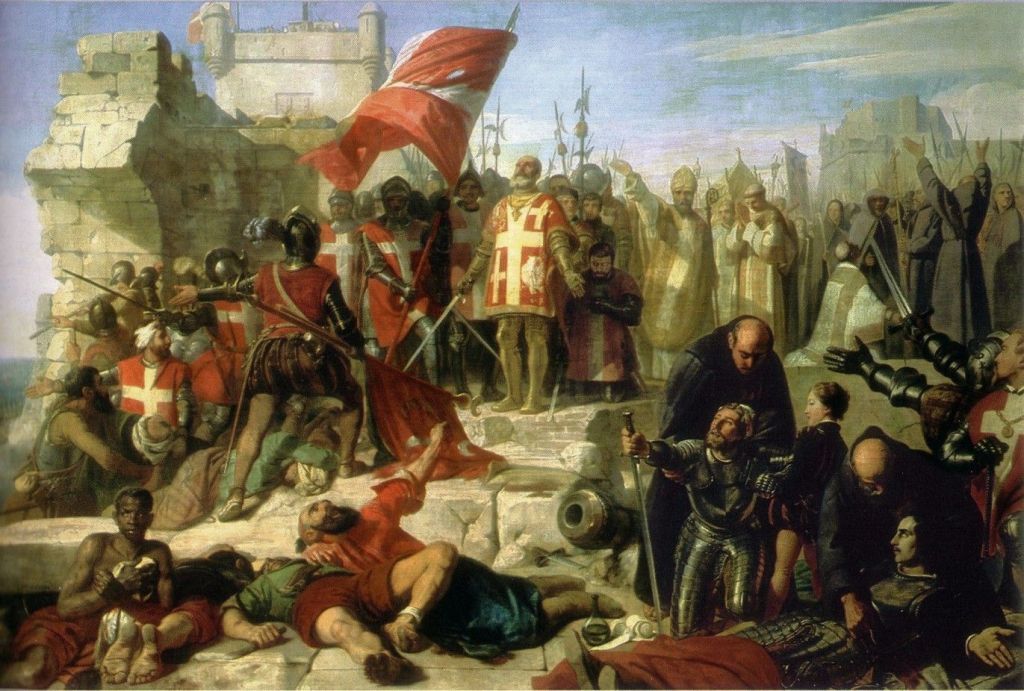
After the fall of Fort Saint Elmo at the end of June 1565, the Turks maintained a constant bombardment and launched a series of joint landward and seaward attacks against the Maltese Knights’ main defenses of the town of Birgu, Fort St. Michel, and Fort St. Angelo.
The attacks were devastating but uncoordinated due to the death of the most competent leader, the Ottoman corsair admiral Dragut Reis who was killed by an errant cannonball during the final assault on Fort St. Elmo. The other two Ottoman commanders, Mustapha Pasha and Piali Pasha, despised each other, and their various schemes undermined the efficient and effective use of the Ottomans’ remaining resources, after losing 1/4th their force at St. Elmo. Nonetheless, they still had 30,000 troops and complete command of the harbor.
The Knights held through these attacks, but only by the slimmest of margins. Many of La Vallette’s subordinates wanted to trade fortifications for time, but La Vallette disagreed. He knew the only wany to defeat the Turks will to fight was to fight for every inch of the defense. Every Turkish assault that was thrown back degraded the Turkish will to continue, and more importantly, delayed the next Turkish assault, as they reorganized.
In the beginning of July, the Turks launched a surprise amphibious attack against the seaward side of the Senglea Peninsula, combined with a landward attack on Fort St. Michel. St Michel was exposed on its harbor side due to the fall of St Elmo, but an enterprising older French knight, Chevalier de Gurial, on his own volition, ordered a battery from the wall of St. Angelo to the shore. The battery waited until the Turks were within 200m before firing and their grapeshot and chainshot killed almost a thousand elite Janissaries. Fort St. Michel would have almost certainly fallen without the actions of de Gurial’s battery, and it allowed the Knights the time to build a palisade along the shore to protect against future attacks.
At the beginning of August, Fort St. Michel was again the focal point of a massive Turkish assault after a mine was exploded underneath one of the bastions creating a breach. The Turks stormed the fort and through sheer numbers forced the remaining defenders back to the chapel. As they were about to be overwhelmed, the Turks inexplicably (to the chapel defenders) fell back in disarray. A raid from the small outpost of Maltese Knights at Mdina, in the center of the island, which was never captured by the Turks, attacked the undefended Turkish camp and gave the impression that the relief army from Sicily had arrived, prompting the Turkish retreat. The Knights and Maltese engineers and citizens immediately repaired the breach and filled the mine. In mid-August, another mine detonated opening a breach in the Birgu wall and the Turks flooded into the town. La Vallette ordered the guns of St Angelo to fire on the town while the 70 year old commander personally led the counterattack to the breach. Despite fierce fighting and many irreplaceable defenders lost to both the Turks and “friendly” cannon, La Vallette and his body guard fought their way to and held the breach as the citizens of Birgu filled it in. An Italian mercenary wrote of La Vallette,
“de Valette was told the Turks were within the walls; the Grand Master ran to the threatened post where his presence worked wonders. Sword in hand, he remained at the most dangerous place until the Turks retired”.
After the failure of the mines, Mustapha placed his faith in two giant siege towers. On 18 August, he attacked the wall of Birgu again but this time with a great siege tower filled snipers which cleared the top of the wall. But as the tower slowly lumbered forward, La Vallette ordered the base of the wall hollowed out. As the tower neared, laborers removed the few remaining stone blocks, and two cannon were pushed forward. They fired chain shot point blank into the base of the tower, toppling it. The second tower’s base was hastily reinforced against the repeat of the same tactic but as it approached the Maltese removed the blocks and instead of cannon, Knights streamed out and stormed the tower, eventually capturing it.
The tower attacks were Mustapha’s last serious attempts to seize the forts. La Vallette maintained that the Turks were losing will after the repeated failed even though the cost to the defenders was dear. La Vallette was right. On 28 August he moved his army to the small outpost of Mdina, where there was a water source so they could winter there. But as they approached, the few knights and Maltese citizens fired all of their cannon recklessly, using up all of their powder. Mustapha thought this meant they had powder to spare, and having none of his own, fell back to his camp near the harbor. Out of gunpowder, and nowhere to winter on the island, the Turks launched one final assault on 1 September, which was beaten back with heavy losses.
On 7 September Don Garcia of Sicliy landed in St Paul’s Bay on the north side of the island with a relief army. Mustapha took the Turkish army to the southern shore and boarded his galleys the next day. The Siege of Malta was over and the fragmented and petty kingdoms of the “soft underbelly of Europe” were safe from Islamic conquest. The Maltese would rebuild the capital of their island and name it Valletta, after the indomitable Jean Pairsot de Vallette, Grand Master of the Order of St John and Defender of Malta.
Operation Starlite: Battle of Van Tuong
In March 1965, the first US Marines landed in South Vietnam to protect US airbases as they supported the South Vietnamese Army’s fight against the Viet Cong and North Vietnam. On 15 August, the Marines learned that the 1st VC Main Force Regiment occupied the village of Van Tuong outside the Chu Lai Airbase on the South Vietnamese coast. In only two days (!?!?!) the Third Marine Division staff planned a joint combined arms hammer and anvil operation in complete secrecy to prevent VC infiltrators in the ARVN from tipping off the regiment about the attack.
On the morning of 18 August, the 3rd Battalion, 3rd Marine Regiment stormed ashore near Van Tuong in LTVPs launched from the landing ship USS Iwo Jima in the first contested amphibious assault since Inchon 15 years before. They were followed by 3/7 Marines. They were the “hammer” while the 2/4 Marines was the “anvil”. 2/4 was air assaulted into three landing zones west of the village by a company of Sikorsky S-58DT helicopters (you know: Riptide). The final battalion in the assault, 1/7, was reinforced with a company of M48 Patton tanks and secured the resupply convoys from the south.
The VC were completely surprised, but the Marines unknowingly played directly into their hands. The landing force did not have enough amtracs for more than one company at a time, so it was fed piecemeal into the fight for the small hamlets south of the village. Also, the far southern landing zone was only 400m from the communist Regimental HQ, was overlooked by the key piece of terrain in the area, Hill 43, and nearly overrun. Finally, one of the supply columns moved before the operation matured, and was promptly ambushed and surrounded. All three general actions (hamlets near beaches, the helicopter LZ’s, and convoy) were not coordinated effectively, and the operation was consumed in trying to desperately and disparately relieve each one simultaneously. Nonetheless, after heavy fighting, the battle was finally sorted out by nightfall: the Marines cleared the village and had the VC regiment surrounded.
Unfortunately, the Marines’ unfamiliarity with the terrain and distractions caused by severe thirst allowed the VC to exfiltrate that night. The Marines suffered 50 killed and 200 wounded, and the Viet Cong suffered about 600 killed. Operation Starlite, or the Battle of Van Tuong, was the first unilateral American ground offensive operation of the Vietnam War.
The Battle of Zadwórze: “The Polish Thermopylae”
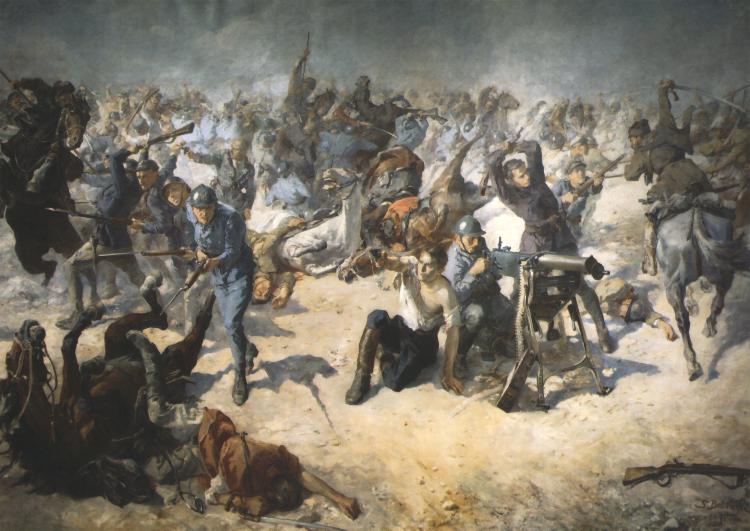
During the Polish-Soviet War immediately following the First World War, Marshal Pilsudski stripped the Southern Front in the Ukraine of many Polish units to prepare for the upcoming Battle of Warsaw. In mid-August, 1920, the Communists of Semyon Budyonny’s 1st Cavalry Army broke through the front and threatened the Polish city of Lwów (now part of the Ukraine). The remaining Polish forces of the Southern Front streamed back to Lwów to hold the city.
On 18 August, 1920, 500 mounted Polish volunteers from Lwow under Captain Bolesław Zajączkowski were sent to reinforce the Polish soldiers that were withdrawing in the face of Budyonny’s 1st Cavalry Army, known simply as the “Konarmiya” or “Horse Army”. As they approached the village of Zadwórze, they received fire; the unit they were looking for was destroyed there the day before. The victorious Communists were the lead elements of the Red 6th Cavalry Division and were happy to see more Poles to kill before they resumed their advance.
Before the Communists could form, Zajączkowski ordered his men on line, and charged the village. They took the train station, but could not seize the entirety of the village. The village of Zadwórze became a vortex for the Red Cavalry, as the Communists committed more and more of the division to break the Polish resistance at the train station. Zajączkowski’s men fought off six successive cavalry charges from their stronghold in the station over the next six hours, while continuing to fight for the rest of the village. With dusk fast approaching and ammunition dangerously low, Zajączkowski ordered what remained his command to fall back to Lwów.
On the way out of the village, Zajączkowski’s men were strafed and bombed by three Communist airplanes, which broke up his formation. Zajączkowski gathered what men he could, and made a last stand in a lineman’s hut just on the outskirts of the village. In the dark, the Poles and Communists battled with bayonets, rifle butts, sabers, and fists. Just after midnight on 18 August, 1920, the hut was overrun, and the last of Polish defenders were dead, or had escaped. The seriously wounded Zajączkowski killed himself rather than be captured and endure the inevitable torture and execution at the hands of the Communists. Of the Zajączkowski’s original 500 men who attacked Zadwórze that morning, only 12 reached Lwów.
The 11 hour battle for Zadwórze consumed the entire 6th Cavalry Division, and held up the advance of the Konarmiya toward Lwów for more than a day. Zajączkowski’s stand gave time for the Polish defense of the city. Not only was Lwów saved, the Budyonny became fixed in front of the city, and could not extricate the Konarmiya quickly enough to ride northwest to affect the decisive Battle of Warsaw.
The Battle of Zadwórze was nicknamed “The Polish Thermopylae” after the Greek stand against the Persians 2400 years before.
(The Poles seem to have an obsession for the Greek Battle of Thermopylae. Zadwórze is one of at least six battles throughout Polish history known as “The Polish Thermopylae”)
The Battle of Thermopylae

After the Achaemenid Persian defeat under Darius at the Battle of Marathon ten years before, his son Xerxes decided, under pressure from his advisors, to invade Greece overwhelmingly by land with an accompanying supply fleet offshore. In the summer of 480 BCE, Xerxes’ Persian Army conducted the largest seaborne invasion of Europe until the Normandy landings in 1944, 2500 years later. And then in one of the engineering marvels of the ancient world, the Persians constructed two 1,300m pontoon bridges across the Hellespont (the modern Dardanelles) and marched the rest of his massive army across over a total of seven days and seven nights.
The Athenian General Themistocles suggested that the Greeks make a stand at the narrow pass at Thermopylae (or “Hot Gates”, named after a warm spring nearby) and the adjacent straits of Artemesium. The narrow confines of each would mitigate the Persians’ greater numbers. Themistocles, an Athenian, would lead the Greek navies at Artemesium, while King Leonidas of Sparta led the Greek armies. On his march to the pass, Leonidas collected various contingents from other Greek city states, but due to the Olympic Games, during which fighting is prohibited, he could only collect limited forces. Nonetheless he planned to delay the Persians long enough for the rest of the Greeks to mobilize after the games. From Sparta, he brought only his personal bodyguard of 300 hoplites, and 900 other squires and armed retainers. The remaining Spartan army would fight with the main Greek army when it formed. Along the march he collected 4000 hoplites and 3000 more armsmen from the city states of Phocia, Trachis, Arcadia, Corinthia, Tegea, Mantinea, Thebes, Thespia, Malia, and Locria.
On 19 August 480 BCE) the 400,000 strong Persian Army under Xerxes I arrived outside of the narrow pass of Thermopylae and met the 8000 Greeks under King Leonidas. A Trachian lamented that the Persians were so many that their arrows would blot out the sun. A Spartan file commander, Dienekes, responded, “Good, then we will fight in the shade.” Hoping that the show of force sufficiently cowed the Greeks, the Persian herald demanded Leonidas surrender his weapons in a show of subservience to Xerxes. Leonidas responded “Molon labe”, “Come and get them.”
It took three days for Xerxes to organize an assault and on 22 August he attacked. The Greeks were armored in their traditional heavy bronze breastplate, helmet, and greaves, and armed with a large bronze shield (hoplon), an 8 ft stabbing spear (dory) that they used overhand, and a short sword (xiphos). They fought in their traditional densely packed shoulder to shoulder formation called a “phalanx” which was amazingly effective in the narrow Thermopylae Pass. The Persians were many and varied and from different provinces of Near Eastern Asia but few were as heavily armed as the Greeks. The only equivalents in the Persian army were Thessalian hoplites from already conquered Greek city states who were forcibly conscripted during the Persian advance. Persian arms and armor were meant for speed, mobility, and ranged attacks in the deserts, steppes, and mountains of their homelands. They could not withstand the rigors of close quarters combat in the narrow valleys of Greece. Their cane arrows and javelins couldn’t pierce the bronze armor; and their cloth, wooden or leather armor, and wicker shields, provided no protection against the iron weapons. Furthermore, the Greeks were soldiers in the Western tradition and valued discipline and maintaining position where their large shields could protect the man next to him. The Persians were warriors in the Eastern tradition which valued the personal kill. The Persian warriors continually broke formation making them easier to kill by the disciplined mass of Greek spears. Even Xerxes’ own bodyguard, the elite Immortals, known so because they always maintained a number of 10,000 due to casualties immediately replaced, could not break the Greek phalanx. Leonidas and his small army held the pass against overwhelming numbers for two days under constant assault.
In the early hours of the third day, a Greek traitor named Ephaliates led the Immortals on a little known mountain track which out flanked Leonidas. The small Phocian force sent to hold it was pushed aside. That morning, the Greeks met to discuss the new situation, and only the Spartans and Thesbians volunteered to remain and fight. The Thebans also stayed, but Herodutus said it was against their will. The rest of the army fell back to join the Greeks mobilizing after the Olympic Games. That afternoon the Persians attacked from both sides of the pass and overwhelmed the remaining defenders. The Thebans, bitter rivals of both the Spartans and Athenians, surrendered to the Persians. Leonidas and the remaining Spartans and Thesbians fought to the death.
Over the next few weeks, Xerxes went on to conqueror Phocis, Boeotia, Euboea, and Attica, to include the city of Athens, which was sacked. However, the time bought with the lives of Leonidas’ Greek defenders at Thermopylae was well spent. In September, Themistocles lured Xerxes fleet into battle in the straits of Salamis, where the Persian navy was decisively defeated. With no way to supply his huge army in Greece, most of it returned to Persia, including Xerxes himself. Xerxes turned the army over to Mardonius, Xerxes most powerful advisor and the newly appointed Satrap of Greece. In 479 BCE, the combined armies of the remaining Greek city states under Leonidas’ nephew, the Spartan regent Pausanias, defeated Mardonius and the Persian army at the Battle of Plataea. The victories of Salamis and Plataea cemented Greek freedom from Persian domination to this day. The Greek experiment in democracy was not killed off in the cradle.
The Battle of Musgrove’s Mill
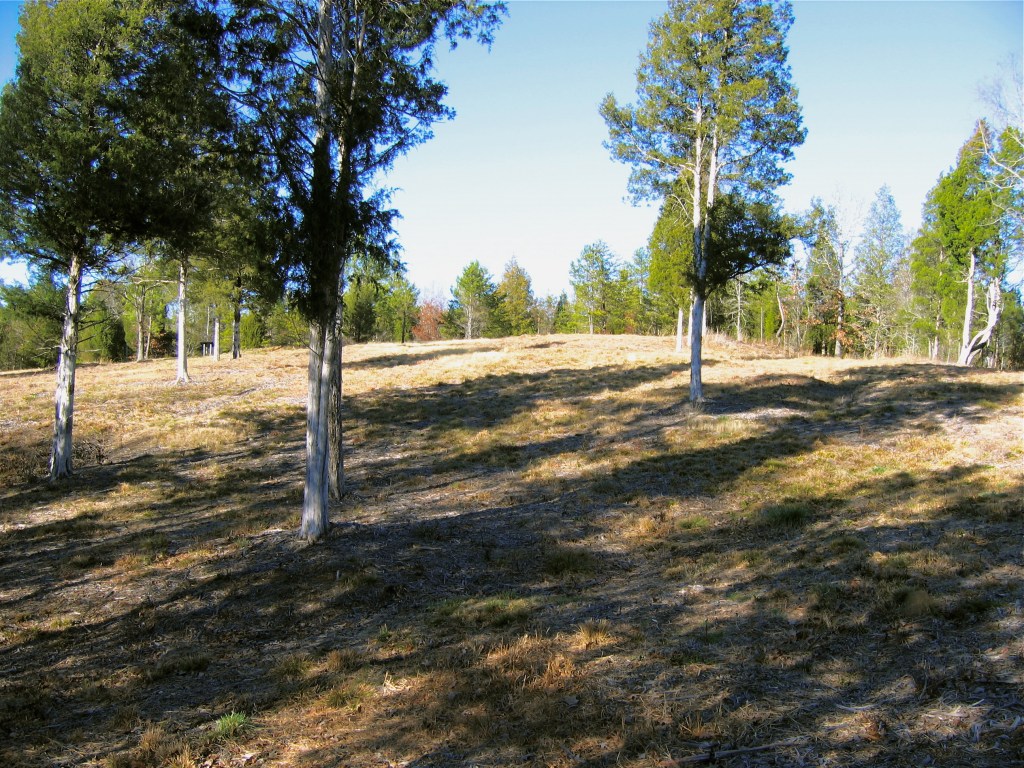
Other raids departed about the same time Sumter and Taylor struck the fords and ferries across the Wateree. One such was Colonel Isaac Shelby’s raid on the Loyalist outpost at Musgrove’s Mill near a ford on the Enoree River. Musgrove’s Mill contained large stores of the area’s grain supply. On 18 August 1780, at the head of about 300 Georgian, and North and South Carolinian partisans, Shelby, the victor at Thicketty Fort, planned to surprise the loyalist militia garrison there, and seize the grain and any other supplies. Shelby was blissfully ignorant of the two recent American defeats at Camden and Fishing Creek.
The element of surprise was lost when Shelby’s men skirmished with a loyalist patrol just as they were approaching Musgrove’s Mill. It was fortunate that they did. The firing from the skirmish alerted a nearby farmer who informed Shelby that the garrison at Musgrove’s Mill was reinforced with several hundred more Loyalist militia and even some British regulars. The reinforcements were on their way to join Major Patrick Ferguson’s future expedition. Shelby was outnumbered more than two to one with no element of surprise. Furthermore, his horses were exhausted, so there was no quick escape.
Shelby decided to force the garrison into attacking him. He withdrew to a nearby hill and threw up make shift breastworks. Shelby then sent Captain Shadrach Inman with 20 Overmountain men down to the ford. When Inman arrived, he engaged the Loyalists on the far bank, and then his men feigned confusion and fell back “in disarray.” The entire Loyalist garrison of Musgrove’s Mill under Lt. Col. Alexander Innis chased after them.
Innis’ regulars weren’t British regulars, but red coated New York and New Jersey provincial regulars. Innis pursued Inman all the way back to Shelby’s defensive position, but Innis’ men didn’t fall for the ambush. However, when they spotted the breastworks, most of the Loyalists ineffectually fired on them. Shelby’s men held their fire. Innis was committed; the momentum of Loyalist advance carried them up the hill. They didn’t, or couldn’t, stop to reload.
Shelby’s North Carolinians, Elijah Clarke’s Georgians, and James William’s South Carolinians unleashed a devastating point blank volley into the advancing Loyalists. Nonetheless, in the brawl that followed, the provincial regulars almost overwhelmed the Patriot right with fixed bayonets. Just as the Americans were on the point of withdrawing, Innis was struck and fell from his horse, which caused the assault to stall. Sensing the moment was right, Inman and his Overmountain men charged into the provincials’ flank. After their feigned retreat, Inman’s men formed Shelby’s reserve, and rested. Screaming Indian war cries and using their tomahawks to devastating effect, the charge of the Overmountain men threw the provincial lines into chaos, and the already bloodied Loyalist militia began to waver. Shelby immediately seized the initiative and ordered his whole command to attack. The charge broke the Loyalist militia, which streamed back to the ford. The regulars surrendered, though some fled. Shelby inflicted nearly 230 killed, wounded, and captured on the Loyalists for just four killed and 16 wounded Patriots.
Shelby couldn’t rest on his laurels long. Soon after the battle ended, he was informed of the losses at Camden and Fishing Creek. Though disconcerting, the more immediate problem was Ferguson was not far off and was on his way to Musgrove Mills. On captured horses, Shelby and his men fled over the mountains into the Watauga Association, where they were temporarily safe from Ferguson. The Watauga Association was a semi-autonomous region of Overmountain Men settlements who had banded together to petition incorporation into North Carolina. (The Watauga Association would be integral to the future defunct State of Franklin, and eventually form the far eastern part of Tennessee.) Ferguson arrived at Musgrove’s Mill 30 minutes after Shelby departed.
The Battle of Musgrove Mills was one of the only battles in the American Revolution where militia defeated regulars, albeit provincial instead British regulars, but regulars nonetheless, in a straight up battle. More importantly, the news of the American victory was received after the losses at Fishing Creek and Camden, and did not get lost in the mix. The victory at Musgrove’s Mill softened the devastating blows that were the previous days’ defeats, and gave hope to the population that there were Patriots still fighting and winning against the British in the South. The American cause was not lost at Camden.
 Buk's Historical Ad Hockery
You must be logged in to post a comment.